
By Michael Nielsen, Publisher | 15+ Years in Diesel Repair
Last Updated: October 2026
⏱ Estimated reading time: 13 minutes
Semi truck fuel economy averages about 6.9 mpg across the U.S. fleet, while the fleets in the North American Council for Freight Efficiency (NACFE) study reached 7.77 mpg in 2023, and much of the gap between a tired truck and a good one comes from maintenance, tires, idling and speed you can measure and fix.
Heavy Duty Journal (HDJ), written by publisher Michael Nielsen, built this guide in October 2026 from primary pages published by NACFE, the U.S. Environmental Protection Agency (EPA), the U.S. Department of Energy (DOE) and the American Transportation Research Institute (ATRI). HDJ labels its own shop-floor judgment as judgment and does not repeat mpg percentages it could not trace to a source.
The guide shows what the benchmark numbers say, how to measure real mpg, and where a drop usually comes from: tires, drag, the engine and aftertreatment, idling and speed. It ends with a recovery order of operations and the math on what a small gain is worth.
Key Takeaways
- ✓Measure before you fix. Compare fuel purchased to miles driven over several fills, because a single reading or one dash display can mislead.
- ✓Tires come first. EPA says tires 10 psi under pressure can cut fuel economy by 0.5 to 1 percent, and tires can lose up to 2 psi a month.
- ✓Idling is the easiest leak. EPA puts a long-haul truck at about 0.8 gallons per idling hour.
- ✓Benchmarks give you a target. As of October 2026, NACFE's 2024 study shows 7.77 mpg for studied fleets against a national average of 6.9.
- ✓Small gains add up. At 100,000 miles a year, the gap between 6.9 and 7.77 mpg is about 1,600 gallons per truck.
In This Guide
- Semi Truck Fuel Economy: What the Numbers Say
- Measuring Real MPG Before You Chase a Cause
- Tires, Pressure and Alignment
- Drag: Wheel Ends, Brakes and Aerodynamics
- Engine, Air, Fuel and Aftertreatment Causes
- Idling, Speed and Driver Settings
- What a One Percent MPG Gain Is Worth
- An MPG Recovery Order of Operations
- Frequently Asked Questions
- The Bottom Line
Semi Truck Fuel Economy: What the Numbers Say
The most useful benchmark comes from NACFE, a nonprofit that studies freight efficiency. According to NACFE's December 2024 Fleet Fuel Study release, 14 fleets operating 75,000 trucks averaged 7.62 mpg in 2022 and 7.77 mpg in 2023, up 4.2 and 2.0 percent. NACFE's executive director put the national average at 6.9 mpg, so the studied fleets beat it by roughly 0.9 mpg.
The NACFE Fleet Fuel Study page adds more context. It says the Federal Highway Administration (FHWA) figure for combination trucks rose from 5.85 mpg in 2013 to 6.91 mpg in 2022, and that the latest model-year trucks in the study reach roughly 8.0 to 9.5 mpg, with some touching 10 mpg on certain routes, in certain seasons.
Those numbers set expectations. In HDJ's judgment, a modern tractor running 6.0 mpg on a steady regional route deserves a closer look, while one running 8.5 mpg on mixed freight is doing well. Route, load, season and model year all matter, so the table below treats each figure as a reference point rather than a target for every truck.
| Reference point | Figure | Source |
|---|---|---|
| National average, combination trucks | About 6.9 mpg | NACFE, December 2024 |
| NACFE study fleets, 2023 | 7.77 mpg (14 fleets, 75,000 trucks) | NACFE, December 2024 |
| Latest model-year trucks in the study | Roughly 8.0 to 9.5 mpg | NACFE Fleet Fuel Study page |
| Tires 10 psi under recommended pressure | 0.5% to 1% lower fuel economy | EPA SmartWay tire brief |
| Long-haul truck idling | About 0.8 gallons per hour | EPA SmartWay idle brief |
| SmartWay designated trailer (aero devices plus tires) | At least 6% fuel savings | EPA SmartWay page |
Fuel is also the cost you can influence daily. ATRI Operational Costs of Trucking research put the industry-average cost to operate a truck at $2.336 per mile in 2025, and $1.854 per mile excluding fuel. As of October 2026, that difference works out to roughly 48 cents a mile on fuel, which makes every tenth of an mpg visible on the P&L.
Measuring Real MPG Before You Chase a Cause
Before chasing a cause, confirm the drop is real. The dash display and the electronic control module (ECM) report averages that can differ from what the fuel card shows, especially if the display is reset between trips. The most reliable method is simple: total gallons purchased divided by total miles driven, over several fills.
Fix measurement first, using fuel-card gallons and odometer miles over at least three fills before anyone touches a wrench. Compare like with like. A truck that moved from long-haul freight to regional stop-and-go work will lose mpg without anything being wrong, and so will a truck pulling a heavier load or running in a headwind. Track mpg by truck, lane and season so a real change stands out from normal variation.
Telematics makes this easier. HDJ's fleet fuel management systems guide compares telematics, fuel cards and driver coaching as ways to track fuel use. Whatever tool you use, record mpg per truck every week so a drift shows up in days instead of at the end of a quarter.
Tires, Pressure and Alignment
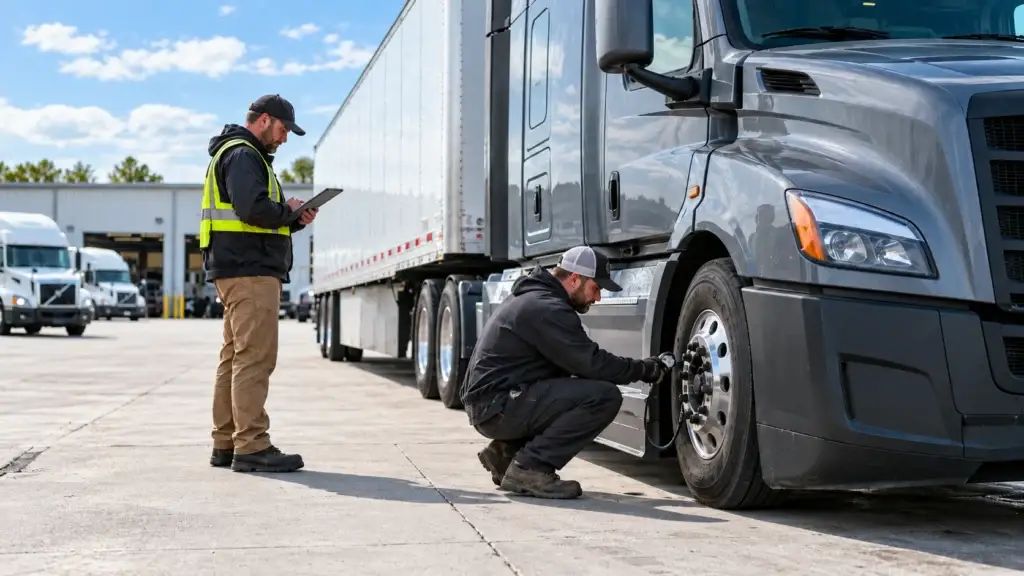
Tires are the first place to look because they are cheap to check and costly to ignore. As of October 2026, the EPA SmartWay tire pressure brief says tires inflated 10 psi below the recommended level can reduce fuel economy by 0.5 to 1 percent, and that tires can lose up to 2 psi a month even with tight rim seals and valve stems.
That means a truck can drift 6 to 10 psi low in a few months without anyone noticing, which is why pressure checks belong in the routine and not in the exception. Heavy Duty Journal's heavy duty tire management guide covers pressure, rotation and wear in detail.
Automatic tire inflation (ATI) and tire pressure monitoring systems (TPMS) take the guesswork out. EPA says ATI on a truck's drive and trailer axles costs up to $800 and is generally recouped in just over two years through fuel and maintenance savings. For trailers, HDJ's trailer TPMS installation guide walks through setup and troubleshooting.
EPA also notes that no scientific studies document fuel savings from nitrogen inflation, although one large fleet reported a 1 to 1.5 percent reduction in fuel use after switching. Nitrogen does not replace regular pressure checks. Treat it as optional, and put the budget into gauges, monitoring and a routine.
Alignment matters too, because a misaligned axle drags the tire sideways and scrubs both tread and fuel. If a truck wears tires unevenly or pulls, correct the alignment before blaming the engine. HDJ's heavy duty truck suspension alignment guide covers the process and cost.
Tire choice also counts. EPA's SmartWay program credits verified low rolling resistance tires with about 1 percent fuel savings on a designated trailer, and mixing tire types on one axle or running mismatched diameters creates extra drag. Match tires on each axle, and keep the spec consistent when replacing a set.
⚠️ Safety Warning
Never inflate a tire that has been run significantly underinflated or flat without following the servicing rules. Under the Occupational Safety and Health Administration (OSHA) rule in Title 29 of the Code of Federal Regulations (CFR), 29 CFR 1910.177, employees must stay out of the trajectory when inflating a tire, and a restraining device or barrier is required in most cases. Only trained staff should do the work.
Drag: Wheel Ends, Brakes and Aerodynamics
Drag from the wheel ends and brakes is a quiet thief of semi truck fuel economy. A seized caliper, a sticking brake shoe or a failing wheel bearing makes the engine push against resistance every mile. A quick infrared temperature check at each wheel end after a normal run, comparing left and right, finds a dragging end before it becomes a fuel and safety problem.
Failing wheel bearings also destroy the spindle. HDJ's coverage of wheel bearing failure explains how a small leak or noise turns into a major repair, which is another reason to treat an unusual wheel-end temperature as a repair order and not a curiosity.
Aerodynamics is the other half of drag. The U.S. Department of Energy page on fuel-saving equipment lists trailer gap reducers, side skirts and airfoils as ways to reduce drag at highway speed. As of October 2026, under EPA SmartWay designated tractors and trailers page, a SmartWay designated trailer needs aerodynamic devices worth at least 5 percent fuel savings plus verified tires, for at least 6 percent in total.
The same page says SmartWay Elite trailers combine two or more devices for at least 9 percent savings, or 10 percent with tires. Those figures describe the devices when intact. Missing, cracked or flapping skirts and fairings give back part of that gain, so add aero parts to the walkaround inspection.
Gap and trim settings matter on the tractor side. A roof deflector set too high or too low, a loose side extender or an open gap between tractor and trailer creates turbulence. Adjust the deflector to the trailer height you actually pull, and keep the same setting when the driver changes.
Engine, Air, Fuel and Aftertreatment Causes
When semi truck fuel economy slips after tires and drag check out, look at what the engine is being asked to do. In HDJ's experience, a restricted air filter or a leak in the charge air system makes the engine work harder for the same power, and the first sign is often a slow mpg slide without a fault code. Check the restriction gauge or ECM data, and inspect charge air hoses and clamps.
Aftertreatment can also cost fuel. A diesel particulate filter (DPF) that needs frequent regeneration burns extra fuel each time, and a truck stuck in short, low-load duty cycles regenerates more often. HDJ's DPF regeneration problems guide explains the common causes and what to check first.
Read the ECM before replacing parts. Active and stored fault codes, regeneration counts, derates and parameter settings tell you whether the truck is running as spec'd. Confirm road speed limits, cruise settings and idle shutdown timers still match fleet policy, since software updates and repairs can reset them to defaults.
Injectors, fuel quality and oil can matter, but treat them as the second-wave checks. A leaking or imbalanced injector wastes fuel, and the wrong oil grade can raise friction. Use only the oil viscosity and specification the engine maker approves, and follow the OEM service interval instead of stretching it to save cost.
Cooling system faults matter as well. A cooling fan that stays engaged, a stuck thermostat or a restricted radiator keeps the engine out of its efficient range and adds parasitic load. When mpg drops along with a high coolant temperature, fix the cooling problem first and retest before looking elsewhere.
Idling, Speed and Driver Settings
Idling burns fuel with no miles to show for it. As of October 2026, the EPA SmartWay idle reduction brief says a typical long-haul combination truck uses about 0.8 gallons of diesel for each hour of idling, and that long-haul trucks often idle 5 to 8 hours a day over 300 days a year, using 900 to 1,400 gallons per truck annually.
EPA estimates a long-haul truck that eliminates unnecessary idling could save over 900 gallons a year, and that an auxiliary power unit (APU) could save between $3,600 and $5,500 in fuel costs. Those dollar figures date from 2016 pricing, so recalculate with today's price using the hourly burn rate.
HDJ's fleet idle reduction guide covers idle certification and reduction options. In the shop, check that the idle shutdown timer is set, that the APU or bunk heater works, and that the driver is not idling to keep the cab cool because of a failed battery or inverter.
Speed is the other big lever on semi truck fuel economy. NACFE states that speed is a very significant predictor of fuel efficiency for all vehicles, and notes that truck speeds remain high. The simplest fix is a governed road speed and a cruise setting the fleet chooses on purpose, not whatever the ECM shipped with.
Drivers matter, but treat coaching as a tool and not a punishment. Share mpg by truck and lane, explain what the numbers mean, and ask drivers what they see: dash warnings, odd noises or slow acceleration. They often spot a failing component before a scan tool does.
What a One Percent MPG Gain Is Worth
A small gain in semi truck fuel economy is worth more than it looks. At a hypothetical 100,000 miles a year, a truck at 6.9 mpg burns about 14,493 gallons and one at 7.77 mpg burns about 12,870, a difference of roughly 1,623 gallons. At a hypothetical $4.00 a gallon, that is about $6,500 per truck per year.
NACFE's own number points the same way: it says the 14 study fleets saved $512 million in 2023 compared with the average truck on the road. Across 75,000 trucks, that works out to roughly $6,800 per truck. The arithmetic here is HDJ's, and your savings depend on your fuel price and miles.
Smaller fixes can be worth tracking too. EPA estimates that proper tire inflation with ATI on a typical long-haul truck saves about 100 gallons a year, a 0.6 percent mpg gain in its example. On a fleet of 50 trucks that is about 5,000 gallons, so even a modest repair order has a measurable payback.
Count the repair cost against the gain. If a hypothetical $300 alignment and tire correction recovers 1 percent on a truck burning 14,000 gallons, that is about 140 gallons, or $560 at a hypothetical $4.00 a gallon. Track the before and after mpg so you know which fixes pay and which do not.
Key Recommendation
Record mpg before and after every fuel-related repair order. A tire, alignment or air filter fix that cannot be shown in the numbers over the next few fills is a guess, and a logged result tells you which fixes to repeat across the fleet.
An MPG Recovery Order of Operations
When semi truck fuel economy drops, work the list in order of cost and likelihood. HDJ's suggested sequence is below. It is a practitioner method, not an OEM procedure, so follow your engine and chassis maker's service information for any repair.
- Verify the drop with fuel-card gallons and odometer miles over several fills.
- Check tire pressure, tire matching and uneven wear; correct the alignment if wear points to it.
- Scan for active and stored codes, regeneration counts and derates.
- Inspect wheel ends and brakes for drag with an infrared temperature check.
- Inspect air filter restriction, charge air hoses and the cooling system.
- Walk the trailer and tractor for missing or damaged aero parts and check deflector settings.
- Confirm governed speed, cruise and idle shutdown settings in the ECM.
- Review idle hours and the APU or bunk heater.
- Retest mpg over the same lane and compare to the baseline.
Add the results to the truck's maintenance record so the next technician sees what was found. HDJ's fleet maintenance guidance covers how records, telematics and preventive routines fit together, and a fuel-economy check fits naturally into any preventive maintenance service.
Free Diesel Maintenance Checklist
Get HDJ's free, field-tested diesel maintenance checklist delivered instantly to your inbox — print it, laminate it, keep it in the shop.
Instant PDF • 100% Free • No Spam

Frequently Asked Questions
What is a good mpg for a semi truck?
As of October 2026, NACFE reports the national average at about 6.9 mpg and its study fleets at 7.77 mpg for 2023. NACFE says the latest model-year trucks in its study reach roughly 8.0 to 9.5 mpg, and some reach 10 mpg on certain routes.
Why did my semi truck fuel economy suddenly drop?
Verify the drop first with fuel-card gallons and odometer miles. Then check tire pressure, wheel-end drag, air filter restriction, regeneration frequency, damaged aero parts, idle time and speed settings. A change in route, load or season can also explain it.
How much does low tire pressure cost in fuel?
EPA says truck tires inflated 10 psi below the recommended pressure can reduce fuel economy by 0.5 to 1 percent. Tires can lose up to 2 psi a month, so regular checks, ATI or tire pressure monitoring help prevent the loss.
How much fuel does a semi burn while idling?
EPA says a typical long-haul combination truck uses about 0.8 gallons of diesel per hour of idling. Over 5 to 8 idling hours a day for 300 days, that is 900 to 1,400 gallons a year, so idle shutdown and APUs pay off.
Do aerodynamic parts really improve semi truck fuel economy?
EPA's SmartWay program says a designated trailer with aerodynamic devices and verified tires saves at least 6 percent, and SmartWay Elite trailers save at least 10 percent. Those results assume the parts are intact, so damaged skirts and fairings give some of it back.
Does nitrogen in truck tires improve fuel economy?
EPA says no scientific studies document fuel savings from nitrogen inflation, although one large fleet reported a 1 to 1.5 percent reduction in fuel use after switching. Nitrogen does not replace regular pressure checks, so treat it as optional and keep your gauges calibrated.
The Bottom Line
Semi truck fuel economy is rarely lost in one place. Measure real mpg over several fills, then work through tires, wheel-end drag, aero parts, the engine and aftertreatment, idling and speed in order of cost. The benchmark numbers give you a target, and the arithmetic shows why even small recoveries pay.
Michael Nielsen and the Heavy Duty Journal team publish more fleet maintenance and cost guides at heavydutyjournal.com. Always follow your engine and chassis maker's service information, and confirm any figure that drives a purchase against current fuel prices and your own mileage.
Share This With Your Fleet Manager
If someone on your team watches fuel spend or runs the shop, pass this heavydutyjournal.com guide along.