
By Michael Nielsen, Publisher | 15+ Years in Diesel Repair
Last Updated: October 2026
⏱ Estimated reading time: 13 minutes
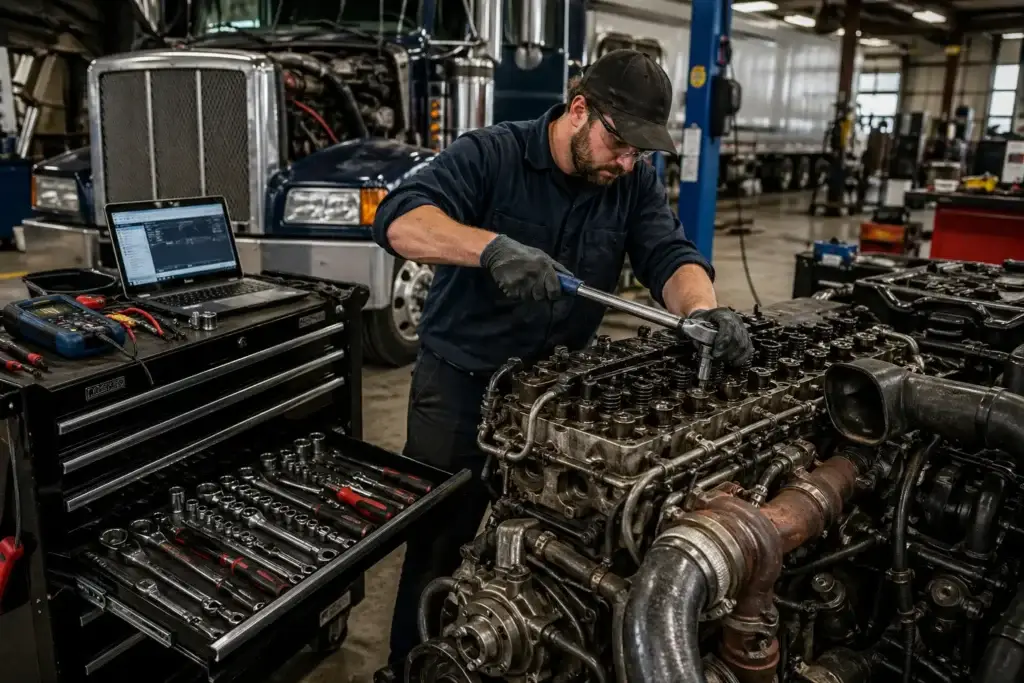
A diesel mechanic tools list is the working inventory of hand tools, diagnostic instruments, specialty tools, lifting equipment, and protective gear a technician needs to service Class 6 through Class 8 trucks, in a shop bay or from a service truck. It tells you what to own, what the shop should supply, and what to buy next.
Heavy Duty Journal's editorial team, led by publisher Michael Nielsen, rebuilt this list for working diesel technicians, shop foremen, and mobile service operators. HDJ checked the federal safety rules in the Code of Federal Regulations (CFR) and the labor and tool-cost data as of October 2026, and it names tool categories and specifications rather than brands because model numbers change faster than a tool box.
According to Heavy Duty Journal's October 2026 review, the hard part of a diesel mechanic tools list is cost and sequence. The American Transportation Research Institute (ATRI) report on the diesel technician shortage found that tool cost was the biggest barrier to entry for technicians, so the list below puts tools in the order most technicians actually need them.
Key Takeaways
- ✓Build in phases. Buy foundation hand tools first, then diagnostics, then specialty tools as jobs demand them, then field equipment.
- ✓Cost is the barrier. ATRI reported tool cost as the top barrier to entry at 29.0 percent, and said a basic set can cost as much as $10,000.
- ✓Unsafe tools are the shop's problem too. The Occupational Safety and Health Administration (OSHA) makes the employer responsible for the safe condition of tools, including tools furnished by employees.
- ✓Buy by specification. Match torque range, capacity, and protocol coverage to the equipment you service, then check the manufacturer's service documents.
- ✓Lifting is a safety system. OSHA requires a raised load to be cribbed, blocked, or otherwise secured at once, so stands and cribbing belong on the list.
- ✓Protective gear is mostly the employer's cost. Personal protective equipment (PPE) must be provided at no cost, with exceptions such as non-specialty safety-toe footwear.
In This Guide
- Why a Diesel Mechanic Tools List Needs a Plan
- Foundation Hand Tools for Commercial Diesel Work
- Diagnostic and Electrical Tools
- Engine, Drivetrain, and Brake Specialty Tools
- Shop Bay Equipment and Lifting
- Service Truck Tools for Field Work
- PPE and Shop Safety
- Building Your Diesel Mechanic Tools List Over Time
- Frequently Asked Questions
- The Bottom Line
Why a Diesel Mechanic Tools List Needs a Plan
As of October 2026, the Bureau of Labor Statistics (BLS) Occupational Outlook Handbook counts 316,000 diesel service technician and mechanic jobs and projects 4 percent growth from 2025 to 2035, with about 24,400 openings a year. It describes the work as using pneumatic wrenches, lathes, grinding machines, welding equipment, and hand tools such as pliers, sockets, and ratchets, but it does not say who pays for them.
As of its August 2025 report, ATRI answers the cost question. Most technicians supply their own basic set, which the report says can cost as much as $10,000 even when the shop provides specialty tools.
29.0%
Share of technician respondents who named the cost of tools as the biggest barrier to entry. Source: American Transportation Research Institute, August 2025.
Who pays is not the same as who is responsible. 29 CFR 1910.242(a) says each employer is responsible for the safe condition of tools and equipment used by employees, including tools furnished by employees, so a cracked socket or a damaged jack is a shop safety issue even when the technician bought it.
The environment changes the list. A shop bay has shop air, lifts, and stationary equipment, while a service truck has limited space, no overhead lift, and only the power it carries. HDJ's diesel technician tools investment guide covers the money side of that decision, and this article covers the tools.
Foundation Hand Tools for Commercial Diesel Work
A diesel mechanic tools list starts with hand tools used on every job. Buy them in professional grade, meaning forged and heat-treated steel with a real warranty, because large, corroded fasteners punish weak tools and a rounded socket costs more than the price difference.
Sockets and Drive Sizes
Carry 1/4-inch, 3/8-inch, and 1/2-inch drive sets as the daily foundation, then add 3/4-inch and 1-inch drive for drivetrain and wheel-end work on Class 7 and Class 8 trucks. Each set should cover inch and metric sizes in standard and deep lengths.
Six-point sockets grip the flats of a fastener instead of the corners, so use them for impact work and for anything rusted. Add Torx and hex-bit sockets for cab, electrical, suspension, and hydraulic fasteners.
Wrenches and Pliers
A combination wrench set in inch and metric sizes covers most fasteners, and flare nut wrenches are essential for fuel and brake line fittings because open-end wrenches round them off. Ratcheting flex-head wrenches save time wherever access is tight.
Pliers should include combination, needle nose, diagonal cutters, locking pliers, and retaining ring pliers for drivetrain and hydraulic work. Spring-style hose clamps are common in cooling systems, so a hose clamp plier saves knuckles on every coolant job.
Wire strippers, crimpers, and terminal release tools for the connector styles on your trucks complete the electrical side of the hand tool set. An inspection mirror and a telescoping magnet cost little and save dropped-fastener hunts.
Diagnostic and Electrical Tools
Modern commercial diesels are electronic systems, so the diagnostic tools are where a basic setup and a professional one differ most. A fault code points you to a circuit or a component, and the instruments in this section tell you which.
Scan Tools and Adapters
A laptop adapter paired with the engine maker's own software gives the deepest access to a given engine control module (ECM), and a multi-brand software package or standalone tablet scanner covers mixed fleets. Many shops carry both: the engine maker's tool for deep work, and a multi-brand scanner for quick reads and mobile calls.
The J1939/73 standard from SAE International (SAE) defines the diagnostic messages used on J1939 networks, including broadcasting active fault codes, reading or clearing them, and accessing control module memory. Ask any vendor which engine makers, protocols, and service functions a scanner covers, then test it on your own fleet. HDJ's diesel scan tool buyer's guide compares the options by category.
Electrical and Mechanical Test Equipment
A digital multimeter is the first electrical instrument to buy. Choose one with a safety category rating that suits the circuits you work on, with that rating marked on the meter, and pair it with a clamp meter whose range sits above the starter-circuit current in the engine's service data. A graphing multimeter or an entry-level oscilloscope shows how a signal changes over time, which static readings miss on intermittent faults.
For mechanical diagnosis, a compression tester rated above the engine's specification, a cooling system pressure tester, a charge air leak test kit, and an oil pressure gauge with the right adapters give readings no scan tool can. An infrared thermometer checks exhaust, brake drum, and cooling temperatures without contact, and a battery load tester sized for the battery bank confirms starting-system health.
Engine, Drivetrain, and Brake Specialty Tools
These are tools you buy when the work arrives, not before the first job, and they are some of the best-value purchases on a diesel mechanic tools list because they turn dangerous or damaging jobs into routine ones.
Torque Wrenches
Plan on three ranges: an inch-pound wrench for sensors and small fasteners, a 1/2-inch drive wrench for mid-range fasteners, and a 3/4-inch drive wrench for large engine and drivetrain fasteners. Pick ranges that bracket the values in the service information you actually use.
Never use a torque wrench as a breaker bar, store click-type wrenches as the maker directs, and recheck any wrench after a drop or overload. HDJ's torque wrench calibration guide covers shop-level checks.
Engine Service Tools
Use injector pullers made for the specific engine, and confirm the tool against the engine maker's procedure before you pull an injector.
Add a cylinder liner puller for wet-sleeve engines, a harmonic balancer puller and installer, a valve spring compressor for diesel heads, a thread repair kit, and an oil pressure test kit. The gauge confirms whether a low oil pressure reading is real or a sensor fault.
Drivetrain and Brake Tools
A transmission jack must be rated above the transmission weight in the service documents, with a tilting saddle and adapters for the transmission you remove. U-joint tools, wheel-end tools, and driveline alignment tools belong here too.
Brake work needs a drum micrometer, an automatic slack adjuster tool, and a spring brake caging tool. A caging tool is a safety item, not a convenience, because the chamber holds a compressed power spring, and HDJ did not find a federal rule that specifies the caging method, so follow the chamber manufacturer's instructions every time. HDJ's commercial truck brake tools guide covers the full S-cam and air disc kit.
Shop Bay Equipment and Lifting
Shop bay equipment includes a floor jack, stands, an engine hoist, a shop press, and a parts washer. Whether the shop or the technician owns it, the safety rules below apply either way.
Choose a floor jack and stands by rated capacity and by what you lift. 29 CFR 1910.244(a) requires the rated load to be legibly and permanently marked on the jack, so verify the rating on every jack, and use stands rated above the axle load.
⚠️ Safety Warning
HDJ's rule is never to work under a load held only by a jack. OSHA says a raised load must be cribbed, blocked, or otherwise secured at once, so set stands or cribbing on solid ground and confirm the load is stable before anyone goes underneath.
A shop press handles bearings, bushings, seals, and U-joints, so size its capacity to the largest component you press. An engine hoist, a rolling oil drain sized to the engine's capacity, and a parts washer complete the bay.
Parts washer choice is a waste decision as much as a cleaning one. The Environmental Protection Agency (EPA) says generators are responsible for determining whether spent solvents are hazardous wastes, so read the washer fluid's safety data sheet (SDS) and plan disposal before you buy.
Service Truck Tools for Field Work
A service truck changes the constraints, not the principle: limited bed space, no shop air, no overhead lift, and a wide range of problems at one stop. Everything on the truck should earn its place, and every item should have an assigned location.
Power and Air
An inverter generator sized to the loads you will run is the base of independent field service. The Centers for Disease Control and Prevention (CDC) advises using generators only outdoors, more than 20 feet from windows, doors, and vents, and HDJ applies the same rule to service sites by placing the generator away from the cab and any bay door.
For air, a 12-volt portable compressor handles tires and light work. An engine-driven or truck-mounted system is the choice when you need sustained air tool use, and you should match its cubic feet per minute (CFM) to your most air-hungry tool.
Cordless Tools and Fluid Handling
A matched cordless platform eliminates air hose management in the field. Compare each impact wrench's published fastening torque and breakaway torque, and test it on your own fasteners, since a high peak number does not guarantee it will move a rusted bolt.
Add a 12-volt fluid transfer pump, a grease gun that reaches the fittings on your equipment, a jump starter pack rated for your engines' displacement and cranking current, and a tripod work light. Keep commercial-grade jumper cables as backup for battery banks the pack cannot start.
A service truck covered by the federal motor carrier safety regulations also needs the emergency equipment in 49 CFR 393.95: a fire extinguisher, and either three bidirectional reflective triangles meeting Federal Motor Vehicle Safety Standard (FMVSS) 125 or at least six fusees. HDJ's mobile diesel mechanic tools checklist goes deeper on loadout and organization for field work.
PPE and Shop Safety
PPE belongs on every diesel mechanic tools list as a core category. OSHA's rule at 29 CFR 1910.132(h) says PPE used to comply with its standards must be provided by the employer at no cost, with exceptions that include non-specialty safety-toe footwear, non-specialty prescription safety eyewear, and everyday clothing.
Eye protection should meet the American National Standards Institute (ANSI) Z87.1 standard that OSHA names in 29 CFR 1910.133. Choose gloves for the hazard in front of you, whether cuts, chemicals, or heat, instead of relying on one rating for every task.
OSHA requires a hearing conservation program when noise exposure reaches an 8-hour time-weighted average of 85 decibels, and its permissible limit is 90 decibels for 8 hours. A respirator for brake dust or solvent vapor must be certified by the National Institute for Occupational Safety and Health (NIOSH), and 29 CFR 1910.134 requires a medical evaluation and a fit test before use.
HDJ's diesel mechanic PPE guide covers selection in more detail.
Building Your Diesel Mechanic Tools List Over Time
The question at every career stage is what to buy next. The answer depends on the work in front of you, but the order is consistent.
Start with foundation hand tools: a complete socket set in 1/4, 3/8, and 1/2-inch drive, a full combination wrench set, a quality digital multimeter, a 1/2-inch drive torque wrench, a complete plier set, and professional-grade automotive equipment to organize and protect the investment.
The second phase is diagnostics: a laptop adapter and at least one engine maker's software subscription, a compression tester, and a cooling system pressure test kit. A technician who diagnoses accurately generates more billable work than one who guesses.
Buy specialty tools as specific jobs arrive, and buy safety-critical items before the job: a spring brake caging tool, rated stands, and complete PPE. Field technicians add power generation and a cordless platform as the third phase.
| Phase | What to buy | When to buy |
|---|---|---|
| 1. Foundation | Sockets, wrenches, pliers, multimeter, torque wrench, storage | Before the first job |
| 2. Diagnostics | Laptop adapter, engine maker software, compression and cooling system testers | Once you work on engines regularly |
| 3. Specialty | Pullers, valve spring compressor, transmission jack, brake tools | As specific jobs arrive |
| 4. Safety-critical | Spring brake caging tool, rated stands, complete PPE | Before the job, never after |
| 5. Field | Generator, air supply, cordless platform, fluid handling | When mobile work begins |
Heavy Duty Journal's Diesel Mechanic Tools Guide at heavydutyjournal.com is a companion reference you can use to check your own inventory against this list. Review both whenever your fleet, shop, or service territory changes.

Frequently Asked Questions
What tools does a diesel mechanic need to start?
A new diesel mechanic needs socket sets in 1/4, 3/8, and 1/2-inch drive, a combination wrench set, pliers, screwdrivers, a digital multimeter, a torque wrench, and PPE. Check the shop's tool policy before day one, since specialty tools and software are often supplied.
How much does a diesel mechanic tool set cost?
ATRI says most technicians supply their own basic set, which can cost as much as $10,000 even when shops provide specialty tools. HDJ found no primary source for cost by career stage, so build in phases and price each phase from current catalogs.
Do diesel mechanics have to buy their own tools?
Usually, for hand tools: ATRI reports that most technicians supply their own basic set. Employers must still keep tools in safe condition under 29 CFR 1910.242(a) and provide required PPE at no cost under 29 CFR 1910.132(h), apart from the listed exceptions.
How are diesel mechanic tools different from automotive tools?
Heavy-duty fasteners and components are larger and heavier, so diesel work calls for bigger drive sizes, higher-capacity jacks and stands, and torque wrenches covering larger values. Diagnostics also differ, because trucks use J1939 networks, so confirm any scan tool supports the protocols your trucks use.
What tools does a mobile diesel service truck need?
A service truck needs a generator or other power source, an air supply, a cordless impact platform, a fluid transfer pump, a grease gun, a jump starter, and a work light. It also needs the emergency equipment in 49 CFR 393.95 and the same diagnostic tools a shop technician carries.
The Bottom Line
A diesel mechanic tools list is built, not bought. Start with the foundation, add diagnostics, buy specialty tools as jobs arrive, and never compromise on lifting gear, PPE, or any tool where a failure can hurt someone.
Heavy Duty Journal's guidance at heavydutyjournal.com, from publisher Michael Nielsen and the HDJ editorial team, is to buy by specification, verify ratings against the manufacturer's service documents, and keep the list current as your fleet changes. Revisit it every time you take on a new engine platform or a new kind of work.
Share This With Your Shop and Fleet
If this diesel mechanic tools list helped you assess your setup, equip a new technician, or plan your next tool purchase, share it with the technicians and fleet managers in your network.


