
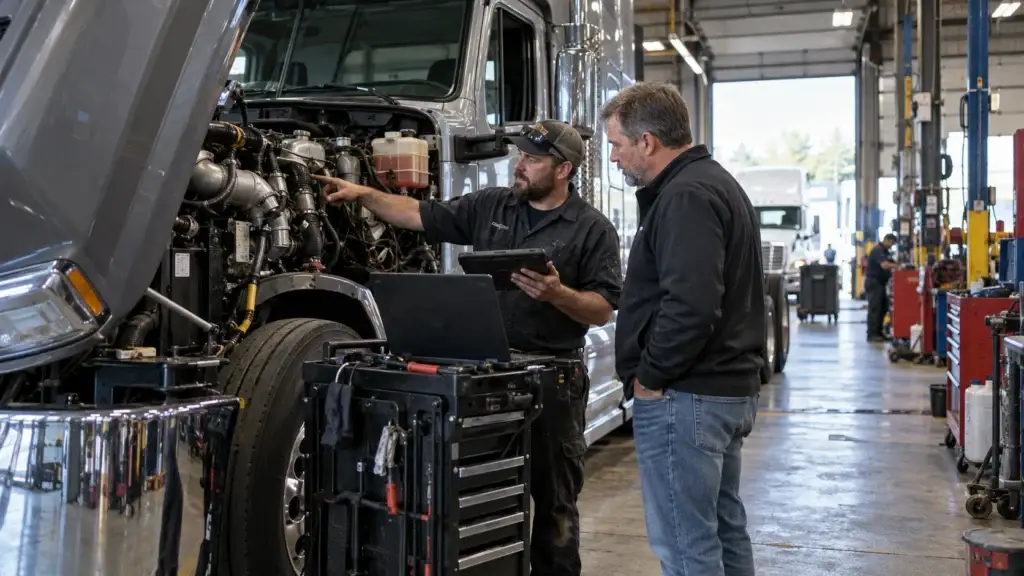
By Michael Nielsen, Publisher | 15+ Years in Diesel Repair
Last Updated: October 2026
⏱ Estimated reading time: 13 minutes
Searching for diesel mechanics near me returns a long list of shops and almost no way to tell which ones can actually fix a modern diesel. This guide shows what qualified means, which credentials and records you can verify, how to vet a shop before you hand over the keys, and which red flags mean you should walk away.
Heavy Duty Journal (HDJ) publisher Michael Nielsen and the HDJ editorial team built it on public sources: the Bureau of Labor Statistics (BLS), the Code of Federal Regulations (CFR) sections on vehicle inspection, the Federal Trade Commission (FTC) on warranties and repairs, and the U.S. Environmental Protection Agency (EPA) on emissions tampering. It prints no hourly rates, because no primary source publishes shop prices.
Where no source exists, this guide says so and labels the advice as HDJ's judgment.
Key Takeaways
- ✓Qualified is something you can check. Ask for written proof of training and experience, a written estimate and a written warranty before you approve work.
- ✓Federal rules set a bar for inspection work. Annual inspections and brake inspections require documented inspector qualifications that the carrier must keep.
- ✓Warranty fears are often overstated. The FTC says a manufacturer generally cannot void a warranty only because you used an outside shop or part.
- ✓A delete is a walk-away. Federal law prohibits installing parts that defeat emissions controls, so a shop that offers to remove a filter is a shop to leave.
- ✓Find the shop before you need one. Vetting a shop during a breakdown means accepting whatever you get, so choose one while the truck is running.
In This Guide
- Diesel Mechanics Near Me: What Qualified Means
- Credentials and Records You Can Check
- Where to Search for a Diesel Mechanic
- How to Vet a Shop Before You Commit
- Red Flags That Mean Walk Away
- Mobile Service or Shop Repair
- How to Read a Repair Estimate
- Specialists, Emergencies and Ongoing Care
- Frequently Asked Questions
- The Bottom Line
Diesel Mechanics Near Me: What Qualified Means
A qualified shop is not the closest one or the cheapest one. It is the one that has the people, tools and records to diagnose your engine correctly the first time and to prove it. When you search for diesel mechanics near me, you are looking for evidence of that, not a star rating alone.
Modern diesels depend on electronic controls and emissions systems, so the work is as much diagnosis as wrenching. BLS says diesel technicians inspect, repair and overhaul diesel-engine vehicles and, in many shops, use computer diagnostic equipment to detect problems and adjust engine functions.
Mechanic or Technician: Why the Label Matters Less
Shops use mechanic and technician interchangeably, and BLS groups them in one occupation. What matters is what the person can do on your truck. Ask who will diagnose it, what tools they use, and how much of their work is on trucks like yours.
Heavy-duty trucks add systems such as air brakes that light-duty diesels lack. A shop that mostly services pickups may not have the equipment or experience for a Class 8 tractor.
What a Good Shop Has in Common
- Technicians who can tell you what they will test and why, in plain language
- Diagnostic tools that read your engine's own data, not only generic codes
- Written estimates, written warranty terms and records of past work
- A bay and lift sized for your truck, and parts sources they can name
- Customers with trucks like yours who will vouch for the work
Credentials and Records You Can Check
Credentials help, but they are not all equal and not all required. BLS says, as of October 2026, that certification for diesel technicians is sometimes required and sometimes optional: employers may require or prefer it, and it may bring higher pay. The typical entry requirement is a high school diploma, and some employers prefer postsecondary diesel training.
So a certificate on the wall is a good sign, not a guarantee. Ask which technician holds it, what it covers and whether it is current. The strongest evidence is a mix: formal training, documented experience on your engine type, and a history of repeat fleet customers.
What Federal Rules Require for Inspection Work
Federal rules do set qualification standards in one area you may touch: required inspections. Under 49 CFR 396.17, a vehicle needs an annual inspection at least once in 12 months. A carrier may do it itself, or use an outside business such as a commercial garage that has the facilities and qualified inspectors.
49 CFR 396.19 says the inspector must understand the inspection criteria and be able to find defective components. The inspector must also have completed a Federal- or State-sponsored training program or hold a qualifying State certificate, or have at least a year of training or experience. The carrier must keep evidence of the inspector's qualifications.
49 CFR 396.25 sets a similar standard for brake inspectors, accepting an apprenticeship, a qualifying certificate, or at least one year of brake-related training or experience. HDJ's annual vehicle inspection guide explains the inspection itself.
A Common Mix-Up About Section 609
Some articles say that EPA Section 609 certification is essential for diesel emissions work. The EPA Section 609 page says it covers servicing motor vehicle air conditioning, including refrigerant recovery, and it does not mention diesel particulate filters, selective catalytic reduction or exhaust gas recirculation. Ask for emissions-system experience separately.
State Rules Vary, So Ask Locally
Repair-shop registration, estimate rules and consumer protections differ by state, and HDJ did not find a primary source that covers every state. Contact your state's consumer protection or licensing agency to learn what applies to your shop and your truck.
Where to Search for a Diesel Mechanic
Combine several search methods, because each has blind spots. Map searches show who is nearby. Referrals show who fleets trust. Neither shows whether a shop can work on your engine, so use both and then verify.
Maps, Directories and Reviews
A search for diesel mechanics near me in a map app lists nearby shops with ratings and photos. Check that the shop works on heavy-duty diesels, not only diesel pickups. Look at what the photos show: bay size, lifts, and whether trucks like yours are in the yard.
Read reviews for patterns instead of averages. Useful reviews describe a diagnosis, how the shop handled a surprise, and whether the truck stayed fixed. Be wary of runs of short, generic praise posted close together, and note how the shop answers criticism.
Referrals From People Who Run Trucks
Fleet managers, owner-operators and other drivers know which shops diagnose accurately and finish when they say. Ask what happened the last time something went wrong, because that is when a shop shows its character. Online trucking groups can help, but treat them as leads to check, not proof.
Dealer or Independent Shop
Dealerships have brand-specific training and parts access and handle warranty and recall work. Independent shops often work on several brands and may offer more flexibility on parts and scheduling. The right choice depends on your truck, its warranty status and the repair.
HDJ's independent shop vs dealership guide compares the two.
For a wider checklist, see HDJ's guide to choosing a truck repair shop.
What Your Warranty Does and Does Not Require
A common fear is that an independent shop voids the warranty. The FTC says manufacturers generally cannot condition warranty coverage on the use of particular brands of parts or service, and cannot deny coverage solely because an outside party did the work or supplied the part.
The FTC adds that a company may still decline to cover damage actually caused by an unauthorized part or by faulty service. Keep records of every service either way. HDJ's emission control warranty guide covers the separate federal emissions protections.
How to Vet a Shop Before You Commit
A short conversation tells you most of what you need. To vet diesel mechanics near me, call or visit before you have a problem, and ask the questions below. A shop that is proud of its work will answer them without hesitation.
Diagnostic Equipment and Capability
Ask what the shop uses to read your engine and how it confirms a fault before replacing parts. A trouble code points to a system, not always a failed part. Good shops confirm with measured tests, such as pressure, compression or electrical checks, and can show you the result.
Ask whether they handle emissions-system work, computer reprogramming and air brake service, and which of those they send elsewhere. A clear answer about what they do not do is a good sign.
Warranty, Timing and Parts
Ask for the warranty on parts and labor in writing, including what it excludes. Ask how long a repair like yours usually takes, where parts come from and how they will tell you about delays. Ask whether they offer more than one parts option and can explain the difference.
Insurance and Records
Ask for proof of insurance that covers customer vehicles while they are in the shop's care. Ask who will work on your truck, whether outside contractors are covered, and how the shop documents work, since records matter if a repair fails or a warranty question comes up.
| Ask about | Why it matters | Good sign | Warning sign |
|---|---|---|---|
| Diagnosis | Codes alone do not name the failed part | Shows measured test results | Replaces parts to see what happens |
| Estimate | Sets the scope and price before work | Itemized and written | Verbal price for a complex repair |
| Warranty | Defines who pays if it fails again | Written, with exclusions listed | Vague or verbal only |
| Insurance | Protects your truck on their property | Provides proof on request | Hesitates or deflects |
| Delays | Downtime costs you money | Calls before extending the job | Silence until pickup |
Key Recommendation
Ask for proof you can check: who the technician is, what training or experience applies, a written estimate and a written warranty. If the shop will not put these in writing before work starts, it will not do so afterward.
Red Flags That Mean Walk Away
Most bad outcomes show up as bad communication first. Treat the red flags below as a reason to pause, not proof of dishonesty, and keep looking if several appear together.
Offers to Delete Emissions Equipment
The most serious red flag is any offer to remove or bypass the diesel particulate filter (DPF), exhaust gas recirculation (EGR) or selective catalytic reduction (SCR) system, or to install a tuner that does. The EPA page on tampering and aftermarket defeat devices says the Clean Air Act prohibits anyone from selling or installing aftermarket parts that defeat emissions controls, and that dealers can be fined per tampered vehicle.
A shop that suggests a delete to avoid a hard diagnosis is solving its problem, not yours, and the EPA alert describes penalties that apply per device or per vehicle tampered.
Pressure, Vague Answers and Missing Paperwork
- Pressure to approve major work at once, with no written explanation
- Vague answers about who will work on your truck or what they will test
- A price quote over the phone for a complex problem with no inspection
- A refusal to provide a written estimate, warranty terms or proof of insurance
- Different answers from the front desk and the technician
- Promises of exact fuel economy or power gains
Facilities That Do Not Match the Job
A shop with no lift for your truck, no diesel diagnostic tools, or no space to store parts cleanly may not be set up for your work. A messy bay is not proof of poor work, but visible safety hazards such as spills or blocked exits are worth noting.
Trust your reaction to the visit. If questions about credentials meet defensiveness, move on. There are shops that welcome the scrutiny.
Mobile Service or Shop Repair
Mobile service brings the technician and tools to the truck, and a shop brings the truck to the tools. BLS notes that diesel technicians occasionally repair vehicles on roadsides or at worksites, and that some truck and bus shops offer 24-hour maintenance and repair.
Mobile service suits breakdowns, routine service and repairs that fit a service truck, such as filters, electrical checks and some brake and fuel work. Shops suit jobs that need a lift, heavy equipment, controlled conditions or several technicians, such as engine or transmission removal.
Ask a mobile provider the same questions as a shop: who will do the work, what they carry, what they refer out, and how they handle warranty and insurance. HDJ's mobile truck service vs shop repair guide covers when each makes sense.
How to Read a Repair Estimate
A usable estimate lets you compare shops on the same basis. It should list each repair, the parts with their type, the labor hours and rate, fees such as shop supplies and waste disposal, taxes and the total, along with a written warranty. HDJ prints no price benchmarks because no primary source supports them.
Compare scope before price. Shops may have diagnosed different problems, so a lower estimate can mean a different repair. Ask whether the diagnostic fee applies to the repair, and ask the shop to call you before it does any work not on the estimate.
Parts quality varies. Ask whether a part is new, remanufactured or aftermarket, who stands behind it and what the warranty is. Emissions and safety parts deserve extra care. HDJ's truck repair costs guide explains how labor and parts pricing works.
Keep every estimate, invoice and warranty. 49 CFR 396.3 requires carriers to keep maintenance records, and the same habit protects an owner when a repair fails or a warranty question arises.
Specialists, Emergencies and Ongoing Care
Some problems call for a specialist. Match the problem to the person instead of assuming a general shop can do everything.
| Problem area | When to look for a specialist | What to ask |
|---|---|---|
| Engine internals | Compression loss, bearing noise, overhaul | Do you do the machining or send it out? |
| Electrical and computer | Intermittent faults, lights no one can trace | What tools and data do you use? |
| Emissions systems | Filter, fluid or derate problems | How do you confirm the fault first? |
| Drivetrain | Slipping, noise, fluid leaks | Do you rebuild or replace? |
| Air brakes | Pressure, adjustment, inspection | What brake experience do your technicians have? |
Choose an Emergency Contact Before You Need One
Find out who offers real round-the-clock service, not an answering service. Ask about response area, what they can fix at the roadside, how they bill after hours and how you pay. Save the number in your phone and your truck, and give it to whoever dispatches you.
Build a Relationship With One Shop
A shop that knows your truck notices changes, keeps a service history and often gives better scheduling. Use the shop for routine service as well as emergencies. Follow the maintenance schedule for your engine, and keep your own records of what was done.
Free Diesel Maintenance Checklist
Get HDJ's free, field-tested diesel maintenance checklist delivered instantly to your inbox — print it, laminate it, keep it in the shop.
Instant PDF • 100% Free • No Spam
Frequently Asked Questions
How do I find diesel mechanics near me that I can trust?
Combine a map search, referrals from fleets and drivers, and a short vetting call. Ask who will work on your truck, what tools they use, and for a written estimate and warranty. Check that the shop services trucks like yours. Choose before a breakdown, when you have time to compare.
Does a diesel mechanic need to be certified?
BLS says certification is sometimes required and sometimes optional, and may bring higher pay. Inspection work has its own rules: 49 CFR 396.19 requires annual inspectors to have qualifying training or at least a year of experience, and carriers keep the records. Ask for proof either way.
Will using an independent shop void my warranty?
Generally not solely for that reason. The FTC says manufacturers cannot condition warranty coverage on particular brands of parts or service, or deny it only because an outside party did the work. They may decline damage caused by faulty work or parts. Keep service records and read your own warranty.
Should I use a mobile diesel mechanic or a shop?
Use mobile service for breakdowns, routine work and repairs that fit a service truck. Use a shop when you need a lift, heavy equipment, controlled conditions or several technicians, such as an engine or transmission job. Ask either one the same vetting questions about credentials, warranty and insurance.
What should a written repair estimate include?
It should list each repair, parts with their type, labor hours and rate, fees, taxes, total price and warranty terms. Ask whether the diagnostic fee applies to the repair and whether the shop will call before adding work. Compare scope first, because a lower estimate may cover a different repair.
Is it legal for a shop to delete my DPF or EGR?
No. EPA says the Clean Air Act prohibits anyone from selling or installing parts that defeat emissions controls, and it protects diesel particulate filters, exhaust gas recirculation and selective catalytic reduction systems. Penalties apply per device or vehicle, and a shop that offers a delete is a red flag.
The Bottom Line
Finding diesel mechanics near me comes down to evidence you can check: who does the work, what proof they can show, and whether the estimate, warranty and insurance are in writing. A shop that welcomes those questions has earned a closer look.
Vet a shop while your truck is running, keep your records, and walk away from any shop that offers to delete emissions equipment. Michael Nielsen and the Heavy Duty Journal editorial team keep this guide current at heavydutyjournal.com. Confirm local licensing and estimate rules with your state.
Help Fellow Operators Find a Good Shop
Know a driver, owner-operator or fleet manager who needs a reliable diesel shop? Share this free Heavy Duty Journal guide from Michael Nielsen at heavydutyjournal.com so they can vet one before the next breakdown.


