

By Michael Nielsen, Editor & Publisher | 15+ Years in Diesel Repair
Last Updated: December 2025
📖 Estimated reading time: 19 minutes
Managing truck repair costs effectively separates profitable fleet operations from those hemorrhaging money on unplanned maintenance. Whether you oversee a 500-unit fleet or run a three-truck owner-operator business, understanding what drives your repair expenses directly impacts your bottom line. According to the American Transportation Research Institute, repair and maintenance costs reached $0.198 per mile in 2024—representing thousands of dollars annually per truck that demands strategic management.
Modern commercial vehicles incorporate sophisticated emissions systems, electronic controls, and diagnostic requirements that have fundamentally changed the repair landscape. A Class 8 tractor rolling into a shop today presents diagnostic challenges that didn’t exist a decade ago. DPF regeneration issues, SCR catalyst problems, and complex CAN bus faults require specialized equipment and trained technicians—all of which influence what appears on your invoice.
This guide breaks down every component affecting your maintenance budget: labor rate structures across facility types, parts pricing strategies, repair cost benchmarks by system, and proven approaches to controlling expenses. Fleet managers and owner-operators who master these concepts consistently outperform competitors still operating on intuition rather than data.
Key Takeaways
- Labor rates range from $100-$200 per hour depending on facility type, with diesel specialists and dealerships commanding premium pricing for specialized diagnostic capabilities
- Parts selection significantly impacts total costs: OEM components cost 25-60% more than quality aftermarket alternatives, while remanufactured options deliver 30-50% savings on major components
- Preventive maintenance delivers 5:1 ROI: Every dollar invested in scheduled service prevents an estimated five to ten dollars in emergency repair costs
- In-house maintenance reduces costs: Fleets performing maintenance internally average lower per-mile repair expenses than those outsourcing all work
- Heavy-duty repairs cost 2-4 times more than light-duty equivalents due to component size, diagnostic complexity, and specialized labor requirements
- Regional pricing varies 40-60% between highest and lowest cost markets, creating opportunities for strategic repair scheduling
Understanding Commercial Truck Repair Cost Components
Every repair invoice reflects two fundamental cost categories: labor and parts. These components interact in ways that create opportunities for fleet managers who understand their relationship. Labor charges cover technician time, shop overhead, diagnostic equipment investment, and the expertise required to service modern commercial vehicles. Parts pricing encompasses component quality tiers, sourcing strategies, and markup structures that vary significantly between providers.

Labor typically represents 40-60% of total repair costs, though this percentage shifts based on repair complexity and parts requirements. A turbocharger replacement on a Cummins ISX might show 60% parts cost due to component expense, while extensive diagnostic work on an intermittent electrical fault could approach 80% labor with minimal parts involved.
Diagnostic time increasingly appears as a separate line item, particularly for emissions-related issues or electronic system faults. Technicians may spend two to four hours identifying the root cause of problems before actual repair work begins. This investigative phase requires sophisticated scan tools accessing multiple ECU modules, technical databases from OEM sources, and analytical expertise developed through years of experience with specific platforms.
Federal regulations under 49 CFR Part 396 require motor carriers to systematically inspect, repair, and maintain all commercial vehicles under their control. This regulatory framework establishes minimum maintenance standards that influence repair costs industry-wide. Carriers must maintain detailed records documenting inspection findings, repairs performed, and maintenance completed—administrative requirements that factor into shop overhead costs.
Shop Overhead and Equipment Investment
Labor rates reflect far more than technician wages. Commercial vehicle repair facilities invest heavily in infrastructure that enables proper diagnosis and service. A well-equipped heavy-duty shop maintains scan tools from multiple OEM platforms—Cummins Insite, Detroit Diesel Diagnostic Link, PACCAR Davie—each requiring licensing fees and annual updates. Diagnostic equipment investment alone can exceed $50,000 for comprehensive coverage.
Physical infrastructure adds substantial overhead. Heavy-duty lifts capable of supporting 80,000-pound vehicles cost significantly more than automotive equivalents. Specialized tools for air brake service, wheel-end work, and emissions system maintenance require ongoing investment. Insurance premiums, environmental compliance costs, and technician training programs all contribute to the hourly rate appearing on your invoice.
Understanding these overhead realities helps fleet managers evaluate quotes realistically. A shop charging $85 per hour may lack the diagnostic equipment or trained personnel to properly service late-model trucks with complex aftertreatment systems. The apparent savings evaporate when misdiagnosis leads to replaced components that weren’t actually faulty.
2025 Labor Rate Structures by Facility Type
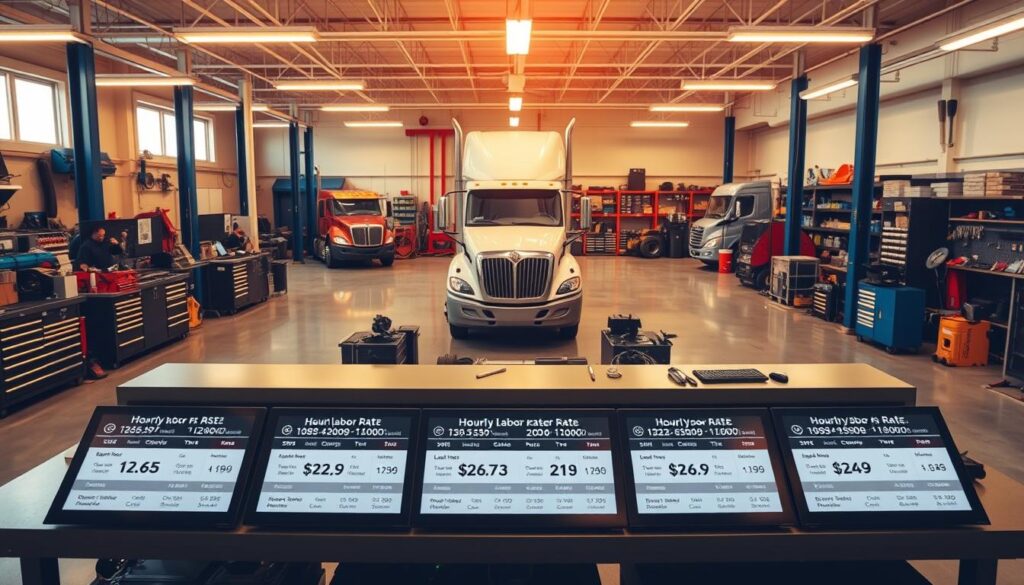
Labor rates across the commercial vehicle repair industry span a substantial range, reflecting differences in facility capabilities, technician expertise, and overhead structures. Fleet managers selecting service providers must match their needs with appropriate facility types rather than simply choosing the lowest quoted rate.
Independent Heavy-Duty Repair Facilities
Independent shops typically charge $100-$140 per hour for commercial vehicle service, positioning them below dealership rates while maintaining the equipment and expertise required for heavy-duty work. These facilities often develop deep expertise in specific applications—linehaul tractors, vocational trucks, or particular engine platforms—that enables efficient diagnosis and repair within their specialization.
The independent shop advantage extends beyond pricing to include scheduling flexibility and personalized service relationships. Fleet managers working with established independent facilities often receive priority scheduling during critical breakdowns, phone consultations on developing issues, and flexible payment arrangements during cash flow challenges. These relationship benefits compound over years of partnership.
Parts sourcing flexibility represents another independent shop advantage. Unlike dealer networks often contractually obligated to OEM components, independents can offer quality aftermarket alternatives that reduce total repair costs without compromising reliability. A skilled parts manager at an independent facility knows which applications genuinely require OEM components and where reputable aftermarket options perform equivalently.
OEM Dealership Service Departments
Manufacturer-authorized service centers command premium rates ranging from $150-$200 per hour, reflecting substantial investments in factory training programs, proprietary diagnostic systems, and direct manufacturer technical support. These facilities employ technicians who complete OEM certification programs and receive ongoing training on emerging systems and service procedures.
Dealership service becomes essential rather than optional in specific scenarios. Trucks under factory warranty require authorized repairs to maintain coverage. Recall repairs and technical service bulletin updates must occur at authorized facilities. Complex electronic system failures sometimes require proprietary diagnostic capabilities unavailable in the independent aftermarket.
The ASE T-series certification program establishes baseline technician qualifications across the industry, but OEM training programs build specialized expertise beyond these fundamentals. A dealership technician who has completed Cummins’ advanced diagnostics curriculum brings platform-specific knowledge that accelerates diagnosis of complex emissions system faults.
Diesel Specialists and Fleet Service Providers
Specialized diesel and fleet service operations occupy the middle ground at $120-$175 per hour, concentrating exclusively on commercial vehicles and developing deep expertise that general repair facilities cannot match. These specialists understand the productivity costs of downtime and often prioritize faster turnaround times for revenue-generating equipment.
Fleet service providers offer comprehensive maintenance programs that extend beyond individual repair events. Scheduled preventive maintenance, DOT annual inspections, and coordinated parts inventory management create efficiencies that reduce total maintenance costs over time. These relationships prove particularly valuable for fleets operating consistent equipment types where the provider develops intimate familiarity with specific truck configurations.
$0.198 per mile
Average fleet repair and maintenance cost in 2024 — ATRI Operational Costs Report
Parts Pricing: OEM, Aftermarket, and Remanufactured Options
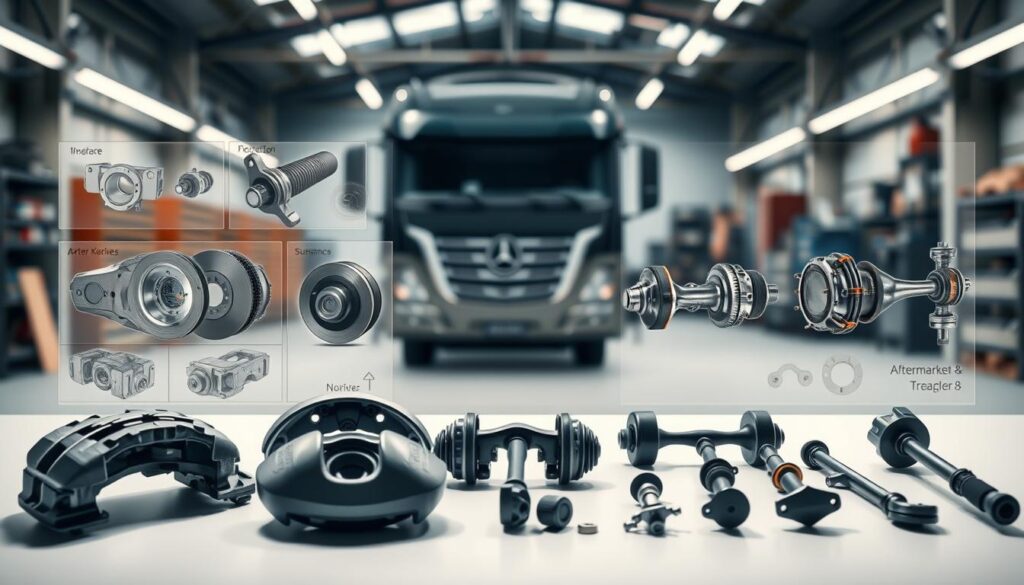
Component selection dramatically influences total repair costs, with pricing differences of 30-60% between OEM and aftermarket alternatives for identical applications. Understanding when premium components justify their cost—and when quality aftermarket options deliver equivalent performance—enables strategic purchasing decisions that optimize maintenance budgets.
OEM Components and Premium Pricing
Original Equipment Manufacturer parts command premium pricing—typically 25-60% above aftermarket alternatives—reflecting guaranteed compatibility, precise engineering tolerances, and comprehensive warranty coverage. For trucks under manufacturer warranty or lease agreements requiring OEM components, this pricing structure is unavoidable. The investment preserves warranty coverage that could offset thousands in future repair costs.
Certain applications genuinely warrant OEM components regardless of warranty status. Fuel injection system components, emissions aftertreatment parts, and safety-critical brake system elements benefit from factory engineering that ensures proper operation in demanding commercial applications. A premium-brand injector designed specifically for a given engine platform delivers calibrated fuel delivery that generic replacements may not replicate precisely.
Quality Aftermarket Alternatives
The aftermarket parts landscape spans from economy-grade components to premium offerings that match OEM specifications at reduced cost. Established aftermarket brands—Dorman, Delphi, Standard Motor Products, and similar manufacturers—invest heavily in reverse engineering and testing to produce components meeting or exceeding original equipment standards.
Quality indicators help separate reliable aftermarket options from questionable alternatives. Look for ISO 9001 certification, published specification compliance, and warranty terms comparable to OEM coverage. Premium aftermarket suppliers typically offer 12-24 month warranties on their components, signaling confidence in product quality that budget manufacturers avoid.
Application-appropriate aftermarket selection requires understanding which components tolerate non-OEM alternatives and which demand factory parts. Filtration products, belts, hoses, and routine wear items often perform identically whether sourced from OEM or quality aftermarket suppliers. Electronic sensors, fuel system components, and emissions-related parts deserve more cautious aftermarket selection given their sensitivity to manufacturing tolerances.
Remanufactured Components and Cost Optimization
Remanufactured major components deliver 30-50% savings compared to new OEM parts while maintaining factory performance standards. Professional remanufacturing involves complete disassembly, thorough cleaning, detailed inspection, and rebuilding with new wear components—far beyond simple cleaning and resale of used parts.
Remanufactured options excel for major component failures where new pricing seems disproportionate to vehicle value. A remanufactured transmission at $4,500 makes financial sense for an eight-year-old tractor worth $35,000, while a $9,000 new unit strains the cost-benefit calculation. Fleet operators frequently leverage remanufactured engines, transmissions, differentials, and turbochargers to extend vehicle service life economically.
The Technology & Maintenance Council’s Recommended Practices provide industry-consensus standards for component quality and maintenance procedures that help fleet managers evaluate remanufactured component suppliers. TMC’s peer-reviewed practices represent decades of accumulated industry knowledge on maintaining commercial vehicles cost-effectively.
| Parts Category | Cost vs. OEM | Typical Warranty | Best Application |
|---|---|---|---|
| OEM Original | 100% (Baseline) | 12-36 months | Warranty repairs, emissions systems, newer trucks |
| Premium Aftermarket | 75-90% | 12-24 months | Post-warranty service, routine maintenance |
| Economy Aftermarket | 40-60% | 90 days-12 months | Older trucks, non-critical components |
| Remanufactured | 50-70% | 12-36 months | Major component failures, aging fleet vehicles |
Common Repair Cost Benchmarks by System
Understanding realistic cost ranges for major repair categories enables fleet managers to evaluate estimates critically and budget appropriately for anticipated maintenance expenses. These benchmarks reflect industry averages—actual costs vary based on specific equipment, regional markets, and repair complexity.
Diesel Engine Repairs: $2,000 to $20,000
Engine repair costs span the widest range of any system category, from relatively affordable gasket replacements to complete overhauls requiring substantial investment. Diagnostic complexity on modern electronically-controlled diesels adds time and expense that mechanical engines of previous generations never required.
Minor engine repairs addressing external components and seals typically cost $500-$1,500. Valve cover gasket replacement runs $400-$900 depending on engine accessibility. Oil pan gasket service ranges from $600-$1,500 on engines requiring subframe removal for adequate clearance.
Mid-range engine repairs include turbocharger replacement at $2,000-$4,500 for quality components properly installed, EGR cooler service at $1,500-$3,500, and injector replacement at $500-$1,000 per cylinder including programming. Timing gear and front cover repairs typically cost $2,500-$5,000 depending on engine platform and component wear discovered during service.
Major engine work—cylinder head repairs, in-frame overhauls, or complete engine replacement—represents significant investment. Head gasket replacement with machining verification runs $3,500-$7,000. In-frame overhauls addressing pistons, rings, bearings, and associated components cost $12,000-$18,000 with quality parts. Complete engine replacement with remanufactured units typically costs $15,000-$25,000 installed, while new crate engines may exceed $30,000.
Transmission Service and Rebuild: $2,500 to $10,000
Transmission costs vary dramatically based on whether service involves routine maintenance, component replacement, or complete rebuilds. Modern automated manual transmissions add diagnostic complexity that increases labor costs beyond traditional manual gearbox service.
Routine transmission service—fluid and filter changes—costs $350-$600 and should occur at manufacturer-specified intervals to maximize component life. Clutch replacement on manual and automated manual transmissions runs $2,500-$5,000 depending on component selection and accessibility challenges.
Complete transmission rebuilds cost $5,000-$8,500 for comprehensive overhauls addressing all wear components. Replacement with remanufactured units typically runs $6,000-$12,000 including labor, with heavier-duty applications commanding premium pricing. Automated transmissions like Eaton UltraShift and Detroit DT12 require manufacturer-specific diagnostic procedures that add complexity and cost.
Brake System Service: $800 to $3,000 Per Axle
Air brake systems on commercial vehicles require service approaches distinct from hydraulic automotive brakes. Component sizing, federal inspection requirements, and the critical safety implications of brake system integrity all influence service costs.

Standard brake service including shoes, drums resurfacing or replacement, and hardware costs $800-$1,500 per axle on steer and drive positions. Trailer brake service runs somewhat lower at $600-$1,200 per axle given simpler access and smaller component sizing. Premium brake components—ceramic friction materials and balanced drum sets—add $200-$400 to typical service costs.
Comprehensive brake system overhauls addressing chambers, slack adjusters, cam bushings, and associated components cost $1,500-$3,000 per axle. Air system repairs including compressor service, valve replacement, and line repairs add $500-$2,000 depending on component requirements. ABS module diagnosis and replacement, when required, adds $800-$1,500 per unit.
Stay Ahead of Maintenance Costs
Get weekly insights on fleet maintenance best practices, cost-saving strategies, and industry benchmarks delivered directly to your inbox.
Suspension and Steering Components: $600 to $4,000
Commercial vehicle suspension systems endure punishing loads that accelerate component wear beyond automotive norms. Addressing wear items proactively prevents cascading failures that multiply repair costs and compromise safety.
Individual suspension component replacement—shock absorbers, spring bushings, torque rod bushings—typically costs $300-$800 per item including labor. Spring pack replacement runs $800-$1,500 per side depending on spring configuration and accessibility. Air suspension systems add complexity with bag replacement costing $400-$800 per corner plus associated hardware and leveling valve service.
King pin replacement on steer axles represents significant investment at $1,500-$3,000 per side due to labor intensity and precision requirements. Complete front-end rebuilds addressing all wear points cost $3,000-$5,000 when performed comprehensively. These thorough overhauls often prove more cost-effective than staged repairs that require repeated disassembly.
Heavy-Duty vs. Light-Duty Repair Cost Comparisons
Vehicle classification fundamentally determines repair expenses because engineering requirements differ dramatically across truck classes. Class 8 tractors incorporate components designed for 500,000+ mile service lives at gross combination weights exceeding 80,000 pounds—engineering parameters that drive both component cost and service complexity.

Class 8 Commercial Vehicle Repairs
Heavy-duty commercial truck repairs typically cost two to four times more than comparable work on light-duty pickups. This differential reflects component sizing, diagnostic complexity, specialized equipment requirements, and the expertise necessary to service professional-grade equipment.
A commercial truck brake job ranges from $1,500-$3,500 per axle—substantially exceeding light-duty costs due to larger friction materials, air brake system complexity, and federal inspection requirements. Diesel engine repairs span $5,000-$30,000 depending on severity, while transmission service commands $4,000-$15,000 for comprehensive work.
Fleet operators must factor downtime costs into repair economics. A linehaul tractor sidelined for three days generates cascading impacts beyond the actual repair invoice—missed loads, driver scheduling disruptions, and customer service failures that affect business relationships. This productivity context often justifies premium pricing for faster turnaround from well-equipped facilities.
Medium-Duty Commercial Applications
Medium-duty trucks—Ford F-650/F-750, International CV series, Freightliner M2—occupy cost positions between light-duty pickups and Class 8 tractors. These vehicles incorporate commercial-grade components while remaining serviceable at facilities lacking full heavy-duty capabilities.
Medium-duty brake service typically runs $1,000-$2,500 per axle. Diesel engine repairs range from $3,000-$18,000 depending on severity. Transmission service costs $2,500-$9,000 for comprehensive work. These figures reflect commercial-grade component pricing with somewhat reduced labor intensity compared to Class 8 applications.
The HDJ Perspective
After decades covering commercial vehicle maintenance, one pattern emerges consistently: fleets that invest in understanding their actual repair costs—not just tracking invoices but analyzing cost drivers, comparing facility performance, and benchmarking against industry data—consistently outperform competitors managing maintenance reactively. The most successful fleet managers treat maintenance data as a strategic asset, using repair cost analysis to inform spec’ing decisions, evaluate service provider relationships, and identify equipment approaching replacement thresholds. Those who simply pay invoices without analysis leave significant money on the table and often find themselves surprised by expenses that more analytical operators anticipated and planned for.
Diagnostic Fees and Inspection Costs
Professional diagnostic services represent essential investments that prevent misdiagnosis and unnecessary parts replacement. Modern commercial vehicles contain dozens of electronic control modules, hundreds of sensors, and interconnected systems requiring professional diagnostic equipment to evaluate properly.
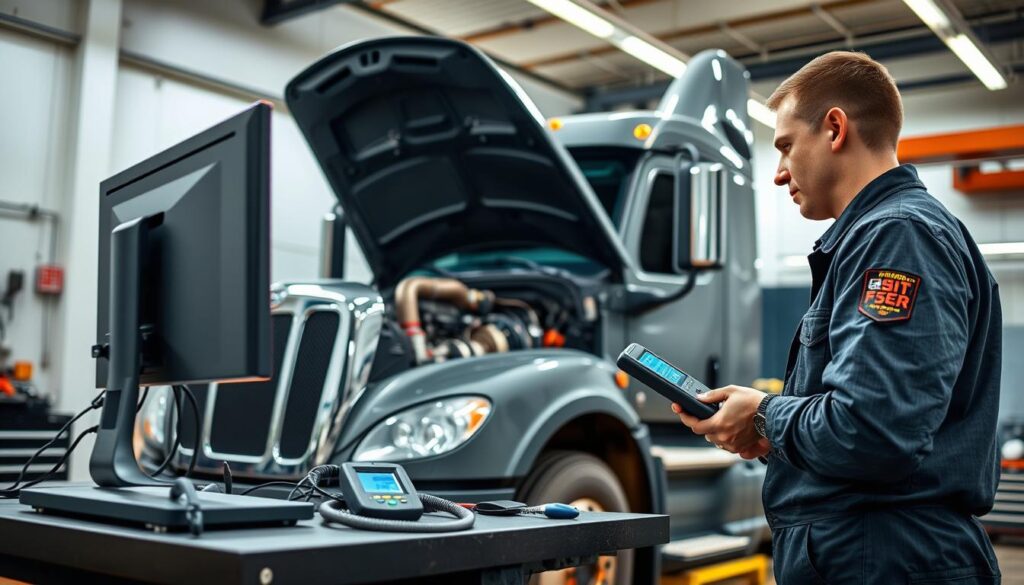
Diagnostic fees typically range from $125-$250 for commercial vehicle diagnosis, reflecting equipment investment, technician training, and the analytical expertise required to interpret complex fault data. Most reputable facilities apply diagnostic charges toward repair costs when work is authorized, ensuring customers don’t pay twice for the same service.
Comprehensive vehicle inspections—DOT annual inspections, pre-purchase evaluations, or seasonal condition assessments—cost $150-$300 depending on thoroughness. These inspections identify developing problems before they cause roadside failures, enabling planned repairs at convenient times rather than emergency service at premium rates.
Preventive Maintenance: Investment vs. Emergency Repair Costs
Every dollar invested in scheduled preventive maintenance typically prevents five to ten dollars in future emergency repair costs. This return stems from addressing wear items before they fail catastrophically and cause expensive secondary damage to adjacent components.
Standard PM service intervals include oil and filter changes ($250-$400 for commercial diesels), fuel filter service ($150-$300), transmission fluid service ($350-$600), and coolant system maintenance ($200-$400). Annual PM costs for typical linehaul operations run $2,500-$4,500 per tractor—a fraction of the single major repair that deferred maintenance often causes.
ATRI data consistently shows that fleets with robust in-house maintenance programs achieve lower per-mile repair costs than those outsourcing all service. In-house programs enable proactive component replacement, consistent service quality, and elimination of markup on parts and labor that external providers necessarily charge.
Regional Cost Variations and Strategic Repair Planning
Geographic pricing differences create 40-60% cost variations for identical repairs across different markets. Major metropolitan areas on both coasts command premium rates reflecting higher facility costs, wage competition, and regulatory compliance expenses. Midwest and southern markets generally offer more affordable pricing without sacrificing service quality.
Fleet managers operating across multiple regions can leverage these differences strategically. Scheduling major planned repairs at facilities in lower-cost markets—when operational logistics permit—generates meaningful savings on significant work like transmission rebuilds or engine overhauls. Emergency repairs necessarily occur wherever breakdowns happen, but planned maintenance allows geographic optimization.
Share Your Maintenance Expertise
Are you a fleet maintenance professional with insights on controlling repair costs? We’re looking for experienced voices to contribute to Heavy Duty Journal.
Proven Cost-Control Strategies for Fleet Operations
Effective repair cost management requires systematic approaches rather than reactive decisions. The most successful fleet maintenance programs combine preventive scheduling, strategic parts sourcing, service provider relationships, and data-driven analysis to optimize total maintenance spending.
Building Service Provider Relationships
Establishing ongoing relationships with quality repair facilities yields significant long-term cost advantages. Shops value consistent customers who provide reliable business volume and typically extend benefits unavailable to transactional customers—preferential scheduling, flexible payment terms, priority attention during critical breakdowns, and occasionally discounted labor rates.
Relationship-based service selection provides advantages beyond direct pricing. Facilities familiar with your specific equipment diagnose problems more efficiently by understanding previous repair history and recurring issues. Established trust enables acceptance of recommendations without questioning motivations. Long-term relationships create accountability that encourages quality work to maintain customer retention.
Optimizing Parts Procurement
Strategic parts sourcing can reduce component costs by 20-40% without compromising quality. Larger fleets often establish direct relationships with parts distributors, bypassing shop markup on components while paying separately for labor. Even smaller operations benefit from understanding parts pricing and negotiating component costs as a separate line item from service charges.
Inventory management for high-turn items—filters, belts, common wear parts—enables bulk purchasing that reduces per-unit costs. Fleets maintaining consistent equipment types can stock common parts in-house, eliminating markup and wait time while enabling rapid response to developing issues before they escalate.
Leveraging Technology and Data
Fleet maintenance management systems transform repair cost control from intuitive judgment to data-driven decision making. Tracking cost-per-mile by unit, identifying equipment approaching replacement thresholds, and comparing service provider performance requires systematic data collection that manual processes struggle to provide.
Telematics integration enables predictive maintenance approaches that address developing problems before they cause failures. Monitoring DPF loading, tracking coolant temperatures, and analyzing fault code trends allows proactive intervention that prevents expensive emergency repairs.
Frequently Asked Questions
How much does it cost to maintain a commercial truck per mile?
According to ATRI’s 2025 Operational Costs of Trucking report, the industry average repair and maintenance cost was $0.198 per mile in 2024. This figure varies significantly based on fleet size, truck age, duty cycle, and maintenance practices. Less-than-truckload carriers typically experience higher per-mile costs ($0.22+) due to intensive urban driving cycles, while well-maintained linehaul fleets often achieve lower figures through optimized preventive maintenance programs. Owner-operators should budget $0.18-$0.25 per mile for maintenance depending on equipment age and operating conditions.
When does it make sense to rebuild versus replace a diesel engine?
The rebuild-versus-replace decision depends on overall truck condition, remaining useful life expectations, and comparative costs. In-frame rebuilds typically cost $12,000-$18,000 compared to $15,000-$25,000 for remanufactured engine replacement. Rebuilding makes sense when the truck has significant remaining value, other major systems are in good condition, and the engine block passes inspection. Replace when rebuilding costs approach replacement pricing, when the truck faces multiple simultaneous major repairs, or when emissions compliance issues make retention impractical.
How can fleet managers reduce diagnostic costs?
Invest in basic diagnostic capability—quality scan tools that read fault codes enable preliminary troubleshooting before authorizing professional diagnosis. Train drivers to provide detailed symptom descriptions including operating conditions when problems occur. Maintain thorough repair history records that help technicians identify patterns. Choose service providers who apply diagnostic charges toward authorized repairs. For recurring diagnostic needs, consider in-house equipment investment or fleet management systems that provide remote diagnostic access.
What maintenance intervals maximize component life without over-servicing?
Follow OEM-specified service intervals as baseline requirements, then adjust based on duty cycle severity. Severe-duty applications—vocational trucks, urban delivery, heavy towing—typically require intervals 25-40% shorter than manufacturer specifications. Oil analysis programs provide objective data on lubricant condition that enables interval optimization. Track component life systematically to identify equipment-specific patterns. For critical systems like brakes and steering, err toward more frequent inspection rather than extending intervals.
How do fleet size economics affect repair costs?
Larger fleets achieve lower per-unit costs through volume purchasing, in-house maintenance programs, and dedicated management resources. Fleets exceeding 50 units typically justify dedicated maintenance staff. Operations with 100+ units often establish in-house shop facilities that eliminate external labor markup. Smaller fleets can partially offset disadvantages through buying group participation, consistent service provider relationships, and systematic maintenance management that prevents expensive reactive repairs.
Taking Control of Your Maintenance Budget
Managing truck repair costs effectively requires understanding the components driving your invoices—labor rate structures, parts pricing strategies, and the cost benchmarks that define fair market value for common repairs. Fleet managers who master these concepts consistently achieve lower total maintenance costs while maintaining equipment reliability that supports operational performance.
The path forward combines preventive maintenance investment with strategic service provider relationships, data-driven decision making, and continuous attention to cost optimization opportunities. Start by analyzing your current spending patterns, benchmarking against industry data, and identifying the highest-impact opportunities for improvement. Small optimizations across multiple cost categories compound into substantial annual savings that directly improve your operation’s profitability.
Share This Guide With Your Network
Know a fleet manager or owner-operator who could benefit from these cost-control strategies? Help them optimize their maintenance spending.