
By Michael Nielsen, Publisher | 15+ Years in Diesel Repair
Last Updated: October 2026
⏱ Estimated reading time: 13 minutes
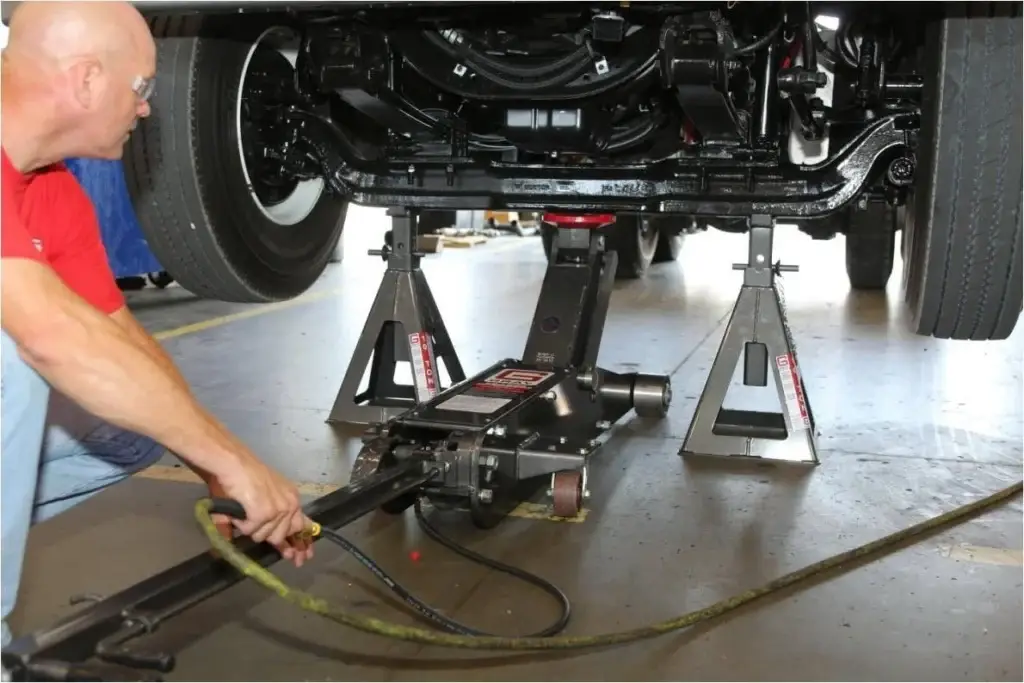
A heavy duty floor jack has to be sized to the load at the lift point, not to the badge on the frame. A 20-ton jack is rated for 40,000 pounds and a 50-ton jack for 100,000 pounds, but the model has to fit the truck, the floor, and the shop's air supply as well. This guide compares published specifications and the safety rules that apply.
Heavy Duty Journal's editorial team, led by publisher Michael Nielsen, rebuilt this guide for shop managers, fleet maintenance directors, and technicians. HDJ used manufacturer product pages from Sunex and a Hein-Werner catalog, plus the Occupational Safety and Health Administration (OSHA), the American Society of Mechanical Engineers (ASME), and the Department of Energy (DOE), all checked as of October 2026. HDJ did not test any jack.
According to Heavy Duty Journal's October 2026 review, the biggest correction is the model list. An earlier version named a Hein-Werner HW93720 as a 20-ton jack, but trade listings show the HW93720 as a half-ton transmission jack, and Sunex lists no 50-ton model 6350. This version compares models HDJ could confirm on a manufacturer page or catalog.
Key Takeaways
- ✓Rating comes from the operator. OSHA says the operator shall make sure the jack has a rating sufficient to lift and sustain the load, and the rated load must be marked on the jack.
- ✓Sunex lists no 50-ton jack. Its heavy-duty line tops out at a 44-ton axle jack (6744) and a 55-ton truck jack (6855), so the 50-ton class is covered by those two.
- ✓Specs differ more than tonnage. The 20-ton Sunex 6623 lists 8.66 to 23.35 inches, while the Hein-Werner HW93733 lists 9.00 to 19.75 inches and 88.5 pounds.
- ✓The old pressure figure was wrong. A 100,000-pound load on a 6-inch round base is about 3,500 pounds per square inch (psi), not the 14,000 psi the earlier version stated.
- ✓Stands do the holding. OSHA says a raised load shall be cribbed, blocked, or otherwise secured at once, and a New York fatality involved a truck that fell off a jack stand.
- ✓ASME B30.1 excludes these jacks. ASME says B30.1 does not cover automotive service jacks, which fall under its portable automotive service equipment standard instead.
In This Guide
- How to Size a Heavy Duty Floor Jack
- Heavy Duty Floor Jack Specifications Compared
- When 20 Tons Is Enough and When It Is Not
- Ground Pressure and Floor Surface
- Jack Stands and Securing the Load
- Inspection, Lubrication, and Used Fluid
- Buying Checklist: Questions to Put in Writing
- Frequently Asked Questions
- The Bottom Line
How to Size a Heavy Duty Floor Jack
Sizing starts with the weight the jack will actually carry. As of October 2026, Sunex lists its 20-ton 6623 at 40,000 pounds, and 20 US tons of 2,000 pounds each equals 40,000 pounds, or about 18,144 kilograms. A 50-ton rating works out to 100,000 pounds. Always check whether a catalog means US tons or metric tonnes.
40,000 lb
The load a 20-ton jack is rated for, using 2,000 pounds per US ton; a 50-ton rating equals 100,000 pounds.
The Code of Federal Regulations (CFR) puts the sizing decision on the operator. As of October 2026, 29 CFR 1910.244(a), OSHA's jack standard, says the operator shall make sure the jack has a rating sufficient to lift and sustain the load, and it requires the rated load to be legibly and permanently marked on the jack.
The rule sets no safety multiplier, so HDJ does not assign one. HDJ recommends getting the real weight at the lift point from an axle scale, a weigh ticket, or the equipment maker, then choosing a rating with clear room above it. Ask the maker how it defines rated load.
Terminology matters too. The models compared here are air hydraulic truck jacks with a long chassis and wheels, which shops call floor jacks. Bottle jacks are a different tool. HDJ left out the Torin T92007A, a 20-ton air bottle jack, because Torin's product page did not list it.

Heavy Duty Floor Jack Specifications Compared
The table below uses manufacturer-published figures as of October 2026. Sunex figures come from its product pages and the Hein-Werner figures from a distributor-hosted Omega Lift Equipment catalog. A dash means the page did not state the figure, and HDJ did not test any of these jacks.
| Model | Rated capacity | Height range | Other published detail |
|---|---|---|---|
| Sunex 6623 | 20 tons, 40,000 lb | 8.66 to 23.35 in | 14.69 in power raise; 45 in handle; 1-year warranty |
| Hein-Werner HW93733 | 20 tons | 9.00 to 19.75 in | 88.5 lb; 110 to 140 psi; 52.5 in handle |
| Sunex 6635 | 22/35 tons, 70,000 lb | 8.625 to 19.75 in | Two-stage telescopic; 12 in power raise; 49 in handle |
| Sunex 6744 | 44 tons | 8.25 to 21 in | Narrow chassis; air return; self-retracting ram |
| Sunex 6855 | 55/33/16.5 tons | 5.9 to 16.75 in | 146 lb shipping weight; 55 tons at 116 to 174 psi |
Capacity is only the first filter. The two 20-ton jacks differ by several inches at the top of their range, and the larger Sunex models start at lower heights than the 20-ton pair. The 6855's 5.9-inch minimum is the lowest listed here, which matters for low frames.
The 20-Ton Pair
Sunex's 6623 is a telescoping-ram truck jack with an integrated air-motor filter, overload and bypass safety valves, and a 1.75-inch saddle with two 4-inch extension adapters. Its page cites a voluntary certification process under the 2019 edition of ASME's Portable Automotive Service Equipment (PASE) standard but gives no weight or air consumption.
The Hein-Werner HW93733 lists a dual-purpose handle, a stamped base, and a pressure relief valve. At 88.5 pounds it is heavy enough that HDJ recommends confirming one person can move it safely before committing to a purchase.
The 44-Ton and 55-Ton Models
Sunex's 6744 is a 44-ton axle jack with wiper seals to protect the hydraulic system from contaminants, and its 8.25 to 21-inch range gives reach on higher axles. HDJ did not find an air consumption figure on the page, so ask Sunex for it before sizing a compressor.
The 6855 is a three-stage 55/33/16.5-ton jack with a springless ram, a flash-chromed ram for rust resistance, a 50.75-inch handle, and a 6.25-inch wheel. Its published 116 to 174 psi range is higher than the 110 to 140 psi listed for the Hein-Werner 20-ton, which is worth checking against the shop's air system.
Multi-stage titles need care. The 6635 is titled 22/35 tons and the 6855 is titled 55/33/16.5 tons, but the 6855 page lists 55 tons at 116 to 174 psi. Confirm with Sunex which rating applies at the height you need before assuming the largest number is available throughout the lift.
Omega Lift Equipment also lists a 20-ton long chassis service jack (22201) and a 50-ton air hydraulic truck jack (23501), but HDJ could not open their specification pages, so no figures are given for them. HDJ's repair shop layout planning guide covers how bay space affects equipment choices like these.
When 20 Tons Is Enough and When It Is Not
Weight class gives the first reality check. As of October 2026, the Department of Energy's vehicle weight class table, based on Federal Highway Administration definitions, lists Class 6 at 19,501 to 26,000 pounds gross vehicle weight rating (GVWR), Class 7 at 26,001 to 33,000, and Class 8 above 33,001. The earlier version put Class 6 and 7 together at 26,000 to 33,000, which is Class 7 alone.
| Weight class | GVWR | What to confirm before choosing a jack |
|---|---|---|
| Class 6 | 19,501 to 26,000 lb | Weight at the lift point against the jack rating |
| Class 7 | 26,001 to 33,000 lb | Weight at the lift point, and the reach needed under the axle |
| Class 8 | Above 33,001 lb | Actual axle or lift-point weight, since GVWR alone is not the load |
GVWR is the most the vehicle may weigh, not the weight on one jack. The load at a corner or axle end depends on the weight distribution, cargo, and which end is raised, so HDJ does not use a percentage rule of thumb. Weigh it, or ask the chassis maker for the axle weight.
A 20-ton jack carries 40,000 pounds. That covers many lift points on medium-duty trucks, but a loaded Class 8 tandem can exceed it, and then the 44-ton or 55-ton class is the right tool. HDJ's transmission jack guide compares specialized jacks for a different job.
Ground Pressure and Floor Surface
A jack's load spreads over whatever touches the floor. Pressure is force divided by contact area, so a 100,000-pound load on a 6-inch round base, about 28.3 square inches, comes to roughly 3,500 psi. That is HDJ arithmetic using an illustrative contact area, not a manufacturer figure.
The earlier version gave 14,000 psi and said a 12-inch steel plate cuts pressure sixteen-fold. A 12-inch square is 144 square inches, about five times the 28.3, so the load drops to roughly 700 psi, and the plate must be rated to carry it.
Surface condition matters as much as the numbers. HDJ recommends working on level, sound concrete, avoiding soft or broken ground, and asking the jack maker what base size, plate, or cribbing it recommends. OSHA's jack standard says a block shall be placed between the cap and the load if the cap could slip.
The same standard says the jack base shall be blocked if there is no firm foundation. HDJ's mobile column lifts guide covers another way to raise a truck when the floor or the load makes a single jack a poor choice.
Jack Stands and Securing the Load
A jack lifts and a stand holds. OSHA says that after the load has been raised, it shall be cribbed, blocked, or otherwise secured at once. HDJ recommends setting stands rated above the supported weight at the maker's lift points before anyone works beneath, with the jack left in place as backup.
⚠️ Safety Warning
Never work beneath a vehicle held only by a hydraulic or air jack. Set rated stands or cribbing at the lift points first, chock the wheels, and keep the jack under load as a second support. Seals, valves, and air lines can fail without warning.
Fatality records show why. The National Institute for Occupational Safety and Health (NIOSH) runs the Fatality Assessment and Control Evaluation (FACE) program, and its 2020 New York FACE report described a town highway mechanic killed when a truck fell off a jack stand. The truck's wheels were not chocked, and a single 12-ton stand was the only support.
The same report noted the transmission was left in neutral and the keys were accessible in the cab. HDJ recommends setting the parking brake, chocking the wheels, and keeping the keys out of the cab before lifting.
The report recommended wheel chocks and cribbing during truck maintenance. HDJ's OSHA compliance guide for diesel repair shops covers how a written safety program turns those recommendations into shop routine.
Two ASME standards come up often. ASME's Safety Standard for Portable Automotive Service Equipment (PASE) covers automotive hand jacks, mechanical jacks, stands, ramps, mobile vehicle lifts and jacks, and shop cranes, and as of October 2026 its page lists the 2024 edition. In contrast, ASME B30.1 says it does not cover automotive service jacks, so it is not the standard to ask about.
Sunex's pages cite the PASE-2019 edition and describe a voluntary certification process, and ASME's PASE page says nothing about third-party laboratory testing or certificate expiration. HDJ therefore advises asking each maker for its test documentation instead of assuming a mark means independent testing.
Inspection, Lubrication, and Used Fluid
OSHA's jack standard says all jacks shall be properly lubricated at regular intervals. It also requires inspections at least once every 6 months for constant or intermittent use at one locality, and the rated load must stay legible on the jack.
Free Diesel Maintenance Checklist
Get HDJ's free, field-tested diesel maintenance checklist delivered instantly to your inbox — print it, laminate it, keep it in the shop.
Instant PDF • 100% Free • No Spam
Air-powered jacks add the compressed air system to the inspection. HDJ recommends checking the hose, fittings, and the air filter the maker lists, and confirming the supply pressure sits inside the range on the jack's page.
HDJ recommends a short check before each use on top of the OSHA schedule:
- Look for fluid at the ram, seals, and fittings, and for a jack that drifts down under load
- Check that the rated-load marking is still legible
- Inspect the air hose, filter, and fittings on air-powered models
- Check wheels, handle, and saddle for cracks, bends, or looseness
- Run the ram through its travel without load and watch for jerky motion
- Tag out any jack that fails a check until it is repaired
Used hydraulic fluid is regulated waste. EPA's used oil guidance for businesses says oils used as hydraulic fluids count as used oil, that containers should be labeled Used Oil, and that used oil should not be mixed with solvents or chemicals. Follow the jack manual for the correct fluid grade and change interval.
Keep a log of each inspection with the date, the technician's name, and what was found. A record shows the shop recognized the hazard and acted on it, which supports the General Duty Clause of the Occupational Safety and Health Act, and it makes a drifting jack easy to spot over time. HDJ's fleet shop safety training guide covers training operators to run these checks.
Buying Checklist: Questions to Put in Writing
Before you accept a quote for any heavy duty floor jack, ask the dealer to confirm these items in writing so the figures on the sheet become commitments:
- The rated load marked on the jack, compared with the weight at your heaviest lift point
- Minimum and maximum height, compared with the frames and axles you service
- Air pressure and air consumption, compared with what your compressor can sustain
- Weight of the jack and whether one person can move it safely
- Saddle size and the extension adapters included
- Whether the maker describes testing to ASME PASE and will provide the test documentation
- Warranty term, seal and parts availability, and who services the jack
Air supply deserves its own question. As of October 2026, Hein-Werner lists 110 to 140 psi for the HW93733 and Sunex lists 116 to 174 psi for the 6855, and neither page HDJ read gives airflow in cubic feet per minute (CFM). Ask the maker for CFM and compare it with what your compressor sustains while other tools run.
Match the answers to your bays. A jack that fits the spec sheet but not your lift points, your floor, or your air supply is the wrong jack.
Frequently Asked Questions
What size floor jack do I need for a semi truck?
Choose a rating above the weight at your heaviest lift point. As of October 2026, a 20-ton jack is rated for 40,000 pounds and a 50-ton jack for 100,000 pounds. OSHA requires a rating sufficient to lift and sustain the load, so weigh the axle or ask the maker.
Does Sunex make a 50-ton floor jack?
HDJ found no 50-ton model on Sunex's heavy-duty jack page as of October 2026. Sunex lists a 44-ton axle jack (6744) and a 55/33/16.5-ton truck jack (6855). Earlier versions of this guide named a Sunex 6350, which HDJ could not confirm on any Sunex page.
Do I need jack stands with a heavy duty floor jack?
Yes. OSHA says a raised load shall be cribbed, blocked, or otherwise secured at once, and HDJ recommends rated stands or cribbing before anyone works beneath. A 2020 New York FACE report described a mechanic killed when a truck fell off a jack stand without wheel chocks.
Is a floor jack the same as a bottle jack?
No. The models compared here are long-chassis air hydraulic truck jacks on wheels, while a bottle jack is a vertical cylinder jack with a small base. Ratings can match, but reach, base size, and stability differ, so check the model's published height and base before substituting one for the other.
How often should a heavy duty floor jack be inspected?
OSHA's jack standard calls for inspection at least once every 6 months for constant or intermittent use at one locality, and it requires regular lubrication and a legible rated-load marking. HDJ recommends a quick check before each use as well, plus a written log of every inspection.
The Bottom Line
A heavy duty floor jack earns its place when its rating covers the weight at the lift point, its height range reaches the axle, and its air demand fits the shop. The Sunex 6623 and Hein-Werner HW93733 anchor the 20-ton class, while the Sunex 6744 and 6855 cover the 44-to-55-ton class.
Heavy Duty Journal's guidance at heavydutyjournal.com, from publisher Michael Nielsen and the HDJ editorial team, is to confirm rating, height, and air requirements in writing, set stands before anyone works beneath a load, and inspect the jack on the OSHA schedule.
Share This Guide With Your Team
If a shop manager or fleet director on your team is choosing a heavy duty floor jack, pass this heavydutyjournal.com guide along so they can compare published specifications and OSHA jack rules before they request quotes.


