Best Heavy Duty Transmission Jacks for Trucks (2025)

Table of Contents
    Add a header to begin generating the table of contents

    By Michael Nielsen, Editor & Publisher | 15+ Years in Diesel Repair

    Last Updated: February 2026

    📖 Estimated reading time: 23 minutes

    Choosing the best heavy duty transmission jack for commercial trucks means matching equipment capacity to the actual weight demands of your service bay. Medium-duty transmissions run 400 to 800 pounds, while heavy-duty Class 8 units exceed 1,000 pounds—far beyond the 1,100-pound ceiling of passenger vehicle jacks. Using underrated equipment puts technicians at risk and slows down every job it touches.

    This guide evaluates the top professional transmission jack systems available in 2025, comparing hydraulic and air-assisted models across capacity, lifting range, safety features, and real-world durability. Fleet maintenance managers and independent shop owners will find clear recommendations based on performance data and operational value—not marketing claims. Whether your facility services a mixed fleet of delivery vans and box trucks or runs heavy-duty Class 8 tractors through the bay daily, the right jack makes transmission work faster, safer, and more profitable.

    Key Takeaways

    • Best overall pick: The Omega 41020C 2-Ton delivers the strongest balance of 4,000 lb capacity, build quality, and value for most commercial truck shops.
    • Capacity must match your heaviest loads: Light-duty fleets need 2,000 lb minimum; heavy-duty Class 7-8 operations require 4,000 lb capacity with 2.5-3x safety margins.
    • Air/hydraulic saves 15-20 minutes per job: High-volume shops recover the premium cost of dual-power systems within the first year through productivity gains.
    • Low-profile designs solve modern truck clearance problems: Aerodynamic commercial trucks with reduced ground clearance demand jacks collapsing below 9 inches.
    • Safety features are non-negotiable: Load-restraining chains, overload bypass valves, and stable wide-base platforms prevent catastrophic failures and protect technicians.
    • Match the jack to your fleet mix: Shops servicing diverse vehicle types benefit from 2-ton models that eliminate the need for multiple jacks.

    Transmission Jack Requirements for Commercial Truck Maintenance

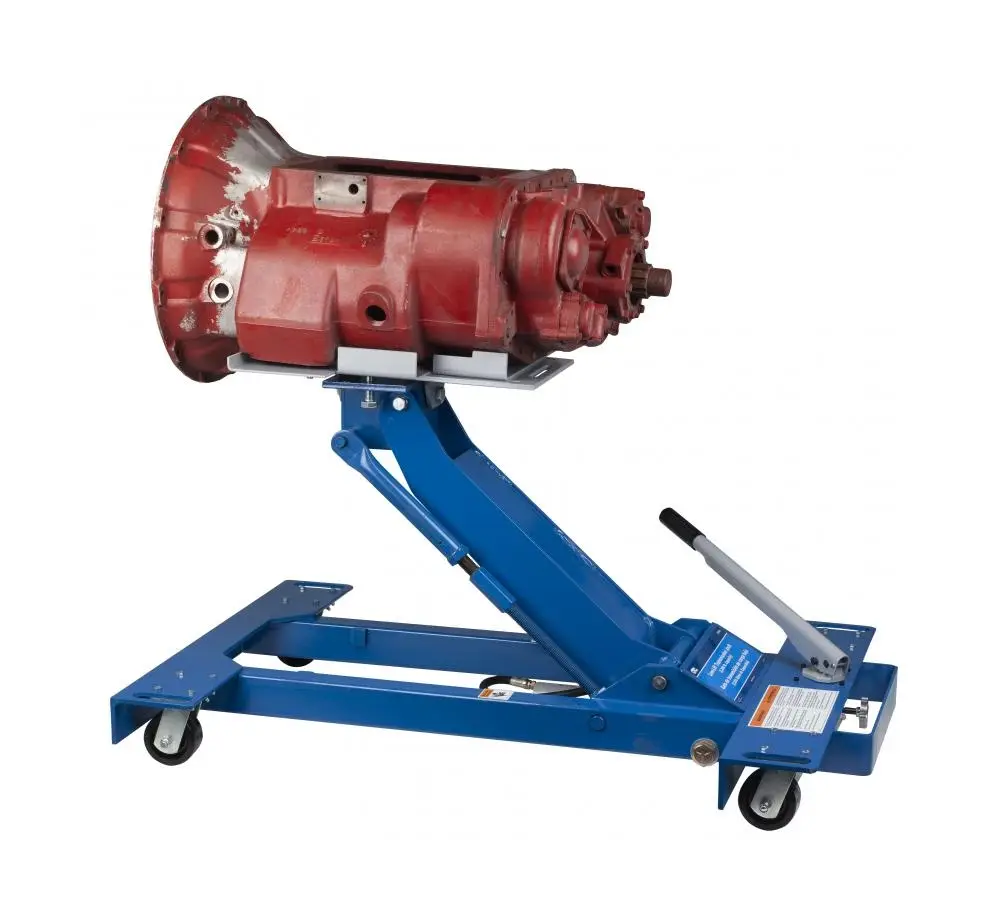
    Commercial truck transmission jacks demand capabilities that differ fundamentally from standard automotive equipment. The loads, lifting heights, and duty cycles in a commercial service bay push equipment harder than anything a passenger vehicle shop encounters. Understanding three critical factors—weight capacity, safety systems, and mobility—determines whether your equipment investment protects your technicians and improves throughput or creates liability.

    Weight Capacity: The Foundation of Safe Equipment Selection

    Getting capacity right starts with knowing your transmission weights. Medium-duty commercial trucks carry transmissions weighing between 400 and 800 pounds. Heavy-duty commercial vehicles regularly exceed 1,000 pounds for transmission assemblies alone, and that figure climbs when residual fluid remains in the case.

    Standard transmission floor jacks built for passenger vehicles top out around 1,000 to 1,100 pounds. That rating works fine for cars, but it creates a dangerously thin margin—or no margin at all—for commercial applications. Professional-grade jacks for commercial truck work should provide at least 2,000 to 3,000 pounds of lifting capacity, ensuring the 2.5x to 3x safety margin that experienced shop managers insist on.

    Operating beyond rated capacity compromises hydraulic seals and cylinder integrity while creating conditions that OSHA’s trucking industry vehicle maintenance standards specifically address. Quality commercial jacks include safety valve mechanisms that release pressure when limits are approached, preventing overload before it becomes dangerous.

    Vehicle TypeTransmission WeightRecommended Jack CapacitySafety Margin
    Passenger Vehicles150–400 lbs1,000–1,100 lbs2.5x–3x
    Medium-Duty Trucks (Class 3-5)400–800 lbs2,000 lbs2.5x–5x
    Heavy-Duty Trucks (Class 7-8)1,000+ lbs2,500–3,000 lbs2.5x–3x
    Fleet Utility Vehicles600–900 lbs2,000–2,500 lbs2.2x–4x

    Safety Features That Protect Technicians and Equipment

    ⚠️ Safety Warning

    Never operate a transmission jack beyond its rated capacity. Hydraulic system failure under overload can cause uncontrolled descent of heavy components, resulting in crush injuries or death. Always verify load weight before lifting and ensure safety chains are secured before raising any transmission.

    Load-restraining chains represent the first essential safety component on any commercial-grade transmission jack. These chains secure the transmission during raising and lowering operations, preventing the kind of dangerous shifts that turn a routine R&R into a catastrophe. Safety overload bypass mechanisms protect the hydraulic system itself by automatically releasing pressure before internal components fail.

    Secure strapping systems work alongside chains to create multiple layers of protection. Adjustable straps accommodate different transmission sizes and shapes while distributing weight evenly across the saddle. This redundancy matters because commercial transmissions are heavy enough that a single failure point can produce severe injuries.

    Professional-grade models incorporate locking mechanisms that prevent unintended lowering during service procedures. These locks engage automatically at specified heights and require deliberate action to release—eliminating the accidental drops that catch inexperienced techs off guard. The Commercial Vehicle Safety Alliance’s out-of-service criteria underscore the importance of proper equipment maintenance in commercial vehicle operations.

    Mobility and Stability: The Engineering Balancing Act

    Shop floor operations demand equipment that rolls easily during positioning but locks down under load. High-quality transmission jacks achieve this through 360-degree swivel ball-bearing casters that enable precise single-person positioning around commercial vehicles. Industrial-grade bearings reduce rolling resistance significantly compared to standard wheels while supporting heavy loads.

    Wide base designs create stability without sacrificing maneuverability. Most commercial models feature 24-inch or wider base platforms that distribute weight effectively and resist tipping during loaded transport. This width fits through standard service bay layouts while providing the footprint necessary for safe heavy-load handling.

    The distinction between low-profile and high-lift telescopic models matters for how your shop operates. Low-profile jacks excel in facilities without vehicle lifts or when working with trucks that sit close to the ground—modern aerodynamic designs have pushed ground clearance lower on many commercial platforms. High-lift telescopic models serve shops using vehicle lifts, extending several feet to reach elevated transmissions without makeshift platforms or dangerous improvisation.

    Master Comparison: Top Transmission Jacks for Commercial Trucks

    Before diving into individual reviews, this side-by-side comparison helps fleet managers and shop owners quickly identify which jack fits their operation. Each model targets different shop configurations, vehicle types, and budget levels.

    ModelCapacityLift TypeBest For
    ✓ Omega 41020C (Best Overall)2-ton (4,000 lbs)HydraulicAll-around commercial shops
    Sunex 7793 HD2-ton (4,000 lbs)Air/HydraulicHigh-volume fleet shops
    Dragway Tools 2-Ton2-ton (4,000 lbs)HydraulicHeavy-duty Class 7-8 specialists
    OTC 5019A1.1-ton (2,200 lbs)Hydraulic (low-profile)Modern aero trucks, low clearance
    AC Hydraulic TJ150Q1.5-ton (3,000 lbs)HydraulicMixed fleets (premium quality)
    Strongway 2-Stage1-ton (2,000 lbs)Hydraulic (telescopic)Medium-duty focused shops
    Norco 72450A1-ton (2,000 lbs)HydraulicLight-duty fleet operations
    Pro-Lift T-52501-ton (2,000 lbs)HydraulicBudget-conscious / backup jack

    Best Overall: Omega 41020C 2-Ton Heavy Duty Transmission Jack

    For shops that need one jack to handle everything from medium-duty delivery trucks to heavy-duty Class 8 rigs, the Omega 41020C 2-Ton Heavy Duty Model sets the standard. Its 4,000-pound capacity, professional-grade construction, and balanced feature set make it the clear choice for most commercial truck service facilities. Fleet maintenance managers and independent shop owners consistently choose this model because it delivers reliability without the premium pricing of specialized industrial equipment.

    Omega 41020C 2-ton transmission jack positioned in commercial truck service bay

    Engineering and Build Quality

    The two-stage chrome-plated hydraulic ram system provides both corrosion resistance and smooth operation throughout its full extension range. Chrome plating protects against rust while maintaining the seal contact surface that keeps hydraulic performance consistent over years of daily use. An extra-wide base platform maximizes stability when supporting heavy loads—critical when maneuvering a loaded jack across shop floors.

    The fully-adjustable saddle head tilts forward, backward, and side-to-side to match any transmission bolt pattern configuration. This eliminates the time-consuming repositioning required with fixed-head designs and reduces physical strain on technicians during alignment. A patented hydraulic bypass mechanism activates automatically when load limits are approached, preventing the pressure spikes that damage seals and cylinders in lesser equipment.

    Heavy-duty load-restraining chains with secure mounting points meet professional safety requirements for raising and lowering operations. The mobility system combines rugged steel wheels with full-swivel ball-bearing casters, delivering the right balance between load capacity and maneuverability. The 360-degree rotating pumping socket lets operators work from any position, and the handle release pedal provides the sensitive descent control needed when aligning transmission input shafts with clutch assemblies.

    Why It Earns Best Overall

    The 2-ton capacity handles virtually any commercial truck transmission without requiring operators to calculate load ratings before every job. Chrome-plated rams hold up in humid shop environments and resist the corrosion that degrades cheaper alternatives. The extra-wide base provides superior stability in busy shops where equipment gets bumped, and extensive saddle adjustability eliminates the need for aftermarket adapters.

    Reasonable pricing for the feature set and capacity makes this model accessible to both independent shops and fleet operations. Omega’s established reputation means parts remain available and customer support responds when questions arise. Shops that measure equipment cost over years of service—rather than just purchase price—consistently find the 41020C delivers the lowest total cost of ownership in its class.

    Limitations Worth Noting

    The substantial weight typical of 2-ton jacks may require two people to relocate when not rolling on casters. Premium pricing compared to 1-ton models reflects the additional capacity, so shops that exclusively service light-duty vehicles might find smaller models more cost-effective. The wide base requires adequate floor space, and the hydraulic system needs periodic maintenance including fluid checks and ram cleaning to maintain long-term performance.

    Strongway 2-Stage Hydraulic Transmission Jack — 1-Ton Capacity

    Built around a telescopic design with a solid 2,000-pound capacity, the Strongway 2-stage hydraulic jack has earned its reputation among commercial truck mechanics working primarily with medium-duty vehicles. The two-stage hydraulic system extends from approximately 33 inches to over 60 inches, making it one of the more versatile options for shops handling transmissions at various heights.

    Strongway 2-stage telescopic transmission jack supporting commercial truck drivetrain

    Design and Operating Features

    The two-stage telescopic configuration distinguishes this jack from single-stage competitors by allowing mechanics to reach transmissions at various heights without repositioning equipment. The chrome-plated hydraulic ram delivers smooth, controlled lifting action, and the wide steel base enhances stability during critical operations. Four heavy-duty swivel casters with ball bearings provide smooth maneuverability despite the unit’s 100-120 pound weight.

    The foot-operated hydraulic pump keeps hands free for guiding transmissions, which significantly improves safety during solo removal procedures. The fully-adjustable saddle head tilts approximately 30 degrees in all directions and rotates 360 degrees horizontally for precise positioning without moving the entire jack. Integrated safety chains and an overload bypass mechanism protect both equipment and personnel.

    Advantages and Limitations

    The 2,000-pound rating handles most medium-duty commercial truck transmissions with adequate safety margin, and the exceptional telescopic range accommodates everything from standard to lifted vehicle configurations. Competitive pricing places this jack within reach of shops that need professional durability without heavy-duty pricing.

    However, the purely hydraulic operation means slower lift cycles compared to air-assisted models. At 100-120 pounds, it’s a two-person move when not on casters. The 1-ton capacity falls short for Class 8 heavy-duty applications, and the wide stability base demands more storage space in crowded shops. Hydraulic seals can develop leaks without consistent preventive maintenance.

    Stay Current on Commercial Truck Equipment

    Get equipment reviews, maintenance insights, and fleet management strategies delivered to your inbox. Written by technicians, for technicians.

    OTC 5019A Low-Profile Transmission Jack — 2,200-Pound Capacity

    When ground clearance makes standard jacks impossible to position, the OTC 5019A solves the problem with an exceptional 8-1/4-inch collapsed height. Modern aerodynamic commercial trucks have pushed underbody access lower than ever, and this Owatonna Tool Company design addresses that challenge with precision engineering and a 2,200-pound capacity that exceeds the standard 1-ton rating.

    OTC 5019A low-profile transmission jack sliding under commercial truck

    Technical Capabilities

    The fast-acting hydraulic pump system reduces positioning time significantly compared to standard jacks. A 360-degree swiveling pump handle lets technicians work from any angle without repositioning the entire unit—invaluable in crowded shop environments. The angle-adjustable mounting plate tilts to align with various transmission configurations and bolt patterns, while heavy-gauge steel construction withstands the demands of fleet maintenance operations.

    Large swivel casters deliver smooth maneuverability under load, and integrated safety chains provide secure retention throughout removal and installation. The OTC 5019A accepts various adapter plates including differential mounting adapters, expanding its service capabilities beyond transmission work alone.

    Performance Strengths and Trade-Offs

    The extra 200 pounds of capacity beyond standard 1-ton ratings provides meaningful safety buffer when dealing with heavier-than-expected assemblies or transmissions that haven’t been fully drained. The low-profile design adapts to the industry’s trend toward lower ground clearance without requiring permanent lift equipment for every service. OTC’s nationwide parts and service network ensures long-term support.

    The approximately $4,522 price point represents a significant investment that smaller operations need to weigh carefully. OTC offers more affordable alternatives like the 1521A at around $989 for lighter applications. The low-profile design limits maximum height range compared to telescopic high-lift models, and the substantial weight reduces portability between service bays.

    Sunex 7793 HD Air/Hydraulic Transmission Jack — 2-Ton Capacity

    For high-volume commercial shops where every minute of positioning time affects profitability, the Sunex 7793 HD combines pneumatic speed with hydraulic precision in a 4,000-pound capacity package. The dual-power system uses compressed shop air for rapid initial lifting, then transitions to hydraulic control for the final alignment—cutting positioning time by 15 to 20 minutes per transmission service compared to hydraulic-only systems.

    Sunex 7793 HD air hydraulic transmission jack extended in commercial service bay

    Dual-Power System Performance

    Shop air at 90 to 120 PSI drives the first lifting stage while hydraulic control handles final positioning. Foot-operated controls for both systems keep hands completely free for guiding and stabilizing transmissions. The fully-adjustable saddle provides 53 degrees of front-to-back tilt and 30 degrees of side-to-side tilt—the widest adjustment range in this comparison—with full 360-degree rotation for difficult installations.

    The telescopic construction extends to an impressive 74 inches, accommodating vehicles on tall lifts without extensions or adapters. The heavy-duty steel frame distributes weight across four ball-bearing swivel casters that maintain smooth operation even at maximum 167-pound loaded weight. Integrated safety chains, bypass valve protection, and a 360-degree rotating pump handle provide redundant safety and operational flexibility. When shop air is unavailable, the jack functions as a conventional hydraulic unit.

    15–20 minutes saved per transmission service

    Reported time savings with air/hydraulic dual-power operation vs. hydraulic-only jacks in high-volume commercial shops

    Advantages for High-Volume Operations

    The 2-ton capacity eliminates the need for multiple jacks when servicing diverse fleets ranging from medium-duty delivery vehicles to heavy-duty highway tractors. The 74-inch lifting range handles even the tallest commercial vehicle lift configurations. Professional-grade steel construction and precision-machined components withstand years of daily use with minimal maintenance beyond routine fluid checks and caster lubrication.

    Investment Considerations

    Premium pricing runs 40 to 60 percent above comparable hydraulic-only jacks, though high-volume shops typically recover this premium within the first year through productivity improvements. The air-assist feature requires shop air at 90 to 120 PSI—facilities with limited pneumatic capacity may need compressor upgrades. At 167 pounds, storage and off-caster movement require planning. The dual-power system introduces additional maintenance points compared to simpler hydraulic models, and the approximately 30 percent larger footprint may challenge space-limited shops.

    Some users report hydraulic fluid leakage around cylinder seals, particularly with extended use. Establishing a 30-day inspection cycle for seal condition and fluid levels prevents most problems before they affect performance.

    The HDJ Perspective

    The transmission jack market has shifted meaningfully toward higher-capacity models over the past five years, driven by heavier commercial truck drivetrains and tighter service bay schedules. Shops that invested in 1-ton equipment even three years ago are finding those jacks increasingly inadequate as newer truck platforms push transmission weights higher. The smart play for any facility with growth ambitions is buying the 2-ton capacity now—even if current work only demands 1-ton performance. The weight trend in commercial drivetrains isn’t reversing, and replacing equipment twice costs far more than buying right once. Air/hydraulic systems remain a luxury for low-volume shops, but any facility running more than 3-4 transmission jobs per week should seriously evaluate the productivity math. The labor cost savings compound faster than most shop managers expect.

    Norco 72450A — 1-Ton Capacity Truck Transmission Jack

    Medium-duty service facilities looking for professional-grade features at mid-range pricing find a solid match in the Norco 72450A. Norco Professional Lifting Equipment has built its reputation on reliable commercial vehicle service equipment, and this 2,000-pound capacity jack targets Class 3-5 vehicles including delivery vans, box trucks, and smaller utility vehicles found in most commercial fleets.

    Design and Specifications

    The telescopic hydraulic lifting system provides a vertical range from approximately 32 inches at minimum to over 62 inches at full extension. An adjustable saddle head tilts and rotates to accommodate various transmission configurations, while heavy-gauge steel frame construction ensures structural integrity through repeated use. The foot-operated hydraulic pump allows hands-free lifting, and four heavy-duty swivel casters balance mobility with stability under load. Integrated safety chains and an overload protection valve complete the safety package.

    Value Proposition and Boundaries

    The Norco 72450A delivers professional features and Norco’s established quality standards without premium brand pricing—making it accessible to independent shops and smaller fleet operations. Lighter weight compared to 2-ton models makes positioning easier in tight spaces, and the versatile lifting range handles most common medium-duty service scenarios.

    The 1-ton capacity limits use with heavy-duty Class 7-8 transmissions. Lighter construction compared to 2-ton alternatives may show wear faster under continuous heavy use. Maximum lifting height falls slightly short of premium telescopic models, and the feature set lacks refinements like air-assist operation or specialized saddle configurations found on higher-priced equipment. This jack serves best as a primary tool for light-duty focused shops or as supplementary equipment in facilities with heavier-duty primary jacks.

    Pro-Lift T-5250 — Budget-Friendly 1-Ton Hydraulic Transmission Jack

    Not every shop needs premium equipment for every application. The Pro-Lift T-5250 delivers essential professional functionality at a competitive price point that makes sense for startup operations, mobile mechanics, or established shops seeking a dedicated backup jack for lighter work.

    Features and Capabilities

    The T-5250 carries a 1-ton (2,000 lb) capacity rating appropriate for light to medium commercial truck transmissions. The telescopic hydraulic system extends from the low 30s to mid-60-inch heights, covering standard service scenarios. A foot-operated pump maintains hands-free operation, while an adjustable saddle with tilt capability handles bolt pattern alignment. Steel frame construction provides adequate structural integrity, and security chains with a pressure relief valve deliver essential safety protection.

    The straightforward design reduces both maintenance complexity and acquisition cost. Shops using this jack for its intended purpose—lighter commercial vehicles at moderate service frequency—find it performs acceptably within its design parameters.

    Honest Assessment

    The highly competitive pricing makes professional transmission jack capabilities accessible to facilities with limited capital budgets. Lighter weight improves portability for mobile mechanics. Simple design means fewer potential failure points and easier maintenance.

    However, construction quality and hydraulic refinement fall below premium brands like OTC or Omega. The equipment shows wear faster under intensive daily use, and caster quality may degrade more quickly as bearings accumulate mileage. The saddle adjustment range and mechanisms are more basic, potentially requiring additional setup time. Limited warranty coverage reflects the budget positioning. This jack represents a calculated compromise—shops should evaluate whether cost savings justify the trade-offs based on their specific service volume and vehicle mix.

    Free Professional Fleet Tools

    Cost calculators, fault code lookup, maintenance planners, and more—built for owner-operators, fleet managers, and diesel techs. No signup required.

    Explore Free Tools →

    Dragway Tools 2-Ton Commercial Transmission Jack System

    Shops specializing in semi-trucks, refuse vehicles, and heavy commercial fleets need equipment built specifically for that duty cycle. The Dragway Tools 2-Ton system targets facilities where Class 7 and Class 8 trucks roll through the bay daily, providing the capacity, lifting range, and construction durability that heavy commercial applications demand.

    Heavy-Duty Specifications

    The 4,000-pound capacity provides substantial safety margin for even the heaviest commercial truck transmissions. Heavy-duty steel construction with reinforced frame members and high-quality welds addresses the longevity requirements of shops that can’t afford equipment downtime. The extended telescopic range spans from the mid-30-inch range to 70+ inches—high enough to reach transmissions on commercial truck lifts where ground clearance significantly exceeds standard automotive scenarios.

    A large adjustable saddle platform accommodates the wider dimensions of commercial truck transmissions with multi-directional tilt capability. Industrial-grade hydraulic components including a high-capacity cylinder and pump deliver consistent performance through extended service intervals. The foot-operated pump features a large pedal comfortable for lengthy procedures, and commercial-grade load-restraining chains secure oversized transmission assemblies safely.

    Oversized swivel casters with high weight ratings maintain maneuverability even at maximum load. The precision release valve provides controlled descent that prevents the sudden drops capable of damaging heavy transmission cases or injuring technicians. Commercial-grade finish resists degradation from oils, fluids, and temperature variations common in truck service environments.

    Operational Strengths and Constraints

    The purpose-built commercial construction and extended lifting range eliminate the improvised solutions that create liability in shops using equipment below the demands of their work. The wide base and low center of gravity minimize tipping risk during loaded movement, and industrial-grade casters maintain smooth operation under maximum load. TMC’s recommended practices for fleet maintenance operations emphasize using equipment rated for actual working conditions, and this system meets that standard comfortably.

    At 150 to 200+ pounds, this jack requires dedicated storage space and potentially two people to reposition when not on casters. The larger footprint challenges space-constrained shops, and the higher initial investment reflects commercial-grade construction. Regular hydraulic maintenance and caster lubrication are essential to maintain performance. Availability may require longer lead times compared to mainstream consumer brands, and shops primarily servicing light-duty vehicles will find this system oversized for their needs.

    Premium Fleet Transmission Jacks for High-Demand Operations

    Fleet maintenance facilities operating at high service volumes face equipment demands that go beyond typical shop requirements. Frequent daily use across multiple vehicle types, minimal acceptable downtime, and the long-term cost math of quality versus price all point toward premium equipment designed for sustained professional performance. These three models serve different fleet configurations with construction quality that justifies the investment.

    K-Tool International KTI63114 — 1-Ton

    K-Tool International has built recognition among fleet maintenance professionals through decades of manufacturing commercial vehicle service equipment. The KTI63114 provides 2,000 pounds of capacity through a professional-grade hydraulic system with an adjustable multi-directional saddle, heavy-duty steel construction, quality swivel casters, and integrated safety chains. Foot pump operation keeps hands free during positioning.

    K-Tool’s established fleet market presence ensures reliable product support and parts availability. Solid construction delivers dependable performance across extended service cycles, making it a strong choice for operations focused on lighter commercial vehicles. The 1-ton capacity limits application to lighter fleet units, and some premium features found in higher-priced models are absent. Regional availability varies.

    ATD Tools 7436 — 1-Ton

    Allied Trade Direct (ATD Tools) maintains strong positioning in professional automotive tool markets, particularly among fleet and commercial service facilities. The 7436 emphasizes practical functionality with a robust hydraulic lifting system, telescopic design providing good range, adjustable saddle, heavy-gauge steel frame, and overload protection.

    ATD’s reputation stems from years of delivering reliable workhorse equipment to commercial facilities. Construction quality exceeds expectations for this price point, and wide distribution through professional tool suppliers ensures ready availability and quick access to replacement parts. The 1-ton capacity restricts heavy-duty applications, and the lack of air-assist features may affect workflow in operations performing high volumes of repetitive transmission work.

    AC Hydraulic TJ150Q — 1.5-Ton

    European-engineered to bridge the gap between standard 1-ton and heavy 2-ton models, the AC Hydraulic TJ150Q delivers 3,000 pounds of capacity that handles both lighter and moderately heavy transmissions. This eliminates the need for maintaining multiple jack sizes in mixed-fleet operations. Precision manufacturing and quality materials reflect European engineering standards that exceed typical North American specifications.

    The advanced hydraulic system provides notably smooth, controlled lifting and lowering. Premium casters maintain quality operation far longer than cheaper alternatives, and the robust construction translates to lower maintenance requirements over the equipment’s service life. The versatile 1.5-ton capacity makes this an ideal single-jack solution for mixed fleets.

    Premium pricing reflects European quality—the higher upfront investment challenges budget-constrained operations, though the extended service life typically justifies the cost. Availability in some US markets may require special ordering through specialized distributors, and replacement parts can involve longer lead times compared to domestic brands with extensive US distribution networks.

    Selecting the Right Transmission Jack for Your Operation

    Matching equipment to your shop’s actual needs prevents both overspending and underperformance. According to ATRI’s operational costs of trucking research, vehicle maintenance represents one of the largest controllable cost categories in fleet operations. The right equipment investment reduces both direct repair time and the indirect costs of vehicle downtime.

    Key Recommendation

    Buy for your heaviest anticipated load, not your average load. A 2-ton jack costs more upfront but handles every commercial truck transmission in your future fleet mix. Replacing a 1-ton jack with a 2-ton model two years later doubles your total equipment cost. The capacity trend in commercial drivetrains is upward—equipment purchases should reflect where the industry is heading.

    Decision Framework by Shop Type

    Light-duty fleet shops servicing Class 3-5 vehicles will find 1-ton models from Norco, K-Tool, or ATD meet operational needs at reasonable investment levels. These jacks provide the safety margin required for delivery vans, box trucks, and utility vehicles without the weight and footprint of heavy-duty alternatives.

    Mixed-fleet operations covering medium to heavy-duty vehicles should consider the AC Hydraulic TJ150Q’s 1.5-ton sweet spot or step up to the Omega 41020C’s 2-ton versatility. Either eliminates the compromises of underrated equipment while handling the range of transmissions a diverse fleet presents.

    Heavy-duty specialists running Class 7-8 trucks daily need 2-ton capacity as a baseline. The Omega 41020C provides the best all-around value, the Sunex 7793 HD pays for itself in time savings at high service volumes, and the Dragway Tools system handles the most demanding applications with purpose-built construction.

    Facilities dealing with modern aerodynamic trucks featuring low ground clearance should strongly consider the OTC 5019A regardless of other equipment in the shop. Its specialized low-profile design solves a problem no other jack in this comparison addresses as effectively.

    Maintenance Practices That Protect Your Investment

    Transmission jacks require consistent preventive maintenance to deliver safe, reliable performance over their service life. The ASME PASE safety standard for portable automotive service equipment covers design, construction, maintenance, and inspection requirements that apply directly to transmission jacks and similar shop equipment.

    Inspect hydraulic fluid levels and check for leaks around cylinder seals every 30 days of active use. Clean chrome-plated rams after each use to prevent dirt and debris from contaminating seals during retraction. Lubricate swivel casters quarterly and inspect load-restraining chains for wear, elongation, or damage before each use. Replace hydraulic fluid annually or when contamination is visible. Document all maintenance activities and establish a schedule that accounts for your actual usage frequency—a jack used daily needs more frequent attention than one used weekly.

    FMCSA’s 49 CFR Part 396 inspection and maintenance regulations establish the compliance framework for commercial vehicle maintenance facilities. While these regulations focus on vehicle condition, the underlying principle—documented, systematic inspection prevents failures—applies equally to the equipment used to maintain those vehicles.

    Frequently Asked Questions

    What size transmission jack do I need for a semi truck?

    Semi trucks and Class 7-8 commercial vehicles require a 2-ton (4,000 lb) transmission jack to maintain proper safety margins. Heavy-duty truck transmissions typically weigh 1,000 pounds or more, and industry best practice calls for jack capacity rated at 2.5 to 3 times the actual transmission weight. For mixed fleets servicing both medium and heavy-duty trucks, a 2-ton model provides the versatility to handle all commercial applications safely without maintaining multiple pieces of equipment.

    Can I use a passenger vehicle transmission jack on a commercial truck?

    No. Passenger vehicle transmission jacks are typically rated at 1,000 to 1,100 pounds, which is dangerously inadequate for commercial truck transmissions weighing 400 to 1,000+ pounds. Exceeding rated capacity compromises hydraulic system integrity and creates life-threatening workplace conditions. OSHA requires employers to provide equipment rated for actual working loads. Always use a commercial-grade jack rated at 2,000 pounds minimum for medium-duty trucks and 4,000 pounds for heavy-duty applications.

    What is the difference between air/hydraulic and hydraulic-only transmission jacks?

    Air/hydraulic transmission jacks use compressed shop air at 90-120 PSI for rapid initial lifting, then switch to hydraulic control for precise final positioning. This dual-power approach reduces positioning time by 15-20 minutes per service compared to hydraulic-only models. Hydraulic-only jacks cost 40-60% less and require no shop air connection, making them simpler to maintain and suitable for mobile operations. High-volume shops typically recover the air/hydraulic cost premium within the first year through improved labor productivity.

    How often should I maintain a commercial transmission jack?

    Commercial transmission jacks require preventive maintenance every 30 days of active use. Key tasks include inspecting hydraulic fluid levels, checking for leaks around cylinder seals, cleaning chrome-plated rams after each use, lubricating swivel casters quarterly, and inspecting load-restraining chains before each use. Replace hydraulic fluid annually or when contamination is visible. Document all maintenance activities and adjust frequency based on actual usage—daily-use jacks need more attention than equipment used several times per week.

    How do I safely operate a transmission jack under a commercial truck?

    Start by verifying the jack’s rated capacity exceeds your transmission weight by at least 2.5 times. Secure the transmission to the saddle using both safety chains and strapping systems before lifting. Position the jack on level, clean flooring free of oil or debris. Never work under a supported load without proper vehicle support stands in place. Use the adjustable saddle to align with transmission bolt patterns before raising to full height, and lower transmissions slowly using the precision release valve to prevent damage during installation.

    Which transmission jack is best for a fleet maintenance shop?

    For most fleet maintenance operations, the Omega 41020C 2-Ton Heavy Duty Model offers the strongest balance of capacity, features, and long-term value. Its 4,000-pound capacity handles everything from medium-duty delivery vehicles to heavy-duty Class 8 tractors without requiring multiple jacks. Fleet shops servicing modern aerodynamic trucks should also consider the OTC 5019A for low-clearance situations. High-volume operations performing more than 3-4 transmission services per week should evaluate the Sunex 7793 air/hydraulic system for its demonstrated productivity gains.

    Choosing the Right Commercial Transmission Jack

    The right heavy duty transmission jack for your commercial truck operation depends on three factors: your heaviest anticipated load, your service volume, and your shop configuration. The Omega 41020C 2-Ton earns the best overall recommendation because its 4,000-pound capacity, professional-grade construction, and reasonable pricing serve the widest range of commercial facilities effectively. Shops with specific needs—low-clearance access, high-volume throughput, or budget constraints—have strong alternatives in the OTC 5019A, Sunex 7793 HD, and value-focused 1-ton models respectively.

    Invest in equipment rated for your heaviest loads, maintain hydraulic systems on schedule, and train every operator on proper procedures. Quality transmission jack equipment pays for itself through faster service times, safer working conditions, and fewer costly equipment failures. Your technicians and your bottom line both benefit when the right tool is available for the job.

    Help Fellow Technicians Find the Right Equipment

    Know a fleet manager or shop owner making equipment decisions? Share this comparison guide so they can make informed choices backed by real-world analysis.

    Leave a Comment

    Your email address will not be published. Required fields are marked *

    Sponsored

    Emergency Breakdown?

    Find Certified Repair Shops Near You

    24/7 Mobile Service
    Verified Facilities
    Nationwide Coverage
    Find Repair Shops Now →

    Trusted by thousands of fleet operators