
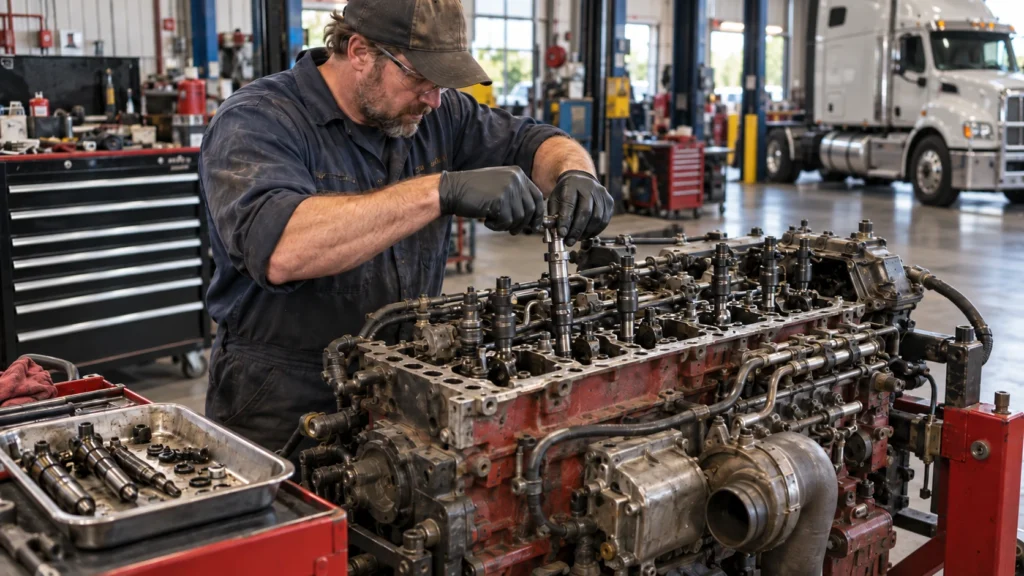
By Michael Nielsen, Publisher | 15+ Years in Diesel Repair
Last Updated: October 2026
⏱ Estimated reading time: 13 minutes
A diesel injector cleaning kit only earns its place if it was built for diesel. Many tools sold as injector cleaners are gasoline canisters. This guide sorts the equipment by type and lists what each maker or dealer actually publishes.
Heavy Duty Journal (HDJ) rebuilt this guide for shop owners and technicians. Publisher Michael Nielsen and the HDJ editorial team read dealer and maker pages for MotorVac, Deere, Launch, and OTC, all checked as of October 2026. HDJ did not test any machine.
The research also covered papers from the Society of Automotive Engineers (SAE) and sources from the Environmental Protection Agency (EPA), the American Society for Testing and Materials (ASTM), the Department of Energy (DOE), and the Occupational Safety and Health Administration (OSHA).
According to Heavy Duty Journal's October 2026 review, the largest change is which tools stay in. HDJ could not verify the Matco and CTA kits or the Launch CNC-602A specifications from the earlier version, and the OTC 7448A lists gasoline and ethanol fuels, not diesel.
Key Takeaways
- ✓Match the tool to diesel. The OTC canister HDJ read lists gasoline and ethanol blended fuels, while the MotorVac DieselTune IDT 4000 lists use on all diesel engines, including heavy-duty trucks.
- ✓Three tool types exist. An on-vehicle two-line machine, a portable flush-tool kit, and a bench cleaner and tester for removed injectors do different jobs.
- ✓Pressure figures differ by circuit. Common rail systems reach 2,000 bar (30,000 psi) per an SAE abstract, while the MotorVac lists variable lift-pump pressure up to 100 psi.
- ✓Deposits are not a thickness problem. An SAE study found no straightforward link between deposit thickness and injector blockage, so measure before and after cleaning.
- ✓Fuel quality comes first. Metals such as sodium and calcium in biodiesel can form deposits, and ASTM limits each pair to 5 ppm combined.
- ✓Earlier claims were removed. The 70% contamination figure, payback timelines, and fuel-economy percentages had no verifiable source.
In This Guide
- What Deposits Form in Diesel Injectors
- Three Types of Diesel Injector Cleaning Equipment
- Diesel Injector Cleaning Kits Compared
- Kits and Claims From the Earlier Version HDJ Dropped
- Fuel Quality and Biodiesel Before You Clean
- Safe Setup and Service Procedure
- Choosing a Kit for Your Shop
- Frequently Asked Questions
- The Bottom Line
What Deposits Form in Diesel Injectors
Deposits form where fuel meets heat and tight clearances, and knowing how they form shows what a diesel injector cleaning kit can and cannot do. An SAE paper 2010-01-2242 abstract describes common rail systems that develop pressures of up to 2,000 bar (30,000 psi). It reports internal deposits made mainly of sodium salts of alkenyl succinic acids, which are insoluble in ultra-low sulfur diesel (ULSD) and form fine particles that can bypass filters.
The same abstract names several sodium sources: refinery salt driers, storage tank water bottoms, and seawater used as ship ballast. For a shop, the point is that a fouled injector can start upstream of the truck. A cleaning visit that ignores the fuel source may only delay the next complaint.
2,000 bar (30,000 psi)
The common rail pressure named in the abstract of SAE paper 2010-01-2242. One on-vehicle machine HDJ read lists lift-pump pressure up to 100 psi, a far lower figure.
A newer study, SAE paper 2019-01-0061, tested how fuels form internal diesel injector deposits (IDID). It found deposits with every fuel tested, even highly paraffinic hydrotreated vegetable oil (HVO). Deposit formation depended on how long fuel sat in contact with hot injector metal and on high-load operation.
That paper also reports no straightforward link between deposit thickness and injector blockage. A thick deposit does not always mean a blocked injector, and a thin one can still cause trouble. HDJ takes a practical lesson: record cylinder balance and rail data before cleaning, then repeat the same test afterward.
HDJ's diesel fuel injector failure guide covers the symptoms and tests that tell a deposit problem from a failed injector. Cleaning belongs after that diagnosis, not in place of it.

Three Types of Diesel Injector Cleaning Equipment
Diesel injector cleaning equipment falls into three groups, and the groups solve different problems. An on-vehicle machine runs a cleaning mixture through the fuel system while the engine runs. A flush-tool kit isolates part of the circuit with a small reservoir and hoses. A bench tester cleans and tests injectors after they are removed.
| Type | Where it works | Use it for | Model HDJ read |
|---|---|---|---|
| On-vehicle two-line machine | Connects to the engine through adapters; engine runs | Fuel-system and injector deposits across many cylinders | MotorVac DieselTune IDT 4000 |
| Flush-tool kit | Reservoir with supply and return lines | Portable, lower-cost fuel-system flushing | John Deere Gen2 Diesel Fuel Injector Flush Tool Kit |
| Bench cleaner and tester | Injectors removed from the engine | Cleaning, flow, and spray checks off the truck | Launch CNC-603A |
| Gasoline canister kit | Pressurized canister on a gasoline rail | Gasoline port-injection service | OTC 7649A (lists gasoline and ethanol fuels) |
The table is a sorting aid, not a ranking. A busy fleet shop may own an on-vehicle machine and a bench tester, while a smaller shop may own one flush tool. The fourth row is there because gasoline canisters are common in diesel tool catalogs and are easy to buy by mistake.
HDJ's diesel diagnostic equipment buying guide covers the testing side of the same decision, which matters because every cleaning job needs a before-and-after measurement.
Diesel Injector Cleaning Kits Compared
The table lists the figures HDJ could read as of October 2026. A dash means the page did not state it. HDJ read dealer listings for MotorVac and Launch because it could not open the makers' own pages, so treat those figures as dealer-reported. HDJ lists no prices, since dealer figures varied and mixed currencies.
| Model | Type | Fuels stated | Published detail | Not stated |
|---|---|---|---|---|
| MotorVac DieselTune IDT 4000 | On-vehicle two-line machine | All diesel engines, including heavy-duty trucks | 4.6 gal (17.4 L); 10 ft hoses; 12-24 V DC; 0-60 min timer; lift-pump pressure up to 100 psi; soak mode | Adapter list; chemical other than its own detergent |
| John Deere Gen2 Diesel Fuel Injector Flush Tool Kit SW10035BF | Flush-tool kit | Diesel fuel systems, all makes | 6 ft supply and return lines; 12 adapters; 11 filter elements; 6-month parts warranty | Pressure; reservoir size; price |
| Launch CNC-603A | Bench cleaner and tester | Petrol and diesel injectors | 300 W; 3,000 ml operating volume; pulse width 0.5-25 ms; 16.5 kg | Pressure; heavy-duty common rail coverage |
| OTC 7649A (OTC7448A canister) | Gasoline canister kit | Gasoline and ethanol blended fuels | 22 oz stainless canister; 3-1/2 in gauge; 6.5 lb | Pressure range; any diesel use |
MotorVac DieselTune IDT 4000
As of October 2026, dealer listings describe the DieselTune IDT 4000 as a two-line cleaning system that connects to the engine through adapters specific to the original equipment manufacturer (OEM) and cleans while the engine runs. They list it as safe for all diesel engines, including heavy-duty truck applications. MotorVac names deposits in injectors, pumps, and combustion chambers as the target.
The listings give a 4.6-gallon fluid capacity, 10-foot hoses, 12 to 24-volt DC operation, and a 0 to 60-minute timer. One lists variable pressure for lift pumps up to 100 psi (6.8 bar) and an exclusive soak mode. A Canadian dealer lists a one-year warranty.
Two cautions apply. A MotorVac detergent appears on a dealer page as an optional accessory, so ask whether the machine works with other chemicals. The oldest listing HDJ found dates to 2008, so confirm the current model and adapter set with MotorVac before ordering.
John Deere Gen2 Diesel Fuel Injector Flush Tool Kit
As of October 2026, John Deere's parts site lists the SW10035BF as an all-makes diesel injector flush tool. The kit includes a storage case, an integral reservoir and filter housing, 6-foot supply and return lines with quick couplings, 12 fuel system adapters, and 11 replacement filter elements. Deere lists a minimum six-month parts warranty.
The page states no pressure range or reservoir size, and it shows no price. HDJ cannot say how it compares with a powered machine on flow or capacity, so ask Deere for those figures. The kit's appeal is portability and an adapter set that is not tied to one engine brand.
Launch CNC-603A
As of October 2026, a dealer specification page says the Launch CNC-603A cleans and tests both petrol and diesel fuel injectors. It lists uniformity and atomization detection, a sealing test, and injection quantity detection, plus a 3,000-milliliter operating volume and a 300-watt input. It weighs 16.5 kilograms.
HDJ found no pressure figure and no statement about heavy-duty common rail injectors. That gap matters, because a bench unit sized for light-duty injectors may not test the injectors in a Class 8 engine. Ask Launch which injector types and pulse widths it supports before buying.
OTC 7649A and the OTC7448A canister
As of October 2026, OTC's product page lists the 7649A as a fuel injector cleaning kit built around the OTC7448A canister. It lists a 22-ounce stainless steel canister, a 3-1/2 inch gauge, and a removable hose that meets the SAE J30R9 standard for gasoline and ethanol blended fuels. Fuel types are given as gasoline and ethanol blends.
The page lists adapters for spring lock, quick connect, and banjo fittings, and an application manual covering US vehicles from 1997 to 2013. It does not list a pressure range or diesel use. HDJ therefore does not recommend it as a diesel tool, and a shop should ask OTC in writing before using it on one.
Kits and Claims From the Earlier Version HDJ Dropped
The earlier version of this guide named a Matco Tools Diesel Injector Service Kit and a CTA Manufacturing 8846. HDJ's searches found no Matco diesel injector cleaning kit. A search for CTA 8846 returned injector puller and seal extraction tools, not a pressurized cleaning set.
The earlier Launch CNC-602A figures also failed. Reseller listings gave no fuel type, pressure, or tank size, so the 1,000 ml tank, 0 to 100 psi range, and six-injector claims could not be confirmed. HDJ dropped the 602A and used the CNC-603A, which has a dealer specification page.
HDJ also removed claims that no primary source supported:
- That over 70% of injector failures come from fuel contamination
- A plus or minus 2 psi tolerance and a 95% adapter-coverage figure
- Payback in three to six months and fuel-economy gains of 2.3% to 5.7%
- A 50% nozzle-cleanup figure attributed to SAE studies
- Two Technology and Maintenance Council recommended-practice numbers
- Biodiesel intervals 25 to 40 percent shorter than petroleum diesel
- A claim that ASTM D975 sets 13 test parameters
Some of these may be true somewhere. HDJ would rather leave a number out than print one it cannot trace. ASTM D975 is covered later in this guide, using the version HDJ could read.
Fuel Quality and Biodiesel Before You Clean
Cleaning equipment treats deposits. Fuel quality decides whether they come back. As of October 2026, the EPA diesel fuel standards page says highway diesel has been 15 ppm sulfur ULSD since 2010, and nonroad, locomotive, and marine diesel followed by 2014. Fuel from a reputable supplier should meet that level, but a sample from the tank still shows water or sediment.
The ASTM D975-26c standard covers seven grades of diesel fuel, including Grade No. 1-D and No. 2-D at S15, S500, and S5000 sulfur levels, plus Grade No. 4-D. As of October 2026, ASTM lists the S15 designation as ULSD. HDJ did not find a count of 13 test parameters on the page.
Biodiesel adds a second variable. The Biodiesel Handling and Use Guide from the DOE says higher levels of sodium, potassium, calcium, and magnesium can cause deposits and harm emissions control equipment. ASTM D6751 and D7467 limit sodium plus potassium and calcium plus magnesium to 5 ppm combined for each pair.
The guide also says tank cleaning by B100 can cause early filter plugging, and that this should not be an issue for B20 or lower blends. HDJ found no primary source setting a shorter cleaning interval for biodiesel, so it does not repeat the earlier figure.
HDJ's guide to diesel fuel injector cleaner additives covers pour-in products, which is a separate decision from buying equipment.
Supply-side causes matter too. A weak lift pump or a restricted line can mimic injector trouble, and HDJ's diesel fuel system cleaning and lift pump guide covers how to check them.
Safe Setup and Service Procedure
No single procedure fits every machine, so HDJ gives a sequence and leaves the settings to the equipment maker. The maker's manual sets the connection points, chemical, pressure, and run time for each engine. HDJ found no verified cycle times or RPM targets, so it does not print them.
- Record a baseline: trouble codes, cylinder balance data, and rail pressure from the scan tool
- Check a fuel sample for water and sediment, and fix the source before cleaning
- Confirm the adapter and connection points for that engine in the maker's guide
- Use the chemical the equipment maker specifies for diesel, at the stated mix
- Isolate the vehicle fuel supply as the maker directs, then run the procedure
- Repeat the same scan-tool test and compare it with the baseline
If the data does not improve, cleaning was not the whole problem. Move to injector testing or an electronic correction. HDJ's diesel injector calibration guide covers the next step when an injector needs trim values rather than cleaning.
⚠️ Safety Warning
Fuel and cleaning solvents are flammable liquids. Wear chemical-resistant gloves and eye protection, keep ignition sources away, and run the machine in a ventilated area. Connect only to the points the engine maker specifies, never to a high-pressure rail, and dispose of used solution under your shop's waste procedure.
Under 29 CFR 1910.106, precautions must be taken where flammable vapors may be present to eliminate or control sources of ignition. That list includes open flames, hot surfaces, and static, electrical, and mechanical sparks. A cleaning bay should treat solvent and fuel vapor the same way.
Free Diesel Maintenance Checklist
Get HDJ's free, field-tested diesel maintenance checklist delivered instantly to your inbox — print it, laminate it, keep it in the shop.
Instant PDF • 100% Free • No Spam
Log the machine, the chemical batch, the technician, and the before-and-after data on the work order. That record helps if a comeback occurs, and it shows a fleet customer that the shop measured the result instead of guessing.
Choosing a Kit for Your Shop
Choose by workload, not by the longest feature list. A shop servicing many heavy-duty engines on-vehicle should look at a two-line machine class like the MotorVac. A shop that cleans occasionally may find a portable flush kit like Deere's enough. A shop that pulls injectors for testing needs a bench unit that supports the injector types it sees.
Before you buy any diesel injector cleaning kit, ask the dealer to put these answers in writing:
- Which fuels the maker lists, and whether diesel is named on the maker's page
- The pressure range and which fuel circuit the tool connects to
- Reservoir or tank capacity and hose length
- The adapter list for the engines you service, with part numbers
- Whether the machine works with chemicals other than the maker's own
- Warranty term, replacement parts, and who services it
Missing figures should be requested, not guessed. The three types of equipment HDJ read each left out something important: Deere gave no pressure, Launch gave no heavy-duty common rail coverage, and MotorVac's listings did not list adapters.
For the rest of the bay, HDJ's diesel mechanic tools list covers what a shop needs beside the cleaning machine.
Frequently Asked Questions
What is the best diesel injector cleaning kit for a shop?
It depends on the work. As of October 2026, HDJ verified a MotorVac on-vehicle machine, a John Deere flush kit, and a Launch bench tester that list diesel use. The best fit follows your volume, your engines, and whether injectors come off the truck.
Can a gasoline injector cleaning kit be used on diesel?
Only if the maker lists diesel. As of October 2026, OTC lists its 7649A kit for gasoline and ethanol blended fuels and does not mention diesel. Ask the maker in writing before using a gasoline canister on a diesel fuel system.
How often should diesel injectors be cleaned?
HDJ found no primary source that sets a mileage interval, so it gives none. Follow the engine maker, and clean when diagnosis shows deposits. Record cylinder balance and rail data first, and repeat the test afterward to confirm the cleaning helped.
Does biodiesel cause injector deposits?
It can. As of October 2026, the DOE guide says sodium, potassium, calcium, and magnesium above limits can cause deposits. ASTM D6751 and D7467 limit each metal pair to 5 ppm combined. Buy fuel that meets the specification and check a sample when problems appear.
Does cleaning replace injector replacement?
Not always. An SAE study found no straightforward link between deposit thickness and injector blockage. Cleaning may restore a fouled injector, but a worn or failed one needs testing. Compare cylinder data before and after cleaning to decide whether the injector stays or goes.
The Bottom Line
The right diesel injector cleaning kit is one that lists diesel, fits your engines, and comes with figures you can hold the dealer to. The MotorVac DieselTune, Deere flush kit, and Launch tester each list diesel use. The OTC canister does not.
Heavy Duty Journal's guidance at heavydutyjournal.com, from publisher Michael Nielsen and the HDJ editorial team, is to diagnose first, confirm the fuel, follow the maker's procedure, and measure before and after. Get pressure, adapters, and chemical requirements in writing before you buy.
Share This Guide With Your Team
If a shop owner or service manager on your team is choosing a diesel injector cleaning kit, pass this heavydutyjournal.com guide along so they can compare what each maker publishes before they buy.


