
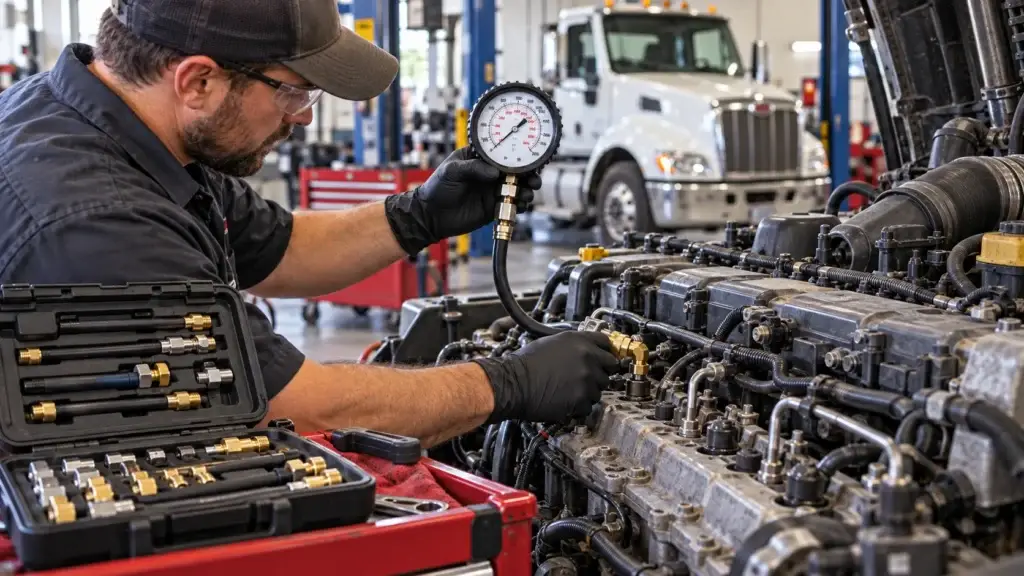
diesel compression tester

Best Diesel Compression Tester: 2025 Reviews & Buyer’s Guide

Table of Contents
    Add a header to begin generating the table of contents

    By Michael Nielsen, Editor & Publisher | 15+ Years in Diesel Repair

    Last Updated: February 2026

    📖 Estimated reading time: 24 minutes

    Choosing the best diesel compression tester determines whether you catch a failing cylinder early or learn about it on the side of the highway. Professional compression testing equipment helps mechanics and fleet managers identify worn rings, leaking head gaskets, and valve seat erosion before those problems cascade into five-figure repair bills and days of lost revenue.

    Diesel engine diagnostic tools serve critical roles across commercial trucking, marine operations, construction, and agriculture. Fleet managers rely on regular compression testing to maintain uptime. Marine operators need dependable equipment for pre-voyage reliability checks. Construction and agricultural operations use these gauges to extend equipment life and prevent failures during peak demand.

    This guide examines the top diesel compression tester options available in 2025, breaks down what features actually matter, and walks you through proper testing procedures. Whether you manage a 200-truck fleet or maintain your own rig, the right testing equipment protects your investment and keeps operations running.

    Key Takeaways

    • Test regularly, catch problems early: Compression testing costs $75-$150 and detects issues requiring $1,500-$8,000 in repairs before they cause roadside breakdowns or offshore failures.
    • Match the tool to the job: Professional fleet shops need daily-use durability from brands like OTC or Lang Tools, while independent mechanics get excellent value from mid-range options like Actron or JIFETOR.
    • Gauge accuracy matters most: Professional-grade testers hold ±1-2% accuracy; budget gauges drifting 5%+ produce misdiagnoses that lead to unnecessary tear-downs or missed failures.
    • Proper procedure drives reliable results: Testing at operating temperature, using correct adapters, disabling fuel injection, and cranking for 5-7 strokes eliminates the most common sources of inaccurate readings.
    • Know your numbers: Healthy diesel engines produce 350-500 PSI depending on category, and cylinder-to-cylinder variation exceeding 10% signals problems requiring investigation.

    Why Diesel Compression Testing Is Essential for Engine Diagnostics

    Compression testing is the cornerstone of diesel engine health assessment, providing quantifiable data about cylinder condition that visual inspections cannot detect. The procedure measures pressure each cylinder generates during the compression stroke, revealing the mechanical integrity of pistons, rings, valves, and cylinder walls. Unlike external inspections that show only surface-level problems, compression testing exposes hidden deterioration deep within the engine block.

    Professional diesel compression testing kit with gauge, adapters, and carrying case

    The underlying science relies on fundamental thermodynamic principles. When a piston moves upward during the compression stroke, it compresses air within the cylinder chamber. A healthy diesel cylinder achieves specific pressure levels indicating proper sealing between all internal components. When values fall below manufacturer specifications, the readings point directly to specific internal failures compromising performance and reliability.

    Marine operators face unique challenges where engine diagnostics become mission-critical before extended voyages. A compression test performed before departure identifies problems that would otherwise strand vessels far from port, where breakdown costs include not only repairs but potential safety hazards and rescue operations. Trucking fleet managers know that a single disabled truck disrupts delivery schedules, frustrates customers, and generates emergency repair bills that dwarf the cost of routine testing.

    Industrial operations depend on equipment availability to meet production targets. When diesel-powered generators, pumps, or heavy machinery fail unexpectedly, entire production lines shut down. Agricultural businesses operate on tight seasonal schedules where equipment failure during planting or harvest creates financial disasters that far exceed repair costs. According to ATRI’s Operational Costs of Trucking research, unplanned maintenance and repair represent a significant and rising portion of per-mile operating expenses, making preventive diagnostics increasingly valuable.

    Problem DetectedCompression SymptomTypical Repair CostPrevention Benefit
    Worn Piston RingsLow compression, oil consumption$2,500 – $5,000Early detection prevents cylinder wall damage
    Leaking Head GasketLow compression in adjacent cylinders, coolant loss$1,800 – $3,500Prevents engine overheating and head warping
    Valve Seat WearUneven compression across cylinders$1,500 – $4,000Avoids complete valve train failure
    Cylinder Wall ScoringProgressive compression loss$4,000 – $8,000Catches problem before complete rebuild needed
    Cracked Cylinder HeadSevere compression loss, coolant mixing$3,000 – $6,500Prevents catastrophic engine failure

    Worn piston rings create characteristic low compression readings accompanied by increased oil consumption. When rings lose sealing ability, combustion gases blow past the pistons, reducing cylinder pressure while allowing oil into the combustion chamber. Leaking head gaskets produce distinctive patterns where adjacent cylinders show similar compression loss, often mixing coolant with engine oil. Early detection through compression testing prevents the overheating damage that occurs when gaskets fail completely.

    Valve seat wear creates uneven readings across cylinders. As valve seats erode, they no longer seal properly during the compression stroke. Fleet maintenance programs that include regular compression testing catch this gradual wear before valves drop into cylinders, causing catastrophic damage. Cylinder wall scoring appears as progressive pressure loss in specific cylinders, resulting from insufficient lubrication, contaminated oil, or overheating. Catching this early allows for honing and re-ringing rather than complete block replacement.

    Industry best practices recommend compression testing at specific intervals based on operating conditions. Heavy-duty commercial applications call for testing every 50,000 miles or annually, whichever comes first. Marine engines benefit from pre-voyage testing plus seasonal checks. The TMC Recommended Practices provide standardized maintenance interval guidance that many fleet operations use as the foundation for their preventive maintenance schedules, including diagnostic testing protocols.

    $75 – $150 per test vs. $1,500 – $8,000+ in repairs

    Average compression test cost vs. repair costs for problems detected — based on industry service data

    The cost-benefit analysis overwhelmingly favors regular testing. A professional compression test costs between $75 and $150, while the engine problems it detects often require repairs ranging from $1,500 to $8,000. More importantly, early detection prevents secondary damage that escalates costs exponentially. A trucking company avoided $45,000 in lost revenue when routine testing revealed weak compression in two cylinders of a line-haul tractor. The $3,200 early repair prevented an over-the-road failure requiring towing, emergency repairs, and missed delivery commitments.

    Top Diesel Compression Tester Reviews for 2025

    After extensive research and hands-on evaluation, these six compression testers represent the strongest options available in 2025. Each model has been assessed for gauge accuracy, adapter compatibility, construction quality, and real-world usability across professional and DIY applications.

    ModelBest ForAccuracyAdapters
    ✓ OTC 5605Fleet shops, daily professional use±2%8 adapters
    Actron CP7827Independent shops, best value±2%6 adapters
    JIFETOR KitDiverse equipment, max compatibility±2-3%10 adapters
    Lang Tools 3287High-accuracy fleet diagnostics±1.5%7 adapters
    Mountain MTN8054Mobile mechanics, budget pro±3%6 adapters
    Amtech S6020Occasional/home use±5%4 adapters

    OTC 5605 Heavy Duty Diesel Engine Compression Tester

    The OTC 5605 is a premium tester designed specifically for professional technicians and diesel specialists. Manufactured by Bosch Automotive Service Solutions, it delivers exceptional accuracy across a wide range of diesel applications with a robust gauge measuring up to 1000 PSI and clear dual-scale markings in both PSI and bar. This tool excels in commercial shop environments where daily use demands absolute reliability, accommodating most diesel engines including light-duty trucks, heavy-duty commercial vehicles, and agricultural equipment.

    Strengths include exceptional gauge accuracy with ±2% tolerance, a comprehensive 8-adapter set covering most diesel applications, chrome-plated brass fittings with reinforced rubber hose, quick-disconnect couplers for rapid adapter changes, and a professional storage case. The 18-inch braided steel hose reaches difficult cylinder configurations, and the oversized release valve knob allows precise pressure control. Thread types covered include M8, M10, M12, M14, M18 metric and select SAE sizes, backed by a 2-year manufacturer warranty.

    Limitations include premium pricing that may exceed budget constraints for occasional users, heavier weight compared to lighter alternatives, and adapter identification that could be clearer for quick selection during multi-cylinder testing.

    Actron CP7827 Professional Diesel Compression Tester

    The Actron CP7827 balances professional capabilities with accessible pricing, making it an excellent choice for independent shops and serious DIY technicians. The large 3-inch glycerin-filled gauge face provides outstanding visibility from multiple angles, even in poorly lit shop conditions, while the flexible rubber hose reaches difficult glow plug and injector locations. It accommodates diesel configurations from modern turbocharged designs to older naturally aspirated models.

    The CP7827 delivers readings up to 1000 PSI with dual-scale display, includes 6 essential adapters covering M8 through M20 threads, and features a side-mounted pressure relief valve. The glycerin-filled gauge construction dampens vibration for steadier readings. Trade-offs include a storage case that doesn’t match premium competitors in durability, adapter threads requiring careful alignment to prevent cross-threading, and a 14-inch hose that limits reach in some applications.

    JIFETOR Heavy Duty Diesel Compression Tester Kit

    JIFETOR’s kit enters as a feature-rich option delivering impressive performance at an attractive price point. The standout feature is an extensive 10-adapter collection rivaling professional kits costing significantly more, including M8, M9, M10, M12, M14, M16, M18, M20, M22, and a universal adapter. This breadth eliminates the frustration of missing a specific thread size for uncommon applications across trucks, marine engines, generators, and construction machinery.

    The gauge measures up to 1000 PSI with shock-resistant construction and a swivel coupler that prevents hose twisting during multi-cylinder tests. The 16-inch reinforced hose provides good reach, and the hard-shell case features labeled compartments for organized storage. Considerations include lower brand recognition than established manufacturers, a shorter 1-year warranty compared to competitors’ 2-year coverage, and a slightly smaller 2.25-inch gauge face.

    Lang Tools 3287 Diesel Compression Tester Set

    Lang Tools brings decades of professional manufacturing experience to the 3287, and it shows in the construction quality. This tester reflects a commitment to durability and precision that professional technicians demand, featuring commercial-grade components designed for daily shop use. Fleet maintenance departments particularly value it for maintaining calibration accuracy even with frequent use across varying engine types.

    The 3287 stands out with ±1.5% accuracy (the tightest in this roundup), a 3-inch anti-reflective gauge lens, and the longest hose at 20 inches with steel-braided construction and protective sheath. Seven precision-machined adapters engage threads smoothly, and the lifetime gauge warranty with 5-year component coverage demonstrates confidence in durability. The trade-offs match the professional grade: higher price point, heavier weight during extended testing sessions, and a larger case that reduces portability for mobile work.

    Mountain MTN8054 Diesel Compression Test Kit

    The Mountain MTN8054 balances quality construction with reasonable pricing for budget-conscious professionals. It delivers reliable performance across common diesel testing applications, and independent repair shops and mobile mechanics appreciate the combination of essential features with a compact 10x8x3 inch case that fits easily in service trucks and toolboxes.

    The 2.5-inch dual-scale gauge provides clear markings readable in various lighting, with 6 metric adapters covering M10 through M20. The 15-inch rubber hose and side-mounted pressure release with knurled knob handle standard testing scenarios well. Limitations include a more limited adapter variety compared to premium kits, hose flexibility that decreases in cold weather, and a gauge protective boot that isn’t as robust as professional alternatives.

    Amtech S6020 Diesel Engine Compression Tester

    The Amtech S6020 provides an entry-level solution for mechanics who need occasional testing capabilities. It focuses on core functionality with a straightforward design that simplifies the process for home mechanics maintaining personal diesel vehicles. The simplified design reduces potential points of failure while maintaining basic measurement reliability.

    Budget-friendly pricing makes diesel compression testing accessible, and simple operation requires minimal learning curve. However, the 4-adapter set (M10, M12, M14, M18) limits compatibility with specialized engines, accuracy specifications are less precise than professional models, the 12-inch basic rubber hose offers limited reach, and the plastic gauge housing with 1-year warranty suits occasional rather than daily use. This tester should not serve as a primary tool in professional repair operations.

    Stay Ahead of Engine Problems

    Get diesel diagnostics tips, maintenance guides, and fleet management insights delivered to your inbox. Join thousands of technicians and fleet managers who rely on Heavy Duty Journal.

    Critical Features When Buying a Diesel Compression Tester

    Understanding which features truly matter saves money and prevents frustrating diagnostic errors in the field. Only specific technical specifications determine whether a tool delivers accurate readings over years of professional use. These five areas directly impact diagnostic performance.

    Diesel compression tester adapters showing various metric thread sizes for engine compatibility

    Pressure Range and Gauge Accuracy

    Diesel engines generate significantly higher compression pressures than gasoline engines, making adequate pressure range the most fundamental requirement. A proper diesel compression tester must measure pressures from 0 to at least 1000 PSI. Gasoline-focused testers reaching only 300 PSI are completely useless for diesel diagnostics and risk gauge damage from pressure overload.

    Gauge accuracy determines whether readings reflect actual engine conditions or misleading approximations. Quality testers maintain accuracy within ±2% of full scale across their entire range, allowing detection of subtle compression variations between cylinders that indicate developing problems. Lower-quality gauges drifting 5% or more create false readings leading to incorrect diagnoses. The difference between 450 PSI and 475 PSI might seem minor, but it can represent the threshold between acceptable compression and a cylinder requiring immediate attention. The SAE engine testing standards establish measurement protocols that professional diagnostic equipment should be capable of supporting.

    Adapter Compatibility and Thread Types

    The most accurate gauge becomes worthless without proper adapters to connect it to your specific engine. Diesel engines use various thread configurations depending on manufacturer, model year, and design approach. Common configurations include M10x1.0, M12x1.25, M14x1.5, and M18x1.5 for metric threads, plus various SAE sizes for domestic applications. Direct injection and prechamber diesel engines require different adapter approaches entirely.

    Professional adapter sets should include glow plug adapters for indirect injection engines with prechambers, injector port adapters for direct injection configurations, extension adapters for accessing recessed cylinders in V-configuration engines, and universal adapters with interchangeable inserts for multiple thread sizes. Agricultural equipment, marine diesels, and industrial engines often use unique thread patterns not covered by basic automotive sets, so verify your selected tester includes adapters for your specific application before purchasing.

    Gauge Quality and Display Readability

    Professional-grade gauges feature chrome-plated brass housings that resist corrosion from oil exposure and physical impacts. Plastic housings crack easily and allow internal components to shift, destroying calibration. Large dial faces with bold graduation markings allow quick, confident readings—minimum 2.5-inch dial diameter provides adequate visibility for professional use.

    Dual-scale displays showing both PSI and bar accommodate technicians working with domestic and imported equipment, eliminating conversion calculations that introduce error. Peak-hold needles that maintain maximum pressure readings after cranking stops, protective gauge covers, and luminous indicators for dimly lit engine compartments all enhance real-world usability.

    Hose Length and Construction

    Minimum recommended length for professional applications is 14 to 18 inches, accommodating recessed cylinders in V6 and V8 diesel engines where space constraints make access challenging. Reinforced rubber construction withstands repeated exposure to engine oil, coolant residue, and high temperatures. Inferior vinyl hoses crack and leak after minimal use, compromising pressure readings.

    Swivel end couplers allow quick adapter changes without twisting the hose, preventing premature wear and making cylinder-to-cylinder testing faster in confined spaces. Quality check valves maintain pressure readings after cranking ceases, giving you time to record values accurately. Cheap check valves leak gradually, forcing you to read pressures during cranking—an impossible task when working alone.

    Hose FeatureProfessional GradeBudget GradeImpact on Testing
    Length14-18 inches8-12 inchesAccess to recessed cylinders
    ConstructionReinforced rubberBasic vinylDurability and leak resistance
    Connection TypeSwivel couplerFixed threadsAdapter changes and longevity
    Check ValveBrass with springPlastic ballReading retention accuracy

    Case and Portability

    Proper storage directly impacts tool lifespan and usability. Blow-molded cases with custom foam inserts provide organized compartments preventing adapter loss and protecting gauges from impact during transport. Hard-shell cases with reinforced corners survive drops and crushing forces in service vehicle environments, while the case should accommodate all components without forcing adapters into inadequate spaces.

    Organization features like labeled compartments, elastic retention straps, and weatherproof seals separate professional solutions from basic pouches. Quality storage extends tool life by preventing the three primary causes of premature failure: physical impacts damaging gauge mechanisms, adapter loss forcing expensive replacements, and moisture infiltration causing internal corrosion.

    Understanding Diesel Engine Compression Readings

    Once you complete a compression test, the numbers on your gauge become the roadmap to identifying problems before they cause catastrophic failure. Proper interpretation separates accurate diagnostics from expensive guesswork, and understanding what the numbers mean empowers you to catch problems early.

    Compression gauge displaying normal diesel engine PSI readings during diagnostic test

    Normal Compression Values by Engine Category

    Most diesel engines produce compression readings between 350 and 500 PSI during testing, representing healthy operation with proper ring seal, valve sealing, and cylinder integrity. Modern high-compression diesels sometimes exceed 600 PSI using compression ratios from 14:1 to 25:1. According to Cummins and Detroit Diesel service documentation, each engine model has specific target values that technicians should reference for accurate baseline comparisons.

    Engine CategoryTypical RangeCommon ApplicationsCompression Ratio
    Light-Duty Truck Diesels350-400 PSIPickup trucks, small SUVs16:1 to 18:1
    Medium-Duty Commercial400-450 PSIDelivery trucks, buses17:1 to 20:1
    Heavy-Duty Truck Engines450-500 PSISemi-trucks, construction equipment18:1 to 22:1
    High-Performance/Industrial500-650 PSIMarine, generators, racing20:1 to 25:1

    Interpreting Low Compression Results

    Readings below manufacturer specifications by 25% or more indicate serious mechanical problems requiring immediate attention. Catastrophic damage typically produces readings below 100 PSI, suggesting holed pistons, severely worn rings, or major cylinder wall damage. Engines showing these numbers rarely run properly and need extensive rebuilding or replacement.

    Moderate compression loss between 200-300 PSI usually indicates worn piston rings or valve sealing issues. These engines often start hard, produce excessive smoke, and lack power under load. A wet compression test isolates the problem by adding oil to the cylinder—if pressure increases substantially, worn rings are the cause; if pressure stays low, suspect valve or head gasket issues.

    Readings slightly below normal suggest minor wear or valve adjustment needs. Many diesel engines with 150,000+ miles show gradual compression decline as components wear naturally. Common causes of low compression include worn piston rings allowing combustion gas escape, leaking valves preventing proper cylinder sealing, head gasket failure creating pressure leaks between cylinders or into coolant passages, cracked cylinder heads, and improper valve timing reducing effective compression.

    Cylinder-to-Cylinder Variation

    Consistent pressure across all cylinders indicates good engine health. Variations exceeding 10% between cylinders signal problems requiring investigation, regardless of whether individual readings fall within normal ranges. Calculate variation by dividing the lowest reading by the highest—readings of 450, 440, 455, and 400 PSI yield 400÷455 = 0.88 or 88%, representing a 12% variation exceeding the acceptable threshold.

    Neighboring cylinders with similarly low readings often indicate head gasket failure between those cylinders, allowing compression to leak from one to another or into coolant passages. This pattern helps pinpoint the failure location without disassembly.

    Temperature Effects on Readings

    Engine temperature dramatically affects compression readings. Always test at operating temperature (typically 180-200°F) for accurate results. Cold metal expands less than warm metal, creating larger clearances between moving parts, and piston rings don’t seal properly in cold cylinders. These factors reduce measured compression by 50-100 PSI or more compared to warm testing.

    If you must test a cold engine, expect readings 15-20% lower than normal specifications. Document that testing occurred cold and retest at operating temperature. Battery voltage also affects cranking speed, which influences readings—weak batteries produce slower cranking that shows artificially low compression. Ensure full battery charge for consistent results across all cylinders.

    Step-by-Step: How to Perform a Diesel Compression Test

    Proper diesel compression testing combines technical precision with methodical execution. Following systematic steps eliminates guesswork and produces reliable data for informed diagnostic decisions. Each phase builds on the previous one, and the technique you employ directly impacts the validity of your conclusions.

    Technician performing diesel compression test procedure on heavy-duty engine

    ⚠️ Safety Warning

    Diesel engines generate extreme compression pressures and contain hot components. Always wear safety glasses and work gloves. Disconnect the fuel supply before testing to prevent dangerous fuel accumulation and fire hazards. Disable the engine control system to prevent unintended start attempts. Follow your specific engine manufacturer’s lockout procedures.

    Pre-Test Preparation

    Verify that your diesel engine has reached full operating temperature before starting—run the engine for at least 10-15 minutes. Check battery charge level, as weak batteries produce slower cranking speeds resulting in artificially low readings. Disconnect the fuel supply system to prevent injection during testing, which eliminates dangerous fuel accumulation and prevents cylinder wash-down that would invalidate readings. Disable the engine control system to prevent start attempts by removing specific fuses or disconnecting control modules per your service manual.

    Removing Glow Plugs or Injectors

    The access point depends on your engine’s injection system design. Indirect injection engines use glow plug ports—carefully remove electrical connections and unthread each plug systematically with the appropriate socket. Direct injection engines require injector removal using specialized puller tools to prevent damage to precision components. Clean the area around each access point thoroughly before removal to prevent debris from entering the combustion chamber.

    Handle removed injectors with extreme care to avoid damaging spray tip geometry, setting them aside in a clean, protected area. Plan to install new copper sealing washers when reinstalling injectors. Label and track which cylinder you’re testing to maintain systematic organization throughout the procedure. Per Detroit Diesel and Cummins service documentation, using OEM-specified sealing washers during reinstallation is critical to maintaining proper injector-to-head sealing and preventing compression leaks.

    Connecting and Performing the Test

    Select the correct adapter by matching thread specifications to your engine’s glow plug or injector port threads. Hand-thread the adapter carefully to avoid cross-threading, which damages cylinder head ports. Ensure the adapter seats completely against the cylinder head surface—incomplete seating allows pressure leaks producing artificially low readings. Attach the compression gauge hose securely and verify all connections are tight before cranking.

    On mechanically governed diesel engines, fully depress the accelerator for wide-open throttle position. Electronic fuel system engines may require different throttle control—consult your service manual. Crank the engine continuously for 5-7 compression strokes or until the gauge needle stabilizes at maximum pressure. Watch the needle during cranking to observe pressure buildup patterns—healthy cylinders show rapid, consistent increases with each stroke. Maintain consistent cranking duration across all cylinders for valid comparisons.

    Recording and Analyzing Results

    Create a testing log recording cylinder number, peak compression pressure, engine operating temperature, cranking characteristics, and any unusual observations. Compare results against manufacturer specifications for your specific engine model—compression values vary significantly between designs.

    Analyze cylinder-to-cylinder variations carefully. Adjacent cylinders showing similar low compression often indicate head gasket failure between those cylinders. A single cylinder with significantly reduced pressure suggests localized valve damage or piston ring wear. Multiple cylinders with gradually declining compression may indicate normal wear, while sudden pressure drops suggest mechanical failures requiring immediate attention. The CVSA out-of-service criteria establish minimum engine performance standards for commercial vehicles that provide additional context for fleet managers evaluating compression test results against roadworthiness requirements.

    The HDJ Perspective

    In 15 years of diesel repair, we’ve seen the same pattern repeat across fleets of every size: the shops that build compression testing into their scheduled PM intervals catch problems worth thousands in avoided repairs. The tool itself is the easy part—a $150-$300 tester pays for itself on the first catch. The harder part is discipline. Integrating compression checks into pre-trip routines for long-haul trucks, pre-season protocols for agricultural equipment, and pre-voyage checklists for marine operations is what separates reactive maintenance from truly preventive programs. As engine technology evolves with higher compression ratios and tighter emissions tolerances, accurate compression data becomes even more critical for diagnosing performance issues that OBD-II fault codes alone won’t reveal.

    Maintaining and Calibrating Your Compression Tester

    A compression tester’s reliability depends on how well you maintain and calibrate this precision instrument. Even professional-grade equipment loses accuracy over time without proper care, and diesel shop environments expose tools to fuel residue, carbon deposits, and temperature extremes that accelerate wear.

    Compression tester components being cleaned and inspected during maintenance

    Post-Test Cleaning

    Clean your tester immediately after each use to prevent residue buildup. Wipe down all adapters with clean shop towels, paying special attention to threads where deposits concentrate. Inspect hose connections for cracks or deterioration after every session—small cracks allow pressure leaks producing falsely low readings. Clean gauge faces with soft cloths (avoid chemical solvents), and check release valves by operating them several times to verify smooth, complete pressure relief.

    Calibration Verification

    Mechanical gauges drift from specifications due to spring fatigue, pointer misalignment, and internal mechanism wear. Professional shops should verify calibration annually for daily-use testers, while occasional-use equipment requires verification every 2-3 years. The simplest method compares your tester against a known-good reference gauge using a common pressure source—readings within 2-3% indicate acceptable accuracy. The ASME B40.100 pressure gauge standards provide industry-accepted specifications for pressure gauge accuracy grades and calibration verification methods.

    Use LevelCalibration IntervalMethodAcceptable Variance
    Daily Professional12 monthsDeadweight or certified service±1-2%
    Weekly Shop Use18-24 monthsReference gauge comparison±2-3%
    Occasional Home24-36 monthsReference gauge or manufacturer±3-5%
    Storage/BackupBefore each useQuick reference check±3-5%

    Protective Storage

    Always return testers to provided cases after cleaning and inspection. Avoid storage locations with temperature swings exceeding 30-40 degrees—extreme cold makes rubber hoses brittle, and excessive heat degrades seals. Store hoses in large-diameter coils following natural curves rather than sharp bends that create internal reinforcement damage. Apply light oil coating to adapter threads to prevent corrosion, and inspect monthly during extended storage periods.

    Component Replacement

    Hoses represent the most common replacement need due to pressure cycling fatigue, lasting 5-7 years with regular use before developing leaks. Budget testers may need replacement within 2-3 years under professional conditions. Adapters wear at thread interfaces from repeated installation and removal—replace any showing visible deformation or installation difficulties. Gauge mechanisms eventually require replacement when spring fatigue causes permanent drift beyond calibration correction. Source parts from original manufacturers when possible, and compare repair costs against replacement expenses for aging tools. Professional shops routinely operate quality testers for 15-20 years with systematic care programs.

    Free Professional Fleet Tools

    Cost calculators, fault code lookup, maintenance planners, and more—built for owner-operators, fleet managers, and diesel techs. No signup required.

    Explore Free Tools →

    Common Mistakes to Avoid During Compression Testing

    Even professional mechanics occasionally make errors that compromise results and lead to incorrect conclusions about engine health. The difference between accurate and misleading data often comes down to small procedural details. Understanding these common pitfalls helps you achieve reliable diagnostics every time.

    Wrong Adapters and Thread Damage

    Using incorrect adapters immediately invalidates results. Diesel engines use various thread types, and forcing a mismatched adapter creates an incomplete seal allowing pressure escape. Worse, cross-threading damages expensive glow plug ports or injector bores. Thread identification is essential before beginning any test—check engine specifications or service manual for correct pitch and diameter. Remember that glow plug adapters and injector port adapters are not interchangeable despite appearing similar.

    Testing at Wrong Temperature

    Cold engines produce readings 50-100 PSI lower than warm engines due to thermal expansion differences. Metal components haven’t expanded to close clearances, and piston rings don’t achieve optimal sealing. This variation can make a healthy engine appear to have serious compression problems. Run the engine until normal operating temperature is reached—the thermostat should have opened and coolant should be circulating at designed temperature. A quick 30-second warm-up is insufficient.

    Insufficient Cranking and Premature Readings

    Stopping too early captures only partial compression development, understating actual compression by 20-40%. Diesel engines typically require 5-7 compression strokes to reach peak pressure. Watch the gauge needle during cranking and continue until it stabilizes. Premature readings lead to unnecessary engine tear-downs. Professional technicians count compression strokes or crank for 6-8 seconds consistently, and battery condition matters—weak batteries cranking slowly may not generate sufficient piston speed.

    Fuel System Still Active

    Continuing fuel injection during testing washes protective oil film from cylinder walls, removing the sealing layer that contributes to accurate readings. Accumulated fuel also creates fire hazards when mixed with hot compression air. Mechanical diesel systems require the shutdown solenoid activation or fuel supply disconnection, while modern common-rail systems typically need scanner tools to command injectors off. Some engines offer a “compression test mode” in the ECU—consult your service information.

    Gauge Reading Errors

    Many compression gauges display both PSI and bar scales, and confusing these produces drastically incorrect interpretations—30 bar equals approximately 435 PSI, not 30 PSI. Parallax error from viewing at an angle adds or subtracts 10-20 PSI. Position yourself directly in front of the gauge face at eye level. Zero the gauge between each cylinder test, ensure adequate lighting, and write down values immediately rather than relying on memory. Fleet operations subject to 49 CFR Part 396 inspection and maintenance requirements understand that accurate diagnostic data begins with proper measurement technique.

    Key Recommendation

    Match your compression tester investment to your usage frequency. Professional fleet shops testing daily should invest in the OTC 5605 or Lang Tools 3287 for career-long reliability. Independent mechanics testing weekly get excellent value from the Actron CP7827 or JIFETOR kit. Reserve budget options like the Amtech S6020 only for occasional personal vehicle testing—they lack the accuracy and durability for professional diagnostic work.

    Frequently Asked Questions

    What PSI should a healthy diesel engine have on a compression test?

    Most healthy diesel engines produce compression readings between 350 and 500 PSI, though values vary by engine category. Light-duty truck diesels typically read 350-400 PSI, medium-duty commercial engines reach 400-450 PSI, and heavy-duty truck engines produce 450-500 PSI. High-performance industrial and marine diesels may exceed 600 PSI due to compression ratios reaching 25:1. Always check your specific engine manufacturer’s specifications for exact target values, as each model has unique design characteristics that affect normal readings.

    How much compression variation between cylinders is acceptable in a diesel engine?

    Cylinder-to-cylinder compression variation should not exceed 10% in a healthy diesel engine. Calculate this by dividing the lowest reading by the highest reading. For example, readings of 450, 440, 455, and 400 PSI yield 400 divided by 455, which equals 88%, representing a 12% variation that exceeds the acceptable threshold. When one cylinder reads significantly lower, perform a wet compression test by adding oil through the glow plug or injector hole—if pressure increases substantially, worn piston rings are the likely cause. If pressure stays low, suspect valve or head gasket problems.

    Can you use a gasoline compression tester on a diesel engine?

    No. Gasoline compression testers typically measure only up to 300 PSI, while diesel engines generate 350-600+ PSI during testing. Using a gasoline tester risks pegging the gauge at maximum, potentially damaging the mechanism, while providing no useful diagnostic data. Diesel testers are specifically designed with pressure ranges up to 1000-1200 PSI, heavier-duty hose construction, and metric thread adapters sized for glow plug and injector ports rather than spark plug holes.

    Why do cold diesel engines give lower compression readings?

    Cold engines produce readings 50-100 PSI lower than warm engines because metal components haven’t expanded to close clearances between pistons and cylinder walls. Piston rings don’t seal properly in cold cylinders, and cold oil provides less effective sealing between moving parts. Always test at operating temperature (180-200°F) after running the engine for at least 10-15 minutes. If you must test cold, expect readings 15-20% below normal specifications and document the condition. Never base major repair decisions solely on cold compression readings.

    How often should diesel engines be compression tested?

    Testing frequency depends on the application. Heavy-duty commercial trucks should be tested every 50,000 miles or annually, whichever comes first. Marine engines benefit from pre-voyage testing plus seasonal maintenance checks. Industrial equipment like generators and pumps should undergo testing during scheduled overhauls or when performance issues arise. Agricultural machinery should be tested before peak seasons. Fleet operations using TMC-recommended preventive maintenance practices often integrate compression testing into their scheduled PM intervals for systematic engine health monitoring.

    Protect Your Diesel Investment With the Right Compression Tester

    Selecting the right diesel compression tester comes down to matching pressure range, adapter compatibility, and gauge accuracy to your specific application. Fleet operators handling daily diagnostics benefit from comprehensive kits like the OTC 5605 or Lang Tools 3287, while independent mechanics find strong value in the Actron CP7827 or JIFETOR kit. Budget-conscious owners performing occasional tests can start with the Amtech S6020 or Mountain MTN8054.

    Proper testing procedures matter as much as equipment quality. Using correct adapters, testing at operating temperature, disabling fuel injection, and maintaining consistent cranking duration eliminates the most common sources of diagnostic error. Build compression testing into your preventive maintenance schedule rather than waiting for symptoms—this approach extends engine life, reduces unexpected failures, and controls long-term costs across every diesel application in your operation.

    Help a Fellow Tech or Fleet Manager

    If this compression testing guide saved you time or helped you avoid a misdiagnosis, share it with your shop crew or fleet management team.

    Leave a Comment

    Your email address will not be published. Required fields are marked *

    Sponsored

    Emergency Breakdown?

    Find Certified Repair Shops Near You

    24/7 Mobile Service
    Verified Facilities
    Nationwide Coverage
    Find Repair Shops Now →

    Trusted by thousands of fleet operators