
By Michael Nielsen, Publisher | 15+ Years in Diesel Repair
Last Updated: September 2026
⏱ Estimated reading time: 15+ minutes
AI in diesel repair has moved from marketing buzzword to a genuinely useful response to a real problem: modern diesel engines generate an overwhelming amount of diagnostic data — hundreds of fault codes and sensor streams that traditional manual inspection was never designed to process.
Michael Nielsen and Heavy Duty Journal's editorial team built this guide because that mismatch, not marketing hype, is the real reason AI in diesel repair is showing up on shop floors nationwide: technicians face mounting pressure to deliver faster turnaround times while maintaining accuracy, and the volume of data involved has genuinely outgrown what one person can hold in their head.
This isn't futuristic science fiction. Diesel diagnostic technology powered by machine learning is already operating on facility floors nationwide. This guide examines how AI-powered diagnostics actually work, what they realistically deliver, and how to evaluate the claims you'll hear from vendors before you spend money on any of it.
Key Takeaways
- ✓Diagnostic efficiency: AI systems can meaningfully cut diagnostic time and improve first-time fix rates — but the size of the gain varies widely by shop, platform, and vehicle mix. Treat any vendor's specific percentage as a claim to verify against your own numbers, not an industry standard.
- ✓Predictive capabilities: Machine learning can flag developing component failures from sensor patterns before they trigger a fault code, shifting reactive repair toward planned maintenance.
- ✓Workforce enhancement: With most shops already reporting technician understaffing, AI augments the technicians a shop already has rather than replacing them — it doesn't solve the shortage, but it makes existing staff more effective against it.
- ✓Real cost, real payback window: Hardware, software subscriptions, and training all carry genuine upfront cost — model your own payback against your own diagnostic volume rather than a vendor's example.
- ✓Adoption requires training, not just purchase: Shops that pair AI tools with deliberate technician training see far more value than shops that treat the tool as a plug-and-play replacement for judgment.
In This Guide
- The Diagnostic Challenges Facing Modern Diesel Repair Shops
- Understanding AI Technology in Diesel Diagnostics
- AI-Powered Diagnostic Tools and Systems
- Benefits of AI for Diesel Repair Shop Operations
- Predictive Maintenance Capabilities
- Reducing Diagnostic Time and Labor Costs
- Integration with Existing Shop Management Systems
- Training Technicians for AI-Enhanced Workflows
- Cost Considerations and Return on Investment
- Data Security and Customer Privacy in AI Systems
- Future Trends in AI for Diesel Repair
- Frequently Asked Questions
The Diagnostic Challenges Facing Modern Diesel Repair Shops
Today's diesel technicians wrestle with diagnostic challenges that previous generations never faced, from sensor overload to a widening experience gap. Three interconnected problems define the current state of diesel diagnostics, and each compounds the others.
Overwhelming Engine Sophistication and System Integration
Modern diesel systems incorporate emissions control technologies that were unimaginable two decades ago — Diesel Particulate Filters (DPF), Selective Catalytic Reduction (SCR), Exhaust Gas Recirculation (EGR), and DEF injection systems, all working simultaneously to meet environmental standards. Each of these components communicates with multiple Electronic Control Units that constantly monitor and adjust engine performance, and modern tractors can generate 700 to 1,000 distinct fault codes — a volume that requires technicians to rapidly separate critical failures from false positives.
The real challenge emerges when these systems interact in unexpected ways. A technician might chase a DPF regeneration fault code, only to discover the actual problem stems from a faulty NOx sensor affecting SCR operation. Fault codes often provide only surface-level information about deeply interconnected system failures — what worked for diagnosing older mechanical engines, experience-based intuition and sequential testing, breaks down when confronting this much information density.
Critical Workforce Shortages and Vanishing Expertise
The diesel repair industry faces a technician shortage that is already showing up on shop floors, not a distant projection. Per Bureau of Labor Statistics occupational data, demand for diesel service technicians continues to outpace the pipeline of newly trained workers. HDJ's own technician shortage guide covers the scale of this directly: industry surveys put the share of maintenance shops reporting understaffing above 65%, and the TechForce Foundation projects roughly a million new technicians will be needed across transportation sectors this decade.
The problem extends beyond headcount. Senior technicians carry pattern-recognition ability built over decades of real-world troubleshooting — they can hear an unusual engine noise and immediately narrow the likely cause. Newer technicians, even with formal training, generally lack that intuitive layer. Faced with ambiguous fault codes on complex modern systems, they can end up replacing parts based on probability rather than confirmed diagnosis, which wastes time and increases the odds of a comeback when the replaced part wasn't actually defective.
The Hidden Costs of Traditional Diagnostic Methods
Manual diagnostics follow a familiar and inefficient pattern: pull codes with a generic scan tool, cross-reference against service manuals or forums, then test and replace parts based on experience and educated guesses. A single complex diagnostic can easily consume 3-4 hours of bay time across retrieval, research, physical testing, part replacement, and a confirming test drive — with no guarantee the first attempt actually finds the real problem.
$500 – $2,000
Typical range of cost per comeback incident when accounting for parts, labor, and lost bay opportunity — an industry estimate, not a documented average across all shops.
When initial diagnostics miss the true problem, customers experience comebacks — returning with the same complaint after paying for a repair that didn't fix it. These situations damage customer relationships, require unpaid rework, and tie up a bay that could be generating revenue. Perhaps most frustrating are the "mystery faults" that plague modern diesel diagnostics: a warning light activates, but the fault code alone provides insufficient guidance, and the technician ends up spending hours chasing possibilities while the vehicle occupies a valuable bay.
Understanding AI in Diesel Repair: The Core Technology
Modern diagnostic AI rests on three interconnected technologies that work together to enhance repair accuracy and speed. Shop owners don't need a computer science background to benefit from these tools, but understanding how they work helps you choose the right solutions and set realistic expectations with your team.
Machine Learning Fundamentals for Automotive Applications
Machine learning diagnostics represent a shift from static troubleshooting to dynamic, adaptive problem-solving. These algorithms improve through exposure to large datasets of repair histories, learning which fault-code combinations correlate with specific component failures. Unlike a diagnostic tree that stays fixed year after year, a machine learning system refines its recommendations as more real repair outcomes feed back into it.
In practice, when a scan tool reads codes from a diesel engine, the system compares that specific combination against its database of prior repairs and ranks likely causes by how often each has actually resolved that pattern historically. This delivers prioritized troubleshooting instead of a flat list of possibilities — technicians see a ranked starting point rather than a blank slate, informed by outcomes across many prior repairs rather than one technician's individual memory.
Neural Networks and Pattern Recognition
Neural network systems analyze far more sensor data simultaneously than a technician can track by hand, identifying subtle patterns in temperature variation, pressure fluctuation, and timing irregularity that don't individually cross any alarm threshold. A network might notice exhaust gas temperature drifting up gradually while boost pressure drops by a fraction of a PSI — neither change alone would prompt a technician to look twice, but together they can indicate developing turbocharger bearing wear well before it produces an audible symptom.
| Diagnostic Approach | Detection Method | Typical Timing |
|---|---|---|
| Traditional Manual | Visual inspection and fault codes | After failure occurs or a code sets |
| Neural Network Analysis | Multi-parameter pattern recognition | Can flag developing issues before a code sets |
| Hybrid AI-Human | AI recommendation with technician verification | Earliest practical warning, with a person confirming before action |
The hybrid row in that table is the important one. A neural network flagging a pattern is a lead, not a verdict — the systems that actually earn their keep in a shop are the ones where a technician still confirms the finding before parts get ordered or work begins, not ones that replace that judgment entirely.
Natural Language Processing for Service Records
Natural language processing analyzes unstructured data — service histories, technician notes, warranty claims — to extract troubleshooting insight that would otherwise sit buried in years of written documentation. When a technician encounters an unusual symptom combination, an NLP system can scan historical notes for phrases like "rough idle after regen" or "intermittent power loss uphill" and surface relevant past repairs, effectively giving every technician access to institutional knowledge that would otherwise exist only in senior mechanics' memories.
These systems generally understand context and synonyms well enough to recognize that "loss of power," "reduced acceleration," and "won't pull hills" describe related complaints — semantic matching that makes searches far more useful than simple keyword lookup, and that can interpret the shorthand and abbreviations common in technician notes.
AI-Powered Diagnostic Tools and Systems
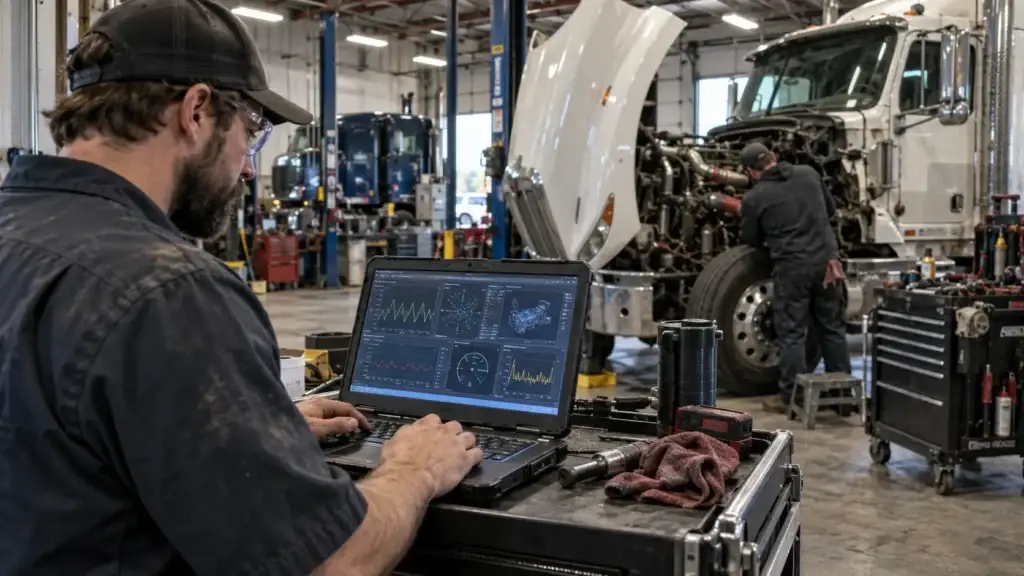
Today's intelligent diagnostic tools represent a real step up from traditional code readers, offering context and probability-ranked guidance rather than a flat list of trouble codes — one of the clearest, most concrete examples of AI in diesel repair actually earning its keep on a shop floor. Modern AI scan tools don't simply retrieve codes — they layer historical repair data on top to suggest where to look first.
Intelligent Scan Tools and Code Readers
Several AI-powered diagnostic platforms are currently available to diesel repair shops. Noregon TripVision focuses on fleet monitoring and proactive repair, offering remote diagnostics and predictive alerts aimed at catching problems before breakdowns occur. Diesel Laptops with Preteckt AI provides all-makes diagnostics with AI-generated repair suggestions layered on top of standard code retrieval. TEXA IDC6 targets multi-brand shops with smart test selection across its diagnostic database. Cummins Guidanz serves mobile technicians specifically, with Bluetooth scanning and plain-English fault interpretation.
The practical value of these platforms shows up in how they reframe a fault code. Instead of a bare "Fuel Rail Pressure Too Low" message, a probability-ranked AI tool presents the most common resolutions for that specific code first — a failed rail pressure sensor, a chafed wiring harness, an injector issue — ordered by how frequently each has actually resolved similar cases historically, rather than leaving the technician to work through every possibility with equal weight.
For the SPN/FMI code structure these tools are interpreting under the hood, HDJ's SPN and FMI fault code guide breaks down the raw code structure manually. HDJ's diagnostic tools guide covers the full toolkit these platforms sit alongside — oscilloscopes, OEM software, aftertreatment-specific instruments — in more depth than fits here.
Computer Vision for Visual Inspections
Computer vision brings AI capability to visual assessment tasks that have traditionally relied entirely on technician experience — analyzing images to identify component wear, cracks, or degradation. This addresses one of diesel repair's more persistent problems: the gap in visual-inspection accuracy between a 20-year veteran and a technician still building that judgment.
Trained image-analysis models can flag abnormal wear patterns on brake pads, bearing surfaces, and belts that a less experienced eye might pass over during a routine inspection — though as with fault-code triage, this works best as a second set of eyes confirming a technician's own inspection, not a replacement for it.
Acoustic Analysis Systems
Acoustic diagnostic tools use AI to analyze engine sound, bearing noise, and mechanical vibration for patterns that indicate developing problems — comparing recordings from smartphone microphones or dedicated sensors against a database of normal and abnormal mechanical sound signatures. The system distinguishes normal injector clicking from the irregular pattern of a failing one, flags bearing wear through high-frequency vibration analysis, and recognizes the characteristic whine of a developing turbocharger problem — capability aimed at extending a genuinely trained ear to technicians still building that specific skill.
Benefits of AI for Diesel Repair Shop Operations
Shop owners who implement AI diagnostic tools generally report improvements across diagnostic speed, accuracy, and customer retention — real gains, though the specific magnitude varies enough by shop and platform that any single number should be treated as a starting hypothesis to test, not a guarantee.
Diagnostic Accuracy Improvements
Modern AI systems analyze multiple data streams simultaneously — fault codes, sensor readings, vehicle history, and outcomes from similar prior cases — which tends to surface root causes rather than symptoms more consistently than working from a fault code alone. First-time fix rate is the metric this shows up in most directly: correctly identifying the actual problem before parts get replaced, rather than after a comeback proves the first guess wrong.
The confidence scoring most platforms attach to their recommendations is genuinely useful here — technicians get a probability ranking rather than a flat list, letting them prioritize the diagnostic path most likely to be right first instead of working through possibilities in arbitrary order.
Reduced Human Error and Comebacks
AI systems function as a check against diagnostic mistakes, flagging inconsistencies between a proposed repair and the available diagnostic data before parts get ordered. Comeback reduction is one of the more directly measurable benefits shops report — since every comeback carries duplicate labor, parts handling, and reputational cost on top of the original job, even a modest reduction compounds meaningfully over a year of volume. The right way to evaluate a specific platform's impact here is your own before-and-after comeback rate over a few months, not a vendor's published average.
Enhanced Customer Satisfaction
Faster, more accurate diagnostics show up directly in the customer experience — shorter wait times, more accurate estimates, and fewer return visits. Fleet operations benefit in a specific way: AI tools can filter out irrelevant fault codes so technicians focus on genuine problems, which matters for fleet availability since every hour a revenue-generating truck sits in a bay is an hour it isn't hauling freight.
The confidence AI-backed diagnostics provide also improves customer communication — service advisors can explain a problem with a probability behind it rather than a guess, and give a more accurate completion timeframe, which builds trust and reduces the anxiety customers often feel facing an expensive repair.
Predictive Maintenance Capabilities
Instead of waiting for components to fail, diesel shops increasingly use AI to forecast failures and prevent costly breakdowns — a shift from reactive repair and calendar-based preventive maintenance toward monitoring actual component condition. Rather than replacing parts on a fixed schedule regardless of condition, these systems recommend intervention based on genuine degradation indicators: a turbocharger showing early bearing-wear patterns gets attention before it fails mid-haul, an aftertreatment system exhibiting subtle pressure anomalies gets service before it clogs during a DOT inspection.
Failure Prediction Models
Advanced systems build failure-probability models by analyzing historical breakdown cases for the subtle warning signs that precede specific failure types — variations in vibration, temperature, pressure, and performance that a technician working alone might not connect.
Different engine systems need specialized models tailored to their own failure patterns: turbocharger algorithms track bearing temperature and shaft speed for signs of wear long before audible noise or visible smoke appears; fuel system algorithms track injection timing precision and rail pressure stability for developing pump or injector problems; cooling system models analyze thermostat response and coolant flow to anticipate water pump failures before they strand a truck.
Fleet Management Integration
Predictive AI becomes considerably more valuable for shops serving commercial fleets, since aggregating data across multiple vehicles reveals patterns invisible when examining units individually. If three vehicles from the same fleet show similar fuel pressure anomalies, the pattern points toward a bad fuel batch or supplier issue rather than three unrelated part failures. If several units show accelerated DPF loading together, that points toward a duty-cycle change or driver behavior pattern worth investigating fleet-wide rather than servicing each truck as an isolated case.
Per the American Transportation Research Institute's operational costs research, unplanned maintenance carries costs well beyond planned repair — towing, expedited parts, overtime labor, and lost revenue all compound on top of the repair itself, which is the core financial argument for shifting toward predictive scheduling wherever the data supports it.
Reducing Diagnostic Time and Labor Costs
Every minute a technician spends diagnosing instead of repairing is time that isn't generating billable work. AI addresses this by automating the interpretation and research steps that traditionally consumed the largest share of diagnostic time, rather than the hands-on repair itself.
Instant Code Translation and Prioritization
A raw fault code like "P0087" means nothing without context, historically forcing technicians to consult manuals, search databases, or call a technical support line. Automated code interpretation replaces that lookup step with plain-language explanations and probable causes ranked by likelihood, drawn from patterns across many prior repairs rather than one person's memory of similar jobs — the same underlying idea behind HDJ's own guide to reading diesel DTC codes manually, just automated.
Correlation Analysis for Accurate Problem Identification
Traditional diagnostics tend to follow a linear path — test one component, move to the next if symptoms persist, repeat. This wastes time on intermittent problems that don't present consistently during testing. AI correlation analysis instead looks across multiple data streams simultaneously — fault codes, voltage fluctuations, temperature variation, pressure readings — to find connections that sequential manual testing typically misses.
Consider a hypothetical shop billing $125 an hour that cuts its average complex-diagnostic time from roughly 2.5 hours to closer to one hour with AI assistance: that's a rough labor-cost saving in the neighborhood of $180 per diagnostic event before accounting for tool or subscription cost. Run that math against your own shop's actual complex-diagnostic volume and labor rate — the concept holds directionally, but the real number is specific to your operation, not a figure to copy from an article.

Integration with Existing Shop Management Systems
Connecting AI diagnostic systems to shop management platforms eliminates manual data entry and reduces administrative burden. The real value shows up when a completed scan automatically generates a work order, populates a parts list based on the suggested repair, and routes the job to a technician by skill level and urgency — rather than a technician or service writer re-entering the same diagnostic findings into a separate system by hand.
Software Compatibility Requirements
Successful integration starts with confirming your existing systems can actually receive and process the diagnostic data streams these tools generate. APIs create the connective pathway — fault codes, sensor readings, and recommended repairs flow from the scan tool into work orders, inventory, and customer systems automatically, eliminating the transcription errors that come with manual re-entry.
Cloud-Based Solutions and Remote Access
Cloud-hosted diagnostic and management platforms offer advantages traditional on-premises systems can't match — access from multiple locations, automatic software updates, and storage that scales with the business without dedicated server hardware or in-house IT staff. Remote diagnostic access lets a technician review data before arriving at the shop, a fleet manager check repair status without a phone call, and a parts supplier receive an order automatically the moment a diagnostic system identifies a component failure.
Training Technicians for AI-Enhanced Workflows
AI diagnostic systems augment rather than replace human expertise — but that only holds true if technicians are actually trained to work with them well. The most successful shops match technology investment with equal commitment to training, since a powerful tool used poorly delivers little of its potential value.
Skill Development Programs
Many AI diagnostic platforms now include interactive repair guides that walk technicians through unfamiliar procedures step by step, reducing the learning curve on a repair a shop doesn't see often. Internal mentoring — pairing technicians who've adapted quickly to a new system with colleagues still learning it — builds proficiency in ways that address a shop's own specific workflows and vehicle mix more effectively than generic training alone.
The credentialing landscape is moving too, though carefully: ASE (the National Institute for Automotive Service Excellence) has partnered with an AI-focused firm to explore accreditation standards specifically for AI in automotive diagnosis and repair — an early step toward industry-wide standards, not yet a formal AI competency requirement baked into current certification exams. Shops paying attention to that space now will be positioned ahead of whatever the eventual standard looks like.
Overcoming Resistance to Technology Adoption
Even well-designed AI systems fail without user buy-in. Experienced technicians sometimes view intelligent diagnostic tools as a threat to their expertise or job security — a concern worth addressing directly rather than dismissing, since it's rooted in a real fear about the profession, not just stubbornness.
The most effective framing emphasizes what the tool actually removes: the tedious research and documentation work, not the skilled hands-on repair a technician prefers doing. Demonstrating a genuine quick win — AI correctly narrowing down a difficult intermittent problem faster than the usual approach — tends to shift attitudes faster than any amount of mandated training ever does.
Editorial note: Vendor materials for AI diagnostic and inspection tools frequently cite specific accuracy percentages (often in the 90%+ range) against "expert technician" benchmarks. HDJ was unable to independently verify a consistent, named source for these figures across the products we reviewed for this guide — treat any such claim as a question to ask the vendor directly ("what dataset, what benchmark, can I see the methodology") rather than a number to plan around.
Cost Considerations and Return on Investment
Every shop owner evaluating AI diagnostic systems needs to weigh real upfront costs against genuine, but shop-specific, financial benefit. The equation extends beyond the equipment purchase itself — capital outlay, ongoing subscription cost, and the revenue opportunity advanced technology creates all factor in.
Breaking Down Your Initial Technology Investment
Professional-grade AI-enhanced scan tools typically range from $3,000 to $15,000 depending on manufacturer and feature set (industry estimate, as of September 2026). Software subscriptions add recurring cost — most AI diagnostic platforms charge somewhere in the range of $100 to $500 per workstation monthly for cloud access and continuous database updates. Shops with outdated computer hardware may need $1,500 to $3,000 per workstation to run modern diagnostic software, and networking upgrades for reliable cloud connectivity can add another $2,000 to $5,000.
Calculating Your Own Payback
Rather than quoting a single industry-wide payback window — which varies too much by shop volume, labor rate, and platform to be meaningful as a universal number — the more useful exercise is building your own.
Multiply your typical complex-diagnostic time savings by your labor rate and your annual diagnostic volume for the labor side of the equation; separately estimate reduced parts waste from fewer misdiagnosis-driven replacements. Compare that combined figure against your actual hardware, subscription, and training costs to get a payback window specific to your shop, rather than borrowing a number from a vendor's best-case example.
| Investment Category | Typical Cost Range | What to Calculate |
|---|---|---|
| AI Diagnostic Hardware | $3,000 – $15,000 | Your reduced diagnostic time × your labor rate × your annual volume |
| Software Subscriptions | $1,200 – $6,000/year | Your reduction in misdiagnosis-driven parts waste |
| Training & Integration | $4,000 – $10,000 | Your added daily vehicle capacity, if any |
| Total Typical Investment | $8,200 – $31,000 | Model your own payback window from the rows above |
Data Security and Customer Privacy in AI Systems
AI-powered diagnostic tools introduce real responsibilities for protecting proprietary vehicle data and customer privacy. These systems collect, store, and analyze large amounts of sensitive information, and shops that neglect data security standards face legal liability, customer trust erosion, and regulatory penalties that can outpace any operational challenge.
Protecting Proprietary Vehicle Data
Modern diesel vehicles carry proprietary information beyond basic maintenance records — performance calibrations and operating parameters that represent real competitive value for fleet operators who've tuned their engines for specific applications. Shops need access controls that balance security with service delivery, with multi-level authentication ensuring only authorized technicians see sensitive calibration data while still maintaining the access needed for effective diagnostics.
Compliance with Federal and State Regulations
The regulatory landscape governing automotive data spans multiple jurisdictions with varying requirements, and state-specific rules often impose stricter standards than federal baselines. California is the clearest example: any shop serving California-based customers needs to account for CARB's Clean Truck Check program, which requires periodic emissions testing and onboard diagnostic data submission for heavy-duty vehicles over 14,000 lbs GVWR operating on California roads, regardless of where the vehicle is registered.
AI tools can help with this kind of compliance by continuously monitoring emissions-related systems and prompting corrective action when a parameter drifts, while also keeping the service-history and sensor logs that prove invaluable during an audit or roadside inspection.
⚠️ Security Warning
Never use shared login credentials for diagnostic systems. Each technician needs unique credentials tied to individual activity logs. Shared passwords create accountability gaps that complicate incident investigation and may violate data protection regulations.
Cybersecurity Best Practices
Protecting diagnostic systems from external threats requires multiple layers of defense. Network segmentation — isolating diagnostic systems from general internet access — is the first line, and NIST's own guidance on security segmentation for smaller operations makes the same case: grouping assets by communication and security needs prevents external attackers from directly reaching sensitive equipment and data. Regular software updates patch the vulnerabilities attackers actually exploit, and automated update systems remove the dependence on a technician remembering to apply a patch manually.
Data encryption in storage and in transit protects information even if an attacker intercepts it — reputable AI diagnostic vendors build encryption in as a foundational design choice, not an afterthought, and it's a fair question to ask any vendor directly during evaluation.
Future Trends in AI for Diesel Repair
The next wave of innovation in diesel repair points toward more autonomous initial assessment, immersive repair guidance, and tamper-resistant record-keeping. Early adopters of these directions gain a lead that becomes harder for competitors to close the longer they wait.
Self-Learning Systems and Autonomous Initial Assessment
Some platforms now perform an initial evaluation the moment a truck arrives, analyzing sensor data and prioritizing likely service needs before a technician even opens the hood. The most advanced systems extend this toward genuinely predictive scheduling — flagging a predicted failure early enough to schedule the repair and pre-order the likely parts before the truck actually breaks down. Fleet vehicles are leading this adoption, since continuous telematics data gives these systems more to work with than a vehicle only seen at service intervals.
Augmented Reality Repair Guidance
Augmented reality overlays digital guidance onto a technician's field of view through glasses or a tablet — component identification, torque specifications, assembly sequence, and safety warnings appearing directly in the technician's line of sight during a repair. This effectively gives a technician an expert advisor for an unfamiliar procedure, which can meaningfully reduce training time while improving consistency on repairs a shop doesn't perform often. Aviation and industrial maintenance already use this technology at scale; automotive and heavy-duty applications are still relatively early but growing as hardware costs fall.
Tamper-Resistant Maintenance Records
Blockchain-style distributed-ledger record-keeping aims at a long-standing problem: falsified or lost maintenance documentation. An immutable service entry benefits multiple parties — shops face fewer warranty disputes with indisputable documentation, fleet operators can verify vendor compliance with maintenance schedules, and used-vehicle buyers get transparent history before purchase. Integration with IoT sensors adds a verification layer on top, automatically recording operating conditions and component wear alongside the shop's own service entry.
Frequently Asked Questions
How much can AI reduce diesel diagnostic time?
Meaningfully, in most reported cases — but the exact percentage varies too much by shop, vehicle mix, and platform to quote a single reliable figure. Track your own average diagnostic time before and after adoption rather than planning around a vendor's published number.
What is the typical ROI timeline for AI diagnostic equipment?
It depends heavily on diagnostic volume and labor rate — there's no reliable industry-wide number. Build your own estimate using your actual complex-diagnostic frequency, labor rate, and current comeback rate against the tool's real cost, rather than borrowing a vendor's best-case example.
Will AI replace diesel technicians?
No — these systems handle data processing and pattern analysis while technicians perform hands-on repairs, verify AI recommendations, and manage the customer relationship. The ongoing technician shortage makes skilled people more essential, not less; AI's real contribution is making existing technicians more productive against that shortage.
What AI diagnostic platforms work best for diesel repair shops?
Options include Noregon TripVision for fleet monitoring and predictive alerts, Diesel Laptops with Preteckt AI for all-makes diagnostics, TEXA IDC6 for multi-brand coverage, and Cummins Guidanz for mobile technicians. The right choice depends on fleet versus retail focus, brand coverage needs, budget, and integration with your existing management system — most offer trial periods worth using before committing.
How does predictive maintenance technology prevent breakdowns?
By continuously analyzing sensor data for degradation patterns before a component fails — subtle changes in temperature, pressure, or vibration that fall within normal range individually but together signal a developing problem. This early warning enables scheduled repair during planned downtime rather than an emergency roadside failure.
What cybersecurity measures protect AI diagnostic systems?
Network segmentation to isolate diagnostic equipment from general internet access, unique per-technician credentials instead of shared logins, encryption for stored and transmitted data, comprehensive activity logging, and tested backup procedures. Ask any cloud-based vendor about their specific security certifications and data-handling practices before committing.
The Road Ahead for AI-Powered Diesel Diagnostics
AI in diesel repair is a real competitive factor for repair shops navigating a genuine technician shortage and increasingly complex engine systems — faster, more consistent diagnostics translate into better bay throughput and stronger customer relationships when the technology is matched to a shop's actual needs and paired with real training.
The most successful shops combine machine intelligence with human expertise rather than treating one as a replacement for the other. Seasoned technicians bring irreplaceable hands-on judgment; AI-powered diagnostics remove time-consuming guesswork so that judgment gets applied to the repairs that actually need it. Evaluate any vendor's specific claims against your own shop's numbers, not the other way around — the discipline Michael Nielsen and Heavy Duty Journal's editorial team apply across every technology guide on heavydutyjournal.com.
Found This Guide Useful?
Share it with fellow shop owners weighing an AI diagnostic investment — the questions to ask a vendor matter more than any single feature on their spec sheet.


