
By Michael Nielsen, Editor & Publisher | 15+ Years in Diesel Repair
Last Updated: April 2026
📖 Estimated reading time: 21 minutes
Heavy-duty diesel diagnostic tools are what separate a technician who guesses from one who knows. A fault code is not a diagnosis — every experienced commercial technician learns this early, often the hard way, after replacing a part the code pointed to and finding the truck back in the bay three days later with the same symptom. The code is a starting point. The right instruments are what convert that starting point into an accurate diagnosis, an efficient repair, and a truck that stays out of the shop for the right reasons. The technicians who consistently earn the highest diagnostic efficiency numbers — jobs closed per day, first-time fix rates, diagnostic accuracy — are the ones with the right tools for every layer of the process, not just the scan tool everyone carries.
The commercial diesel diagnostic tool landscape has shifted significantly in the past two years. The protocol transition from J1939 to CAN FD and DoIP on post-2024 emissions systems is creating a real capability gap between shops with current diagnostic equipment and shops running tools from three or four years ago. According to the U.S. Bureau of Labor Statistics, approximately 26,500 diesel service technician positions open annually — and the technicians commanding the highest wages are the ones whose diagnostic skill translates directly into fewer comebacks, faster cycle times, and the ability to fix trucks that other shops cannot. The right tools are how that skill gets expressed.
This guide covers the complete heavy-duty diesel diagnostic toolkit organized the way professional commercial technicians actually build it: foundation electrical instruments first, scan tool strategy second, advanced diagnostic instruments third, and aftertreatment specialty tools as the fourth layer. Each category explains not just what to buy but why it occupies that position in the diagnostic process — and what it cannot do, which is as important as what it can.
Key Takeaways
- A fault code is not a diagnosis: Scan tools identify what systems are reporting problems. Foundation instruments — multimeters, compression testers, pressure gauges — confirm the physical cause. Both categories are mandatory for accurate diagnosis.
- Protocol support is the first evaluation criterion: Any diagnostic adapter purchased in 2025 must support CAN FD and DoIP alongside legacy J1939 and J1708. Tools without CAN FD support cannot communicate with post-2024 emissions systems.
- OEM software and aftermarket platforms serve different roles: OEM software provides the deepest access to specific engine families. Multi-brand platforms provide the breadth to service mixed fleets efficiently. Professional shops need both.
- The oscilloscope is the diagnostic skill separator: Modern commercial trucks have up to 20 ECMs. The oscilloscope makes network communication visible and captures intermittent faults that multimeters and scan tools cannot catch. This is the investment that defines master-level diagnostic capability.
- Aftertreatment diagnostics require specialized instruments: DPF pressure testing, DEF quality verification, and SCR thermal analysis require tools beyond standard scan tool capability. These systems generate the largest share of emissions-related CSA violations.
- Build your toolkit by career stage: Entry-level technicians need the foundation instruments and a quality standalone scanner. The OEM software investment and oscilloscope belong to the journeyman and master technician stages, where diagnostic billing justifies the cost.
Understanding the Diagnostic Protocol Landscape in 2025
A diagnostic tool that cannot communicate with the vehicle’s electronic systems is not a diagnostic tool — it is an expensive brick. Before evaluating any heavy-duty diesel diagnostic tool, every technician and shop owner needs to understand what communication protocols the vehicles they service require and verify that the tools being considered actually support them. The protocol landscape in 2025 covers three distinct generations of commercial truck electronic systems, and each generation is still actively in the field.
J1708 and J1587 — Legacy Protocol Still Running
The SAE J1708 physical layer and J1587 application layer represent the original heavy-duty vehicle diagnostic standard, dominant through the 1990s and into the mid-2000s. J1708 operates at 9,600 baud — slow by modern standards, but reliable for the engine, transmission, and ABS data it was designed to carry. A significant population of pre-2010 commercial vehicles still operating in vocational, municipal, and fleet service requires J1708/J1587 access for complete diagnostic coverage. Any shop servicing vehicles more than 15 years old must have diagnostic tools that support these legacy protocols. Dropping J1708 support to save cost on a new diagnostic platform is a mistake that creates an immediate blind spot for a real portion of the service market.
SAE J1939 — The Current Standard
SAE J1939 became the dominant heavy-duty vehicle diagnostic and control protocol beginning around 2000. Built on the Controller Area Network (CAN) physical layer, J1939 operates at 250 kbps for standard applications and 500 kbps in high-speed configurations. Its use of standardized Parameter Group Numbers (PGNs) allows diagnostic tools to access data from multiple ECUs through a single network connection — engine RPM, fuel rate, exhaust temperatures, DPF pressure differential, DEF dosing rate, and hundreds of other parameters all broadcast on the shared J1939 network. J1939 is the protocol behind virtually every Class 6-8 commercial truck built between 2000 and the mid-2020s, which means it covers the overwhelming majority of the current commercial vehicle population. A heavy-duty diagnostic tool without solid J1939 support is missing its primary market.
CAN FD and DoIP — What Is Changing Right Now
CAN FD (Controller Area Network with Flexible Data-rate) extends the J1939 architecture to operate at up to 2 megabits per second with larger data payloads per message frame — eight times faster than standard J1939. The J1939-17 standard incorporates CAN FD into heavy-duty vehicle networks to support the data throughput demands of advanced driver assistance systems, complex aftertreatment management, and integrated vehicle telematics on post-2024 commercial trucks. DoIP (Diagnostics over Internet Protocol) extends diagnostic communication over Ethernet-based vehicle networks, enabling faster ECM programming and the real-time data transfer that modern vehicle systems require.
The practical implication for technicians: diagnostic adapters that do not support CAN FD and DoIP will fail to communicate with the newest generation of commercial truck ECMs entirely. This is not a feature gap — it is a complete communication failure. The Nexiq USB-Link 3, released specifically to address this protocol transition, supports CAN FD, DoIP, J1939, and J1708 simultaneously and carries OEM approvals from the major commercial engine manufacturers. Any shop investing in diagnostic infrastructure for 2025 and beyond must verify CAN FD support before committing to an adapter platform.
20+ ECMs
The number of electronic control modules on some modern Class 8 commercial trucks — up from three (engine, transmission, ABS) on trucks from the early 2000s. This complexity is why oscilloscope diagnostics and CAN FD-capable tools have become the standard for advanced commercial truck electrical diagnosis.
Tier 1: The Foundation Every Commercial Diesel Technician Needs First
The foundation layer of heavy-duty diesel diagnostic tools is the electrical and mechanical instrumentation that exists independently of any scan tool or software platform. These instruments measure the physical reality of what is happening in the truck’s systems — voltage, resistance, current, compression pressure, coolant system pressure — and they are the tools that confirm or disprove what the scan tool suggests. Technicians who skip the foundation layer and rely exclusively on scan tool output are missing diagnoses that a $400 multimeter would have caught in five minutes.
True-RMS Digital Multimeter
The True-RMS digital multimeter is the most important instrument in a commercial diesel technician’s toolkit. Not the most expensive. Not the most specialized. The most important — because no other single tool is used more frequently across more diagnostic scenarios in a commercial diesel bay. The multimeter verifies voltage supply to sensors, checks sensor resistance against specification, measures circuit continuity, tests VGT actuator coil resistance, verifies glow plug and grid heater resistance, and confirms ground integrity on the chassis electrical system. It is the first tool that goes on the truck and the last tool that comes off before a diagnostic is called complete.
For commercial diesel work, True-RMS measurement is mandatory — not preferred, mandatory. Commercial vehicle electrical systems generate significant electrical noise from motor loads, relay switching, and J1939 network communication. An average-responding multimeter exposed to this noise produces readings that are inaccurate by enough to misdiagnose circuits. True-RMS measurement calculates the actual root mean square value of a complex waveform, delivering accurate readings regardless of the noise environment. The Fluke 87V is the industry benchmark — True-RMS, 1,000V CAT III safety rating, a low-pass filter that eliminates interference during VFD and inverter circuit testing, and auto-ranging that handles the full range of commercial vehicle circuit values without manual range selection. A clamp-on ammeter rated minimum 600 amps extends the multimeter’s capability to commercial battery bank and starter circuit analysis — commercial truck starting circuits can exceed 1,000 amps under cold cranking conditions.
Diesel Compression Tester
No scan tool, no matter how sophisticated, can measure cylinder compression. The compression tester provides the mechanical baseline data that determines whether a complaint about hard starting, low power, or excessive smoke has a mechanical cause — worn rings, stuck rings, valve sealing problems, blown head gasket — or an injection and calibration cause that scan tool work can address. Testing compression before recommending any major engine repair is not optional in professional commercial diesel diagnostics. It is the data that prevents unnecessary engine teardowns and the comebacks that follow from misdiagnosed mechanical conditions.
Commercial diesel engines require compression testers rated to 1,000 PSI minimum — automotive testers rated to 300 PSI are measuring only a fraction of the operating range of a diesel compression cycle. Healthy diesel engines typically produce 350 to 600 PSI depending on engine family and compression ratio, and the variation between cylinders is often more diagnostically significant than the absolute value. Less than 10 percent variation indicates excellent cylinder condition; variation exceeding 15 percent confirms significant differences that require further investigation through cylinder leak-down testing. Adapters specific to each engine family’s glow plug or injector port configuration are required — a universal adapter that doesn’t seal correctly produces readings that are meaningless at best and dangerously misleading at worst.
Cooling System Pressure Test Kit
Cooling system failures are among the most common causes of Class 8 diesel breakdowns, and a leak that is invisible at ambient temperature and atmospheric pressure becomes obvious the moment the cooling system is pressurized to operating level. A professional cooling system pressure test kit with adapters covering commercial radiator cap sizes and the overflow tank connections of major commercial truck brands allows a technician to find the leak in the bay rather than sending a truck out with an unresolved cooling system diagnosis. External leaks — water pump seals, hose connections, EGR cooler external seals, radiator seam cracks — are straightforward. The more critical function is identifying internal leaks: a combustion gas leak into the cooling system that does not produce obvious external symptoms but progressively degrades coolant quality and causes chronic overheating. A block tester using chemical indicator fluid detects combustion gases in coolant in under two minutes and does not require the cooling system to be at operating temperature.
Infrared Thermometer
A non-contact infrared thermometer rated 0 to 1,200°F is one of the highest-productivity diagnostic instruments for the price in a commercial diesel shop. Temperature differential across a row of exhaust manifold ports identifies cylinders with injection problems, low compression, or cam timing issues without removing any components. Surface temperature of a DPF canister after a regen cycle confirms whether regeneration actually occurred and whether the canister is achieving proper oxidation temperatures. Temperature variation across an SCR catalyst inlet and outlet confirms thermal performance during active DEF dosing. Comparing radiator inlet and outlet temperatures during a suspected thermostat failure gives a fast answer without a test drive. An infrared thermometer is used in some form on nearly every diagnostic job in a well-equipped commercial diesel shop.
Diagnostic Tips, Tool Updates & Compliance Guidance
Heavy Duty Journal delivers practical diesel diagnostic guidance, emissions compliance updates, and tool recommendations to the inbox of thousands of commercial technicians and fleet managers. Always free, always field-relevant.
Tier 2: Scan Tool Strategy — OEM, Multi-Brand, and Standalone Tablet
The scan tool category is where most discussions of heavy-duty diesel diagnostic tools begin and end. That framing understates what scan tools actually do and overstates what they do on their own. A scan tool reads what the vehicle’s electronic control systems are reporting — fault codes, parameter values, sensor data, system status. It does not measure compression, verify fuel delivery, or confirm that a circuit is actually delivering specified voltage to the component it powers. It is the most powerful single instrument in the toolkit, but its power is maximized when the technician using it also has the foundation instruments to verify what it is saying.
The Laptop-Based OEM Approach
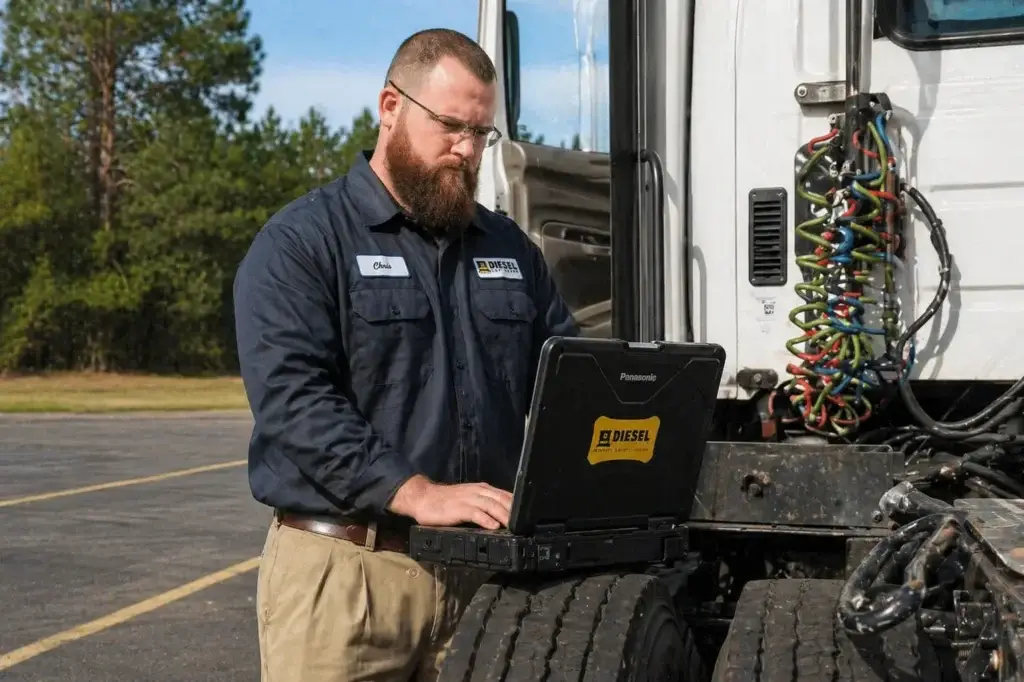
Laptop-based OEM diagnostic software connected through a compatible vehicle interface adapter provides the deepest available access to commercial truck ECMs. Cummins Insite accesses ISX, X15, ISB, and ISL engine families with the full functionality that Cummins authorizes for authorized service centers — injector coding, single cylinder cutout tests, ECM parameter programming, DPF and SCR calibrations, and complete fault code management including inactive and pending codes that standalone scanners frequently miss. Detroit Diesel Diagnostic Link covers the DD13, DD15, and DD16 engine families with equivalent depth. PACCAR DAVIE4 covers PACCAR MX-13 and MX-11 engines in Kenworth and Peterbilt trucks. JPRO Professional from Noregon provides multi-brand OEM-comparable coverage across 60-plus commercial vehicle brands in a single software subscription, making it the practical primary platform for independent shops servicing mixed fleets.
The adapter that connects the laptop to the truck is as important as the software. A quality adapter handles data correctly without dropouts, supports all the protocols the software requires, and remains stable through long active testing sessions. The Nexiq USB-Link 3 is the industry standard adapter — it carries OEM approvals from Cummins, Detroit Diesel, PACCAR, Volvo/Mack, International, and Allison, supports CAN FD and DoIP alongside J1939 and J1708, and is available in both wired USB and wireless Bluetooth configurations. The wired version is preferred for extended diagnostic sessions and ECM programming where a dropped connection mid-write can create serious problems. The wireless version provides the mobility benefit for routine reads and active tests where the technician needs to be away from the laptop.
Multi-Brand Diagnostic Platforms
Multi-brand diagnostic platforms — JPRO Professional, Diesel Explorer, and similar all-makes software suites — provide the breadth that OEM-specific software cannot. A shop that services Freightliner, Kenworth, and International trucks in the same week cannot maintain active subscriptions for every OEM software platform economically. A quality multi-brand platform covers all three manufacturers through a single subscription and single interface, reducing the learning curve and the software management overhead. The depth of access varies by platform and engine family — multi-brand tools generally cannot perform the full parameter programming that OEM software provides, but they cover the diagnostic reads, active tests, DPF regenerations, service resets, and fault management that constitute the majority of daily diagnostic work. The annual subscription model for multi-brand platforms reflects the continuous coverage updates required to keep pace with new model year vehicles.
Standalone Tablet Scanners as the Daily Driver
A quality standalone heavy-duty tablet scanner — the TOPDON ArtiDiag HD is a frequently cited example for broad commercial coverage — covers 60-plus commercial truck brands with guided functions for DPF regeneration, SCR reset, injector coding, urea drive reset, and idle speed adjustment through a touchscreen interface that does not require laptop setup. For routine work — pulling codes on an incoming truck, checking DPF soot load before a maintenance interval decision, verifying SCR system function after a DEF contamination repair — the tablet scanner provides faster access than opening a laptop, connecting cables, and loading OEM software. The standalone scanner does not replace OEM software depth; it eliminates the setup overhead for the jobs that don’t need that depth. The practical workflow for most professional shops: tablet scanner for initial assessment and routine maintenance resets, laptop-based OEM software for anything requiring calibration, parameter programming, or deep fault tree analysis.
Diagnostic Platform Selection Guide
| Shop Type | Primary Platform | Secondary |
|---|---|---|
| Single-brand dealer/fleet | OEM software (Insite, DDDL, DAVIE4) | Standalone tablet for quick reads |
| Multi-brand independent shop | JPRO or multi-brand suite | Top 2 OEM software titles for volume brands |
| Mobile / roadside tech | Standalone tablet + multi-brand | Laptop-based OEM for depth when needed |
| Owner-operator | Quality standalone tablet scanner | Specific OEM software for their engine |
Tier 3: Advanced Diagnostic Instruments That Separate Good from Great
The third tier of heavy-duty diesel diagnostic tools contains the instruments that differentiate a technician who can diagnose straightforward fault codes from one who can diagnose the intermittent electrical faults, the subtle sensor signal deterioration, and the network communication issues that other technicians cannot solve. These tools require investment in both the hardware and the learning curve — but the technicians who make that investment consistently generate more diagnostic revenue, complete more difficult jobs, and build the reputation that attracts fleet service contracts.
The Oscilloscope: The Tool Redefining Commercial Truck Diagnostics
Modern Class 8 commercial trucks can have 20 or more electronic control modules communicating over shared J1939 and CAN FD networks. When those networks have problems — corrupted signals, weak transmitters, bus loading issues, intermittent opens in the data link — a multimeter reads normal static voltage and a scan tool shows communication errors without identifying where they originate. The oscilloscope makes those network signals visible as voltage waveforms over time, allowing a technician to identify exactly where a signal degrades, at what frequency a glitch occurs, and whether the issue is in a sensor, a module, or the wiring between them.
The practical diagnostic value extends well beyond network analysis. A cam position sensor whose signal is degrading produces a waveform that shows the degradation — the peaks are getting lower, the rise times are getting slower, the noise floor is rising — before the sensor fails completely or generates a fault code. An injector return circuit with an intermittent short produces a characteristic waveform anomaly that appears only under certain conditions and at certain engine loads. A technician with an oscilloscope and the knowledge to read these waveforms can catch problems that would otherwise generate a two-week intermittent diagnostic nightmare. The Diesel Scope, built on PicoScope hardware with guided diagnostic tests specifically developed for medium and heavy-duty commercial vehicles, is the entry point that most commercial shops use — the guided test library walks technicians through proper connection points and provides reference waveforms to compare against actual readings.
Heavy-Duty Battery and Electrical System Tester
Commercial trucks typically run 12V systems with dual battery banks, and Class 8 tractors with APUs or sleeper electrical loads frequently carry four or more batteries in series-parallel configurations. A battery load tester rated for commercial systems — minimum 12V and 24V capability covering 100 to 2,000 CCA — is mandatory for any shop performing electrical diagnosis on commercial vehicles. The Midtronics conductance testing platform is the worldwide standard used by commercial truck OEM service networks and performs a complete battery state-of-health assessment in under seven seconds with a printed result that documents the finding for the customer.
More importantly, starter circuit analysis on a commercial diesel engine — checking cable voltage drop under cranking load, verifying alternator output voltage and current under charge load, measuring the full starting circuit for resistance — requires a clamp-on ammeter rated for commercial current levels. A standard 200-amp automotive clamp meter reading a Class 8 diesel starter circuit drawing 1,000 amps is reading pegged to the top of its scale and providing no useful data. The Fluke 381 with iFlex flexible current probe reaches 2,500 amps and allows the technician to work from a safe distance during cranking tests — both practically useful in the tight spaces of a Class 8 engine bay and essential for accurate measurement.
Thermal Imaging Camera
A thermal imaging camera is not a diagnostic tool that most technicians buy early in their career, but every technician who owns one will tell you they cannot imagine working without it. A thermal image of a diesel engine bay during operation shows temperature distribution across every surface simultaneously — coolant passages that are flowing versus blocked, exhaust manifold segments that are cooler than others due to injection problems, EGR cooler hot spots indicating internal failure, brake drums that are running 200°F hotter than their companions on the same axle, air brake chambers that are warm indicating a dragging brake. What would take a multimeter and a series of targeted temperature checks twenty minutes to assess, a thermal camera covers in thirty seconds of scanning. Entry-level thermal cameras with sufficient resolution for commercial vehicle work have dropped below $500, and the diagnostic value across cooling, exhaust, brake, and electrical categories justifies the investment for any shop doing serious volume diagnostic work.
The HDJ Perspective
The conversation about heavy-duty diesel diagnostic tools in 2025 is inseparable from the conversation about the technician shortage. The technicians who are leaving the industry are taking decades of diagnostic knowledge with them, and the incoming technicians face a commercial truck that is exponentially more complex than the one their mentors learned on. The oscilloscope and thermal camera are not luxury items for elite shops — they are the tools that make it possible for a journeyman technician with three years of experience to diagnose a vehicle that a veteran with twenty years of experience would have struggled to troubleshoot with the older toolkit. The right diagnostic tools don’t replace expertise. They amplify it — and in a market where 26,500 technician positions open annually and shops are competing for qualified people, giving your technicians tools that make them faster and more capable is as much a retention strategy as it is an operational one.
Specialty Diagnostic Tools for Aftertreatment Systems
Aftertreatment systems — diesel particulate filters, selective catalytic reduction systems, diesel exhaust fluid dosing — are the most inspection-intensive component category on modern commercial diesels and the source of a disproportionate share of CSA violations. Under FMCSA’s CSA Safety Measurement System, aftertreatment-related OOS violations in the Vehicle Maintenance BASIC carry severity weights that directly affect a carrier’s safety score and shipper relationship. Shops that can diagnose, service, and verify aftertreatment systems accurately are providing a service that fleet operators genuinely need and will pay for — and shops without the right specialty tools cannot provide it completely.
DPF Differential Pressure Test Kit
Every scan tool that supports DPF diagnostics reads the ECM-calculated differential pressure across the DPF — the difference between exhaust pressure upstream and downstream of the filter. That calculated value is based on the readings from pressure sensors that can themselves be failed or fouled. A DPF differential pressure test kit with calibrated mechanical gauges and port adapters for each commercial engine family’s DPF inlet and outlet taps provides the actual measured differential pressure independent of the sensors and ECM calculation. When the ECM reports high DPF differential pressure but the mechanical test shows normal pressure, the diagnosis is a failed sensor or plugged sensor port — not a plugged DPF. When both confirm high restriction, the DPF is the correct diagnosis. This distinction saves the cost of an unnecessary DPF replacement on one hand and prevents a missed diagnosis on the other — both of which are significant dollar amounts in commercial diesel service.
DEF Quality Tester
Diesel exhaust fluid contamination — water dilution, wrong fluid added, storage degradation — is a more common cause of SCR system faults than most technicians initially expect. A DEF quality tester confirms urea concentration and identifies contamination before condemning an SCR catalyst or NOx sensor based on fault codes. Refractometer-style testers using the refractive index of DEF to measure urea concentration are the most accessible — a proper 32.5 percent urea solution produces a consistent refractive index reading, and deviation from that reading indicates either dilution (concentration below 30 percent) or contamination. Electronic DEF testers provide faster results and are less subject to user technique variation. Either type is a required tool for any shop that services SCR-equipped commercial trucks — and at under $200, it is among the lowest-cost diagnostic tools with the highest return on a per-diagnosis basis.
NOx Sensor Diagnostic Test Kit
NOx sensors on Class 8 commercial trucks monitor exhaust nitrogen oxides upstream and downstream of the SCR catalyst. A failed upstream NOx sensor causes the ECM to use a default value that typically results in over-dosing DEF and a urea deposit buildup in the exhaust. A failed downstream NOx sensor causes the SCR efficiency calculation to fail, producing fault codes that trigger engine derates under EPA heavy-duty diesel engine emissions standards. Before replacing a NOx sensor — which can cost $200 to $600 depending on engine family — testing sensor heater circuit resistance and verifying proper sensor supply voltage with a multimeter eliminates wiring and supply issues that are less expensive to correct than the sensor itself. The scan tool can read the sensor’s output value; the multimeter and a wiring diagram confirm whether the sensor has what it needs to report accurately.
Free Professional Fleet Tools
Cost calculators, fault code lookup, maintenance planners, and more — built for owner-operators, fleet managers, and diesel techs. No signup required.
Building Your Diagnostic Tool Investment by Career Stage
The full toolkit described in this guide represents a $10,000 to $20,000 investment accumulated over years. No technician and no shop needs to buy everything at once. The right sequence of investment aligns tool acquisition with the diagnostic capability and billing volume that each stage of a technician’s career generates. Buying an oscilloscope before you have the scan tool experience and electrical foundation to use it productively is money wasted. Waiting too long to invest in OEM software when your shop is servicing Cummins-powered fleets every week is revenue left on the table.
Entry-Level Technician — Foundation First
The entry-level commercial diesel technician’s diagnostic toolkit starts with a quality True-RMS multimeter (Fluke 87V or equivalent), a diesel compression tester rated to 1,000 PSI with adapter sets for the engine families most commonly seen in the shop, a cooling system pressure test kit, and an infrared thermometer. These tools cost $600 to $1,200 total and are used on every diagnostic job from day one. A quality standalone tablet scanner — the TOPDON ArtiDiag HD or a comparable platform with DPF regen capability and 60-plus commercial brand coverage — rounds out the entry-level set at another $800 to $1,500. This foundation set provides the capability to handle maintenance diagnostics, emissions service resets, fault code reads and clears, and mechanical verification testing across the full commercial truck service range.
Mid-Career Journeyman — OEM Software and Battery Diagnostics
The journeyman technician generating productive diagnostic billing should invest in laptop-based OEM software for the engine families that represent the majority of their shop’s service volume. One or two OEM software subscriptions — Cummins Insite and JPRO as a common combination for mixed-fleet independent shops — plus the Nexiq USB-Link 3 adapter represents $2,000 to $4,000 in investment that expands diagnostic capability into calibrations, parameter programming, and the complete fault management that earns the highest diagnostic billing rates. The Midtronics commercial battery and electrical system tester and a clamp-on ammeter rated 600 amps or higher complete the mid-career diagnostic toolkit at another $800 to $1,500. This configuration allows the journeyman technician to diagnose and complete the full range of commercial diesel repair work short of intermittent electrical issues that require oscilloscope analysis.
Master Diagnostic Technician — Oscilloscope and Thermal Imaging
The master diagnostic technician or shop owner with a strong diagnostic billing volume should invest in an oscilloscope — the Diesel Scope based on PicoScope hardware with guided diesel diagnostic tests is the current commercial truck standard — and a thermal imaging camera. Combined investment of $2,500 to $5,000 for this tier. These tools pay for themselves through their ability to resolve intermittent electrical faults and complex network issues that would otherwise generate repeat diagnostic attempts, extended vehicle down time, and customer dissatisfaction. The oscilloscope specifically should be accompanied by formal training — the tool’s power is proportional to the technician’s ability to interpret what it shows, and that interpretation skill requires structured learning beyond what comes with the hardware. Under the ASE Medium/Heavy Truck certification framework, the Electrical/Electronic Systems (T6) and the Advanced Level Electronic Diesel Engine Diagnosis Specialist (L2) credentials validate the diagnostic knowledge that makes oscilloscope investment productive.
What to Evaluate When Selecting Diagnostic Software Subscriptions
Diagnostic software subscriptions represent a recurring annual cost that compounds significantly over time — a $2,000 annual software subscription costs $10,000 over five years before accounting for the adapter hardware and the laptop that runs it. Evaluating subscriptions carefully before committing is worth the time.
Coverage breadth is the first criterion: which vehicle makes, model years, and systems does the software actually support, and are the engine families you service most frequently in the core coverage or in a supplemental add-on that costs extra? Coverage depth is the second: does the software support bi-directional active tests, DPF regeneration, injector coding, and parameter programming for those engine families, or only fault code reads and clears? The difference between a software platform that reads codes and one that calibrates sensors and programs parameters is the difference between a diagnostic tool and a full service tool — and the billing rates reflect that difference.
Update frequency is the third criterion: commercial vehicle manufacturers release system updates throughout the model year, and a software subscription that provides annual updates falls behind within months of the subscription renewal. Quarterly major updates with continuous minor fixes is the standard for serious diagnostic platforms. Software age is particularly critical for aftertreatment diagnostics, where the calibration files and regen procedures for new model year aftertreatment system configurations must be current to function correctly. Under 49 CFR Part 396 maintenance record requirements, a shop that performs an aftertreatment system service without completing all required calibrations and verifications because their software is out of date is creating a documentation gap in the carrier’s compliance record — a liability for both the shop and the carrier in the event of a post-inspection or post-accident review.
Key Recommendation
Verify CAN FD support before purchasing any diagnostic adapter in 2025. This is the single most consequential technical requirement in the current commercial diagnostic tool market. Adapters without CAN FD support will not communicate with post-2024 emissions-compliant engines, and the number of those vehicles entering the service market is growing with every new model year. Future-proof your diagnostic infrastructure now rather than replacing it in 24 months.
Frequently Asked Questions
What is the most important diagnostic tool for a heavy-duty diesel technician?
A True-RMS digital multimeter is the single most important diagnostic instrument for a heavy-duty diesel technician — more important than any scan tool. The multimeter verifies the electrical reality that scan tool fault codes only suggest. A scan tool may report a VGT actuator fault; a multimeter confirms whether that fault reflects a failed actuator, a wiring fault, or a sensor problem. For commercial diesel work, the Fluke 87V is the industry standard — True-RMS measurement handles the electrical noise of J1939 networks, the 1,000V CAT III safety rating covers commercial vehicle systems, and the low-pass filter eliminates interference during variable-frequency circuit testing. No other single instrument is used more frequently across more diagnostic scenarios in a commercial diesel shop.
What is the difference between OEM diagnostic software and aftermarket scan tools for heavy-duty trucks?
OEM diagnostic software — Cummins Insite, Detroit Diesel Diagnostic Link, PACCAR DAVIE4 — provides the deepest access to a specific engine family’s ECM, enabling injector coding, parameter programming, calibrations, and ECM updates that aftermarket tools cannot perform. Aftermarket scan tools and multi-brand platforms like JPRO cover 60-plus commercial vehicle brands through a single interface, making them the practical daily-use tool in independent shops and mixed-fleet environments. The right approach for most professional shops is both: OEM software for deep work on the engine families that dominate their service volume, and a quality multi-brand platform for quick reads, routine resets, and trucks outside OEM coverage.
Do heavy-duty diesel diagnostic tools need to support CAN FD?
Yes — any diagnostic adapter purchased in 2025 or later must support CAN FD and DoIP to communicate with the newest commercial truck ECMs. Post-2024 emissions-compliant engines and their aftertreatment management systems increasingly use CAN FD’s higher bandwidth. Adapters without CAN FD support will fail to communicate with these systems entirely — not a feature gap, but a complete communication failure. The Nexiq USB-Link 3 is the current standard, supporting CAN FD, DoIP, J1939, and J1708 simultaneously with OEM approvals from major commercial engine manufacturers. Verify CAN FD support before committing to any diagnostic adapter platform.
What diagnostic tools do diesel technicians need for aftertreatment systems?
Aftertreatment system diagnostics require tools beyond standard scan tool capability: a DPF differential pressure test kit with calibrated mechanical gauges and engine-specific port adapters to verify actual filter restriction independent of ECM sensor values; a DEF quality tester to confirm urea concentration and identify contamination before condemning an SCR system; an infrared thermometer rated to 1,200°F for thermal performance assessment of DPF canisters and SCR catalysts; and a scan tool with active DPF regeneration capability. Shops without these tools cannot diagnose or fully verify repair of the aftertreatment systems that generate the highest percentage of CSA Vehicle Maintenance violations.
When should a diesel technician invest in an oscilloscope?
A diesel technician should invest in an oscilloscope when they consistently encounter intermittent electrical faults that neither a multimeter nor scan tool can reproduce or isolate. The oscilloscope captures voltage signals over time in graphical waveform format — it reveals cam sensor signal decay, injector return pulse anomalies, CAN bus communication errors, and VGT actuator actuation patterns that a multimeter reads as normal because the fault occurs in microseconds. A mid-level PicoScope-based diagnostic scope with diesel-specific guided tests is the practical entry point, with an investment of $2,000 to $4,000. Plan for 30 to 60 days of practice before the tool pays for itself in diagnostic time savings — the oscilloscope’s power is proportional to the technician’s ability to read what it shows.
What diagnostic tools does a mobile diesel technician need?
A mobile diesel technician needs a compact, ruggedized setup covering the most common roadside failure scenarios: a rugged laptop with OEM diagnostic software and a multi-brand platform subscription; a Nexiq USB-Link 3 or equivalent CAN FD-compatible adapter with a complete cable set for 6-pin, 9-pin, and OBD-II connections; a True-RMS digital multimeter with a flexible current probe for battery bank assessment; a diesel compression tester with adapters for common engine families; an infrared thermometer; and a quality standalone tablet scanner as backup. A portable battery load tester rated for 24V commercial systems completes the roadside electrical diagnostic capability. Everything should fit in a single organized case that protects equipment during transit.
Equipping for the Diagnostic Work Ahead
The heavy-duty diesel diagnostic tools covered in this guide represent four distinct layers of capability — foundation instruments, scan tool platforms, advanced diagnostic instruments, and aftertreatment specialty tools — each one building on the last. A technician who has built the complete stack and knows how to use each layer productively is a technician who can diagnose any commercial truck that rolls into the bay, generate accurate first-time fixes, and build the reputation with fleet customers that generates consistent work and premium diagnostic billing rates.
The protocol transition underway — the shift from J1939 to CAN FD and DoIP on the newest commercial truck generation — is the immediate practical priority in 2025. Any diagnostic adapter investment made this year should be verified for CAN FD support before the purchase is made. The truck population that requires it is growing, and the shops that are equipped for it will service those trucks while the shops that are not will send them to competitors. The rest of the toolkit can be built systematically, career stage by career stage, dollar by dollar, job by job. Start with the multimeter and the compression tester. Build toward the oscilloscope. The diagnostic capability that results is what separates a good technician from an indispensable one.
Share This With Your Shop Team
If this diagnostic tool guide helped you think through your toolkit or your shop’s equipment investment strategy, share it with the technicians and fleet managers in your network. The protocol transition to CAN FD in particular is information that every commercial diesel shop needs to have before the next diagnostic adapter purchase.


