By Michael Nielsen, Publisher | 15+ Years in Diesel Repair & Fleet Operations
Last Updated: November 2026
⏱ Estimated reading time: 13 minutes
Diesel fuel gelling is the thickening of diesel when paraffin wax crystallizes in cold weather and clogs fuel filters, lines and pumps. It starts at the fuel's cloud point, which varies by batch, and it can stall a truck even when the engine and batteries are healthy. Prevention means winter-grade fuel, a cold flow additive and filters that are clean before the first hard freeze.
This Heavy Duty Journal guide explains how diesel fuel gelling works, what cloud point and cold filter plugging point mean, and which published temperatures hold up. It covers winter blends, additives, heaters, biodiesel blends and what to do when a truck gels. HDJ's diesel truck winterization guide and cold-weather no-start diagnostic guide cover the wider winter checklist.
Key Takeaways
- 01Gelling is wax, not ice. Paraffin wax crystals form at the cloud point and plug filters before the fuel stops flowing.
- 02No single gel temperature exists. Published cloud points for No. 2 diesel range from about -31°F to 23°F, so test your own fuel.
- 03Additives prevent, they do not cure. A cold flow improver must be in the fuel before the wax forms.
- 04Blend with No. 1 diesel. State and extension guidance favors a No. 1 and No. 2 blend set with the fuel supplier.
- 05Filters are the weak point. Modern fine filters can plug at a warmer temperature than the fuel's listed CFPP.
- 06Never use a flame. Thaw gelled fuel with approved heat and de-gelling products, not torches.
In This Guide · 13 sections
- What Diesel Fuel Gelling Is
- Cloud Point, CFPP and Pour Point
- At What Temperature Does Diesel Gel?
- Signs a Truck Is Gelling
- Winter Blends and No. 1 Diesel
- Anti-Gel Additives vs Emergency De-Gellers
- Fuel Heaters, Filters and Tanks
- Biodiesel Blends and Cold Flow
- What to Do When a Truck Gels
- A Fleet Winter Fuel Plan
- What HDJ Could Not Confirm
- Frequently Asked Questions
- The Bottom Line
01
What Diesel Fuel Gelling Is
Diesel fuel gelling happens when paraffin wax dissolved in diesel falls out of solution as the fuel cools. The wax forms crystals, the crystals link into a lattice and the fuel turns cloudy, then thick. A Commercial Carrier Journal guide, updated September 2026, describes the result as wax that restricts flow and clogs filters, with hard starts, power loss and falling fuel economy as the early warning signs.
Gelling is a fuel property problem, not an engine fault. The same truck can run fine on one load of fuel and stall on the next, because the wax content and cloud point differ between batches and refiners. That is why Heavy Duty Journal treats winter fuel as a purchasing and handling decision as much as a maintenance one.
02
Cloud Point, CFPP and Pour Point
In diesel fuel gelling, cloud point is the temperature at which small solid crystals are first visible as fuel is cooled. NREL's Biodiesel Handling and Use Guide defines it that way and says crystals formed below it may plug filters or settle in a storage tank (NREL Biodiesel Handling and Use Guide, Sixth Edition). Pour point is the temperature at which so many crystals agglomerate that the fuel is essentially a gel and no longer flows.
| Term | What it measures | Why it matters |
|---|---|---|
| Cloud point | First visible wax crystals | Wax starts to form; filters can begin to plug |
| CFPP | Lowest temperature fuel passes a test filter | Closer to real filter plugging |
| LTFT | Low-temperature flow test, slow cooling | Used to judge additive effects |
| Pour point | Fuel stops flowing as a gel | Too late for a running truck |
ASTM D975, the U.S. diesel specification, lists cloud point and the CFPP and LTFT tests as operability properties but sets no numeric limit. In the D975-24 edition HDJ read, a footnote says it is unrealistic to specify low-temperature properties that ensure operation in all ambient conditions, and that the supplier and purchaser should agree on them. In practice, the cold-weather limit is a contract term, not a federal number.
03
At What Temperature Does Diesel Gel?
No single temperature marks the start of diesel fuel gelling. Published cloud points for No. 2 diesel differ by tens of degrees because they describe different fuels, different regions and different seasons. As of November 2026, the safest approach is to treat any quoted figure as an example and get the cloud point of the fuel actually in the tank from the supplier.
| Source | Figure reported | Note |
|---|---|---|
| NREL Handling and Use Guide | Diesel -35°C to -5°C (-31°F to 23°F) | Range across diesel fuels |
| Minnesota Dept. of Agriculture (2018) | No. 2 about -5°F to 5°F; No. 1 -40°F or lower | Minnesota winter fuel |
| CHS refined fuels (2018) | No. 2 about 14°F | Supplier example |
| Ryder via Transport Topics (2016) | No. 2 about 15°F | Fleet rule of thumb |
| Cummins bulletin 6511756 (Dec. 2024) | ULSD #2 typically -14°F to 15°F | Standby genset document |
| NDSU Extension (2022) | Summer-blend wax solidifies near 32°F | Farm equipment context |
Two sources are worth reading closely. The NDSU figure shows that unblended summer fuel can start to wax near freezing, which is why a late-fall cold snap catches fleets still running summer fuel. The Cummins range shows that even a single engine maker puts the typical No. 2 cloud point across a 29-degree spread.
04
Signs a Truck Is Gelling
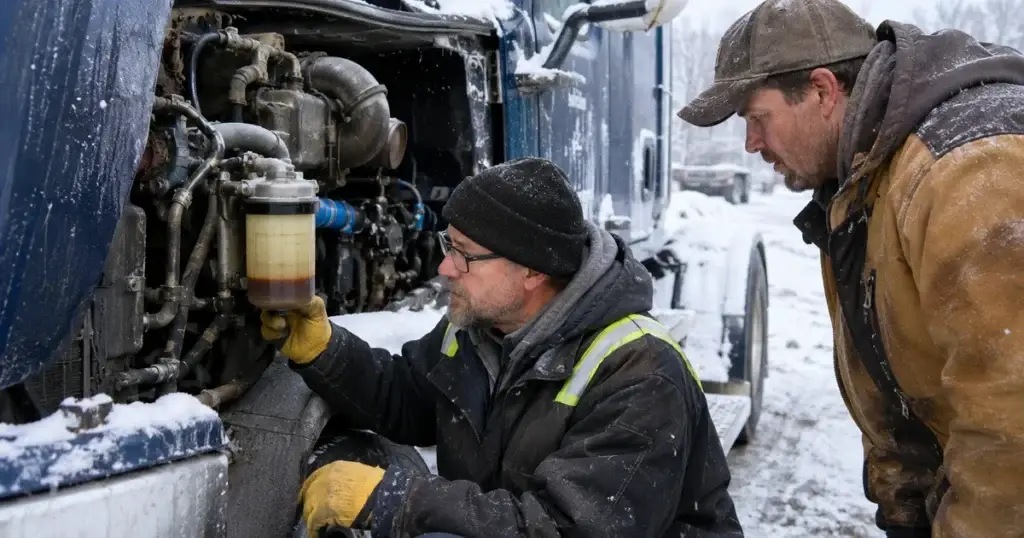
Diesel fuel gelling usually shows up as a hard start, power loss under load or a stall after a few minutes, because the filter plugs as the fuel pulls through it. The engine may restart after sitting and warming, then fail again. Fuel economy often falls before the stall, since the lift pump and injection system work harder against a restricted filter.
| Symptom | Gelling signs | Rule out |
|---|---|---|
| Hard or no start | Cold morning, waxy or cloudy fuel in the filter | Weak batteries; air in the system |
| Power loss under load | Worse at highway speed; filter restriction | Plugged filter from contamination |
| Stalls after a few minutes | Restarts after warming | Lift pump or air leak |
| Ice instead of wax | Water below 32°F in filters or tank | Water in fuel; see contamination guide |
Water ice is the most common lookalike. The Minnesota Department of Agriculture notes that water in filters can freeze below 32°F and block flow, so a clear water-separator bowl and a drained sump matter as much as additives. HDJ's fuel contamination prevention guide and air in the fuel system guide help separate gelling from the other causes, and the low-pressure fuel system testing guide covers the tests.
05
Winter Blends and No. 1 Diesel
Winter diesel is usually No. 2 diesel blended with No. 1 diesel, which is lighter and has a much lower cloud point. The Minnesota Department of Agriculture lists No. 1 at -40°F or lower and says users should set the blend ratio with the distributor. It also advises putting No. 1 in the tank first and No. 2 on top, so the two mix as the tank fills. Blending is the first defense against diesel fuel gelling.
| Condition | Blend example | Additive |
|---|---|---|
| Below 35°F | About 70% No. 2, 30% No. 1 | Cold flow improver |
| Deep winter | About 30% No. 2, 70% No. 1 | Cold flow improver |
| Below -30°F | Straight No. 1 diesel | Premium additive to restore levels |
Treat Exhibit 4 as one supplier's published example from 2018, not a rule. ASTM D975 allows No. 1 and No. 2 grades to be blended when a cloud point below -12°C is specified, with flash point, viscosity and distillation limits adjusted. A diluted blend also has less energy per gallon, so fleets should expect some mileage loss and confirm the ratio with the supplier and the engine maker.
06
Anti-Gel Additives vs Emergency De-Gellers
Anti-gel additives, also called cold flow improvers, modify wax crystals so they stay small enough to pass through the filter. They prevent plugging; they do not make the cloud point lower. NREL says additives usually do not change cloud point but can lower CFPP and LTFT, which is why CFPP better predicts operability for treated fuel. CHS puts a typical cold flow improver effective down to about 0°F, which makes additives the second defense against diesel fuel gelling.
Timing matters. The Minnesota Department of Agriculture says winter additives should go in when the fuel is at least 10°F above its cloud point, because wax already formed is not reliably reversed. Emergency de-gelling products are a different class, sold to re-liquefy fuel and thaw filters after a truck has gelled. HDJ's diesel fuel additives guide compares the categories without endorsing a brand.
Engine makers do not agree on additives. In a 2016 Transport Topics report, Navistar said additives should follow a diagnosis, Daimler Trucks North America warned that overtreatment can plug filters and preferred a No. 1 and No. 2 blend, and Peterbilt called additives a temporary fix. HDJ could not find a current, single OEM position, so follow the engine maker's fuel guidance and the supplier's dosing.
07
Fuel Heaters, Filters and Tanks
Heat and filtration keep treated fuel flowing when the wind chill is worst. NREL says heated fuel lines and tanks may be needed in colder months, and that pumps, lines and dispensers should be protected from cold and wind chill with properly approved heating and insulating equipment. OEMs offer factory filter, line and tank heaters on many heavy-duty trucks, and they are worth specifying for northern routes.
Filters need attention before the freeze. Replace them ahead of the first hard cold, because a half-plugged filter has no margin left once wax forms. CHS notes that newer engines with finer filters can plug at a warmer temperature than the documented CFPP, so do not run to the number. HDJ's fuel filter maintenance guide covers intervals and replacement.
Tanks play a part too. NDSU Extension advises keeping at least half a tank to prevent line freezing and gelling, and the Minnesota guide says to keep storage tanks as full as possible to limit air and water entry. Underground bulk tanks stay warmer than aboveground tanks, which should be sheltered or painted with reflective paint.
08
Biodiesel Blends and Cold Flow
Biodiesel raises the risk of diesel fuel gelling because it gels at a higher temperature than petroleum diesel, so blends need extra cold-weather planning. NREL says B100 gels at higher temperatures than most diesel and heating oil, with a cloud point that starts around -3°C (27°F) and can run much higher. NDSU reports untreated B20 can freeze about 3°F to 5°F sooner than No. 2 diesel, while B2 and B5 have little or no effect.
For blends, NREL says the fix is mixing with the winter diesel delivered in your area and testing the result, because no formula predicts it. Penn State Extension adds that flow-improving additives typically lower the usable temperature range by about 5 to 8 degrees and that winter blends with kerosene or winter diesel extend operation to about -20°C. HDJ's biodiesel versus renewable diesel comparison compares the fuels.
Fuel quality testing helps confirm what is in the tank. A lab can report cloud point and water, and HDJ's diesel fuel quality testing guide explains which tests matter. Check the engine maker's biodiesel limits and warranty terms before running a blend through winter, because NDSU specifically advises confirming warranty effects.
09
What to Do When a Truck Gels
A gelled truck should be moved to a heated shop or warmed with approved equipment, then given fresh filters and treated fuel. The steps below follow the extension and trade sources HDJ read. They are a practical order, not an OEM procedure, so check the engine maker's manual first.
Safety Warning
Never use an open flame, torch or heat gun on a fuel tank, filter housing or fuel line. Diesel vapor and fuel leaks can ignite. Use a heated shop, an approved fuel-system heater or a de-gelling product, and keep ignition sources away from open fuel.
Steps when a truck has gelled
- Get it warm. Move the truck into a heated bay or use approved heaters; give the fuel time to warm.
- Add an emergency de-gelling product. Follow the label; this class is made to re-liquefy gelled fuel and thaw filters.
- Replace the filters. Waxed filters often need changing, sometimes more than once.
- Drain water from the separator. Check for ice and water as well as wax.
- Prime and check for air. Run the system pressure checks before cranking repeatedly.
- Treat and top off. Add a cold flow improver and fill with winter-grade fuel to prevent a repeat.
Transport Topics reported in 2016 that gelled trucks sometimes have to be towed to a shop to thaw and that filters may need multiple changes. Avoid repeated cranking, which strains the starter and batteries without moving fuel. If the fuel stays thick after warming, the tank may hold wax-heavy fuel that needs draining and replacement.
10
A Fleet Winter Fuel Plan
A plan for diesel fuel gelling puts timing, fuel grade and filters into one schedule. Heavy Duty Journal suggests tying the plan to the first date the forecast low reaches 10°F above the fuel's cloud point, because that is where the Minnesota guidance says additives should already be in the tank. Michael Nielsen advises assigning one person to own the plan and keep the supplier's fuel data on file.
| When | Action | Owner |
|---|---|---|
| Before the first freeze | Replace filters, drain separators, ask the supplier for cloud point and CFPP | Shop manager |
| When lows near cloud point + 10°F | Start cold flow improver or winter blend | Fuel buyer |
| Cold snaps | Keep tanks over half full and carry spare filters | Drivers |
| After a gel event | Record fuel source, date and temperature | Safety manager |
Record every gelling event with the fuel stop, date and low temperature. Two or three entries often point to one supplier or one tank, which is cheaper to fix than a dozen roadside calls. Share the log with the supplier so winter blends can be adjusted for your lanes, and review it before each winter to see whether diesel fuel gelling events cluster by stop or tank.
-31°F to 23°F
cloud point range NREL gives for diesel fuels, which is why no single gel temperature applies to every load (NREL Biodiesel Handling and Use Guide, Sixth Edition).
Editorial Insight
The HDJ Perspective
According to Heavy Duty Journal, the cheapest gelling protection is knowing the fuel. In HDJ's field experience across 15+ years of coverage, fleets that ask the supplier for cloud point and CFPP in writing, and treat before the forecast low, have far fewer roadside gel events than fleets that react after the first tow.
Key Recommendation
Get the cloud point of your winter fuel from the supplier, add a cold flow improver while the fuel is still at least 10°F above it, and change filters before the first hard freeze.
Free Diesel Maintenance Checklist
Get HDJ's free, field-tested diesel maintenance checklist delivered instantly to your inbox — print it, laminate it, keep it in the shop.
Instant PDF • 100% Free • No Spam

11
What HDJ Could Not Confirm
HDJ could not find a single authoritative temperature for diesel fuel gelling in No. 2 diesel, and the sources above disagree for good reasons: fuels, regions and years differ. Several of the practical figures, including the blend ratios and the 10°F additive-timing rule, come from state, extension or supplier guidance from 2016 to 2022, not from a current engine-maker document.
HDJ also did not test any additive or heater, did not find a current OEM-wide position on aftermarket additives, and did not verify how any particular winter fuel is blended in your region. Figures are current as of November 2026 and should be checked against your supplier's data and the engine manual.
FAQ
Frequently Asked Questions
At what temperature does diesel fuel gel?
There is no single temperature. Published cloud points for No. 2 diesel range from about -31°F to 23°F depending on the fuel, and sources commonly cite 14°F to 15°F. Wax begins at the cloud point, so ask your supplier for the number on your fuel.
What is the difference between cloud point and CFPP?
Cloud point is where wax crystals first appear. Cold filter plugging point (CFPP) is the lowest temperature at which fuel still passes a test filter, and it sits a few degrees lower. Modern fine filters can plug at a warmer temperature than the listed CFPP.
Can an anti-gel additive fix fuel that has already gelled?
Generally no. Anti-gel additives are cold flow improvers meant to go in before wax forms, and the Minnesota guidance says to add them at least 10°F above the cloud point. Emergency de-gelling products are the type sold to re-liquefy gelled fuel and thaw filters.
Is No. 1 diesel better than No. 2 in winter?
For cold flow, yes. No. 1 diesel is lighter and is listed at -40°F or lower for cloud point by the Minnesota Department of Agriculture. It also holds less energy per gallon, so most fleets blend it with No. 2 at a ratio set by the supplier.
How do I tell fuel gelling from frozen water in the fuel?
Look at the filter and water separator. Wax shows as cloudy, waxy or slushy fuel, while ice appears as frozen water in the bowl or filter. Water freezes at 32°F, so ice can block flow before wax does, and both can occur together.
Does biodiesel gel sooner than regular diesel?
Yes. NREL says B100 gels at higher temperatures than most diesel, and NDSU reports untreated B20 can freeze about 3°F to 5°F sooner than No. 2 diesel. B2 and B5 have little effect. Test the actual blend and use winter diesel or additives to compensate.
Should I use a torch to thaw a gelled fuel filter?
No. Open flame near fuel is a fire hazard. Move the truck to a heated shop, use approved heaters or a de-gelling product, and replace the filters. Never use a torch, heat gun or open flame on a tank, filter housing or fuel line.
Can a full fuel tank prevent gelling?
It helps but does not prevent it. NDSU Extension advises keeping at least half a tank to reduce line freezing and gelling, and the Minnesota guide says full tanks limit air and water entry. Treated, winter-grade fuel is still what prevents wax from clogging filters.
When should fleets switch to winter diesel and additives?
Before the forecast low nears the cloud point. The Minnesota guidance says to add winter additives when fuel is at least 10°F above its cloud point, and summer fuel usually carries no cold flow additive. Ask the supplier when winter blends start for your region.
Wrap-up
The Bottom Line
Diesel fuel gelling is predictable. Know the cloud point and CFPP of the fuel you buy, switch to a No. 1 and No. 2 blend and add a cold flow improver before the wax forms, and change filters before the first freeze. If a truck does gel, warm it safely, thaw and replace filters, and never use a flame.
Michael Nielsen and the Heavy Duty Journal team publish fuel system and winter maintenance guides at heavydutyjournal.com. For fleets, the most useful step is a written winter fuel plan, and HDJ's diesel fuel gelling guidance on heavydutyjournal.com will be updated as supplier and OEM practice changes.
Share This Winter Fuel Guide
Know a fleet or owner-operator heading into winter? Share this guide so their trucks stay out of the tow lot.