
The transportation sector faces mounting pressure to reduce emissions without sacrificing operational performance. Biodiesel and renewable diesel have emerged as leading alternatives to petroleum diesel, yet fleet managers often treat these fuels as interchangeable solutions. That assumption can prove costly.
Biodiesel (FAME) and renewable diesel (HVO) represent fundamentally different products with distinct operational characteristics. Biodiesel comes from biological feedstocks processed through esterification, creating fatty acid methyl esters with oxygen molecules in their structure. Renewable diesel undergoes hydrotreating to produce paraffinic hydrocarbons chemically identical to petroleum diesel, with zero oxygen content.
These production differences create significant performance variations. Renewable diesel functions as a true drop-in replacement requiring no engine modifications, blending restrictions, or infrastructure changes. Biodiesel requires blend level management, separate storage infrastructure, and attention to cold weather limitations.
Fleet managers operating Class 8 trucks, agricultural equipment, or mixed vehicle fleets need accurate information to evaluate which fuel serves their specific requirements. Engine compatibility varies between these options. Cold weather performance differs substantially. Total cost of ownership calculations must account for fuel pricing, efficiency impacts, and maintenance considerations.
Last Updated: November 2025
Key Takeaways
- Chemical Structure: Renewable diesel consists of pure hydrocarbons matching petroleum diesel specifications, while biodiesel contains oxygen molecules creating distinct performance characteristics
- Engine Compatibility: Renewable diesel works in all diesel engines without modifications or warranty concerns, while biodiesel requires checking manufacturer blend level approvals
- Cold Weather Performance: Renewable diesel operates reliably at -10°F to -30°F, while biodiesel gels at 32-40°F requiring winterization strategies
- Cost Differential: Biodiesel typically costs $0.20-$0.80 per gallon above petroleum diesel, renewable diesel commands $0.50-$1.50 premiums before federal and state incentives
- Environmental Benefits: Both fuels achieve 50-85% greenhouse gas reductions compared to petroleum diesel, with waste-based feedstocks delivering superior carbon intensity scores
Biodiesel’s ester-based molecular structure differentiates it from petroleum diesel’s pure hydrocarbon composition
What Is Biodiesel?
Fatty acid methyl ester, commonly known as FAME biodiesel, serves as a domestically-produced renewable fuel for compression ignition engines. Manufacturers create it by chemically transforming lipids from plants and animals into diesel-compatible liquid fuel through transesterification.
The presence of oxygen molecules within biodiesel’s structure fundamentally distinguishes it from petroleum diesel. This chemical difference affects combustion characteristics, storage stability, and cold weather performance. The oxygen content contributes to cleaner burning but introduces unique handling requirements that fleet operators must understand.
Chemical Composition and Production Process
Transesterification represents the core manufacturing method for biodiesel production. This chemical reaction breaks apart triglyceride molecules found in fats and oils, then recombines them with methanol to form methyl esters.
During transesterification, manufacturers introduce methanol and a catalyst—typically sodium hydroxide or potassium hydroxide—to heated feedstock oils. The catalyst accelerates the reaction that separates glycerin from fatty acid chains. These fatty acids then bond with methanol molecules to create fatty acid methyl esters.
The reaction produces two distinct products: biodiesel and glycerin. Glycerin settles to the bottom of processing tanks, allowing producers to separate it for use in soap manufacturing and industrial applications. The biodiesel undergoes washing to remove residual catalyst and methanol before final drying to meet ASTM D6751 specifications.
Temperature control during transesterification directly impacts production efficiency and fuel quality. Most operations maintain temperatures between 140°F and 160°F to optimize reaction rates without causing feedstock degradation.
Common Feedstocks for Biodiesel
Biodiesel producers source raw materials from diverse biological origins. Feedstock selection depends on regional availability, cost considerations, and desired fuel characteristics.
Soybean oil dominates United States biodiesel production, accounting for the majority of feedstock inputs. The extensive soybean cultivation across Midwestern states provides reliable supply chains and established processing infrastructure. Canola oil serves as another significant vegetable oil feedstock, particularly in northern growing regions.
Animal fats from beef tallow, pork lard, and poultry fat represent cost-effective feedstock alternatives. Meat processing facilities generate these materials as byproducts, creating steady supply streams independent of agricultural crop cycles.
Used cooking oil collected from restaurants and food processors provides an increasingly valuable feedstock source. This waste stream diverts material from landfills while offering favorable carbon intensity scores under environmental regulations. In 2022, global trade of used cooking oil for clean fuels reached 3.7 billion gallons, with 850 million gallons available in the United States.
Biodiesel Blends and Designations
The biodiesel industry uses standardized nomenclature to identify fuel blend percentages. These designations combine pure biodiesel with petroleum diesel in specific ratios, with the numerical value indicating the biodiesel percentage.
B100 indicates pure biodiesel without any petroleum diesel content. This fuel delivers maximum renewable content and emissions benefits but requires special handling considerations for cold-weather operations. Most vehicle manufacturers do not warranty engines operating on B100 without specific approvals.
The B20 blend combines 20% biodiesel with 80% petroleum diesel, representing the most widely-used higher-level blend in commercial applications. Fleet operators favor B20 because it provides substantial emissions reductions while maintaining compatibility with existing diesel engines and fuel systems.
B5 contains just 5% biodiesel mixed with 95% petroleum diesel, meeting the most conservative manufacturer warranty specifications. Virtually all diesel engines manufactured since 2000 can operate on B5 without modifications or special precautions.
What Is Renewable Diesel?
Green diesel, technically known as hydrotreated vegetable oil (HVO), transforms biological feedstocks into fuel chemically indistinguishable from petroleum-derived diesel. This advanced biofuel consists entirely of paraffinic hydrocarbons with zero oxygen content.
The production process removes all oxygen, nitrogen, and sulfur compounds through sophisticated refining. This results in fuel that meets ASTM D975 specifications—the same standard applied to conventional petroleum diesel. Renewable diesel functions as a true drop-in replacement without requiring engine modifications or infrastructure changes.
Hydrotreating removes oxygen atoms and saturates hydrocarbon chains to create fuel identical to petroleum diesel
Chemical Structure and Manufacturing
The molecular architecture of HVO renewable diesel consists exclusively of saturated hydrocarbon chains. These straight-chain and branched alkanes mirror the exact chemical structure found in petroleum diesel refined from crude oil.
Manufacturing begins with feedstock pretreatment to eliminate contaminants. The cleaned biological materials then enter specialized hydrotreating reactors operating at temperatures between 300-400°C and pressures of 30-130 bar in the presence of proprietary catalysts.
During hydrotreating, feedstock molecules react with hydrogen gas under these extreme conditions. The process breaks ester bonds present in vegetable oils and animal fats. Oxygen atoms are removed as water molecules, while double bonds become saturated with hydrogen.
The catalytic reaction produces linear and branched paraffins chemically identical to diesel fuel molecules. This transformation explains why renewable diesel performs identically to petroleum diesel in all applications.
Feedstock Sources for Renewable Diesel
Renewable diesel production utilizes diverse biological materials as starting ingredients. Current manufacturing predominantly relies on waste streams and residual materials rather than virgin crops.
Used cooking oil represents one of the most valuable feedstocks for renewable diesel production. Restaurants, food processors, and industrial kitchens generate substantial quantities of waste cooking oil that would otherwise require disposal. This feedstock offers excellent carbon intensity scores because it diverts waste from landfills while avoiding land use change impacts.
Animal fats from rendering operations provide another significant feedstock source. Tallow, poultry fat, and other animal-derived lipids work effectively in hydrotreating processes. Corn oil extracted during ethanol production adds to the feedstock supply chain, creating an additional revenue stream for ethanol facilities.
Purpose-grown energy crops offer potential for future feedstock expansion. Camelina and carinata represent low-input oilseed crops that grow on marginal lands with minimal water and fertilizer requirements. However, current production focuses primarily on waste-based feedstocks due to favorable economics and sustainability profiles.
How Renewable Diesel Differs from Biodiesel Chemically
The fundamental chemical distinction between renewable diesel and biodiesel determines their divergent performance characteristics. Biodiesel consists of fatty acid methyl esters containing oxygen atoms within the molecular structure. Renewable diesel contains zero oxygen, existing as pure paraffinic molecules.
This hydrocarbon-only composition makes renewable diesel molecularly identical to petroleum diesel. The structural difference explains why renewable diesel qualifies as a drop-in fuel while biodiesel requires blending considerations.
| Fuel Property | Renewable Diesel (HVO) | Biodiesel (FAME) | Petroleum Diesel |
|---|---|---|---|
| Chemical Composition | Paraffinic hydrocarbons | Fatty acid methyl esters | Paraffinic hydrocarbons |
| Oxygen Content | 0% | 10-11% | 0% |
| ASTM Standard | D975 (same as diesel) | D6751 (separate standard) | D975 |
| Cloud Point Range | -10°F to -30°F | 32°F to 40°F | 0°F to 15°F |
The oxygen content in biodiesel affects fuel stability, storage characteristics, and cold weather performance. Ester bonds are susceptible to oxidation and microbial growth during extended storage. Renewable diesel’s hydrocarbon structure eliminates compatibility concerns with engine seals, gaskets, and fuel system components.
Infrastructure compatibility represents another critical difference stemming from chemical structure. Renewable diesel flows through conventional petroleum pipelines without segregation requirements. Biodiesel requires separate handling, dedicated storage, and cannot be transported in multi-product pipelines due to its distinct properties.
Stay Ahead of Industry Trends
Get expert insights, equipment reviews, and operational strategies delivered to your inbox weekly.
Production Methods and Quality Standards
Production methodologies separate biodiesel from renewable diesel through distinct chemical pathways that determine fuel quality and engine compatibility. Understanding these manufacturing differences provides essential context for evaluating performance characteristics and infrastructure requirements.
Transesterification Process for Biodiesel
Biodiesel production relies on transesterification, a relatively straightforward chemical process accessible to operations ranging from small farm facilities to large industrial plants.
Feedstock preparation begins with critical cleaning steps. Degumming removes phospholipids that interfere with catalyst performance. Neutralization eliminates free fatty acids that cause soap formation, while drying reduces moisture content below specifications.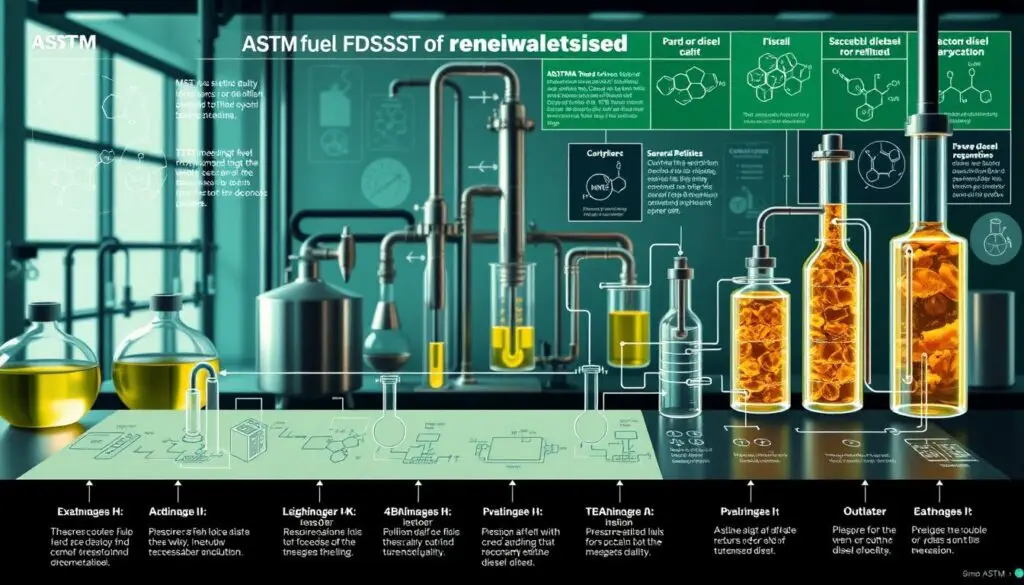
Separate ASTM standards govern biodiesel (D6751) and petroleum diesel (D975), reflecting their distinct chemical properties
The core reaction combines cleaned triglycerides with methanol in a 6:1 molar ratio alongside a base catalyst. Heated reaction vessels maintain optimal temperatures while the catalyst breaks the glycerol backbone, yielding three methyl ester molecules plus glycerin as a valuable co-product.
Hydrotreating Process for Renewable Diesel
Renewable diesel production demands significantly more sophisticated infrastructure through hydrotreating, a process requiring specialized high-pressure reactors, hydrogen supply systems, and advanced catalyst technologies.
Feedstocks undergo rigorous pretreatment before entering hydrotreating reactors operating at elevated temperatures and pressures. Multiple simultaneous reactions transform organic molecules into saturated hydrocarbons chemically identical to petroleum diesel components.
Hydrogenation saturates carbon-carbon double bonds, improving fuel stability and cold weather performance. Hydrodeoxygenation removes oxygen atoms as water or carbon dioxide, creating true hydrocarbon molecules. These reactions ensure the finished fuel meets ultra-low emission standards.
The resulting saturated hydrocarbons pass through fractionation units that separate products matching diesel, jet fuel, and naphtha specifications. This versatility allows renewable diesel producers to optimize product slates based on market demands.
Quality Standards and Certifications
Different production methods necessitate separate quality frameworks governing fuel specifications and performance requirements. ASTM D6751 establishes comprehensive requirements specifically for biodiesel fuel, measuring ester content, flash point, water and sediment levels, cloud point, and oxidation stability.
Renewable diesel’s chemical equivalence to petroleum diesel allows it to meet ASTM D975—the identical standard governing conventional diesel fuel. This remarkable compatibility eliminates the need for separate handling infrastructure or specialized storage facilities.
Quality assurance programs track production consistency through continuous monitoring of feedstock quality, process parameters, and finished product specifications. Third-party verification ensures compliance with all applicable standards, building confidence across supply chains.
Engine Compatibility and Vehicle Applications
The practical implementation of alternative diesel fuels depends heavily on equipment compatibility and warranty considerations. Fleet managers evaluating fuel options must understand how each type interacts with existing engines, fuel systems, and infrastructure.
Biodiesel Compatibility with Diesel Engines
Modern diesel engines accommodate biodiesel blends successfully when the fuel meets strict ASTM D6751 specifications. These standards govern properties like cetane number, cloud point, oxidation stability, and cold soak filterability.
Manufacturers typically specify maximum biodiesel blend levels in warranty documentation. Light-duty diesel vehicles generally approve B5 blends as standard. Medium-duty applications often accept B20 blends without modifications. Some heavy-duty engines approve higher biodiesel blends up to B100 for specific models.
Equipment built before the mid-1990s may contain elastomers vulnerable to biodiesel. Natural rubber compounds and certain synthetic materials can experience swelling, hardening, or deterioration when exposed to biodiesel. Modern engines use biodiesel-compatible materials throughout fuel systems, including fluorocarbon elastomers and advanced synthetic compounds.
Renewable Diesel as a Drop-In Replacement Fuel
Renewable diesel offers distinct advantages for diesel engine compatibility across all applications. Its chemical structure matches petroleum diesel specifications precisely, eliminating compatibility concerns that sometimes accompany biodiesel adoption.
Renewable diesel requires no modifications to fuel injection systems, pumps, or engine components
The fuel meets ASTM D975 standards for petroleum diesel without modifications. This compliance allows renewable diesel to function identically to conventional fuel in all diesel engines. Fleet operators experience seamless transitions without technical complications.
Renewable diesel requires absolutely no engine modifications, fuel system component changes, or operational procedure adjustments. This compatibility extends to existing fuel storage and distribution infrastructure. Tanks, pumps, filters, and dispensing equipment handle renewable diesel identically to petroleum diesel.
Manufacturer Warranties and OEM Approvals
Original Equipment Manufacturers maintain varying positions on biodiesel blend levels in warranty documentation. Major engine manufacturers including Cummins, Detroit Diesel, and Caterpillar explicitly approve renewable diesel use without warranty restrictions, as renewable diesel meets ASTM D975 petroleum diesel specifications.
The warranty distinction between biodiesel and renewable diesel significantly impacts fleet decisions. Operators concerned about warranty protection often prefer renewable diesel for critical equipment. This consideration becomes particularly important for expensive heavy-duty engines where warranty coverage protects substantial capital investments.
Fuel Performance Comparison
Fuel performance characteristics separate biodiesel from renewable diesel in ways that matter to fleet managers and individual drivers. Understanding how these alternative fuels behave in real-world conditions helps operators select the right option for their vehicles and applications.
Cetane Ratings and Combustion Quality
The cetane number measures a fuel’s ignition quality and combustion characteristics. Higher cetane ratings indicate shorter ignition delay periods and smoother, more complete combustion.
Biodiesel typically exhibits cetane numbers between 47 and 65, depending on feedstock source. Soybean-based biodiesel averages 50-55, which meets or exceeds the ASTM D6751 minimum requirement of 47.
Renewable diesel demonstrates exceptional performance in this category. The fuel delivers cetane numbers typically ranging from 70 to 90, significantly exceeding petroleum diesel’s usual 40-45 range. This substantial advantage translates into enhanced cold starting capability, reduced combustion noise, lower emissions output, and improved engine response.
Renewable diesel’s superior cetane rating delivers measurable performance advantages in ignition quality and combustion efficiency
Energy Content and Fuel Economy
Energy density directly influences how far vehicles travel on each gallon of fuel. Biodiesel contains approximately 118,000 BTU per gallon compared to petroleum diesel’s 130,000 BTU per gallon. This represents roughly 8-10% lower energy density due to oxygen molecules present in the ester structure.
Renewable diesel approaches conventional diesel’s energy content more closely, containing approximately 123,000 to 128,000 BTU per gallon. This closer match results from renewable diesel’s hydrocarbon structure that closely mimics petroleum diesel molecules.
Vehicles running on B20 biodiesel blends typically experience approximately 1-2% fuel economy reduction compared to straight petroleum diesel. Renewable diesel maintains fuel economy performance much closer to conventional diesel, with most operators reporting less than 1-2% difference in miles per gallon during typical operations.
Cold Weather Performance and Cloud Point
Temperature sensitivity creates one of the most significant operational differences between these alternative fuels. Biodiesel faces challenges in cold climates due to its higher cloud point—the temperature where wax crystals begin forming.
Soybean biodiesel typically shows cloud points between 32°F and 40°F, which can cause filter plugging and fuel line blockages in winter conditions. Operators in northern regions must implement specific winterization strategies including using lower biodiesel blend percentages during cold months, adding cold flow improver additives, storing vehicles in heated facilities, and purchasing specially formulated winterized biodiesel blends.
Renewable diesel excels in cold weather conditions. The fuel exhibits cloud points between -10°F and -20°F, with some formulations reaching -30°F or lower. These superior cold flow properties make renewable diesel suitable for Arctic operations and extreme winter climates without special additives or modifications.
Lubricity and Engine Protection
Lubricity describes a fuel’s ability to reduce friction between moving parts in fuel injection systems. Both biodiesel and renewable diesel provide excellent lubricity characteristics that help protect fuel injection systems.
These alternative fuels surpass petroleum diesel in lubricating properties, offering superior protection for precision components. The natural lubricity reduces wear on fuel pumps, injectors, and other critical engine parts. The enhanced lubricity partially offsets other potential challenges, making both options attractive for preserving expensive fuel injection equipment.
Cost Analysis and Economic Factors
The financial landscape for alternative diesel fuels involves complex pricing dynamics, government incentives, and long-term operational costs. Understanding these economic elements helps businesses develop effective fuel procurement strategies.
The alternative diesel market has created substantial economic value across the United States. The biodiesel and renewable diesel industry supports $23.2 billion in economic activity and maintains 75,200 jobs nationwide, according to U.S. Department of Energy data.
Current Market Prices and Regional Variations
Biodiesel cost typically runs $0.20 to $0.80 per gallon above conventional petroleum diesel depending on market conditions. Feedstock expenses represent the largest production cost component, accounting for 70-85% of total manufacturing expenses.
Geographic location and feedstock availability create significant price variations across U.S. regions
Geographic location significantly affects biodiesel cost due to feedstock availability and transportation logistics. Midwest agricultural regions near soybean processing facilities typically offer the most competitive pricing. Coastal markets generally pay premium prices because of transportation costs from inland production facilities.
Renewable diesel price commands a premium typically ranging from $0.50 to $1.50 per gallon above petroleum diesel. These elevated costs reflect the capital-intensive hydrotreating process, hydrogen requirements, and sophisticated refining infrastructure. Nearly all domestically produced renewable diesel flows to California due to economic advantages under the Low Carbon Fuel Standard.
Federal and State Incentives
Renewable fuel incentives fundamentally alter the economic competitiveness of alternative diesel fuels compared to conventional petroleum products. The federal Blenders Tax Credit provides $1.00 per gallon for biodiesel and renewable diesel blended with petroleum diesel.
California’s Low Carbon Fuel Standard program awards tradable credits based on fuels’ carbon intensity scores. These LCFS credits historically trade at values between $80 and $200 per metric ton of CO2 equivalent. The program provides substantial revenue to low carbon fuels producers.
Renewable diesel’s superior carbon intensity profile generates more valuable LCFS credits compared to biodiesel. This advantage explains why renewable diesel producers target the California market despite higher distribution costs.
Total Cost of Ownership Considerations
Comprehensive economic analysis requires examining costs beyond simple pump prices. Total cost of ownership encompasses fuel economy impacts, maintenance expenses, infrastructure requirements, and environmental compliance value.
Fuel characteristics influence maintenance requirements throughout vehicle service life. Renewable diesel’s superior cetane rating and chemical purity may reduce fuel injector maintenance needs and extend service intervals. Biodiesel may require more frequent fuel filter changes, particularly when using higher blend percentages.
| Cost Factor | Biodiesel (B20) | Renewable Diesel | Petroleum Diesel |
|---|---|---|---|
| Price per Gallon (Before Incentives) | $3.80-$4.60 | $4.20-$5.20 | $3.60-$4.00 |
| Relative Energy Content | 92-94% | 98-100% | 100% |
| After Federal Tax Credit | $2.80-$3.60 | $3.20-$4.20 | $3.60-$4.00 |
Environmental compliance value represents an increasingly important cost consideration for corporate fleets. Emission reduction credits, sustainability reporting benefits, and corporate environmental goals provide intangible value that enhances the economic case for alternative fuels.
Environmental Impact and Sustainability
Clean diesel fuels deliver measurable environmental advantages extending beyond simple fuel substitution to comprehensive carbon reduction strategies. Both biodiesel and renewable diesel offer transportation operators effective pathways to reduce greenhouse gas emissions while improving local air quality.
Greenhouse Gas Emission Reductions
Lifecycle greenhouse gas emission calculations account for all carbon releases from feedstock cultivation through final combustion. Research demonstrates that biodiesel and renewable diesel reduce greenhouse gas emissions by at least 50% compared to petroleum diesel, according to National Renewable Energy Laboratory studies.
Biodiesel typically achieves 50-60% greenhouse gas reduction when produced from soybean oil. Waste-based biodiesel from used cooking oil and animal fats achieves even greater emission reductions, reaching 70-80% compared to petroleum diesel.
Renewable diesel achieves more substantial greenhouse gas reductions than biodiesel across most production pathways. Waste oil-based renewable diesel typically delivers 65-80% emissions reduction compared to petroleum diesel. Some optimized production pathways exceed 85% reduction through advanced processing techniques and efficient feedstock utilization.
Waste-based feedstocks deliver the lowest carbon intensity scores for both biodiesel and renewable diesel
Carbon Intensity Scores Under California LCFS
California’s Low Carbon Fuel Standard program quantifies fuel performance through carbon intensity measurements. Carbon intensity represents grams of CO2 equivalent per megajoule of energy delivered.
Petroleum diesel establishes the baseline at approximately 94 grams of carbon intensity per megajoule. Renewable diesel from used cooking oil achieves scores as low as 20-30 gCI, representing 68-78% reduction. Biodiesel from soybean oil typically scores 40-50 gCI, delivering 47-57% reduction compared to the petroleum baseline.
These carbon intensity scores directly determine credit generation and economic value under the LCFS program, creating financial incentives for lower-carbon fuel production.
Air Quality and Particulate Matter Emissions
Local emission impacts affect urban areas and communities near transportation corridors. Clean diesel fuels improve air quality through reduced particulate matter, carbon monoxide, and hydrocarbon emissions.
Biodiesel reduces tailpipe emissions containing particulate matter by 45-50% compared to petroleum diesel in most engines. This substantially lowers harmful soot that contributes to respiratory health problems. Carbon monoxide emissions decrease approximately 35-50% with biodiesel use.
Renewable diesel achieves particulate matter reductions of 30-40% compared to petroleum diesel. These reductions occur consistently across different engine types and operating conditions. Both fuels deliver immediate health benefits in populated areas with heavy diesel vehicle traffic.
Nitrogen oxide emissions present a complex comparison. Biodiesel shows slight NOx increases (2-5%) with older engines, though modern engines with advanced emission control systems show neutral or reduced NOx. Renewable diesel demonstrates consistent NOx reductions of 5-15% compared to petroleum diesel across all engine types.
Sustainability and Feedstock Considerations
Feedstock sourcing considerations extend environmental analysis beyond combustion emissions. Waste-based feedstocks including used cooking oil and animal fats offer superior sustainability profiles by utilizing existing waste streams.
These waste materials avoid land use and agricultural impacts associated with purpose-grown energy crops. Converting waste into clean diesel fuels prevents methane emissions from decomposition while creating valuable energy products. Transportation operators increasingly prioritize waste-based fuels to maximize environmental benefits.
Share Your Expertise
Join Heavy Duty Journal as a guest author and reach thousands of industry decision-makers.
Biodiesel vs Renewable Diesel: Direct Comparison
Fleet managers face an important decision when choosing between alternative diesel fuels that significantly affect performance and profitability. The best fuel type depends on vehicle specifications, operating conditions, and cost-effectiveness for specific circumstances.
Performance Metrics Side by Side
Comparing operational characteristics reveals important distinctions affecting daily fleet operations. Renewable diesel’s higher cetane rating and energy density more closely approximate petroleum diesel performance. The fuel maintains rated horsepower and torque specifications across the entire operating range.
Biodiesel’s slightly lower energy content results in marginal power reduction for blended fuels. B20 blends typically show a 1-3% decrease in power output that operators rarely notice in typical applications. However, this difference may affect performance during maximum load conditions.
Storage characteristics significantly impact operational flexibility. Biodiesel’s unsaturated ester bonds make it susceptible to oxidation, limiting storage periods to 3-6 months without antioxidant additives. Renewable diesel’s saturated hydrocarbon structure provides excellent oxidation stability comparable to petroleum diesel, supporting storage periods exceeding 12 months.
| Performance Factor | Biodiesel (B20) | Renewable Diesel | Petroleum Diesel |
|---|---|---|---|
| Cetane Number | 47-55 | 70-90 | 40-45 |
| Cloud Point | 32-40°F | -10°F to -30°F | 0°F to 15°F |
| Storage Stability | 3-6 months | 12+ months | 12+ months |
| Infrastructure Compatibility | Dedicated storage required | Common tanks with diesel | Standard infrastructure |
Application-Specific Recommendations
Economic analysis requires application-specific evaluation since optimal fuel selection varies by use case.
For heavy-duty trucks and commercial fleets, Class 8 trucks represent the primary target market for alternative diesel adoption. These vehicles consume 20,000-30,000 gallons annually while traveling 150,000+ miles. Heavy-duty operations benefit most from renewable diesel’s performance advantages. The higher cetane rating improves combustion efficiency, while energy content matching petroleum diesel maintains fuel economy.
Off-road and agricultural equipment face unique considerations affecting fuel selection. Seasonal usage patterns, extended storage periods, and operation in remote locations create challenges. Biodiesel’s oxidation sensitivity and cold flow limitations create problems for agricultural applications. Renewable diesel’s stability and cold performance prove advantageous for seasonal equipment.
Which Alternative Diesel Fuel Is Right for Your Needs
Selecting between biodiesel and renewable diesel requires evaluating multiple factors specific to your operation.
Choose renewable diesel if operations include frequent exposure to extremely cold conditions, equipment under manufacturer warranties with blend restrictions, extended fuel storage periods between uses, mixed fleets requiring universal fuel compatibility, or operation in LCFS states where carbon credits offset higher fuel costs.
Choose biodiesel if priorities are minimizing upfront fuel costs while achieving environmental benefits, operating in regions with established biodiesel distribution networks, running older equipment approved for higher blend levels, or managing fleets in moderate climates without extreme cold exposure.
Regional considerations significantly influence fuel selection. Midwest operators find abundant biodiesel supplies at competitive prices. West Coast fleets benefit from renewable diesel incentives and availability. Climate conditions play a decisive role in fuel performance, with northern states favoring renewable diesel’s cold flow properties.
Conclusion
The transportation industry continues moving toward cleaner solutions that reduce fossil fuel consumption. Understanding the differences in biodiesel vs renewable diesel helps fleet managers make informed decisions balancing performance, cost, and environmental goals.
Renewable diesel stands out as a drop-in replacement working seamlessly with existing diesel engines and infrastructure. This sustainable diesel option delivers excellent cold weather performance and provides the highest emission reductions without requiring equipment modifications.
Biodiesel offers a cost-effective path to sustainability for fleets operating in warmer climates or those willing to manage blend level requirements. The lower price point makes it attractive for price-sensitive operations with established regional supply chains.
Both fleet fuel solutions deliver immediate carbon reductions between 50-85% compared to petroleum diesel. Transportation operators can start reducing their carbon footprint today using existing diesel equipment. Fleet managers should evaluate specific needs by consulting engine manufacturer specifications and analyzing regional fuel availability.
Frequently Asked Questions
Can I use biodiesel and renewable diesel interchangeably in my diesel vehicle?
No, these fuels are not interchangeable despite both being sustainable alternatives. Biodiesel requires checking your manufacturer’s warranty for approved blend levels (typically B5-B20), may require separate storage infrastructure, and has different cold weather characteristics. Renewable diesel functions as a true drop-in replacement requiring no engine modifications, fuel system changes, or special handling procedures.
What is the difference between B20 biodiesel and renewable diesel?
B20 biodiesel is a blend containing 20% biodiesel (fatty acid methyl esters) and 80% petroleum diesel, governed by ASTM D6751 specifications with oxygen content. Renewable diesel is 100% paraffinic hydrocarbons molecularly identical to petroleum diesel, requiring no blending and meeting ASTM D975 conventional diesel standards. B20 may cause 1-2% fuel economy reduction and has cloud points around 32-40°F, while renewable diesel maintains fuel economy and performs in temperatures as low as -20°F to -30°F.
Which alternative diesel fuel offers better fuel economy?
Renewable diesel provides significantly better fuel economy performance. Biodiesel contains approximately 118,000 BTU per gallon compared to petroleum diesel’s 130,000 BTU per gallon, representing 8-10% lower energy density that translates to slightly reduced fuel economy. Renewable diesel contains 123,000-128,000 BTU per gallon, approaching petroleum diesel’s energy content with minimal fuel economy impact.
Do I need to modify my diesel engine to use renewable diesel?
No modifications whatsoever are required to use renewable diesel. It functions as a complete drop-in replacement fuel compatible with all diesel engines from passenger vehicles to Class 8 heavy-duty trucks, agricultural equipment, marine vessels, and stationary generators. You need no fuel system component changes, infrastructure investment, or maintenance schedule modifications.
How does biodiesel perform in cold weather compared to renewable diesel?
Renewable diesel demonstrates vastly superior cold weather performance. Biodiesel typically has cloud points between 32-40°F, potentially causing filter plugging and fuel gelling in winter conditions, requiring winterized blends, fuel additives, or lower blend percentages. Renewable diesel exhibits cloud points between -10°F to -20°F, with some formulations reaching -30°F or lower, making it suitable for Arctic and extreme winter operations without special additives.
What are the typical cetane ratings for biodiesel versus renewable diesel?
Biodiesel typically exhibits cetane numbers between 47-65 depending on feedstock, with soybean-based biodiesel averaging 50-55. Renewable diesel demonstrates superior cetane performance with values typically ranging from 70-90, significantly exceeding petroleum diesel’s typical 40-45 range. This elevated cetane number results in improved cold starting, reduced combustion noise, lower emissions, and enhanced engine performance.
How much more expensive is renewable diesel compared to biodiesel?
Renewable diesel typically costs more than biodiesel before incentives are applied. Biodiesel usually trades at premiums ranging from $0.20 to $0.80 per gallon above petroleum diesel, while renewable diesel commands premium pricing typically $0.50 to $1.50 per gallon above petroleum diesel. However, the federal Blenders Tax Credit ($1.00 per gallon) and California’s Low Carbon Fuel Standard credits substantially improve cost competitiveness.
Can biodiesel damage older diesel engines or fuel systems?
Biodiesel’s solvent properties can degrade certain elastomers and natural rubber compounds used in older fuel systems manufactured before the mid-1990s, potentially causing swelling, hardening, or deterioration of seals and gaskets. Modern diesel engines manufactured after the mid-1990s use biodiesel-compatible materials including fluorocarbon elastomers that resist degradation. Fleet operators with older equipment should verify fuel system material compatibility or consider renewable diesel.
Which alternative diesel fuel provides greater greenhouse gas emission reductions?
Renewable diesel generally achieves higher greenhouse gas reductions, though both fuels deliver substantial environmental benefits. Biodiesel typically achieves 50-60% greenhouse gas reduction when produced from soybean oil, with reductions reaching 70-80% for waste-based biodiesel. Waste oil-based renewable diesel achieves 65-80% lifecycle emission reductions, with some optimized production pathways exceeding 85% reduction.
How long can I store biodiesel compared to renewable diesel?
Renewable diesel offers significantly better storage stability than biodiesel. Biodiesel’s unsaturated ester bonds make it susceptible to oxidation, limiting storage periods to 3-6 months without antioxidant additives. Renewable diesel’s saturated hydrocarbon structure provides excellent oxidation stability comparable to petroleum diesel, supporting storage periods exceeding 12 months without degradation.
Do biodiesel and renewable diesel require separate storage tanks from petroleum diesel?
Biodiesel requires dedicated storage tanks, transfer equipment, and blending facilities separate from petroleum diesel infrastructure due to its distinct chemical properties and ASTM D6751 specification classification. Renewable diesel’s complete compatibility with existing petroleum infrastructure enables storage in common tanks with conventional diesel, transfer through existing pipelines, and distribution through conventional terminals without dedicated equipment investment.
Will using biodiesel or renewable diesel void my vehicle warranty?
Renewable diesel will not void warranties since major engine manufacturers explicitly approve its use without restrictions as it meets ASTM D975 petroleum diesel specifications. Biodiesel warranty coverage depends on blend level and manufacturer specifications. Most light-duty diesel vehicles approve B5 blends, medium-duty applications often accept B20, and some heavy-duty engines approve higher blends up to B100.
Which alternative diesel fuel is better for agricultural equipment?
Renewable diesel generally proves superior for agricultural equipment due to seasonal usage patterns, cold weather exposure, extended storage periods, and remote operation locations. Biodiesel’s oxidation sensitivity limits storage to 3-6 months and cold flow limitations create challenges for winter operations. Renewable diesel’s storage stability exceeding 12 months suits seasonal equipment, and cold weather performance accommodates early spring and late fall operations.
What carbon intensity scores do biodiesel and renewable diesel achieve under California’s LCFS?
Under California’s Low Carbon Fuel Standard, renewable diesel from used cooking oil achieves carbon intensity scores as low as 20-30 grams of CO2 equivalent per megajoule (gCI), representing 68-78% reduction compared to petroleum diesel’s baseline of approximately 94 gCI. Biodiesel from soybean oil typically scores 40-50 gCI (47-57% reduction), while waste-based biodiesel achieves 25-40 gCI.
Are there tax credits or incentives available for biodiesel and renewable diesel?
Yes, substantial federal and state incentives affect the economic competitiveness of both fuels. The federal Blenders Tax Credit provides $1.00 per gallon for biodiesel and renewable diesel blended with petroleum diesel. California’s Low Carbon Fuel Standard program awards tradable credits based on carbon intensity scores, with credits historically worth $80-200 per metric ton of CO2 equivalent. Oregon and Washington maintain similar programs.
Share This Article
Share this post with your network and help other industry professionals stay informed.