

Electrifying a heavy-duty fleet requires a complete transformation of assets, depots, workflows, and data systems. A practical fleet electrification plan delivers a clear roadmap that fleet managers can execute today while preparing for future scale across Class 3-8 operations.
The path to successful electrification starts with an EV feasibility study that models charger counts, grid capacity, and operational readiness. Utility approvals, permitting, and equipment procurement often run 12 to 24 months.
Transformers, switchgear, and panels typically drive the schedule. A disciplined approach synchronizes procurement, construction, scheduler training, and data integration to reduce risk and protect on-time departures.
Last Updated: November 2025
Key Takeaways
- Phased roadmap: A structured electrification roadmap reduces risk and keeps procurement, utility coordination, and training synchronized
- Feasibility first: EV feasibility studies establish charger counts, grid capacity needs, and departure confidence before capital commitment
- Charging strategy: Depot charging blends AC and DC fast charging to match duty cycles, budgets, and dwell windows
- Long lead times: Plan for 12+ month delivery windows for panels, transformers, utility-grade meters, and switchgear
- Smart energy management: Cloud-based systems reduce demand charges and support reliable departures using time-of-use optimization
- Operational readiness: Telematics integration, scheduler training, and vendor interoperability testing protect uptime at scale
- Proven playbooks: Real-world deployments show disciplined execution delivers measurable TCO improvement and emissions reduction

Commercial fleets are deploying electric Class 3-8 vehicles as policy support, infrastructure availability, and total cost of ownership converge.
Why Heavy-Duty Truck Fleets Are Electrifying Now
Fleet decision-makers across North America see a clear business case emerging for electrification. Policy alignment, improving vehicle availability, and operational cost advantages are moving Class 3-8 electrification from pilot programs into production-scale deployments.
Operators map adoption drivers against route requirements, grid constraints, and uptime goals to maintain service reliability while transitioning powertrains. The transformation resembles a major IT system upgrade.
New hardware, new software, and revised workflows all require careful coordination. Utility approval timelines and equipment lead times set the deployment pace.
Teams use feasibility simulations and staged build-outs to manage power capacity risk. The result is a viable path toward net-zero fleet operations without service disruption.
Market momentum and policy drivers in the United States
Federal fleet electrification targets signal clear direction, with goals pointing toward 50% of new fleet vehicle acquisitions being electric by 2030. This policy momentum pairs with utility programs and financial incentives.
These drivers help fleets coordinate permitting, transformer procurement, and charge management deployment before vehicles arrive. Manufacturer and carrier case studies show steady deployment across port drayage, urban delivery, and regional haul applications.
A phased approach—assess, pilot, expand—keeps Class 3-8 electrification on schedule even when grid upgrades are required.
Net-zero commitments and brand value for commercial fleets
Nearly two-thirds of the world’s largest public companies now pursue net-zero targets, reshaping freight procurement dynamics. Buyers increasingly favor vendors that document emissions reductions.
This trend pushes more operators toward zero-emission fleets. Early adopters report stronger brand positioning as customers reward visible sustainability progress with contract preferences.
Shippers and retailers track carbon footprints with greater scrutiny. Clear reporting, verified data, and public targets reinforce trust while supporting long-term contracts and access to premium freight lanes.
Total cost of ownership trends for Class 3-8 vehicles
Electricity typically costs less per mile than diesel, and smart charging deepens savings through time-of-use rate optimization. Controlled charge windows help avoid demand spikes, protecting margins as fleet volumes scale.
Lower maintenance requirements—eliminating oil changes and reducing brake wear—add durable operational value. Vehicle purchase price premiums continue narrowing as competitive models enter key duty cycles.
Research from the National Renewable Energy Laboratory shows that when paired with available incentives and optimized depot layouts, Class 3-8 electrification can meet range requirements while delivering favorable total cost of ownership.
Executive Vision, Scope, and Governance for Electrification
Establish a clear strategic direction that connects duty-cycle requirements to board-level objectives. Early governance structures reduce risk, shorten timelines, and prepare sites for long lead-time equipment.
Strong executive alignment keeps funding, policy compliance, and brand goals moving in concert. Utilities and developers can lock in construction schedules when leadership commits early.

Cross-functional leadership teams drive successful electrification by aligning operations, finance, IT, and compliance from program inception.
Appointing an electrification or sustainability program lead
Select an experienced program leader to own strategy and delivery. Grant this individual authority across procurement, operations, IT, and legal functions.
The role drives cross-functional alignment with fleet managers, facility teams, and data security owners. Coordination with utilities such as Pacific Gas and Electric, Duke Energy, and regional cooperatives is essential.
Support the leader with an internal steering committee that meets on a fixed cadence. Include representatives knowledgeable in charging software platforms from companies like Siemens, ABB, and ChargePoint.
Defining timeline, scope, and success criteria
Anchor the timeline to policy milestones and known equipment procurement windows. Define scope by operational segment—last mile, middle mile, regional haul—and map candidate sites to available grid capacity.
Specify software requirements for charging orchestration and energy management to enable load shaping and maintain uptime. Publish measurable success criteria that build executive confidence.
Target total cost of ownership payback within 24 months. Aim for on-time departure reliability above 98%, along with charger availability targets and safety compliance metrics.
Tie these indicators to quarterly business reviews so capital allocation adjusts as operational data improves.
Aligning stakeholders across operations, finance, and compliance
Deploy a governance charter that codifies roles for operations, finance, and compliance functions. Finance teams model incentive structures and demand charge exposure.
Operations groups set duty cycles, maintenance windows, and dispatcher protocols. Compliance manages EPA reporting, OSHA requirements, and state-specific mandates.
Formal governance supports procurement standards, cybersecurity baselines, and access rights for depot facilities and charging data. With durable executive alignment, fleet strategy scope and success metrics remain synchronized from pilot through deployment.
Baseline Fleet Assessment and Data Readiness
Strong program foundations begin with accurate visibility into existing assets, operational patterns, and route structures. A comprehensive fleet baseline assessment establishes shared facts for planning teams, drivers, and finance stakeholders.
Build data readiness capabilities early so decisions align with actual duty requirements and site limitations.

Telematics integration and duty cycle analysis provide the foundation for accurate charger sizing, scheduling, and infrastructure investment decisions.
Inventory, routes, duty cycles, and telematics integration
Document every vehicle by class, model year, VIN, gross vehicle weight rating, and average payload. Map routes with stop counts, dwell times by location, and seasonal variations.
Pair odometer trends with fuel receipts and idling summaries to enable precise duty cycle analysis. Enable telematics integration with platforms from Geotab, Samsara, or Verizon Connect.
Stream trip data into charging management systems to support on-time departure validation, range buffer verification, and charger schedule alignment with actual operational patterns.
Identifying segments: last mile, middle mile, and regional haul
Improve planning precision by segmenting routes into last mile, middle mile, and regional haul categories. Use segmentation to match vehicle range capabilities, payload requirements, and dwell windows with available battery-electric vehicle options.
Where needed, identify bridge strategies using hybrid-electric or plug-in hybrid vehicles for edge cases. Flag urban shuttle operations under 150 miles per day for early adoption consideration.
Tag middle-mile routes with fixed hub-and-spoke patterns and midday dwell opportunities. Mark regional runs exceeding 300 miles with waypoint analysis and overnight dwell.
Environmental impact benchmarking and reporting foundations
Establish emissions benchmarking using EPA emissions factors and verified fuel consumption data. Create baselines for CO2 equivalent, nitrogen oxides, and particulate matter by route segment and operating location.
These figures anchor progress tracking and shape utility engagement discussions. Standardize data readiness with consistent field definitions, timestamp protocols, and GPS accuracy requirements.
Maintain audit trails for route modifications and charging session records. Sustainability reports should align with GHG Protocol methodologies and meet investor-grade review standards.
| Assessment Focus | Key Metrics | Primary Data Source | Action for Electrification |
|---|---|---|---|
| Fleet Baseline | VIN, GVWR, payload, average daily miles | ERP, maintenance logs | Prioritize vehicles with high idle time and short routes |
| Duty Cycle Analysis | Dwell time, stop count, speed profile, idle hours | Telematics trip files | Match charger power levels and schedules to dwell windows |
| Telematics Integration | Data latency, GPS accuracy, CAN bus depth | Geotab, Samsara, Verizon Connect | Feed charging management system to ensure on-time departures |
| Route Segmentation | Last mile, middle mile, regional haul classification | Route plans, dispatch history | Select battery-electric now; identify hybrid bridge for long runs |
Technology Readiness: Vehicles, Chargers, and Site Constraints
Technology selections must align with duty cycles, depot schedules, and local grid constraints. Use pilot data and simulation tools to establish charger power levels, laydown requirements, and uptime targets before committing capital expenditures.

Depot charging infrastructure combines AC overnight charging with DC fast charging to balance capital costs, throughput requirements, and grid capacity.
Selecting battery-electric vehicle options for heavy-duty use cases
Match range requirements, payload capacity, and charging windows to available models from manufacturers including Freightliner eCascadia, Volvo VNR Electric, Tesla Semi, and Lion Electric. Heavy-duty battery-electric vehicles require thermal management systems and preconditioning capabilities.
Build in range buffers for routes encountering grade or adverse weather. Prioritize depot-based charging to control energy costs and maximize time-of-use rate benefits.
Validate real-world efficiency in miles per kilowatt-hour across seasonal conditions. Confirm battery specifications support shift requirements and available dwell time.
AC versus DC fast charging for trucks and buses
Level 2 AC charging supports off-shift energy delivery for yard tractors, step vans, and pool vehicles. It provides steady overnight charging at lower installed costs per charging position.
For transit coaches, refuse trucks, and regional haul applications, DC fast charging reduces required dwell time and maintains tight schedule adherence. DC charging connects more directly to battery packs.
This enables higher power throughput for both buses and delivery vans when route schedules compress available charging windows.
Charger-to-vehicle ratios and grid capacity considerations
Right-size charger deployment ratios based on duty cycle characteristics and dwell patterns. AC charging banks can operate at 3:1 to 5:1 vehicle-to-charger ratios when overnight shifts provide extended dwell.
DC fast charging typically requires 1:1 or 2:1 ratios for rapid turnaround operations. Stage capacity growth to align with transformer and feeder limitations.
Engage utilities early to surface grid constraints, equipment lead times, and make-ready program options. Time-of-use rate alignment and intelligent scheduling reduce peak demand exposure while protecting departure schedule reliability.
Vendor interoperability testing and security profiles
Establish a qualified vendor list of two to three charger manufacturers—such as ABB, Siemens, and ChargePoint—to diversify supply chain and service risk. Conduct laboratory and field interoperability testing with vehicles and charge management platforms.
Verify Open Charge Point Protocol compliance, ISO 15118 functionality, and fault handling behavior. Confirm security profiles include certificate-based authentication, transport encryption, and signed firmware update processes.
Document acceptance criteria to enable consistent, scalable deployment patterns across multiple sites.
Feasibility Modeling and Site Simulations
Build deployment confidence through phased EV charging simulations that transform route and duty-cycle data into actionable site plans. Deploy power capacity modeling to size service upgrades accurately.
Apply departure modeling to protect schedule reliability under real-world operating conditions including temperature extremes and weather events. Run 10 to 20 scenarios per depot location.
Test weekday peak loading, weekend utilization, weather sensitivity, and time-of-use tariff impacts. Simulation outputs guide charger optimization, construction phasing, and site rollout sequencing tied to business priorities.
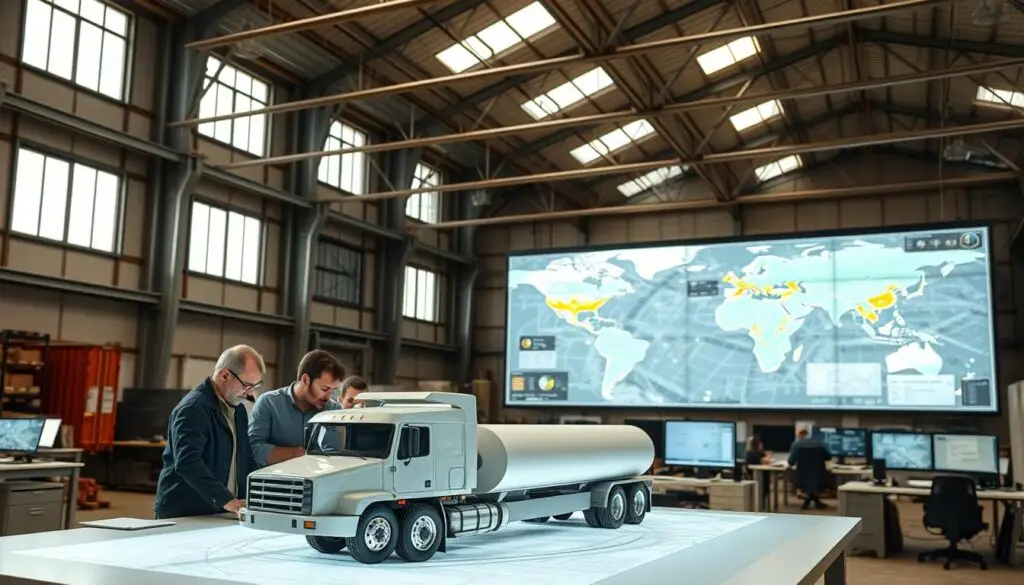
Simulation modeling validates charger quantities, power requirements, and operational schedules before infrastructure investment commitments.
Determining required power capacity and total chargers
Begin analysis with existing transformer capacity limits and electrical panel schedules. Map Class 3-8 vehicles to appropriate charger power levels from qualified vendors.
Power capacity modeling quantifies feeder requirements and helps right-size conduit runs, switchgear specifications, and utility interconnection designs. Charging simulations reveal total charger requirements per depot.
Base calculations on shift patterns, dwell time availability, and load management control logic. This approach prevents infrastructure overbuilding while maintaining throughput capacity for operational peaks.
Scenario modeling for on-time departures and throughput
Deploy departure modeling to validate first-phase rollout plans. Stress-test queue management logic, preconditioning time windows, and energy reserve buffers for summer and winter conditions.
Range can vary by approximately 20% across temperature extremes. Layer time-of-use tariff structures into scheduling logic to shift charging sessions into lower-cost rate periods.
The objective is steady yard workflow with minimal tractor and trailer repositioning.
Reducing capital expenditure via optimized charger ratios
Charger optimization analysis compares 3:1 to 5:1 vehicle-to-charger ratios for AC installations. Evaluate mixed DC fast charging deployment for peak operational waves.
The analysis targets capital expenditure reduction and can defer utility service upgrades. Stagger charging sessions and implement smart power-sharing controls to maximize infrastructure utilization.
Results shape phased installation approaches. Install underground conduit and equipment pads during initial construction, then add charging pedestals progressively as fleet volumes grow.
Key performance indicator outputs
Track charging metrics that matter to finance and operations stakeholders: average session duration, delay risk probability, annual energy costs, and readiness factor for planned trips.
Include charger power specifications and total positions required per operating shift. These indicators align with business case reviews during Phase 2 and Phase 3 deployment stages.
Refine assumptions through pilot program results before committing to full-scale expansion.
| Modeling Focus | Key Method | Primary Output | Operational Benefit |
|---|---|---|---|
| Power capacity | Feeder and transformer load curves across TOU windows | Required site power and upgrade timing | Avoids oversizing and reduces lead-time risk |
| Charging simulations | 10-20 depot scenarios with weather sensitivity | Total chargers and power specs by shift | Right-sizes hardware and staging plans |
| Departure modeling | Queue and dwell logic with preconditioning buffers | Delay risk and readiness factor | Protects dispatch punctuality |
| Charger optimization | Vehicle-to-charger ratio testing with AC and DC | CAPEX reduction and upgrade deferral | Lower upfront cost with stable throughput |
Stay Ahead of Industry Trends
Get expert insights, equipment reviews, and operational strategies delivered to your inbox weekly.
Infrastructure Build-Out: Electrical, Communication, and Controls
Heavy-duty depot facilities demand precise electrical planning from project inception. Engage experienced electrical contractors with fleet electrification expertise to design infrastructure that scales from 300 kilowatts to multi-megawatt service levels.
Coordinate early with utilities, electrical inspectors, and environmental reviewers. Keep designs aligned with code requirements and construction schedules.

Transformer delivery lead times often exceed 12 months, making early procurement and utility coordination critical to project schedules.
Panels, transformers, switchgear, meters, and lead times
Order electrical panels, conductors, utility-grade meters, and switchgear immediately after single-line diagram approval. Build project schedules around transformer lead times that frequently exceed 12 months.
Secure delivery commitments from verified suppliers including Eaton, Siemens, and Schneider Electric. Size electrical service for current phase requirements while installing stub conduits and equipment pads for subsequent expansion.
This forward-looking approach protects capital budgets and maintains infrastructure alignment with route network growth.
Redundant connectivity strategies
Deploy wired local area network infrastructure as the primary communication path for charger control and monitoring. Add cellular failover capability using dual-SIM routers from manufacturers such as Cradlepoint, Cisco, or Sierra Wireless.
Enable virtual private network tunnels and firewall policies for secure operations and uptime protection. Extend coverage with industrial-grade wireless networking where yard operations require mobility.
Implement remote link monitoring to identify connectivity issues before they impact dispatch operations.
Cloud energy management versus local site controllers
Adopt cloud-based energy management platforms to orchestrate charging schedules, apply time-of-use rate structures, and integrate with telematics and route planning systems. This architecture reduces peak demand exposure.
Where sites host solar generation, battery storage, or substantial co-located loads, add local controllers for rapid on-premises orchestration. Prioritize connectivity improvements so cloud and edge systems operate in coordination.
Designing for future expansion and multi-site standardization
Plan infrastructure with future capacity requirements in view. Reserve physical space for additional chargers, upgraded electrical service, and redundant switchgear.
Pre-provision underground conduit, spare circuit breaker positions, and network connections to accelerate second-phase construction. Improve return on investment by standardizing equipment layouts, naming conventions, and control architectures.
Consistent design patterns enable teams to replicate energy management systems and communication infrastructure fleetwide without site-specific rework.
Funding, Incentives, and Financial Analyses
Capital planning begins with comprehensive mapping of available tax credits, state programs, and carbon credit opportunities. Align funding sources with utility delivery timelines.
Connect long-lead transformer and switchgear procurement to budget approval gates. Equipment ordering and construction must remain synchronized.
Build cash flow projections that capture demand charges and time-of-use optimization to maintain predictable operating costs.

Comprehensive financial modeling captures vehicle incentives, infrastructure grants, and operational savings to quantify total investment returns.
Federal tax credits, state programs, and carbon credit opportunities
Federal regulations can provide up to $7,500 per qualifying vehicle through clean vehicle tax credits. Numerous states layer additional rebates and voucher programs on top of federal incentives.
Agencies including the California Air Resources Board and New York State Energy Research and Development Authority publish stackable incentive programs. These combine with utility make-ready offerings to reduce upfront costs.
Where applicable, monetize Low Carbon Fuel Standard credits or similar carbon credit mechanisms. Verify eligibility requirements early, including vehicle classification criteria and charger technical specifications.
Partner with manufacturers and integrators experienced in incentive applications. Avoid documentation errors and validate metering requirements for ongoing credit generation.
Grant readiness and procurement timing
Securing competitive grants requires disciplined calendar management and complete business case documentation. Prepare project narratives, electrical load studies, and site engineering drawings in advance.
Application submissions must align with utility upgrade schedules and municipal permitting windows. Issue purchase orders only after obtaining utility service commitment letters and completing environmental review requirements.
Strong grant applications reference comprehensive fleet TCO analysis from strategic planning phases. Demonstrate realistic deployment timelines, workforce training plans, and measurable implementation milestones.
Some integration partners manage permitting, utility negotiations, and capital financing with consolidated invoicing structures. This approach improves cash flow management during infrastructure build-out.
Energy cost optimization and demand charge management
Charging strategy directly influences operating cost performance. Apply time-of-use optimization to concentrate bulk charging during discounted off-peak hours, similar to overnight rate structures utilized by public charging networks.
Use charge-rate controls and staggered session starts to minimize demand charges. These charges can significantly increase monthly utility bills.
Ground each site financial model in total cost of ownership analysis. For example, an electric delivery van may carry approximately $4,500 additional upfront cost but can generate roughly $2,500 annual savings.
Replace gasoline with managed charging to reach break-even within two years. This timeline excludes maintenance cost reductions, which further improve economics.
Combine these projections with available grant funding to address remaining financial gaps.
| Funding Lever | Typical Impact | Key Requirements | Execution Tips |
|---|---|---|---|
| Federal tax credits | Up to $7,500 per vehicle | Vehicle eligibility, tax liability | Verify VIN and battery specs with manufacturer finance |
| State programs | Stackable rebates and vouchers | In-state operations, weight class | Apply early; sync delivery with funding windows |
| Carbon credits | Recurring revenue from clean energy | Approved metering and reporting | Enroll equipment; establish monetization workflow |
| Infrastructure grants | Covers vehicles and chargers | Shovel-ready scope with utility letters | Match grant calendar to equipment lead times |
Operations, Maintenance, and Uptime Management
High-utilization depot operations depend on tight operational windows. Charger uptime becomes a front-line performance metric at this scale.
Large fleet facilities can host dozens of DC fast chargers with aggregate power demands rivaling commercial office buildings. This scale elevates operations and maintenance from reactive tasks to disciplined programs.
Deploy charging management systems that aggregate equipment health alerts, energy consumption data, and queue orchestration logic into unified dashboards. Pair centralized monitoring with 24/7 oversight protocols.
Equipment faults should receive triage attention before first-shift operations begin. Routine on-site inspections verify indicator lights, display screens, cable condition, and connector pin integrity.
These checks support preventive maintenance programs and reduce avoidable vehicle delays. Charging operations align with off-shift scheduling windows, enabling planned maintenance work.
Use software control rules to precondition vehicles during temperature extremes. Stage charging sessions for on-time departure requirements.
In mixed-use yard environments, establish access permissions and straightforward payment flows. Avoid adding complexity for driver interactions.
During deployment phases, train drivers and yard personnel on proper charger operation protocols and exception handling procedures. Track pilot program data through fleet-focused charging management platforms.
Refine dwell time targets, confirm throughput capacity, and adjust parts inventory levels. For leased facility locations or driver home charging programs, define installation responsibilities and equipment removal procedures.
Maintain clean operations and auditable expense tracking. Partner selection significantly impacts operational outcomes.
Experienced integration firms coordinate equipment vendors, code compliance verification, and warranty claim management. This coordination reduces downtime exposure at high-utilization depot locations.
| Practice | Why It Matters | Owner | Supporting Tools |
|---|---|---|---|
| Remote monitoring | Detects faults early to preserve availability | Network operations center | Charging platform, manufacturer APIs, alerts |
| Preventive maintenance | Reduces wear-driven failures | Site technicians and partners | Checklists, spare kits, diagnostic equipment |
| Training programs | Ensures proper connector handling | Fleet training coordinator | Videos, guides, on-shift refreshers |
| Off-shift scheduling | Aligns charging with rate structures | Energy manager | Load shaping software, TOU profiles |
Track performance indicators that validate program success. Monitor idle time reduction, fuel cost savings, and charging session success rates alongside charger availability metrics.
Use these results to refine preventive maintenance intervals. Tune software control parameters as fleet deployment expands.
Risk, Security, and Compliance
High-power depot facilities demand disciplined control frameworks. Protect physical assets, operational data, and service continuity through integrated planning.
A practical security plan integrates site access management, robust cybersecurity protocols, and proactive utility coordination. Fleets maintain safety code compliance and regulatory obligations while keeping vehicles service-ready.
Physical site security and access management
Establish perimeter security fundamentals: controlled-access gates, LED lighting, camera surveillance, and security patrols coordinated with equipment uptime verification. Implement badge-based access control for authorized drivers and maintenance technicians.
Secure power distribution rooms, electrical panels, and charger pedestals. Prevent unauthorized port access or equipment tampering through physical barriers and monitoring.
Document site security standards in procurement specifications. Ensure vendors supply hardened enclosures and tamper detection capabilities.
Define access authorization by role, time window, and task assignment. Establish role-specific permissions for yard movements, maintenance operations, and contractor activities.
Maintain auditable access logs to enable rapid, accurate incident response.
Cybersecurity for chargers, routers, and management systems
Require strong authentication mechanisms, encrypted communication sessions, and validated Open Charge Point Protocol security profiles. Test these in laboratory environments before field deployment.
Pair charging equipment with network routers supporting modern firewall capabilities and virtual private network connectivity. Deploy redundant communication paths including dual-SIM cellular connections and wired network backhaul.
Within charging management platforms, enforce least-privilege access principles and implement scheduled credential rotation. Align charger cybersecurity practices with broader data governance frameworks covering telematics and dispatch systems.
Configure control policies to recognize time-of-use rate structures and demand events. Management systems can safely throttle or shift charging loads when needed.
Regulatory coordination with utilities and stakeholders
Engage local electric utilities early regarding interconnection reviews, transformer sizing requirements, and protection relay settings. Map utility coordination activities according to IEEE interconnection standards and construction phase milestones.
Include permit applications, environmental screening, and metering plans to satisfy compliance requirements without project rework. Collaborate with property owners, fire marshals, and authorities having jurisdiction.
Address code requirements from NFPA 70 (National Electrical Code) including equipment clearances, safety signage, and emergency disconnect placement.
Maintain a single authoritative source for electrical drawings, one-line diagrams, and test documentation. Approval processes advance efficiently when documentation is centralized and current.
| Control Area | Key Actions | Primary Risks Mitigated |
|---|---|---|
| Physical Access | Gates, cameras, badges, secured panels | Unauthorized entry, tampering, theft |
| Network Security | Dual-SIM plus wired, VPN, firewalls | Outages, unauthorized access, compromise |
| System Controls | Role-based access, API scopes, scheduling | Data misuse, incorrect pricing, disruption |
| Utility Coordination | Early engagement, studies, compliance | Delays, rework, code violations |
Integrating Renewable Energy, Storage, and Microgrids
High-power truck depot facilities commonly draw 300 kilowatts to 5 megawatts currently. Some locations reach 10 megawatts or more.
To right-size electricity supply and control operating costs, operators blend utility service with on-site renewable generation, battery storage, and intelligent controls. Thoughtful distributed energy resource integration supports multi-megawatt charging requirements.
Avoid stranding capital investments or creating operational bottlenecks through careful planning.
Solar, wind, and batteries to meet multi-megawatt site loads
Combining solar generation with battery storage alongside grid power enables peak demand reduction. Capture low-cost energy during time-of-use tariff off-peak periods.
Wind resources can complement daytime solar output in certain geographic regions and seasonal patterns. When batteries charge during off-peak hours, stored energy can discharge during evening demand ramps.
Serve charging operations while limiting utility demand charges. Real-world fleet deployments utilize rooftop and carport solar arrays from manufacturers including First Solar and Qcells.
Pair these with containerized battery systems from Tesla Megapack, Fluence, or Powin. These distributed energy resources help match vehicle dwell schedules and enable cabin and battery preconditioning.
Reduce required utility feeder upgrades during infrastructure build-out.
Local power management and microgrid controllers
Local controllers coordinate charging equipment, solar inverters, and facility loads. Maintain operational continuity even during weak network connectivity periods.
Control platforms such as Ampcontrol, AmpEdge, and Schneider Electric EcoStruxure interface with utility meters and photovoltaic inverters. Microgrid controllers from Siemens and ABB balance power flows across depot microgrid architectures.
Where distributed energy resources are deployed, on-site control logic ensures stable operations if cloud-based energy management systems lose communication connectivity. Under normal connected conditions, cloud and edge systems collaborate.
Optimize charging schedules, apply utility price signals, and standardize control settings across multiple sites for consistent fleet-wide scaling.
Resilience planning for depot-critical operations
Severe weather events, wildfires, and grid disturbances can disrupt fleet departure schedules. Hybrid infrastructure designs combining island-capable microgrid systems improve operational resilience.
Size battery storage for priority route requirements and implement selective load shedding. Local controllers enforce power setpoints for critical charging positions and essential building systems during utility outage events.
Operations teams refine resilience strategies through pilot deployments. Incorporate results into capacity planning models.
As electrification adoption progresses, planning adjusts charger sequencing logic, battery reserve capacity levels, and time-of-use alignment. These refinements support reliable dispatch operations while limiting grid stress.
| Design Element | Primary Role | When to Prioritize |
|---|---|---|
| Solar with storage | On-site generation and peak reduction | Strong solar resources or large TOU differentials |
| Local controllers | Edge control of DERs and chargers | Substantial DERs or unreliable connectivity |
| Microgrid controller | System-level power optimization | Complex sites with multiple feeders |
| Resilience design | Operations continuity during outages | Mission-critical sites or frequent weather events |
Share Your Expertise
Join Heavy Duty Journal as a guest author and reach thousands of industry decision-makers.
Building Your Fleet Electrification Plan
A disciplined implementation roadmap transforms strategic intent into measurable results. This fleet electrification plan aligns executive vision with operational realities.
Use data-driven decision frameworks, cross-functional teams, and proven tools. Advance from pilot programs to full-scale deployment while protecting uptime metrics and cash flow stability.
Leaders who integrate engineering rigor with operational expertise achieve faster investment payback and smoother organizational change management outcomes.
The seven-step path from assessment to expansion
Establish a comprehensive electrification strategy defining program scope, candidate sites, and target duty cycles. Deploy a seven-phase implementation approach.
Capture baseline assessment, feasibility modeling, infrastructure design, financing structure, operational procedures, risk controls, and expansion planning. Model route networks and power requirements to right-size charging equipment deployment.
Balance AC and DC fast charging infrastructure. Establish vehicle-to-charger ratios that reduce capital expenditure without delaying departure schedules.
Implement cloud-based energy management platforms with local control failover capabilities where site conditions warrant.
Pilot deployment, measurement, and scaling strategy
Launch focused pilot operations with limited vehicle quantities and charging positions at a representative depot location. Establish clear organizational roles for uptime management, parts inventory, and escalation procedures.
Verify utility service delivery schedules, construction lead time assumptions, and driver workflow integration. Expand deployment scope only after validation.
Instrument pilot programs with comprehensive performance tracking. Monitor cost per mile, vehicle dwell time, charging session duration, and on-time departure reliability.
Incorporate results into phased rollout plans targeting similar route characteristics and geographic regions.
Telematics-driven optimization and scheduler training
Integrate telematics platforms with charging software. Forecast state-of-charge levels, queue charging sessions intelligently, and avoid utility demand spike exposure.
Connect scheduling logic to time-of-use rate structures and planned maintenance windows. Protect service reliability through intelligent coordination.
Invest in comprehensive scheduler training so dispatch coordinators, warehouse personnel, and drivers operate from consistent procedures. Configure automated alerts for late vehicle arrivals and low state-of-charge conditions.
Integrate notification systems with existing fleet management tools from providers including Geotab and Samsara.
Measurable outcomes: total cost of ownership, emissions, reliability, and workforce adoption
Track total cost of ownership performance against diesel baseline projections using standardized calculation methodologies. Measure emissions reduction at route and depot levels.
Align reporting frameworks with corporate sustainability goals and state program requirements. Monitor service reliability through charger uptime percentages, first-attempt connection success rates, and mean time to repair metrics.
Survey drivers regarding vehicle comfort and training adequacy. Guide adoption strategy refinement and operating policy adjustments based on workforce feedback.
Conclusion
This comprehensive fleet electrification plan demonstrates a clear implementation path from strategic vision to operational results. Policy momentum, improving total cost of ownership economics, and expanding Class 3-8 vehicle availability make electrification transition practical today.
A successful roadmap depends on phased execution, data-driven decision-making, and commitment to measurable performance indicators. Track charger uptime, on-time departure reliability, and energy cost per mile as core metrics.
Program success requires disciplined planning and infrastructure execution. Conduct thorough feasibility simulations and synchronize long-lead electrical equipment procurement.
Standardize on centralized charging management platforms with telematics integration. Design for future depot operations with time-of-use aware controls, temperature-informed planning, and proactive operations protocols.
These practices protect high-utilization facility performance as deployment scales. Diversified vendor relationships, resilient communication infrastructure, and rigorous security frameworks maintain operational stability.
Sites scaling to multi-megawatt power levels require robust technical foundations. Pilot program insights reduce procurement risk, validate charger deployment ratios, and refine utility interconnection timelines.
Establish deployment standards for Class 3-8 expansion phases through systematic learning. Integrated distributed energy resources and local control systems add operational resilience.
Scalable strategies maintain cost control and service reliability across depot networks. With a comprehensive electrification roadmap linking governance structures, capacity modeling, infrastructure design, and operational management, fleets transform sustainability goals into actionable programs.
The outcome delivers competitive advantages: lower total cost of ownership, reduced emissions footprint, higher service reliability, and a workforce prepared for the transition. Build operations to expand without service disruption.
Frequently Asked Questions
Why are heavy-duty truck fleets electrifying now in the United States?
Policy momentum and market maturity have aligned to support commercial fleet electrification. Federal targets aim for 50% of new fleet vehicle sales to be electric by 2030.
Utilities and private investors scale charging infrastructure availability. Total cost of ownership continues improving as electricity typically costs less than diesel per mile, with maintenance savings approaching 40%.
Brands pursuing electrification gain competitive advantages with consumers and shippers who prefer environmentally responsible companies.
What net-zero and brand benefits can commercial fleets expect from electrification?
Nearly two-thirds of the world’s largest public companies maintain net-zero commitments. United Nations targets point to global net-zero by 2050.
Fleet electrification substantially reduces greenhouse gas emissions—typically around 60% versus internal combustion engines when using grid-mix electricity. Electrification decreases noise pollution and improves urban air quality.
Early adopters experience brand value lift with North American consumers favoring sustainable companies. This strengthens request-for-proposal positioning and environmental, social, and governance reporting credibility.
How do electric vehicles impact total cost of ownership for Class 3-8 operations?
Vehicle purchase price premiums continue narrowing as production volumes increase. Fuel cost reductions drive substantial savings—replacing approximately $4,000 in annual gasoline expenditure with roughly $1,500 in managed charging costs.
Generate $2,500 yearly savings per vehicle. Investment payback often occurs within two years before accounting for maintenance cost reductions.
Time-of-use rate optimization and intelligent charge controls further reduce utility demand charges, improving long-term operating economics.
Who should lead a fleet electrification program?
Appoint an experienced electrification or sustainability program manager reporting to an executive sponsor with budget authority. This leader coordinates operations, finance, information technology, facilities management, and compliance functions.
Steer utility negotiations and vendor partnerships. The role establishes procurement standards, cybersecurity protocols, and access control frameworks.
Clear governance structures accelerate permit approvals, utility interconnection processes, and capital planning execution.
How should organizations define timeline, scope, and success metrics for electrification programs?
Start with board-level objectives and construct phased implementation roadmaps. Define program scope by fleet segment and geographic coverage—last mile, middle mile, regional haul.
Establish core performance indicators. Track on-time departure reliability, charger uptime percentage, cost per mile, emissions reduction verification, and capital investment payback period.
Anticipate multi-year deployment timelines with staged infrastructure construction and vehicle procurement sequences.
What goes into a comprehensive baseline fleet assessment?
Construct detailed vehicle inventories capturing routes, duty cycles, depot locations, dwell times, and software system integrations. Deploy telematics platforms to record daily mileage patterns, idling behavior, and available charging windows.
Establish emissions and fuel consumption baselines using Environmental Protection Agency factors. Quantify reduction opportunities and verify reporting accuracy against environmental, social, and governance frameworks.
When should fleets choose AC versus DC fast charging infrastructure?
Level 2 AC charging typically adds 20 to 40 miles of range per hour. It supports cost-effective off-shift depot charging for delivery vans and some truck applications.
Heavy-duty trucks and transit buses with large battery capacities usually require DC fast charging to achieve necessary turnaround speeds. DC fast charging maintains schedule adherence for rapid-turnaround operations.
Many depot facilities deploy mixed charging infrastructure to balance capital expenditure with operational throughput requirements.
How do optimized charger-to-vehicle ratios reduce capital expenditure?
Deploying ratios higher than 1:1—such as 3:1 or 5:1 vehicles per AC charger—reduces infrastructure capital costs. This approach can defer utility service upgrade requirements.
Use simulation modeling to validate proposed ratios against departure schedule requirements. Prevent operational bottlenecks while maximizing charging asset utilization rates and return on investment.
What electrical equipment lead times should fleet operators anticipate?
Order electrical panels, transformers, switchgear, utility-grade meters, and conductors immediately following design approval. Lead times frequently exceed 12 months for major components.
Engage electrical contractors experienced in fleet electrification projects. Coordinate utility approval processes parallel with detailed design and permitting workflows to prevent schedule delays.
What incentives and credits can commercial fleets leverage for electrification?
Federal clean vehicle tax credits provide up to $7,500 per qualifying vehicle. Many states offer stackable rebate and voucher programs.
Regional programs allow monetization of Low Carbon Fuel Standard credits or similar carbon credit mechanisms. Synchronize incentive applications with utility upgrade schedules and equipment procurement windows.
How should fleets manage charging energy costs and utility demand charges?
Prioritize depot-based charging to control time-of-use rate exposure and maximize off-peak pricing benefits. Deploy software systems to stagger charging sessions and establish site demand caps.
Schedule battery preconditioning during low-cost rate periods. For large depot facilities, consider battery storage systems to reduce peak demand charges and manage utility tariff structure transitions.
What cybersecurity controls are essential for charging infrastructure?
Require encrypted, authenticated communication connections between charging equipment and management platforms. Deploy robust certificate management protocols.
Enable virtual private network connectivity and advanced firewall protection on network routers. Implement regular firmware update schedules and enforce role-based access controls with least-privilege principles.
Maintain comprehensive audit logging for security monitoring and compliance verification.
When are renewable energy and storage systems necessary for fleet depots?
Truck depot facilities can require 300 kilowatts to 10 megawatts of electrical power. This often substantially exceeds legacy facility loads.
Solar generation paired with battery storage can defer expensive utility service upgrades and reduce peak demand charges. These systems enhance operational resilience during grid disturbances.
Microgrid coordination improves service continuity during utility outage events affecting mission-critical fleet operations.
How should organizations plan operational resilience at depot-critical sites?
Combine dual utility feeds where available with battery storage, on-site renewable generation, and redundant communication systems. Configure charging management platforms to prioritize essential vehicles during constrained operations.
Maintain adequate spare parts inventory. Conduct periodic emergency response drills for extended outage scenarios affecting fleet departure capabilities.
What measurable outcomes should fleet electrification programs deliver?
Target investment payback periods under 24 months. Achieve emissions reduction exceeding 60% versus internal combustion baseline using grid-mix electricity.
Improve on-time departure reliability and monitor charger uptime percentages. Enhance driver satisfaction through quieter vehicle operation and cabin preconditioning capabilities.
Real-world case studies from operators including WattEV, Electrada, and Revel demonstrate these outcomes are achievable at commercial scale.
Share This Article
Share this post with your network and help other industry professionals stay informed about fleet electrification best practices.