
By Michael Nielsen, Publisher | 15+ Years in Diesel Repair
Last Updated: October 2026
⏱ Estimated reading time: 13 minutes
Truck repair is the diagnosis and correction of faults in a commercial truck's engine, aftertreatment, drivetrain, brakes, suspension, electrical and air systems, done on a schedule or after something breaks. It falls into three kinds: preventive work that heads off a failure, corrective work that fixes one, and inspection-driven repairs that federal rules require before a truck keeps running.
This guide from Heavy Duty Journal (HDJ), written by publisher Michael Nielsen and the HDJ editorial team, covers the main types of truck repair by system, how shop, dealer and mobile service differ, what drives repair costs, and what federal rules ask of carriers. It also shows how to choose a shop you can hold accountable.
It rests on public sources and prints no per-job prices, because no primary source publishes them. Where HDJ is giving editorial judgment instead of a sourced fact, the text says so.
Key Takeaways
- ✓Three kinds of repair, three different clocks. Preventive work follows your schedule, corrective work follows the fault, and inspection-driven work follows federal rules that no shop can waive.
- ✓Repair costs are rising about twice as fast as the broader trend. The American Transportation Research Institute (ATRI) reports repair and maintenance up 8.6% in 2025, against 4.2% for cost per mile excluding fuel.
- ✓A defect report starts the repair clock. A carrier must repair a listed safety defect before the truck operates again, and keep the paperwork.
- ✓An outside shop does not automatically void a warranty. The Federal Trade Commission (FTC) says a company generally cannot deny coverage solely because of an unauthorized part or service.
- ✓An emissions delete is never a repair. The Clean Air Act bars removing emissions controls, and installers are covered by that rule.
In This Guide
- What Truck Repair Covers and Who Does It
- Common Types of Truck Repair by System
- Planned vs. Emergency Truck Repair and the Rules Behind It
- Truck Repair at a Shop, Dealer or Mobile Service
- What Drives Truck Repair Costs
- How to Choose a Truck Repair Shop
- Warranty and Emissions Rules Every Customer Should Know
- Frequently Asked Questions
- The Bottom Line
What Truck Repair Covers and Who Does It
Truck repair covers any work that diagnoses, fixes or restores a commercial truck system, from a failed sensor to a full engine overhaul.
A Class 8 tractor carries air brakes, multiple axles, electronic engine controls and emissions equipment, so a repair often means diagnosing one system that depends on three others.
Three Kinds of Repair Work
Preventive repair is planned work on a schedule, such as inspecting and replacing wear items before they fail. Corrective repair is unplanned work that responds to a fault the driver or the engine has already reported.
Inspection-driven repair is the third kind: work that follows a defect found on a daily report, a roadside inspection or the annual inspection. HDJ separates it because its deadline comes from the rules and the finding, not from your calendar or the shop's.
Who Actually Does the Work
The Bureau of Labor Statistics (BLS) says, as of October 2026, that about 316,000 people worked as diesel service technicians and mechanics in 2025, with a median pay of $61,770 a year. They inspect, repair and overhaul diesel-engine vehicles, and in many shops they use computer diagnostic equipment to find faults.
BLS adds that employers may require or prefer certification, which it says may bring higher pay. A certificate helps you judge a technician, but it does not replace asking what the shop will do on your truck.
Common Types of Truck Repair by System
Repair is easiest to understand system by system, because each system fails in recognizable ways and carries its own safety and cost weight. The table below maps the main systems to the work shops do on them.
| System | Typical repair work | Why timing matters |
|---|---|---|
| Engine and fuel system | Injector, turbocharger, cooling and lubrication repairs; overhauls | A small fault left alone can grow into major engine damage (HDJ judgment) |
| Aftertreatment and emissions | Diesel particulate filter (DPF) cleaning or replacement, selective catalytic reduction (SCR) and exhaust gas recirculation (EGR) repairs | Faults can limit engine power, and repairs must keep emissions controls intact |
| Transmission and driveline | Clutch, transmission, driveshaft and differential service | Driveline wear often shows up as noise or vibration before it fails |
| Brakes | Air brake components, drums, rotors, adjustment and lines | Brakes are a safety system, so a defect cannot wait for a convenient day |
| Suspension, steering, wheels and tires | Springs, bushings, steering linkage, wheel-end and tire work | Federal maintenance rules list suspension, axles, wheels and steering among parts to keep safe |
| Electrical and electronics | Batteries, alternators, wiring, sensors and engine control module (ECM) faults | One bad connection can set several codes at once |
Match the Symptom to the System
Drivers usually report symptoms rather than systems: a noise, a vibration, a warning lamp, a loss of power or a pull to one side. Using the table above to map the symptom to the likely system helps you describe the problem accurately and keeps the first call to the shop short.
Write down when the symptom happens, such as at cold start, under load, at highway speed or while braking, and whether a lamp or code came with it. In HDJ's editorial judgment, a precise complaint saves diagnostic time, and diagnostic time is a billable line.
Fault Codes: A Starting Point
Modern diagnosis starts with a fault code, which the engine control module stores when it detects a fault, such as a sensor reading outside its expected range. Codes are written as a Suspect Parameter Number (SPN) and a Failure Mode Identifier (FMI), and HDJ's free Truck Fault Code Lookup tool decodes them.
A code points to a circuit, not always to a part. A good technician treats it as the first step of a test sequence, so be wary of any shop that replaces a part on the code alone.
Planned vs. Emergency Truck Repair and the Rules Behind It
Planned repair lets you pick the shop, the day and the parts, while emergency repair leaves you with whoever can reach the truck. Some repairs are also never optional, because federal rules set the standard regardless of schedule.
49 Code of Federal Regulations (CFR) 396.3 requires every motor carrier to systematically inspect, repair and maintain the vehicles under its control, and it says parts and accessories must stay in safe and proper operating condition at all times. As of October 2026, the same section requires service records kept where the vehicle is housed for 1 year, and for 6 months after it leaves the carrier's control.
⚠️ Safety Warning
Do not defer a safety-related repair. Under 49 CFR 396.3, brakes, steering, suspension, wheels and tires must be kept in safe and proper operating condition at all times, so a known defect belongs on a repair order, not on a wish list.
The Defect Report That Starts the Clock
As of October 2026, 49 CFR 396.11 has drivers report defects in writing at the end of each day's work. The carrier or its agent must repair any listed defect likely to affect safe operation before the vehicle is operated again, and certify on the report that the repair was made or was unnecessary.
The carrier keeps the report, the repair certification and the driver's review certification for three months. A driver who finds no defect does not have to prepare a report.
The Annual Inspection
As of October 2026, 49 CFR 396.17 requires each listed component to pass an inspection at least once during the preceding 12 months, and the vehicle must carry proof of it. A carrier can use a commercial garage or similar business for the work, if that business has the facilities and qualified inspectors.
The First Ten Minutes of a Breakdown
As of October 2026, 49 CFR 392.22 sets the emergency signals for a stopped commercial motor vehicle. The driver must turn on the hazard flashers immediately and keep them on until the warning devices are placed, and the devices must go out as soon as possible and no later than 10 minutes after stopping.
The section calls for three devices and sets where each one goes, with different distances on divided or one-way highways. Once the truck is protected, call for help with the unit number, location, symptoms and any codes ready, because a clear complaint speeds the first decision.
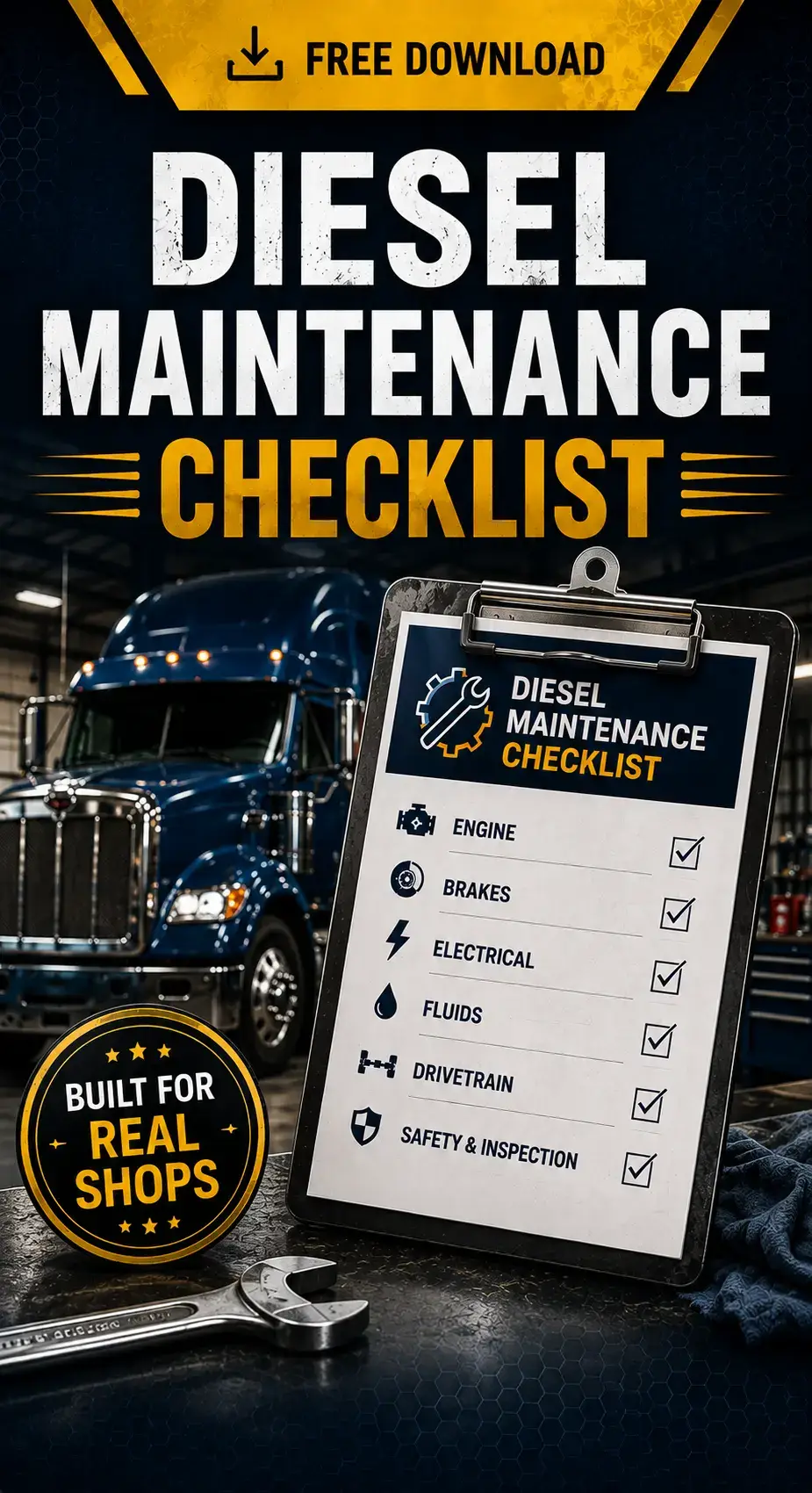
Free Diesel Maintenance Checklist
Get HDJ's free, field-tested diesel maintenance checklist delivered instantly to your inbox — print it, laminate it, keep it in the shop.
Instant PDF • 100% Free • No Spam
Truck Repair at a Shop, Dealer or Mobile Service
The right place for a repair depends on the job: dealers suit warranty and brand-specific work, independent shops suit mixed fleets and long relationships, and mobile service suits breakdowns and minor repairs on the road. None is best for every job, and HDJ gives no price comparison here because no primary source publishes one.
| Option | Best for | Confirm before you commit |
|---|---|---|
| Dealer service | Warranty, recall and brand-specific diagnostics | Scheduling, loaner or towing options, and itemized estimates |
| Independent shop | Mixed-brand fleets and ongoing relationships | Diagnostic software for your engine, parts policy and written warranty |
| Mobile service | Roadside breakdowns and minor repairs | What the service truck carries, and a safe place to work |
For a closer look at the first two, read HDJ's comparison of an independent shop versus a dealership.
Tooling is the quiet differentiator. Engine and aftertreatment faults are often diagnosed with manufacturer-specific software, so ask any shop, dealer or independent, whether it can read your engine's own data rather than only generic codes. In HDJ's editorial judgment, a shop that cannot is guessing at the cause, and guessing is billed by the hour.
The practical test is whether the work needs a lift, specialty tools or a controlled space. A tire, a belt or an air line often fits a service truck, while a clutch job or an engine overhaul belongs in a bay.
Fleets deciding between a service truck and a bay can use the guide to mobile truck service versus shop repair.
Breakdowns have their own playbook, covered in HDJ's guide to mobile roadside repair best practices. Know whom you will call before the truck stops, because that decision is far harder to make on a shoulder.
Sublet Work and Towing
Some shops sublet jobs they do not perform in-house, such as machine work, driveline balancing or aftertreatment cleaning. Ask which jobs stay in the building, who warrants the sublet work, and whether the schedule changes when a part goes out.
If the truck cannot move, ask whether the shop or dealer arranges towing and whether the tow is billed to the repair order. Settling that before the truck arrives avoids a surprise line on the final invoice.
What Drives Truck Repair Costs
Truck repair costs come from labor, parts, diagnosis and downtime, and the latest industry data show them rising faster than the cost of running a truck overall. Each piece moves for different reasons, so a single total on an invoice tells you little.
Labor is the part you can compare, since shops state a rate. Parts vary by tier, from original equipment to aftermarket and remanufactured, and diagnosis time is the line most often disputed. HDJ breaks each down in its guide to truck repair costs by labor and parts.
Downtime is the cost that never appears on the invoice. A truck waiting on a part still has a driver, a payment and a load that needs another carrier, so the cheapest estimate is not always the lowest cost.
8.6%
ATRI reports in its July 2026 release that industry repair and maintenance costs rose 8.6% in 2025, with tires up 6.4%. As of October 2026, it puts average operating cost at $2.336 per mile, or $1.854 excluding fuel, up 4.2%.
How to Compare Two Estimates
A fair comparison needs the same scope on both estimates. Ask each shop to list the repair it recommends, the labor hours, the parts and their tier, any diagnostic charge and whether it is credited toward the repair, the warranty, and the expected completion time.
Differences in scope explain most gaps between estimates. One shop may price the full repair and another only the failed part, so in HDJ's judgment the lower number can leave you paying for the rest later.
When Repair Bills Point Toward Replacement
Repair bills climb as a truck ages, and at some point the question becomes whether to keep repairing or to replace it. A decision framework helps, and HDJ covers it in its guide to repair versus replace for heavy-duty trucks.
Track repair spending per truck from your work orders to see the pattern. A truck whose bills keep rising while its uptime falls is telling you something an invoice alone will not.
How to Choose a Truck Repair Shop
Choose a truck repair shop on evidence you can check: who diagnoses the truck, what records the shop keeps, and what it will put in writing before work starts. A star rating is a starting point, not a verdict.
- Ask who will diagnose your truck and what tools they use for your engine
- Get a written estimate that separates labor, parts and diagnosis
- Get the warranty on parts and labor in writing, with its length and limits
- Ask for the repair order to record the complaint, cause, parts and final test
- Ask for references from customers running trucks like yours
HDJ's guide to choosing a truck repair shop walks through twelve factors in depth. If the shop will do your annual inspection, confirm it employs qualified inspectors, since 49 CFR 396.17 requires them.
Keep Your Own Repair File
Keep a file for each truck with the repair orders, estimates, parts receipts and inspection proof. A carrier already has to keep service records under 49 CFR 396.3, and an owner-operator's file settles warranty questions and shows the next shop what has been done.
Red Flags That Mean Walk Away
A shop that refuses a written estimate, pressures you to approve work on the spot or cannot explain a charge has told you what you need to know. So has a shop that offers to delete emissions equipment, which federal law prohibits.
Warranty and Emissions Rules Every Customer Should Know
Using an outside shop does not automatically void a truck warranty. The FTC says that under the Magnuson-Moss Warranty Act a company cannot condition coverage on the use of particular products or services, and generally cannot deny coverage solely because a customer used another company's part or an unauthorized service provider.
The FTC notes two narrow exceptions, free service from the company or an FTC waiver, and says a company may still deny coverage for damage the outside part or service actually caused. Keep your work orders and parts receipts, because they are your proof.
Why an Emissions Delete Is Never a Repair
The U.S. Environmental Protection Agency (EPA) page on tampering and aftermarket defeat devices says the Clean Air Act bars knowingly removing or disabling required emissions controls, and also bars making, selling or installing aftermarket devices that defeat them. A delete is not a repair, it is a violation of federal law, and a shop that offers one is telling you how it treats the rules.
Frequently Asked Questions
What does truck repair include?
It includes preventive maintenance, corrective repair after a fault, and inspection-driven repairs on engines, aftertreatment, transmissions, brakes, suspension, wheels and tires, and electrical systems. See the table of repair types by system above for the typical work on each one.
How much does truck repair cost?
No primary source publishes per-job prices, so any single figure is a guess. ATRI reports repair and maintenance costs rose 8.6% in 2025, as of October 2026. Get an itemized written estimate that separates labor, parts and diagnosis, and compare it across at least two shops.
Should I use a dealer or an independent shop for truck repair?
Dealers suit warranty, recall and brand-specific diagnostics, and independent shops suit mixed fleets and ongoing relationships. Ask either one whether it has the tooling for your engine, then get a written estimate and a written warranty before you approve any work.
How often does a commercial truck need an inspection?
Under 49 CFR 396.17, each listed component must pass an inspection at least once during the preceding 12 months, and the vehicle must carry proof of it. Drivers also report any defects in writing at the end of each day's work.
Can an independent shop void my truck warranty?
Generally no. The FTC says a company cannot deny coverage solely because you used an unauthorized part or service provider, though it can deny coverage for damage that part or service actually caused. Keep every work order, receipt and inspection record.
What should I do when my truck breaks down?
Turn on the hazard flashers immediately and place the warning devices within 10 minutes of stopping, as 49 CFR 392.22 requires. Then call roadside or mobile service with your location, unit number, symptoms and any fault codes ready, so the dispatcher can send the right help.
The Bottom Line
Good truck repair comes down to knowing the three kinds of work, keeping the paperwork the rules require, and choosing a shop that puts its diagnosis, estimate and warranty in writing. Repair costs are rising faster than the rest of operating cost, so the written record is also how you control them.
Michael Nielsen and the HDJ editorial team will update this guide at heavydutyjournal.com as the rules and ATRI data change, so check back before your next major repair decision.
Pass This to Your Shop Foreman
Fleet managers and owner-operators who book shop work can use the estimate, warranty and records checklist before the next breakdown. Michael Nielsen and Heavy Duty Journal publish the guide free at heavydutyjournal.com.


