

By Michael Nielsen, Editor & Publisher | 15+ Years in Diesel Repair
Last Updated: December 2025
📖 Estimated reading time: 22 minutes
Commercial trucks transport approximately 75% of all freight by weight across the United States, making mobile roadside truck repair services essential infrastructure for the national economy. When these vehicles experience mechanical failures on the highway, every hour of downtime translates directly into lost revenue—with unplanned breakdowns costing fleets between $448 and $760 per vehicle per day according to industry benchmarking data.
For fleet managers and owner-operators, having reliable access to emergency truck repair capabilities separates minor inconveniences from operational crises. Professional mobile repair services bring skilled technicians and specialized equipment directly to disabled vehicles, typically arriving within 45 to 60 minutes of a service call. This immediate response capability minimizes the cascading effects of breakdowns on delivery schedules, customer relationships, and driver satisfaction.
This comprehensive guide examines proven strategies for managing roadside emergencies, from building multi-vendor service networks to implementing technology solutions that enable predictive maintenance. Whether you’re developing a comprehensive fleet maintenance program or preparing for individual breakdown scenarios, these best practices will help maintain productivity when unexpected problems arise.
Key Takeaways
- Downtime costs $448-$760 daily: Unplanned breakdowns create cascading financial impacts beyond immediate repair expenses through lost revenue, contract penalties, and customer relationship damage.
- Response time benchmarks matter: Industry-standard response is 45-60 minutes, but telematics-enabled fleets achieve sub-30-minute arrivals through predictive dispatch.
- Multi-vendor networks reduce risk: Relying on a single provider creates dangerous vulnerability; build relationships with at least two qualified providers per major operational zone.
- Preventive maintenance reduces emergencies by 40%: Systematic inspection protocols and scheduled mobile maintenance significantly decrease roadside incident frequency.
- Safety compliance is non-negotiable: All 50 states have Move Over laws, yet 71% of drivers remain unaware—technicians must implement proper traffic control before any repair work.
- Technology integration accelerates response: GPS tracking, telematics, and digital dispatch platforms transform reactive emergency response into proactive fleet management.
Understanding Mobile Roadside Truck Repair Services
When commercial trucks break down on the highway, every minute counts toward operational efficiency and customer satisfaction. Mobile roadside truck repair services have transformed how fleet operators approach vehicle maintenance and emergency response, bringing professional technicians and specialized equipment directly to disabled vehicles rather than requiring costly tows to distant facilities.
The mobile repair industry addresses a fundamental operational challenge: trucks generate revenue only when wheels are turning. Understanding the full scope of these services helps managers make informed decisions about maintenance strategies and emergency response planning.

What Professional Mobile Repair Actually Includes
Professional mobile repair extends far beyond basic roadside assistance. Qualified providers arrive with fully equipped service vehicles containing diagnostic computers, specialty tools, and quality replacement parts for common failure scenarios. Technicians hold certifications specific to commercial vehicle systems—including ASE Medium/Heavy Truck certifications and OEM-specific training—that verify their expertise on complex diesel powertrains and air brake systems.
Mobile units typically handle tire changes and replacements, battery testing and replacement, air brake adjustments and component repairs, cooling system service including hose replacement and thermostat service, fuel delivery and filter replacement, electrical diagnostics, and forced DPF regenerations. Professional providers stock commonly needed components to complete most repairs without waiting for parts delivery, and maintain proper insurance coverage and business licensing that distinguishes them from unlicensed operators.
Emergency Services Versus Scheduled Mobile Maintenance
Emergency services address unexpected breakdowns requiring immediate attention to restore vehicle operation. These calls typically involve mechanical failures, tire blowouts, or system malfunctions occurring during active operation—situations where rapid response directly impacts revenue and delivery commitments.
Scheduled mobile maintenance represents a different service category entirely. Technicians visit fleet facilities on predetermined schedules to perform preventive inspections, oil changes, and routine servicing. This proactive approach brings maintenance to the trucks rather than taking vehicles out of service for shop visits, maximizing asset utilization during peak operational hours. Companies like Spiffy have demonstrated this model’s effectiveness by operating outside traditional business hours, including early mornings, evenings, and weekends.
The Financial Impact of Downtime
Vehicle downtime creates cascading financial consequences beyond immediate repair costs. Each hour a truck sits disabled represents lost revenue from missed deliveries and unmet contractual obligations. According to Element Fleet Management research, the hourly cost for a typical driver plus lost profit opportunity exceeds $79 per hour—and that figure escalates rapidly with extended delays.
| Downtime Duration | Average Revenue Loss | Additional Costs | Customer Impact |
|---|---|---|---|
| 1-2 hours | $150-$300 | Driver idle time, minor schedule delays | Minimal disruption |
| 3-6 hours | $450-$900 | Load rescheduling, potential towing fees | Delivery delays, customer notifications required |
| 6-24 hours | $900-$3,600 | Full day lost, replacement vehicle costs | Significant service disruption, contract penalties possible |
| 24+ hours | $3,600+ | Multi-day revenue loss, customer relationship damage | Severe impact, potential contract termination |
Quality emergency repair partnerships reduce these expenses by restoring vehicles to service quickly and preventing small problems from becoming major failures. For a 1,000-unit fleet experiencing an average of five 90-minute downtime events per vehicle annually, total downtime costs approach $595,000—making investment in rapid-response capabilities clearly justifiable.
Essential Components of Effective Emergency Response
When a commercial truck breaks down unexpectedly, the quality of emergency response hinges on specific measurable factors. Effective emergency truck repair services require coordinated systems addressing response speed, geographic reach, communication infrastructure, and diagnostic expertise. Fleet managers who understand these components can build robust contingency plans that minimize operational disruptions.

Response Time Benchmarks That Matter
Response time directly impacts the financial consequences of vehicle breakdowns. Industry standards indicate professional mobile repair services typically arrive within 45 to 60 minutes of receiving a service call for most emergency scenarios. This timeframe begins when the dispatcher confirms the service request and ends when the technician arrives at the breakdown location.
Leading operations achieve significantly faster response through technology integration. Werner Enterprises has documented repair times under 30 minutes using telematics solutions that provide real-time vehicle location data and diagnostic fault codes, enabling proactive service deployment before drivers even call for help.
| Response Category | Standard Time | Best-in-Class | Critical Success Factors |
|---|---|---|---|
| Critical Safety Issues | 30-45 minutes | Under 30 minutes | Priority dispatch, GPS routing |
| Mechanical Failures | 45-60 minutes | 35-45 minutes | Network density, parts availability |
| Non-Critical Service | 60-90 minutes | 45-60 minutes | Resource allocation, scheduling |
| Remote Rural Areas | 90-120 minutes | 60-90 minutes | Regional partnerships, mobile units |
Geographic Coverage and Network Density
Network density significantly affects response capabilities across different operational territories. High-traffic corridors and urban centers typically feature concentrated service provider networks that enable faster response times. Rural areas present challenges due to greater distances between service locations and breakdown sites.
Strategic coverage planning addresses these geographic limitations through regional partnerships. Penske’s Roadside Assistance network includes more than 18,000 emergency providers nationwide, demonstrating the scale required for comprehensive coverage. Fleet operators should evaluate provider networks along their primary routes and identify coverage gaps requiring backup service arrangements.
24/7 Availability and Dispatcher Expertise
True round-the-clock availability requires more than phone answering services. Effective emergency dispatch operations employ experienced personnel with detailed knowledge of Class 8 trucks who can coordinate complex repair scenarios. Night shift dispatchers require the same training and access to technical resources as day shift personnel, with technology infrastructure supporting seamless handoffs between shifts without information loss.
Skilled dispatchers gather critical information during initial contact that enables technicians to arrive prepared. Structured questioning about symptoms, warning lights, fluid leaks, and unusual sounds determines which tools and replacement parts the technician should bring to the breakdown location. This phone diagnostic process transforms reactive emergency response into informed, efficient repair deployment.
$448-$760/day
Average unplanned downtime cost per commercial vehicle — Element Fleet Management research
Common Roadside Repairs and Emergency Solutions
Understanding the most common breakdown scenarios prepares fleet managers for rapid response decisions. Mobile technicians address predictable mechanical failures accounting for the majority of emergency service calls. Recognizing these situations enables faster diagnosis and appropriate resource allocation.
Tire Failures and Replacement Services
Tire-related emergencies represent the leading cause of commercial vehicle breakdowns, accounting for approximately 22% of roadside incidents according to Michelin research. Federal regulations under 49 CFR 393.75 mandate truck tire replacement at 4/32 tread depth for steer tires and 2/32 for drive and trailer tires. However, industry leaders implement more conservative standards, replacing tires at 5/32 and 3/32 respectively to prevent roadside failures.
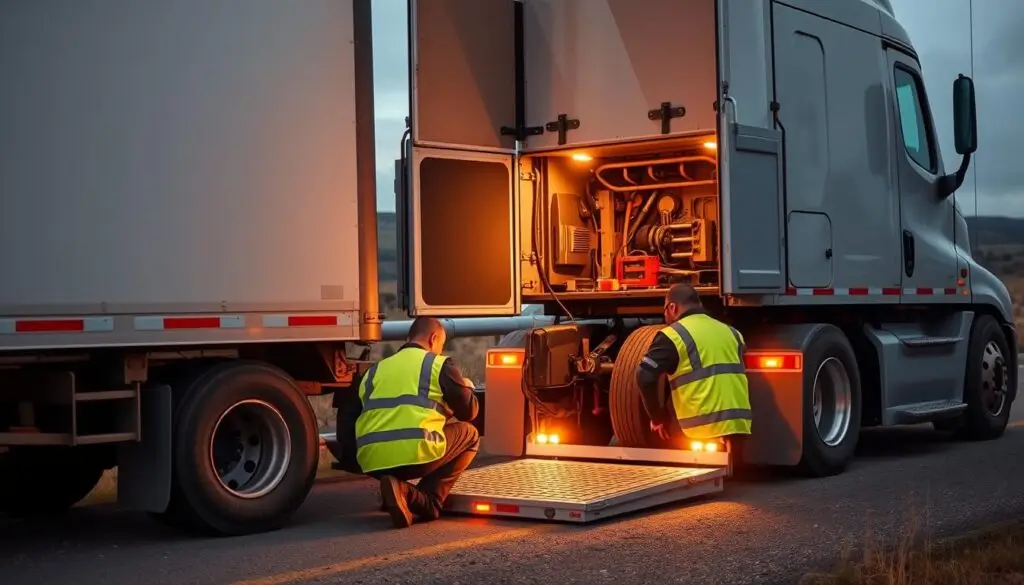
Mobile technicians assess whether punctures qualify for repair or require complete replacement based on puncture location, size, and sidewall integrity. Professional service teams carry inventory for multiple axle configurations. Complete tire blowouts on multi-axle configurations present unique challenges requiring specialized high-capacity jacks designed for commercial applications, with careful attention to weight distribution and stability on potentially uneven roadside surfaces.
Battery Failures and Starting System Issues
Cranking system failures typically present as slow engine turnover or dimmed cabin lighting. Battery jump-start services provide immediate solutions using high-amperage portable jump starters designed for diesel engines—these units deliver sufficient power to crank large-displacement engines without requiring a second vehicle.
Technicians test battery health using digital analyzers that measure cold cranking amps and overall condition. When testing reveals battery failure, on-site replacement prevents recurring breakdowns. Professional service includes terminal cleaning and electrical system inspection to identify parasitic drains or charging system issues.
Air Brake System Emergencies
Air brake system problems compromise stopping ability and require immediate attention. Pressure loss in brake systems represents a critical safety concern demanding expert evaluation. Mobile technicians diagnose air leaks, adjust brake shoes, and replace faulty components when possible.
⚠️ Safety Warning
Certain brake failures exceed roadside repair capabilities and necessitate towing to full-service facilities. Technicians must assess whether mobile repair provides a safe solution or whether comprehensive shop-based service is mandatory. Never compromise on brake system safety.
Chamber replacements, slack adjuster repairs, and valve servicing often qualify for on-site completion by qualified technicians. However, when repairs involve major component replacement or require specialized equipment, the responsible decision is arranging transport to an appropriate facility.
Cooling System and Overheating Issues
Overheating incidents result from coolant leaks, thermostat failures, or radiator obstructions. Mobile technicians perform diagnostic procedures to identify failure points and determine repair feasibility. Temporary sealing solutions address minor leaks, while coolant delivery services restore proper fluid levels.
Professional service includes pressure testing to verify system integrity after temporary repairs. Technicians advise whether vehicles can safely continue operation or require towing. Hose replacement and thermostat service represent common roadside solutions that restore cooling system function.
Fuel System Problems
Running out of fuel remains a preventable yet common breakdown cause. Mobile technicians deliver diesel fuel and prime fuel systems to restore operation. Winter months increase diesel fuel contamination risks when paraffin wax gels in cold temperatures, requiring specialized treatment.
Contaminated fuel requires system purging and filter replacement before engines restart safely. Technicians assess fuel quality and determine whether complete tank draining is necessary. Water contamination particularly affects fuel injectors and requires thorough system cleaning.
Stay Ahead of Breakdown Trends
Get weekly insights on fleet maintenance best practices, emerging repair technologies, and regulatory updates delivered directly to your inbox.
Pre-Trip Preparation and Breakdown Prevention
Systematic vehicle preparation and regular maintenance scheduling form the cornerstone of reducing emergency roadside repairs. Companies prioritizing preventive maintenance report up to 40% fewer roadside incidents compared to reactive maintenance models. These strategies combine technology, documentation, and human expertise to create robust systems protecting both vehicles and drivers.
Daily Vehicle Inspection Protocols
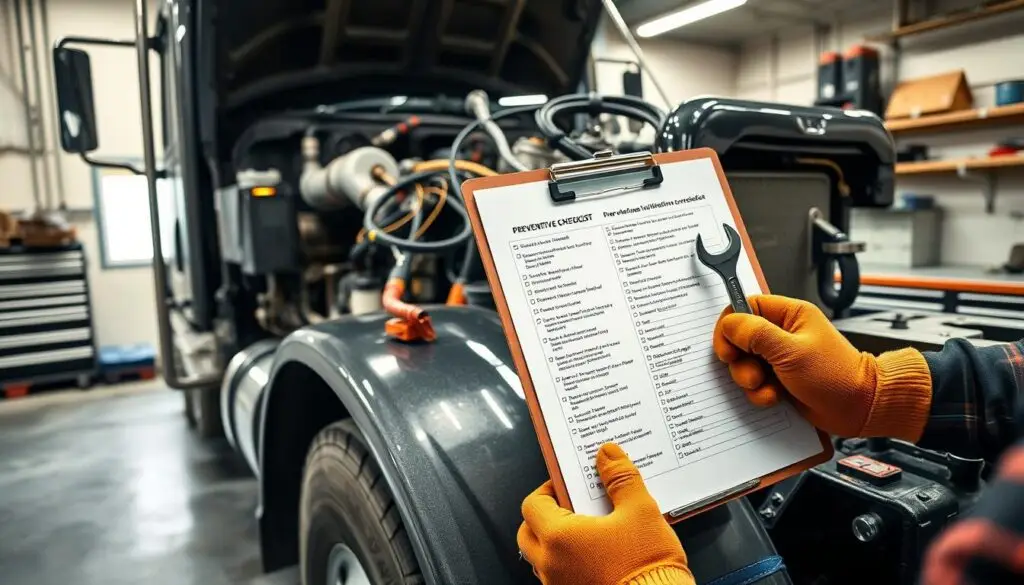
A comprehensive inspection checklist serves as the first line of defense against mechanical failures. Drivers must evaluate critical components during pre-trip and post-trip inspections, covering tire pressure and tread depth, fluid levels including oil and coolant, air brake system integrity, lighting systems, coupling devices, and cargo securement mechanisms.
Modern digital inspection tools streamline documentation while ensuring compliance with 49 CFR 396.11 driver vehicle inspection requirements. Daily draining of air tanks and visual checks for leaks prevent minor issues from escalating into major problems. Service representatives at fueling locations can supplement driver inspections by checking fluid levels, completing visual assessments, and identifying potential concerns.
Preventive Maintenance Scheduling
Establishing maintenance intervals based on manufacturer recommendations and operating conditions maximizes vehicle reliability. Effective scheduling incorporates mileage-based services, time-based inspections, and condition-based assessments. Advanced analytics identify patterns signaling impending component failures.
Telematics data enables predictive maintenance strategies addressing issues before they cause roadside breakdowns. As ATRI’s 2024 Operational Costs of Trucking report documents, repair and maintenance costs continue rising—making prevention increasingly valuable compared to emergency intervention. Maintenance programs should continually update PM inspection plans based on failure rates and vehicle history.
Emergency Supply Requirements
Every commercial vehicle should carry a comprehensive inventory of emergency supplies organized by function.
| Category | Required Items | Purpose |
|---|---|---|
| Safety Equipment | Reflective triangles, road flares, high-visibility vests, flashlights | Roadside visibility and accident prevention |
| Mechanical Tools | Basic tool kit, tire pressure gauge, extra fluids | Minor repairs and system checks |
| Emergency Provisions | First aid kit, fire extinguisher, water, blankets | Driver safety during extended delays |
| Communication | Cell phone charger, emergency contact list, service provider numbers | Maintaining contact with dispatch and services |
Winter weather operations require additional provisions including extra blankets, non-perishable food, and additional water. Fire extinguishers and first aid supplies address immediate safety concerns until professional assistance arrives.
Driver Training on Warning Signs
Comprehensive driver training educates operators on recognizing mechanical problems before they cause complete failures. Unusual noises, vibrations, or handling changes often signal developing issues. Dashboard warning lights demand immediate attention and proper reporting to maintenance personnel.
Drivers trained to identify fluid leaks, tire wear patterns, and brake performance changes become valuable assets in breakdown prevention. Performance anomalies such as reduced power, excessive smoke, or temperature fluctuations require prompt investigation. Immediate reporting prevents minor concerns from progressing to major roadside emergencies.
Building a Comprehensive Mobile Repair Program
A comprehensive approach to mobile truck repair services begins with understanding your fleet’s unique operational footprint. Successful fleet management requires deliberate program design addressing vendor relationships, performance standards, geographic coverage, and financial planning. The difference between reactive crisis management and proactive emergency preparedness lies in systematic program development.
Developing Multi-Vendor Service Networks
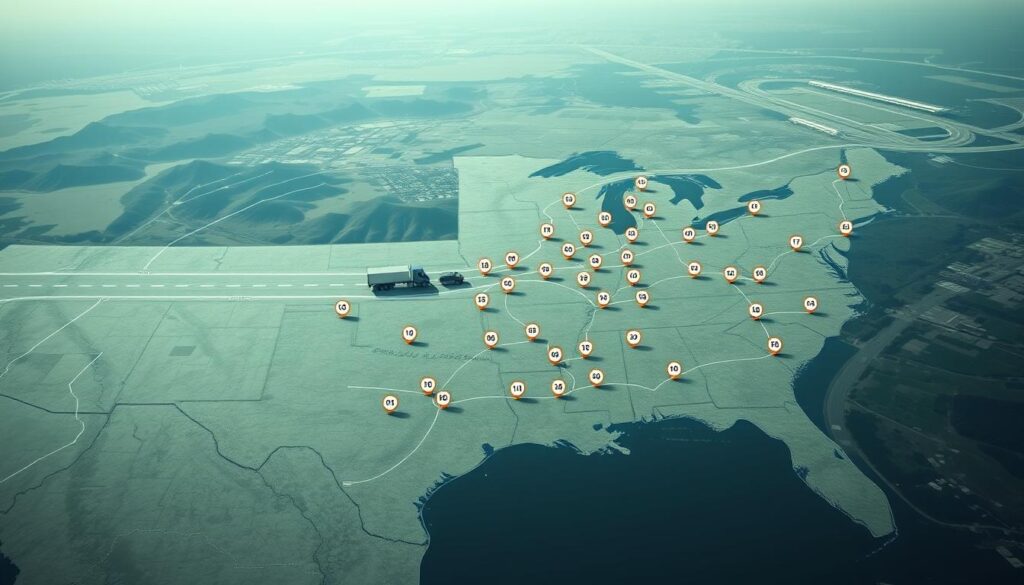
Relying on a single provider creates dangerous vulnerability during roadside emergencies. A robust repair network requires relationships with multiple qualified vendors across your operational territory. National networks like FleetNet America and Penske Roadside Assistance demonstrate the scale needed for comprehensive coverage.
Your service network should balance national service chains with regional specialists. National providers offer consistency and standardized processes, while local shops provide faster response in specific areas and specialized knowledge of regional conditions. Vendor selection criteria must include licensing verification, insurance requirements, technician certifications, and equipment capabilities. Establish redundancy by identifying at least two qualified providers in each major operational zone.
Service Level Agreement Essentials
Clear service level agreements establish measurable performance expectations protecting your operational interests. SLAs must specify response time commitments for different emergency categories—typically ranging from 60 minutes for critical breakdowns to 120 minutes for non-urgent situations.
Effective agreements address quality standards for repairs, parts warranty requirements, and pricing structures. Include communication protocols mandating status updates every 30 minutes during active repairs. Define performance reporting requirements enabling objective evaluation of provider effectiveness. SLAs should outline remedies for non-compliance, including service credits or contract termination provisions.
The HDJ Perspective
The mobile repair landscape has shifted dramatically over the past five years. We’re seeing traditional shop operators add mobile capabilities while technology platforms connect independent technicians with fleet customers in real-time. For fleet managers, this means more options—but also more complexity in evaluating provider quality. The most successful programs we’ve observed combine contracted primary relationships for predictable coverage with pay-per-incident backup for extended territories. Don’t let price alone drive decisions; response time reliability and first-time fix rates ultimately determine total cost of ownership.
Budget Allocation Strategies
Strategic cost management begins with accurate forecasting based on fleet size, vehicle age, and operational intensity. Allocate approximately 8-12% of total maintenance budgets for emergency roadside repairs, adjusting based on historical patterns and fleet composition.
Evaluate contracted service models against pay-per-incident approaches. Contracted relationships with predictable monthly fees provide budget stability, while pay-per-incident models offer flexibility for smaller fleets. The break-even point typically occurs around 15-20 vehicles, favoring contracted services for larger operations. Maintain budget reserves equivalent to 3-6 months of average emergency costs for unexpected major failures.
| Service Model | Response Time | Cost Structure | Best For |
|---|---|---|---|
| National Contracted | 60-90 minutes | Fixed monthly fee plus parts | 20+ vehicle fleets |
| Regional Agreements | 45-75 minutes | Discounted hourly rates | Single state/region operations |
| Pay-Per-Incident | 90-120 minutes | Standard market rates | Under 15 vehicles |
| ✓ Hybrid Multi-Vendor | 60-90 minutes | Base fee plus usage | Expanding operations |
Technology Integration for Enhanced Response
Sophisticated technology platforms have revolutionized mobile roadside repair capabilities, enabling faster and more accurate emergency responses. Modern fleet operations now depend on interconnected digital systems that dramatically reduce downtime while improving service quality. These technological solutions create a responsive ecosystem transforming how companies manage breakdowns and coordinate repairs.

GPS and Location Services
GPS fleet tracking enables immediate, precise identification of disabled vehicles regardless of location. Dispatchers can instantly view exact positions of stranded trucks and identify the nearest qualified mobile technician available to respond. This technology eliminates the frustrating back-and-forth communication that once delayed service by 20-30 minutes or more.
Integration with mapping software provides technicians with optimal routing to breakdown locations. Traffic conditions, road closures, and distance calculations happen automatically, ensuring the fastest possible arrival times.
Digital Dispatch and Communication Platforms
Digital dispatch systems connect all parties in real-time through unified communication platforms. These systems automatically notify available service providers when breakdowns occur, allowing technicians to accept assignments and confirm estimated arrival times instantly. Multi-party communication features enable remote diagnostic support, with experienced mechanics guiding on-site technicians through complex repairs.
Mobile applications streamline the process of requesting and receiving roadside assistance. Drivers can initiate service requests with a few screen taps, dramatically reducing response initiation time while automatically transmitting vehicle location and diagnostic information.
Telematics and Predictive Maintenance
Telematics integration represents the most advanced layer of fleet management capability. These systems continuously monitor performance parameters across entire fleets, using predictive analytics to identify developing problems before they cause breakdowns. Fault code monitoring, performance trending, and automated alerts enable proactive intervention preventing roadside emergencies.
According to Penske’s operational research, fleets maximizing onboard technology capabilities better track asset performance and predict maintenance needs, reducing breakdown risk and downtime. The return on investment from telematics often justifies the technology cost through reduced emergency repair expenses alone.
Share Your Mobile Repair Expertise
Are you a fleet manager or mobile repair professional with insights on emergency response best practices? Heavy Duty Journal welcomes contributions from industry practitioners.
Safety Standards and Compliance Requirements
Working alongside active traffic lanes creates inherent dangers making safety compliance non-negotiable for mobile repair operations. According to NHTSA safety data, approximately 28,008 traffic crashes occurred along road shoulders in 2023—585 of which were fatal. Technicians face constant exposure to passing vehicles, many driven by distracted operators, making proper safety protocols essential.
⚠️ Critical Safety Statistic
Despite Move Over laws existing in all 50 states, 71% of Americans remain unaware of these requirements according to AAA research. Technicians cannot assume approaching traffic will slow down or change lanes.
OSHA and Federal Workplace Requirements
OSHA compliance forms the foundation of lawful roadside repair operations. The general duty clause requires employers to provide workplaces free from recognized hazards that could cause death or serious physical harm. Employers must maintain hazard communication programs informing technicians about chemical exposures from fuels, lubricants, and cleaning agents.
Documentation demonstrating compliance includes safety training records, incident reports, and equipment inspection logs. Technicians performing roadside repairs must receive training on hazard recognition and emergency response procedures as part of permanent safety records.
DOT Documentation Standards
DOT regulations require specific documentation for repairs affecting safety-critical truck systems. Repairs to brake systems, steering components, and tire replacements must be recorded in vehicle maintenance files in accordance with 49 CFR Part 396 inspection and maintenance requirements.
Roadside technicians must measure and document tire tread depths according to federal specifications. When repairs address violations discovered during inspections, technicians must provide detailed documentation satisfying both federal requirements and state enforcement standards.
Personal Protective Equipment Standards
Every roadside technician must wear safety footwear with reinforced toes, eye protection rated for impact resistance, and work gloves appropriate for the specific repair task. High-visibility garments meeting ANSI/ISEA 107 standards are mandatory—Class 3 garments provide the highest visibility recommended for roadside work environments.
Technicians should wear vests or coats with fluorescent background material in orange, yellow-green, or red combined with retroreflective striping. Seasonal considerations affect clothing choices, but visibility standards remain constant regardless of weather conditions.
Establishing Safe Work Zones
Traffic control measures determine whether technicians can safely perform roadside repairs. Before beginning any work, technicians must assess vehicle positioning, traffic flow, and environmental conditions affecting safety. If positioning creates unacceptable risk, technicians have the authority and obligation to refuse the repair and request towing to a safer location.
Warning triangles must be positioned at precisely measured distances behind the disabled vehicle: 15 meters, 30 meters, and 45 meters according to Tire Industry Association recommendations. The mobile service vehicle should park approximately 30 feet behind the disabled truck, making the work area more visible to oncoming traffic while providing some protection. Technicians should never stand or work in the space between the service truck and disabled vehicle.

Quality Assurance and Provider Selection
Building relationships with reliable mobile repair providers before breakdowns occur separates proactive fleet operations from reactive ones. The quality of emergency repair partnerships directly impacts how quickly disabled trucks return to revenue-generating operations.
Evaluating Provider Credentials
Thorough credential assessment protects your fleet from substandard service during critical moments. Essential factors include years of operation serving commercial fleets similar to yours, client references from organizations with comparable vehicle types, and membership in professional organizations such as the Technology & Maintenance Council.
Insurance coverage deserves careful scrutiny—confirm adequate liability limits protecting your organization from potential damages. Review safety performance records identifying providers with strong incident-free operations history. Verify ASE Medium/Heavy Truck certifications and OEM-specific training credentials for technicians.
Assessing Service Capabilities
Operational capabilities determine whether providers can address your specific repair needs. Evaluate the scope of repairs each provider performs at roadside locations versus those requiring shop facilities. Inspect equipment their mobile units carry, including diagnostic tools, specialized repair equipment, and parts inventory breadth.
Network size significantly impacts response capabilities. Assess whether providers cover your primary routes and can respond effectively to your fleet size. Technician qualifications should reflect current knowledge of commercial truck systems including modern emissions equipment, electronic controls, and diagnostic procedures.
Understanding Pricing Structures
Transparent pricing enables accurate budget forecasting and prevents surprise expenses. Common models include flat-rate emergency callout fees combined with hourly labor charges, per-incident pricing bundling diagnosis and labor, and annual service contracts with predetermined rates.
Hidden costs often emerge in after-hours surcharges, mileage fees for technician travel beyond standard service radius, parts markups exceeding competitive pricing, and administrative fees for documentation processing. Request detailed pricing breakdowns during the vetting process to compare total cost scenarios across providers.
Key Recommendation
Invest time in building service provider relationships before emergencies force rushed decisions under pressure. The most costly repairs often result from selecting providers based solely on immediate availability rather than verified capability and reliability.
Frequently Asked Questions
How quickly should mobile truck repair services respond to a breakdown?
Industry-standard response times range from 45 to 60 minutes for most emergency scenarios, measured from service request confirmation to technician arrival. Leading operations achieve faster response through telematics integration, with some providers documenting arrival times under 30 minutes. Critical safety issues warrant priority dispatch with 30 to 45-minute targets, while non-critical service calls typically fall within 60 to 90 minutes. Remote rural areas may extend to 90 to 120 minutes due to geographic limitations and provider network density.
What repairs can mobile technicians perform roadside versus requiring a shop?
Mobile technicians can handle tire changes and replacements, battery testing and replacement, air brake adjustments and minor component replacement, cooling system repairs including hose replacement and thermostat service, fuel delivery and filter replacement, electrical diagnostics and minor repairs, and forced DPF regenerations. Complex repairs requiring heavy equipment, extensive disassembly, specialized facilities, or major component replacement typically require towing to a shop. Brake repairs affecting stopping ability should be carefully evaluated—if any doubt exists about roadside repair adequacy, transport to a full-service facility is the responsible choice.
How much does commercial truck downtime actually cost?
Unplanned downtime costs commercial fleets between $448 and $760 per vehicle per day according to industry research. This figure accounts for lost revenue from missed deliveries, driver idle time wages, potential towing fees, load rescheduling costs, and customer relationship damage. A 1,000-unit fleet averaging five 90-minute downtime events per vehicle annually faces costs exceeding $594,000. Extended breakdowns compound costs through contract penalties, expedited shipping alternatives, and potential customer loss.
What safety equipment must mobile repair technicians use during roadside work?
OSHA and industry standards require high-visibility garments meeting ANSI/ISEA 107 Class 3 specifications, safety footwear with reinforced toes, impact-rated eye protection, and work gloves appropriate to the repair task. Warning triangles must be positioned at 15, 30, and 45 meters behind the disabled vehicle. Service vehicles should park approximately 30 feet behind the disabled truck with all flashers and strobes activated. Technicians should never position themselves between the service vehicle and disabled truck during repairs.
Should fleets use contracted service networks or pay-per-incident providers?
The break-even point typically occurs around 15 to 20 vehicles. Contracted relationships with predictable monthly fees provide budget stability and often faster response times for larger fleets due to priority dispatching. Pay-per-incident models offer flexibility for smaller operations but may result in longer response times and higher per-event costs. Most fleets benefit from hybrid models combining contracted primary providers for core territories with pay-per-incident backup coverage for extended routes and overflow situations.
Moving Forward with Mobile Repair Readiness
Mobile roadside truck repair services transform unexpected breakdowns from operational crises into manageable incidents when proper systems are in place. Fleet operators implementing comprehensive prevention, response, and quality assurance practices reduce both downtime and financial losses significantly.
The return on investment for robust mobile repair programs far exceeds their cost. Extended downtime, customer dissatisfaction, and cascading operational disruptions create expenses that dwarf investment in proper emergency response infrastructure. Emerging telematics and predictive analytics continue advancing mobile repair effectiveness, providing earlier failure warnings and streamlined response coordination.
For commercial fleets operating in today’s demanding transportation environment, comprehensive mobile roadside truck repair capabilities represent operational necessities rather than optional enhancements. The best practices detailed throughout this guide provide the framework for minimizing breakdown impacts and maintaining fleet productivity—because in trucking, the wheels have to keep turning.
Share This Guide
Know a fleet manager or owner-operator who could benefit from these mobile repair best practices? Help them prepare for the inevitable roadside challenges.


