HDJ Buyer's Guide · Independent Editorial Evaluation
By the HDJ Buyer's Guide Team
Last Updated: October 2026
DPF cleaning equipment from Filtertherm covers two methods, thermal and aqueous, sold as complete packages with published list prices of $51,000 and $82,500. That makes it one of the few DPF cleaning equipment lines a shop can budget before talking to sales, and this guide evaluates whether it fits a heavy duty shop's filter volume, power service and floor space.
HDJ selected Filtertherm on editorial merit. This is not a sponsored placement, the manufacturer did not review it, and nothing here links to Filtertherm's websites. Facts were re-verified in October 2026 against manufacturer pages, and manufacturer claims are labeled as such.
Key Takeaways
- ✓Two packages, two published prices. The thermal package lists at $51,000 and the aqueous package at $82,500, each with a free first year of FILTERtrak software.
- ✓Method sets the workflow. Aqueous cleaning takes as little as two hours per filter, while the thermal oven bakes six to eight filters per overnight batch.
- ✓Facility needs are substantial. Both packages call for 208V three-phase power, and the aqueous machine circulates 600 gallons of water.
- ✓Support terms are thin. The warranty is one year, and training specifics and post-year-one software pricing are not published.
- ✓Volume decides the case. Filtertherm puts in-house operating cost at $30–$60 per filter against $250–$500 outsourced.
$51,000
Thermal package MSRP
$82,500
Aqueous package MSRP
6–8
Filters per oven batch
1 yr
Warranty
In This Guide
Who This Is For
- Fleet maintenance shops with steady filter volume that clean enough filters each month to justify a dedicated bay and want a published price to build the case.
- Independent diesel shops adding aftertreatment service that have three-phase power and floor space and want one manufacturer for the machine, drying and inspection.
- Shops that must document every filter for fleet customers, since both packages include an inspection table and a year of FILTERtrak.
What to Evaluate When Choosing DPF Cleaning Equipment
- Cleaning method: thermal and aqueous suit different filter shapes and soaking conditions.
- Throughput: batch size and cycle time set filters per week.
- Facility fit: power, compressed air, water and floor space can cost more than the gap between two quotes.
- Compliance: ash, spent surfactant and wastewater are the shop's waste to classify.
- Cost and support: price, supplies, warranty, training and software renewal.
Service interval sets volume. Filtertherm recommends cleaning at least once a year or every 75,000–100,000 miles, and EPA's bulletin on retrofit filters says ash cleaning is typically needed every 6 to 12 months (EPA DPF bulletin).
Compliance anchors the decision. Federal rules prohibit removing or rendering inoperative an installed emission control device, with an allowance for repairs that restore proper function (40 CFR 1068.101); see emissions tampering penalties. EPA reports 172 civil enforcement cases finalized from fiscal 2020 through 2023, with $55.5 million in civil penalties (EPA defeat device initiative).
Waste must be classified as hazardous or not where it is generated (40 CFR 262.11). OSHA sets no exposure limit for diesel particulate matter but names truck garage workers as exposed (OSHA 3590).
$190–$470
Per-filter saving from cleaning in-house instead of outsourcing, from Filtertherm's own figures: $30–$60 in-house operating cost against $250–$500 outsourced. A manufacturer estimate, verified October 2026.
Stay Current on Shop Equipment & Emissions Compliance
Get HDJ's equipment evaluations, compliance updates and shop profitability strategies delivered weekly — built for diesel professionals making real capital decisions.
Filtertherm DPF Cleaning Equipment
Best ForShops with steady DPF volume, three-phase power and floor space that want published pricing, a choice of thermal or aqueous cleaning, and built-in documentation.
Profile last verified: October 2026 against filtertherm.com and rep.direct
Filtertherm equipment is built in Redding, California by Diesel Emissions Service, a family-owned company that began in 2007 as a division of North State Truck Equipment. Redline Emissions Products distributes the line.
Aqueous Package — $82,500 MSRP
Includes
Cleaning machine (FTM 1100), drying cabinet (FTM 2000 or 2001), inspection table (FTM 8003)
Cycle
10-minute pre-soak, wash of about 20 minutes, drying of about 20 minutes; total as little as 2 hours
Throughput
Up to 20 filters in an 8-hour shift (manufacturer claim)
Water
600 gallons recirculated through a self-contained, dual-filter system
Power
Machine 208V three-phase, 30A GFCI; dryer two 40A circuits; inspection table 120V, 19A
Footprint
About 120 × 78 in with clearance; 96 in tall
Thermal Package — $51,000 MSRP
Includes
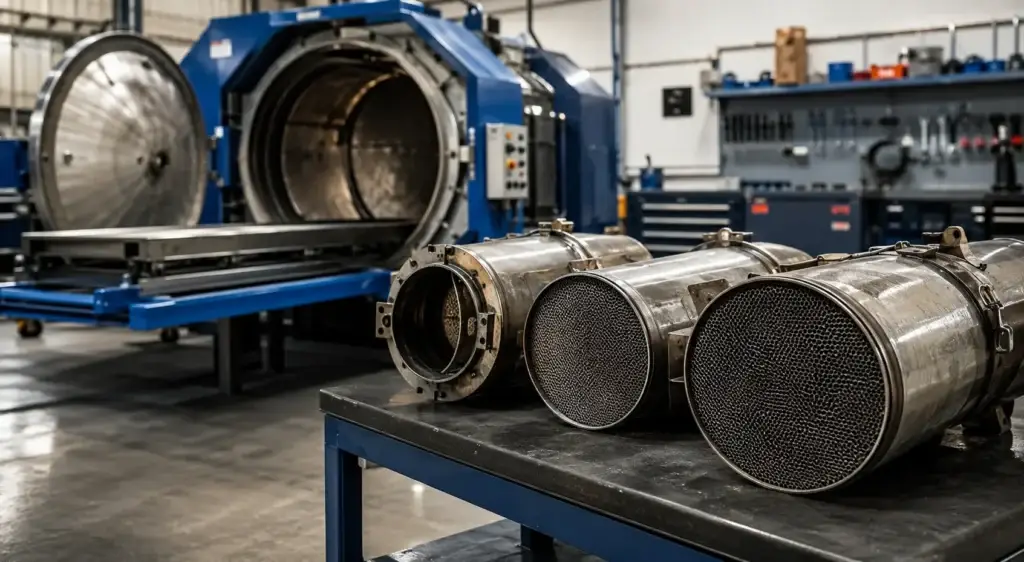
Thermal oven (FTM 24403A), Gen2 pulse cleaner (FTM 9981), cooling cart (FTM 9001), inspection table; optional dust collector kit (FTM 8004)
Capacity
6–8 filters per oven batch, baked overnight; pulse pass of about 20 minutes before and after
Power and air
Oven 208/220/240V three-phase, 40A; pulse cleaner 115V, 15A, 90 psi minimum at 4 CFM
Footprint
Oven 70 H × 64 W × 98 D in
Dust control
Optional kit: hospital-grade HEPA filtration, 22-gallon bin
Both packages
Free first-year FILTERtrak ($1,200 value), one-year warranty, Tri-Lease financing
Strengths
- Published MSRPs for both packages let a shop budget before a sales call.
- Two methods from one manufacturer: aqueous handles odd-shaped, light-duty and off-road filters with quick-change adapters, while thermal suits standard filters in volume.
- The oven has a cool-touch exterior, temperature-controlled door lock, over-temperature shutoff and passcode access.
- The inspection table covers pin, flow, weight and crack checks, and FILTERtrak stores before-and-after photos and service records.
- Supply costs are published: Filtertherm estimates about $5 per filter for aqueous supplies.
Considerations
Both packages need 208V three-phase power, and Filtertherm gives no wastewater-disposal guidance for the aqueous system. Thermal cleaning is limited to standard-shaped filters, per the manufacturer. Warranty is one year, registered within 45 days, with failures reported within 24 hours. Training specifics and FILTERtrak pricing after year one are not published, and aqueous machine dimensions differ between Filtertherm's and its distributor's pages.
Who Should Look Elsewhere
Shops without three-phase power, shops that clean only a few filters a month, and shops that want a pneumatic or manual system should research alternatives. Smaller operations may find outsourcing cheaper than a $51,000 or $82,500 purchase.
HDJ Verdict
Filtertherm is a strong choice for shops with the volume and electrical service to support it. Published prices, two methods and built-in documentation make it easy to evaluate; three-phase power, wastewater planning and a one-year warranty are the points to settle in writing before ordering.
Implementation & Onboarding
Setup starts with a quote, an electrical review and a layout check. Filtertherm publishes owner's manuals, footprint schematics and an ROI tool before purchase. Plan the 208V circuits, a water and drainage plan for the aqueous system, and 90 psi of compressed air for the pulse cleaner; see diesel shop compressed air quality, heavy duty repair shop layout and equipment financing options.
The first week is about benchmarking. Record before-and-after weight and airflow for every filter and photograph each one in FILTERtrak. Filtertherm's benchmark is an after-weight roughly 50 grams lower with improved flow, plus a star-pattern pin test on the inlet face.
Is It Right for Your Shop?
Is It Right for Your Shop?
Answer honestly. The more "yes" answers, the stronger the fit.
Fewer than three "yes" answers — this may not be the strongest fit. Five or more — it's very likely worth a quote.
Editorial Insight
The HDJ Perspective
HDJ's Buyer's Guide Team has found that the deciding number in this purchase is not the package price but the filters-per-month count. A $51,000 oven that runs twice a week is cheaper to own than an aqueous system that sits idle, and an outsourced cleaning at $250 to $500 remains the right answer below that volume. Count 90 days of DPF work orders first, then ask for an itemized quote listing supplies, electrical requirements and software renewal.
Frequently Asked Questions
How much does Filtertherm DPF cleaning equipment cost?
Filtertherm lists an $82,500 MSRP for its aqueous package and $51,000 for its thermal package. Both include a free first year of FILTERtrak, and Tri-Lease financing is available. Aqueous supplies run about $5 per filter.
How long does Filtertherm take to clean a DPF?
Aqueous cleaning takes as little as two hours, including a pre-soak, a wash of about 20 minutes and drying of about 20 minutes. Thermal cleaning bakes filters overnight, with 20-minute pulse passes.
What power does Filtertherm DPF cleaning equipment need?
The aqueous machine lists 208V three-phase at 30A, and its dryer uses two 40A circuits. The thermal oven lists 208/220/240V three-phase at 40A. The pulse cleaner needs 115V and 90 psi air.
Does Filtertherm DPF cleaning equipment have a warranty?
Every product carries a one-year warranty covering repair or replacement of defective parts. Owners must register within 45 days of purchase and report a failure within 24 hours with photos.
Is cleaning a DPF legal under EPA rules?
Cleaning and reinstalling a filter keeps the emission control working. Federal rules prohibit removing or rendering inoperative an installed control, with an allowance for repairs that restore proper function.
The Bottom Line
Filtertherm DPF cleaning equipment suits shops that can fill it: steady filter volume, three-phase power and a plan for waste. For others, outsourcing or a cheaper system will cost less. Shops weighing the alternative can start with DPF cleaning methods and DPF replacement cost.
Before ordering, get an itemized written quote that covers supplies, electrical requirements, training and software renewal.
For Manufacturers & Software Providers
Want Your Product Featured in an HDJ Buyer's Guide?
This format — independent evaluation, transparent HDJ Fit Ratings, and an honest look at contract terms and total cost — is also available as a sponsored placement for DPF cleaning equipment brands serving the heavy duty repair market.
Learn About Buyer's Guide Placements →Know a Shop Weighing DPF Cleaning Equipment?
Send this guide to the owner or service manager comparing quotes. A shared work-order count and an itemized quote can keep a shop from buying the wrong size of machine.