
By Michael Nielsen, Publisher | 15+ Years in Diesel Repair
Last Updated: October 2026
⏱ Estimated reading time: 13 minutes
Mobile column lifts raise a heavy vehicle on a set of wheeled, portable columns that work together, and the choice between the two systems compared here comes down to power: the Stertil-Koni ST 1085 is wireless and battery-powered, while the BendPak PCL-18B is cabled and runs on three-phase power. Fleet shops should decide on power supply, floors, vehicle mix, and certification status before they look at a brochure.
Heavy Duty Journal's editorial team, led by publisher Michael Nielsen, rebuilt this comparison for shop managers, fleet maintenance directors, and technicians. HDJ checked manufacturer specification pages, the Occupational Safety and Health Administration (OSHA) interpretation on automotive lifts, and the Automotive Lift Institute (ALI) as of October 2026, and it removed every claim it could not confirm.
According to Heavy Duty Journal's October 2026 review, the biggest correction concerns compliance. OSHA says it has no specific standards that apply to a user of automotive lifts, so "OSHA compliant" is not a feature a lift can carry, and a shop should look to ALI certification and the manufacturer's instructions instead.
Key Takeaways
- ✓Two designs. The Stertil-Koni ST 1085 is wireless and battery-powered, while the BendPak PCL-18B is a cabled, three-phase system.
- ✓Capacity. Stertil-Koni lists 18,500 or 22,000 pounds per column, and BendPak lists 18,000 pounds per column, or 144,000 pounds across eight columns.
- ✓No OSHA lift standard. OSHA states it has no specific standards that apply to a user of automotive lifts and no certification requirement for them.
- ✓Certification is model-specific. ALI says that if a lift is not listed in its directory, it is not certified, so check the exact model.
- ✓Locks carry the load. Both systems use mechanical locks, and no technician should work under a vehicle that rests on hydraulics alone.
- ✓Put it in writing. Specifications change, so ask the dealer to confirm capacity, power, certification, and warranty in the quote.
In This Guide
- How Mobile Column Lifts Work in a Heavy-Duty Bay
- What the Rules Say About Lift Compliance and Certification
- Stertil-Koni ST 1085 and BendPak PCL-18B Compared
- Stertil-Koni ST 1085: Wireless Capacity and Control
- BendPak PCL-18B: Cabled Capacity and Control
- Wireless vs. Cabled Mobile Column Lifts
- Operating Mobile Column Lifts Safely
- Buying Checklist: Questions to Put in Writing
- Frequently Asked Questions
- The Bottom Line
How Mobile Column Lifts Work in a Heavy-Duty Bay
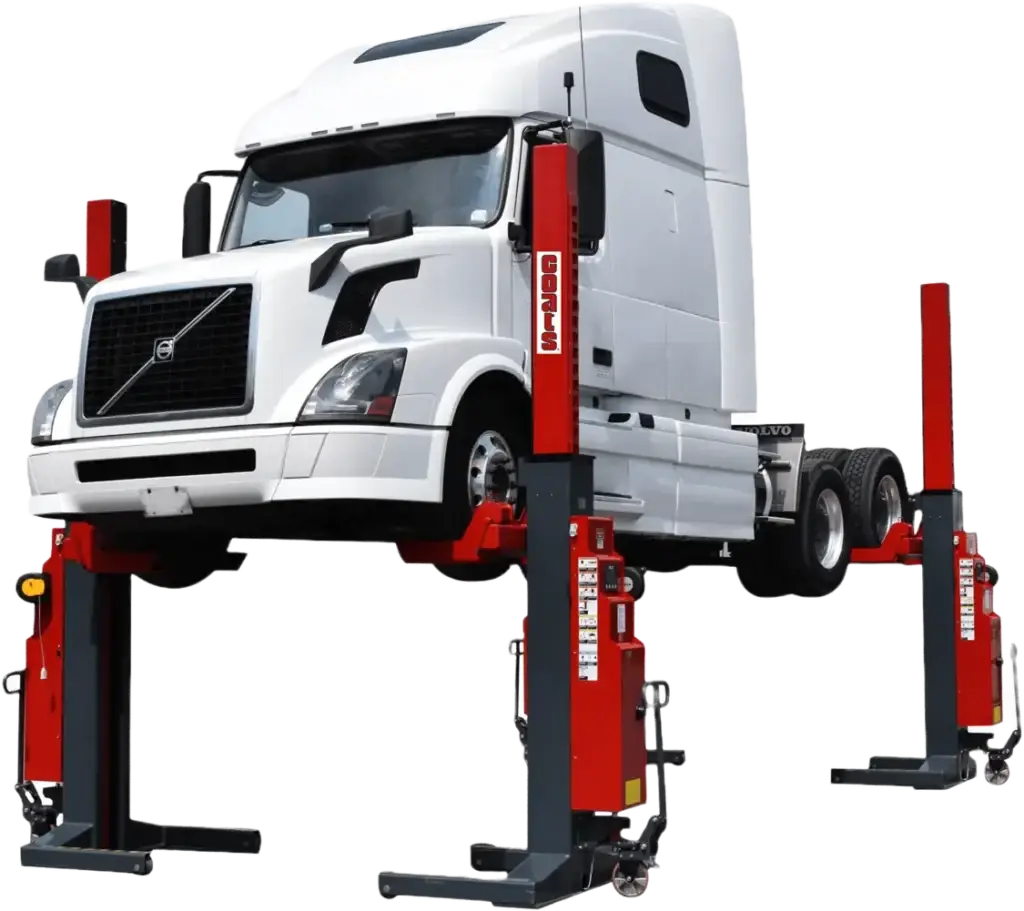
Mobile column lifts are sets of individual columns that stand on the shop floor, each with its own lifting carriage and forks. Placed at each wheel position and linked together, the columns raise the whole vehicle in step. Because they roll, a shop can move them between bays instead of dedicating one lane to one lift.
Column count sets the job. BendPak sells the PCL-18B in two-, four-, and eight-column sets, and Stertil-Koni says its ST 1085 can connect up to 32 columns in a set. A bus or a multi-axle truck needs more columns than a two-axle vehicle, so count the wheel positions before you count dollars.
Weight matters at each column, not only in total. Add the heaviest axle load to a safety margin and compare it with the per-column rating, because a system rated for a large total can still be wrong for a heavy single axle.
Cost pressure makes bay time worth protecting. As of July 2026, the American Transportation Research Institute (ATRI) reported in its 2026 operational costs update that repair and maintenance costs rose 8.6 percent in 2025. A lift that is ready when the truck arrives is one less delay, and HDJ's shop bay management guide covers how to schedule the bays around it.

What the Rules Say About Lift Compliance and Certification
Start with what the rules actually say. OSHA's November 2014 interpretation on automotive lifts states that OSHA does not have any specific standards that apply to a user of automotive lifts, and that no OSHA standard contains certification requirements for them.
That does not make lifts unregulated. The General Duty Clause in Section 5(a)(1) of the Occupational Safety and Health Act requires an employer to furnish a place of employment free from recognized hazards that are causing or are likely to cause death or serious physical harm.
The same OSHA interpretation says national consensus standards and manufacturers' recommendations may be used as evidence of hazard recognition and of feasible ways to correct a hazard. In practice, an inspector can point to the American National Standards Institute (ANSI) lift standards and the maker's manual when judging whether a shop recognized a risk.
OSHA names ANSI/ALI ALOIM:2008, the lift operation, inspection, and maintenance standard, as the industry-recognized consensus standard for employers operating automotive lifts. HDJ treats that as the baseline for a shop's lift program, alongside the manufacturer's inspection and maintenance instructions for each model.
Certification is a separate question. The Automotive Lift Institute (ALI) certification FAQ states that only lifts bearing ALI's gold certification label are certified, and that all others are not. A manufacturer can design to a standard without being certified to it, which is why the wording on a spec sheet matters.
ALI also publishes the ALI Directory of Certified Lifts, where it says every current ALI certified lift model is listed and that a lift that is not listed is not certified. Certification therefore attaches to a model, so check the exact model and configuration you plan to buy, not just the brand.
Here is what the manufacturers say. As of October 2026, the Stertil-Koni ST 1085 brochure lists the lift as ANSI/ALI ALCTV certified for the United States, referring to the standard for automotive lift construction, testing, and validation. BendPak's product pages state that not all of its models are ALI certified, and HDJ did not confirm the status of each PCL-18B model.
Treat that gap as a question for the dealer. Ask for the ALI directory listing, or the certification label, for the exact PCL-18B configuration in the quote, and keep the answer in the purchase file. HDJ's diesel shop safety programs guide covers how a written program supports the General Duty Clause.
Stertil-Koni ST 1085 and BendPak PCL-18B Compared
The table below sets the two systems side by side using manufacturer information as of October 2026. HDJ did not test either unit, and specifications can change by configuration, so confirm each figure with the dealer before you order. Voltage terms use volts of direct current (VDC) and volts of alternating current (VAC).
| Specification | Stertil-Koni ST 1085 | BendPak PCL-18B |
|---|---|---|
| Capacity per column | 18,500 or 22,000 lb | 18,000 lb |
| System size | Up to 32 linked columns | Eight columns total 144,000 lb |
| Maximum lift | 73 in in 94 seconds | 71.5 in in 85 seconds |
| Control | 7-in. ebright touchscreen | Single, pair, and team modes; fault codes |
| Power | Wireless, 24 VDC; cabled three-phase and single-phase options | Cabled, three-phase |
| Locks | Independent mechanical locks, 1 3/8-in. increments | Mechanical locks every 4 in. |
| Moving | About 1,350 lb per wireless column | 180° pallet-jack steering; tandem polyurethane-covered steel wheels |
| ALI status | Brochure lists ANSI/ALI ALCTV certified (U.S.) | BendPak states not all models are ALI certified |
The numbers are close where it counts for a service bay. Capacity per column differs by 500 to 4,000 pounds, and lift height differs by 1.5 inches. The real differences are how the columns are powered and controlled, which the next two sections explain, and how each model stands on certification.
Stertil-Koni lists cabled versions on three-phase 208/230, 460/480, and 575 VAC and single-phase 220 VAC, so a shop can match the lift to the power it already has.
Stertil-Koni ST 1085: Wireless Capacity and Control
The Stertil-Koni ST 1085 is the wireless option. As of October 2026, the brochure lists a maximum lift of 73 inches in 94 seconds, capacity of 18,500 or 22,000 pounds per column, and up to 32 linked columns. HDJ treats those figures as the manufacturer's published ratings, not as measured results.
Control and Synchronization
The ST 1085 is run from the ebright Smart Control System, which Stertil-Koni describes as a full-color, high-resolution 7-inch touchscreen control panel. The brochure says synchronization engages at a height difference of just 9/16 inch, and the wireless page lists overload protection and synchronization as standard.
Power and Charging
Wireless columns run on 24 VDC. As of October 2026, Stertil-Koni's wireless-lift page states that special deep cycle batteries only need to be recharged every two weeks and are charged from a 110-volt wall socket.
Every two weeks
The recharge interval Stertil-Koni states for the ST 1085's deep cycle batteries, as of October 2026. Treat it as the maker's figure and plan charging around your own duty cycle.
Locks, Forks, and Weight
The brochure says an independent mechanical locking system engages 5 inches above the finished floor, with locking increments of just 1 3/8 inches. It lists 14-inch forks suited to vehicles with super single tires, a wireless column weight of about 1,350 pounds, and a lifetime parts guarantee on the synthetic runner wheels.
Weight affects how a column is staged. Walk the route from the storage spot to the bay and check doorways and thresholds before you commit to a number of columns.
BendPak PCL-18B: Cabled Capacity and Control
The BendPak PCL-18B is the cabled option, offered in two-, four-, and eight-column sets. As of October 2026, BendPak lists 18,000 pounds per column, a 71.5-inch lift in 85 seconds, and a total of 144,000 pounds for an eight-column set. As with the Stertil-Koni figures, HDJ treats these as published ratings.
Cables and Control
BendPak describes three 30-foot cables in a horseshoe arrangement that keeps one end of the work area open. The controls offer single, pair, and team operation, and the system monitors faults with codes, which gives a technician a starting point when a column stops. Because the columns are cabled, the layout of those cables is part of the bay plan.
Locks and Lowering
BendPak lists mechanical locks every 4 inches, emergency stops on each column, and two-speed lowering. BendPak's PCL-18B pages do not list a park mode or an outdoor rating, so HDJ does not credit the lift with either.
Steering and Wheels
Each column steers through a 180° pallet-jack-style handle and rolls on tandem polyurethane-covered steel wheels, according to BendPak's product pages. Ask the dealer for the weight per column and check the surface it will cross before you commit to a number of columns.
A few of the same checks apply to both. Match the lift to your power supply, confirm the certification of the exact model, and confirm the rated capacity of the system and the individual column against your heaviest vehicle. HDJ's heavy-duty repair shop layout guide covers how bay width, doors, and power drops shape that decision.
Wireless vs. Cabled Mobile Column Lifts
Power is the practical divider. A wireless column carries its own batteries, so the shop needs a charging routine and a wall outlet for it. A cabled column needs a power source and a cable path to every column, so the shop needs the electrical service and a bay plan to match. Neither is better in every shop.
| Factor | Wireless (ST 1085) | Cabled (PCL-18B) |
|---|---|---|
| Power source | 24 VDC batteries, charged from a 110-volt socket | Three-phase shop power |
| Floor cables | None between columns | Three 30-foot cables in a horseshoe |
| Recharging | Stertil-Koni states every two weeks | Not applicable |
| Largest set | Up to 32 columns | Eight columns (144,000 lb) |
| Plan around | Charging routine and battery condition | Cable routing and power drops |
Plan for the failure mode of each design. A wireless set that has not been charged is a set that will not lift, and a cabled set with a damaged cable or a lost power source is down as well. Neither design removes the need for a tech to inspect the equipment before use.
Space and approach also matter. A horseshoe cable layout keeps one end of the lift area open, as BendPak describes it. A wireless set has no cables between columns, so no cable crosses the vehicle path, which is the main reason shops with variable bay use look at that design.
Neither design ends a shop's need for ordinary jacks and stands on other jobs. HDJ's heavy duty transmission jack guide covers the equipment that supports driveline work on a raised truck.
Operating Mobile Column Lifts Safely
A lift is only as safe as the procedure behind it. Because OSHA says consensus standards and manufacturer instructions may be used as evidence of hazard recognition, HDJ recommends that a shop write its own lift procedure from the manufacturer's manual for each model and train each technician on it before the first lift.
Inspect before every use. Check the columns, cables or batteries, forks, and wheels for damage, and take any lift with a problem out of service until a qualified person repairs it. The ANSI/ALI ALOIM standard that OSHA cites covers operation, inspection, and maintenance, so a shop should obtain it and build its inspection routine from it.
⚠️ Safety Warning
Never work under a vehicle that is supported only by hydraulic pressure. Lower the columns onto their mechanical locks, confirm that each column's lock is engaged, and keep people out of the area while the lift is moving. Follow the manufacturer's procedure for the exact lock sequence on your model.
Set up on a surface that suits the equipment. Walk the floor for cracks, seams, slopes, and obstructions before the columns go down, and keep the work area clear of cords, tools, and people who are not part of the job. If the manufacturer limits use to a type of surface, or limits outdoor use, follow it.
Protective gear belongs in the plan too. HDJ's diesel mechanic personal protective equipment guide lists the protective gear a shop should supply, and a technician working beneath a raised truck should wear it as the shop's program requires.
Document training and inspections. Written records show a shop recognized the hazard and acted on it, which is the point of the General Duty Clause discussion in OSHA's interpretation. Keep the manual, the certification evidence, and inspection records where a supervisor can find them.
Plan for preventive maintenance (PM) on the lift itself. Put each lift on the same schedule as other shop equipment, assign someone to follow the maker's maintenance instructions, and record each inspection with the date and the technician's name.
Free Diesel Maintenance Checklist
Get HDJ's free, field-tested diesel maintenance checklist delivered instantly to your inbox — print it, laminate it, keep it in the shop.
Instant PDF • 100% Free • No Spam
Buying Checklist: Questions to Put in Writing
Before you accept a quote for any mobile column lift, ask the dealer to confirm these items in writing so the figures on the sheet become commitments:
- Per-column and total system capacity for the exact number of columns quoted
- ALI certification status for the exact model, with the directory listing or gold label
- Power requirements, including voltage, phase, and circuit size for cabled sets
- For wireless sets, battery type, charging method, and replacement cost
- Lift height, lift time, and fork length for your heaviest vehicle
- Warranty terms, training, and service support for the model
Match the answers to your bay. HDJ recommends walking the floor with a tape measure and a copy of the electrical plan, because the lift that fits the spec sheet may not fit the door, the slab, or the circuit.
A set of columns is one tool in a larger shop plan, so settle bay count, door width, and power in the same conversation as the lift, and use the equipment and safety guides at heavydutyjournal.com to check the rest of the bay.
Frequently Asked Questions
What is the capacity of mobile column lifts like the ST 1085 and PCL-18B?
Stertil-Koni lists the ST 1085 at 18,500 or 22,000 pounds per column and up to 32 linked columns. BendPak lists the PCL-18B at 18,000 pounds per column, with eight columns totaling 144,000 pounds. Confirm the exact system capacity for your configuration with the dealer.
Should I choose wireless or cabled mobile column lifts?
Choose by power and layout. Wireless sets like the ST 1085 use 24 VDC batteries, so they need a charging routine but no floor cables. Cabled sets like the PCL-18B use three-phase power and cable routing. Match the design to your electrical service and how often you move the columns.
Are mobile column lifts required to be OSHA compliant?
OSHA says it has no specific standards that apply to a user of automotive lifts and no certification requirement for them. Employers must still provide a workplace free from recognized hazards, and consensus standards and manufacturer instructions can be used as evidence of those hazards.
How do I know if a lift is ALI certified?
ALI says only lifts bearing its gold certification label are certified. Its directory lists every current certified model, and a lift that is not listed is not certified. Look up the exact model and configuration, and ask the dealer to supply the listing in writing.
Can a shop work under a lift that is raised on its hydraulics?
No. Lower the lift onto its mechanical locks and confirm that every lock is engaged before anyone goes under the vehicle. Follow the manufacturer's procedure for the exact sequence, and take any lift whose locks do not engage out of service until a qualified person repairs it.
The Bottom Line
Mobile column lifts earn their place when the system matches your power, floors, and vehicles. Pick the Stertil-Koni ST 1085 if you want wireless flexibility and can manage a charging routine, and pick the BendPak PCL-18B if you have three-phase power and want a cabled system. Either way, verify the certification of the exact model.
Heavy Duty Journal's guidance at heavydutyjournal.com, from publisher Michael Nielsen and the HDJ editorial team, is to build the lift program from the manufacturer's instructions and ALI standards, train every technician, and get capacity, power, and certification confirmed in writing before you buy.
Share This Guide With Your Team
If a shop manager or fleet director on your team is choosing mobile column lifts, pass this guide along so they can compare verified specifications and the certification facts before they request quotes.


