By Michael Nielsen, Editor & Publisher | 15+ Years in Diesel Repair
Last Updated: January 2026
📖 Estimated reading time: 22 minutes
Industrial machinery poses serious risks to workers in manufacturing and fleet maintenance environments across the United States. Nearly 49% of power press injuries result in amputation, making hydraulic press safety a critical priority for any shop operating this equipment. When operators work with press brakes without adequate protection, statistics become even more alarming—83% of reported incidents occur where proper safeguards are absent.
Fleet maintenance facilities increasingly rely on hydraulic presses for bearing installations, suspension work, brake component service, and drivetrain repairs. Understanding OSHA compliance requirements protects both workers and shop owners from devastating consequences. This guide covers the regulatory framework, operational protocols, training requirements, and emergency procedures that every fleet manager and shop supervisor needs to implement effective hydraulic press safety procedures.
Key Takeaways
- Nearly half of power press injuries cause amputation: Hands and fingers are most vulnerable, requiring multiple layers of protection including guards, sensors, and proper PPE.
- OSHA 29 CFR 1910.212 and 1910.147 are mandatory: Machine guarding and lockout/tagout compliance form the legal foundation for all hydraulic press operations.
- Daily inspections prevent catastrophic failures: Pre-operation checklists covering hydraulic systems, guards, and safety devices are required before each shift.
- Proper training dramatically reduces incidents: Operators must complete documented competency testing before working independently, with annual refreshers required.
- Violation penalties reach $156,259: Willful violations resulting in fatalities can lead to criminal prosecution beyond financial penalties.
OSHA Regulatory Framework for Hydraulic Press Safety
Workplace safety around hydraulic presses depends on strict adherence to multiple layers of federal and industry regulations. The Occupational Safety and Health Administration establishes mandatory standards that protect workers from serious injuries and fatalities. These hydraulic press regulations form the legal backbone of every compliant manufacturing and fleet maintenance operation.
Compliance is not optional. Federal law requires specific safety measures at every hydraulic press installation. The regulatory framework combines general machine safety principles with specialized requirements for hydraulic equipment.
OSHA 29 CFR 1910.212 Machine Guarding Requirements
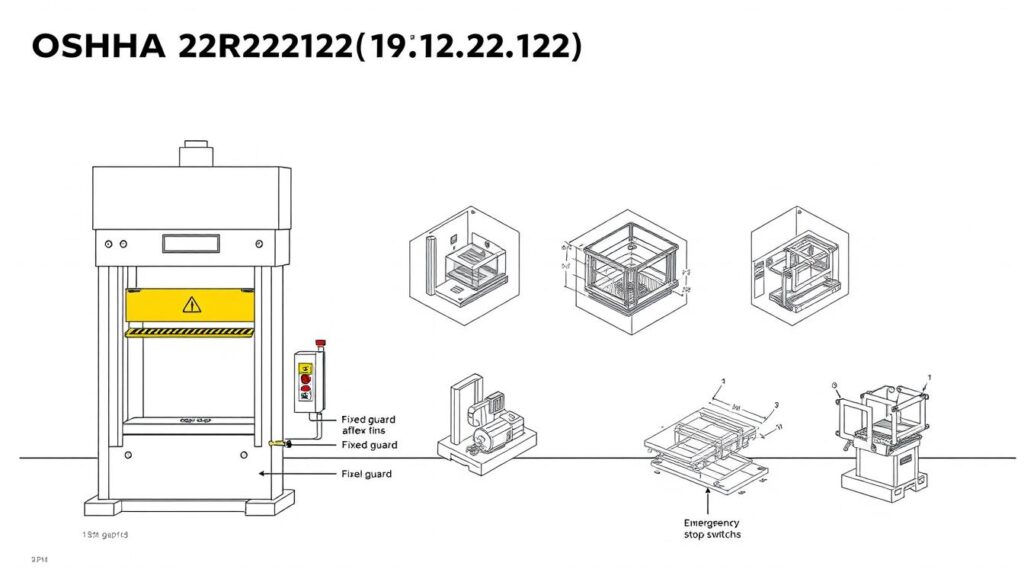
The foundation of hydraulic press safety begins with OSHA 29 CFR 1910.212, which establishes comprehensive machine guarding requirements for all industrial equipment. This regulation mandates that employers provide guards to protect workers from hazardous moving parts, addressing rotating components, flying chips, sparks, and dangerous point-of-operation zones.
Machine guarding requirements demand one or more protective methods including fixed barrier guards, interlocked guard systems, adjustable guards, and self-adjusting guards. Each method must prevent worker contact with hazardous areas during normal operations. For hydraulic presses, the regulation requires specific attention to point-of-operation protection where material positioning and forming occur, ingoing nip points where material feeds into the press, rotating parts including flywheels and pulleys, and flying debris protection from metal chips during operation.
Guards must maintain secure attachment to the machine without interfering with normal operations or creating additional hazards. They must also allow necessary lubrication and maintenance activities while maintaining worker protection. The standard requires guards for foot pedal controls and enclosed protection for pump and motor assemblies.
OSHA 29 CFR 1910.147 Lockout/Tagout Standards
Maintenance and servicing activities introduce unique hazards requiring specialized protection protocols. OSHA 29 CFR 1910.147 establishes lockout/tagout standards controlling hazardous energy during these critical operations, preventing unexpected equipment startup that could cause severe injuries or fatalities.
Lockout/tagout standards require employers to develop written energy control procedures identifying all energy sources connected to the hydraulic press, including electrical power, hydraulic pressure, pneumatic systems, and stored mechanical energy. Compliance involves preparation for shutdown, equipment shutdown using normal procedures, energy isolation by disconnecting all power sources, lockout device application, stored energy release including hydraulic pressure, and verification testing to confirm complete energy isolation.
Only authorized employees may perform lockout/tagout procedures, with each worker using individually assigned locks. Annual training documentation becomes critical during OSHA inspections and incident investigations.
ANSI B11.2 Standards for Hydraulic Presses
While OSHA regulations provide general requirements, ANSI B11.2 delivers detailed technical specifications specifically for hydraulic power presses. The American National Standards Institute developed these standards to address unique characteristics of hydraulic press equipment, and OSHA frequently references them during compliance determinations.
Key provisions include control system design requiring fail-safe operation and redundancy, two-hand control specifications with anti-tie-down features, presence-sensing device installation with safety distance formulas, brake system performance monitoring, and point-of-operation safeguarding effectiveness criteria. Many insurance providers and third-party auditors require ANSI B11.2 compliance as a condition of coverage.
$156,259
Maximum OSHA penalty per willful or repeat violation—plus potential criminal prosecution for fatalities
Penalty Structure for Non-Compliance
Understanding the financial and legal consequences reinforces the importance of regulatory compliance. OSHA categorizes violations into several types, each carrying different penalty ranges based on severity and employer compliance history.
| Violation Type | Maximum Penalty | Characteristics |
|---|---|---|
| Serious | $15,625 | Substantial probability of death or serious harm where employer knew or should have known of hazard |
| Willful | $156,259 | Intentional disregard or plain indifference to employee safety requirements |
| Repeat | $156,259 | Same or similar violation within five years at the same facility |
| Other-Than-Serious | $15,625 | Direct relationship to job safety but unlikely to cause death or serious injury |
Beyond financial penalties, OSHA can pursue criminal prosecution in cases involving worker fatalities. The true cost of non-compliance extends to increased workers’ compensation premiums, civil lawsuits, and reputational damage. State-plan states may impose penalties equal to or greater than federal amounts.
Essential Hydraulic Press Safety Procedures
Essential safety procedures transform OSHA mandates into daily practice, creating multiple protective layers that shield workers from mechanical hazards during every phase of production. OSHA requires facilities to establish comprehensive press operation protocols addressing machine design, operator behavior, and environmental factors.
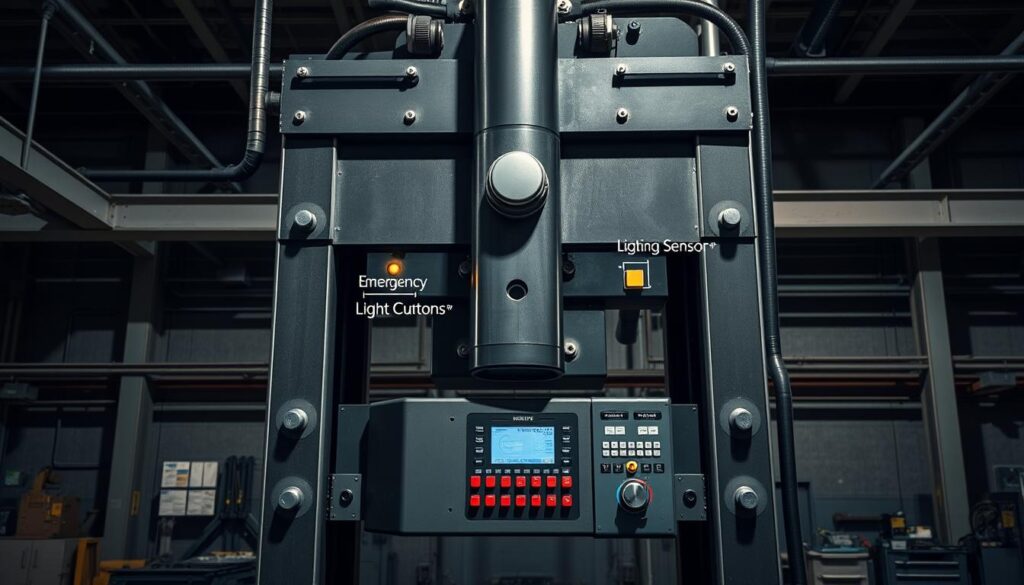
Physical Barriers and Sensing Technologies
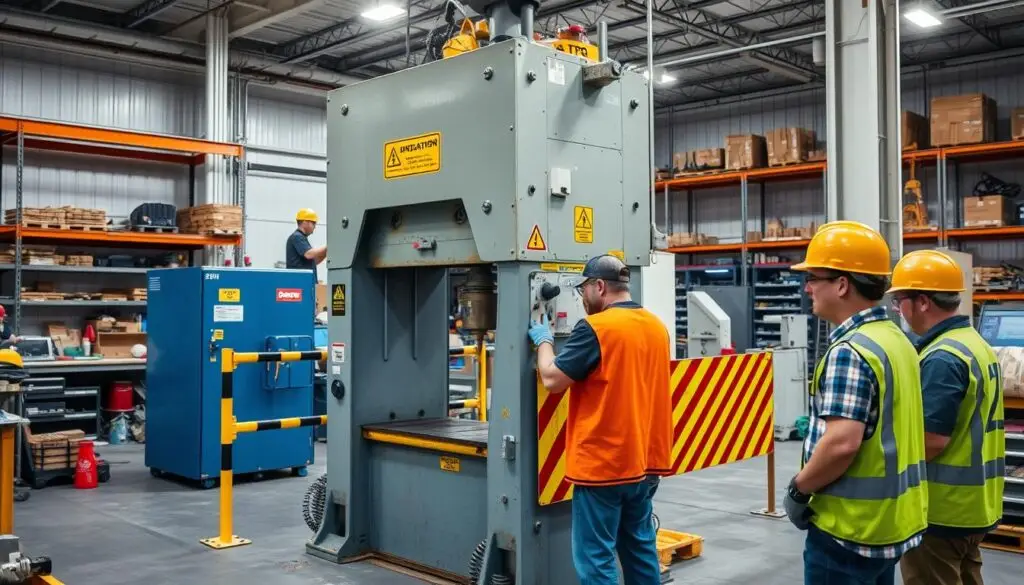
Point-of-operation safeguarding protects workers from the most dangerous zone where the press tool contacts the workpiece. Fixed barrier guards provide permanent physical separation between operators and crushing hazards, constructed from robust materials that withstand impact. Adjustable guards accommodate varying die sizes while maintaining protection, though strict protocols for positioning verification before each production run are required.
Interlocked guard systems prevent press activation when protective barriers are opened or removed, automatically disabling machine operation if guards are not properly secured. Presence-sensing devices use light curtains or laser scanning technology to create invisible protective fields around danger zones, halting ram movement immediately when the sensing beam detects an interruption.
| Safeguarding Method | Protection Level | Best Applications |
|---|---|---|
| Fixed Barrier Guards | Highest physical protection | Repetitive production with standard dies |
| Interlocked Guards | High – prevents operation when open | Operations requiring periodic die access |
| Light Curtains | Very high – immediate response | High-volume production with frequent cycles |
| Two-Hand Controls | Moderate – requires both hands engaged | Manual loading operations with skilled operators |
Control and Emergency Systems
Two-hand control systems require simultaneous activation of separate buttons positioned beyond reach of the danger zone, ensuring both hands remain clear of the point of operation during the press cycle. Anti-tie-down features prevent operators from defeating two-hand controls by securing one button in the activated position, with modern systems incorporating timing circuits that detect bypass attempts.
Foot pedal guards prevent accidental activation from dropped objects or unintended contact. Emergency stop buttons must be positioned within immediate reach at every control station, colored red with yellow backgrounds for instant recognition. Activation must cut power and apply mechanical brakes to halt ram movement immediately.
Safe Work Practices
Never reach into the point of operation during press cycles, regardless of production pressure or time constraints. This absolute prohibition prevents the most common cause of hydraulic press injuries. Operators must use push sticks, magnetic retrievers, or purpose-designed tools for material handling near danger zones.
Clear communication protocols become critical when multiple workers operate near the same equipment. Facilities must establish zero-tolerance policies for safety device bypassing—any attempt to circumvent guards or override controls warrants immediate disciplinary action. Immediate reporting requirements apply to any safety system malfunction or unusual equipment behavior.
Pre-Operation Safety Inspections and Checklists
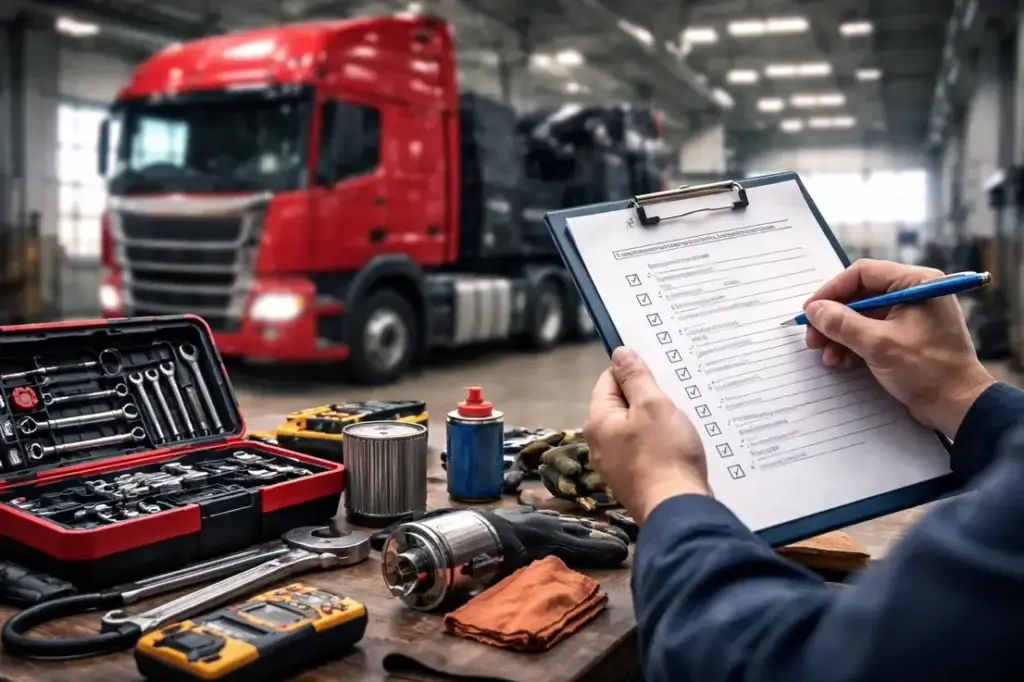
Every work shift demands a comprehensive safety check before hydraulic press equipment receives power activation. Regular inspections identify equipment deficiencies that could lead to catastrophic failures, worker injuries, or production delays. A thorough pre-operation checklist takes only minutes to complete but prevents accidents that cost thousands in medical expenses and lost productivity.
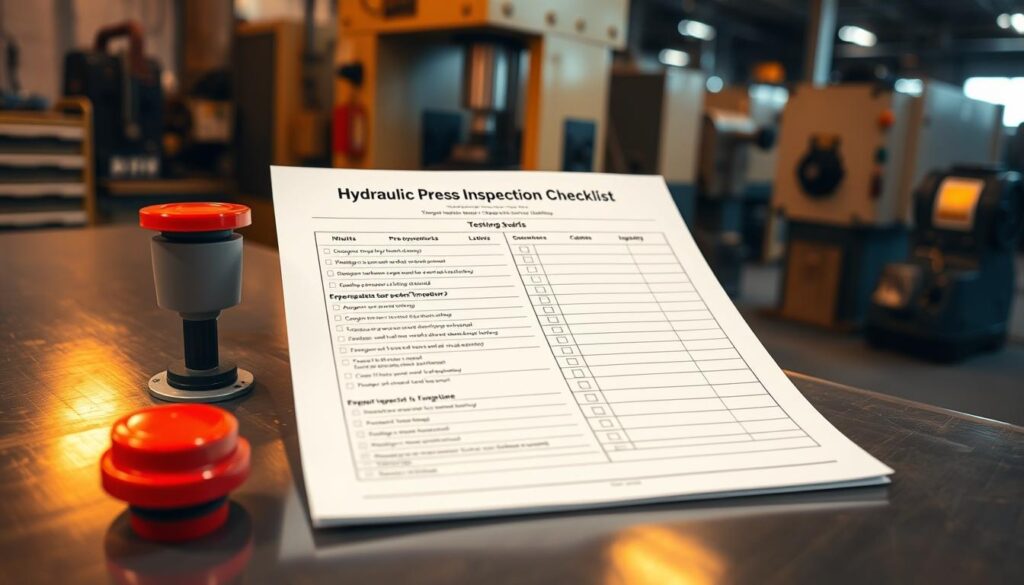
Daily Visual Inspection Protocol
Begin by inspecting hydraulic hoses for signs of deterioration including cracks, bulges, abrasion marks, or active leakage. Damaged hoses can fail catastrophically, releasing high-pressure fluid that causes injection injuries or creates slip hazards. Check all hose connections and fittings for tightness and evidence of seepage.
Examine all machine guards and safety devices to verify proper positioning and secure mounting. Guards should show no signs of modification, damage, or defeat mechanisms. Inspect the ram, die sets, and work surfaces for cleanliness and absence of debris—metal chips, oil accumulation, or material remnants can cause workpiece instability.
| Inspection Category | Components | Required Action if Deficient |
|---|---|---|
| Hydraulic System | Hoses, fittings, reservoir, pump | Replace damaged components; refill fluid to specifications |
| Guards and Barriers | Fixed guards, interlocked doors, light curtains | Lockout machine until repaired or replaced |
| Control Systems | Emergency stops, control buttons, foot pedals | Replace defective controls; clear obstructions |
| Structural Components | Frame, ram, bed, tie rods | Tag out machine; conduct engineering assessment |
Safety Device Functionality Tests
Safety device testing verifies that protective systems respond correctly to hazardous conditions. Test emergency stop buttons by activating each location while the press cycles in a controlled manner—the machine should halt all motion immediately. Verify light curtain operation by passing a test rod through the sensing field at various heights. Check two-hand control systems to ensure simultaneous activation is required and anti-tie-down features function properly.
Interlocked guard switches demand verification that the press cannot operate when guards are open. If the machine operates with any guard defeated, immediately lockout the equipment. Written inspection logs recording date, time, inspector name, and specific items examined create an auditable trail proving systematic hazard identification efforts.
Personal Protective Equipment Standards
Proper selection and consistent use of personal protective equipment dramatically reduces the severity of hydraulic press-related injuries when engineering controls fail. OSHA requires employers to provide appropriate PPE at no cost to workers and ensure its proper use during all operations.
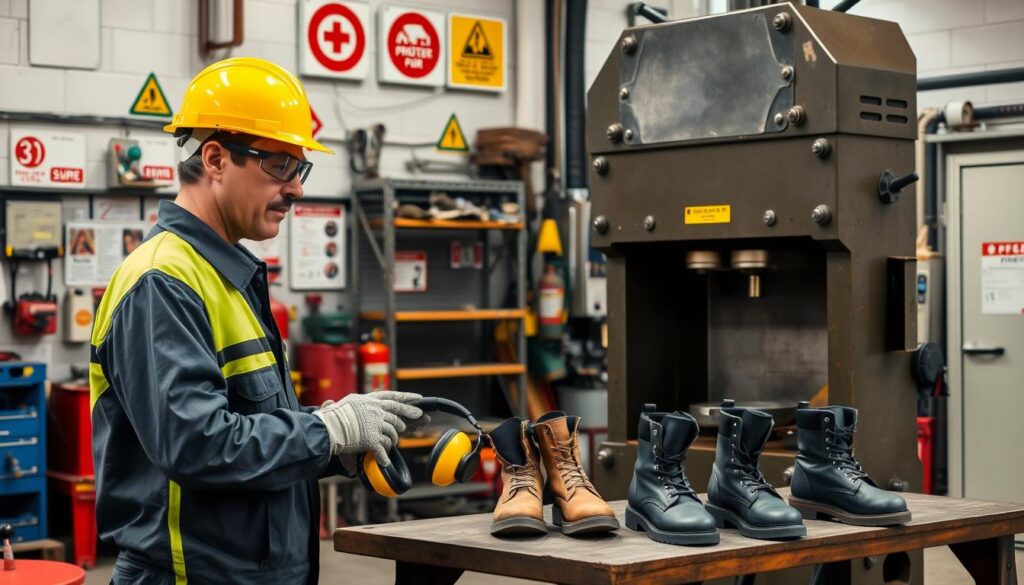
“PPE is the last line of defense. When all other controls fail, proper protective equipment can prevent a workplace incident from becoming a workplace tragedy.”
— OSHA Safety and Health Topics: Personal Protective Equipment
Eye, Face, and Hand Protection
All personnel within the hydraulic press operating area must wear ANSI Z87.1-compliant safety glasses with side shields as minimum protection. Full face shields become mandatory when operations involve materials prone to shattering or when working with hydraulic systems that could spray pressurized fluid. Hydraulic fluid injection injuries to the eyes represent one of the most devastating hazards in press operations.
For handling sharp metal stock, operators need cut-resistant gloves rated ANSI A2 or higher. Impact-resistant gloves with padded knuckles suit heavy material handling tasks. Glove fit is critically important—excess material can catch in moving parts, creating severe entanglement hazards. Some operations require bare hands for precise control, in which case additional safeguards like extended guards or feeding tools are necessary.
Hearing Protection and Work Attire
Hydraulic presses operating above 85 decibels require mandatory hearing protection. High-pressure operations frequently generate extreme noise levels causing permanent hearing damage with repeated exposure. Disposable foam earplugs offer noise reduction ratings of 29-33 decibels, while earmuff-style protection delivers NRR 22-33 with more consistent protection.
Loose sleeves, neckties, jewelry, and dangling accessories are absolutely prohibited in the press operating area. These items can catch in moving parts and pull operators into dangerous positions faster than emergency stops can respond. All jewelry including rings must be removed—wedding rings pose particular risk of degloving injuries. Steel-toed boots or composite-toe safety footwear rated ASTM F2413 protect against falling dies or materials weighing hundreds of pounds.
Machine Guarding Systems and Protective Devices
Engineering controls through barrier guards and presence-sensing devices deliver the most effective protection for hydraulic press operations. OSHA requires one or more methods of guarding to protect employees from machine hazards, with specific emphasis on point-of-operation protection.
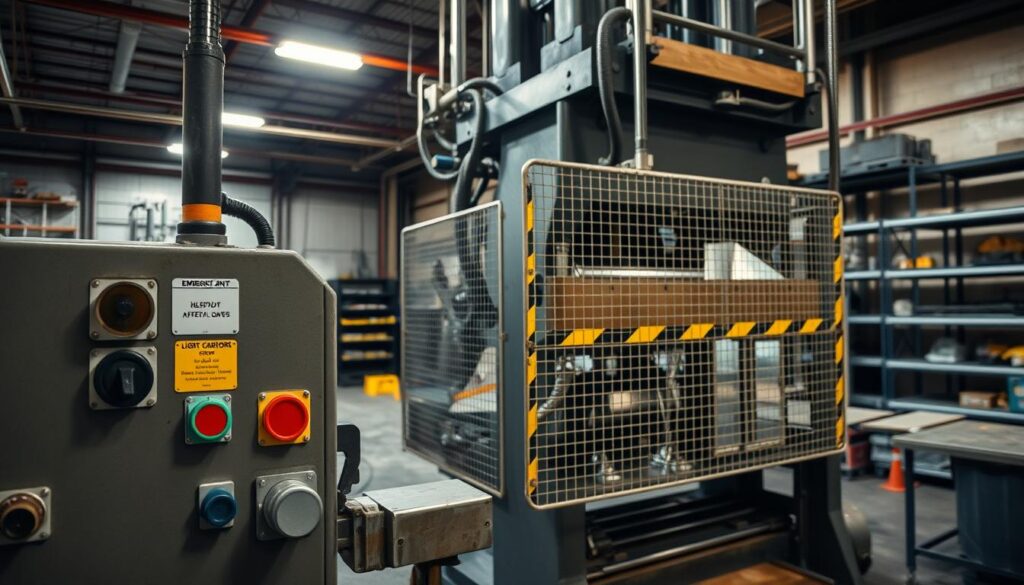
Fixed Barrier and Interlocked Guard Installation
Permanent guards constructed from durable materials provide continuous protection around hydraulic press danger zones. Fixed barrier guards utilize sheet metal, perforated metal, expanded metal, or polycarbonate panels to completely enclose hazardous areas while maintaining operator visibility. Installation specifications require guards to remain securely attached using fasteners that necessitate tools for removal.
ANSI B11.19 safety distance calculations determine proper guard sizing and placement, preventing reach-over or reach-around access to danger zones. Openings less than 0.25 inches prevent finger access to moving parts, while distances between 2.5 to 15 inches from pinch points require maximum opening sizes of 0.375 inches.
Electrical and mechanical interlock designs prevent press operation when guards are open or displaced. Key-interlock systems require physical key removal from the guard to enable press controls. Magnetic switches detect guard position through proximity sensing, immediately sending stop signals when guards open. Interlock defeat through bypassing constitutes a serious OSHA violation—facilities must implement defeat prevention measures including tamper-evident seals and supervisor monitoring.
Light Curtains and Two-Hand Controls
Photoelectric systems create invisible sensing fields that trigger emergency stops when interrupted. Light curtain safety systems offer flexible protection without physical barriers that might impede material flow. Installation height and distance from the point of operation depend on press stopping time measurements, with self-checking circuitry monitoring internal system functions continuously.
Dual-button activation systems require operators to use both hands simultaneously, keeping them away from danger zones during the hazardous portion of press cycles. Actuation timing standards mandate simultaneous button pressing within 0.5 seconds, with continuous pressure required throughout the hazardous cycle portion. These controls protect only the operator and must be combined with guards to protect other workers in the area.
The HDJ Perspective
Fleet maintenance shops often inherit hydraulic presses without comprehensive safety documentation, creating compliance blind spots that only surface during OSHA inspections or—worse—after injuries occur. The investment in proper machine guarding, documented training programs, and regular safety audits pays dividends that extend far beyond avoiding fines. Shops that build safety culture into daily operations see reduced workers’ comp claims, lower insurance premiums, and better technician retention. In an industry already struggling to attract skilled workers, demonstrating commitment to workplace safety becomes a competitive advantage in recruiting.
Lockout/Tagout Procedures for Maintenance
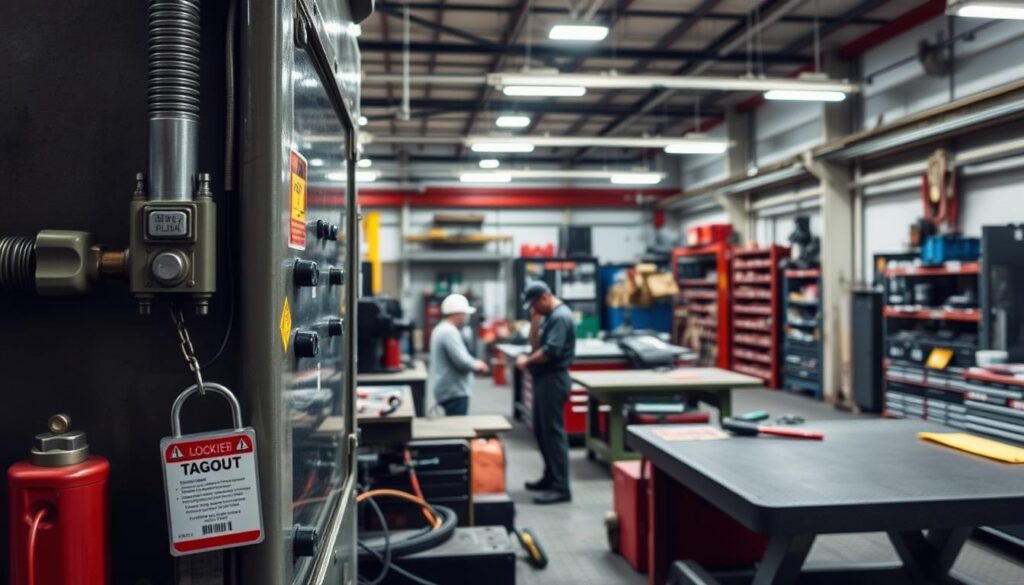
Lockout/tagout procedures form the critical safety barrier between workers and catastrophic injuries during hydraulic press maintenance. OSHA 29 CFR 1910.147 mandates specific protocols for controlling hazardous energy whenever servicing, adjustment, or repair activities require workers to bypass normal safeguards.
⚠️ Safety Warning
Hydraulic accumulators store pressurized fluid at operating levels even after electrical disconnection. Never assume pressure has dissipated naturally—always follow formal pressure release protocols and verify zero pressure on gauges before beginning maintenance work.
Energy Source Identification and Pressure Release
Effective energy isolation begins with comprehensive identification of every hazardous energy source connected to the hydraulic press. Most presses contain multiple energy types requiring simultaneous control: electrical power, hydraulic pressure at thousands of PSI, pneumatic pressure, mechanical energy from elevated rams, and thermal energy in heated platens.
Hydraulic pressure release represents the most critical step. Residual pressure remaining in hydraulic systems after pump shutdown can cause sudden ram movement. The systematic approach involves shutting down the hydraulic pump, identifying all accumulators and pressure-retaining components, locating designated pressure release valves, ensuring no personnel occupy potential ram movement paths, slowly opening release valves to bleed pressure at controlled rates, monitoring pressure gauges until readings reach zero PSI, and verifying the ram cannot move by attempting manual manipulation.
Lockout Device Application and Verification
Each authorized worker must apply their personal padlock to energy isolation points. Group lockout procedures use specialized lockout boxes accepting multiple individual locks. No worker may use another person’s lock under any circumstances. Lockout devices must withstand industrial environments without deterioration, with padlocks using unique keying that prevents unauthorized removal.
Verification testing confirms that energy isolation is complete before workers enter hazard zones. This includes attempting to start the press using normal controls, confirming the ram remains stationary, using voltage testers at the point of work, and checking pressure gauges show zero hydraulic pressure. Electrical testing requires qualified personnel using appropriate test equipment—visual observation of controls is insufficient.
Free Professional Fleet Tools
Cost calculators, fault code lookup, maintenance planners, and more—built for owner-operators, fleet managers, and diesel techs. No signup required.
Operator Training and Qualification
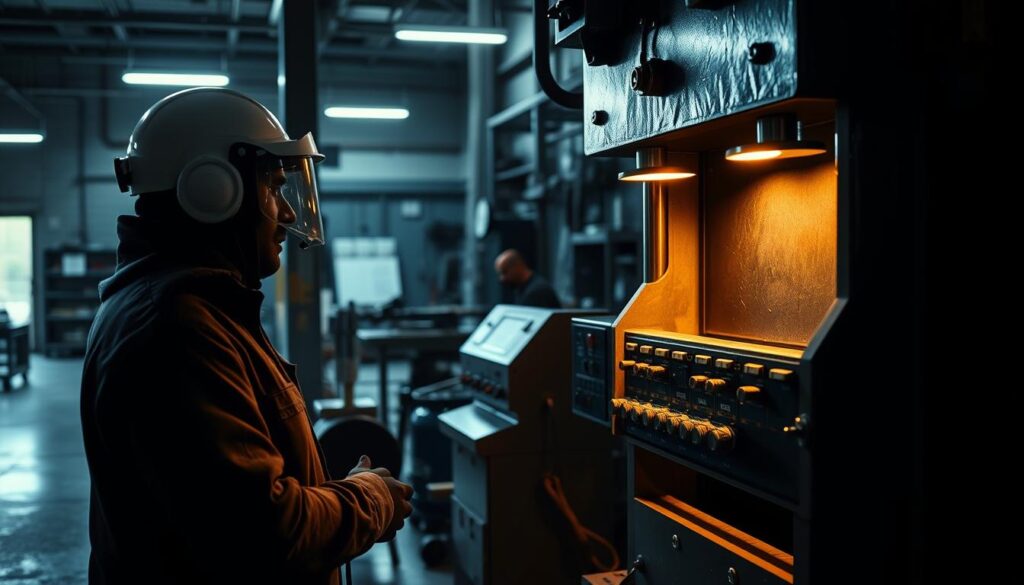
Training programs serve as the foundation for developing competent hydraulic press operators who understand both operational procedures and hazard prevention. Any worker using a hydraulic press machine should be knowledgeable in all areas of operation to take proper safety precautions. Undertrained users face significantly higher risk of injury than those who received proper training.
Initial Training Curriculum
New operator training must include comprehensive review of OSHA regulations and facility-specific safety policies, detailed instruction on press operating principles and hydraulic system functions, hazard identification covering crush points, shear points, and ejection zones, and material handling techniques preventing improper positioning.
Training must cover proper use and limitations of all guards and safety devices, emergency stop activation and response procedures, and PPE requirements with proper usage demonstrations. Operators must learn to recognize abnormal conditions such as unusual noises, vibrations, or hydraulic leaks, with explicit prohibition of guard defeat or safety system bypass.
Competency Testing and Documentation
Classroom instruction alone proves insufficient—competency testing must include supervised practice under observation of experienced operators or trainers. Trainees must demonstrate proper startup and shutdown procedures, correct material positioning for various dies, and appropriate response to simulated emergency scenarios.
Formal competency evaluation combines written tests covering theoretical knowledge with practical demonstrations confirming safe operating practices. Workers cannot receive authorization for independent operation until successfully completing all requirements. Facilities must maintain a roster of authorized press operators for each specific press model, with training records documenting dates, duration, topics covered, trainer identity, and evaluation results.
Annual refresher training maintains operator competency. Retraining becomes mandatory following any accident or near-miss. Requalification is required when operators transfer to different press models or when equipment modifications occur. Training records must be retained for the duration of employment plus at least one year.
Hazard Recognition and Risk Mitigation
Every hydraulic press operation presents multiple risk factors demanding comprehensive hazard analysis and strategic control measures. Understanding these dangers enables facility managers to implement proactive safety protocols rather than responding to injuries after they occur.
Crush Points and High-Pressure Hazards
The primary crush point exists between the ram and bolster where tonnage forces can exceed hundreds of tons. Secondary pinch points exist throughout the machine structure including areas between moving dies and stationary components, shear points where material undergoes cutting, and pinch points in linkages and adjustment mechanisms. Operators must maintain constant awareness of hand and body position relative to these identified danger zones.
Hydraulic fluid injection injury represents one of the most serious yet underestimated hazards. Systems operating at 2,000-5,000 PSI can inject hydraulic oil through intact skin, causing severe internal tissue damage that may not be immediately visible. Even pinhole leaks create invisible high-velocity streams capable of penetrating flesh. Workers must never use hands to check for leaks—use cardboard or paper instead. Any suspected injection injury requires immediate emergency medical treatment regardless of external appearance.
Noise and Ergonomic Considerations
Hydraulic press operations commonly generate noise exposure levels of 85-95 decibels or higher. Facilities must conduct noise level monitoring to determine actual exposure levels, with mandatory hearing protection when 8-hour time-weighted averages exceed 85 dBA.
Cumulative trauma disorders result from repeated material loading and unloading cycles. Workers face ergonomic hazards including prolonged standing on hard surfaces, awkward postures when positioning heavy materials, and hand-arm vibration from impact forces. Effective mitigation includes job rotation, anti-fatigue matting, adjustable-height work surfaces, and mechanical assists such as lift tables and hoists.
Emergency Procedures and Incident Response
Despite the best preventive measures, emergencies can still occur. The ability to respond quickly and effectively often determines whether an incident results in minor injury or permanent disability. All shop personnel must understand emergency response protocols and execute them without hesitation.
Emergency Shutdown and Medical Response
Emergency stop procedures form the foundation of incident response. OSHA standards require readily identifiable and accessible emergency stop devices positioned within immediate reach. Large hydraulic presses must have multiple emergency stop locations. Emergency stops must immediately halt all press motion when activated, automatically releasing hydraulic pressure or activating mechanical locking mechanisms.
When accidents occur, the first action involves activating the emergency stop to prevent additional harm, followed by alerting all personnel in the area. Emergency medical services must be called immediately for serious injuries. Workers should not attempt to move injured personnel unless necessary to prevent further harm. The accident scene must be preserved for investigation unless continued operation creates additional hazards.
⚠️ Critical: Hydraulic Injection Injuries
Hydraulic fluid injection injuries require immediate emergency medical treatment even if entry wounds appear minor. The external wound may be small, but internal damage can be extensive and life-threatening. Delayed treatment beyond a few hours typically results in permanent tissue damage and amputation. Medical providers need to know that hydraulic fluid has been injected under pressure.
Incident Investigation and Documentation
Incident investigation procedures establish requirements for thorough analysis of all accidents, near-misses, and equipment failures. The goal involves identifying root causes rather than simply blaming operators. Investigation procedures include witness interviews, photographic documentation, equipment examination, and analysis of whether established procedures were followed.
The OSHA 300 log establishes federal documentation requirements for workplace injuries. Any accident resulting in amputation, hospitalization, or loss of an eye must be reported within 24 hours. Injury records must be retained for five years. Falsification of injury records constitutes a separate and serious violation.
Preventive Maintenance Programs
Regular inspection and maintenance cycles transform hydraulic press operations from high-risk activities into predictable, controlled processes. Preventive maintenance programs address the constant stress that hydraulic presses endure from high pressure, elevated temperatures, and natural wear.
Maintenance Interval Standards
Operators must conduct visual inspections before each shift examining fluid levels, leaks, and guard condition. Weekly maintenance includes lubricating moving components and verifying hydraulic fluid levels. Monthly inspections require detailed examination of hoses, fittings, seals, and machine guards. Quarterly assessments must include hydraulic system pressure testing and relief valve calibration. Annual comprehensive teardown inspections examine critical wear components including ram packing, valve stems, and hydraulic pump assemblies.
Hydraulic hoses require examination for surface cracks, abrasion, bulging, or hardening indicating imminent failure. High-pressure fittings demand torque verification to manufacturer specifications. Hydraulic fluid analysis reveals contamination, moisture content, and viscosity breakdown—fluid changes become necessary when testing reveals degradation beyond acceptable parameters.
Safety System Verification
Presence-sensing device response time testing uses prescribed test pieces at specified speeds. These tests confirm stopping time meets safety distance calculations required by ANSI B11.2 standards. Emergency stop circuit continuity testing verifies stops reliably de-energize control circuits. Two-hand control systems need anti-repeat and anti-tie-down function testing.
Written maintenance documentation provides evidence of employer due diligence and regulatory compliance. Work orders must document date, technician name, work performed, parts replaced, and any deficiencies requiring follow-up. Equipment history files track all maintenance activities over the machine’s service life, enabling pattern analysis that reveals chronic issues requiring engineering solutions.
Frequently Asked Questions
What are the main OSHA regulations for hydraulic press safety?
The primary OSHA regulations governing hydraulic press safety are 29 CFR 1910.212 for machine guarding requirements and 29 CFR 1910.147 for lockout/tagout procedures. Section 1910.212 mandates point-of-operation guards, barrier guards for rotating components, and protection from flying debris. Section 1910.147 establishes energy control procedures during maintenance and servicing. Additionally, ANSI B11.2 provides detailed technical specifications that OSHA frequently references during compliance inspections.
How often should hydraulic press safety inspections be performed?
Hydraulic press inspections should follow a tiered schedule: daily operator checks before each shift examining fluid levels, leaks, and guard condition; weekly maintenance for lubrication and detailed visual inspection; monthly examination of hoses, fittings, and seals; quarterly pressure testing and safety device calibration; and annual comprehensive teardown inspections of critical wear components. All inspections require documentation for OSHA compliance and should be retained for at least one year.
What PPE is required for hydraulic press operations?
Required personal protective equipment includes ANSI Z87.1-compliant safety glasses with side shields, full face shields for shattering materials or hydraulic spray hazards, cut-resistant gloves rated ANSI A2 or higher for material handling, steel-toed or composite-toe boots meeting ASTM F2413 standards, and hearing protection when noise exceeds 85 decibels. Close-fitting clothing is mandatory—loose sleeves, jewelry, and long hair must be secured to prevent entanglement hazards.
What are the OSHA penalties for hydraulic press safety violations?
OSHA penalties vary by severity: serious violations carry maximum penalties of $15,625 per violation, while willful or repeat violations can reach $156,259 per violation. Beyond financial penalties, willful violations resulting in worker fatalities can lead to criminal prosecution with potential jail time. Costs extend beyond fines to include increased workers’ compensation premiums, civil lawsuits, production downtime, and reputational damage.
What is a hydraulic fluid injection injury and why is it dangerous?
Hydraulic fluid injection injury occurs when high-pressure hydraulic fluid penetrates the skin, typically through pinhole leaks operating at 2,000-5,000 PSI. The danger lies in the deceptive nature—the entry wound often appears minor, resembling a simple puncture, but fluid spreads through tissue causing severe internal damage. Without emergency medical treatment within hours, these injuries frequently result in amputation. Workers should never use hands to check for leaks and must treat any suspected injection as a medical emergency.
What training is required for hydraulic press operators?
OSHA requires comprehensive training covering regulatory requirements, equipment operation principles, hazard recognition, safety system functions, and emergency response procedures. Training must include hands-on competency testing under supervision before operators work independently. Annual refresher training maintains qualification, with immediate retraining required after any accident or near-miss. Employers must maintain detailed training records documenting dates, topics covered, trainer identity, and competency evaluations for the duration of employment plus one year.
Building a Safety-First Press Operation
Protecting employees must remain the highest priority in every hydraulic press operation. The safety best practices outlined in this guide provide a proven framework for preventing injuries and fatalities while maintaining OSHA compliance. Safety measures directly impact your shop’s productivity, insurance costs, and ability to retain skilled technicians.
Begin by conducting a gap analysis comparing current practices against the standards detailed in this guide. Prioritize corrective actions addressing the most serious deficiencies first, and engage frontline workers in safety improvement initiatives since they possess valuable operational knowledge. Resources including OSHA consultation services provide expert guidance for complex situations at no cost to employers.
Every worker deserves to return home safely after each shift. This outcome becomes achievable through diligent application of proven safety principles—proper machine guarding, documented training programs, consistent daily inspections, and a workplace culture that treats safety as non-negotiable rather than optional.
Share This Safety Resource
Know a shop manager or fleet supervisor who could benefit from this guide? Share it with your network to help improve workplace safety across the industry.