
By Michael Nielsen, Publisher | 15+ Years in Diesel Repair
Last Updated: October 2026
⏱ Estimated reading time: 13 minutes
Excavator bucket types fall into a few families: general purpose, heavy duty and rock buckets for digging, plus trenching, skeleton, grading and tilt buckets for specific jobs. The right choice depends on the material, the machine's rated lift capacity and the work, and a wrong match slows production or overloads the machine.
Heavy Duty Journal (HDJ), written by publisher Michael Nielsen, rebuilt this guide in October 2026. It relies on primary text from the Occupational Safety and Health Administration (OSHA), the UK Health and Safety Executive (HSE) and published standards, and it labels HDJ's practical judgment as judgment.
The guide covers bucket families, sizes and capacity ratings, matching a bucket to the machine, quick coupler safety, digging near trenches and utilities, wear parts and buying decisions. Specific widths, weights and limits come from the original equipment manufacturer (OEM) for your machine, so this guide gives methods rather than size tables.
Key Takeaways
- ✓Match the bucket to the material. General purpose buckets suit mixed soil, while abrasive or rocky ground needs heavier construction and stronger wear protection.
- ✓Check the lift chart. A bucket plus its load must stay within the machine's rated capacity at the working radius, so weigh the bucket as well as the payload.
- ✓Capacity ratings are comparisons. Published bucket capacity is a conventional rating, not a measured load, so confirm how it was rated.
- ✓Quick couplers need a check every time. Confirm the retaining pin or lock is in place before lifting, and never work under a suspended bucket.
- ✓Inspect wear parts early. Teeth, adapters, cutting edges and welds are cheaper to replace before they fail than after.
In This Guide
- Excavator Bucket Types and What Each One Does
- General Purpose, Heavy Duty and Rock Buckets
- Specialty Buckets: Trenching, Skeleton, Grading and Tilt
- Bucket Sizes and Capacity Ratings
- Matching a Bucket to Your Machine and Material
- Quick Couplers and Attachment Safety
- Digging Near Trenches and Utilities
- Wear Parts, Inspection and Replacement
- Buy, Rent or Rebuild
- Frequently Asked Questions
- The Bottom Line
Excavator Bucket Types and What Each One Does
A bucket is the part of the excavator that touches the ground, so it sets how fast the machine digs and how fast it wears. Its main parts are the shell, the cutting edge, the teeth and adapters, the side cutters and the wear plates. Each excavator bucket type changes those parts to suit a material or a task.
The table below summarizes the common excavator bucket types, what each does best and what to watch. It is HDJ practitioner guidance for choosing a starting point, not an OEM approval, so confirm that any bucket and coupler combination is approved for your machine.
| Bucket type | Best for | Watch-outs |
|---|---|---|
| General purpose | Mixed soil, utility trenches, backfill and everyday digging | Wears quickly in rock or abrasive sand |
| Heavy duty | Abrasive material, shot rock and demolition debris | Extra weight reduces payload and lift capacity |
| Rock | Hard, blasted or consolidated ground | Poor for finishing work and sticky soil |
| Trenching | Narrow utility and pipe trenches | Small volume per pass |
| Skeleton | Separating soil from rock, roots or debris | Fine, wet material passes through or clogs the grid |
| Grading and ditch cleaning | Finish grading, slopes and drainage ditches | Not made for hard digging |
| Tilt and tilt-rotator | Shaping slopes and working at angles without repositioning the machine | Added weight, hydraulic needs and operator training |
Teeth come in styles for different ground. Chisel-style teeth suit general digging, tiger or pointed teeth concentrate force to penetrate hard or compacted ground, and flat or smooth edges suit finishing. Bolt-on adapters and pinned teeth can be changed in the field, while weld-on parts take more work, so ask your bucket maker which style your excavator bucket types use.
Editorial Insight
The HDJ Perspective
According to Michael Nielsen, publisher of Heavy Duty Journal, most bucket trouble comes from using one bucket for everything. In HDJ's editorial judgment, built on 15+ years in diesel repair, fleets that keep the right two or three excavator bucket types on a quick coupler lose less time to wear, rework and overloaded machines than fleets that run one bucket until it fails.
General Purpose, Heavy Duty and Rock Buckets
The general purpose bucket is the standard choice for mixed soil, topsoil, clay and gravel. It balances shell strength and weight, which keeps payload high, and it usually comes with the machine. It is the right default for foundations, utility trenches, backfill and site work where the material is fairly uniform.
A heavy duty bucket adds thicker plate, extra wear protection and stronger stress points. It suits abrasive material, such as sharp sand, crushed stone and demolition debris, where a general purpose bucket would wear through. The trade-off is weight: a heavier bucket carries less material before the machine reaches its lift limit.
A rock bucket goes further, with a shape and tooth setup made to break into hard or consolidated ground. Teeth are usually longer and the cutting edge is arranged to concentrate force. Rock buckets work in quarries and on blasted rock, and they are a poor choice for finishing, sticky clay or fine grading.
Abrasion-resistant plate, often sold in grades named for nominal Brinell hardness such as AR400, resists wear better than ordinary structural steel. Harder plate can be less forgiving of impact and welding, so ask the bucket maker which grade fits your material and whether repairs need special procedures.
Specialty Buckets: Trenching, Skeleton, Grading and Tilt
A trenching bucket is narrow and deep for pipe, conduit and cable trenches. It limits how much material you remove and how much backfill you need. Pick the width from the pipe or conduit size, the bedding and clearance the job requires, and local rules, not from a general chart.
A skeleton bucket has gaps in the shell so loose soil falls through while larger rocks, roots and debris stay in the bucket. It saves a separate screening step on jobs such as site clearing or recovering rock. It works best on drier material, because wet, sticky soil clogs the openings.
A grading or ditch-cleaning bucket is wide and shallow, often with a smooth cutting edge and no teeth. It is made for finishing slopes, shaping drainage ditches and leveling, not for breaking out hard ground. A smooth edge also makes sense near buried utilities, which is HDJ practice rather than a rule.
A tilt bucket, or a tilt-rotator, adds hydraulic movement so the bucket can angle without repositioning the machine. That helps with slopes, shaping and precise work. It also adds weight and plumbing, needs a compatible coupler and demands operator training, so check the excavator's hydraulic capacity with the OEM first.
Stay Ahead of Equipment Selection
Get HDJ field guides on heavy equipment selection, safety and maintenance delivered to your inbox weekly.
Bucket Sizes and Capacity Ratings
Bucket size has two parts: width and capacity. Width controls how much ground a pass covers and how easily the bucket fits a trench. Capacity is the volume of material it holds. Bucket makers publish both, and the machine maker publishes the largest bucket and the heaviest bucket allowed for each excavator.
Capacity figures follow standard methods. The International Organization for Standardization (ISO) publishes ISO 7451, a current standard that sets out a method for estimating the volume a hoe-type bucket can contain from its internal dimensions, and it describes the result as a conventional way to compare buckets, not true capacity. The Society of Automotive Engineers (SAE), now SAE International, published SAE J296 for hoe buckets, and its page lists that standard as canceled.
Ask whether a quoted capacity is struck, meaning level with the cutting edge and sides, or heaped, meaning mounded above them. Two buckets from different makers can look different on paper because of how they were rated. Compare buckets by the same basis, and check the weight and the width as well.
A bucket must also fit the machine. Pin spacing, pin diameter and the linkage geometry have to match the stick and the coupler, or the bucket will not rotate and dump correctly. Buckets from one maker do not always fit another maker's coupler, so confirm the fit with the supplier before ordering.
Machine class sets the range. Smaller excavators need narrower and lighter buckets, and larger ones can take wider and heavier buckets with more teeth and wear plate. Do not pick a size by tonnage alone. Use the OEM's recommended bucket chart for the exact model, and the lift chart, which also depends on the stick length and the counterweight.
Matching a Bucket to Your Machine and Material
Start with the material. Soil weight changes with the type of material and with moisture: wet clay and dense rock weigh far more per cubic yard than dry topsoil. A bucket that is safe in loose soil can be overloaded in wet clay, so get the material weight from the job's geotechnical information or the OEM's bucket selection guide.
Then do the arithmetic. Payload is bucket capacity times fill factor times material weight. For a hypothetical 1.0 cubic yard bucket filled 90 percent with soil weighing 2,500 pounds per cubic yard, payload is 2,250 pounds. Add the bucket's own weight and any coupler, and the total must stay within the lift chart at the working radius.
Check the lift chart for the position the machine will actually work in. Rated capacity drops as reach increases and depends on the surface, the stick and the boom. Oversized buckets also slow the cycle and leave less margin for stability on slopes, so heavier is not always more productive. HDJ's excavator hydraulic problems guide covers what weak or slow hydraulics look like.
Match the bucket to the truck as well. Passes needed equals the truck's capacity divided by the bucket's capacity times the fill factor. For a hypothetical 10 cubic yard bed and a 1.5 cubic yard bucket filled 90 percent, that is about 7.4, so plan on seven or eight passes. A bucket that leaves a ninth pass wastes truck time, which is why matching excavator bucket types and sizes to the haul fleet pays.
Lifting with the bucket is a separate question. As of October 2026, under Title 29 of the Code of Federal Regulations (CFR), 29 CFR 1926.1400 excludes excavators from the crane rules, even when they are used with chains, slings or other rigging to lift suspended loads.
That exclusion does not remove the machine's own limits. Follow the OEM load chart and the manufacturer's lifting points, and see the Infrastructure Health and Safety Association (IHSA) article on lifting with excavators for practice points.
Quick Couplers and Attachment Safety
A quick coupler lets one excavator change between buckets and attachments from the cab. It is the main tool that makes owning several excavator bucket types practical. It also adds a hazard: if the locking device is not engaged, the bucket can swing loose or fall.
Couplers come in manual, semi-automatic and fully hydraulic types, and each locks differently. Some use a pin or wedge that the operator sets, and some lock from the cab. Operators must know exactly how their own coupler locks, how it shows that it is locked, and what to do if the lock does not engage.
⚠️ Safety Warning
Never work or stand under a suspended bucket or attachment, and never run the machine unless the coupler is locked. Before lifting, confirm the manufacturer's retaining pin or lock is in place, and check again each time the attachment is changed.
The HSE guidance on quick hitches says a hitch can keep working for some time without its retaining pin, then suddenly swing open or fall off. As of October 2026, the page lists missing retaining pins or bars as the common factor in the fatal incidents it cites, and recommends operator training, using only the pins made for the hitch, and checking before work starts.
The same guidance says to forbid ad-hoc substitutes such as bolts or wire and to check with the manufacturer before modifying a hitch. Operators also need to be qualified for the machine and attachment. HDJ's heavy equipment operator certification requirements guide explains which credentials apply.
Digging Near Trenches and Utilities
Digging near trenches and buried lines changes the bucket decision. Under 29 CFR 1926.651, the estimated location of underground utilities must be determined before an excavation is opened. Choose a bucket and a method that suit locating and exposing the line, and follow the utility owner's rules for working near it.
The same section requires excavated material and equipment that could fall or roll into the excavation to be kept at least 2 feet from the edge, or restrained. It also calls for a warning system, such as barricades or signals, when mobile equipment works near an edge and the operator cannot see it clearly. Plan where the bucket places spoil before digging starts.
Wear Parts, Inspection and Replacement
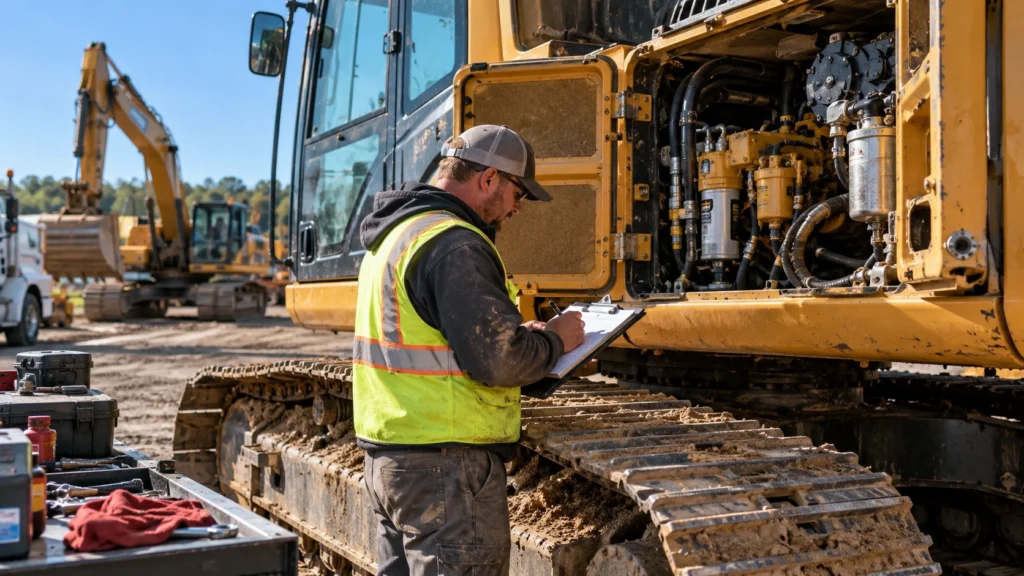
Teeth, adapters, cutting edges, side cutters and wear plates take the abuse, so they are designed to wear while the shell lasts. Check them at the start of every shift: loose or missing teeth, cracked adapters, rounded cutting edges, worn wear plates and cracks near welds. Replace parts by the bucket maker's wear limits, not by feel.
Worn teeth slow penetration and push the machine harder, and a worn adapter can lose a tooth in the load. Rotate or replace teeth by the manufacturer's guidance, and repair cracks properly instead of welding over them. Heavy Duty Journal's heavy equipment maintenance checklist shows where bucket checks fit in a seven-system routine.
For tooth work, lower the attachment, shut the machine down and take the key. 29 CFR 1926.600 requires that blades, buckets and similar equipment be fully lowered or blocked when equipment is being repaired or not in use. Wear eye protection, because striking teeth and pins can throw fragments.
Key Recommendation
Inspect the bucket and coupler at the start of every shift. A thirty-second walkaround that checks the pin, the teeth and the cutting edge is cheaper than a dropped bucket, a lost tooth in the load or a cracked shell.
Buy, Rent or Rebuild
Buying makes sense for the bucket you use most, usually a general purpose or a grading bucket. Renting suits a specialty bucket you need for one job, such as rock, skeleton or trenching. Compare the real cost of ownership, which includes wear parts, repair, storage and the time the bucket sits idle, not just the price.
For most fleets, HDJ's view is to own the buckets that do most of the work, such as a general purpose bucket and a grading bucket, and to rent the rest for the jobs that need them. That keeps the number of excavator bucket types in the yard small and keeps every coupler and bucket pairing checked and recorded.
Rebuilding a worn bucket can be reasonable if the shell and pin bores are sound. Cracks, thin plate and worn bores often cost more to repair than the bucket is worth, and a poor repair is a safety risk. Our fleet total cost of ownership guide covers how to compare the options.
A used bucket needs the same checks as a used machine. Inspect welds, bores, pins, plate thickness and wear parts, and confirm the fit with your coupler. HDJ's used heavy equipment red flags guide lists what to look for before you buy.
Frequently Asked Questions
What are the main excavator bucket types?
The main excavator bucket types are general purpose, heavy duty and rock buckets for digging, plus trenching, skeleton, grading or ditch-cleaning, and tilt buckets for specific work. Choose by material, the machine's lift capacity and the task, and confirm the fit with the OEM.
How do I choose the right excavator bucket size?
Check the OEM's recommended bucket width, capacity and weight for your exact model. Then compare payload, which is capacity times fill times material weight, plus the bucket and coupler weight, against the lift chart at the working radius. Bucket size is not chosen by tonnage alone.
What is the difference between struck and heaped capacity?
Struck capacity is the volume level with the bucket's cutting edge and sides, and heaped capacity includes material mounded above them. Makers rate buckets differently, so ask which basis a figure uses before comparing buckets from different brands.
Are quick couplers safe?
They are safe when used as designed. HSE reports that missing retaining pins or bars were the common factor in fatal quick hitch incidents. Train operators, keep the manufacturer's pin on the hitch, confirm it is engaged before lifting, and never stand under a suspended bucket.
When should bucket teeth be replaced?
Replace teeth and adapters by the bucket maker's wear limits, and sooner if teeth are loose, cracked or worn so that penetration drops. Check them at the start of every shift. A worn adapter can lose a tooth, so inspect adapters too.
Can I lift loads with an excavator bucket?
OSHA's crane rule excludes excavators, even with rigging, but the machine's own limits still apply. Use the OEM load chart, the manufacturer's lifting points, rated rigging and hose burst protection where fitted. Never run slings over bucket teeth or exceed the chart.
The Bottom Line
Excavator bucket types are tools: a general purpose bucket for everyday digging, heavy duty or rock buckets for abrasive and hard ground, and specialty buckets for trenching, sorting, grading and shaping. Match the bucket to the material and the machine's lift chart, compare capacity ratings on the same basis, and inspect the coupler and wear parts every shift.
Michael Nielsen and the Heavy Duty Journal team publish more equipment selection, safety and maintenance guides at heavydutyjournal.com. Confirm widths, weights and limits in the manual for your machine and with the bucket maker before buying or fitting any attachment.
Share This With Your Crew Lead
If someone on your team selects or maintains excavator attachments, pass this heavydutyjournal.com guide along.