By Michael Nielsen, Editor & Publisher | 15+ Years in Diesel Repair
Last Updated: December 2025
📖 Estimated reading time: 22 minutes
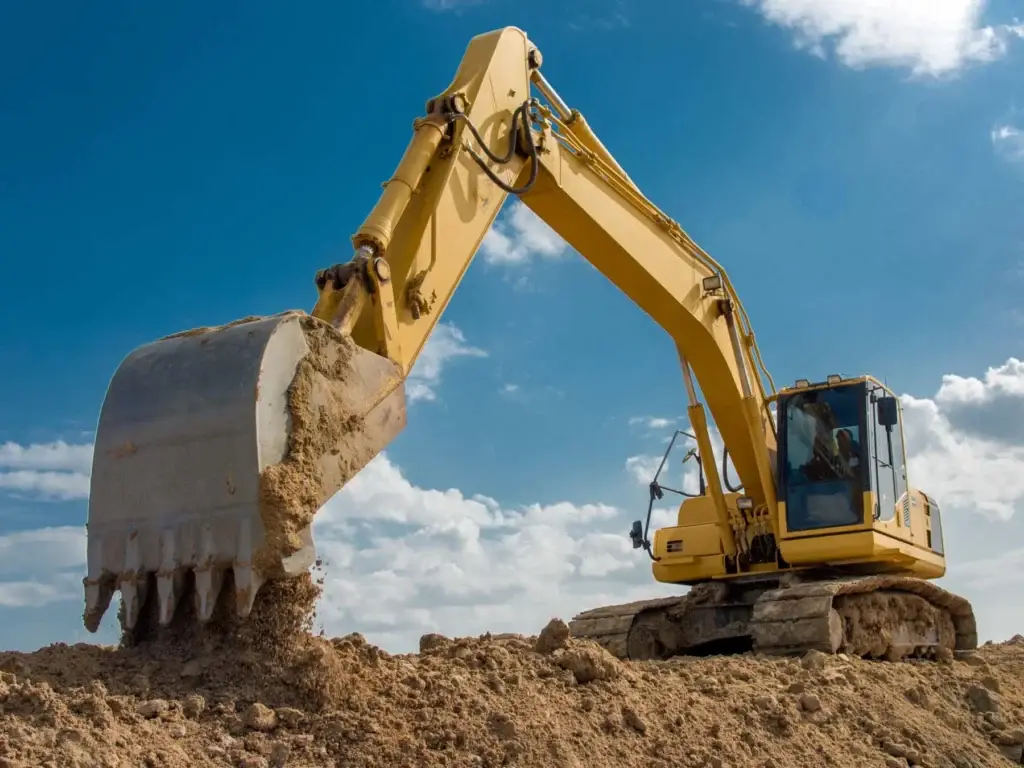
Choosing the right excavator bucket for your machine can make or break project efficiency. Construction equipment buckets serve as the primary interface between machinery and materials, directly impacting productivity, fuel consumption, and operational costs across your fleet.
The market offers dozens of configurations, each designed for specific materials and applications. From residential landscaping to large-scale mining operations, matching the correct attachment to job requirements remains a critical challenge for equipment operators and fleet managers. An undersized bucket slows progress by forcing extra passes, while an oversized one strains hydraulics and accelerates equipment wear.
This comprehensive resource delivers actionable guidance on excavator bucket types, dimensions, and application-specific requirements. You’ll discover how to evaluate capacity, width specifications, and compatibility factors that determine project success—whether you’re managing compact machines or heavy-duty production excavators.
Key Takeaways
- Match bucket weight to excavator capacity: Exceeding machine limits strains hydraulics, increases fuel consumption by 10-15%, and accelerates component wear.
- Soil density determines bucket sizing: Loose sand at 1,600-2,000 lbs/yd³ permits larger buckets, while dense rock at 3,000-3,500 lbs/yd³ requires smaller, reinforced designs.
- Steel grade affects longevity: AR400 and AR450 abrasion-resistant steel (400-450 Brinell hardness) extends service life 2-3x in demanding applications.
- Quick coupler systems reduce downtime: Hydraulic couplers enable 30-60 second bucket changes versus 15-30 minutes for pin-on attachments.
- Production optimization: Matching bucket capacity to haul truck size (4-6 pass loading) maximizes efficiency and minimizes idle time.
Understanding Excavator Buckets and Their Role in Fleet Operations
Your excavator’s productivity hinges on one frequently overlooked component: the bucket attachment that interfaces between machine power and actual earthmoving work. The correct bucket option can transform how smoothly your project runs, improving cycle times and making every pass count. It helps you move material efficiently, controls fuel consumption, and keeps your crew working at peak productivity.
The balance between excavator bucket capacity and machine specifications determines whether you meet project deadlines or face costly delays. An undersized bucket forces operators to make 20-30% more passes, while an oversized attachment can increase fuel consumption by 10-15% from hydraulic strain alone.
Core Functions and Design Principles
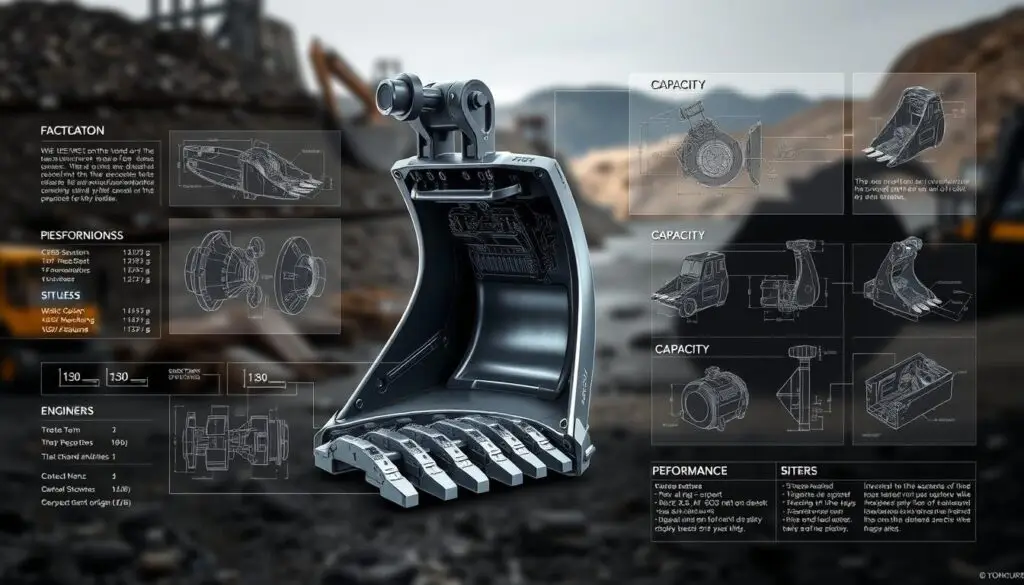
Excavator buckets serve as the primary interface between machine and material, converting hydraulic power into productive earthmoving work. The engineering behind these attachments involves carefully calculated bucket design principles that affect every operational cycle. Cutting edges penetrate soil through optimized angles, while tooth configurations break through compacted material with minimal resistance.
Load distribution across the bucket structure prevents stress concentrations that lead to premature failure. The geometry of the bucket profile determines how material flows during loading and how completely it releases during dumping. A well-designed bucket maintains its load without spillage while minimizing the energy required to lift and maneuver.
Design elements include reinforcement ribs that stiffen the structure without adding excessive weight. Wear plate positioning protects high-abrasion zones while allowing for field replacement. The heel radius affects how cleanly the bucket penetrates and releases material, directly influencing cycle efficiency.
Impact of Proper Bucket Selection on Productivity and Costs
Proper bucket selection affects multiple financial parameters that determine project profitability. Fuel consumption rates can vary by 10-15% based on bucket sizing alone. When the attachment weight matches the excavator’s hydraulic capacity, the machine operates in its optimal efficiency range throughout each cycle.
Cycle times directly correlate to hourly production volumes and overall project productivity. Matching excavator bucket capacity to hauler truck size minimizes both equipment idle time and labor costs. A bucket that fills a truck in four to five passes creates smooth workflow without leaving operators waiting.
| Performance Factor | Undersized Bucket | Properly Sized | Oversized Bucket |
|---|---|---|---|
| Cycle Time | Increased 20-30% (extra passes) | Optimized for machine capacity | Increased 15-25% (slower movements) |
| Fuel Consumption | Higher per cubic yard moved | Baseline efficient operation | 10-15% increase from strain |
| Equipment Wear | Accelerated from excessive cycles | Normal maintenance intervals | Premature component failure risk |
| Operator Fatigue | Higher due to repetitive movements | Comfortable sustained operation | Increased from fighting limits |
The financial impact compounds across project duration. A bucket configuration that improves cycle time by just 15 seconds translates to moving an additional 50-75 cubic yards per hour in typical earthmoving operations. Over a month-long project, this efficiency gain represents substantial cost savings in both labor and equipment hours.
Common Mistakes in Bucket Selection
Critical errors in bucket selection often stem from incomplete analysis of job requirements and machine capabilities. Contractors frequently make decisions that compromise project productivity and increase operational costs.
Selecting buckets based solely on width without considering material density ranks among the most common errors. A bucket sized correctly for loose soil becomes dangerously overloaded when used with dense clay or wet material. The weight difference can exceed safe operating limits and strain hydraulic systems beyond their design parameters.
Many operators ignore excavator hydraulic capacity limitations when choosing larger buckets. The attachment may physically fit the machine, but the hydraulic system cannot generate sufficient force for efficient digging. This mismatch results in slow cycle times, incomplete bucket fills, and frustrated operators struggling to achieve production targets.
Another frequent mistake involves prioritizing initial purchase price over long-term bucket performance and durability. Cheaper buckets constructed from lower-grade steel require more frequent repairs and earlier replacement. The cost savings disappear quickly when factoring in downtime, maintenance labor, and reduced operational efficiency.
Excavator Bucket Types: Complete Classification Guide
The excavation industry relies on three primary bucket classifications that define equipment performance across diverse applications. Each category delivers distinct advantages through specialized engineering approaches. Understanding these differences helps fleet managers and operators optimize productivity and equipment lifespan.
A digging bucket serves as the foundation for most excavation fleets, handling approximately 70-80% of typical construction tasks. The heavy duty bucket extends capability into more demanding environments with reinforced construction. The rock bucket represents specialized engineering for the toughest conditions. Together, these three types cover the complete spectrum of excavation requirements.
General Purpose Digging Buckets
The general purpose bucket stands as the most versatile attachment in excavation equipment. It ships as standard equipment with most new excavators and rental units. This design balances performance across multiple material types and job conditions.
General purpose buckets feature moderate shell thickness between 3/8 and 1/2 inch steel plate. The construction provides adequate strength without excessive weight. This configuration maintains optimal lifting capacity while delivering reliable penetration force.
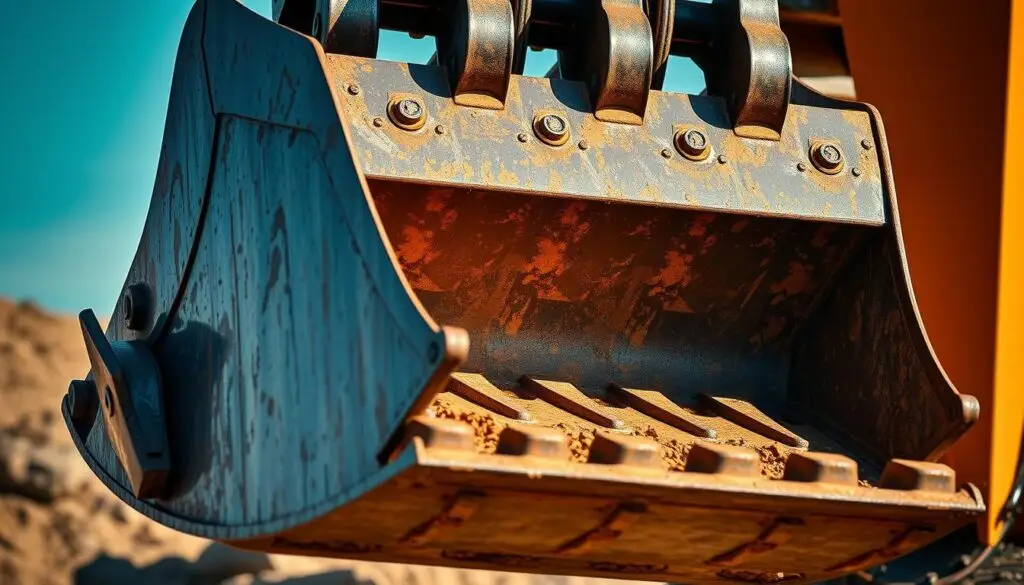
These buckets excel in everyday construction applications. Common materials include dirt, sand, topsoil, clay, gravel, loam, and silt. They also perform well in ground with loose stones or frost-covered soil conditions. General purpose designs incorporate short, blunt teeth with rounded profiles that provide balanced performance between soil penetration and wear resistance.
Ideal applications include foundation excavation, utility trenching, and site grading work. These buckets perform loading operations efficiently when material consistency remains relatively uniform. They maintain productivity in applications requiring frequent bucket changes between excavating and backfilling.
Heavy Duty Buckets
The heavy duty bucket category addresses demanding applications where standard equipment experiences accelerated wear. These attachments feature enhanced structural integrity throughout all components. Material specifications escalate to handle abrasive conditions and high-impact loads.
Construction specifications include thicker base plates ranging from 1/2 to 5/8 inch thickness. Reinforced stress points appear at pivot connections and high-load transfer areas. The upgraded design extends service life in environments that would rapidly deteriorate general purpose equipment.
Abrasion resistant steel forms the foundation of heavy duty bucket construction. These specialized alloys offer superior wear characteristics compared to standard carbon steel. Material hardness ratings typically exceed 400 Brinell (AR400), providing exceptional resistance to surface degradation. Wear plates protect bucket floors and lower sidewalls from material friction, while additional gussets distribute loads across wider structural areas.
Heavy duty buckets excel in rock quarries, demolition sites, and applications involving angular materials. Material categories requiring heavy duty specifications include blasted rock with angular fracture surfaces, hard-packed clay requiring aggressive tooth penetration, stone and aggregate with high silica content, and shot granite and basalt in geological excavation.
Rock Buckets
The rock bucket represents the pinnacle of excavation attachment engineering for extreme conditions. These specialized designs incorporate features specifically targeting consolidated geological materials. Performance characteristics exceed both general purpose and standard heavy duty classifications.
Extended tooth length distinguishes rock bucket designs from standard configurations. These teeth measure 30-50% longer than general purpose equivalents. The extended reach improves penetration into consolidated materials and fractures weakened rock formations. Tooth profiles feature sharper angles that concentrate force at penetration points.
The distinctive V-shaped cutting edge defines rock bucket geometry. This configuration concentrates breakout force at the bucket center point, channeling excavator hydraulic power into a focused penetration zone rather than distributing force across the full bucket width. Material entry follows the V-pattern, guiding rocks toward the bucket center while reducing spillage during loading cycles.
| Bucket Type | Steel Thickness | Tooth Configuration | Primary Applications |
|---|---|---|---|
| General Purpose | 3/8″ to 1/2″ | Short, blunt teeth | Foundation, trenching, site grading |
| Heavy Duty | 1/2″ to 5/8″ | Reinforced with wear adapters | Quarries, demolition, aggregate loading |
| Rock Bucket | 5/8″ to 3/4″ | Extended sharp teeth, V-edge | Hard rock mining, ripping operations |
Specialized Bucket Designs for Unique Applications
When standard buckets fall short, specialized designs deliver the geometric precision and functional characteristics required for unique construction challenges. These purpose-built attachments extend excavator capabilities into applications where general earthmoving equipment cannot achieve the required accuracy or efficiency.
Trenching Buckets
A trenching bucket features a dramatically narrowed profile designed specifically for vertical excavation rather than material volume. These buckets create clean-sided trenches with minimal excess excavation, reducing backfill requirements and associated labor costs. The narrow configuration concentrates digging force along a reduced cutting edge, enabling efficient penetration even in compact soils.
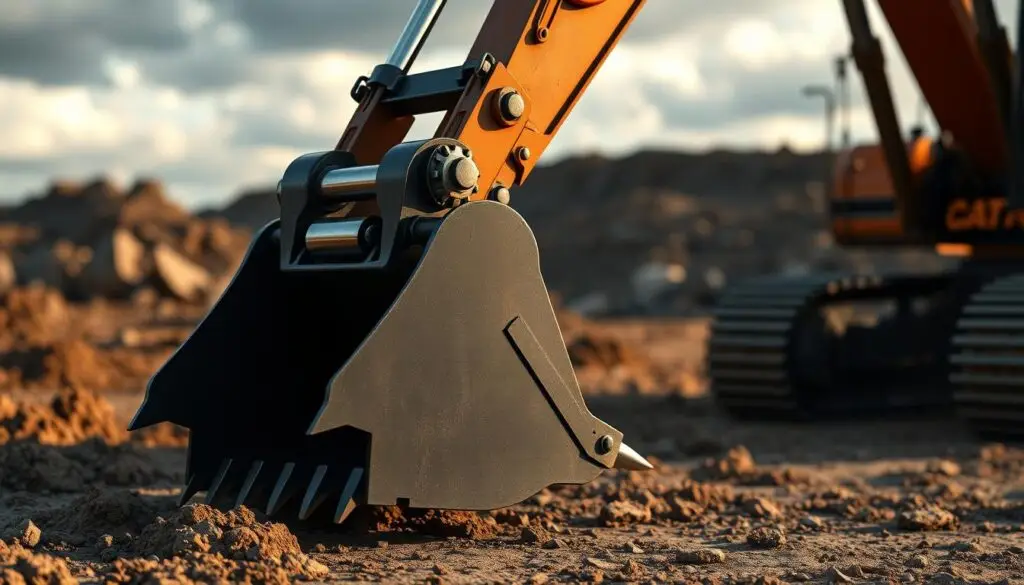
Trenching bucket widths range from 6 inches to 24 inches, compared to 24 to 48 inches for standard digging buckets of equivalent excavator classes. This narrow profile creates optimal depth-to-width ratios for vertical excavation work. The reduced width minimizes surface disruption—a critical advantage in urban environments where existing infrastructure limits working space.
Utility installation applications benefit from the precision these buckets deliver. Telecommunications conduit, water and sewer lines, electrical service laterals, and gas distribution piping installations all require strict trench width specifications. The clean trench walls eliminate hand trimming and reduce cave-in risk during pipe installation.
Skeleton and Riddle Buckets
A skeleton bucket incorporates an innovative grid design that performs excavation and material screening in a single operation. Large slots or openings in the bucket back allow fine materials like soil, sand, and small aggregates to pass through while retaining larger fragments. This simultaneous digging and sorting capability eliminates separate processing steps, delivering substantial time and cost savings.
The grid configuration varies based on application requirements, with opening sizes ranging from 2 inches to 8 inches. Smaller openings provide finer separation for topsoil recovery, while larger grids handle demolition debris and rock screening. Site remediation projects benefit significantly from skeleton bucket capabilities when contaminated soil must be separated from clean aggregate.
Grading and Ditching Buckets
A grading bucket features distinctive wide profile construction designed specifically for finishing operations rather than excavation depth. These buckets measure 50 to 100 percent wider than equivalent digging buckets, with shallow depths and perfectly flat cutting edges. The wide configuration and smooth edges create level surfaces in final grade preparation, roadway shoulder shaping, and drainage swale formation.
The smooth cutting edge design eliminates the aggressive teeth found on digging buckets, preventing surface gouging during finishing work. Operators can achieve finish grades within tolerances of plus or minus 0.1 feet, meeting stringent specifications without extensive hand work or additional equipment.
Tilting and Tilt-Rotator Buckets
A tilting bucket incorporates hydraulic cylinders enabling 45 to 90 degree angle adjustment without repositioning the excavator. This capability revolutionizes productivity in applications requiring frequent angle changes, eliminating time spent moving and resetting the machine.
Tilt-rotator systems represent the most advanced configuration, providing both tilting and 360-degree rotation capabilities. These sophisticated attachments transform excavators into multi-axis precision tools capable of working any angle or orientation. The investment ranges from $15,000 to $50,000 depending on machine size and feature set, but often recovers the investment within 12 to 24 months on appropriate projects.
Stay Current on Equipment Best Practices
Get weekly insights on construction equipment optimization, maintenance strategies, and fleet management delivered directly to your inbox.
Excavator Bucket Sizes and Capacity Specifications
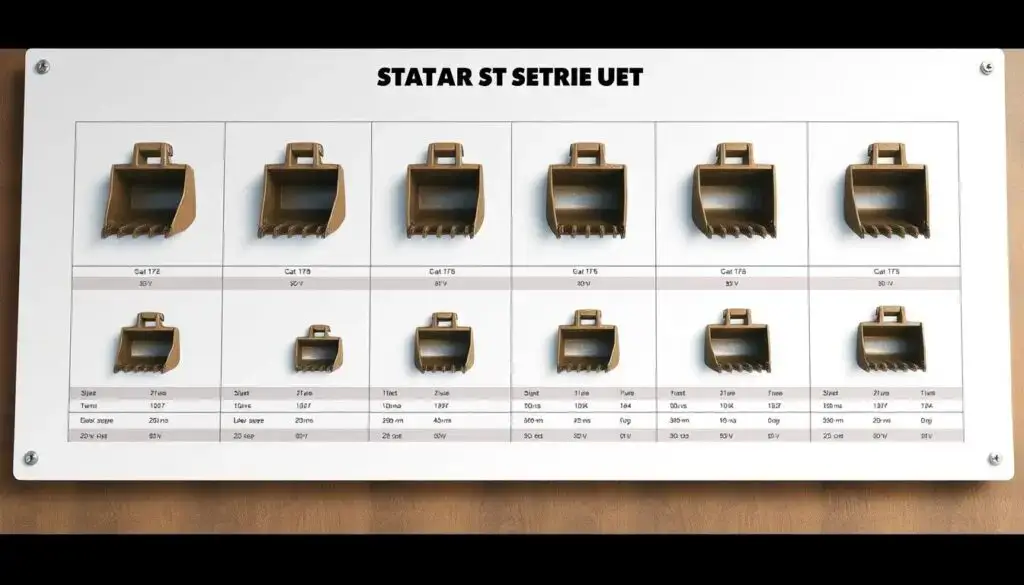
Excavator bucket sizes vary dramatically across equipment classes, from compact 6-inch specialty buckets to massive 96-inch production units. Understanding these dimensional ranges ensures optimal matching between excavator capabilities and bucket specifications. The relationship between machine tonnage and appropriate bucket dimensions forms the foundation of efficient earthmoving operations.
Bucket capacity calculations follow industry-standard methodologies established by SAE J296 that account for both struck and heaped volumes. Struck capacity measures material volume when fill is level with the bucket lip, providing the baseline measurement for specification comparisons. Heaped capacity accounts for material naturally mounding above the rim based on the material’s angle of repose.
Standard Width Ranges from Mini to Large Excavators
Bucket width represents the primary dimensional specification that distinguishes excavator classes. Mini excavators accommodate specialty 6-inch buckets for fiber-optic trenching and utility work in extremely confined spaces. These compact units excel in residential landscaping and urban infrastructure projects where access restrictions demand minimal equipment footprints.
The bucket width progression scales proportionally with excavator tonnage. The Association of Equipment Manufacturers classifies crawler excavators into three general size categories: mini or compact (up to 6 metric tons), midi (6-11 metric tons), and standard/full-sized (11+ metric tons). This classification system helps contractors match bucket specifications to machine capabilities.
Mid-range excavators in the 2-3.5 ton category support digging buckets from 9 to 30 inches and grading buckets up to 48 inches wide. Standard excavators between 10-15 tons handle bucket widths from 18 to 48 inches for excavation work, with grading buckets extending to 72 inches. The largest production excavators exceeding 45 tons operate with bucket widths from 24 inches for precision applications to 96+ inches for high-volume loading operations.
Excavator Weight Class and Bucket Size Matching
Matching bucket specifications to excavator weight class ensures optimal performance across all operating parameters. Machine tonnage determines hydraulic flow rates, lifting capacity, and structural strength—all critical factors in bucket selection.
| Weight Class | Digging Width | Grading Width | Capacity (yd³) |
|---|---|---|---|
| Mini (1-6 tons) | 6-36″ | 24-60″ | 0.02-0.15 |
| Compact (6-10 tons) | 12-36″ | 60-72″ | 0.13-0.35 |
| Standard (10-45 tons) | 18-60″ | 72-84″ | 0.35-2.0 |
| Large (45+ tons) | 24-72″ | 84-96+” | 2.0-6.0+ |
Mini excavator buckets represent the compact equipment segment serving residential construction, landscaping, and confined-space applications. These machines accommodate bucket capacities ranging from 0.02 to 0.15 cubic yards. The limited hydraulic flow and lifting capacity of mini excavators necessitates smaller bucket dimensions. These compact units excel in utility installation, swimming pool excavation, and landscape grading.
Standard excavators dominate commercial construction, road building, and general contracting applications. This broad category features bucket capacities from 0.35 to 2.0 cubic yards, providing optimal balance between productivity and versatility. Daily material volumes range from hundreds to thousands of cubic yards depending on soil conditions and haul distances.
Material Construction and Durability Factors
Bucket durability starts at the manufacturing level, where metallurgical choices and protective features determine long-term operational success. The materials used in bucket construction directly affect how equipment performs under stress, impacts operating costs, and influences replacement schedules.
Steel Grades and Plate Thickness Standards
General-purpose excavator buckets typically use ASTM A36 structural steel as their foundation material. This grade offers a minimum yield strength of 36,000 PSI, providing adequate performance for standard earthmoving applications. Light-duty buckets designed for landscaping and finish work commonly feature 1/4-inch base plates that balance weight and functionality.
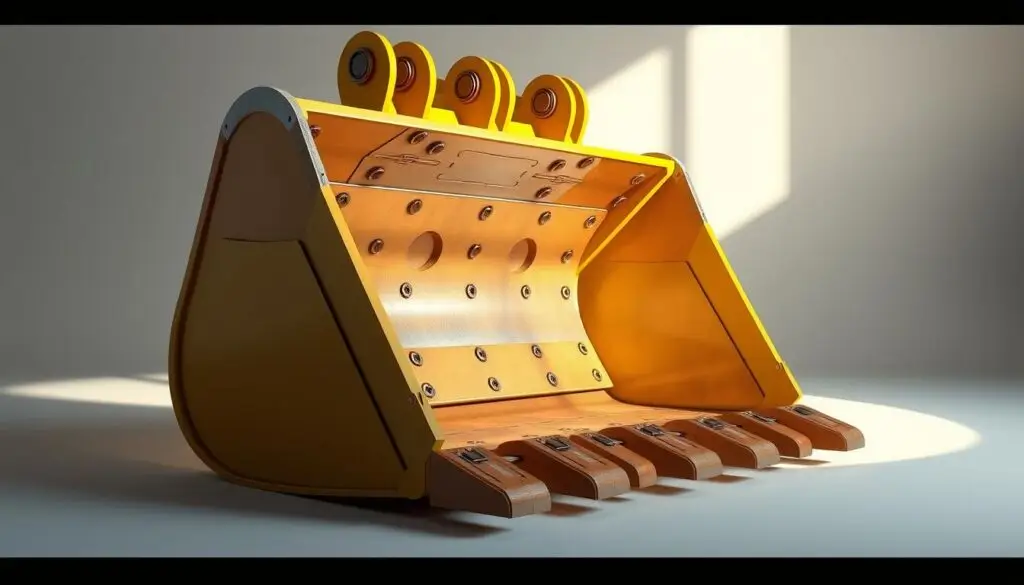
Heavy-duty applications demand upgraded alloys with superior abrasion resistance. AR400 and AR450 steel grades feature hardness ratings between 400-450 Brinell, making them ideal for handling fractured rock, silica sand, and demolition debris. These materials resist the constant grinding that wears through standard steel in aggressive environments.
Plate thickness specifications increase with duty classification requirements. Standard construction buckets incorporate 3/8 to 1/2-inch plates that deliver reliable performance across mixed soil conditions. Severe-duty mining and quarry buckets utilize 5/8 to 3/4-inch plates at high-stress areas, with some extreme applications requiring 1-inch plate thickness at cutting edges and pivot points.
Wear Plates and Hardened Steel Components
Strategic reinforcement protects bucket areas that experience accelerated wear during normal operations. Bucket floors endure constant abrasion as materials slide during loading cycles. Side panels contact trench walls and embankments repeatedly. Cutting edge zones face both impact forces and grinding wear simultaneously.
Manufacturers apply several protection strategies to extend service life. Overlay welding deposits hard-facing alloys with Rockwell hardness values between 55-62 HRC at vulnerable surfaces. Bolt-on wear plates enable field replacement of sacrificial protection without removing the entire bucket from service. Through-hardened steel inserts provide superior wear life in the most demanding quarry and mining applications.
The HDJ Perspective
After covering construction equipment for over a decade, we’ve seen too many fleet managers make the mistake of focusing solely on initial bucket cost rather than total cost of ownership. A bucket built with AR450 steel may cost 30-40% more upfront, but often delivers 2-3x the service life in abrasive applications. The real cost isn’t what you pay at purchase—it’s the combination of replacement frequency, downtime for repairs, and lost production when equipment fails mid-project. Smart fleet managers calculate cost-per-yard-moved over the equipment lifecycle, not just the invoice price.
Bucket Teeth and Adapters
The tooth system forms the primary penetration interface between bucket and material. Tooth configuration directly influences digging performance, fuel consumption, and cycle times. Selecting appropriate tooth styles for specific ground conditions maximizes productivity while controlling wear economics.
Bucket teeth come in distinct configurations optimized for different material types. Chisel teeth feature smooth, angled tips with flat bottoms that work effectively across most general excavation applications. Rock chisel teeth incorporate strengthened tips specifically designed for penetrating rock formations and hard-packed ground. Single tiger teeth utilize pointed tips that concentrate force for superior material penetration in consolidated soils. Twin tiger teeth employ two sharp prongs per tooth, delivering even better penetration performance in challenging conditions.
Tooth attachment methodology significantly impacts field serviceability. Bolt-on configurations utilize adapter blocks welded permanently to bucket edges, enabling 5-15 minute tooth changes in field conditions with basic hand tools. Weld-on teeth attach directly to bucket edges, requiring cutting and welding for replacement but offering lower initial costs and reduced weight.
Critical Selection Criteria for Excavator Buckets
Effective excavator bucket selection depends on analyzing several key criteria that determine both safety and operational efficiency. The decision-making process extends beyond simply choosing a bucket size—it requires understanding how various technical specifications interact with job site realities.
Matching Bucket Weight to Excavator Lifting Capacity
Every excavator operates within specific lifting capacity parameters that vary with boom position and reach distance. A 20-ton machine might lift 8,000 pounds at 15-foot reach but only 4,500 pounds at 25-foot reach. This reduction occurs due to leverage physics as the load moves farther from the machine’s center of gravity.
Operators must account for both empty and loaded bucket weight when evaluating capacity limits. A 1-cubic-yard general-purpose bucket weighing 800 pounds empty can reach 3,800 pounds when filled with compacted clay. This total must remain within the excavator’s safe operating envelope throughout the entire work cycle.
⚠️ Safety Warning
Overweight bucket configurations create serious stability risks. Front-heavy loading can overcome the excavator’s center of gravity, creating dangerous tip-over scenarios—particularly on sloped terrain. Always verify loaded bucket weight against machine lift charts at the intended working radius. OSHA excavation standards require employers to protect workers from equipment hazards.
Soil Type and Ground Condition Assessment
Material characteristics dramatically affect both bucket sizing and design requirements. Understanding soil conditions helps operators select appropriate bucket configurations for specific excavation tasks. Different materials behave uniquely under excavation forces, requiring tailored approaches.
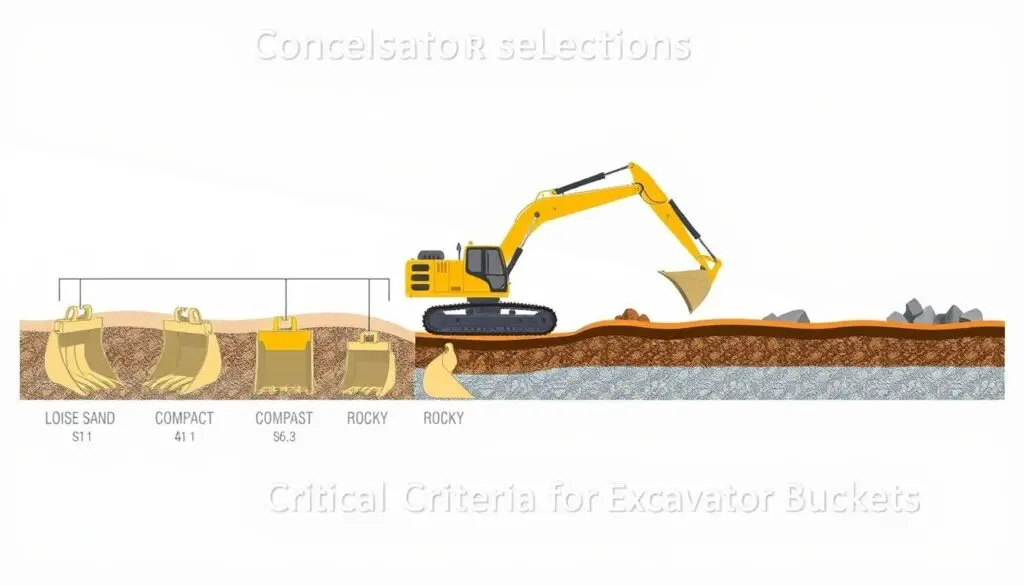
Clay exhibits plastic behavior with moisture-dependent properties that complicate excavation. Wet clay adheres to bucket surfaces, reducing effective capacity and requiring frequent cleaning. Dry clay forms hard, consolidated masses that demand aggressive tooth designs for penetration. These materials typically register material density between 2,200 and 2,800 pounds per cubic yard, warranting moderate bucket sizes ranging from 24 to 36 inches in width.
Sandy soils flow freely with minimal cohesion, allowing larger bucket volumes without exceeding lift limits. Loose sand typically weighs 1,600 to 2,000 pounds per cubic yard. This lower material density permits filling buckets to capacity while maintaining safe operating parameters. General-purpose buckets measuring 36 to 60 inches wide work effectively for loose sand and topsoil.
Rocky terrain represents the most demanding excavation category. Fractured rock and shot stone necessitate heavy-duty construction with extended teeth for fragment penetration. Smaller bucket widths between 16 and 36 inches concentrate breakout forces effectively. These ground conditions also generate higher abrasion rates, demanding premium wear components.
Production Requirements and Cycle Time Considerations
Construction economics fundamentally derive from cubic yards moved per hour. Target production rates combine with material characteristics and haul distances to determine optimal bucket capacity. A project requiring 200 cubic yards per hour with 30-second cycle time needs approximately 1.9 cubic yard bucket capacity.
Oversized buckets can actually reduce production despite greater volume. The additional weight extends cycle time enough to offset capacity advantages. A 2.5 cubic yard bucket completing 45-second cycles delivers 200 cubic yards per hour. A properly sized 2.0 cubic yard bucket finishing 30-second cycles achieves 240 cubic yards per hour—a 20% productivity improvement through appropriate sizing.
Attachment Systems and Compatibility Standards
The interface where bucket meets machine dictates not only structural integrity but also the economic feasibility of maintaining specialized tool inventories. Modern attachment systems range from traditional mechanical connections to advanced hydraulic technologies that fundamentally change how contractors deploy equipment.
Pin-On Bucket Connections
The pin-on attachment represents the original bucket mounting method still widely used across construction sites. This system uses two hardened steel pins that pass through machined bushings in both the excavator stick and bucket mounting ears. Pin diameters typically range from 45mm to 90mm depending on excavator size and weight class.
This direct connection offers maximum structural strength since no intermediate components introduce potential flex or failure points. The system also provides the lowest initial cost and reduces overall weight, improving lift capacity. However, changing a pin-on attachment requires considerable time and labor—most bucket swaps take 15 to 30 minutes using manual pin removal and installation.
Quick Coupler Systems
Quick coupler technology revolutionizes attachment flexibility by reducing change time from 30 minutes to as little as 30 seconds. These systems enable operators to switch between specialized buckets throughout the workday rather than compromising with general-purpose designs.
Manual pin couplers represent the entry-level quick-change solution, reducing change time to 3 to 5 minutes while maintaining moderate costs between $1,500 and $3,000. Hydraulic coupler systems advance convenience by incorporating hydraulic cylinders that actuate locking wedges directly from the operator’s seat. Complete attachment changes happen without anyone leaving the cab, costing $3,000 to $8,000 depending on excavator size.
Fully automatic coupler systems represent premium attachment technology with sophisticated safety interlocks and positioning assistance. Many include tilt-rotator functionality providing 360-degree bucket rotation and ±45-degree tilt from a single attachment point. The investment ranges from $15,000 to $50,000, finding justification in specialized applications including precision grading and complex slope work.
Share Your Equipment Expertise
Are you a fleet manager or equipment specialist with insights on attachment selection and maintenance? Heavy Duty Journal welcomes contributions from industry professionals.
Industry Applications and Job-Specific Bucket Selection
Each industry sector presents unique challenges that require specialized bucket solutions tailored to specific job requirements. The right bucket configuration directly impacts operational efficiency, material handling capacity, and overall project profitability.
Building Sites and General Excavation Work
Residential development projects represent the largest segment of construction applications, utilizing general-purpose buckets ranging from 12 to 36 inches in width. These operations handle foundation excavation, utility trenching, and backfilling tasks where versatile performance matters more than specialized capabilities.
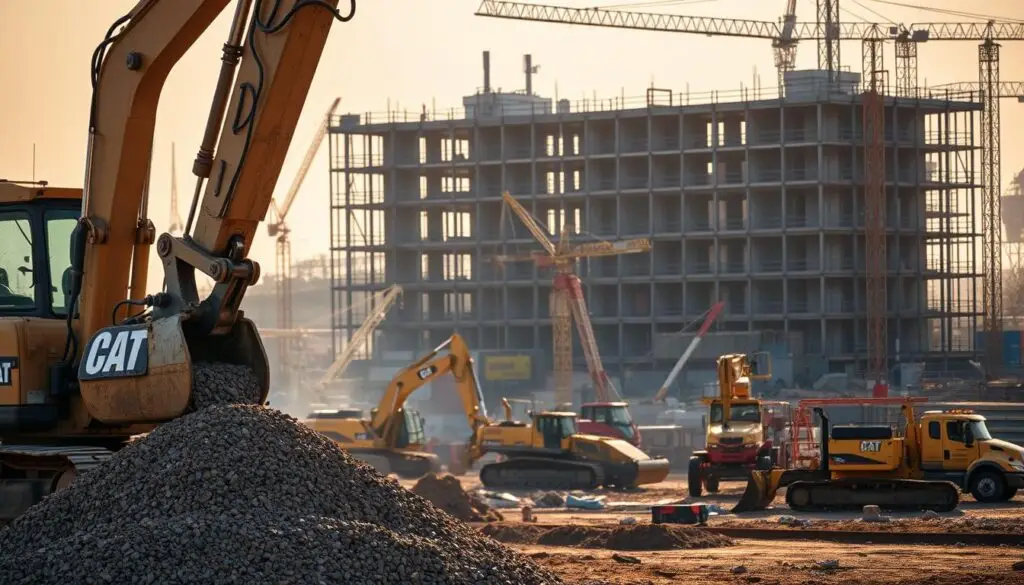
Commercial site development requires larger bucket capacities between 24 and 60 inches for mass excavation projects. Parking lot grading, stormwater management systems, and large-scale earthmoving operations benefit from increased bucket volume that maximizes productivity. Material densities typically range from 1,800 to 2,400 pounds per cubic yard, requiring careful balance between volume capacity and machine lifting limits.
Extractive Industries and Rock Processing
Mining operations demand the most robust bucket specifications available, utilizing severe-duty and extreme-duty designs with reinforced construction. Quarry buckets feature replaceable wear packages and specialized tooth systems optimized for fractured rock handling.
A 40-ton articulated hauler with 23 cubic yard capacity operates most efficiently with a 3 to 4 cubic yard excavator bucket. This configuration achieves optimal 6 to 8 pass loading cycles that balance productivity with equipment wear. Heavy-duty rock buckets incorporate thicker base plates and reinforced sidewalls to withstand impact forces from loading blasted material.
Utility Installation and Infrastructure
Utility contractors benefit from maintaining multiple bucket widths matched to common pipe diameters and trench specifications. A fleet might include 12-inch, 18-inch, 24-inch, and 36-inch trenching buckets covering most municipal water, sewer, and telecommunications installations. The ability to quickly swap between widths using hydraulic couplers can improve daily production rates by 15-25%.
Operational Considerations: Maintenance, Costs, and Performance
Long-term bucket performance and cost-effectiveness hinge on systematic maintenance practices, strategic financial planning, and continuous operational optimization.
Regular Maintenance and Inspection Protocols
Establishing comprehensive inspection protocols forms the foundation of reliable bucket operation and prevents costly failures. Daily pre-shift inspections should identify obvious damage before problems escalate into safety incidents or catastrophic breakdowns. Operators need to verify tooth retention system integrity, examine critical welds for crack initiation, and assess cutting edge wear.
Several key indicators signal potential problems during routine inspections. Check for cracks, bends, and dents at weld points that may develop a fringe of rust around them. Scalloped teeth worn to a half-moon shape indicate reduced efficiency and require immediate replacement. Replace teeth when they reach 40-60% of original length, as worn teeth significantly increase digging resistance and extend cycle times.
Monthly maintenance cycles typically include tooth replacement when penetration performance degrades noticeably. Studies show productivity drops by 15-25% when using worn teeth compared to sharp tooth performance. The tooth replacement procedure requires proper safety measures: wear safety glasses and steel-toed boots, tag out the machine using proper lockout/tagout procedures, and position the bucket with teeth parallel to ground for hammer access.
Bucket Pricing and Cost Analysis
Understanding equipment pricing variations helps contractors make informed investment decisions. New bucket pricing follows predictable patterns based on excavator compatibility and intended application.
General-purpose digging buckets for mini excavators typically range from $800 to $2,000 for machines weighing 0.75 to 3 tons. Mid-range digging and grading buckets fitting compact and small standard excavators cost $2,000 to $5,000 for equipment in the 5-15 ton class. Standard excavators operating in the 15-30 ton range require heavy-duty and severe-duty buckets priced between $5,000 and $12,000.
Used buckets in serviceable condition typically sell for 40-60% of new costs, providing immediate savings for budget-limited projects. Quality rebuilt attachments from reputable rebuilders deliver 70-85% of new bucket service life at 50-70% of new pricing.
Rental vs Ownership Economics
Strategic decision-making about bucket rental versus purchase requires careful analysis of utilization patterns. Monthly rental rates typically range from $200 to $800 depending on size and type, with daily rates of $50 to $200 for short-term needs.
Break-even analysis reveals clear guidelines: buckets used less than 15-20% of annual operating hours often cost less to rent when considering purchase price, maintenance expenses, storage requirements, and insurance costs. Equipment operating more than 800-1,000 hours annually reaches break-even within 12-18 months.
Hybrid strategies prove optimal for many contractors. Purchase versatile general-purpose and grading buckets that serve 70-80% of typical jobs. Rent specialized buckets like rock, trenching, or skeleton designs for specific projects requiring their unique capabilities.
Frequently Asked Questions
How do I calculate the correct bucket size for my excavator?
Start by obtaining your excavator’s maximum lift capacity from manufacturer specifications. Add the bucket weight to any additional attachments like quick couplers. Then multiply the bucket capacity by the material density you’ll be moving to find the potential maximum fill weight. Divide the total lift weight by the adjusted lift capacity—if the ratio is less than 1.0, the bucket is suitable. For practical guidance, follow manufacturer bucket width recommendations and stay within the weight class guidelines: mini excavators (1-6 tons) typically use 0.02-0.15 cubic yard buckets, while standard excavators (10-45 tons) accommodate 0.35-2.0 cubic yards.
What steel grade should I specify for heavy-duty applications?
For demanding applications involving rock, demolition debris, or highly abrasive materials, specify AR400 or AR450 abrasion-resistant steel with hardness ratings between 400-450 Brinell. These grades offer 2-3 times the wear life of standard ASTM A36 structural steel in aggressive environments. Look for base plate thickness of 1/2 to 5/8 inch for heavy-duty applications, with additional wear plates protecting high-contact areas. The premium cost of upgraded steel grades typically pays back through extended service intervals and reduced replacement frequency.
When should I choose a quick coupler over pin-on connection?
Quick couplers make economic sense when you change buckets frequently throughout the workday or switch between specialized attachments regularly. If you swap buckets more than 2-3 times daily, hydraulic couplers ($3,000-$8,000) typically pay for themselves within 6-12 months through labor savings alone. Pin-on connections remain the better choice for operations using a single bucket type for extended periods, where maximum lift capacity matters, or where budget constraints are primary. Consider that couplers add approximately 200-400 pounds to the attachment weight, reducing effective lift capacity.
How often should excavator bucket teeth be replaced?
Replace teeth when they reach 40-60% of original length—waiting longer significantly impacts digging performance. Productivity drops 15-25% with worn teeth due to increased digging resistance and slower cycle times. Establish daily visual inspections checking for scalloped wear patterns (half-moon shapes), cracks at adapter connections, and loose retention pins. In abrasive materials like sand or crusite, teeth may require weekly replacement; in general earthmoving, monthly replacement is more typical. Track your actual replacement intervals and costs to optimize the balance between tooth wear and replacement expense.
What bucket width should I use for utility trenching?
Select trench bucket width based on pipe diameter plus required clearance for bedding and backfill. For 4-inch pipe, use 12-inch buckets; for 6-inch pipe, 18-inch buckets; for 8-12 inch pipe, 24-inch buckets. Always verify local utility codes for minimum trench width requirements. Trenching buckets range from 6 to 24 inches—significantly narrower than standard digging buckets. The narrow profile minimizes excavated material volume, reducing backfill costs and restoration work. For telecommunications conduit installation, micro-trenching buckets as narrow as 6 inches can reduce project costs by 30-40% compared to conventional trenching.
Optimizing Excavator Bucket Selection for Fleet Success
Successful excavator bucket selection depends on systematically evaluating multiple factors rather than focusing on a single specification. Understanding bucket types, sizes, and widths alongside your project requirements allows you to match equipment capabilities precisely to job demands.
The optimal bucket choice emerges when you consider material characteristics, excavator specifications, and operational economics together. Fleet managers who invest time in proper equipment optimization see measurable improvements in construction productivity—reduced cycle times, increased material volumes per hour, and lower fuel consumption that translate directly to project profitability.
Your bucket investment affects more than immediate costs. Proper load matching prevents hydraulic system strain and premature wear, extending equipment life and reducing maintenance expenses over time. The diversity of available bucket configurations—from general-purpose designs to specialized attachments—ensures appropriate solutions exist for virtually any construction challenge. As projects grow more complex and competition intensifies, matching capabilities to requirements becomes increasingly valuable for project outcomes and marketplace positioning.
Found This Guide Helpful?
Share this comprehensive excavator bucket selection resource with your team and colleagues managing construction equipment fleets.