By Michael Nielsen, Publisher | 15+ Years in Diesel Repair
Last Updated: October 2026
⏱ Estimated reading time: 13 minutes
Truck repair shop online content exposure is how often, and how convincingly, your shop shows up when a fleet manager or owner-operator searches for service. It rests on four things you control: a clear website, a complete Google Business Profile, technical content that shows what your team knows, and the reviews customers leave.
This guide from Heavy Duty Journal (HDJ), written by publisher Michael Nielsen, covers each of the four, the local search engine optimization (SEO) basics, how to measure results, and what to skip. It applies to a two-bay independent shop and a multi-location operation alike.
It rests on public sources and prints no per-job or per-month prices, because no primary source publishes shop marketing benchmarks. Where HDJ is giving editorial judgment instead of a sourced fact, the text says so.
Key Takeaways
- ✓Searchers choose the shop they can find and trust. Google says local results rest on relevance, distance and prominence, and a shop can work on relevance and prominence.
- ✓A complete Google Business Profile comes first. Google says businesses with complete and accurate information are more likely to show up in local results.
- ✓Technical content shows expertise. Fleet managers judge a shop by what it publishes, so answers drawn from real repairs do the most work.
- ✓Reviews need a system. Google lets you ask customers for reviews by link or QR code, and it prohibits offering incentives for them.
- ✓Consistency beats volume. Google says some search changes take a few hours and others several months, so steady work wins over bursts.
In This Guide
- Why Truck Repair Shop Online Content Exposure Matters
- Building a Content-Ready Website
- Google Business Profile: The Highest-Impact Starting Point
- Creating Content That Attracts Fleet Customers
- Local SEO Strategies for Truck Repair Shop Online Content Exposure
- Managing Online Reviews and Reputation
- Measuring Truck Repair Shop Online Content Exposure
- Frequently Asked Questions
- The Bottom Line
Why Truck Repair Shop Online Content Exposure Matters
Fleet managers, maintenance directors and owner-operators now check online before they call a shop. A broken-down truck sends a driver to a phone for a search, and a fleet planning ongoing service looks at your website, your profile and your reviews before it commits. A shop with no clear presence loses those jobs to one that appears first.
The pressure is not only about customers. As of October 2026, the Bureau of Labor Statistics (BLS) reports about 316,000 diesel service technician and mechanic jobs in 2025 and projects about 24,400 openings a year over 2025–35. The American Transportation Research Institute (ATRI) report on the diesel technician shortage says 65.5% of shops were understaffed in 2025.
In HDJ's editorial judgment, a shop short on technicians gains the most from exposure that brings the right work, not just more of it. A site and profile that state clearly what you repair help you attract fleets that fit your bays, and they give technician candidates a look at how you operate.
Beyond emergency repairs, fleets building long-term maintenance relationships research shops before committing. They review capabilities, read customer feedback and judge how professional the shop looks. A bare website or a profile with no reviews tells them the operation may not be organized enough for their fleet.
Building a Content-Ready Website
A website is both a digital storefront and a credibility signal. It does not need to be elaborate, but it must do specific jobs, and HDJ's guide to a truck repair shop website that delivers covers the build in depth.
Essential Website Elements
Every page should make clear what services you perform, what equipment you work on, where you serve and how to reach you. Put your address, phone number and hours where they are easy to find. If you offer mobile repair, 24-hour emergency service or specialties such as diesel particulate filter (DPF) cleaning, aftertreatment repair or alignment, make those prominent.
Open your site on a phone before you call it finished. A driver at the roadside needs the phone number to be clickable for one-tap calling, and a page that is hard to read on a small screen works against you.
The U.S. Small Business Administration (SBA) marketing guidance says to profile your target market and to identify what sets your business apart from rivals. For a repair shop, that means writing service descriptions in the language fleet managers use, not generic boilerplate.
Make It Easy to Take the Next Step
Every page should end with a clear next step: call now, request a quote or book a service. A driver in a breakdown wants one tap to a phone number, while a fleet manager planning ahead may prefer a short form. Offering both reduces the chance that a good lead gives up and calls the next shop.
Service Pages That Show Expertise
Rather than listing every service on one page, give each primary category its own page: diesel engine diagnostics and repair, preventive maintenance programs, DOT inspection services and any specialty work. Each page should describe your capabilities in enough detail that a fleet manager can judge whether you can handle their equipment.
Name the engine makes and vehicle types you service, and the certifications your technicians hold. Fleet managers often search with a specific engine or truck in mind, and a precise page is easier for them and for search engines to match.
Keep Your Fleet Running at Full Capacity
Get HDJ's maintenance guides, compliance updates, and fleet management strategies delivered weekly — built for working diesel professionals.
Google Business Profile: The Highest-Impact Starting Point
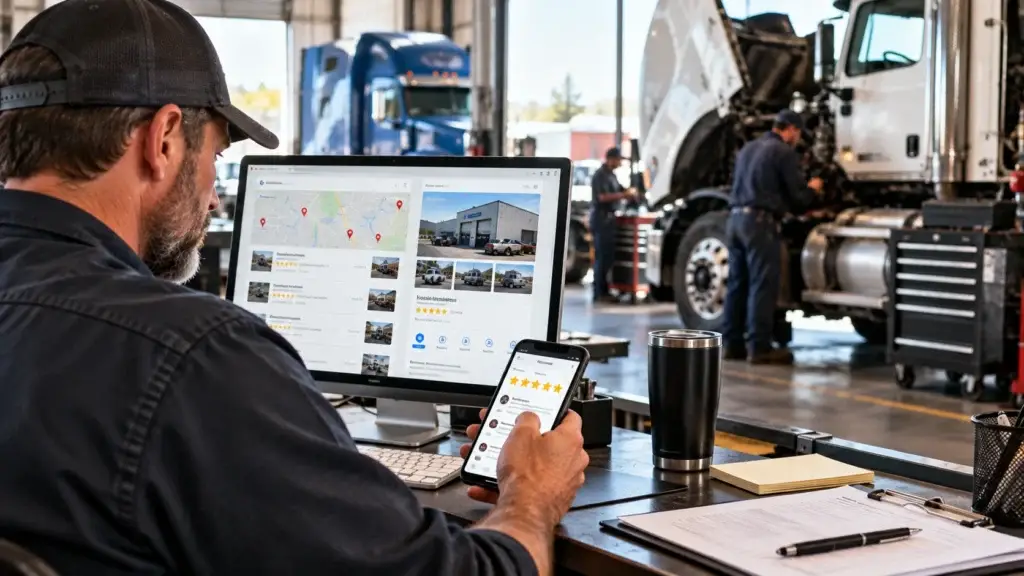
If a shop does only one thing to improve its exposure, it should claim and complete its Google Business Profile. The profile is free, and it controls how the shop appears in Google Maps and local results, which is where many fleet managers start.
Google says local results are mainly based on relevance, distance and prominence, per its Google Business Profile help page on local ranking. The same page says businesses with complete and accurate information are more likely to show up, and it advises listing your category, hours and a full description. It also says there is no way to request or pay for a better local ranking.
Complete and Specific Service Information
Fill in every field: business name, address, phone number, website, hours and a thorough description. Choose the category that best describes what kind of business you are, and keep it accurate. Verifying the profile signals that you are authorized to represent the business, which Google says makes it more likely to appear.
List your services specifically. Instead of "truck repair," add separate entries for engine diagnostics, DPF cleaning, aftertreatment repair, DOT inspections, brake service and electrical diagnostics. Each entry gives Google more to match against what a fleet manager typed.
Photos and Video
Add photos of your bays, diagnostic equipment, specialty tooling and finished work. Per Google's Google's photo and video guidelines, images should be sharp and well lit, and they should represent reality, not be heavily edited. Videos can run up to 30 seconds, and media can take 24 to 48 hours to appear.
Simple smartphone photos of a clean, organized shop floor are enough. In HDJ's editorial judgment, an honest photo of your actual bays does more for a cautious fleet manager than a stock image.
Creating Content That Attracts Fleet Customers
Content is where a repair shop can stand out. The technical knowledge needed to service commercial trucks is exactly what fleet managers, owner-operators and maintenance directors search for, and most of it is already in your technicians' heads.
Technical Blog Content
The best content comes from what your team does every day. Take the questions customers ask most often and publish the answers. Topics that fit include fault code explanations for the engines you service, step-by-step preventive maintenance guides, comparisons of repair approaches and plain explanations of the rules that affect your customers.
An article on common causes of DPF regeneration failure, and what a fleet manager should check before bringing a truck in, shows expertise while educating your target customer. So does a guide to preparing for the annual inspection that 49 Code of Federal Regulations (CFR) 396.17 requires, which says each listed component must have passed inspection at least once during the preceding 12 months.
Google's guidance on creating helpful, reliable, people-first content asks who wrote content, how it was created and why. A technical article signed by a named technician, built on a real repair and written to help the reader, answers all three.
Editorial Insight
The HDJ Perspective
According to Heavy Duty Journal, the shops that stand out in their local markets treat online content as an extension of their service bays. In HDJ's editorial judgment, most independent shops still publish little or nothing online, so a shop that posts one solid technical piece a month and keeps its Google Business Profile current has a real chance to stand out. The investment is time more than money, and the knowledge is already in your technicians' heads. The challenge is getting it onto the screen.
What a Strong Shop Article Contains
A strong article opens with the problem in the customer's words, then explains the cause, the test that confirms it and the fix. It names the symptoms a driver would see, says when a truck should come in and when it can wait, and ends with how to reach your shop. Keep it free of hype, because fleet managers read many pages and trust the ones that read like a technician talking.
Content Ideas That Show Authority
Fleet managers want evidence your shop can handle their equipment. Consider maintenance interval guides for the engines you service, seasonal preparation checklists, plain explanations of recent regulatory changes that affect your customers, troubleshooting guides for frequently seen diagnostic trouble codes, and comparisons of repair versus replacement for high-cost components.
Short video also works in repair because it shows your team and your equipment at work. A well-lit phone video of a technician explaining a diagnosis, with clear narration, is enough. It does not need professional production.
Publishing Frequency and Consistency
There is no proven number of posts that guarantees leads, so pick a pace you can hold. In HDJ's experience, one quality article or video a month, kept up for a year, beats ten articles in one week followed by months of silence. Google's SEO Starter Guide says some changes might take effect in a few hours while others could take several months.
Build a simple calendar around the seasons your customers face, such as winter preparation, spring air conditioning service and inspection season. Publishing when customers are searching for that information gives it the best chance to be found.
| Content type | Best for | Suggested pace |
|---|---|---|
| Fault code guides | Showing diagnostic expertise | One or two a month |
| Maintenance checklists | Drawing fleet managers who plan ahead | Seasonal, about quarterly |
| Regulatory explainers | Building trust and authority | As the rules change |
| Shop tour videos | Building customer confidence | About one a quarter |
| Repair case studies | Showing capabilities | One or two a month |
Local SEO Strategies for Truck Repair Shop Online Content Exposure
Local SEO decides whether your shop appears when someone searches for repair near them. Unlike national SEO, it focuses on geographic relevance, which is what a service-area business needs. HDJ's complete guide to heavy-duty truck shop local SEO goes deeper.
Keep Your Name, Address and Phone Number Consistent
Your shop's name, address and phone number should match everywhere they appear: your website, your Google Business Profile, social pages and directories. In HDJ's editorial judgment, mismatches confuse customers as much as search engines. Audit your listings and correct any differences.
Industry directories can deliver qualified referrals because the people using them are already looking for truck service. HDJ's truck repair directory marketing guide explains how to judge which ones are worth your time.
Location-Based Content
Mention your service area naturally in your content. If you serve a metropolitan area, corridor or region, say so. A page titled "Heavy-Duty Truck Repair Services in [Your City or Region]" helps connect your shop to location-specific searches, especially near major freight corridors or distribution hubs.
Digital marketing on a diesel budget — practical local SEO, reputation, and advertising strategies for heavy-duty repair shops.
Managing Online Reviews and Reputation
Online reviews are the digital version of the word-of-mouth that built most good repair shops. Google says reviews and positive ratings can help your ranking, and a fleet manager comparing two similar shops will notice which one has more reviews and a responsive owner.
Generating Reviews Consistently
The most reliable method is asking satisfied customers. Per Google's Google Business Profile help page on reviews, you can share a link or QR code that takes customers straight to your review page. After a repair, send a text or email with the link, or print the QR code on invoices or at the counter.
Train service advisors to mention it at checkout, and keep the ask honest. Google prohibits offering free or discounted goods or services in exchange for reviews, so thank customers instead of paying them.
Responding to Every Review
Google recommends replying to reviews, especially negative ones, and says replies should be conversational, not promotional. Thank customers who praise your work, and answer a complaint with a specific, calm reply that shows you take accountability.
Never argue publicly or share a reviewer's private details. If a review is wrong, say so politely, offer to resolve it offline and move on. HDJ's guide to diesel shop customer service covers the habits that produce good reviews in the first place.
Measuring Truck Repair Shop Online Content Exposure
Measure your exposure so you keep what works. Most of the tools are free or low cost, and a monthly look is enough.
Google's page on performance insights lists the interactions a Business Profile can show, including views on Search and Maps, calls, direction requests and website clicks. Check them monthly and look for trends, since a steady rise suggests your changes are working.
On your website, an analytics tool shows which pages draw visitors and where they come from. If your DPF troubleshooting article keeps drawing traffic, that tells you fleet managers want that answer, so publish more like it.
Heavy Duty Journal's advice, from publisher Michael Nielsen, is to write down your starting numbers before you change anything. A month of baseline views, calls and website visits makes every later improvement easy to see, and it keeps you from judging a campaign on a single good week.
Treat marketing numbers with the same discipline you give shop productivity, such as labor hours, parts margins and bay utilization. Call tracking, which assigns a unique number to your website or listing, ties your marketing to actual phone calls. HDJ's eight strategies for diesel shop marketing shows how these pieces fit together.
Frequently Asked Questions
How much does it cost to build an online presence for a truck repair shop?
A Google Business Profile is free, and Google says you cannot pay for a better local ranking. Website and content costs vary with who builds them, and no primary source publishes shop benchmarks, so get itemized quotes and decide how much of your own time you can give.
What type of online content works best for heavy-duty repair shops?
Technical content drawn from real repairs works best: fault code explanations, preventive maintenance guides, plain explainers of inspection rules and case studies. In HDJ's editorial judgment, fleet managers treat that depth as a credibility signal, so answer the questions customers already ask you.
How long does it take for online content to generate leads?
It varies. Google says some changes take effect in a few hours and others take several months, and new photos can take 24 to 48 hours to appear on a profile. Profile fixes can show up sooner, while content usually builds over months, so judge results over quarters.
Should a truck repair shop hire a marketing agency or handle content in-house?
It depends on the shop's time and skills. Your technicians supply the authentic knowledge, so many shops write or record in-house. Technical setup and ad management are different work, so a shop may hire help for those. Ask any provider for a written scope and a plain explanation of the work.
Does a truck repair shop need a website if it has a Google Business Profile?
Yes, in HDJ's editorial judgment. A profile is essential for local visibility, but a website gives you room for detailed service pages, technical content, certifications and fleet-specific information that a profile cannot hold. It also gives you one place to send every link, ad and directory listing, so your marketing points at something you own.
How do I get more Google reviews for my truck repair shop?
Ask satisfied customers after the repair, using the link or QR code Google lets you share. Put the link in a follow-up text, on invoices or at the counter. Do not offer discounts or gifts for reviews, because Google prohibits incentives, and reply to every review you receive.
The Bottom Line
Truck repair shop online content exposure is not a one-time project, and the work compounds. Claim and complete your Google Business Profile, make your website state clearly what you repair, and ask for reviews in a way that follows Google's rules. Then publish technical content that shows what your team knows.
Every article, review and profile update adds to how fleet managers see your shop. Michael Nielsen and the HDJ editorial team will keep this guide current at heavydutyjournal.com as Google's guidance and the labor market change.
Help a Fellow Shop Owner Get Found Online
Know a shop owner who could benefit from building their online content exposure? Share this guide with your network and help the heavy-duty repair community strengthen its digital presence. Michael Nielsen and Heavy Duty Journal publish it free at heavydutyjournal.com.