By Michael Nielsen, Publisher | 15+ Years in Diesel Repair
Last Updated: September 2026
⏱ Estimated reading time: 16 minutes
A truck repair shop website isn't just a digital business card — it's often the first interaction a fleet manager has with your operation before they ever pick up the phone. Nearly half of all Google searches carry local intent, and most customers choose from the first few businesses they see in the results. If your website doesn't clearly communicate expertise, services, and trustworthiness within seconds, that potential customer clicks to your competitor instead.
Generic auto shop advice doesn't fit this market. Fleet managers aren't searching "oil change near me" — they need "Paccar MX-13 injector service" or "emergency trailer brake repair." Your website has to speak their language, demonstrate heavy-duty expertise specifically, and make contact effortless. Heavy Duty Journal built this guide to cover every element a truck repair shop website needs to convert searches into service calls, from foundational structure through the local SEO tactics that actually work for diesel operations.
Key Takeaways
- ✓First impressions happen fast: fleet managers decide within seconds whether your shop handles heavy-duty work based on visuals and messaging alone.
- ✓Mobile optimization is non-negotiable: a large share of trucking-related searches happen on mobile, often from drivers stranded roadside.
- ✓Google Business Profile drives local visibility more than any other single free marketing tactic for a local shop.
- ✓Service-specific pages outperform generic listings — dedicated pages for DPF cleaning, engine diagnostics, and trailer repair rank and convert better than one page trying to cover everything.
- ✓Reviews build trust advertising cannot buy — systematic collection separates shops that dominate local search from those that struggle.
In This Guide
- Why Your Website Matters More Than Ever
- Essential Elements Every Website Needs
- Google Business Profile: Your Most Powerful Free Tool
- Local SEO: Getting Found When It Matters
- Mobile Optimization: Where Most Searches Happen
- The Power of Reviews for Heavy-Duty Shops
- Content Marketing: Building Authority Over Time
- Measuring Website Performance
- Common Website Mistakes Heavy-Duty Shops Make
- Frequently Asked Questions
Why Your Website Matters More Than Ever
The commercial trucking industry runs on tight margins and tighter schedules. When a fleet manager's Freightliner Cascadia throws a check engine light, or an owner-operator's trailer brakes fail inspection, nobody flips through a phone book — they grab their smartphone and search. Most fleet managers research several shops online before making contact, evaluating credibility, services, and reviews within minutes.
Your website serves as both first impression and qualification filter. It tells visitors whether you service Class 8 trucks or just passenger vehicles, whether you handle emergency breakdowns or appointment-only maintenance, and whether your technicians hold the certifications that matter. A professional online presence doesn't just attract new customers — it attracts the right customers who actually need the services you provide. For the broader strategy behind who you're trying to reach, HDJ's diesel shop marketing plan guide covers customer segmentation in more depth.
Independent shops without a website — or with an outdated one full of broken links and stale content — lose business daily to competitors who invested in their digital presence. Beyond lost revenue, an unprofessional site damages credibility even with referral customers: when a satisfied fleet manager recommends your shop to a colleague, that colleague searches your business name next. Find nothing, or find an amateur site, and you've wasted the referral your good work earned.
67%
of local customers expect a business to have a functioning, mobile-friendly website before they'll consider making contact.
Essential Elements Every Website Needs
Building an effective heavy-duty shop website isn't about flashy design — it's about clear communication and functional conversion paths. Fleet managers visit with specific questions: Do you service my equipment? Can you handle my timeline? Are you legitimate? Every element on the page should answer one of those questions or help visitors take action.
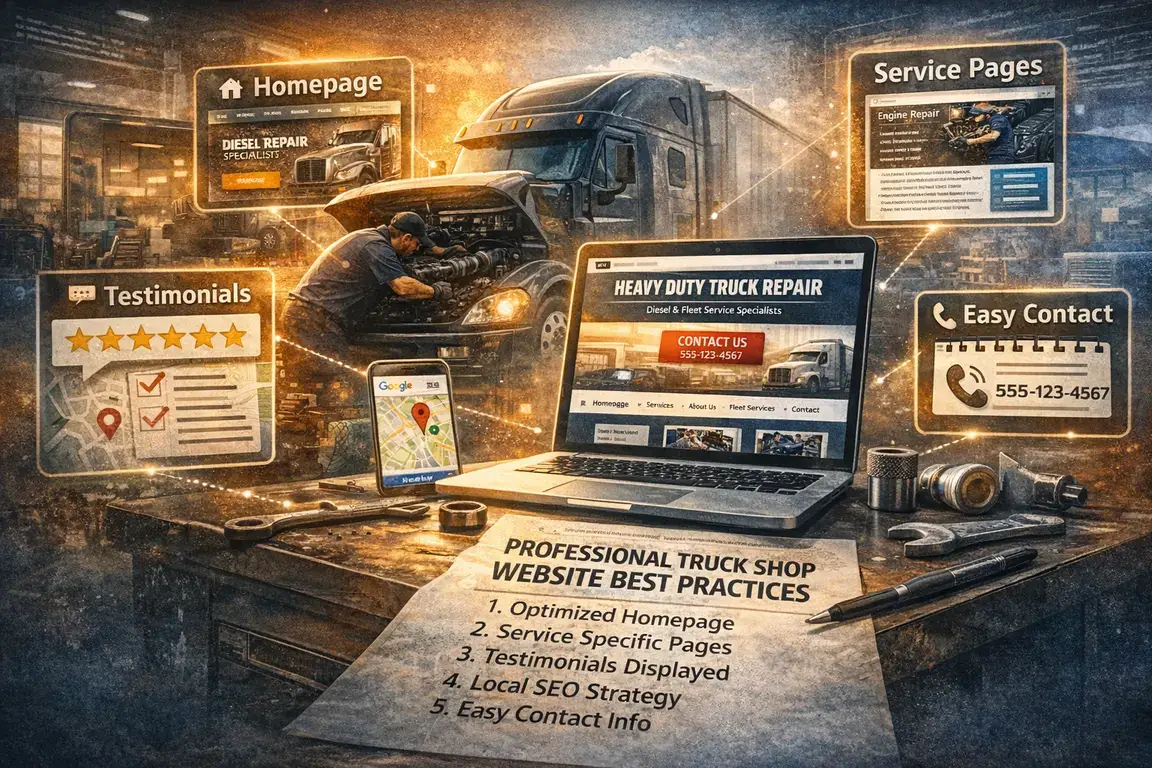
Your homepage must immediately communicate three things: what you do, who you serve, and how to contact you. Include a clear headline stating your specialty, a phone number visible without scrolling, your major services or equipment types, hours including emergency availability, and a physical address with map integration. Fleet managers scanning between breakdown calls don't need paragraphs of mission statement — they need contact information and confirmation you handle their equipment.
Create dedicated pages for each major service rather than cramming everything onto one page. This improves rankings for specific service queries and demonstrates depth of expertise. A DPF cleaning page, for example, should cover forced regeneration procedures, cleaning versus replacement considerations, and the aftertreatment brands you service — technical depth that signals real expertise while capturing traffic from fleet managers researching DPF solutions specifically.
The About page ranks among the most-visited pages on service business sites, yet many shops neglect it entirely. Include shop history, technician certifications, years of experience with specific truck brands, and facility capabilities — bay count, lift capacity, diagnostic equipment. A genuine photo of your techs at work builds more trust here than polished stock photography ever will.
Your Contact page needs to remove all friction: phone number, embedded map, contact form, email, hours, and emergency contact if you offer it — drivers on the road can't always make a call, so give them another way to reach you.
Google Business Profile: Your Most Powerful Free Tool
If you implement only one marketing tactic from this guide, optimize your Google Business Profile. This free listing determines whether your shop appears in the local "Map Pack" when fleet managers search for truck repair in your area, and shops in those top positions receive dramatically more calls than those appearing below them.
Start by searching your business name on Google — claim an existing unclaimed listing, or create one at business.google.com if none exists. Google verifies your business through a postcard, phone call, or email confirming you actually operate at the stated location. Complete every available field: exact business name, address matching your website exactly, main phone line, website URL, full hours including holidays, and a keyword-natural business description.
Most diesel shops make a costly mistake by listing only their primary category. "Truck Repair Shop" might be primary, but additional categories — engine rebuilding, transmission shop, brake shop, diesel engine repair, trailer repair, AC repair — each increase your odds of appearing for a specific service search. The shop listing "brake shop" as a category shows up when someone searches "semi truck brake repair near me"; the shop without it doesn't, full stop.
Google favors businesses showing signs of activity. Upload photos regularly — shop exterior, bays and equipment, technicians at work, completed repairs with permission — and post updates about new services or certifications earned. According to Bureau of Labor Statistics projections, diesel service technician employment continues growing through the decade, making a skilled, visible shop increasingly valuable to fleets seeking a reliable service partner.
Local SEO: Getting Found When It Matters
SEO for local service businesses differs from national strategy in one key way: fleet managers searching for truck repair aren't browsing, they're solving an immediate problem. Optimization has to focus on local intent and service-specific keywords rather than broad terms.
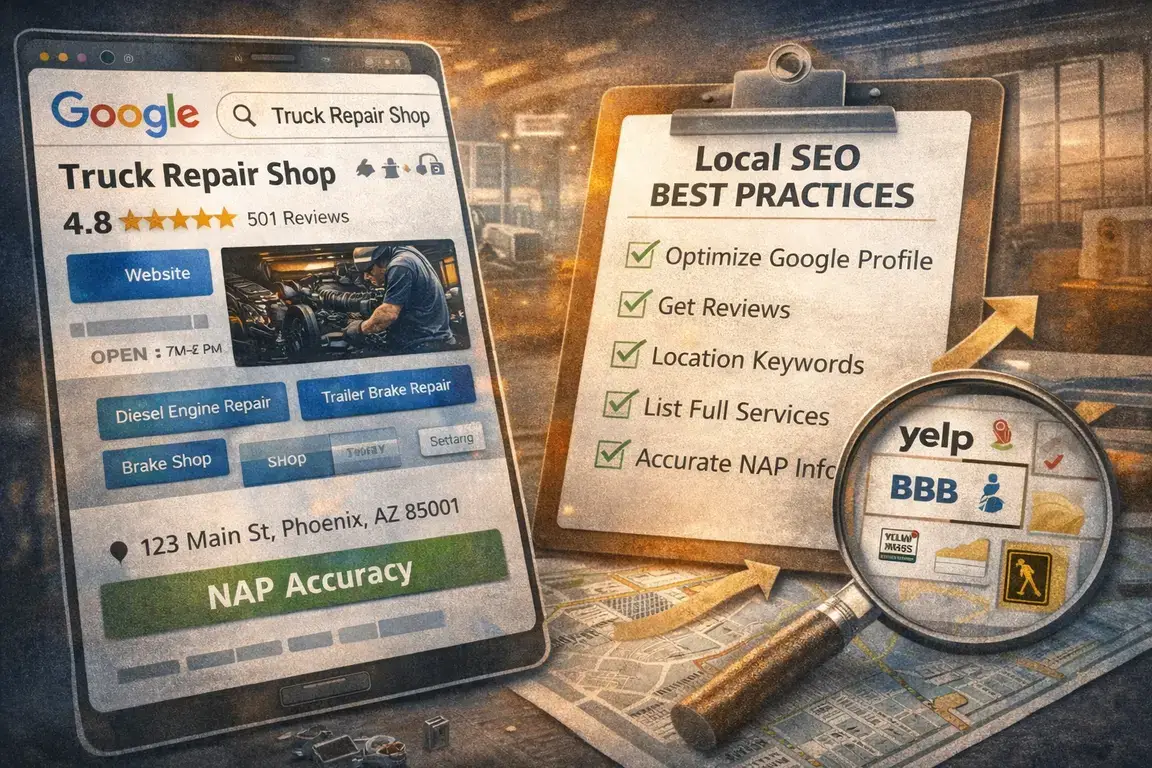
Generic keywords like "truck repair" generate massive competition and attract the wrong traffic. Target service-plus-truck-type patterns ("Peterbilt AC repair," "Kenworth transmission service"), service-plus-city patterns ("DPF cleaning Phoenix"), problem-plus-truck-type patterns ("Cummins ISX overheating"), and emergency-intent patterns ("24-hour truck repair near me"). A page optimized for "DOT inspection Dallas" has a realistic shot at ranking; a generic services page trying to rank for everything ranks for nothing.
NAP — name, address, phone — consistency across every platform directly affects local rankings. If your website lists "123 Main Street" but your Google profile shows "123 Main St." and a directory shows a different suite number, Google reads that as conflicting signals and ranks you lower for it. Audit your website, Google Business Profile, social profiles, and every directory listing for identical formatting.
The Federal Motor Carrier Safety Administration maintains inspection certification standards for shops performing commercial vehicle inspections, and listing those credentials accurately builds authority with both search engines and customers.
Citations — mentions of your business on other sites — strengthen local authority. Pursue trucking-specific directories, your local chamber of commerce, state trucking association member directories, and general listings like Yelp and Yellow Pages. Each legitimate citation reinforces the same local relevance signal Google is already checking through your NAP consistency.
Mobile Optimization: Where Most Searches Happen
A majority of internet traffic now runs through mobile devices, and the share skews even higher for local service searches specifically. When a driver breaks down on the interstate, they're not opening a laptop — they're searching from a phone while standing next to a disabled tractor. A website that doesn't function properly on mobile loses that customer before they ever see your phone number.
Real mobile optimization means responsive design that adjusts automatically to screen size, touch-friendly navigation without tiny precision-click links, phone numbers that dial on tap, load times under three seconds on a cellular connection, readable text without zooming, and forms that actually work on a touchscreen. Test on real devices — both iOS and Android — over a slow connection, and try completing your own contact form with a thumb. If any step frustrates you, it frustrates a customer standing on a highway shoulder.
Click-to-call functionality can single-handedly determine whether a mobile visitor becomes a customer — format every phone number as a tap-to-dial link (<a href="tel:+15551234567">(555) 123-4567</a>) in your header and on every page, especially on mobile layouts. Make calling you the single easiest action available to a mobile visitor.
The Power of Reviews for Heavy-Duty Shops
Online reviews influence purchasing decisions more than nearly any other factor for local services — a remarkable finding for an industry historically built on word-of-mouth, but consistent with how much trust consumers now place in reviews generally.
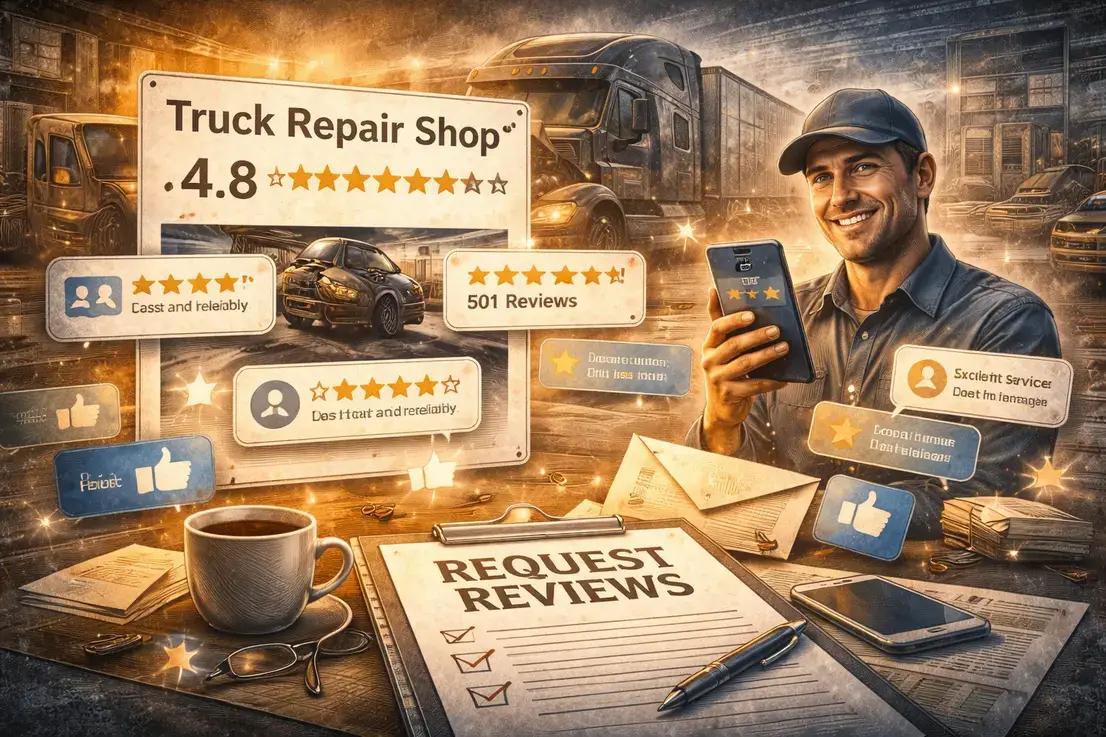
Fleet managers choosing a shop for their equipment face real risk — a botched repair means downtime, CSA violations, or a stranded driver. Reviews provide social proof that mitigates that risk directly, and Google's local algorithm weighs review quantity, star rating, and recency when deciding who appears in the Map Pack.
A shop with consistent five-star reviews from real customers outranks a shop with sparse or no reviews, regardless of how long either has been in business — a pattern HDJ has documented repeatedly across the shop-marketing guides on heavydutyjournal.com.
Reviews don't accumulate automatically — satisfied customers rarely think to leave one unprompted. Ask verbally at job completion when a customer expresses satisfaction, send a follow-up text or email with a direct link to your Google review page, train service writers to request reviews as standard practice, and display simple "review us on Google" signage in customer areas. The American Trucking Associations' Technology & Maintenance Council has documented how reputation increasingly drives fleet maintenance vendor decisions — reviews are a genuine competitive differentiator, not a vanity metric.
Respond to every review, positive and negative. Thank positive reviewers specifically, mentioning the service performed when you can. For negative reviews, respond professionally without getting defensive — acknowledge the concern, offer to resolve it offline, and provide contact information. Future customers reading reviews notice how you handle complaints, and a professional response to criticism often impresses more than the original complaint concerns them.
Content Marketing: Building Authority Over Time
While your core pages handle immediate conversion, blog content builds long-term search authority and demonstrates expertise to customers still evaluating you. Monitor the questions your service advisors hear repeatedly and write content answering exactly those — troubleshooting guides by engine platform, preventive maintenance schedules by manufacturer, regulatory compliance guides, repair-versus-replacement cost comparisons, and seasonal preparation checklists all target real search queries fleet managers make while researching a problem.
One comprehensive, technically accurate article outperforms a dozen thin posts. Google's algorithms increasingly reward genuine depth over publishing frequency — a real 2,000-word DPF troubleshooting guide will rank and convert better than weekly 300-word generic maintenance tips. The American Transportation Research Institute publishes annual industry research worth referencing when building authoritative content about trucking trends.
Measuring Website Performance
A website without tracking operates blind — you can't improve what you don't measure. Google Analytics, free, covers the metrics that actually matter for a service business: traffic source (organic search, Maps, referral), top landing pages, mobile-versus-desktop split, contact form completions, and phone-tap clicks. Track these monthly at minimum, and watch for mismatches — rising mobile traffic paired with falling form submissions usually means your mobile experience needs work.
Most truck repair customers call rather than fill out a form, and without call tracking you can't connect a phone inquiry back to its source. Assign different tracking numbers to your website, Google Business Profile, and any print advertising — when a call comes in on the website-specific number, you know definitively that customer found you through your site.
Common Website Mistakes Heavy-Duty Shops Make
Generic auto shop templates feature sedan and light-duty truck imagery that actively repels commercial fleet traffic — customize any template with heavy-duty imagery and commercial terminology specific to your actual customers. A site without HTTPS encryption triggers browser warnings that destroy credibility instantly, and Federal Motor Carrier Safety Regulations demand meticulous attention to detail from carriers — fleet managers expect the same professionalism from their vendors, and an insecure website suggests careless operations before anyone even reads a word of copy.
Slow-loading pages lose visitors before content ever displays — compress images, minimize unnecessary plugins, and run Google's PageSpeed Insights for a free diagnosis. Every page needs an obvious call-to-action; if a fleet manager reads your engine repair page and wants service, the path to contact should be immediately visible, not buried below the fold. And review your site quarterly — a footer reading "Copyright 2019" or a service you no longer offer damages credibility the instant someone notices it.
Frequently Asked Questions
How much does a truck repair shop website cost?
Professional development typically runs $2,500-$10,000 depending on complexity; DIY WordPress with an industry template runs $500-$1,500 plus $50-$300 monthly hosting. A well-optimized $3,000 site producing consistent calls beats an expensive site sitting dormant without real SEO.
What pages should a heavy-duty repair shop website include?
Homepage, individual service pages for each major offering, an About page, and a Contact page with multiple communication methods. Fleet-focused shops benefit from a dedicated fleet services page; a blog, named testimonials, and a careers page are valuable optional additions.
How do I get my truck repair shop to show up on Google?
Claim and fully optimize your Google Business Profile, add every relevant service category, upload photos regularly, respond to all reviews, keep NAP information identical everywhere, build industry citations, and actively encourage satisfied customers to leave reviews.
Should I use a website builder or hire a professional?
WordPress with an industry-specific theme gives most independent shops the best balance of cost and SEO flexibility. Hire a professional if you lack the time entirely or need custom integration — just make sure whoever builds it understands heavy-duty trucking, not general automotive traffic.
How important are online reviews for truck repair shops specifically?
Extremely — reviews provide the credibility advertising cannot replicate, evidence from other professionals that your shop delivers quality work, and Google's local ranking algorithm weighs review signals heavily in deciding who appears in the Map Pack.
A professional truck repair shop website isn't optional in today's market — it's foundational infrastructure for sustainable growth. Fleet managers research online before calling, Google rewards shops that maintain an optimized digital presence, and competitors investing in visibility capture customers your shop could otherwise serve.
Start with the fundamentals — an optimized Google Business Profile, a mobile-friendly site with service-specific pages, and a systematic review process — and expand into content marketing and advanced local SEO as resources allow. The shops thriving in commercial truck repair recognized early that digital visibility simply amplifies the quality work they were already doing, a theme Heavy Duty Journal returns to across its marketing guides on heavydutyjournal.com.
Help Fellow Shop Owners
Know a shop owner struggling with digital marketing? Share this guide to help them build a website that actually generates business.