
diesel shop marketing

Diesel Shop Marketing Strategies: Complete 2025 Guide

Table of Contents
    Add a header to begin generating the table of contents

    By Michael Nielsen, Editor & Publisher | 15+ Years in Diesel Repair

    Last Updated: December 2024

    📖 Estimated reading time: 16 minutes

    Building a successful diesel shop marketing strategy requires more than mechanical expertise—it demands a systematic approach to reaching fleet managers, owner-operators, and commercial vehicle operators actively searching for reliable repair partners. With over 15.5 million commercial trucks operating across American highways requiring consistent maintenance and repair services, the opportunity for diesel repair businesses has never been stronger.

    The challenge most shop owners face isn’t a lack of technical skill. It’s translating that expertise into a marketing presence that captures the right customers at the moment they need service. Whether you operate a single-bay facility or manage multiple locations, the strategies in this guide provide actionable frameworks for building digital visibility, nurturing customer relationships, and driving sustainable growth in 2025.

    Industry benchmarks suggest service businesses should allocate approximately 5-8% of targeted revenue toward marketing activities. According to the U.S. Small Business Administration, small businesses with revenues under $5 million should allocate 7-8% of revenues to marketing—though the right percentage depends on your growth stage and competitive environment. This guide delivers ready-to-use templates, proven tactics, and implementation roadmaps specifically designed for heavy-duty repair operations.

    Key Takeaways

    • Market Opportunity: The U.S. heavy-duty repair sector serves over 15.5 million commercial trucks, with 91.5% of carriers operating 10 or fewer trucks—creating consistent demand for local independent shops.
    • Budget Benchmarks: Successful diesel service centers allocate 5-8% of targeted revenue toward promotional efforts, with established businesses typically investing closer to 5% while growth-focused operations may invest 7-10%.
    • Customer Segmentation: Fleet operators and owner-operators represent distinct customer segments requiring fundamentally different marketing approaches—fleet managers prioritize uptime guarantees while independents value personal relationships and transparent pricing.
    • Digital Foundation: Google Business Profile optimization, mobile-responsive websites, and strategic local SEO form the foundation of modern diesel repair marketing—most commercial drivers search for services on mobile devices within 15 miles of their location.
    • Retention Over Acquisition: Customer retention programs, preventive maintenance memberships, and referral incentives deliver higher ROI than continuous new customer acquisition efforts.

    Understanding the Diesel Repair Industry Landscape

    The diesel repair market continues to expand as commercial trucking remains the backbone of American freight transportation. According to the American Trucking Associations, trucks moved 11.27 billion tons of freight in 2024, generating $906 billion in gross freight revenues. This massive fleet creates consistent demand for specialized maintenance and repair services across every region of the country.

    The industry structure creates significant opportunities for independent repair shops. Of the nearly 580,000 active motor carriers registered with FMCSA, 91.5% operate 10 or fewer trucks and 99.3% operate fewer than 100 power units. These small fleet operators and owner-operators often prefer working with local independent shops that offer personalized service and competitive pricing over dealership service departments.

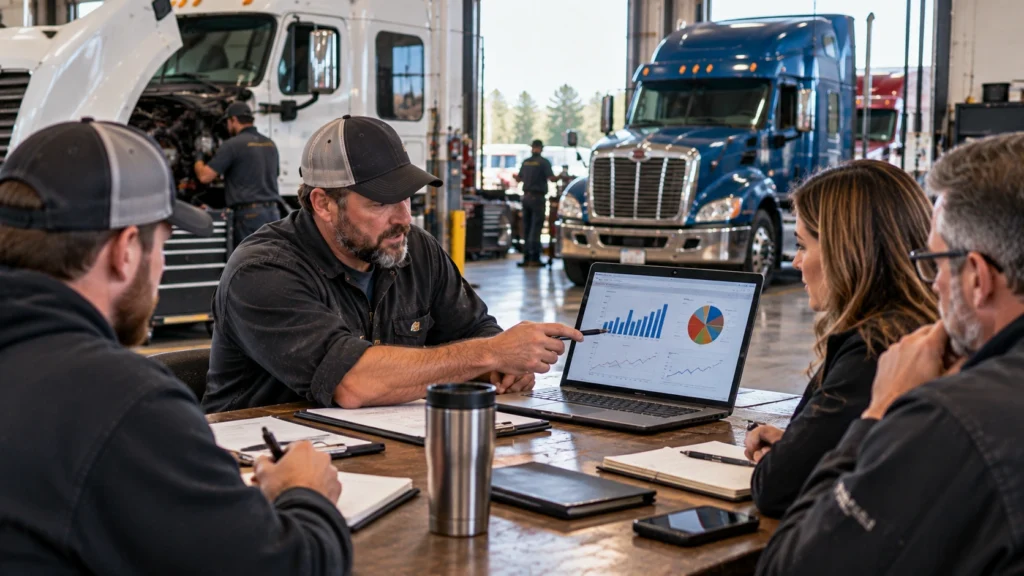
    Fleet manager reviewing diesel service marketing strategies at planning session

    Modern diesel engine technology has become increasingly sophisticated, with complex emissions systems, advanced diagnostics, and integrated electronic controls. Shops that position themselves as specialists in DEF systems, SCR diagnostics, DPF regeneration, and advanced electronic troubleshooting can command premium rates and attract customers willing to travel for genuine expertise.

    Market Growth Opportunities for Diesel Repair Shops

    Several market segments present growth opportunities for diesel repair businesses in 2025. Fleet managers increasingly seek shops offering comprehensive diagnostic capabilities rather than basic repair services. Mobile repair services have emerged as a significant differentiator—commercial operations value technicians who can perform diagnostics and repairs at their facilities, minimizing costly downtime.

    Extended service intervals on modern diesel engines create predictable maintenance schedules that enable shops to build recurring revenue streams through preventive maintenance programs. The owner-operator segment also presents substantial opportunity, as these independent truckers often seek personalized service and transparent pricing from shops they trust.

    Competitive Challenges and Strategic Responses

    Diesel repair businesses face mounting pressures that demand strategic responses. The skilled labor shortage remains critical—experienced diesel technicians are in high demand, making recruitment and retention increasingly expensive. Competition from dealership service departments intensifies as manufacturers expand their networks, leveraging brand recognition and warranty advantages.

    Equipment investment requirements have escalated dramatically. Modern diagnostic tools and specialized equipment for emissions systems represent significant capital expenditures. However, shops that invest in current technology can differentiate themselves from competitors operating with outdated capabilities.

    Challenge CategoryPrimary ImpactStrategic Response
    Technician ShortageLimited service capacity, higher labor costsTraining programs, competitive compensation, retention incentives
    Equipment CostsReduced profitability, capital constraintsPhased investment plans, specialized service focus
    Dealership CompetitionLost market share in warranty workSuperior customer service, relationship building
    Turnaround PressureQuality vs. speed trade-offsProcess optimization, mobile service options

    Identifying and Targeting Your Ideal Diesel Shop Customers

    Every successful diesel shop marketing plan begins with a clear picture of who walks through your bay doors and what problems they need solved. Without this foundational understanding, marketing efforts scatter across too many audiences with messages that resonate with no one. The diesel repair industry serves distinct customer segments, each requiring different approaches.

    Your diesel shop customer base breaks down into recognizable categories. Fleet operators with multiple vehicles have different needs than individual owner-operators making quick repair decisions. Understanding whether your business focuses primarily on emergency repair work or scheduled preventive maintenance helps you target marketing messages that speak directly to customer priorities.

    Fleet manager evaluating diesel shop services for commercial vehicles

    Reaching Fleet Operators and Commercial Clients

    Fleet operators represent the most valuable customer segment for many diesel repair businesses. These commercial clients bring predictable service volumes, scheduled maintenance contracts, and ongoing revenue streams that stabilize your business throughout seasonal fluctuations. However, commercial fleet marketing requires a fundamentally different approach than marketing to individual truck owners.

    Large fleet operations typically employ dedicated maintenance managers or fleet coordinators who evaluate vendors based on specific criteria. These decision-makers prioritize operational uptime above almost everything else. A broken-down truck costs them hundreds or thousands of dollars per day in lost productivity, making reliability your most powerful selling point.

    Successful fleet management marketing emphasizes guaranteed turnaround times with accountability, volume pricing structures that reward ongoing relationships, comprehensive service capabilities that minimize vendor management complexity, transparent communication systems providing real-time repair updates, and dedicated account management with single points of contact who understand fleet-specific needs.

    Connecting with Owner-Operators

    Owner-operators represent a distinctly different customer segment with unique decision-making processes. The Owner-Operator Independent Drivers Association (OOIDA) represents hundreds of thousands of independent truckers who make their own repair decisions without procurement committees or approval processes. They balance cost concerns against quality considerations while building long-term relationships with shops they trust.

    Individual truck owners value personal treatment and transparent communication above almost everything else. They need to understand exactly what’s wrong with their vehicle, why the repair is necessary, and what it will cost before work begins. This segment responds well to local advertising, word-of-mouth referrals, and social media engagement that showcases technical knowledge.

    📥 Free Download: The Heavy-Duty Marketing Playbook

    Get our comprehensive guide to diesel shop marketing with ready-to-use templates, budget worksheets, and campaign frameworks designed specifically for heavy-duty repair businesses.

    Download the Free Playbook →

    Building a High-Converting Digital Presence

    Your online presence functions as the critical bridge between technical expertise and customers searching for dependable diesel repair services. A professional website serves as more than a digital business card—it’s where potential customers evaluate your credibility, understand your capabilities, and decide whether to pick up the phone or submit a service request.

    The difference between shops that generate consistent leads and those that struggle comes down to intentional design choices that guide visitors toward taking action. Every element on your digital platform should work cohesively to build trust and reduce friction in the decision-making process.

    Diesel repair shop website displaying essential features for customer conversion

    Essential Website Features for Diesel Repair Shops

    Your website must include specific elements that address the unique concerns of fleet managers and truck owners searching for reliable service providers. Clear service descriptions form the foundation—specify your capabilities for different vehicle types, from light-duty pickups to Class 8 commercial trucks. Detail repair categories including diagnostics, engine rebuilds, transmission services, brake systems, electrical troubleshooting, and preventive maintenance packages.

    Prominent contact information creates immediate connection opportunities. Include your phone number with click-to-call functionality in the header of every page. Display your physical address with embedded maps showing access routes suitable for commercial vehicles. If you offer mobile repair services, clearly outline your service area coverage.

    Visual credibility builders significantly impact visitor confidence. Professional photography of your facility showcases modern equipment and organized work environments. Team photos with technician certifications humanize your business and highlight qualifications. Before-and-after images of completed repairs demonstrate technical capabilities without requiring extensive text explanations.

    Mobile Optimization for Commercial Drivers

    Fleet managers and owner-operators frequently research service options using smartphones while on the road or between deliveries. Mobile-responsive design isn’t optional—it’s essential for capturing this significant portion of your potential customer base. Fast loading speeds prove critical for mobile users operating on cellular connections. Compress images without sacrificing quality, minimize unnecessary scripts, and implement caching strategies.

    Touch-friendly navigation eliminates frustration for mobile users. Buttons and clickable elements should be sized appropriately for finger taps rather than mouse clicks. Readable text without zooming respects user experience principles—use font sizes of at least 16 pixels for body text.

    Stay Ahead of Industry Marketing Trends

    Get weekly insights on diesel shop marketing strategies, customer retention tactics, and digital presence optimization delivered directly to your inbox.

    Subscribe to the Newsletter →

    Local SEO Strategies to Dominate Your Market

    When truck drivers need emergency repairs, they search online for nearby diesel shops—and your business needs to appear first. Local search optimization determines which repair facilities capture the attention of fleet operators, owner-operators, and commercial drivers actively seeking services in your geographic area.

    According to Google’s guidance on local ranking factors, local results are based primarily on relevance, distance, and prominence. Relevance measures how well your business profile matches search queries. Distance considers how far your shop is from the searcher. Prominence reflects how well-known your business is, based on information Google finds across the web including reviews, links, and directory listings.

    Local SEO dashboard showing diesel repair shop optimization metrics

    Optimizing Your Google Business Profile

    Your Google Business Profile serves as the foundation of local diesel shop marketing efforts. This free platform controls how your business appears in Google Maps and local search results. Shops with optimized profiles receive significantly more visibility than competitors with incomplete or outdated information.

    Start by claiming and verifying your business profile. Verification establishes legitimacy and unlocks advanced features that increase customer engagement. Select appropriate primary and secondary business categories that accurately represent your services—categories like “Diesel Engine Repair Service,” “Truck Repair Shop,” and “Commercial Truck Dealer” help Google understand your business type.

    Complete every section with accurate business information. Include your exact business name, physical address, phone number, website URL, and operating hours. Add detailed service descriptions that incorporate relevant terms naturally—describe specific capabilities like heavy-duty diesel engine diagnostics, fleet preventive maintenance, or commercial truck transmission repair.

    Building Citations and Managing Reviews

    Citations—mentions of your business name, address, and phone number across the internet—significantly impact local search rankings. Focus on both general directories (Yelp, Yellow Pages, Bing Places) and trucking industry resources (Trucker Path, DAT, industry association directories). Consistent NAP information across all platforms reinforces legitimacy.

    Online reviews profoundly influence customer decisions and local search rankings. Search engines interpret positive reviews as trust signals. When you respond to customer reviews—both positive and negative—it shows you value feedback. This engagement can help your business stand out while building trust with potential customers reading reviews before making contact.

    The HDJ Perspective

    After working with diesel repair businesses across the country, we’ve observed a consistent pattern: shops that invest in systematic marketing—even modest investments of 5% of revenue—consistently outgrow competitors relying solely on word-of-mouth. The most successful operations treat marketing as an ongoing operational function rather than a periodic expense. They track metrics, test approaches, and continuously refine their customer acquisition strategies. In an industry where customer lifetime value can reach tens of thousands of dollars, even small improvements in lead generation and customer retention compound into substantial revenue gains over time.

    Social Media Marketing for Diesel Repair Shops

    Building a strong social media presence allows diesel repair shops to showcase expertise while connecting directly with both individual truck owners and fleet managers. These platforms provide opportunities to demonstrate technical knowledge, share customer success stories, and maintain visibility in a competitive marketplace.

    Consistency matters more than frequency when establishing your social presence. Posting three times weekly delivers better results than daily posts that sacrifice quality for volume. Each platform serves distinct purposes—Facebook excels at community building, Instagram showcases visual work, LinkedIn targets commercial decision-makers, and YouTube establishes technical authority.

    Social media analytics dashboard displaying diesel shop engagement metrics

    Platform-Specific Strategies

    Facebook remains the dominant platform for reaching local customers. Create a complete business page showcasing services, hours, location, and contact information. Post a variety of content types including completed repair showcases, maintenance tips, team member spotlights, and customer testimonials. Facebook’s local awareness advertising allows targeting potential customers within specific geographic boundaries around your shop.

    Instagram’s visual format provides ideal opportunities for demonstrating technical capabilities. Before-and-after repair photos perform exceptionally well, showing dramatic transformations that illustrate your skills. Instagram Stories offer powerful tools for real-time engagement—share daily shop activities, introduce team members, or provide quick maintenance tips.

    LinkedIn targets the professional audience most valuable for developing commercial fleet relationships. Fleet managers, transportation company executives, and logistics directors actively use this platform for vendor research. Share thought leadership content positioning your shop as an industry authority—articles about fleet maintenance best practices, regulatory updates, and preventive maintenance strategies.

    Share Your Diesel Shop Marketing Expertise

    Have you developed successful marketing strategies for your diesel repair business? Heavy Duty Journal welcomes contributions from industry professionals sharing real-world insights on customer acquisition and retention.

    Submit Your Expertise →

    Marketing Templates and Implementation Tools

    The right marketing templates transform complex promotional strategies into actionable tools that any diesel shop can customize and deploy. Instead of spending weeks developing campaigns from scratch, you can leverage proven frameworks that generate results while maintaining flexibility to reflect your shop’s unique brand and services.

    Marketing template examples for diesel maintenance promotional campaigns

    Email Marketing Campaign Frameworks

    Email remains one of the most cost-effective channels for nurturing customer relationships and driving repeat visits. A well-structured approach includes automated sequences that deliver timely, relevant messages throughout the customer journey. The key lies in segmentation—fleet managers have different needs than owner-operators, and your templates should reflect these distinctions.

    Welcome email series should unfold over seven to ten days, progressively introducing your shop’s capabilities and building trust. Seasonal maintenance reminders capitalize on predictable service needs throughout the year—winter preparation in early fall, spring post-winter inspections, summer cooling system focus, and fall harvest season preparation.

    Service Reminder and Follow-Up Systems

    Systematic follow-up communication significantly increases customer lifetime value. Immediate thank-you messages should deploy within two hours of service completion. Satisfaction survey requests arrive 48 hours post-service, allowing time for reflection while memories remain fresh. Future service reminder sequences calculate recommended maintenance dates based on service history and manufacturer specifications.

    Customer Retention Strategies That Drive Repeat Business

    Maximizing customer lifetime value requires systematic approaches that convert occasional service visits into long-term partnerships. Diesel shops that implement structured customer retention programs generate predictable revenue while reducing dependence on costly customer acquisition campaigns.

    Preventive maintenance membership program structure for diesel repair shops

    Preventive Maintenance Membership Programs

    Preventive maintenance membership programs create recurring revenue streams while delivering genuine value to commercial fleets and owner-operators. These subscription-based plans bundle scheduled services at discounted rates, making routine maintenance more affordable and convenient for customers while providing your shop with predictable income.

    Tiered membership structures accommodate different customer needs. Basic plans serve individual truck owners with standard maintenance schedules. Premium tiers target fleet operators with multiple vehicles, offering volume discounts and dedicated service advisors who understand their specific equipment and operational requirements.

    Referral Programs and VIP Recognition

    Effective referral programs leverage your existing customer base to generate qualified new business at minimal cost. Word-of-mouth recommendations from trusted peers carry more weight than traditional advertising, especially in the tight-knit trucking community. Structure your referral incentive program with clear rewards for both parties—when an existing customer refers a new client who completes service, both receive meaningful benefits.

    VIP customer programs identify and reward your most valuable clients, reducing churn among accounts that generate disproportionate revenue. Define VIP criteria based on quantifiable metrics such as annual spending thresholds, service frequency, or relationship duration. Exclusive benefits might include dedicated service advisors, extended warranty coverage, special pricing tiers, or waived diagnostic fees.

    Annual Marketing Budget Planning

    A well-structured marketing budget transforms scattered advertising efforts into coordinated growth strategies. Without clear financial planning, shop owners often waste money on ineffective channels while underfunding tactics that actually generate customers. The FMCSA’s industry data shows the commercial trucking sector continues to expand, creating ongoing demand for repair services—but capturing that demand requires strategic marketing investment.

    Most successful diesel repair businesses start by calculating approximately 5% of their targeted annual revenue for marketing investment, with newer or growth-focused operations potentially investing 7-10%. The key lies not just in total spending but in strategic distribution across channels that reach your specific customers.

    Budget Allocation by Shop Size

    Small independent shops typically generating $200,000-$500,000 annually should allocate $10,000-$25,000 for marketing. At this scale, every dollar must deliver maximum impact—focus on Google Business Profile optimization, review generation, organic social media, and modest paid advertising tests.

    Mid-size operations with multiple bays and 3-6 technicians typically generate $500,000-$1,000,000 annually. These businesses should budget $25,000-$60,000 for marketing activities, supporting professional website maintenance, regular content creation, email marketing automation, and meaningful paid advertising campaigns.

    Large multi-location operations or specialized fleet service centers exceeding $1,500,000 in annual revenue should allocate $75,000-$150,000+ for comprehensive programs including dedicated marketing personnel or agency partnerships, advanced digital advertising, and sophisticated customer retention systems.

    Frequently Asked Questions

    How much should a diesel repair shop spend on marketing?

    Most successful diesel repair businesses allocate 5-8% of their targeted annual revenue toward marketing activities. Established shops with strong reputations might operate effectively at 3-5%, while newer operations or those in competitive markets may need to invest 7-10% to build visibility. The U.S. Small Business Administration recommends small businesses with revenues under $5 million allocate 7-8% to marketing. Start with a sustainable percentage based on your current revenue, track results carefully, and adjust based on which channels deliver measurable returns.

    What digital marketing channels work best for diesel shops?

    Google Business Profile optimization and local SEO typically deliver the highest ROI for diesel repair shops because they capture customers actively searching for services. A mobile-optimized website with clear service descriptions and easy contact methods forms the foundation. Social media—particularly Facebook for local engagement and LinkedIn for fleet decision-makers—builds ongoing visibility. Email marketing nurtures existing customers for repeat business. Paid advertising through Google Local Services Ads can generate immediate leads, though requires careful budget management to maintain profitability.

    How can I attract more fleet customers to my diesel shop?

    Fleet operators prioritize reliability, turnaround time, and cost predictability above most other factors. Develop fleet-specific service packages with guaranteed completion times and volume pricing. Create dedicated account management where fleet coordinators have single points of contact who understand their equipment. Offer comprehensive reporting that helps fleet managers track maintenance history and costs. Connect with fleet managers through LinkedIn, industry associations, and local business directories. Most importantly, demonstrate your capabilities through references from existing fleet clients.

    What’s the most important website feature for a diesel repair business?

    Prominent, easy-to-access contact information—particularly a click-to-call phone number visible on every page—converts more website visitors than any other element. Commercial drivers often need service urgently and make decisions quickly. Beyond contact accessibility, clear service descriptions that specify your capabilities (vehicle types, repair categories, specializations), professional photos of your facility and team, and customer reviews build the credibility that influences the call decision. Mobile optimization is essential since most commercial drivers research services on smartphones.

    How do I compete with dealership service departments?

    Independent diesel shops compete effectively by emphasizing advantages dealerships cannot match: personalized service, flexible scheduling, competitive pricing on out-of-warranty work, and technicians who remember individual customers and their equipment. Build relationships rather than transactions. Respond faster to service requests. Offer mobile repair capabilities that minimize customer downtime. Specialize in specific brands or systems where you can match or exceed dealership expertise. Most importantly, deliver consistent quality and transparent communication that earns customer loyalty beyond warranty periods.

    Building Your Diesel Shop Marketing Foundation

    Your path to market growth starts with immediate, focused action. The diesel shop marketing strategies outlined in this guide provide everything needed to compete effectively in 2025’s marketplace. Commercial trucks operating across America need reliable repair partners, creating sustained demand for shops that market systematically.

    Begin implementation today using the provided templates and frameworks. Focus first on strengthening your digital presence—optimize your Google Business Profile, ensure your website captures mobile visitors effectively, and establish consistent review generation. These foundation elements create visibility when potential customers search for diesel repair services in your area.

    Sustainable growth depends on consistency rather than perfection. Start with activities matching your current capabilities and expand gradually. Track performance metrics monthly to identify which channels deliver the strongest returns. The investment required remains minimal compared to potential revenue gains—small shops can compete effectively against larger competitors by executing relationship-focused marketing that demonstrates expertise and builds trust over time.

    Share This Resource With Your Network

    Know a diesel shop owner working to grow their business? Share this comprehensive marketing guide to help them build sustainable customer acquisition strategies.

    Leave a Comment

    Your email address will not be published. Required fields are marked *

    Sponsored

    Emergency Breakdown?

    Find Certified Repair Shops Near You

    24/7 Mobile Service
    Verified Facilities
    Nationwide Coverage
    Find Repair Shops Now →

    Trusted by thousands of fleet operators
