By Michael Nielsen, Publisher | 15+ Years in Diesel Repair
Last Updated: September 2026
⏱ Estimated reading time: 12 minutes
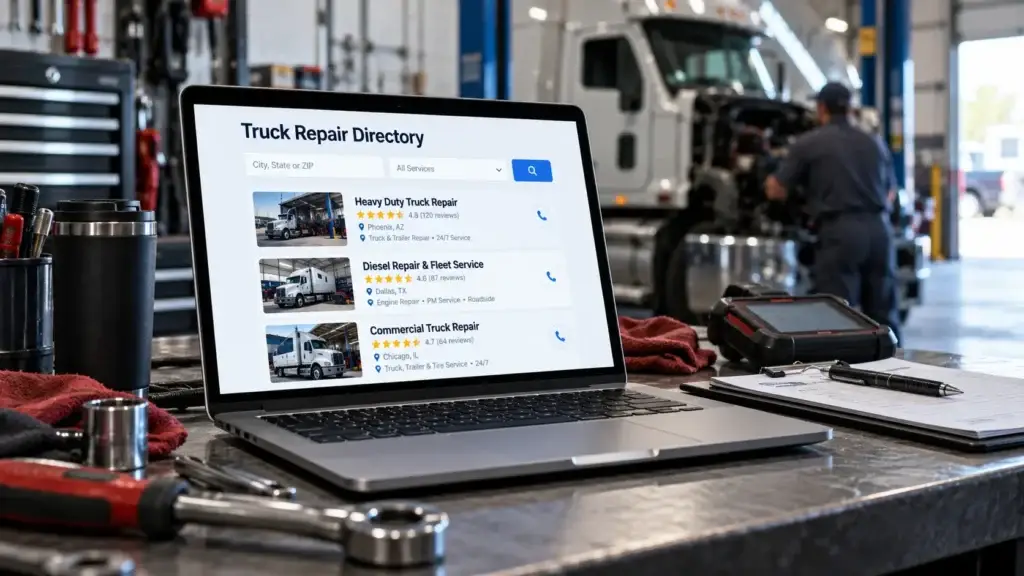
Truck repair directory marketing is the practice of listing your shop on trucking-specific and general business directories so it shows up when a driver or dispatcher searches for help during a breakdown. It works differently than ordinary local SEO because the searches themselves are different — a driver stopped on the shoulder isn't comparison shopping, they're trying to find someone who can help in the next few minutes.
This guide covers which directories are worth your time, what actually makes a listing convert an emergency search into a call, and how directory marketing fits alongside the Google Business Profile and citation work covered in HDJ's broader truck repair marketing guide.
Key Takeaways
- ✓Emergency searches are a different animal: a stranded driver wants a phone number and a confirmed service area in seconds, not a detailed comparison of your capabilities.
- ✓Trucking-specific directories filter for intent: a general business directory mixes your listing in with restaurants and dentists; a trucking directory surrounds it with the exact audience already looking for commercial repair.
- ✓24/7 contact visibility is the highest-leverage change: a listed after-hours number or dispatcher line matters more than almost any other single listing feature for capturing overnight breakdown calls.
- ✓NAP consistency still governs everything: a directory listing with a mismatched phone number or address actively works against your local rankings instead of helping them.
- ✓Fewer, well-maintained listings beat a scattered presence: three to five actively managed directories outperform ten neglected ones.
In This Guide
- Why Emergency Search Behavior Is Different
- Specialized Directories vs. General Business Listings
- What Makes a Directory Listing Actually Convert
- Google Business Profile: The Foundation Underneath Every Directory
- NAP Consistency and Citation Building
- A 90-Day Directory Optimization Plan
- Ongoing Directory Maintenance
- Complementary Channels: Reviews, Backlinks, and Mobile Service Marketing
- Tracking Directory Marketing Performance
- Frequently Asked Questions
Why Emergency Search Behavior Is Different
When a commercial vehicle breaks down, the driver or dispatcher isn't researching — they're trying to solve an immediate problem under time pressure. That search behavior looks different from routine service shopping in a few specific ways.
The decision window is short. A driver stopped on the shoulder scans for three things: how close a shop is, whether it's actually available right now, and a phone number they can call immediately. Detailed service descriptions matter less in this moment than a visible, working contact method.
These searches skew heavily toward mobile devices, often on cellular connections at truck stops or highway shoulders rather than office wifi. Search modifiers reflect the urgency too — "24 hour," "mobile," "emergency," and "near me" show up far more often in breakdown searches than in searches for scheduled maintenance.
Some of these searches follow a failed roadside inspection rather than a mechanical surprise. Under Federal Motor Carrier Safety Administration rules and the 49 CFR Part 396 inspection and maintenance standard, a vehicle placed out of service during an inspection can't return to the road until the defect is corrected — which turns an already time-pressured driver into an even more urgent directory search.
Breakdowns also don't follow business hours. A meaningful share of emergency calls come in overnight, when many shops have no one answering the phone — which is exactly why after-hours contact visibility (covered below) does so much work in directory marketing specifically.
Rural corridors add another wrinkle. A breakdown 40 miles from the nearest town has fewer nearby shops competing for the search in the first place, which means even a basic, accurate directory listing can win visibility that would be far harder to earn in a saturated metro market. Mentioning specific highways, exits, or mile-marker ranges in a listing helps match these geographically specific searches better than a listing that only names the city.
According to Heavy Duty Journal, the shops that consistently win this category of search aren't necessarily the biggest — they're the ones whose listings actually answer the three questions a stranded driver is asking, in the first few seconds of looking.
~4 million
commercial motor vehicle inspections are conducted across North America every year, per the Commercial Vehicle Safety Alliance — a large share of which surface defects that turn into unplanned repair calls.
Specialized Directories vs. General Business Listings
Not every directory delivers the same value. General business directories mix repair shops in with restaurants, retailers, and unrelated services — a lot of traffic, but very little of it looking for commercial truck repair specifically.
Trucking-specific directories filter for exactly the audience you want: fleet managers and drivers who already know they need commercial vehicle service. That focus tends to produce fewer total impressions but a much higher share of genuinely qualified inquiries.
| Directory Type | Strength | Trade-off |
|---|---|---|
| Trucking-specific directories | Audience already needs commercial repair; less noise | Lower overall traffic volume than general platforms |
| Google Business Profile | Highest visibility, zero listing cost, drives Maps ranking | Requires ongoing optimization effort to perform well |
| General local directories | Broad reach; useful for baseline citation consistency | Low conversion quality; audience isn't pre-qualified |
A practical rule of thumb: start with Google Business Profile as the foundation, add two to four specialized trucking directories based on which corridors and customer types you actually serve, and treat general directories as a citation-consistency exercise rather than a lead source in their own right.
Platforms built specifically for this niche — like the national truck and trailer repair directory at NTTR Directory — are worth evaluating first precisely because their entire listing base is commercial trucking, with no unrelated business categories diluting the searcher's intent.
Keep Your Fleet Running at Full Capacity
Get HDJ's maintenance guides, compliance updates, and fleet management strategies delivered weekly — built for working diesel professionals.
What Makes a Directory Listing Actually Convert
A handful of listing features consistently separate directory profiles that generate calls from ones that get scrolled past. None of them require a large budget — they require attention.
24/7 Availability Display
Showing an after-hours contact — even a dispatcher line or answering service that routes to an on-call technician — is the single change most likely to increase emergency call volume. Facilities that only list standard business hours are functionally invisible during the overnight window when a meaningful share of breakdowns happen.
Service Specificity
"We fix trucks" tells a searcher nothing. Listing specific capabilities — reefer and refrigeration unit repair, hydraulic systems, air brake work, DPF cleaning, specific engine platforms serviced — helps directories match your listing to precise searches and signals real expertise to a fleet manager comparing options.
Response Time and Coverage Clarity
A concrete response commitment reduces uncertainty during a stressful decision. So does geographic specificity — mentioning the interstate corridors, mile-marker ranges, or exits you cover helps a driver 30 miles from the nearest town confirm you actually serve their location before they call.
Photos and Equipment Signals
Real photos of your service vehicles, diagnostic equipment, and technicians on real trucks do more for a directory listing than most shops assume. A fleet manager comparing two similar listings will favor the one with visible proof of capability over one with a stock photo or no image at all.
Naming specific equipment — a particular diagnostic scan tool platform, a heavy-duty lift capacity, mobile service truck capabilities — signals professional-grade capability to a fleet manager who has been burned before by a listing that overpromised. This same specificity is what separates a listing that gets a callback from one that gets scrolled past.
Google Business Profile: The Foundation Underneath Every Directory
Specialized directories are worth pursuing, but Google Business Profile remains the single highest-visibility, zero-cost listing available, and it's the one Google itself uses to populate Maps and the local pack.
Claim and fully verify your profile, select accurate primary and secondary categories, and fill in every field — service area, hours including any after-hours availability, and a specific service list rather than a generic description. HDJ's truck repair marketing guide walks through GBP optimization in full detail; treat directory listings as an extension of that same foundation, not a replacement for it.
NAP Consistency and Citation Building
Every directory listing is also a citation — a mention of your business name, address, and phone number that search engines use to verify you're a real, active business. Consistency across every listing matters more than the number of listings themselves.
Editorial Insight
The HDJ Perspective
Michael Nielsen, Heavy Duty Journal's publisher:
The shops I've seen waste directory budget aren't picking bad platforms — they're listing "123 Main St." on one site and "123 Main Street, Suite B" on another, then wondering why neither one ranks. A directory listing only works as hard as the NAP data behind it is consistent. Fix that first, and even a modest handful of listings starts pulling its weight.
"St." versus "Street," a missing suite number, or an outdated phone format all create discrepancies that confuse Google's verification process and dilute the trust signal every listing is supposed to build. Even minor variations can measurably affect how well your local presence performs.
Keep a single master reference document with your business information formatted exactly as it should appear everywhere, and audit your live listings against it at least twice a year — more often if you've recently moved, changed numbers, or adjusted hours.
Third-party data aggregators occasionally introduce their own variations into your listings without you noticing — a duplicate profile with a slightly different suite number, or a phone number formatted differently than your own records. These aren't always your mistake, but they still count against you, so periodic auditing has to cover listings you didn't create yourself.
A 90-Day Directory Optimization Plan
Transforming a scattered directory presence into one that actually generates calls follows a predictable sequence rather than a single overhaul.
Month One: Foundation
Audit every existing listing for NAP consistency and correct any discrepancies. Fully optimize Google Business Profile. Choose two to three specialized trucking directories based on the corridors and customer types you actually serve, and set up call tracking so you can measure what happens next.
Month Two: Enhancement
Complete detailed profiles on every chosen directory — specific services, after-hours contact options, and geographic coverage rather than the bare minimum fields. Begin requesting reviews from recent customers to build social proof across active profiles.
Month Three: Refinement
Review call sources and conversion patterns. Double down on directories that produce qualified calls, and drop or downgrade ones that generate mostly noise. Refine service descriptions based on the actual search terms driving calls, not assumptions made in month one.
Ongoing Directory Maintenance
Directory marketing degrades without upkeep — competitors keep their listings current while yours drift, and inactive profiles gradually lose ground even if they once performed well.
Maintenance Cadence
- Monthly: respond to new reviews within 48 hours, verify phone numbers route correctly, and check for outdated hours or service information
- Monthly: update service listings whenever you add a capability or piece of diagnostic equipment
- Quarterly: analyze call volume by directory source and calculate rough cost per lead where paid placements are involved
- Quarterly: re-audit NAP consistency across every platform, since third-party data aggregators occasionally introduce their own variations
- Quarterly: test whether an underperforming directory deserves continued investment or should be dropped
Complementary Channels: Reviews, Backlinks, and Mobile Service Marketing
Directory listings work best as one piece of a broader presence rather than a strategy on their own. A handful of adjacent channels compound directly with the work covered here.
Reviews on your directory profiles and GBP listing function as a trust signal fleet managers actually read before calling — a directory listing with zero reviews competes at a real disadvantage against one with a handful of recent, specific ones.
Directory listings themselves can also contribute to your site's backlink profile when they link back to your website, adding to the broader authority-building work covered in HDJ's backlinks for truck repair shops guide.
If your shop offers mobile or on-site repair specifically, directory marketing alone won't capture that audience fully — HDJ's mobile truck repair marketing guide covers the website, advertising, and outreach tactics specific to on-site service providers.
Tracking Directory Marketing Performance
Directory marketing without measurement is guesswork dressed up as strategy. A few consistent habits reveal which platforms actually deserve continued investment.
Assign a unique tracking phone number to each directory where that's practical, so incoming calls reveal their true source rather than all funneling to one number you can't attribute. Note conversion — not just call volume — since a directory generating frequent tire-kicker inquiries isn't outperforming one with fewer but higher-intent calls.
Ask every new customer directly how they found you and log the answer, even informally. Over a few months this simple habit builds a clearer picture of which listings are earning their keep than any analytics dashboard alone.
With roughly 580,000 active motor carriers registered with FMCSA as of mid-2025, per the American Trucking Associations, and the vast majority running small fleets that can't absorb downtime easily, the addressable market for well-positioned emergency repair listings isn't going anywhere.
The Bureau of Labor Statistics counted roughly 2.2 million heavy and tractor-trailer truck drivers in 2025 — every one of them a potential searcher the next time a breakdown happens on their route. Michael Nielsen's own take, after years of watching shop marketing budgets get spent: the return on directory listings tracks almost perfectly with how consistently a shop keeps its own data accurate, not with how many platforms it's listed on.
Frequently Asked Questions
How many directories should a truck repair shop maintain?
Start with Google Business Profile plus two to four specialized trucking directories — three to five active listings total is a reasonable range for most independent shops. Quality of upkeep matters far more than quantity. A shop maintaining five current, accurate listings will consistently outperform one spread thin across fifteen neglected ones.
What makes trucking-specific directories better than general business directories?
Trucking-specific directories attract an audience that already knows it needs commercial vehicle repair, rather than mixing your listing in with unrelated local businesses. That focus tends to produce fewer total visitors but a meaningfully higher share of genuinely qualified inquiries — the trade-off most independent shops find worth making.
How long before directory marketing shows results?
Early signals — a handful of new calls — often appear within the first few weeks of optimizing a listing. Full performance tends to stabilize around 90 days, once search algorithms recognize the updated information and early customers have had a chance to leave reviews validating the profile.
How do you track which directories generate actual business?
Assign a unique phone number to each directory where the platform allows it, and ask every new customer directly how they found you. Together these two habits reveal which listings drive real calls far more reliably than profile-view counts, which say nothing about whether a viewer ever picked up the phone.
What information must stay consistent across all directories?
Your business name, address, and phone number need to match exactly, character for character, across every listing. Business hours should reflect real availability, including any after-hours emergency service. Service descriptions can vary in wording to fit each platform's audience, but the core contact information has to stay identical everywhere.
Is it worth paying for a premium or featured directory placement?
It depends entirely on whether you can measure the return. Test one paid feature at a time with dedicated call tracking for 30 to 60 days before committing to an annual contract. A premium placement that can't show its own return isn't worth renewing, regardless of how appealing the platform's own projections look.
Should a shop list on directories its competitors already dominate?
Usually yes, but with realistic expectations about ranking position. Even a modest listing adds a legitimate citation and a chance to appear alongside established competitors when a searcher scrolls past the top result. The bigger mistake is skipping a relevant directory entirely because a competitor already has a strong presence there — that just cedes the search to them completely.
Effective directory marketing comes down to a short list of disciplines done consistently: pick a handful of directories that actually match your audience, keep your NAP data identical everywhere it appears, make after-hours availability visible, and track results well enough to know which listings earn their place.
None of it requires a large budget. It requires the same discipline that keeps a shop running well — attention to detail, applied consistently, over months rather than as a one-time setup task.
Know a Shop Still Relying on One Listing?
Pass this along to a fellow shop owner who's never audited their directory presence — the NAP consistency check alone is worth the ten minutes it takes.