
By Michael Nielsen, Publisher | 15+ Years in Diesel Repair
Last Updated: September 2026
⏱ Estimated reading time: 13 minutes
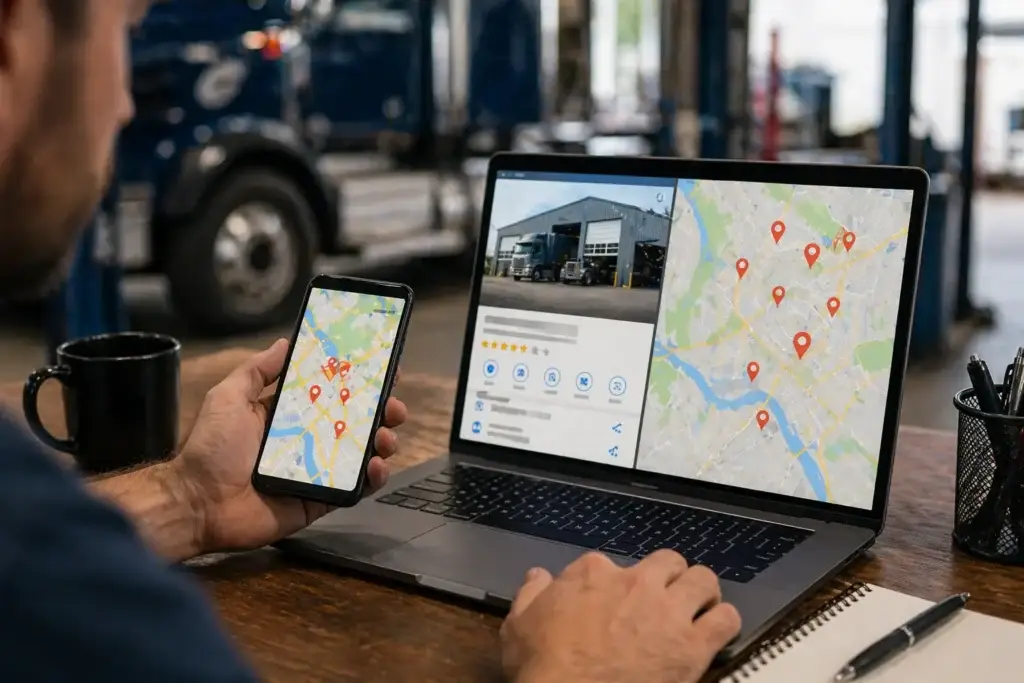
Truck repair marketing is the combination of local SEO, reputation management, and web presence that determines whether your shop shows up when a fleet manager or owner-operator searches for a repair provider near them. For most independent shops, that decision now happens on a phone, in a Google Maps search, seconds after a truck goes down.
Word of mouth still matters, but it no longer decides who gets the call first — the shop with the strongest local search presence usually does.
This guide walks through the layers that make up an effective truck repair marketing strategy for heavy-duty and diesel shops: Google Business Profile, keyword strategy, website architecture, citations, reviews, and link building — plus how AI-driven search is starting to change which shops get surfaced first.
Unlike paid advertising, which stops producing the moment you stop paying for it, this kind of visibility compounds. A profile you optimize this month keeps working for you next year.
Key Takeaways
- ✓Google Business Profile is the foundation, not a nice-to-have: a fully-built profile with a detailed service list and current reviews directly drives whether you appear in the local three-pack.
- ✓Service-plus-city keywords convert; generic terms don't: "DPF cleaning Dallas" attracts a driver ready to book, while "truck repair" attracts a browser comparing options nationally.
- ✓NAP and review signals compound together: inconsistent business listings actively suppress rankings even when your reviews and content are strong, so both need attention at once.
- ✓AI-generated search results are now part of the equation: the same structured, specific content that ranks well in Google also determines whether AI assistants recommend your shop by name.
- ✓Heavy-duty repair remains underserved online: most local SEO competition and advice targets general automotive, leaving room for consistent shops to outrank much larger operations.
In This Guide
- Why Local SEO Drives Truck Repair Marketing Results
- Google Business Profile: Your Most Powerful Local SEO Asset
- Keyword Strategy for Truck Repair Marketing
- Building a Website That Converts Local Searches
- NAP Consistency and Local Citations
- Online Reviews: Your Most Persuasive Marketing Asset
- Local Link Building for Heavy-Duty Repair Shops
- Winning Visibility in AI-Generated Search Results
- Tracking Your Truck Repair Marketing Performance
- Frequently Asked Questions
Why Local SEO Drives Truck Repair Marketing Results
Most marketing advice is written for restaurants, law firms, and retail — businesses with fundamentally different search behavior than a diesel shop. Understanding what makes heavy-duty different is the starting point for a strategy that actually moves the needle.
Trucks moved roughly 72.7% of the nation's freight by weight in 2024, according to the American Trucking Associations — and every one of those trucks needs regular maintenance and unplanned repair. That's a large, constant service market, and shops that show up in local search capture a disproportionate share of it.
72.7%
of U.S. freight by weight moved by truck in 2024, per the American Trucking Associations — representing millions of vehicles that need ongoing repair and maintenance across the country's service network.
Your customers search in motion, not at a desk. A driver who blows a U-joint on I-40 searches from the cab, with an urgent, location-specific, highly commercial query. Voice search ("find a diesel repair shop near Amarillo") is common in trucking, so your Google Business Profile and website both need to be structured for it.
You're marketing to two different buyers. An owner-operator types "semi truck repair near me" and needs help today. A fleet manager types "heavy duty fleet maintenance shop [city]" and is evaluating a vendor relationship, not just a single repair. Your content and profile need to speak to both.
Compliance deadlines create demand spikes. DOT annual inspection deadlines and CVSA Roadcheck week generate predictable surges in searches for inspection and repair services. According to the Federal Motor Carrier Safety Administration, an out-of-service violation found during a roadside inspection requires correction before the vehicle returns to service — exactly the urgent, location-dependent demand local SEO is built to capture.
Competition is lighter than it looks. The general auto repair space is saturated with SEO-savvy competitors. Commercial truck repair remains surprisingly underserved online, so shops that invest consistently often outrank much larger operations simply because few local competitors have built a real digital presence.
According to Heavy Duty Journal, this gap is the single biggest opportunity independent shops overlook: publisher Michael Nielsen has watched shops with a fraction of a big chain's budget out-rank it locally simply by being the only one in the market with a complete, accurate Google Business Profile.
Google Business Profile: Your Most Powerful Local SEO Asset
Google Business Profile (GBP) controls your appearance in Google Maps and the local "three-pack" — the cluster of three businesses at the top of local results. Ranking there drives more calls than any other organic channel available to a repair shop.
Categories and Services: Specificity Wins
Set "Truck Repair Shop" as your primary category, then add every secondary category that accurately describes a service you actually offer — Diesel Engine Repair Service, Brake Shop, Transmission Shop, Truck Parts Supplier if you stock parts. Don't pad the list with tangential categories; Google's algorithm treats mismatch as a negative signal.
The Services field is the most underused part of the platform. Most shops list "Truck Repair" and stop. Every specific service you add — DPF cleaning, DOT annual inspections, driveshaft and U-joint service, air system and compressor work, fifth wheel inspection — is its own search trigger.
A two-to-three sentence description on each one gets indexed for long-tail searches a generic listing never reaches.
Photos, Posts, and the Q&A Section
Upload at least 10–15 genuine photos when you first optimize the profile — bays, diagnostic equipment, technicians on real trucks — and keep adding them. Skip stock photography; fleet managers making vendor decisions want to see your actual shop, not a generic mechanic stock photo.
Post updates at least twice a month, and pre-populate the Q&A section with the questions you already hear most: Do you accept fleet accounts? Do you offer mobile service? What engine brands do you specialize in? Seeding it yourself means you control the narrative before a stranger does.
Keep Your Fleet Running at Full Capacity
Get HDJ's maintenance guides, compliance updates, and fleet management strategies delivered weekly — built for working diesel professionals.
Keyword Strategy for Truck Repair Marketing
The goal isn't to rank for "truck repair" nationally — it's to rank for the specific, high-intent searches your service area is actually typing when ready to book.
| Service Type | Keyword Examples | Priority |
|---|---|---|
| Broad Shop Service | diesel truck repair [city], semi truck repair near me | High |
| Compliance / DOT | DOT inspection [city], annual truck inspection near me | High |
| Emissions / Aftertreatment | DPF cleaning [city], DEF system repair near me | High |
| Engine-Specific | Cummins ISX repair [city], Detroit DD15 service [city] | Medium |
| Roadside / Emergency | roadside truck repair near me, mobile diesel mechanic [city] | High |
| Fleet Accounts | commercial fleet maintenance [city], heavy duty fleet repair [city] | Medium |
Each row deserves its own page on your website and its own line in your GBP service list — a single catch-all Services page competing for all of them ranks for none of them well.
Layer in long-tail phrases too. "Truck blowing white smoke" is informational — the driver is still diagnosing. "EGR cooler replacement diesel truck [city]" is transactional — they know what's wrong and need a shop. Your blog content can address both stages, but service pages should optimize heavily for the transactional terms.
49 CFR Part 396 annual inspection requirements alone generate a steady stream of compliance-driven, ready-to-book searches every fleet manager eventually runs.
This guide focuses on the organic, compounding side of visibility. If you're also weighing paid ads, email and SMS follow-up, or a referral-partner program, Heavy Duty Journal's diesel shop marketing strategies guide covers that broader mix in depth.
Building a Website That Converts Local Searches
Your GBP handles Maps and the local pack. Your website is what earns organic rankings and gives you room to cover the full range of keywords your customers search, and Google cross-validates the two — consistency between them reinforces both.
The single highest-impact change most shops can make is replacing one catch-all Services page with dedicated pages per major service. A page titled "DPF Cleaning Services in [City]" competes directly for that search term; a paragraph on a generic page does not.
Each dedicated page should carry an H1 with the service and city, a 400–600 word description of the process and who it's for, your specific capabilities (equipment, certifications, brands serviced), a clear call to action, your NAP in the footer, and LocalBusiness or Service schema identifying the page. Prioritize your highest-revenue services first — engine repair, DOT inspections, DPF cleaning, preventive maintenance — then build out the rest.
Mobile matters more here than almost anywhere else in local business. Drivers search from a truck stop shoulder, not a desk. Your phone number needs to be click-to-call, pages need to load in under three seconds on a mobile connection, and your address needs to link straight to directions.
For a full page-by-page breakdown of what a converting shop site actually needs, see HDJ's truck repair shop website guide.
Editorial Insight
The HDJ Perspective
Michael Nielsen, Heavy Duty Journal's publisher, on what's actually changed:
Most independent shops are running marketing infrastructure that's a decade or more behind how their customers actually search. As of fall 2026, the shift that matters most isn't a new tactic — it's that fleet managers increasingly get their first answer from an AI summary before they ever click through to a website. A shop that's invisible to that layer is invisible before the comparison even starts. The fundamentals haven't changed — accurate, specific, consistent information wins — but the surface where that information gets read has quietly expanded.
NAP Consistency and Local Citations
Citations are mentions of your shop's name, address, and phone number (NAP) on directories and industry platforms. Search engines use their consistency and breadth to verify your business is real, correctly located, and active. Consistency means identical, not similar — "St." versus "Street," a different phone format, or a missing suite number all create discrepancies that suppress local rankings.
Start with the core directory foundation: Google Business Profile, Apple Maps, Bing Places, Yelp, Facebook Business, Better Business Bureau, and your local Chamber of Commerce. From there, move to trucking-specific directories and state trucking association listings — these carry extra relevance weight because they signal to Google that your business is connected to the commercial trucking community specifically, not just general auto repair.
HDJ's truck repair directory marketing guide breaks down which specialized directories actually convert emergency and fleet inquiries versus which just add noise.
Citations need maintenance, not a one-time setup. Every phone number change, move, or hours update has to propagate everywhere. Audit your citation landscape at least twice a year, and immediately after any business information change — a single outdated phone number on a high-authority directory can suppress rankings for months before anyone traces the cause.
Online Reviews: Your Most Persuasive Marketing Asset
Reviews do two jobs at once: Google's local algorithm uses review volume, recency, and sentiment as a ranking signal, and fleet managers read them before committing to a shop they haven't used before. Neither job works without the other.
Build requests into your workflow rather than hoping customers remember on their own. A text sent to the driver's phone within 24 hours of a completed repair, with a direct link to your review page, outperforms email in an industry where drivers are rarely at a desk.
For fleet accounts, fold the request into your account management relationship — a fleet manager's review, mentioning multi-unit service, carries specific weight with other fleet managers researching your shop.
Respond to every review, good and bad. A brief, specific thank-you on a positive review reinforces relevance; a professional, non-defensive response to a negative one — acknowledging the concern and offering to resolve it offline — often does more for prospective customers than the negative review costs you.
Never argue publicly; a shop owner's tone in a review reply tells a reader exactly how that shop will communicate if a repair goes wrong.
Local Link Building for Heavy-Duty Repair Shops
Backlinks — other sites linking to yours — remain one of the strongest ranking signals in local and organic search, and links from locally or topically relevant sources carry more weight than generic ones.
Trucking association memberships, Chamber of Commerce and Better Business Bureau listings, and supplier or parts-distributor dealer locator pages all generate links that are both relevant and genuinely useful referral traffic.
Educational content earns links naturally, too. A detailed guide on how DOT inspections work, what causes DPF failure, or how to build a preventive maintenance schedule positions your shop as a resource other sites want to reference.
For the mechanics of what actually moves a shop's search authority — technical foundation, anchor text, and how to check whether a publication is a genuine fit before you pitch it — see HDJ's backlinks for truck repair shops guide.
Winning Visibility in AI-Generated Search Results
AI-generated overviews and chat-based search assistants are changing how fleet managers and drivers find a shop before they ever open Google Maps. When someone asks an AI assistant "what's the best diesel repair shop near me for DPF cleaning," the answer is assembled from the same underlying signals that drive traditional local SEO — it just gets summarized instead of listed.
That means the fundamentals in this guide aren't a separate track from AI visibility — they're the same work, done thoroughly. A GBP with specific, accurate service descriptions, a website with clean LocalBusiness schema, and consistent NAP across the web all give AI systems the structured, unambiguous facts they need to recommend your shop by name rather than defaulting to a generic answer.
Shops that skip the specificity — vague service lists, thin "About" pages, inconsistent hours — don't just rank worse; they become harder for an AI system to confidently cite at all.
The practical takeaway: write your website content the way you'd answer a fleet manager's question directly, in plain language, with the specific fact up front — engine brands serviced, response time, inspection capability — rather than burying it in marketing copy. That same clarity that helps a human decide quickly is what an AI system extracts and repeats.
Tracking Your Truck Repair Marketing Performance
Marketing investment without measurement is guesswork. Track a handful of numbers monthly rather than treating this as a one-time setup.
Metrics Worth Tracking Monthly
- GBP Insights: profile views, the search terms that triggered your listing, and click-through actions (calls, direction requests, website visits)
- Local pack ranking: your position for target keywords at different points across your service area, since rankings vary by searcher location
- Organic keyword rankings: which search queries in Google Search Console are driving impressions and clicks to which service pages
- Review velocity: total review count and rating trend — a profile with dozens of old reviews and nothing recent reads as inactive to Google's algorithm
- Call attribution: ask every new customer how they found you, and note it — even manual tracking connects your marketing effort to actual revenue
The Commercial Vehicle Safety Alliance's inspection program and its Roadcheck enforcement calendar create predictable seasonal demand for inspection-related services — tracking your search impressions around those windows helps you time content and GBP posts to catch the surge rather than react to it after it's passed.
With roughly 2.2 million heavy and tractor-trailer truck drivers working in the U.S. as of 2025, per the Bureau of Labor Statistics, the addressable search audience for a well-marketed shop isn't shrinking.
Frequently Asked Questions
What's the single most important factor in truck repair marketing?
Your Google Business Profile. It controls how you appear in Google Maps and the local pack — the three-business cluster that dominates location-based searches like "diesel repair near me." A complete, specific profile with recent reviews outperforms an incomplete one regardless of how good your website is, because most searches never get past the map results.
How long does it take to see results from truck repair marketing?
Most shops see measurable improvement in Google Maps visibility within 60–90 days of consistent GBP work and NAP cleanup. Organic website rankings and link-building results generally take 4–6 months. Review accumulation and citation authority build momentum steadily rather than all at once, so treat this as a compounding investment, not a one-time project.
How do I get my truck repair shop to show up on Google Maps?
Claim and verify your profile at business.google.com, select "Truck Repair Shop" as the primary category, add every accurate secondary category, and fill in every field — specific services, hours, service area, and a keyword-rich description. Upload at least 10 real photos and collect reviews systematically.
Proximity is something Google determines from the searcher's location, but relevance and prominence — both driven by profile completeness and reviews — are within your control.
What online directories should a truck repair shop be listed on?
Start with Google Business Profile, Yelp, Facebook Business, Apple Maps, and Bing Places, then add trucking-specific directories, state trucking association listings, and regional transportation directories. Your Chamber of Commerce and Better Business Bureau listings matter too. Aim for consistent NAP across every listing rather than maximizing the count.
Will AI search tools change how truck repair marketing works?
The tactics don't really change, but the stakes do. AI-generated answers pull from the same GBP data, website content, and citation consistency that traditional local SEO already relies on — a shop with vague, inconsistent information becomes harder for an AI system to confidently recommend, the same way it would rank lower in traditional search.
What keywords should a heavy-duty repair shop target first?
Service-plus-city combinations with high buyer intent: "diesel truck repair [city]," "DOT inspection [city]," "DPF cleaning [city]," and "semi truck repair near me." Avoid competing solely on generic national terms. Layer in engine-specific keywords if you specialize, and don't overlook compliance terms like "annual DOT inspection" or "CVSA inspection station near me" — they're underused and represent urgent, time-sensitive buyer intent.
Truck repair marketing rewards consistent, well-executed effort compounding over 12 to 24 months, not a single campaign. Start with your Google Business Profile: claim it, audit it for completeness, and build out the service specificity that turns profile views into calls.
Then work outward to citations, website architecture, reviews, and link building — each layer strengthens the next, and increasingly, each layer feeds the AI systems that are starting to answer the search before a click ever happens.
Still Relying on Word of Mouth Alone?
Pass this along to a shop owner who's competing for local search visibility for the first time — the Google Business Profile fixes alone are worth the read.


