
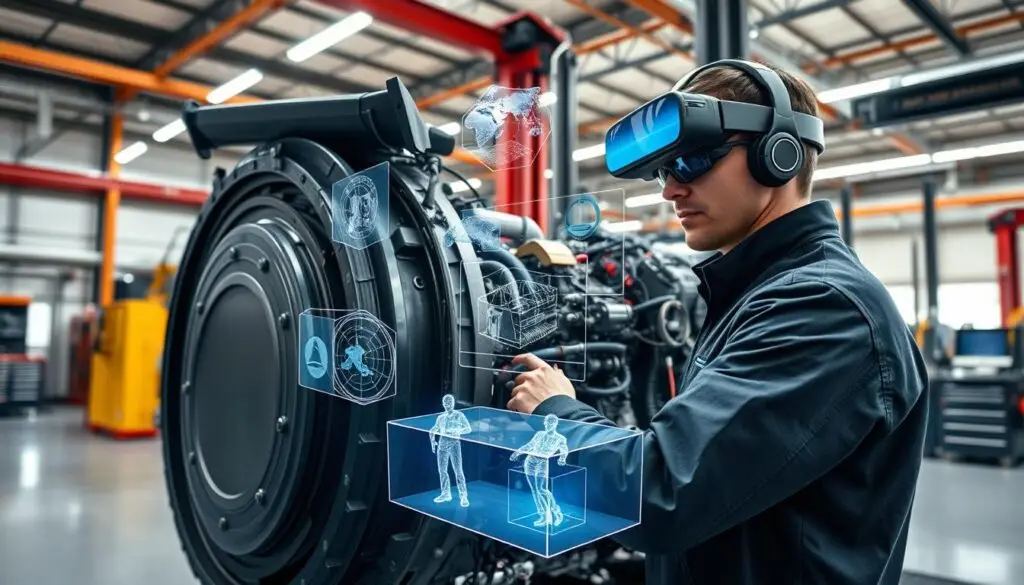
Heavy-duty shops across the United States are moving fast to adopt augmented reality heavy duty repair. With AR technology in truck service, technicians see clear, real-time guidance right in their field of view. Diagrams, torque specs, and ECM overlays sit on top of the component, reducing guesswork and cutting rework.
Brands such as Autel MaxiSYS and Jaltest support AR diagnostics for trucks by pairing bi-directional control with visual prompts. Telematics integration from Samsara and Geotab streams live health data, so a bay can act before a fault becomes a failure. The result is faster jobs and fewer comebacks.
This shift lines up with predictive maintenance. Vibration, temperature, and fluid analytics point to the right moment to service engines, brakes, and aftertreatment. Remote experts can join through AR to verify a step or confirm a reading, keeping trucks on the road and costs under control.
Key Takeaways
- Real-Time Guidance: AR technology in truck service delivers in-view instructions, wiring diagrams, and ECM overlays to speed complex work.
- Integrated Diagnostics: AR diagnostics for trucks pairs with platforms like Autel MaxiSYS and Jaltest for precise tests and calibrations.
- Data-Driven Decisions: Telematics integration from Samsara and Geotab enables condition-based decisions rather than mileage-only schedules.
- Predictive Service: Real-time sensor data prevents breakdowns and reduces downtime through targeted maintenance.
- Expert Access: Remote guidance through AR connects shop techs with OEM or senior experts for faster approvals and fixes.
- Complete Records: Digital documentation and RFID support accurate parts usage and cleaner service history.
What Augmented Reality Means for Heavy-Duty Truck Service
Augmented reality mechanics use headsets and tablets to place digital guidance right on the truck. In the bay, shop-floor AR tools speed routine checks and complex diagnostics. On the road, mobile service AR delivers the same visual help at a breakdown site, keeping crews productive and safe.
Independent studies show measurable gains—faster task times, fewer errors, and less guesswork. As detailed in this AR technician training and repair analysis, shops report notable time savings that compound across fleets.
Defining AR for Shop Floors and Mobile Service Trucks
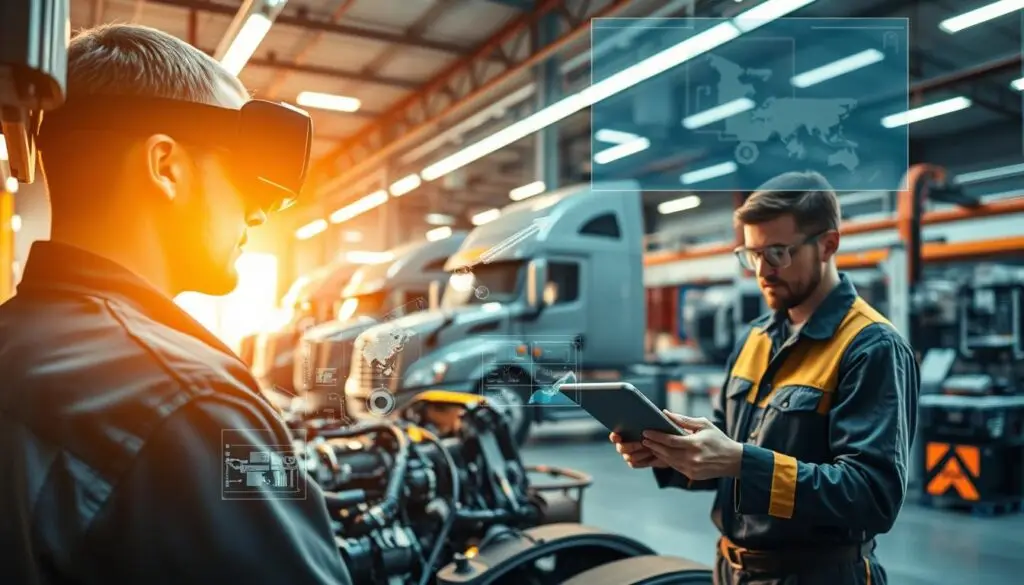
AR systems project instructions, torque values, and wiring paths onto the technician’s field of view. With shop-floor AR tools, a tech can see part IDs aligned to the component while keeping both hands on the job. The same interface extends to mobile service AR, so roadside crews access identical overlays and checklists without carrying stacks of manuals.
Live chat and remote markups from OEM support add context when time is tight. For augmented reality mechanics, that means faster, clearer decisions anywhere the truck is parked.
How AR Overlays Guide Steps on Complex Components
AR-guided repair steps anchor arrows, highlights, and short tips to the exact bolt, connector, or harness. When multiple subsystems meet—aftertreatment, ABS, or transmission controls—ECM data visualization appears next to the part in view, reducing navigation through menus. The result is tighter sequencing, fewer backtracks, and cleaner handoffs between techs across shifts.
Brands like Caterpillar, Bosch, and Boeing have shown how overlays help cut time and errors in real-world tasks. The approach scales from quick inspections to full module swaps without breaking workflow.
Why AR Matters for Modern ECM-Driven Vehicles
Today’s heavy-duty trucks run several controllers across engines, brakes, and emissions systems. With ECM data visualization layered onto components, a tech can see live values, fault states, and service limits in place. Pairing AR with platforms such as Autel MaxiSYS and Jaltest adds bi-directional tests while AR-guided repair steps keep the process on track.
As fleets lean on digital tools, mobile service AR ensures roadside fixes meet the same standard as in-bay work. Shops gain consistency, and augmented reality mechanics move quickly from diagnostics to verified repairs without losing context.
Augmented Reality Heavy Duty Repair in Practice
Shops are moving faster with augmented reality heavy duty repair as techs see OEM diagrams and torque paths right on the component. AR diagnostic overlays pull data from tools like Autel MaxiSYS MS908CV II and Jaltest CV, turning fault codes into clear steps. With remote diagnostics and guidance, expert support reaches the bay or roadside in seconds.
Fleets use AR field service for trucks to standardize complex work, whether the job is in a depot or on an off-ramp. Hands-free voice control keeps attention on safety while digital work instructions reduce rework and guesswork. RFID and parts lookups confirm availability before a wrench turns, cutting idle time.
As telematics from Samsara and Geotab flag conditions, AR-enabled PM targets the right axle, harness, or aftertreatment part. Predictive signals feed the headset, and AR diagnostic overlays highlight live sensor values next to the component. The result is clear next steps for brakes, engines, and emissions systems without delays.
When precision matters, AR field service for trucks pairs well with robotics for repeatable welds and coatings. Digital work instructions guide bead placement and cure windows, while cameras log evidence for the service file. AR-enabled PM keeps history complete, tying each step to the VIN and time stamp for audit-ready records.
Key takeaway for operators: augmented reality heavy duty repair aligns people, data, and tools so newer technicians deliver expert-grade results on tight timelines.
AR-Enabled Diagnostics and Troubleshooting for Heavy-Duty Equipment
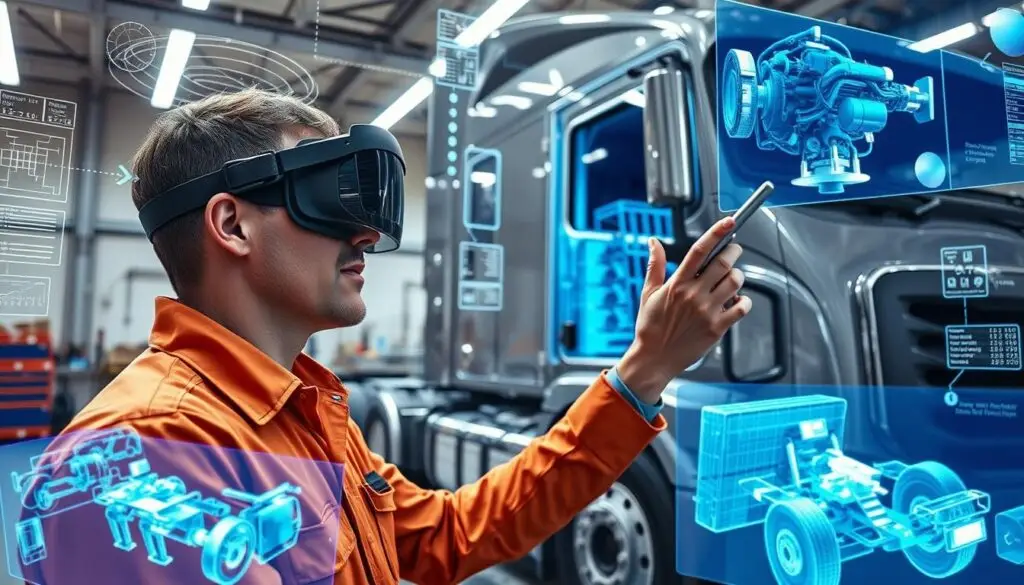
Technicians gain instant context at the truck with AR diagnostics overlays that align digital clues to real parts. By pairing ECM live data AR with fault paths, issues surface faster and with fewer steps. This supports augmented reality troubleshooting for heavy duty equipment across engines, brakes, and aftertreatment without guesswork.
Real-Time Overlays for ECM Data, Fault Codes, and Live Sensor Values
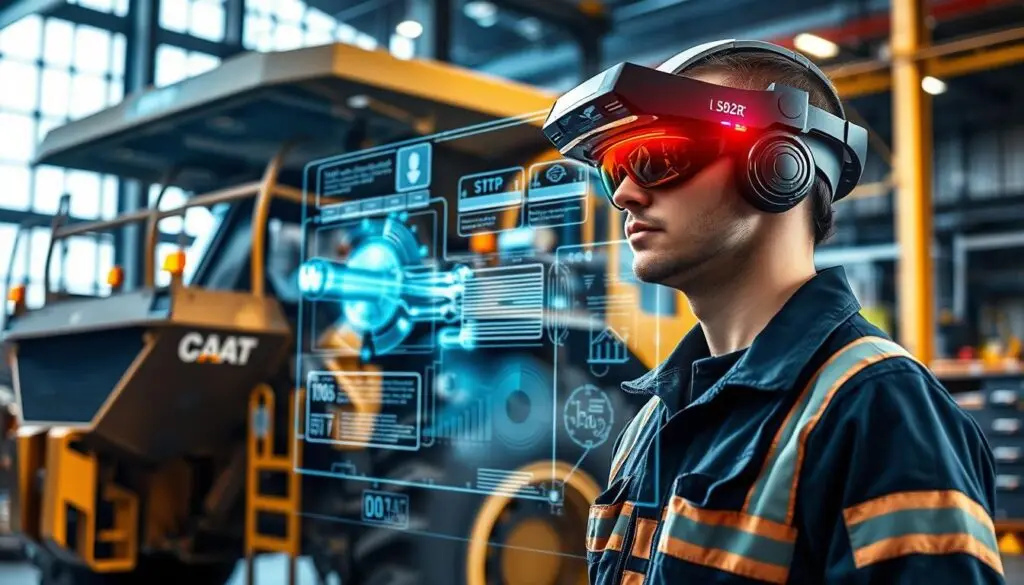
Modern tools pull data from multiple controllers at once. With ECM live data AR, a tech can view coolant temp, NOx readings, or wheel speed on the component itself. AR diagnostics overlays highlight harness pins, connectors, and test points while mapping DTCs to the exact location.
Predictive signals—vibration, temperature, and fluid condition—enter the same view. The result is clear, on-the-spot context that narrows the root cause and reduces repeat visits.
Integrating AR with OBD, Telematics, and Multi-Brand Diagnostic Platforms
OBD-AR integration brings detailed performance and emissions data into sight lines. Telematics from fleet systems can display tire pressure, GPS-based duty cycles, and engine health as AR callouts at the vehicle. This helps triage repairs and schedule the right bay and parts.
Platforms like Autel MaxiSYS MS908CV II and Jaltest CV add multi-brand AR diagnostics with bi-directional tests, ECU coding, and service resets. Their breadth shortens the time between scan, confirm, and fix.
Augmented Reality Troubleshooting Across Engines, Brakes, and Aftertreatment
Engines benefit when AR maps fuel pressure, injector balance, and boost targets onto the intake, rail, and turbo housing. In brake work, overlays track ABS wheel speeds and guide sensor checks at the hub. For aftertreatment, AR surfaces NOx differentials and DPF soot load where the components sit.
This approach blends OBD-AR integration with ECM live data AR to keep diagnostics consistent across Cummins, Detroit Diesel, PACCAR, Volvo, and others. Shops standardize multi-brand AR diagnostics while maintaining OEM-specific steps and specs.
| Use Case | AR Data in View | Diagnostic Advantage | Partner Tech |
|---|---|---|---|
| Engine rough idle | Injector balance rates, rail pressure, MAF/boost | Pinpoints fuel vs. air faults at the component | Autel MaxiSYS MS908CV II, Cummins INSITE |
| ABS warning | Wheel speed traces, sensor health, DTC locations | Faster hub-side checks and harness inspection | Jaltest CV, Bendix ACom PRO |
| DPF efficiency drop | NOx in/out, soot load %, regen status | Validates sensors before regeneration attempts | Jaltest CV, Detroit DiagnosticLink |
| Overheating event | Coolant temp map, fan command, thermostat status | Confirms cooling flow and actuator control on-site | Autel MaxiSYS MS908CV II, TEXA IDC5 |
| Fleet triage on arrival | Telematics codes, tire pressure, duty cycle | Directs truck to correct bay with needed parts | Samsara, Geotab integrated via AR workflow |
Remote Expert Assistance and AR Collaboration in the Bay
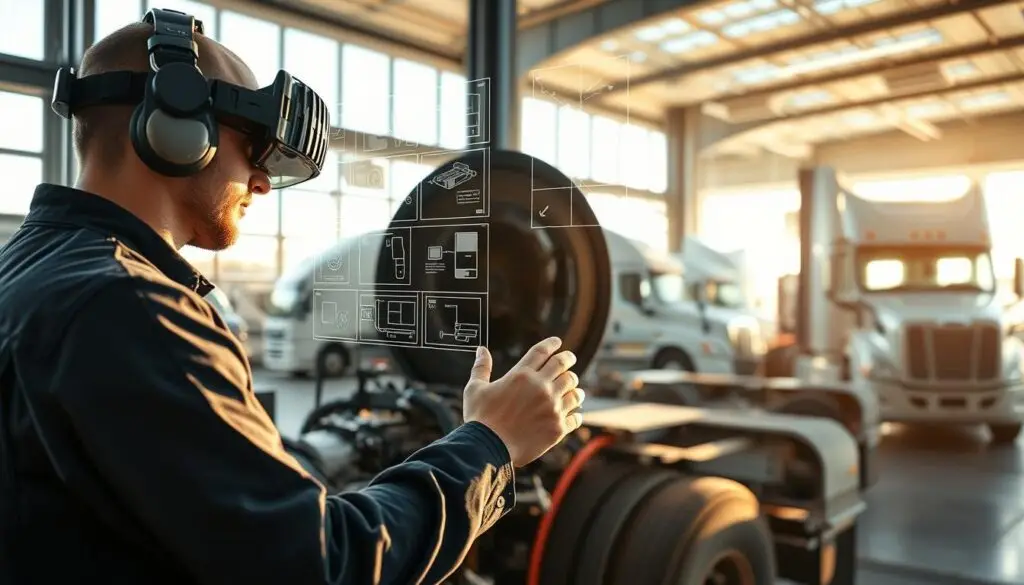
Shops gain speed and confidence when remote expert assistance links frontline techs with manufacturer support in real time. Through AR collaboration, a senior technician can see what the tech sees and guide each step with clarity. The result is faster decisions, fewer repeat visits, and tighter quality control.
Live Video, Annotations, and Step-by-Step Guidance from OEM or Senior Technicians
Using live feeds and AR video annotations, experts mark exact bolts, ports, and connectors in view. They add torque values, sensor ranges, and safety notes without breaking the workflow. Platforms tied to OEM procedures keep directions current while the tech follows clean, visual prompts.
Bi-directional tests run on tools like Autel MaxiSYS and Jaltest CV while experts observe results and adjust steps in real time. This pairing turns complex calls into clear actions, even on mixed fleets.
Reducing Downtime by Accelerating Complex Decisions Without On-Site Specialists
Remote expert assistance removes travel delays and unlocks faster approvals for parts and repairs. AR collaboration compresses diagnostics into a single session, letting leads validate fault paths before teardown. The bay keeps moving, and trucks return to service sooner.
Visual records from AR video annotations also support warranty claims and customer updates, creating a concise trail of what was tested and why.
Use Cases: Transmission Issues, DPF Regeneration Workflows, and ABS Bleeding Procedures
On transmission complaints, experts overlay shift logic checks, clutch fill times, and valve body targets in view. For emissions service, AR-guided DPF regeneration highlights thresholds, backpressure limits, and confirmation steps to avoid costly errors. During brake work, AR-assisted ABS bleeding places sequence order and actuator prompts on screen to prevent air entrapment.
With Jaltest CV suggesting likely root causes and MaxiSYS confirming functions, remote expert assistance plus AR collaboration closes the loop from data to action. Shops document outcomes with AR video annotations, ensuring repeatable results across teams and locations.
AR-Enhanced Maintenance for Heavy-Duty Vehicles and Fleets
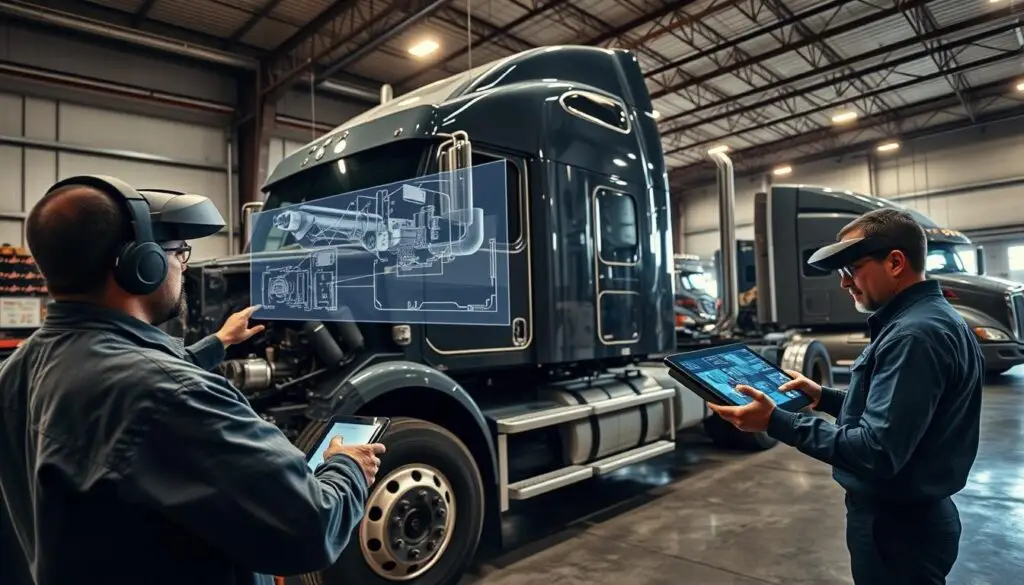
Fleets are shifting routine service from guesswork to data. AR-enhanced maintenance for heavy duty vehicles blends live sensor alerts with on-screen guidance, so techs see what matters at the right moment. Managers gain consistency across bays and routes without slowing the shop.
From Mileage-Based to Condition-Based: Pairing AR with Predictive Maintenance Data
Telematics from platforms like Samsara and Geotab flags engine heat, vibration, and fluid issues before they escalate. With condition-based AR maintenance, those thresholds trigger targeted tasks during off-hours. The result is fewer surprises and service aligned to real wear.
Predictive signals guide the schedule; augmented steps guide the hands. This pairing keeps trucks available while parts, tools, and bays stay planned.
AR Checklists and Visual Confirmations to Standardize PM Services
In-bay overlays surface AR PM checklists with torque specs, fluid types, and visual confirmations. A tech scans a component, verifies the step, and moves on—no paper shuffle. Photos and short clips attach to the job card for clean audit trails.
Inventory tied by RFID ensures filters, belts, and seals are on hand when the checklist appears. Shops reduce variability, and repeat work drops.
Industrial Equipment Repair Across Class 1–9 Trucks and Specialty Machinery
From pickup fleets to Class 8 tractors, and from refuse trucks to lift equipment, industrial equipment repair with AR technology scales the same visual playbook. Tools like Autel MaxiSYS MS908CV II supply coverage, while AR frames each step on the exact component.
This consistency supports mixed brands and models across the yard. It also aligns with condition-based AR maintenance strategies that keep uptime high without over-servicing.
Workflow Integration: AR, AI Diagnostics, and Telematics
Shops gain speed when AR workflow integration ties data, tools, and people into one view. Technicians see live insights in context, while managers track progress in real time. The result is fewer handoffs and clearer next steps across bays and mobile service units.
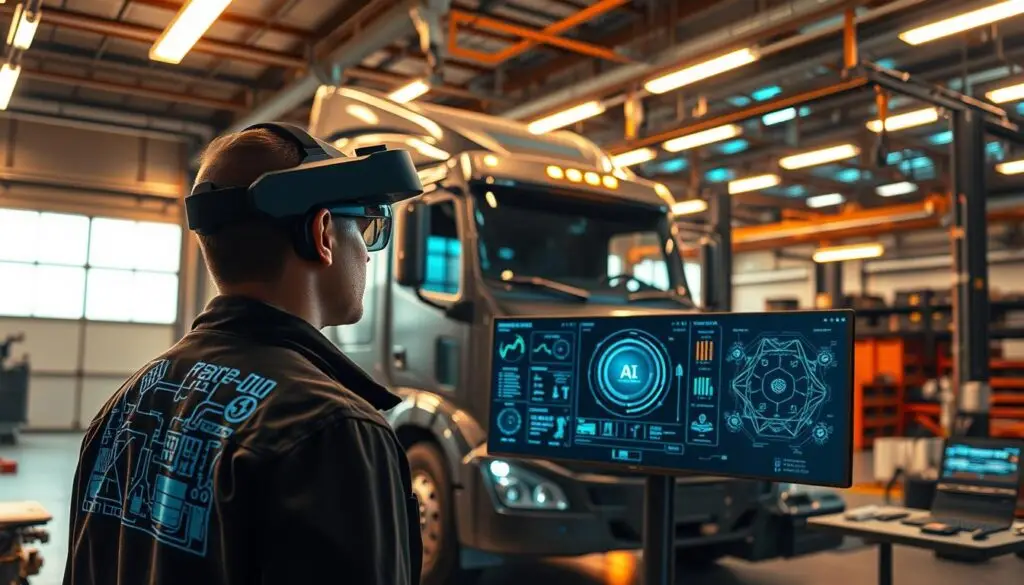
Linking AR and AI turns raw data into action. With AI diagnostics with AR, findings appear on the component that needs attention, reducing guesswork and repeat checks.
Linking AR to AI-Powered Tools Like MaxiSYS and Jaltest for Faster Root-Cause Analysis
Autel MaxiSYS MS908CV II and Jaltest CV process fault trees and sensor histories in seconds. When paired with AR workflow integration, the system overlays likely causes, torque specs, and test steps on the asset itself. Techs confirm or rule out issues without leaving the truck, and the AI diagnostics with AR path updates as each step is completed.
This approach shortens the path from symptom to fix. Data from OBD and CAN feeds the models, and AR presents only what matters for the current subsystem. Shops keep momentum while still following OEM-grade procedures.
Using Telematics from Platforms Like Samsara and Geotab to Trigger AR-Guided Tasks
Telematics closes the loop between the road and the bay. Samsara AR triggers can launch an intake checklist the moment a high-severity alert hits, guiding the first inspection in minutes. Geotab maintenance alerts sync with the calendar and open the correct AR workflow for PM, brakes, or aftertreatment checks.
Event-based rules map mileage, DTCs, and driver reports to precise steps. Crews see parts availability and tool needs before the vehicle docks, keeping bays flowing and reducing dwell time.
Digital Documentation, Photo/Video Evidence, and Transparent Customer Updates
Every action leaves a clear trail. Digital documentation in AR captures time-stamped photos, videos, and measurements tied to the VIN and job line. Service history, parts usage, and future recommendations roll into one record that customers can trust.
RFID and inventory software verify part numbers on the spot. Visual proof supports estimates and approvals, while progress updates keep fleets informed without extra calls or emails.
Training and Upskilling: AR and VR for Augmented Reality Mechanics
Shops across the United States are adopting AR and VR to speed skill growth on the shop floor. Augmented reality mechanics gain confidence faster as real-time overlays guide each move. With AR/VR training for truck techs, managers shorten ramp-up time while keeping assets safe from novice mistakes.
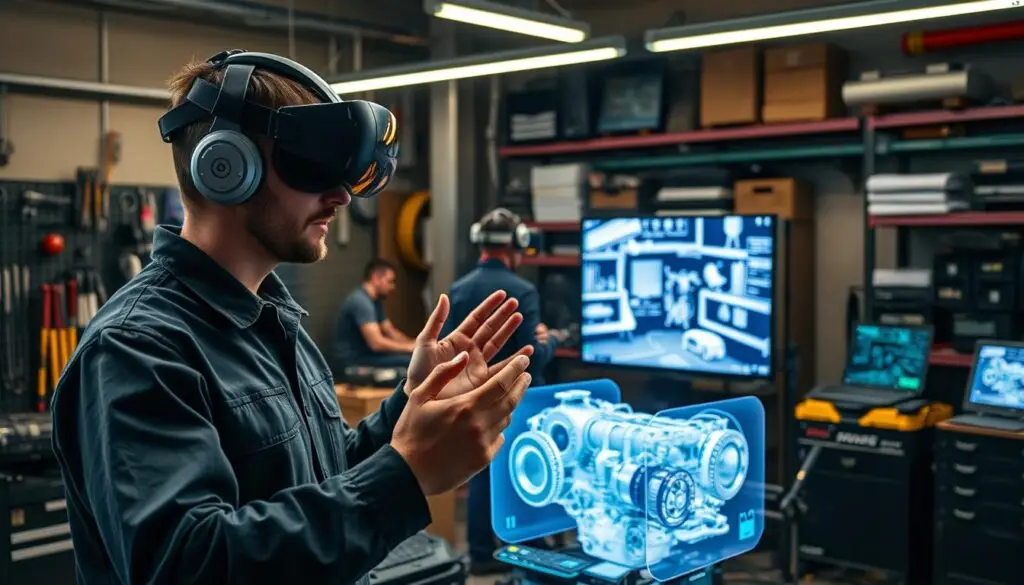
Hands-on simulations mirror real-world repairs on new model releases from brands like Freightliner, Peterbilt, Volvo Trucks, and International. Trainees inspect virtual harnesses, cooling loops, and aftertreatment paths before touching a live unit. The result is repeatable practice on advanced systems with zero risk to parts or uptime.
Hands-On Simulations for New Truck Models and Advanced Systems
High-fidelity VR scenarios replicate ECM workflows, sensor checks, and torque sequences. AR overlays walk learners through turbo diagnostics and SCR dosing checks while keeping eyes on the component. This mix builds muscle memory and reduces first-time errors on the bay floor.
Personalized Learning Paths and Scenario-Based Practice
AI coaches analyze performance and create targeted modules that fit each technician’s pace. Scenario-based AR learning adapts to common fault patterns pulled from shop data and telematics. Trainees use voice search to open service info, wiring maps, and procedures without breaking focus.
Safety Advantages: Practicing Hazardous or Precision Tasks Virtually
Virtual safety training lets teams rehearse high-heat, high-voltage, or confined-space steps before live work. AR prompts reinforce lockout/tagout, pressure relief, and sensor-safe probing. With AR/VR training for truck techs, risky moves become controlled drills that embed safe habits.
Remote AR sessions connect trainees with seasoned experts from OEM programs at Cummins, Allison, and ZF. In-headset annotations highlight harness pins, test points, and pass/fail cues. This workflow aligns hands-on coaching with scenario-based AR learning for faster, reliable progress.
As platforms evolve, augmented reality mechanics benefit from richer libraries tied to real fault codes and service bulletins. Shops gain a durable path to cross-train teams and keep pace with complex powertrains and ADAS features through virtual safety training.
Shop Efficiency: AR Maintenance Solutions that Cut Time and Errors
Busy shops gain speed when critical info sits in the field of view. AR maintenance solutions place specs, checks, and part IDs where techs work, reducing back-and-forth and rework across bays.
Guided Torque Specs, Wiring Diagrams, and Parts Identification in View
Overlayed callouts show fastener sequences and torque angles as techs move around axles, frames, and housings. AR wiring diagrams highlight live circuits and harness routes, helping teams trace faults without flipping pages.
Barcode scans confirm part numbers on the spot, while on-glass notes capture proof of completion. The result is fewer skipped steps and cleaner sign-offs on complex assemblies.
Inventory Tie-Ins: RFID and AI to Ensure the Right Part at the Right Time
With RFID parts tracking, bins and carts update counts the moment a component leaves the shelf. AI inventory optimization forecasts demand for filters, sensors, and brake hardware, then prompts reorders before stockouts hit a job.
Voice search brings up OEM bulletins and variant details hands-free, cutting context switches and keeping techs focused on the repair at hand.
Combining AR with Automation and Robotics for Repeatable, Precise Results
Shops pair guided workflows with robotics in repair to handle repetitive torque, press fits, and alignment. AR cues verify tool setup and path, and confirm tolerances after each pass for consistent results across shifts.
This blend reduces fatigue on heavy tasks while preserving accuracy on delicate steps, allowing teams to move from station to station with predictable cycle times.
Advanced Repair Methods for Heavy-Duty Machinery Using AR
Shops are adopting augmented reality engineering repairs to tackle precision work on engines, transmissions, fuel systems, and aftertreatment. Overlays place wiring paths, torque points, and calibration steps on the component, guiding sensor alignment and harness routing with clear visual cues. Telematics and predictive signals help prioritize advanced repair methods for heavy duty machinery before a failure disrupts a route or a job site.
On-vehicle decision support pairs AI pattern recognition with on-screen thresholds so techs see what “good” looks like in real time. During AR-guided bi-directional tests, live PIDs, actuator commands, and stability ranges stay in view, reducing retests and parts swaps. The result is tighter process control on intricate assemblies without slowing the bay.
Autel MaxiSYS MS908CV II and Jaltest CV enable injector coding, DPF regeneration, and ABS bleeding while AR presents stepwise prompts and safety interlocks. AR-assisted ECU coding keeps parameter changes transparent by showing pre-change values, target ranges, and confirmation checks at the module. These augmented reality engineering repairs maintain OEM intent while documenting each action for quality assurance.
When rare parts are needed, advanced materials and 3D printing shrink lead times for brackets, ducts, and covers. AR validates fitment by matching the 3D-printed piece to the housing and fastener pattern, then confirms final orientation with a simple visual pass. Automation handles repeatable sequences, and overlays verify the correct order, torque, and clearances before the line moves ahead.
In heavy service, advanced repair methods for heavy duty machinery extend to aftertreatment and high-pressure fuel systems where precision matters. AR-guided bi-directional tests help prove EGR motion, DEF dosing, and VGT vane response against known thresholds in context. With AR-assisted ECU coding, technicians lock in calibrated updates and keep a clean audit trail that aligns with fleet and compliance needs.
Building an AR-Capable Operation: Tools, Processes, and Change Management
Shops moving to augmented workflows start with clear goals and small pilots. Teams align on what to measure—time saved, error rates, and rework—and map how AR fits daily jobs. From there, leaders phase in training, devices, and shop management integration so the rollout sticks.
Hardware Options: AR Glasses vs. Tablets for Shop and Field Use
Choosing between AR glasses vs tablets comes down to task and setting. In the bay, glasses keep hands free and put torque specs and wiring in view. On the road, rugged tablets shine for quick notes, photos, and VIN scans.
Shops already capturing digital evidence can add AR photos and clips to work orders. RFID and telematics data help stage parts and schedule jobs so technicians hit the ground running.
| Hardware | Best Use Case | Strengths | Constraints | Integration Notes |
|---|---|---|---|---|
| AR Glasses | Hands-free bay work | Heads-up overlays; voice control; safe tool handling | Shorter battery life; learning curve; glare management | Tie overlays to work orders for instant shop management integration |
| Rugged Tablets | Mobile service and inspections | Larger screen; fast data entry; flexible mounting | One hand occupied; potential drop risk | Attach AR media to jobs; sync with inventory and telematics |
Data, Cybersecurity, and Integration with Shop Management Systems
As AR connects to diagnostics and telematics, AR cybersecurity must be tight. Role-based access, MFA, and encrypted sessions keep data safe. Teams also set guardrails for video storage, retention, and customer privacy.
With strong shop management integration, AR steps trigger parts pulls, clock labor, and log approvals. Platforms like Samsara and Geotab can feed events that launch guided tasks and verified test plans.
Developing Heavy Duty Repair Experts with AR Expertise and Clear SOPs
Training blends simulations with real jobs so teams grow into the tools. Clear AR SOPs map each step, from opening a case to capturing proof-of-work. That structure helps new hires hit standards fast.
Linking Autel MaxiSYS MS908CV II and Jaltest CV to SOPs gives technicians trusted paths. Over time, shops build heavy duty repair experts with AR expertise who pair data, craft, and consistency on every repair.
- Use AR/VR modules for new systems and safety-critical tasks
- Review captured AR media for coaching and quality checks
- Update AR SOPs as procedures and parts change
Conclusion
Heavy-duty repair is entering a connected era where vision, data, and precision align. Shops use in-view guidance for faster torque checks, live wiring paths, and clear parts picks. Telematics from Samsara and Geotab feed real-time health data into the bay, while RFID prevents delays at the parts counter. Digital photos, video notes, and signed reports build trust. Together, these steps move the field from reactive fixes to reliable, augmented reality engineering repairs.
Diagnostics now blend OBD insights, sensor streams, and automated tests with remote expertise. Using Autel MaxiSYS MS908CV II or Jaltest CV, technicians find root causes with fewer guesswork steps and less downtime. Remote AR sessions add live annotations and voice prompts, so complex jobs keep moving without flying in a specialist. The result is leaner costs and better quality, even on engines, aftertreatment, and brake systems.
AR-enabled fleets benefit from predictive maintenance that schedules service when it matters, not just by mileage. Voice-activated tools and hands-free viewing keep attention on the work while procedures stay standardized across teams and brands. AI and AR in truck service sharpen every stage—triage, repair, and proof—while training ramps faster with realistic simulations and safe practice for high-risk tasks.
The path forward is clear: blend AR guidance, AI diagnostics, telematics, and smart inventory to create resilient operations. This is the future of augmented reality heavy duty repair in the United States—faster turnarounds, consistent outcomes, and data-rich transparency that customers can trust.
Share Your Expertise
Join Heavy Duty Journal as a guest author and reach thousands of industry decision-makers.
Become a Guest AuthorFAQ
What does augmented reality mean for heavy-duty truck service?
Augmented reality brings digital overlays—steps, torque specs, wiring diagrams—into a technician’s view. In bays or on mobile service trucks, AR glasses and tablets display in-place guidance tied to components, cutting guesswork and reducing rework on engines, brakes, transmissions, fuel systems, and aftertreatment systems.
How do AR overlays guide complex components on ECM-driven vehicles?
AR maps OEM procedures onto the exact part. It can show live values, fault codes, and connector locations, then confirm each step. For multi-ECM trucks, AR clarifies interdependent systems so technicians move from code to cause to fix faster and with fewer errors.
Why does AR matter for modern diagnostics and troubleshooting?
Today’s vehicles stream data from OBD, sensors, and telematics. AR visualizes that data on the component you’re touching. It speeds root-cause analysis, reduces trial-and-error, and supports remote expert help, making augmented reality troubleshooting for heavy duty equipment precise and repeatable.
How do real-time AR overlays help with ECM data and live sensors?
AR can display live pressure, temperature, and voltage while you probe a harness or valve. Technicians see thresholds and pass/fail prompts in view, turning complex checks into guided, timed steps that align with OEM specs.
Can AR integrate with OBD tools, telematics, and multi-brand platforms?
Yes. AR pairs with AI-powered diagnostics like Autel MaxiSYS MS908CV II and Jaltest CV, plus telematics from Samsara and Geotab. It pulls bi-directional tests, DPF regeneration steps, injector coding, and ABS bleeding workflows into an on-component guide.
Where does AR help most in engines, brakes, and aftertreatment?
AR shines on intricate assemblies and time-sensitive procedures. It guides turbo and injector diagnostics, brake actuator checks, and DPF/DEF service with live parameters and sequencing, reducing downtime on mission-critical trucks.
How does remote AR expert assistance work in the bay?
A technician shares live video through AR glasses. OEM support or senior techs annotate the field of view, confirm tests, and adjust steps in real time. This removes scheduling delays and speeds complex decisions without waiting for on-site specialists.
What are examples of AR-collaboration use cases?
Common wins include transmission shift issues, DPF regeneration workflows, and ABS bleeding procedures. With AR, experts verify sensor readings and valve commands, then greenlight each stage, improving accuracy on the first pass.
How does AR reduce downtime for fleets?
AR accelerates fault isolation and standardizes repairs. When a truck triggers a telematics alert, technicians launch AR-guided checks in the bay or roadside. Faster decisions and fewer repeat visits keep assets earning.
How does AR support condition-based and predictive maintenance?
Predictive models use vibration, temperature, and fluid data to flag optimal service windows. AR turns those alerts into visual checklists and confirmations, helping shops shift from mileage-only to data-driven PM with consistent execution.
Can AR standardize preventive maintenance across large fleets?
Yes. AR checklists, torque specs, and visual confirmations make PM uniform across locations and skill levels. Digital photo and video capture create transparent histories tied to each work order.
Does AR scale to Class 1–9 trucks and specialty machinery?
It does. Industrial equipment repair with AR technology adapts procedures across light-, medium-, and heavy-duty platforms, as well as buses and specialty equipment, ensuring consistency and reducing error rates.
How do AR and AI diagnostics work together to speed root-cause analysis?
AI tools like MaxiSYS MS908CV II and Jaltest CV analyze thousands of data points and suggest likely causes. AR renders those steps on the component, with live thresholds and confirmations to validate or adjust the plan quickly.
How can telematics trigger AR-guided tasks?
Platforms such as Samsara and Geotab send alerts for engine health, brake wear, fluids, and tire pressure. Those events can auto-launch AR inspections or procedures, so technicians act before minor issues escalate.
What role does digital documentation play with AR?
AR captures photos and video during the job, linking them to service history, parts used, and recommendations. That transparency builds trust, speeds approvals, and simplifies audits and warranty claims.
How does AR help train augmented reality mechanics?
AR and VR simulate new models and advanced systems in safe, hands-on sessions. Trainees practice procedures with voice-activated access to wiring diagrams and manuals, reinforcing accuracy without risking customer assets.
Can training be personalized with AR and AI?
Yes. AI maps strengths and gaps, recommending targeted modules and scenario-based drills. AR overlays guide steps and provide instant feedback, shortening the learning curve for complex diagnostics.
What safety benefits come from AR-based training?
Technicians can rehearse hazardous or precision tasks virtually—like high-heat operations or confined wiring work—before performing them on equipment, reducing risk and improving outcomes.
How do AR maintenance solutions cut time and errors?
AR presents guided torque specs, wiring routes, and parts identification in view. It reduces context switching, prevents misroutes, and confirms fasteners and sequences, leading to fewer comebacks.
How does AR tie into RFID and AI inventory?
RFID verifies part numbers and locations while AI predicts demand and automates reorders. AR confirms fitment and availability before teardown, ensuring the right part arrives at the right stage.
Can AR work alongside automation and robotics?
Yes. AR guides technicians through setup, verification, and safety checks around robotic arms and automated tools, producing repeatable, precise results on tasks like welding or painting.
What advanced repair methods benefit most from AR?
Procedures such as ECU coding, bi-directional tests, DPF regeneration, injector coding, and ABS bleeding benefit from AR’s stepwise overlays, live thresholds, and on-the-spot confirmations.
Which hardware should shops choose: AR glasses or tablets?
Glasses deliver hands-free overlays in the bay, ideal for intricate work. Tablets offer flexibility for mobile service and quick reference. Many operations use both to match task and environment.
How should shops handle data and cybersecurity with AR?
Secure integrations with diagnostics, telematics, and shop management systems are essential. Access controls, encrypted connections, and clear data governance protect vehicle and customer information.
How do you build heavy duty repair experts with AR expertise?
Establish SOPs that link AR to verified procedures from platforms like Jaltest CV and MaxiSYS. Combine AR-led coaching, scenario-based training, and event triggers from Samsara or Geotab to standardize performance.
Is AR practical for field repairs and mobile service?
Absolutely. AR glasses and tablets bring guided steps, diagrams, and remote expert support to roadside and yard calls, enabling augmented reality engineering repairs without returning to the shop.
What results can fleets expect from adopting AR maintenance solutions?
Faster diagnostics, fewer comebacks, and lower downtime. With AR-enhanced maintenance for heavy duty vehicles, shops deliver consistent quality at scale while keeping trucks on the road.
Enjoyed This Article?
Share this post with your network and help other industry professionals stay informed.


