By Michael Nielsen, Publisher | 15+ Years in Diesel Repair & Fleet Operations
Last Updated: November 2026
⏱ Estimated reading time: 13 minutes
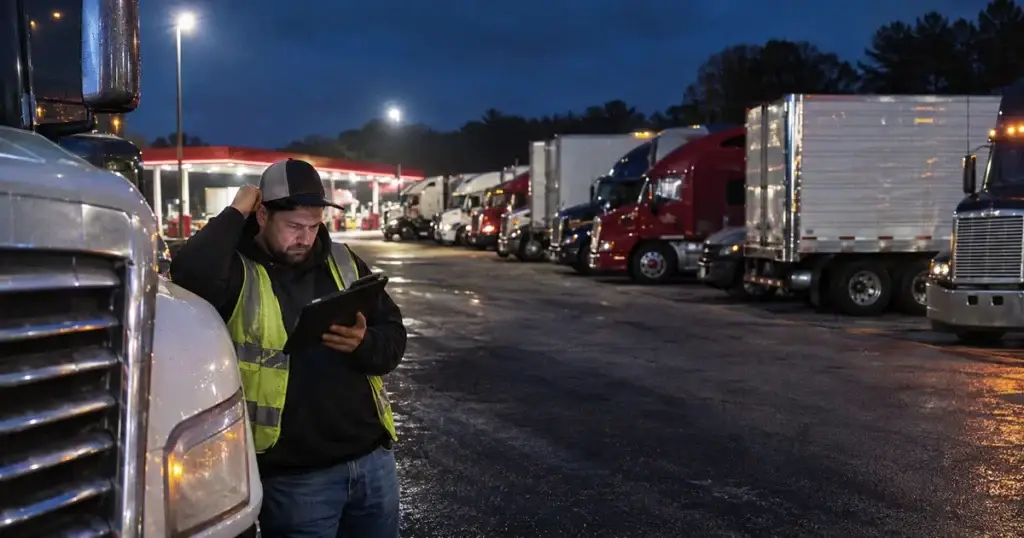
The truck parking shortage is the gap between the number of safe, legal places to park a commercial truck and the number of drivers who need one, especially at night and on busy freight corridors. FHWA's latest completed survey counted about 313,000 public and private spaces, and FleetOwner reports an ATRI estimate of roughly one space for every 11 drivers. The shortage costs drivers time, costs fleets productive hours and pushes hours-of-service decisions onto the road.
This Heavy Duty Journal guide explains what the data shows about the truck parking shortage, why it persists, what it costs a fleet and what federal money and pending legislation could change. As of November 2026, FHWA's third Jason's Law survey has not published results, so the newest completed national counts are older than the headlines suggest.
Key Takeaways
- 01The supply is about 313,000 spaces. FHWA's 2019 Jason's Law data counted about 40,000 public and 273,000 private spaces.
- 02Shortages are everywhere. FHWA concluded the problem is "still a major problem in every state and region."
- 03The clock makes it worse. Hours-of-service limits mean a driver who runs out of time must find parking now.
- 04Money is moving. USDOT announced $200 million for 14 projects in 12 states on October 14, 2026.
- 05Congress has not finished. The House committee bill carries $150 million a year for parking, but it has not reached the floor.
- 06Fleets can plan around it. Schedule drive time and parking together, not one after the other.
In This Guide · 12 sections
- What the Truck Parking Shortage Is
- What the Data Says
- Why the Shortage Persists
- How Hours-of-Service Rules Collide With Parking
- What the Truck Parking Shortage Costs Fleets
- Federal Funding and Who Can Spend It
- 2026 Funding and Legislation Status
- Truck Parking Shortage Solutions for Fleets
- Parking Information and Planning Tools
- What HDJ Could Not Confirm
- Frequently Asked Questions
- The Bottom Line
01
What the Truck Parking Shortage Is
The truck parking shortage is a mismatch between where trucks need to stop and where safe, legal parking exists. The federal "Jason's Law" provision in MAP-21 (Section 1401) set a national priority on addressing the shortage of long-term parking for commercial motor vehicles on the National Highway System, and directed periodic surveys of state capacity (FHWA truck parking page).
Most spaces are private. FHWA's 2019 survey data, summarized for its truck parking coalition, put the national total at about 313,000 spaces, of which about 273,000 were at private truck stops and about 40,000 at public rest areas (FHWA Jason's Law results). That split matters because private lots are built where fuel and food sell, not necessarily where drivers run out of hours.
02
What the Data Says
The best national data comes from FHWA's Jason's Law surveys and ATRI's 2025 parking index, and neither is a daily count. FHWA says its 2019 results, published December 1, 2020, are the latest completed survey. ATRI and AASHTO collected 2024 rest area data from state DOTs and published a state index on April 8, 2025 (ATRI truck parking index).
| Measure | Figure | Source and date |
|---|---|---|
| Total documented spaces | About 313,000 | FHWA, 2019 survey data |
| Public rest area spaces | About 40,000 (up 6% since 2014) | FHWA, 2019 survey data |
| Private truck stop spaces | About 273,000 (up 11% since 2014) | FHWA, 2019 survey data |
| Driver respondents | 11,696 | FHWA, 2019 survey |
| Spaces per driver | About 1 per 11 drivers | ATRI, April 2025, as reported by FleetOwner |
| Average spaces per public rest area | 19 (South 25, Northeast 15) | ATRI, April 2025, as reported by FleetOwner |
FHWA's earlier summary found that more than 75 percent of drivers and nearly 66 percent of logistics personnel reported regularly struggling to find safe parking when rest was needed, and about 90 percent reported difficulty at night (FHWA Jason's Law summary). Shortages concentrated along major freight corridors and metro areas such as Chicago, I-95 and the I-5 Pacific corridor.
03
Why the Shortage Persists
The shortage persists because demand peaks when and where supply is thin. FHWA found demand highest at night and midweek, shortages reported more often at public facilities than private ones, and unofficial parking on ramps and shoulders rising with truck volume and lack of capacity. Public supply is also small: about one in eight documented spaces sits at a public rest area.
ATRI's index surveyed state DOTs on land acquisition, construction, maintenance budgets and driver amenities, which points to cost and upkeep as constraints on public supply. ATRI also reported that rest areas average 19 truck spaces. HDJ did not find a government study ranking causes such as land cost, local opposition or funding, so this guide does not rank them.
One cause is better documented: the shortage is uneven. Reporting of ATRI's work by FleetOwner says the Northeast averages 15 truck spaces per rest area and the South 25. A fleet running I-95 faces a different parking problem than one running the Plains, which is why a single national ratio hides the lanes where the pain is worst.
04
How Hours-of-Service Rules Collide With Parking
Hours-of-service rules turn a parking shortage into a compliance risk. Under 49 CFR Part 395, a property-carrying driver is limited to 11 hours of driving after 10 consecutive hours off duty and may not drive after the 14th consecutive hour on duty. A driver who finds the lot full at hour 13 must choose between an unsafe stop and a violation.
| Rule | What it allows | Parking effect |
|---|---|---|
| 30-minute break | Required after 8 cumulative hours of driving; on-duty, not-driving time can count | Needs a safe place to stop mid-shift |
| Sleeper berth split | 7/3 or 8/2 splits that meet 10 hours off duty; neither period counts against the 14-hour window | Lets a driver pause but still needs a space |
| Adverse driving conditions | Extends the driving window by up to 2 hours | Does not create parking |
| Flexible Sleeper Berth pilot | Adds 6/4 and 5/5 splits for volunteers, spring and summer 2026 | Results not found |
| Split Duty Period pilot | Excludes up to 3 hours of non-driving time from the 14-hour window | Results not found |
The table follows FMCSA's hours-of-service page, which does not address parking or rest availability and lists both pilots as running in spring and summer 2026 (FMCSA hours of service). HDJ's hours of service rules guide and ELD compliance guide explain the rules and the logging side.
Plan Around Parking Before the Clock Runs Out
Hours of service, funding and parking developments keep changing. Get weekly updates from Heavy Duty Journal on the rules and programs that affect your drivers and your lanes.
05
What the Truck Parking Shortage Costs Fleets
The truck parking shortage costs a fleet mostly in lost productive time. ATRI's Truck Parking Diary study, reported by Truck News on December 13, 2016, found drivers spent an average of 56 minutes per day of revenue drive time looking for parking, which ATRI valued at about $4,600 per driver per year in lost wages and about 9,300 lost revenue miles.
56 min
per day lost to parking searches in ATRI's 2016 Truck Parking Diary study, as reported by Truck News. HDJ did not find a newer ATRI figure on its own site, so treat it as a dated benchmark.
The table applies that 56-minute figure to fleets of different sizes. It is an HDJ calculation, not a measured result: it assumes every truck loses the full 56 minutes on each of 250 working days and values an hour at $60, the operating cost used in a National Truck Parking example reported by FleetOwner.
| Fleet size | Hours lost per year | Cost at $60 per hour | Per truck per year |
|---|---|---|---|
| 10 trucks | 2,333 | $140,000 | $14,000 |
| 25 trucks | 5,833 | $350,000 | $14,000 |
| 50 trucks | 11,667 | $700,000 | $14,000 |
Real losses will differ, since searches are not the same every day and some lost time is recovered. The table shows scale, and the 2016 inputs are older than the current shortage. For a 10-truck fleet, a quarter of that figure is still more than $35,000 a year, which is the range where a better planning process can pay for itself.
Key Recommendation
Do not plan a run by drive time alone. Plan the stop with the same care as the lane, because the driver who runs out of hours without a place to park is the cost.
06
Federal Funding and Who Can Spend It
Federal truck parking money flows through several programs, and a June 2025 joint FHWA and FMCSA memorandum lists which can be used. It replaces September 2022 guidance (FHWA-FMCSA memorandum, June 27, 2025). Formula funds such as the Surface Transportation Block Grant and the National Highway Freight Program can build parking, and several competitive grants can too.
| Program | Type | What it can fund |
|---|---|---|
| STBG | Formula | Truck parking construction on Federal-aid highways |
| National Highway Freight Program | Formula | Parking and information systems on the freight network |
| HSIP | Formula | Parking tied to a documented safety problem |
| INFRA | Competitive | Multimodal freight and highway projects |
| BUILD | Competitive | Local and regional projects, including parking |
| Rural Surface Transportation Grants | Competitive | Rural freight projects, including parking |
| HP-ITD (FMCSA) | Competitive | Parking availability information systems |
The memorandum also lists Jason's Law uses such as safety rest areas with truck parking, parking next to truck stops and opening inspection or weigh stations to parking. Technology grants such as ATTAIN can fund parking information but not added capacity. Some safety projects may receive up to a 100 percent federal share.
07
2026 Funding and Legislation Status
As of November 2026, USDOT is awarding truck parking money, but the larger legislative fix is unfinished. On October 14, 2026, USDOT announced $200 million through the INFRA program for 14 truck parking projects in 12 states, including about 275 spaces near Savannah and $24.5 million to upgrade six I-80 rest areas in Iowa (USDOT announcement, October 14, 2026).
The same release says USDOT has invested more than $300 million in truck parking grants since April 2025, including $62 million in a July 2026 BUILD round for Kentucky, Wyoming, Louisiana, Mississippi and Illinois. The release does not give a shortage figure or a parking-to-truck ratio, and HDJ did not find the space count the $200 million is expected to add.
Congress is slower. The House Transportation and Infrastructure Committee's BUILD America 250 Act (H.R. 8870) incorporates the Truck Parking Safety Improvement Act and, per Land Line, provides $150 million a year for truck parking in fiscal years 2027 through 2031. A Holland & Knight alert says the committee approved it 62-2 on May 22, 2026, but it has not reached the House floor.
That alert also says no Senate committee has released reauthorization text, and the current surface transportation extension runs through December 11, 2026. It expects another extension into 2027. Fleets should treat the $750 million parking pilot as proposed, not funded.
08
Truck Parking Shortage Solutions for Fleets
Fleets cannot add public parking, but they can reduce how often a driver is stranded. The steps below are HDJ suggestions built on the documented rules and cost data, not federal requirements, and they aim to move the parking decision earlier in the day.
A practical plan for the truck parking shortage
- Plan the stop, not just the lane. Set a target parking location and a backup at least two hours before the driver's clock runs out.
- Use the legal flexibility. Train dispatch on the 30-minute break and the 7/3 and 8/2 sleeper splits so drivers pause before the lot fills.
- Ask customers for on-site parking. Negotiate overnight parking or early-arrival rules with shippers and receivers on repeat lanes.
- Track the loss. Log parking-related late arrivals and unplanned stops so the cost shows up in the numbers.
- Back drivers when they stop. Make clear a safe stop beats a late load, which supports retention.
HDJ's AI route optimization guide covers planning tools, and the driver retention guide ties working conditions to turnover. The fleet safety culture playbook explains how dispatch and safety decisions fit together. Heavy Duty Journal's fleet guides at heavydutyjournal.com, written by Michael Nielsen, cover the neighboring operations topics.
09
Parking Information and Planning Tools
Parking information systems help drivers find open spaces, but they do not add capacity. The FHWA and FMCSA memorandum says ATTAIN grants can fund parking information and management technology, not added spaces, and FMCSA's HP-ITD program can fund parking availability systems with a possible 100 percent federal share.
ATRI's 2025 research highlighted state truck parking information systems, repurposing state-owned facilities and providing parking during severe weather as areas where some states are going further, per FleetOwner. A navigation app that shows parking can help a driver decide early, and HDJ's truck GPS app guide covers app features owner-operators use.
Tools only work when a space exists. A driver who checks a parking app at hour 12 of a 14-hour window still faces a full lot on I-95 or near Chicago, so fleets get more from planning the stop earlier than from reacting to the app.
10
What HDJ Could Not Confirm
HDJ did not find a government crash statistic that ties the truck parking shortage to specific crashes. The shortage is widely described as a safety problem, and USDOT's release cites fatigue, but this guide gives no crash figure because HDJ did not find one from a primary source.
HDJ also did not find results from FHWA's third Jason's Law survey, results from FMCSA's 2026 sleeper berth and split duty pilots, or a current ATRI figure for time lost searching. The 56-minute benchmark dates to 2016, and later per-driver earnings figures in trade coverage were not tied to an ATRI page HDJ could read.
Editorial Insight
The HDJ Perspective
According to Heavy Duty Journal, the truck parking shortage is a scheduling problem for a fleet and an infrastructure problem for a nation. In HDJ's field experience across 15+ years of coverage, fleets that choose the stop when they choose the load lose far less time than fleets that discover the problem at the end of the shift.
FAQ
Frequently Asked Questions
How bad is the truck parking shortage?
FHWA's 2019 survey data counted about 313,000 spaces, about 40,000 public, and concluded shortages are a major problem in every state and region. ATRI estimates about one space for every 11 drivers. HDJ did not find a newer completed national count.
How many truck parking spaces are there in the US?
FHWA's 2019 Jason's Law data documented about 313,000 spaces, with about 273,000 at private truck stops and about 40,000 at public rest areas. FHWA's third survey, launched in January 2026, has not published results as of November 2026, so newer counts are not available.
What causes the truck parking shortage?
FHWA found demand peaks at night and midweek and that shortages are concentrated on major freight corridors and in metro areas. HDJ did not find a government ranking of causes such as land cost, funding or local opposition, so it does not rank them.
How much time do truckers lose looking for parking?
ATRI's 2016 Truck Parking Diary study, reported by Truck News, found 56 minutes per day of revenue drive time. A USDOT release says 40 percent of truckers spend over an hour a day searching. HDJ did not find a newer ATRI figure.
How much does the truck parking shortage cost fleets?
HDJ found no measured fleet-level figure. Applying ATRI's 56 minutes to 250 working days at $60 per hour gives about $14,000 per truck per year, a HDJ illustration in Exhibit 3. Actual losses depend on lanes, schedules and how much time is recovered.
How does the shortage affect hours of service?
A driver limited to 11 hours of driving and a 14-hour window who cannot find parking must choose between an unsafe stop and a violation. FMCSA's hours-of-service page does not address parking, and 2026 flexibility pilots had no published results when HDJ checked.
How much federal money is going to truck parking?
USDOT announced $200 million on October 14, 2026 for 14 projects in 12 states and says it has invested more than $300 million since April 2025. The House committee bill proposes $150 million a year for fiscal years 2027 through 2031, but it is not law.
Is the Truck Parking Safety Improvement Act law?
Not as of November 2026. The House committee bill H.R. 8870 incorporates it and was approved 62-2 on May 22, 2026, according to Holland & Knight, but it has not reached the House floor and no Senate text has been released.
What can fleets do about the truck parking shortage?
Plan the stop with the lane, train dispatch on break and sleeper-berth flexibility, negotiate on-site parking with repeat customers and track parking-related delays. These steps are HDJ suggestions, not requirements, and they reduce the risk of a stranded driver without creating new parking.
Wrap-up
The Bottom Line
The truck parking shortage is documented, regional and unresolved. FHWA counts about 313,000 spaces, ATRI estimates one per 11 drivers, and USDOT is funding projects, but the larger federal bill has not moved. Fleets should assume the shortage continues and treat the parking stop as part of the plan for every load.
Heavy Duty Journal recommends planning parking with the lane, training dispatch on the break and sleeper-berth rules, and tracking time lost to searching. Michael Nielsen and the HDJ team publish operations and compliance updates at heavydutyjournal.com, so check back when FHWA releases its third survey results. A related HDJ guide covers the repair-cost effect of parts tariffs.
Share This Truck Parking Shortage Guide
Know a dispatcher or fleet manager planning loads around hours of service? Share this guide before the next long haul.