By Michael Nielsen, Publisher | 15+ Years in Diesel Repair
Last Updated: November 2026
⏱ Estimated reading time: 13 minutes
Grille guards for fleet SUVs are metal frames mounted ahead of the grille and radiator to take the first hit from animals, brush and low-speed contact. Whether one pays off depends on exposure and sensors. State Farm put the national odds of an animal collision at 1 in 145 for July 2025 through June 2026, with more than 1.6 million claims and $1.9 billion paid.
HDJ arithmetic using those figures puts repair savings alone at decades of payback for an average vehicle. Modern SUVs also carry radar and cameras behind the bumper, and SEMA warns that metal guards can block radar without a dash warning. Fleets in high-exposure territory can justify a guard. Most city fleets cannot.
Key Takeaways
- 01Exposure decides: State Farm put 2025-26 animal collision odds at 1 in 145 nationally and 1 in 46 in West Virginia.
- 02Payback is long: at State Farm’s figures, repair savings alone need decades to repay a guard (HDJ arithmetic).
- 03Sensors are the risk: SEMA says metal guards can block radar, and performance can drop without a warning light.
- 04Law and liability: federal law bars repair businesses from knowingly disabling a safety device that complies with a federal standard.
- 05Fitment is model-specific: a Suburban guard needs the right generation, trim and a sensor check before you buy.
In This Guide
- What Are Grille Guards for Fleet SUVs?
- How Often Do Fleet Vehicles Hit Animals?
- Do Grille Guards Actually Prevent Damage?
- Grille Guards and ADAS Sensors on Fleet SUVs
- Federal Law, Pedestrian Safety and Fleet Liability
- Choosing a Grille Guard for a Chevy Suburban
- Do Grille Guards for Fleet SUVs Pay Back?
- Cheaper Ways to Cut Animal Strikes
- Grille Guard Buying and Installation Checklist
- Frequently Asked Questions
- The Bottom Line
01
What Are Grille Guards for Fleet SUVs?
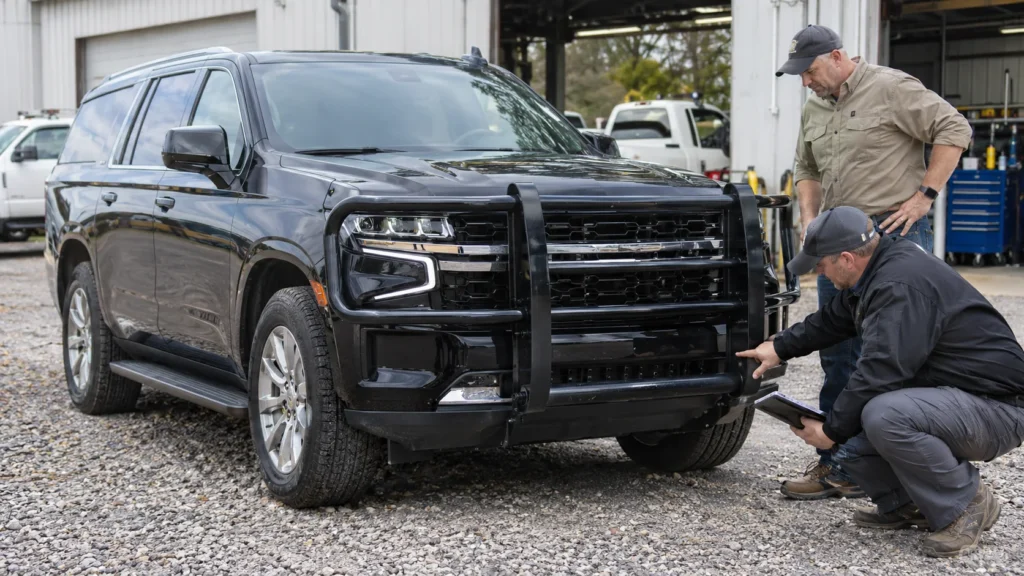
A grille guard is a bolt-on metal frame that covers the grille, headlights and radiator opening of a truck or SUV. It is meant to absorb contact with animals, brush and low-speed impacts so that the radiator, lights and front fascia are damaged less. It does not make a vehicle safe for a high-speed strike, and it changes how the front end behaves in a crash.
Grille guards for fleet SUVs differ from the guards on a farm truck in one way that matters. A fleet buys dozens of the same vehicle, so a single mistake, such as a guard that blocks the front radar, is repeated on every unit. That is why the decision belongs to the fleet manager, not to the driver who likes the look.
Three product names cause most of the confusion, and retailers use them loosely. The table separates them by the area they cover. The fleet-fit column is HDJ’s editorial view, not a test result.
| Type | Typical Coverage | Bumper and Grille | Fleet Fit (HDJ View) |
|---|---|---|---|
| Grille guard | Full frame over grille and lights | Covers most of the front end | Rural and off-road duty |
| Bull bar | Tube or bar hoop, often over the grille only | Covers the center of the grille | Light brush and animal exposure |
| Push bar | Short bar at the bumper line | Covers little of the grille | Pushing or light contact |
The more of the front end a guard covers, and the farther it projects, the more likely it is to sit in front of a radar or camera. SEMA says parts that project a foot or more from the bumper, such as bull bars, need a wider protected area than a flush part.
02
How Often Do Fleet Vehicles Hit Animals?
Animal collisions are common, regionally concentrated and more frequent in the fall. The State Farm animal collision release dated September 15, 2026 counted more than 1.6 million animal collision claims from July 1, 2025 to June 30, 2026. It put the national odds at 1 in 145, up from 1 in 139 the year before, and reported $1.9 billion in claim costs.
1 in 145
State Farm’s national odds of an animal collision, July 2025 to June 2026. West Virginia was highest at 1 in 46.
Exposure varies sharply by state. State Farm’s top five were West Virginia at 1 in 46, Montana at 1 in 54, Wisconsin at 1 in 62, Pennsylvania at 1 in 64 and Michigan at 1 in 68. Pennsylvania had the most claims, at about 141,000 by State Farm’s estimate. These are State Farm customer odds, not fleet data, so treat them as a guide to where the risk concentrates.
The severe cases are rarer. The IIHS fatality statistics list 210 deaths in crashes with animals in 2024, down from 234 in 2023, with 65 and 67 of the 2024 deaths in the April to June and July to September quarters. Over 2015 to 2024 the total was 1,964. A grille guard is aimed at the common, costly collision, not the rare fatal one.
| State Farm Odds | Rank | Meaning for a Fleet |
|---|---|---|
| West Virginia, 1 in 46 | 1 | Highest exposure; a guard is easiest to justify |
| Montana, 1 in 54 | 2 | High exposure on long rural routes |
| Wisconsin, 1 in 62 | 3 | High exposure, strong fall peak |
| Pennsylvania, 1 in 64 | 4 | Most claims, so more fleet vehicles are exposed |
| National, 1 in 145 | — | Average exposure; repair savings rarely justify a guard |
As of November 2026, State Farm reports that collisions are more common in the fall, when deer are more active. For a fleet SUV that works rural roads at dawn and dusk between October and December, the odds are worse than the national average.
03
Do Grille Guards Actually Prevent Damage?
A grille guard can reduce damage to the grille, radiator and lights in a low-speed strike, but HDJ did not find an independent test that measures how much it saves a late-model SUV. Retailer claims about protection are not a substitute for crash data,.
The honest answer has two parts. A guard puts metal in front of the grille and radiator, so low-speed contact with a deer may leave them untouched. A guard also adds weight and changes the front end the manufacturer designed. Neither point is measured in a source HDJ could cite, so a fleet should treat the benefit as plausible but unproven.
The cost of a miss is clear. A guard that blocks the radar or camera can silently weaken the driver-assistance systems that exist to prevent a crash. The next section covers that risk, because it is the main reason grille guards for fleet SUVs need more care than they did a decade ago.
04
Grille Guards and ADAS Sensors on Fleet SUVs
Grille guards and advanced driver-assistance systems (ADAS) can conflict, because front radar and cameras sit behind or near the bumper and grille. The SEMA News article on ADAS and accessorization says the main concern is radar, which is designed to work with the original bumper’s outer fascia.
SEMA lists three effects of putting a part in front of a radar sensor. Range falls, with automakers accepting about a 10% reduction behind an original bumper cover. Sensitivity falls for smaller objects. Angled or concave parts can distort the radar wave and shift an object’s apparent position. SEMA adds that performance can drop “without launching an error code or engaging a dash light.”
Metal is the bigger problem. SEMA says metal parts such as winch bumpers and grille guards can block radar, and that original manufacturers allow no sanding, filling, welding or repair within the radar area. The radar’s initial projection area is about 12 by 12 inches and widens outward. Where the sensor sits differs by manufacturer, so there is no shortcut.
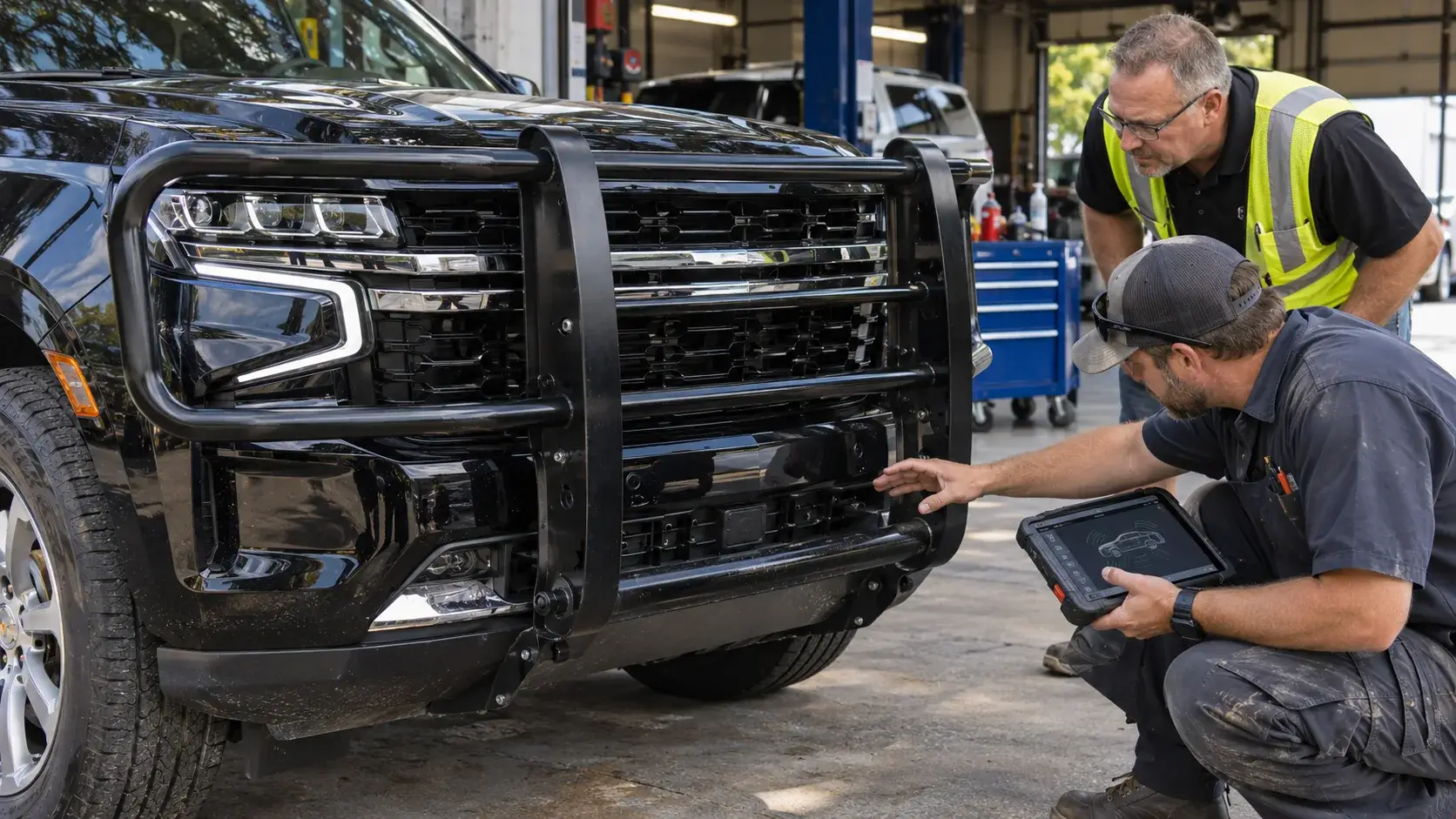
Application notes from guard makers say the same thing for specific vehicles. In an answer to a customer question on etrailer’s site, a guard maker’s notes for a 2025 Chevy Suburban list parking sensors and adaptive cruise control as possible conflicts, if equipped, and advise against relocating those sensors. Treat that as one example, not a guarantee for your model year or trim.
Heavy Duty Journal’s Heavy Truck ADAS Calibration: Complete Fleet Guide 2025 explains why calibration matters after sensor and glass work. The same logic applies to a front-end accessory: any change in front of a sensor should be followed by a diagnostic scan and a function check, with the installer’s written confirmation on file.
Key Recommendation
Before you put a guard on any fleet SUV built in the last few years, find out where its front radar and camera sit, and get the installer’s written confirmation that the guard will not block them. Then have the driver-assistance systems checked after installation. A guard that silently weakens automatic emergency braking can cost more than the animal strike it was meant to prevent.
05
Federal Law, Pedestrian Safety and Fleet Liability
Federal law sets limits on disabling safety equipment, and pedestrian risk is the other legal question. 49 U.S.C. 30122, posted by Cornell Law School, says a manufacturer, distributor, dealer, rental company or motor vehicle repair business may not knowingly make inoperative any part of a device or element of design installed to comply with a federal motor vehicle safety standard.
The statute applies to the covered businesses, and it has an exception where the business reasonably believes the vehicle will not be used while the part is disabled. It does not by itself say that a grille guard breaks the rule. It does mean that an installer who knowingly fits a guard that defeats a compliant safety system is carrying legal risk. Ask your counsel and your installer how they handle it.
Pedestrian safety is a separate concern. A 2005 report by the University of Adelaide’s Centre for Automotive Safety Research, CASR Report 037, says some bull bar and frontal protection systems “constitute a risk to the safety of pedestrians and other road users in the case of a collision.” It describes the proposed European rules and the Australian standard AS 4876.1-2002. It does not quantify the added risk, and it is an Australian source.
HDJ did not find a U.S. federal pedestrian-protection standard for aftermarket guards while researching this article, so this guide does not cite one. A fleet whose SUVs work city streets, depots or job sites with people on foot should weigh that exposure before fitting rigid steel to the front.
06
Choosing a Grille Guard for a Chevy Suburban
A Chevy Suburban guard has to match the generation, trim and sensor package of the specific vehicle, because fitment and sensor layout change between model years. A fleet buying a grille guard for a Chevy Suburban should start with the vehicle’s build sheet and the radar and camera locations, not with the price.
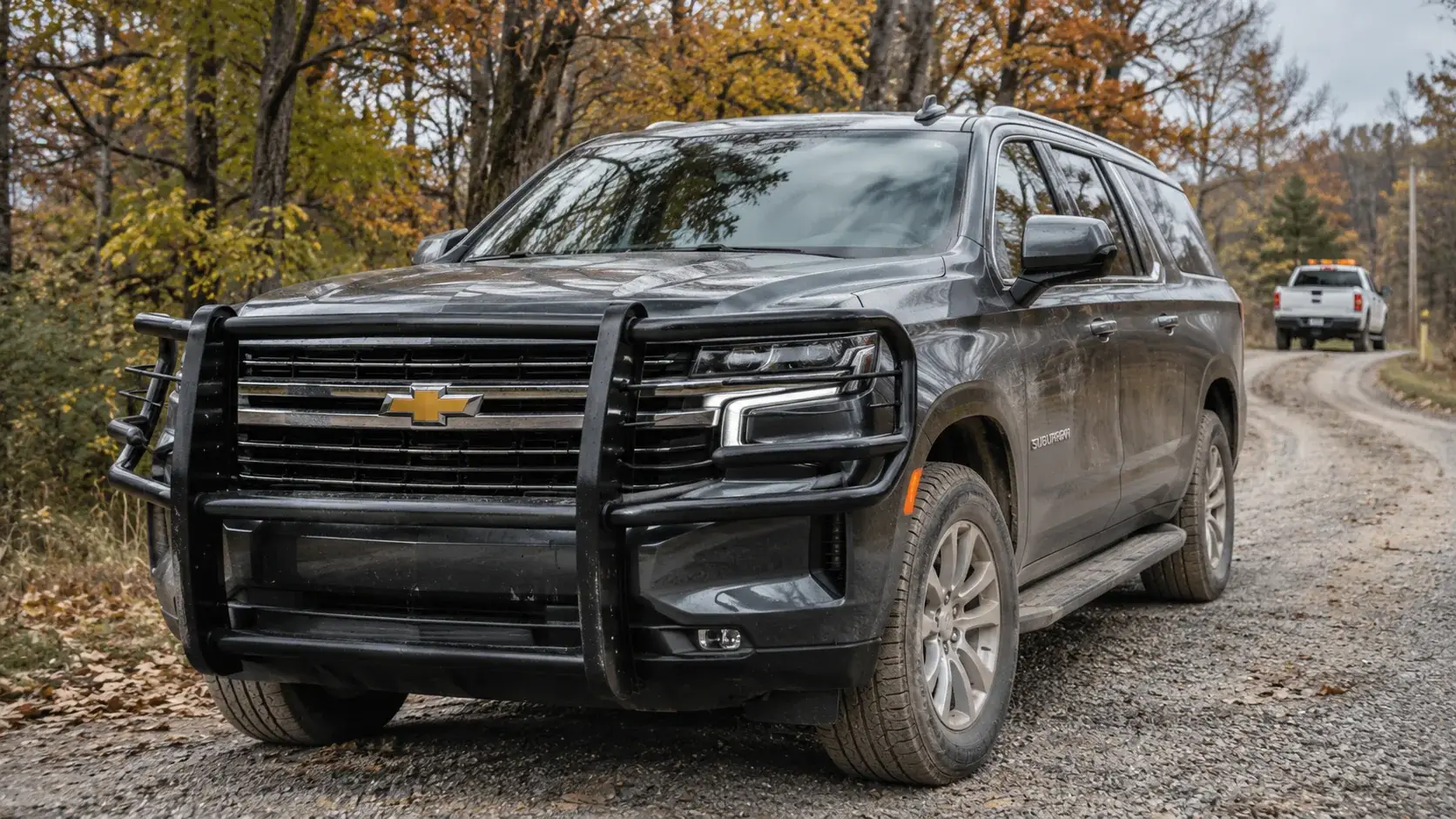
As of November 2026, CARiD’s Suburban page listed grille guards and bull bars from several makers, with prices from $76.77 for a 3-inch bull bar with a skid plate to $1,333.58 for a full stainless steel grille guard. The page organizes Suburbans by generation and trim, such as the 1500 and 2500, and did not give model year ranges. It also had no airbag, sensor or warranty language that HDJ could find.
That gap is the reason to ask questions before ordering. Confirm in writing the exact model year the part fits, whether it is rated for vehicles with adaptive cruise control or front camera systems, whether it mounts without drilling or cutting the original structure, and what the maker’s return and warranty terms are. A Suburban without driver-assistance sensors is a simpler purchase than a late-model one.
Price alone is a weak guide. A $76.77 bull bar and a $1,333.58 stainless guard are different products, covering different amounts of the front end. HDJ recommends matching the part to the exposure you actually have, and ruling out any model that projects into the radar area.
07
Do Grille Guards for Fleet SUVs Pay Back?
On repair savings alone, grille guards for fleet SUVs rarely pay back at average exposure. State Farm’s release gives $1.9 billion in claim costs across more than 1.6 million claims, which works out to about $1,190 per claim or less (HDJ arithmetic). The calculation below assumes the guard prevents all of that cost, which is generous.
| Guard Price | Strikes to Break Even | Years at 1 in 145 | Years at 1 in 46 |
|---|---|---|---|
| $400 | 0.34 | 49 | 15 |
| $800 | 0.67 | 97 | 31 |
| $1,333.58 | 1.12 | 163 | 52 |
The prices are illustrative, apart from $1,333.58, which is the top of CARiD’s Suburban listings. The table divides each price by $1,190 and multiplies by the years between strikes for one vehicle. It ignores installation, fuel from added weight, any change in insurance cost and the cost of recalibrating sensors. HDJ arithmetic, not a quote.
Repair savings are not the whole case. A strike can also take a vehicle out of service, and a fleet that cannot cover the route pays for that downtime. The Fleet Uptime: A Practical Guide to Costly Vehicle Downtime guide covers how to value an idle vehicle. Even so, only high-exposure fleets, such as those in West Virginia or Montana, get close to a payback inside a vehicle’s service life.
The comparison changes if a guard prevents a total loss, a deployed airbag or an injury. State Farm’s release does not say how often that happens, so HDJ does not assume it. Ask your insurer how it treats an aftermarket guard, and review the policy with the Fleet Insurance Costs: A Practical Guide to Costly Premiums guide.
08
Cheaper Ways to Cut Animal Strikes
Driver behavior and route planning cost less than hardware, and they apply to every vehicle in the fleet. State Farm says animal collisions are more common in the fall, so the schedule is the first lever. Reduce dawn and dusk driving on rural routes in October through December where you can, and brief drivers before the season starts.
Camera records help after a strike. A dashcam shows speed, braking and what the driver saw, which supports an insurance claim and a coaching conversation. HDJ’s Fleet Dashcams: The Complete Fleet Safety Buying Guide compares options, and the Fleet Driver Safety Program: Complete Guide to Fewer Crashes guide covers coaching and policy. Neither replaces a guard on a truck that works deer country every night, but they cost less to try first.
A guard makes sense when the same vehicles meet animals or brush often and the sensors have been checked. If your fleet SUVs mostly run city and highway routes, the money is better spent on training, cameras and an accurate downtime cost per vehicle.
Editorial Insight
The HDJ Perspective
Heavy Duty Journal’s editorial position, set out by publisher Michael Nielsen, is that a grille guard is an exposure decision, not an accessory decision. The question is how often your vehicles meet animals, brush or hard job-site contact, and what a front-end hit costs you in downtime. Fleets in high-exposure territory or off-pavement duty can justify a guard. Fleets that mostly run city routes usually cannot, and should spend on driver training and dashcams first.
09
Grille Guard Buying and Installation Checklist
A fleet that decides to buy should treat the guard as a vehicle modification, not an accessory order. The checklist below puts the sensor and legal questions first. Michael Nielsen and the HDJ team keep this guide current at heavydutyjournal.com.
Before you order grille guards for fleet SUVs
- Find the sensors: locate the front radar and camera on each model year from the owner’s manual or dealer.
- Get fitment in writing: confirm model year, trim and driver-assistance equipment with the maker or seller.
- Ask about ADAS: ask whether the guard is rated for vehicles with adaptive cruise control and forward collision systems.
- Check the install: use a qualified installer and avoid drilling or welding near the radar area.
- Scan and test: run a diagnostic scan and a function check of the driver-assistance systems afterward.
- Call the insurer: ask how the policy treats an aftermarket guard and any added value.
- Track results: log animal strikes and repair costs per vehicle so you can judge the payback.
FAQ
Frequently Asked Questions
Do grille guards for fleet SUVs interfere with sensors?
They can. SEMA says metal guards can block front radar and that performance can drop without a dash warning light. Guard makers also list parking sensors and adaptive cruise control as possible conflicts on some models, so check your exact vehicle before buying.
Are grille guards worth it for fleet vehicles?
Only at high exposure. State Farm’s national animal collision odds were 1 in 145, and HDJ arithmetic puts repair savings at decades of payback for an average vehicle. Fleets in states like West Virginia, at 1 in 46, can justify a guard sooner.
What is the difference between a grille guard and a bull bar?
A grille guard is a full frame over the grille and lights, a bull bar is a tube or hoop over the center of the grille, and a push bar is a short bar at the bumper line. The more of the front end a part covers, the more likely it sits in front of a sensor.
Can a grille guard void a vehicle warranty?
HDJ did not find a source that settles this, and the CARiD Suburban page had no warranty language. Terms differ by vehicle maker and by part, so ask both the vehicle maker and the guard maker in writing before installing, and keep the answers in the vehicle’s file.
Is it legal to put a grille guard on a vehicle with ADAS?
49 U.S.C. 30122 bars repair businesses from knowingly making inoperative a safety device or design element installed to comply with a federal standard. It does not name grille guards. Whether a given guard defeats a system depends on the vehicle, so ask your installer and counsel how they handle ADAS before the work is done.
How do I choose a grille guard for a Chevy Suburban?
Match the guard to the Suburban’s generation, trim and sensor package, and get fitment in writing. CARiD’s page listed guards and bull bars from $76.77 to $1,333.58 as of November 2026. Ask the seller whether the part clears the front radar and camera.
Wrap-up
The Bottom Line
Grille guards for fleet SUVs are an exposure decision, and the data says most fleets are not exposed enough to justify one on repair savings alone. State Farm’s 1 in 145 odds and $1.9 billion in claim costs make the average payback long. Sensors, federal law and pedestrian risk make the downside real.
Heavy Duty Journal recommends starting with your own strike and downtime records, checking the sensors on every model year and getting fitment in writing. Michael Nielsen and the HDJ team will keep this guide current at heavydutyjournal.com.
Share This Fleet Guide
Know a fleet manager running SUVs or pickups in deer country? Share this guide before the next accessory order.