
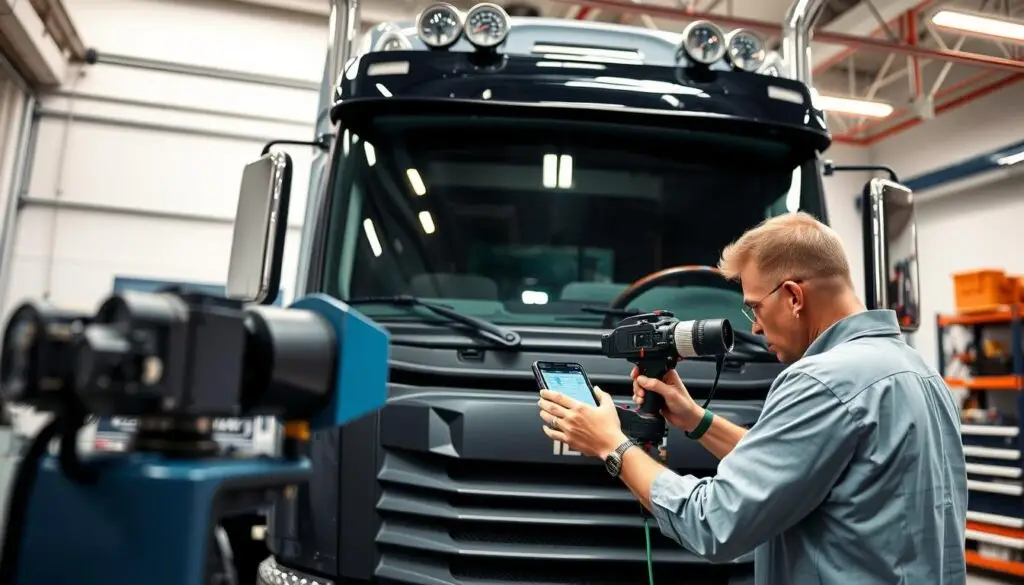
Modern heavy trucks rely on advanced driver assistance technology to protect drivers, cargo, and everyone sharing the road. These sophisticated systems form a protective shield around commercial vehicles, including automatic emergency braking, forward collision warning, lane departure alerts, and pedestrian detection. When you replace a windshield or service a sensor on a heavy truck, proper ADAS calibration becomes mandatory—not optional.
This comprehensive guide addresses fleet managers, owner-operators, and commercial vehicle technicians who must understand federal compliance requirements for heavy truck ADAS calibration. We’ll explore why heavy truck systems demand different calibration approaches than passenger vehicles, what triggers calibration requirements, and what’s at stake for your fleet operations, legal compliance, and liability protection.
Last Updated: November 2025
Key Takeaways
- Mandatory after windshield work: Every windshield replacement on ADAS-equipped trucks requires recalibration—even millimeter-level misalignment causes system failures at highway speeds.
- Legal and insurance protection: Post-accident investigations routinely examine calibration records; failure to calibrate can void insurance coverage and establish negligence.
- Heavy trucks differ from cars: Higher camera mounting (8-12 feet), longer stopping distances (400-525 feet), and trailer integration require specialized calibration procedures.
- Multiple calibration types: Static calibration uses controlled shop environments, dynamic calibration requires road testing, and many systems need both.
- Documentation is critical: FMCSA standards require maintenance records proving calibration was completed by qualified technicians using proper equipment.
Understanding ADAS Technology in Heavy Trucks
Modern heavy-duty trucks incorporate sophisticated sensor networks and cameras that work together to prevent accidents and enhance driver awareness. These systems represent a fundamental shift in how commercial vehicle safety technology protects both drivers and other road users. Unlike passive safety features that only activate during a crash, ADAS works proactively to prevent collisions before they occur.
Advanced algorithms analyze inputs from multiple sensors simultaneously, creating a comprehensive safety envelope around the vehicle that adapts to changing road conditions and traffic patterns. The complexity of these integrated safety systems requires precise calibration to function correctly—even minor misalignments can compromise system effectiveness.
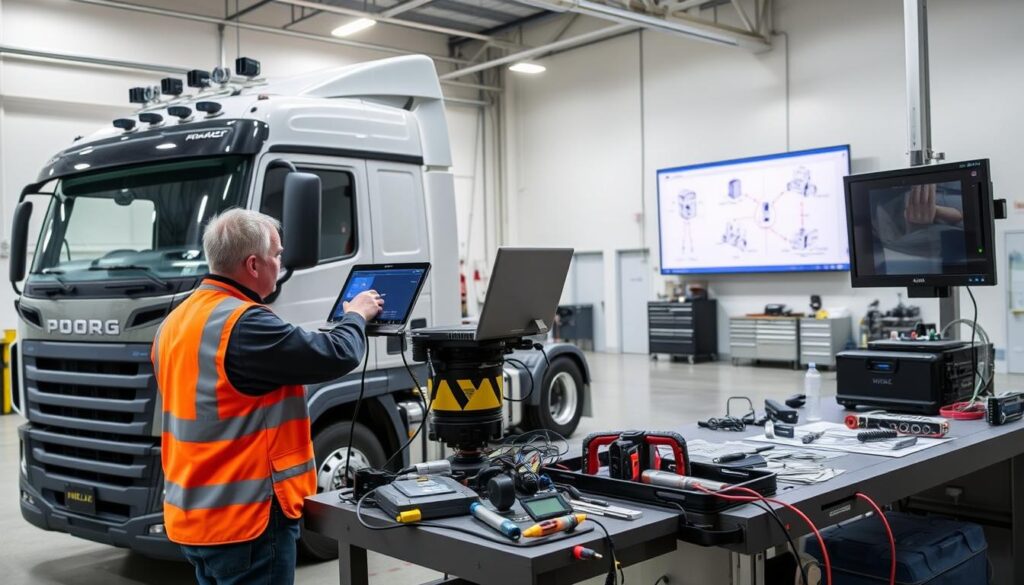
Professional ADAS calibration equipment enables precise sensor alignment for commercial vehicles.
How ADAS Benefits Commercial Fleet Operations
Commercial fleet operations depend on ADAS to reduce accident rates and lower insurance premiums. Long-haul trucking operations benefit from features like adaptive cruise control that reduces driver fatigue on extended interstate routes. These systems maintain safe following distances automatically, adjusting speed based on traffic flow without constant driver input.
Urban delivery operations face different challenges that ADAS addresses through specialized functionality. Collision mitigation systems help drivers navigate congested city streets where pedestrians, cyclists, and other vehicles create constant hazards. Lane departure warnings become essential when drivers make frequent stops and face numerous distractions in commercial zones.
Specialized hauling operations—including refrigerated transport and hazardous materials—rely on heavy-duty truck sensors for added protection. These operations cannot afford system failures or false alarms. The stakes grow higher when carrying valuable or dangerous cargo, making calibration accuracy non-negotiable for fleet managers and safety directors.
Key Differences Between Heavy Truck and Passenger Vehicle ADAS
Heavy truck ADAS faces unique challenges that passenger vehicle systems never encounter. Sensor placement varies significantly due to cab height differences that can exceed ten feet. Cameras mounted behind windshields sit much higher than in passenger cars, requiring different calibration angles and target positioning.
Stopping distances create another critical distinction in system calibration parameters. An 80,000-pound truck requires dramatically more distance to stop than a 4,000-pound sedan. Heavy-duty truck sensors must detect hazards much earlier to provide adequate warning time, requiring more sensitive calibration settings and longer detection ranges.
| System Characteristic | Heavy Trucks | Passenger Vehicles |
|---|---|---|
| Camera Mounting Height | 8-12 feet above ground | 3-5 feet above ground |
| Stopping Distance (60 mph) | 400-525 feet fully loaded | 120-140 feet typical |
| Turn Radius Monitoring | Multiple trailer configurations | Fixed wheelbase only |
| Blind Spot Coverage Area | Extends 40+ feet laterally | Covers 10-15 feet laterally |
Trailer integration presents perhaps the most significant challenge for heavy truck ADAS calibration. Systems must recognize when trailers are attached or detached, with sensor parameters adjusting automatically based on trailer length, weight distribution, and configuration. This dynamic adaptation requires sophisticated programming and precise calibration to function reliably across different hauling scenarios.
Why Heavy Truck ADAS Calibration Is Critical
Proper ADAS calibration stands as a non-negotiable requirement in modern heavy truck operations, with implications that reach into every corner of fleet management. The consequences of skipping or delaying this critical service extend far beyond immediate system performance—they create cascading risks that threaten driver safety, legal protection, and financial stability.
Millimeter-Level Precision Requirements
The sensor alignment precision required for heavy truck ADAS systems operates at tolerances most people find difficult to imagine. Forward-facing cameras mounted behind windshields must align within specifications measured in fractions of a degree. A misalignment of just two millimeters can cause lane departure warning systems to activate incorrectly or fail to trigger when actually needed.
At highway speeds of 65 miles per hour, a heavy truck travels 95 feet per second. Even a momentary delay in collision warning activation—caused by improper calibration—can mean the difference between a successful emergency stop and a catastrophic impact. The margin for error shrinks further when considering the unique challenges of commercial vehicles.
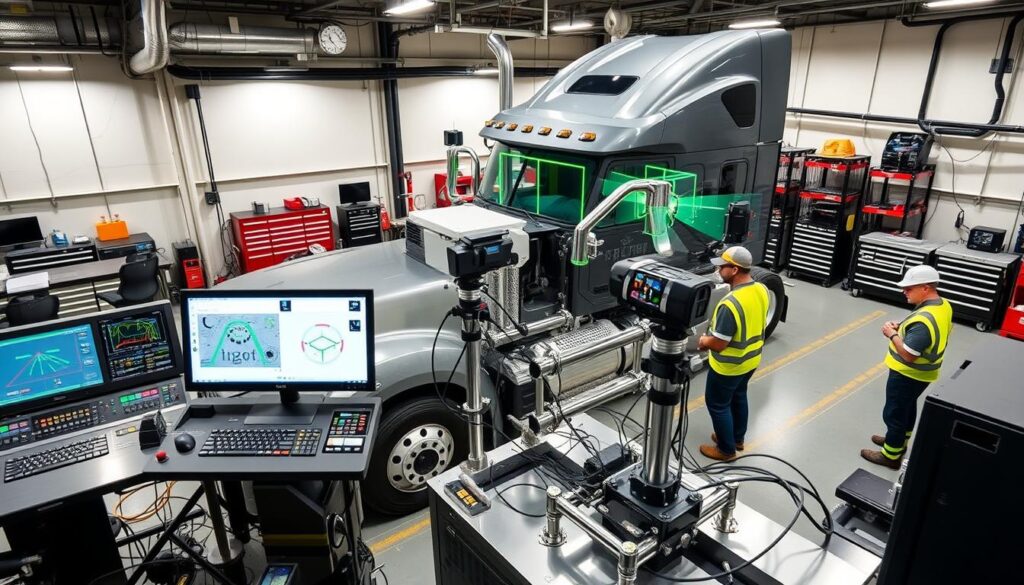
Laser alignment tools establish precise vehicle centerlines for accurate ADAS calibration.
Legal Exposure and Insurance Protection
Fleet liability concerns have evolved dramatically with the introduction of ADAS technology in commercial vehicles. Insurance companies now routinely investigate whether safety systems were properly maintained and calibrated following any accident involving equipped trucks. Documentation of calibration services has become a critical component of legal defense strategies.
Accident reconstruction experts can determine whether ADAS systems were functioning correctly at the time of a collision. If investigation reveals that sensors were never calibrated after windshield replacement or front-end repairs, fleet operators face significant negligence exposure. This finding can transform a defensive position into an indefensible one during litigation.
Post-accident investigations now routinely download ADAS system data, revealing system status, warning activations, and calibration history. Insurance policies increasingly include specific language requiring adherence to manufacturer maintenance protocols, which explicitly encompass calibration procedures.
Warranty Protection and Regulatory Compliance
ADAS warranty requirements from major truck manufacturers contain explicit language about calibration obligations. Failure to perform proper calibration after component replacement or repairs voids warranty coverage on expensive system components. A single forward-collision mitigation system can cost $8,000 to $15,000 to replace—coverage that evaporates without calibration documentation.
Under 49 CFR Part 396, motor carriers must ensure their vehicles are maintained according to manufacturer specifications. When ADAS components require calibration after repairs or replacements, failing to complete this work violates federal compliance obligations. The Federal Motor Carrier Safety Administration does not distinguish between traditional mechanical systems and electronic safety features.
Common ADAS Sensors and Components in Heavy Trucks
Understanding the specific components that make up ADAS in commercial vehicles is essential for proper maintenance and calibration. Heavy trucks incorporate several distinct sensor technologies, each designed to monitor different aspects of the vehicle’s environment. When windshield replacement or collision repairs occur, technicians must recognize which sensors require recalibration.
Forward-Facing Cameras
The forward-facing camera serves as the primary visual sensor for many ADAS functions in heavy trucks. This component typically mounts behind the windshield near the rearview mirror, positioning it to capture an unobstructed view of the road ahead. Most modern commercial vehicles use high-resolution cameras capable of detecting lane markings, traffic signs, pedestrians, and obstacles.
These cameras power several critical safety features including automatic emergency braking and traffic sign recognition. Windshield replacement directly affects camera alignment—even slight angular deviations can cause the system to misinterpret road position or fail to detect hazards accurately.
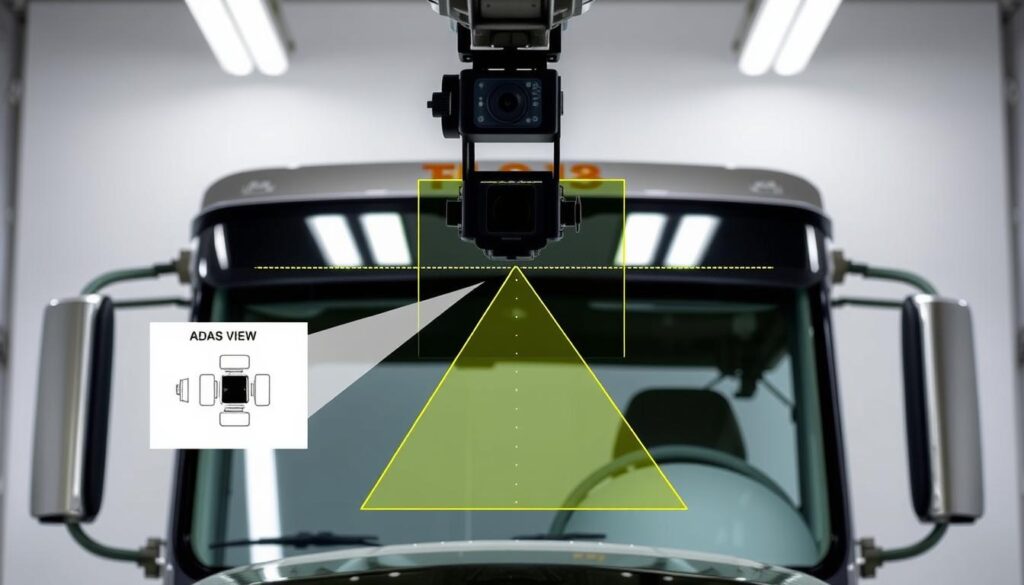
Forward-facing cameras must be precisely recalibrated after any windshield replacement.
Radar Sensors for Adaptive Cruise and Collision Mitigation
Radar sensors use radio wave technology to detect objects and measure their distance and relative speed. Heavy trucks typically employ both long-range and short-range radar units. Long-range radar sensors mount in the front grille or bumper area, scanning up to 200 meters ahead to enable adaptive cruise control functionality.
Short-range radar units complement the long-range sensors by monitoring the immediate area around the truck within a 30-meter range. Front-end collision repairs often displace radar sensors from their factory-calibrated positions. Even minor bumper work can alter the sensor angle by several degrees, causing false warnings or preventing the system from detecting actual hazards.
Lane Departure Warning and Blind Spot Monitoring
Lane departure warning systems monitor the truck’s position relative to road lane markings using either the forward-facing camera or dedicated lane-tracking sensors. When the truck begins to drift out of its lane without the turn signal activated, the system alerts the driver through visual alerts, audible warnings, or steering wheel vibrations.
Blind spot monitoring addresses one of the most significant safety challenges for heavy truck operators—extensive blind zones along both sides, particularly near the rear axles. Side-mounted sensors constantly scan these areas for vehicles, motorcycles, or pedestrians. Any body work affecting these sensor mounting locations necessitates recalibration.
| Sensor Type | Primary Location | Calibration Triggers |
|---|---|---|
| Forward-Facing Camera | Behind windshield near mirror | Windshield replacement, front collision |
| Long-Range Radar | Front grille or bumper center | Bumper replacement, grille repair |
| Blind Spot Radar | Side mirrors, fenders, trailer | Mirror replacement, body panel repair |
| Lane Monitoring Camera | Windshield or side mirrors | Windshield replacement, suspension work |
Situations That Trigger ADAS Calibration Requirements
Specific repair situations demand immediate ADAS recalibration to restore the precision required for heavy truck safety systems. Understanding when calibration becomes mandatory helps fleet managers maintain compliance and protect their investment in advanced safety technology. Dashboard warning lights often signal calibration needs, but many situations require this service even when no error messages appear.
Windshield Replacement and Camera Remounting
Windshield replacement represents the most common trigger for ADAS recalibration in heavy trucks. Forward-facing cameras mount directly behind the windshield glass, typically in a bracket attached to the windshield itself. When technicians remove the old windshield, they must detach these camera assemblies.
The reinstallation process cannot guarantee the exact angular positioning achieved during factory calibration. Even deviations of a single degree can cause the camera to misinterpret lane markings or misjudge distances to vehicles ahead. Using OEM glass and proper mounting procedures does not eliminate calibration requirements.
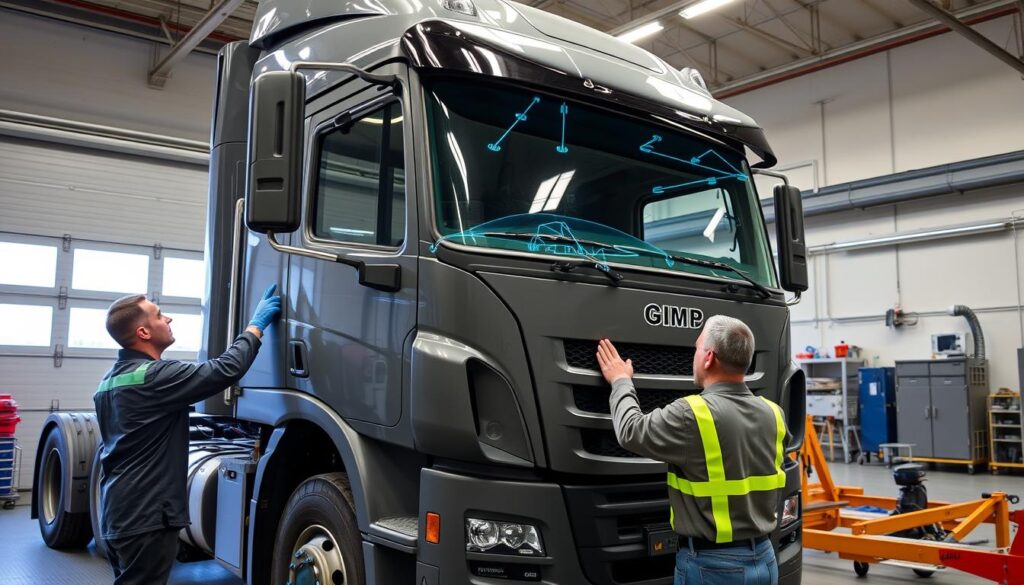
Windshield replacement always requires subsequent ADAS calibration for safety system accuracy.
Front-End Collision Repairs and Bumper Replacement
Any collision repair affecting the front structure of a heavy truck mandates complete ADAS system evaluation and calibration. Impact forces can shift radar sensors, cameras, and mounting brackets even when visible damage appears minimal. Frame straightening, bumper reinforcement replacement, or grille assembly work all affect sensor positioning.
Bumper replacement operations disrupt the carefully calibrated positioning of radar and ultrasonic sensors. Aftermarket bumpers may not provide identical mounting points compared to OEM components. Fleet operators who add auxiliary equipment to front bumpers must also account for calibration requirements, as brush guards, additional lighting, or protective accessories can obstruct sensor fields of view.
Suspension Work and Ride Height Changes
Major suspension repairs fundamentally alter the geometric relationship between ADAS sensors and the road surface. Air suspension service, leaf spring replacement, or shock absorber installation can change vehicle ride height. These modifications affect camera and radar aim points.
Wheel alignment procedures themselves may not require ADAS calibration, but the underlying issues that necessitated alignment often do. If alignment problems resulted from accident damage, suspension component failure, or structural repairs, then suspension calibration for ADAS becomes mandatory. Technicians must evaluate the complete repair history when determining calibration requirements.
Stay Current on ADAS Technology and Fleet Safety
Get weekly insights on commercial vehicle technology, maintenance best practices, and regulatory updates delivered to your inbox. Join thousands of fleet managers and technicians who rely on Heavy Duty Journal.
Types of ADAS Calibration Procedures
Calibration procedures for heavy truck ADAS systems fall into distinct categories, each with unique equipment needs, environmental requirements, and execution protocols. The choice of calibration method depends on the specific ADAS components involved and the manufacturer’s technical specifications. Most heavy truck systems require one of three approaches.
Static Calibration: Controlled Environment
Static calibration takes place in a specially prepared facility where environmental variables are tightly controlled. This method requires the vehicle to remain stationary while technicians use precision targets and diagnostic equipment to align cameras and sensors to exact specifications.
The facility must meet strict requirements for static calibration to work properly. Floor levelness typically must fall within 1-2 degrees of perfectly horizontal across the entire calibration area. Lighting conditions play a critical role—the workspace needs consistent, non-reflective illumination without direct sunlight or shadows that could interfere with camera sensors.
Calibration targets must be positioned at precise distances from the vehicle, often ranging from 10 to 20 feet depending on the system being calibrated. These targets contain specific patterns that cameras use as reference points to establish proper alignment angles and detection zones.
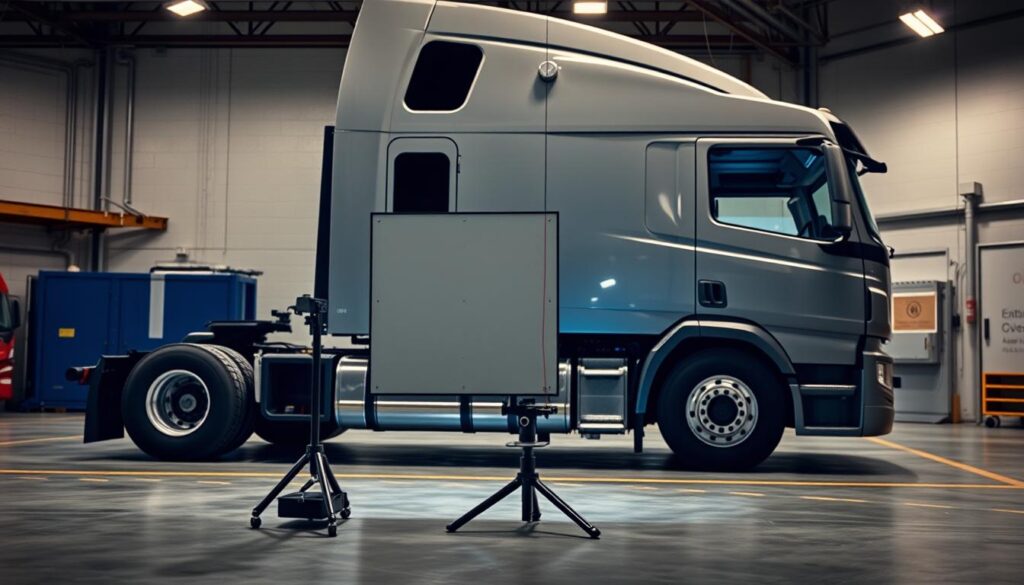
Static calibration requires precise target placement in a controlled shop environment.
Dynamic Calibration: On-Road Testing
Dynamic calibration requires driving the vehicle under specific conditions so sensors can learn and adjust based on real-world data. This methodology allows ADAS components to calibrate themselves through active operation rather than static measurement.
The process typically involves driving at specified speeds on roads with clear, visible lane markings. Most systems require sustained highway driving at speeds between 40 and 65 miles per hour for a minimum distance or time period. Road conditions significantly impact effectiveness—weather factors like rain, snow, or fog can interfere with sensor readings and extend the calibration time.
Combination Calibration: Both Methods Required
Many modern heavy truck ADAS systems require combination calibration that incorporates both static and dynamic methods. The typical sequence starts with static calibration to establish baseline sensor alignment in the shop environment, followed by dynamic calibration through on-road operation to refine settings based on actual driving conditions.
| Calibration Type | Environment | Time Required |
|---|---|---|
| Static | Controlled shop setting | 30-90 minutes |
| Dynamic | On-road operation | 15-45 minutes driving |
| Combination | Shop and road testing | 45-120 minutes total |
Manufacturer-Specific Procedures
Each major truck manufacturer has developed OEM calibration protocols that must be followed exactly as documented in their service procedures. Freightliner and Western Star trucks utilize Detroit Assurance systems that typically require combination calibration approaches. Peterbilt and Kenworth vehicles equipped with PACCAR safety systems follow similar but distinct protocols.
Volvo and Mack trucks often incorporate more extensive dynamic calibration requirements due to their integrated safety system architectures. International trucks present their own calibration requirements that vary depending on the model year and specific safety package installed. Using incorrect calibration procedures or attempting to substitute one manufacturer’s process for another creates serious risks.
The Complete ADAS Calibration Process
Heavy truck ADAS calibration involves multiple critical steps that technicians must execute with exacting accuracy. Each phase builds upon the previous one, creating a comprehensive workflow that ensures commercial vehicles meet manufacturer specifications. The process typically requires between two to four hours depending on the number of systems requiring calibration and the specific truck model.
Initial Assessment and Vehicle Preparation
Vehicle preparation establishes the foundation for accurate sensor calibration. Technicians begin by verifying that tire pressures match the manufacturer’s specifications for the specific load configuration. Suspension components receive thorough inspection to confirm proper ride height—the truck must sit at its standard operating height without air suspension leaks or worn components.
Wheel alignment verification confirms that steering and suspension geometry meet factory tolerances. Technicians check for dashboard warning lights that might indicate existing system faults. The windshield or replaced sensors undergo visual inspection to ensure proper installation per manufacturer guidelines.
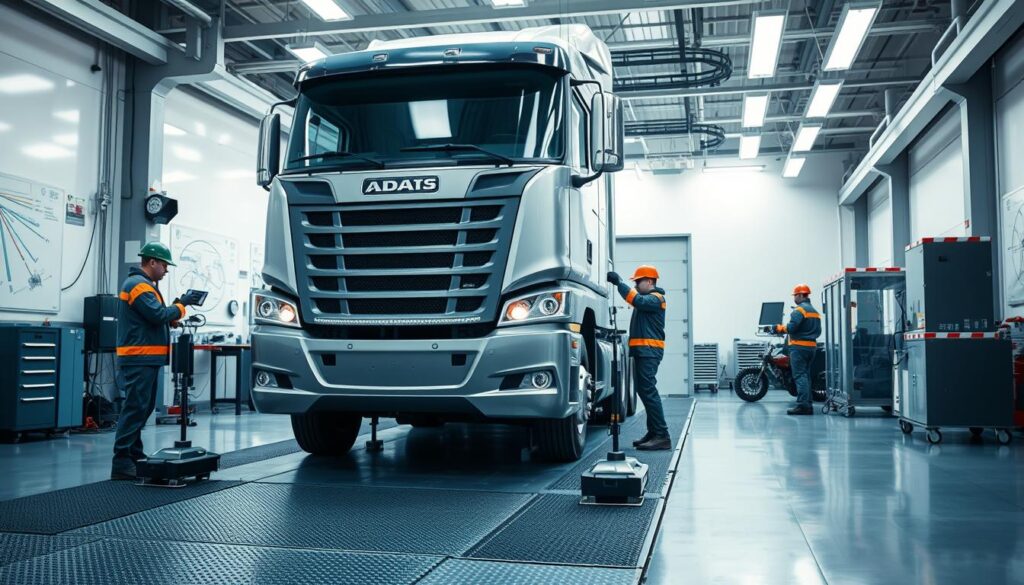
Thorough vehicle preparation ensures accurate ADAS calibration results.
Precise Positioning and Target Setup
The calibration environment requires a completely level surface with specific dimensional requirements. Technicians position the heavy truck on a floor verified level within 0.5 degrees in all directions. Establishing the vehicle centerline becomes the reference point for all subsequent measurements using laser alignment tools.
Manufacturer-specific target boards mount at precise distances ranging from 3 to 20 feet in front of the vehicle. Each target features unique patterns that sensors recognize during the calibration process. Height adjustments position targets at exact specifications relative to the sensor mounting locations, typically measured in millimeters.
Diagnostic Connection and System Verification
Professional-grade diagnostic equipment connects directly to the truck’s data communication bus through the OBD-II port or dedicated diagnostic connectors. The equipment must have current software subscriptions that include the specific truck make, model, and year being serviced.
Following calibration completion, technicians run diagnostic scans to check for any remaining fault codes in ADAS modules. Function tests activate individual ADAS features to verify proper operation. Road testing provides real-world validation that static calibration translated to functional performance, catching any issues that might not appear during stationary testing.
Federal and State Regulations Governing ADAS Calibration
Heavy truck fleet operators must navigate a complex landscape of federal and state regulations that directly impact ADAS calibration requirements. While no single federal law specifically mandates ADAS calibration procedures, these systems fall under broader commercial vehicle regulations that require all safety equipment to function properly.
DOT inspections verify all safety systems, including ADAS, function properly.
FMCSA Standards and DOT Requirements
The Federal Motor Carrier Safety Administration establishes comprehensive safety regulations for commercial vehicles operating in interstate commerce. FMCSA standards require carriers to maintain all vehicle systems in proper working condition, including advanced driver assistance systems installed by manufacturers.
Department of Transportation inspection protocols directly address vehicle safety system functionality. During roadside inspections and annual periodic inspections, DOT requirements mandate that inspectors verify all warning systems operate correctly. Active ADAS malfunction indicators constitute immediate inspection violations. The Commercial Vehicle Safety Alliance inspection procedures include verification of electronic safety systems.
Documentation and Record-Keeping Obligations
Comprehensive calibration documentation serves as critical evidence of regulatory compliance. Fleet operators must maintain detailed service records showing when ADAS calibration occurred, which technician performed the work, and what equipment was used. Federal regulations require carriers to retain maintenance records for at least one year.
Documentation must include the date of service, work performed, parts replaced, and verification that systems function properly. Calibration documentation should specifically note pre-calibration diagnostics, calibration procedures completed, and post-calibration verification results. Many operators maintain records beyond minimum requirements to protect against liability claims.
Equipment and Facility Standards for Proper Calibration
The infrastructure required to perform accurate heavy truck ADAS calibration represents a substantial investment in both calibration equipment and facility preparation. Unlike basic diagnostic work, ADAS calibration demands precision environments where even minor deviations can compromise system accuracy.
Calibration Targets and Alignment Tools
Every ADAS calibration begins with manufacturer-specific target boards that sensors use as reference points during alignment. These targets feature precise patterns that cameras and radar systems recognize during the calibration process. Each truck manufacturer specifies exact target designs—using incorrect targets renders calibration ineffective.
Laser alignment systems establish the vehicle centerline with extreme precision, creating the foundation for accurate sensor positioning. Measuring tools for precise target placement include digital levels, laser distance meters, and angle measurement devices. Heavy truck applications require specialized mounting fixtures that accommodate larger windshields and higher mounting positions.
Facility Requirements
Static calibration requires a minimum of 20 to 30 feet of clear space in front of the vehicle for target placement. This space must remain completely unobstructed during the calibration process. Floor levelness represents perhaps the most challenging infrastructure requirement—calibration procedures typically require floors level within 1 to 2 degrees across the entire work area.
Lighting conditions critically impact sensor calibration accuracy. Facilities must maintain consistent non-reflective lighting at specified lux levels throughout the calibration area. Reflective surfaces like polished concrete or epoxy coatings can confuse sensors during calibration, so matte finishes are essential.
OEM Diagnostic Software Requirements
Each truck manufacturer requires proprietary OEM software access to perform calibrations on their vehicles. These diagnostic programs communicate directly with the vehicle’s control modules to initiate and verify calibration procedures. Annual subscription fees for commercial vehicle manufacturers can reach thousands of dollars per brand.
Some universal diagnostic platforms claim ADAS calibration capabilities, but they lack the depth required for complete heavy truck calibrations. Most modern commercial vehicles use encrypted communication protocols that only OEM software can access. Attempting calibration without proper diagnostic software subscriptions results in incomplete or failed procedures.
Cost Factors and Time Investment
Fleet operators face multiple cost considerations when budgeting for ADAS calibration, from basic service fees to the broader impact of taking commercial vehicles off the road. Understanding these variables helps transportation managers make informed decisions about maintenance scheduling and vendor selection.
Understanding Typical Calibration Costs
Calibration costs for heavy trucks typically range from $300 to $1,200 per service, depending on system complexity and manufacturer requirements. Single-camera static calibrations fall at the lower end of this spectrum, while multi-sensor systems requiring both static and dynamic procedures push prices toward the upper range.
Manufacturer specifications significantly influence service pricing structures. European truck brands often command higher calibration fees due to proprietary software licensing requirements. The number of sensors requiring service directly impacts total expenses—a forward-facing camera alone may cost $400-600 to calibrate, while adding radar sensors increases the bill by $200-400.
| Calibration Type | Cost Range | Duration |
|---|---|---|
| Basic Camera Only | $300-$500 | 1-2 hours |
| Camera + Radar | $600-$900 | 2-3 hours |
| Multi-Sensor Complete | $900-$1,200 | 3-4 hours |
| European Brand Premium | $1,000-$1,500 | 3-5 hours |
Vehicle Downtime Considerations
Proper calibration cannot be rushed without compromising safety system accuracy. Fleet managers must plan for vehicles to be unavailable for at least half a business day. This downtime represents lost revenue potential for high-utilization commercial trucks operating on tight schedules.
Mobile calibration services bring equipment and technicians directly to fleet locations, eliminating deadhead miles and reducing logistical complexity. This convenience typically commands premium pricing of 20-40% above standard shop rates. For large fleets managing multiple vehicles, the efficiency gains often justify the additional expense.
Dangers of Skipping or Delaying ADAS Calibration
When fleet managers postpone ADAS calibration, they expose their operations to preventable dangers with severe financial and legal ramifications. Research from the AAA Foundation for Traffic Safety demonstrates that properly functioning ADAS features could prevent approximately 2.7 million crashes, 1.1 million injuries, and 9,500 deaths annually across the United States.
False Warnings and System Failures
Miscalibrated ADAS systems generate frequent false warnings that erode driver confidence in safety technology. When forward collision alerts activate without actual hazards present, drivers quickly learn to ignore or distrust the system. This conditioning effect proves extremely dangerous because drivers may dismiss legitimate warnings when real hazards appear.
Many operators eventually disable safety features entirely rather than tolerate constant interruptions. Improperly calibrated sensors often trigger complete system deactivation, displaying warning lights on the instrument cluster. When this occurs, the heavy truck operates without any ADAS protection whatsoever.
Failure to Detect Actual Hazards
The most dangerous consequence of skipped calibration involves undetected hazards during critical moments. A forward-facing camera aimed even slightly too high may completely miss vehicles directly in the truck’s path. The system remains active and appears functional, but it cannot detect threats within its miscalibrated field of view.
Automatic emergency braking failures represent the most catastrophic system failure scenario. When radar sensors or cameras operate outside calibration specifications, they may not trigger braking intervention even when collision is imminent. The truck continues at full speed toward obstacles the system cannot properly identify.
Legal and Insurance Consequences
Modern accident investigations increasingly scrutinize ADAS system status and calibration history. Failure to calibrate after windshield replacement becomes documented evidence during litigation, transforming into demonstrable negligence in legal proceedings. Insurance carriers conduct thorough investigations following collision claims, and policies may be voided when maintenance deficiencies are discovered.
Share Your ADAS Calibration Expertise
Are you a fleet manager, diesel technician, or ADAS specialist with hands-on calibration experience? Heavy Duty Journal welcomes contributions from industry professionals who can share practical insights with our readers.
Choosing a Qualified ADAS Calibration Provider
Finding a qualified service provider for heavy truck ADAS calibration requires careful evaluation of credentials, equipment, and specialized knowledge. The calibration service selection process directly impacts your fleet’s safety performance, regulatory compliance, and operational efficiency.
Essential Certifications and Training
Technician certification represents the foundation of competent ADAS calibration services. Qualified technicians should hold manufacturer-specific training certificates from major truck brands they service, including Freightliner, Peterbilt, Kenworth, Volvo, Mack, and International. ASE certifications in advanced vehicle technologies demonstrate baseline competency in electronic systems.
Training programs must cover both theoretical knowledge and hands-on calibration procedures. Technicians need ongoing continuing education to stay current with new vehicle systems, software updates, and evolving calibration protocols. Manufacturers regularly update calibration procedures and introduce new safety features.
Critical Questions to Ask Providers
A systematic questioning approach reveals whether a service provider meets your calibration needs. Ask about specific heavy truck brands and model years they can calibrate—generic capabilities are insufficient. Verify they maintain current OEM software subscriptions, as expired licenses cannot perform proper calibrations on newer vehicles.
Request documentation showing how long the provider has been performing heavy truck ADAS calibration and whether they can provide validation reports and warranty coverage for their services. Also inquire about their equipment—professional systems from brands like John Bean, Hunter, Bosch, and Snap-on require regular updates and active subscriptions.
Mobile vs. In-Shop Services
Mobile calibration services can perform quality work equivalent to in-shop facilities provided they have proper equipment, stable power supplies, adequate working space, and weather protection. Mobile services offer significant advantages for fleet operations including reduced vehicle transit time and convenience for multi-vehicle fleets.
However, mobile units must meet the same stringent requirements as fixed facilities including floor levelness tolerances, proper lighting conditions, and sufficient clear space. Mobile calibration typically commands premium pricing compared to in-shop service, but the operational benefits often justify the additional cost for fleet managers.
Frequently Asked Questions
Does every windshield replacement require ADAS calibration?
Yes, every windshield replacement on a heavy truck equipped with forward-facing cameras requires ADAS calibration. The removal and reinstallation process inevitably alters the precise alignment of cameras mounted behind the windshield, even when using OEM glass and proper mounting procedures. Even millimeter-level misalignment can result in system failures or dangerous false readings at highway speeds. FMCSA standards and manufacturer specifications make this calibration mandatory for commercial vehicle operations.
How much does heavy truck ADAS calibration cost?
ADAS calibration costs for heavy trucks typically range from $300 to $1,200 per calibration depending on several factors. The price varies based on the number of sensors requiring service and the specific truck manufacturer—European brands typically cost more due to software licensing fees. Static calibrations generally cost less than combination calibrations requiring both static and dynamic procedures. Labor time typically ranges from 1-3 hours for static calibrations, with complex systems requiring 4+ hours.
What happens if I skip ADAS calibration after repairs?
Skipping ADAS calibration creates multiple serious problems. Improperly calibrated systems may generate false warnings that cause drivers to disable safety features or ignore legitimate warnings. More dangerously, miscalibrated sensors may fail to detect actual hazards—automatic emergency braking may not activate when needed. From a legal standpoint, post-accident investigations examine ADAS system status and calibration records. Failure to calibrate can establish negligence, void liability protection, and result in insurance claim denials.
How long does ADAS calibration take for a heavy truck?
A typical ADAS calibration requires 1-3 hours for static calibration procedures including vehicle preparation, setup, and execution. Dynamic calibrations add 30-60 minutes of drive time on designated test routes. Complex systems with multiple sensors may need 4+ hours of total service time. Fleet managers must plan for vehicles to be out of service for at least half a day when scheduling calibration appointments—the process requires precise measurements and thorough verification testing.
Can I use the same calibration equipment for heavy trucks and passenger vehicles?
No, heavy truck ADAS calibration requires manufacturer-specific equipment and procedures that differ significantly from passenger vehicle applications. Heavy trucks have unique considerations including camera height variations, longer stopping distances requiring different calibration parameters, and trailer integration challenges. Each major truck manufacturer requires proprietary diagnostic software access. Aftermarket generic tools cannot perform complete calibrations on most modern commercial vehicles.
Conclusion
ADAS calibration importance cannot be overstated in modern commercial vehicle safety operations. Following windshield or sensor replacement, calibration stands as a mandatory procedure—not an optional service that fleet managers can postpone or eliminate from maintenance budgets.
The precision required for heavy truck ADAS systems demands qualified technicians with current equipment and manufacturer-specific software. Fleet safety management protocols must include calibration as a standard requirement after any relevant repair or replacement work. Vehicles should never return to service without completing proper calibration procedures.
Legal liability, insurance coverage, and regulatory compliance all depend on documented proof that systems function as manufacturers intended. The complexity of modern safety technology means shortcuts create dangerous gaps in vehicle protection systems. Investment in proper calibration procedures protects drivers, reduces accident rates, and demonstrates commitment to operational excellence.
The cost of calibration services represents a fraction of potential liability exposure from even a single ADAS-related incident. Fleet operators who prioritize correct calibration procedures position their operations at the forefront of commercial vehicle safety standards while ensuring every truck meets the highest reliability benchmarks on the road.
Help Fellow Fleet Professionals Stay Safe
Know a fleet manager or diesel technician who could benefit from understanding ADAS calibration requirements? Share this comprehensive guide to help them protect their operations and drivers.