By Michael Nielsen, Publisher | 15+ Years in Diesel Repair
Last Updated: September 2026
⏱ Estimated reading time: 13 minutes
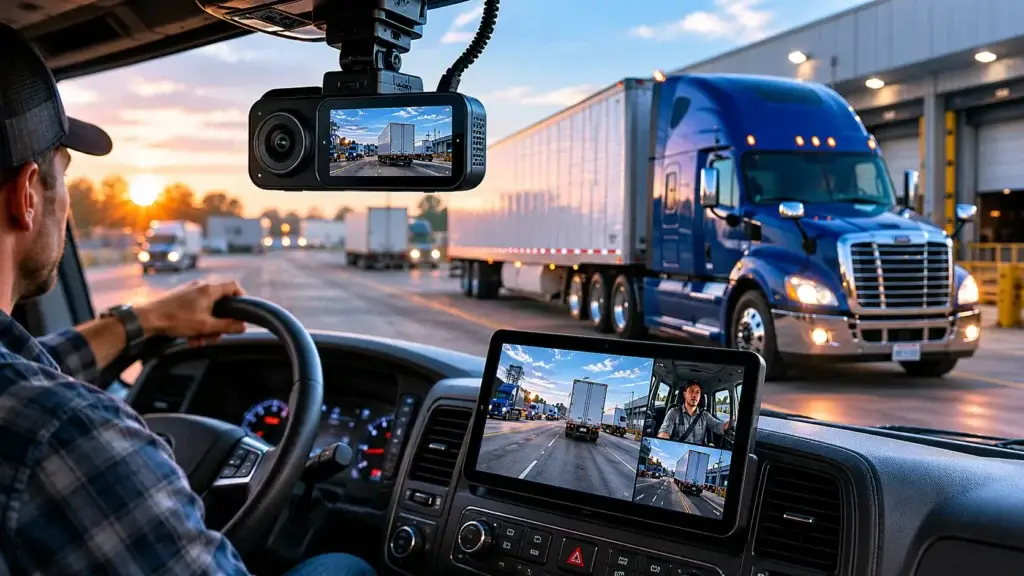
A fleet dashcam is a commercial-grade video recording system that captures road-facing footage, driver behavior, and incident data — and in 2026 it's one of the few safety investments a fleet manager can point to with a specific, documented dollar return.
Carriers sharing AI dashcam and telematics data are qualifying for 10-15% liability premium discounts under active carrier programs, and Louisiana has gone further: as of January 1, 2026, state law requires insurers to discount the liability portion of any qualifying commercial policy outright.
On the other side of the ledger, nuclear verdicts against carriers reached a median of $36 million in 2022 — and a documented AI safety program is increasingly what separates a carrier that can defend itself in that environment from one that can't.
This guide covers camera configurations, the AI features that actually move the safety needle, federal and state compliance, insurance economics, data retention, and driver adoption — the full decision framework for a purchase most fleets now treat as non-optional.
Key Takeaways
- ✓Camera configuration determines what you can actually prove. Road-facing cameras defend against false claims; dual-facing systems add driver coaching data; multi-camera and 360-degree setups close blind-spot evidence gaps on Class 8 and high-value cargo.
- ✓Insurance discounts now come from two directions. Carrier programs (Progressive, HDVI, and others) offer 5-20% for documented AI safety data; Louisiana's R.S. 22:1482.2 now legally requires an actuarially-justified discount for any qualifying commercial policy, effective January 1, 2026.
- ✓Litigation exposure is rising faster than most fleets have adjusted for. ATRI's late-2025 forensic analysis found improper hiring/onboarding allegations increase expected award size by 272%, and substance-abuse allegations by 341% — video evidence is one of the few things that can shorten that exposure window.
- ✓Federal mounting rules apply everywhere; audio consent law depends on where the truck is, not where it's registered. 49 CFR § 393.60 governs placement nationwide; California, Florida, and Illinois require all-party consent to record audio.
- ✓Driver buy-in decides whether any of this works. Fleets that deploy cameras as a coaching and exoneration tool — not a surveillance tool — see adoption rates above 90% within six months; fleets that don't see drivers disable or route around the system.
In This Guide
- Why Commercial Fleets Are Adopting Dashcams at Record Rates
- Fleet Dashcam Types and Camera Configurations
- AI Features That Actually Change Fleet Safety Outcomes
- Federal and State Compliance Requirements
- How Fleet Dashcams Affect Commercial Truck Insurance
- Data Retention Policy: The Legal Framework Most Fleets Overlook
- Driver Adoption: The Make-or-Break Factor
- What to Evaluate When Comparing Vendors
- Total Cost of Ownership
- Frequently Asked Questions
Why Commercial Fleets Are Adopting Dashcams at Record Rates
Three converging pressures explain the pace of dashcam adoption: rising commercial auto insurance costs, an increasingly hostile litigation environment, and video telematics data that has now accumulated enough of a track record to be hard to argue against.
Commercial auto liability insurance costs reached 10.2 cents per mile in 2024, according to ATRI's operational cost research — up 18.6% since 2021, outpacing inflation by 5.4 percentage points over that span even as heavy-duty truck-involved crash rates fell 2.6% industry-wide. Underwriters are increasingly asking fleets to document their own risk management rather than pricing purely on loss history.
The litigation side of the pressure has intensified sharply. ATRI's December 2025 forensic analysis of trucking litigation found the median nuclear verdict — a jury award of $10 million or more — reached $36 million in 2022, roughly 50% higher than the 2013 median.
In that environment, video evidence that can establish what actually happened within hours of an incident, rather than months into discovery, is operational protection as much as it is a safety tool.
Without footage, a fleet manager reconstructing an incident is working from driver statements, police reports, and whatever physical evidence survived the scene. With dashcam footage uploaded to the cloud within minutes of an event, that reconstruction compresses dramatically — and so do the legal costs that follow it.
Fleet Dashcam Types and Camera Configurations
The camera configuration you choose determines what events get captured, what coaching data you can generate, and how much weight your insurance carrier will give the footage.
A road-facing (forward-facing) camera records the view through the windshield — the entry-level, most widely adopted format, strong for rear-end collisions, intersection events, and weather or road-condition evidence. Its limitation is equally clear: it tells you nothing about what the driver was doing when the event happened.
A dual-facing system adds an in-cab lens monitoring attention, phone use, fatigue indicators, and seatbelt compliance alongside the road view. This is the configuration most fleets use for coaching, since it gives a driver concrete context — not a subjective conversation — when a safety alert fires.
Multi-camera and 360-degree systems extend coverage to blind spots, trailer connections, and cargo areas via a central Mobile Digital Video Recorder, and are the right call for Class 8 trucks running wide trailers, flatbeds, tankers, or high-value refrigerated cargo where a blind-spot evidence gap is expensive.
| Camera Type | Best For | Key Limitation |
|---|---|---|
| Road-Facing Only | Incident documentation, false claim defense | No driver behavior data |
| Dual-Facing (Road + Driver) | Driver coaching, insurance discounts, full incident context | Requires a real driver buy-in strategy |
| Multi-Camera / MDVR | Class 8 trucks, high-value cargo, blind-spot coverage | Higher cost, more complex installation |
| 360-Degree Systems | Urban fleets, premium cargo, dock-to-dock liability | Significant investment; heavier data storage demand |
Keep Your Fleet Running at Full Capacity
Get HDJ's maintenance guides, compliance updates, and fleet management strategies delivered weekly — built for working diesel professionals.
AI Features That Actually Change Fleet Safety Outcomes
"AI dashcam" has become marketing language for nearly every camera on the market, which makes it worth being specific about what actually moves safety outcomes.
Real-time in-cab coaching is the feature with the most direct impact: when the system detects tailgating, lane departure, hard acceleration, or fatigue indicators, it delivers an immediate audio or visual alert inside the cab — feedback that can influence the next five seconds of driving, not a report reviewed after the shift ends.
Driver monitoring systems (DMS) use the in-cab lens with AI processing to track eye gaze, head position, and blink rate, identifying distraction and fatigue onset before a driver loses alertness.
Advanced Driver Assistance Systems (ADAS) use the forward lens to track following distance and lane position — genuinely important for commercial vehicles specifically, since a fully loaded 80,000-pound tractor-trailer at 65 mph needs roughly 525 feet to stop, nearly double a passenger car's stopping distance at the same speed.
Event-triggered recording keeps data costs manageable: rather than uploading continuous HD video, the system stores footage locally and uploads only flagged clips, typically within minutes of an event.
10-25%
Commercial auto liability premium discount range for fleets with documented AI dashcam and coaching programs, per current carrier program data — the low end for cameras alone, the high end requiring an active weekly coaching cadence, not just hardware.
Federal and State Compliance Requirements
Compliance has two distinct layers: federal mounting rules that apply everywhere, and state audio-consent law that depends on where the truck is operating, not where the fleet is registered.
Under 49 CFR § 393.60(e), a vehicle safety technology device mounted on the interior of a windshield must sit outside the driver's sight lines, no more than 8.5 inches below the upper edge of the wiper-swept area, and no more than 7 inches above its lower edge.
In practice, this means mounting behind the rearview mirror or in the upper corner — FMCSA doesn't prohibit dashcams, it regulates placement so they don't create the visibility hazard they're meant to document.
Audio recording is where the legal complexity concentrates. One-party consent states (Texas, Michigan, New York, and most of the Southeast) allow recording as long as one participant — typically the driver, via employment agreement disclosure — is aware of it.
All-party consent states, including California, Florida, and Illinois, require every recorded party's consent before recording begins. For multi-state fleets, the safest default is disabling audio recording entirely and relying on video for coaching and documentation; enabling it requires written driver acknowledgment, cab signage, and counsel review in all-party states.
⚠️ Safety Warning
California's Consumer Privacy Act and Illinois's Biometric Information Privacy Act (BIPA) add a further layer for fleets using AI dashcams with facial recognition or biometric DMS features, which capture facial geometry data. These systems may trigger consent, retention-disclosure, and deletion obligations under state biometric privacy law — verify requirements with counsel before deploying biometric DMS in either state.
State windshield-placement rules are also converging toward the federal standard rather than diverging from it.
California's SB 506, enacted in October 2025 and effective January 1, 2026, revises the state's own placement rule (Vehicle Code § 26708) to align with 49 CFR 393.60 for large commercial vehicles — a meaningful simplification for fleets that previously had to track separate state and federal placement limits.
How Fleet Dashcams Affect Commercial Truck Insurance
The insurance impact runs across two channels that are increasingly distinct: carrier discount programs, and — new as of 2026 — a state-mandated discount. Carriers including Progressive and HDVI offer 5-20% premium reductions for fleets that share AI dashcam data showing measurable behavior improvement, not just cameras installed.
A dashcam recording to a local SD card with no cloud connectivity or coaching workflow rarely qualifies; carriers want to see a system generating safety data that's actually being acted on.
Louisiana has gone a step further. Under R.S. 22:1482.2, effective January 1, 2026, insurers must provide an actuarially-justified discount on the liability portion of any qualifying commercial motor vehicle policy where the vehicle carries a working 1080p+ forward-facing dashcam paired with a compatible telematics system, verified annually.
It's the first law of its kind, and other states under similar insurance-market pressure are a reasonable bet to follow.
The litigation-defense value compounds the insurance case. ATRI's forensic analysis found that allegations of improper hiring or onboarding increase expected total award size by 272.3%, and substance-abuse allegations by 340.7% — multipliers that now exceed most on-road infraction types.
A carrier that can produce clean video documentation, driver qualification records, and a coaching history is defending against a fundamentally different case than one that can't.
Data Retention Policy: The Legal Framework Most Fleets Overlook
Dashcam footage that exists becomes discoverable evidence in litigation — which means a retention policy needs to address three categories distinctly. Routine driving footage with no safety flag is typically deleted on a rolling 7-30 day cycle.
Safety-event clips flagged by G-sensor or AI triggers are retained for coaching review, commonly 60-90 days. Footage tied to a reported incident must go under an immediate legal hold and be retained for the applicable statute of limitations — commonly 2-4 years for personal injury claims, depending on state.
The legal hold step is the one fleets most often get wrong: once your fleet becomes aware of an incident that may result in litigation, automatic deletion must pause immediately for all footage tied to that incident, vehicle, and driver.
Failing to do so after notice of a potential claim can trigger spoliation sanctions — a court finding that you destroyed evidence, which is frequently more damaging than the original footage would have been.
Driver Adoption: The Make-or-Break Factor
The most sophisticated AI dashcam system delivers no safety benefit if drivers disable or route around it — and drivers who feel surveilled rather than protected will find a way to do exactly that.
Fleets that achieve adoption rates consistently above 90% within six months share one approach: they deploy cameras as a coaching and exoneration tool, not a discipline tool, and they say so before installation, not after the first flagged event.
Concrete practices that support adoption: involve driver representatives in vendor selection before purchase; use early coaching events to exonerate drivers from incidents caused by other vehicles, not exclusively to document driver error; and set clear, written policy on who can access footage and when.
Installation security matters too — hardwired power connections and tamper-proof SD card covers prevent a driver from disabling the system or deleting footage immediately after an event, which cloud-connected systems with near-real-time upload make largely moot regardless.
What to Evaluate When Comparing Vendors
The market has consolidated around a tier of established platforms — Motive, Lytx, Samsara, Geotab, Netradyne, and Verizon Connect among the most widely deployed in North American trucking — alongside a broad range of hardware-only and regional vendors. HDJ's fleet telematics and ELD buyer's guide compares Samsara, Motive, Geotab, and Verizon Connect directly on contract terms, AI safety capability, and total cost of ownership if you're evaluating a full platform rather than hardware alone.
Minimum spec for a commercial fleet dashcam in 2026 is 1080p with infrared night vision and at least a 140-degree wide-angle lens; low-light enhancement is not a substitute for true infrared in genuine darkness.
Telematics integration is where the real operational value shows up: when a hard-braking event triggers simultaneously in the dashcam system and the fleet's GPS/ELD platform, the combined record — video plus location, speed, and vehicle diagnostic state — is far richer for coaching and claims than either system alone.
Cellular-connected systems provide real-time upload and live streaming anywhere there's signal; Wi-Fi-only systems cost less to operate but introduce a delay.
A 3 a.m. incident may not reach the dashboard until the truck returns to the yard. For fleets where speed of response matters, cellular is worth the added monthly cost. The Commercial Vehicle Safety Alliance publishes guidance on incorporating on-board safety technology into a documented safety management program — worth reviewing when you define what "safety program" means for insurer evaluation.
Key Questions to Ask Every Vendor
- What AI events does the system detect in real time? Ask for the full list, not a marketing summary.
- What happens to footage if cellular connectivity drops? Confirm local storage and upload-retry behavior.
- What are the default retention periods, and can they be customized? Understand the deletion schedule before signing.
- Does the platform support legal holds with a single action? Can you pause deletion for specific vehicles and dates instantly?
- Which insurance carriers have formal discount programs with this platform? Ask for documentation, not a verbal assurance.
- Does audio recording default to off, and how does the platform handle multi-state consent?
- What telematics and ELD systems integrate natively? API access is not the same as native integration.
Editorial Insight
The HDJ Perspective
In 15+ years of diesel repair and fleet operations, Michael Nielsen has seen the ROI conversation around dashcams stop at the premium discount and the avoided claim — and miss the hidden cost of claims management time. A disputed accident that drags into litigation pulls a safety manager or owner away from operations for statements, depositions, and documentation gathering that easily runs 40-60 hours per incident. A dashcam that resolves a claim in 48 hours because the footage is unambiguous doesn't just save legal fees — it gives your best people their time back. Factor that into the model before deciding a basic camera with no cloud connectivity is good enough. And with Louisiana's new law effectively pricing this decision into the insurance market directly, expect the "should we get dashcams" conversation to shift to "which system" faster than most fleets have planned for.
Total Cost of Ownership
Total cost of ownership spans hardware, installation, monthly platform subscription, cellular data, and internal management time — and fleets that select on hardware price alone are frequently surprised that ongoing platform and data fees run two to three times the annualized hardware cost.
Commercial-grade AI dashcam hardware runs roughly $200-$500 per unit for single-camera systems, scaling to $1,000+ for multi-camera or 360-degree configurations, with professional installation adding $100-$200 per unit. Monthly platform subscriptions for cloud connectivity, AI processing, and the coaching dashboard typically run $30-$80 per vehicle.
For a 20-vehicle fleet, total first-year investment for a full-featured AI system with cloud connectivity and coaching typically runs $25,000-$40,000 including hardware, installation, and platform fees — a figure most operators find pays for itself within the first year once measured against the insurance discount, avoided claim costs, and the time value of faster incident resolution.
The American Trucking Associations' technology and safety resources offer useful benchmarking context for prioritizing this investment against other fleet technology spending.
For owner-operators and fleets of 2-5 units, the framework simplifies considerably: a commercial-grade forward-facing camera with cloud connectivity and automatic event upload covers the core need of incident documentation and false-claim defense.
Cloud upload matters more for a single operator than for a large fleet — a local SD card does no good if it's damaged in the collision it was supposed to document.
The Owner-Operator Independent Drivers Association maintains resources on evaluating vendor claims and understanding what a policy actually requires versus recommends for discount qualification — worth checking with your broker directly before buying, since not every carrier approves every platform.
Frequently Asked Questions
Are dashcams legal in commercial trucks?
Yes. The federal requirement is that cameras be mounted per 49 CFR § 393.60, outside the driver's sight lines and within the specified windshield zone for vehicle safety technology. Audio recording consent requirements vary by state. FMCSA does not restrict dashcam use — it regulates placement so the device doesn't obstruct the view it's meant to document.
Do dashcams actually lower commercial truck insurance premiums?
Yes, through two distinct paths. Carriers including Progressive and HDVI offer 5-20% discounts for fleets sharing AI-generated safety data showing measurable improvement — basic, non-connected cameras rarely qualify. Separately, Louisiana's R.S. 22:1482.2 now legally requires insurers to discount the liability portion of a qualifying commercial policy, effective January 1, 2026, regardless of carrier-specific programs. Confirm with your broker which path applies to your policy.
Can a fleet dashcam be used against a driver in an accident?
Yes — footage is neutral evidence and can cut either way. If it shows distracted driving at the moment of a collision, it's discoverable and will be produced in litigation. This is exactly why data retention policy and legal holds matter: a fleet that actively coaches drivers on dashcam data, rather than passively storing it, builds a documented safety program and reduces the odds the footage will ever show the behavior it exists to prevent.
How long should a fleet keep dashcam footage?
Routine, unflagged footage on a rolling 7-30 day cycle; AI-flagged safety events for the coaching review cycle, typically 60-90 days; and any footage tied to a reported incident under an immediate legal hold, retained for the applicable statute of limitations — commonly 2-4 years for personal injury. Formalize this with transportation law counsel before deploying any system commercially.
Will drivers accept dashcams, or will it drive turnover?
Acceptance has improved significantly as fleets have learned to frame cameras as protection rather than surveillance. Initial resistance is common with dual-facing configurations specifically, but fleets using a coaching-first approach — communicating purpose up front, limiting footage access, and using early events to exonerate rather than discipline — routinely see adoption above 90% within six months.
The fleet dashcam decision is a risk-management decision before it's a technology decision. Start with your loss history and your next insurance renewal conversation — if your broker is already raising video telematics as a condition of coverage or a path to a lower premium, you have a clear financial anchor for the purchase.
A well-documented program — written policy, driver acknowledgment, a real retention schedule, legal-hold capability, and telematics integration — is one of the more defensible investments a fleet manager can make in the current operating environment, and Louisiana's new law is a signal, not an outlier, of where insurance markets are headed on this question.
Heavy Duty Journal covers fleet management technology, driver safety tools, and commercial vehicle operations across North America — Michael Nielsen and the HDJ editorial team track dashcam vendor and insurance-program changes as they happen, and Heavy Duty Journal's free fleet cost calculators (linked earlier in this guide) cover cost per mile and operating cost analysis for the rest of your technology budget, no account required.
Share This With Your Safety Manager or Fleet Supervisor
If you're the one making the dashcam decision, your safety manager and dispatcher need this framework too — the deployment only works when the whole team is aligned on purpose, policy, and driver communication from day one.