
By Michael Nielsen, Publisher | 15+ Years in Diesel Repair
Last Updated: September 2026
⏱ Estimated reading time: 15+ minutes
Every minute your commercial vehicles sit idle costs your business money. Fleet uptime optimization isn't just a maintenance priority — it's a revenue protection strategy that directly impacts customer relationships, operational efficiency, and your competitive position in the market.
The numbers make the case clearly. Fleets implementing comprehensive uptime strategies typically achieve 15-20% reductions in operational costs within the first year. Predictive maintenance programs can boost vehicle availability by 20% while cutting maintenance expenses by up to 25% — results that translate directly to your bottom line.
This guide provides ten proven methods that keep vehicles on the road, reduce unexpected breakdowns, and deliver measurable returns — practical solutions successful fleet operations use daily to maintain competitive advantages.
Key Takeaways
- ✓Proactive maintenance reduces operational costs 15-20% within the first year through scheduled service intervals replacing emergency repairs.
- ✓Predictive maintenance increases vehicle availability by 20% while cutting maintenance expenses by up to 25% compared to reactive approaches.
- ✓Emergency repairs cost 3-4x more than planned maintenance due to premium labor rates, expedited parts shipping, and after-hours service fees.
- ✓Driver behavior directly impacts component longevity — aggressive driving can increase fuel consumption by 15-30% and accelerate brake and tire wear.
- ✓Strategic parts inventory management prevents extended downtime waiting for critical components to arrive.
- ✓Technology integration through telematics enables early fault detection that prevents minor issues from becoming catastrophic failures.
In This Guide
- Understanding the Critical Impact of Fleet Downtime on Business Operations
- Implement Preventive Maintenance Scheduling Programs
- Utilize Fleet Management Software for Real-Time Monitoring
- Establish Strategic Parts Inventory Management
- Develop Comprehensive Driver Training Programs
- Deploy Telematics and IoT Sensors for Enhanced Monitoring
- Partner with Reliable Service Providers and Maintenance Vendors
- Implement Vehicle Replacement and Lifecycle Planning Strategies
- Create Backup Vehicle Strategies and Contingency Plans
- Conduct Regular Fleet Performance Audits and Analysis
- Invest in Quality Vehicles and Equipment from the Start
- Frequently Asked Questions
Understanding the Critical Impact of Fleet Downtime on Business Operations
The impact of vehicle unavailability extends far beyond the repair shop, affecting every aspect of business performance. When even a single truck goes offline, consequences cascade through your organization. Operations teams scramble to reassign routes, customer service handles frustrated calls, and finance watches profit margins shrink.
Fleet downtime creates a domino effect touching every department. This interconnected vulnerability makes fleet reliability a critical business priority rather than just a maintenance concern.
The True Cost of Vehicle Unavailability
The financial burden of fleet downtime goes far deeper than the mechanic's invoice. Direct costs represent only the visible tip of a much larger expense iceberg. Emergency repairs typically cost three to four times more than planned maintenance because of premium labor rates, expedited parts shipping, and after-hours service fees.
Lost revenue from missed deliveries often dwarfs actual repair costs. A single commercial vehicle might generate $1,000 to $3,000 in daily revenue depending on your operation. When that vehicle sits idle for three days, you're looking at $3,000 to $9,000 in lost income that can never be recovered.
Rental vehicle costs add another layer of operational expense. Temporary replacements for commercial trucks can run $150 to $400 per day, and specialized equipment climbs higher still. Labor inefficiencies compound the problem further: when drivers arrive for shifts without available vehicles, you're paying wages without generating revenue.
| Cost Category | Planned Maintenance | Emergency Repair | Cost Multiplier |
|---|---|---|---|
| Labor Rate | $85/hour | $125-150/hour | 1.5-1.8x |
| Parts Availability | Standard shipping | Expedited/premium | 2-3x |
| Vehicle Downtime | 4-6 hours | 2-5 days | 8-20x |
| Total Impact | $500-800 | $2,000-5,000 | 3-6x |
How Downtime Affects Customer Satisfaction and Revenue
Customer relationships suffer immediately when fleet downtime disrupts service delivery. A single late delivery can damage trust that took years to build, and the business impact extends far beyond that one transaction.
Contract penalties for missed service level agreements hit your bottom line directly. A fleet with chronic vehicle unavailability might forfeit 2-5% of contract value through these penalties — for a $500,000 annual contract, that represents $10,000 to $25,000 in avoidable losses.
Brand reputation takes years to build but moments to damage, and competitors actively pursue accounts where service reliability becomes questionable. The revenue protection argument for uptime optimization becomes clear when you calculate retention value — keeping an existing customer typically costs five to seven times less than acquiring a new one.
Implement Preventive Maintenance Scheduling Programs
A well-designed preventive maintenance program serves as the foundation for maximizing vehicle availability and extending fleet asset lifespan. This systematic approach transforms fleet operations by replacing unpredictable breakdowns with planned service intervals.
Regular oil changes, fluid refills, wheel inspections, and brake evaluations ensure all components remain in optimal condition. The Technology & Maintenance Council's Recommended Practices — now nearly 3,700 pages in the 2026-2027 edition — provide industry-standard guidelines for establishing effective service intervals across various vehicle types and operating conditions.
Creating Data-Driven Maintenance Calendars
Building effective maintenance scheduling systems requires leveraging multiple data sources to establish accurate service timelines. Historical maintenance records reveal which parts require attention most frequently and help predict future service needs.
Manufacturer recommendations form the baseline for service schedules — fleet managers should treat these guidelines as minimum requirements rather than optional suggestions. Operational data adds crucial context, since tracking actual vehicle usage patterns and operating conditions enables customized calendars reflecting real-world demands rather than generic assumptions.
| Service Type | Time Interval | Mileage Interval | Critical Components |
|---|---|---|---|
| Oil and Filter Change | Every 3 months | Every 25,000 miles | Engine oil, oil filter, drain plug gasket |
| Tire Service | Every 6 months | Every 50,000 miles | Tire rotation, pressure check, tread depth, alignment |
| Brake Inspection | Every 6 months | Every 100,000 miles | Brake pads, rotors, fluid levels, hydraulic lines |
| Comprehensive System Check | Annually | Every 150,000 miles | All fluids, belts, hoses, filters, electrical systems |
Moving from Reactive to Proactive Maintenance
Reactive maintenance approaches wait for component failures before initiating repairs. This "fix-it-when-it-breaks" strategy creates unpredictable downtime and operational disruptions, and cascading failures often accompany it — a failed component may damage related systems before the vehicle reaches a repair facility.
Proactive maintenance prevents failures through systematic intervention before problems develop. Regular inspections identify worn components while they remain functional, allowing replacement during scheduled downtime rather than unexpected breakdowns — and cost predictability follows naturally when maintenance expenses track planned schedules instead of random failure patterns.
HDJ's preventive maintenance ROI guide walks through the full financial case for making this shift, including the timeline most fleets can expect before a program pays for itself.
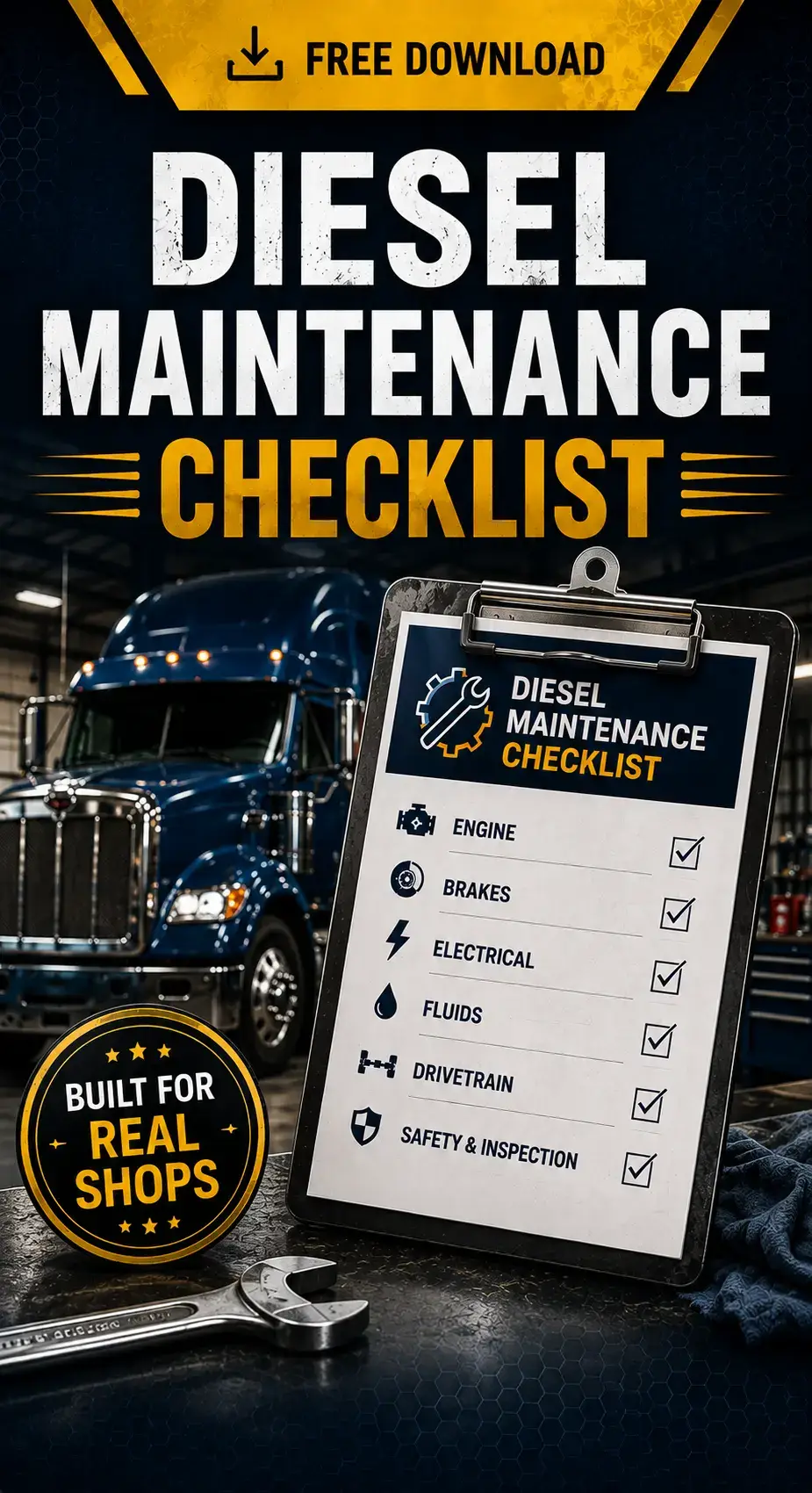
Free Diesel Maintenance Checklist
Get HDJ's free, field-tested diesel maintenance checklist delivered instantly to your inbox — print it, laminate it, keep it in the shop.
Instant PDF • 100% Free • No Spam
Utilize Fleet Management Software for Real-Time Monitoring
Investing in advanced fleet management software creates a digital command center where managers gain unprecedented control over vehicle performance and availability. These platforms integrate data from GPS systems, maintenance records, fuel cards, and driver behavior reports into unified dashboards.
Essential Features for Tracking Vehicle Health
Modern fleet technology platforms offer specialized capabilities designed to maximize vehicle uptime. Centralized vehicle profiles serve as the foundation for comprehensive tracking, maintaining complete maintenance histories, service schedules, and performance benchmarks for every asset.
Integration with vehicle onboard diagnostic systems unlocks powerful preventive capabilities. Fleet management software connects directly to OBD-II ports to continuously monitor engine RPM, coolant temperature, oil pressure, and transmission performance, flagging potential issues the moment readings deviate from normal ranges.
Rather than waiting for a check engine light to trigger driver concern, managers receive instant notifications when diagnostic trouble codes appear. This proactive approach can reduce emergency breakdowns by up to 40% according to industry research, and battery health monitoring identifies failing batteries weeks before they leave drivers stranded.
Automated Alert Systems for Immediate Response
Configurable notification systems transform vehicle tracking data into actionable alerts demanding immediate attention. Check engine light notifications represent the most fundamental alert type — the moment a diagnostic trouble code appears, designated personnel receive instant messages via email, text, or mobile app.
Maintenance due date reminders eliminate missed services, and operational alerts monitor abnormal idle time, unauthorized vehicle use, harsh driving events, and geofence violations. Priority escalation features ensure critical alerts reach the right people, routing urgent notifications to multiple contacts if initial recipients don't respond within specified timeframes.
Establish Strategic Parts Inventory Management
A well-organized spare parts strategy can mean the difference between a two-hour repair and a week-long vehicle outage. Even with accurate diagnostics and skilled technicians, repairs cannot proceed without correct components available.
Identifying Critical Spare Parts and Components
Not all parts deserve equal attention in your inventory strategy. Failure frequency ranks among the most important considerations — components failing regularly across your fleet deserve priority stocking attention.
The cost impact of unavailability provides another essential criterion. When a $50 part grounds a vehicle generating $500 daily revenue, the decision to stock that component becomes obvious. Seasonal variations emerge from analyzing historical repair data — cooling system parts may fail more frequently during summer months, while battery replacements spike during winter.
Focus your inventory investment on consumables with predictable replacement intervals: filters, belts, brake pads, and fluids. The FMCSA periodic inspection requirements under 49 CFR 396.17 mandate specific component conditions that determine whether vehicles can remain in service, which is a useful starting point for deciding what belongs on a safety-critical stocking list.
Optimizing Stock Levels to Minimize Repair Downtime
Determining the right quantity for each stocked component requires systematic analysis. Establish minimum and maximum stock levels for each critical part, and calculate reorder points based on supplier lead times and historical usage rates — if a component requires five days for delivery and your fleet uses two units per week, your reorder point should be set at three units.
Consider economic order quantities balancing ordering costs against carrying costs, and develop just-in-time relationships with local suppliers for common maintenance parts. Regular inventory audits ensure accuracy between system records and physical stock — discrepancies can lead to stockouts despite showing available inventory.
Develop Comprehensive Driver Training Programs
Driver behavior stands as a powerful yet frequently overlooked lever for maximizing fleet availability. Even perfectly maintained vehicles experience premature failures when operated improperly. Aggressive driving increases fuel consumption by 15-30% compared to smooth operation techniques, and beyond fuel costs, harsh driving accelerates brake and tire wear, stresses powertrains and suspension systems, and significantly increases accident risk.
Teaching Fuel-Efficient and Vehicle-Friendly Driving Techniques
A comprehensive driver training curriculum addresses both fuel efficiency and vehicle longevity through proven techniques reducing stress on critical components. Start with smooth acceleration and deceleration practices minimizing drivetrain stress, and teach drivers to anticipate traffic flow rather than react to it.
Structure driver training through multiple touchpoints: initial onboarding programs establishing expectations, quarterly refresher courses, one-on-one coaching sessions for drivers whose telematics data reveals concerning patterns, and recognition programs rewarding fuel-efficient driving. This multi-layered approach ensures training becomes embedded in fleet culture rather than a one-time event.
| Driving Behavior | Component Impact | Cost Increase | Downtime Risk |
|---|---|---|---|
| Hard braking | Brake pads, rotors, hydraulics | 50-100% higher replacement frequency | Emergency repairs, safety failures |
| Rapid acceleration | Transmission, clutch, tires | 30-60% reduced component life | Drivetrain failures, tire blowouts |
| Excessive idling | Engine, exhaust system, fuel system | 25% increase in maintenance costs | Carbon buildup, sensor failures |
| Over-revving | Engine internals, cooling system | 40-80% higher repair expenses | Catastrophic engine damage |
Proper Load Management and Weight Distribution
Load-related training prevents handling problems, premature wear, and safety incidents taking vehicles out of service. Drivers must understand how to verify loads remain within vehicle capacity ratings before departing — exceeding weight limits stresses frames, suspensions, brakes, and tires beyond design specifications.
Proper weight distribution prevents handling issues compromising driver safety and vehicle control. Unbalanced loads create uneven tire wear and unpredictable steering characteristics, and educating drivers on how load weight affects braking distances matters just as much — a fully loaded vehicle requires significantly more distance to stop safely.
Deploy Telematics and IoT Sensors for Enhanced Monitoring
Deploying telematics and IoT sensors creates a data-driven foundation for fleet uptime optimization extending far beyond traditional maintenance approaches. These connected vehicle systems transform physical assets into digital information streams, capturing thousands of data points every minute.
Real-Time Monitoring of Critical Engine Performance Metrics
Comprehensive engine monitoring through connected sensors provides continuous assessment of mechanical health indicators predicting potential failures. Advanced telematics systems capture engine RPM, coolant temperature, throttle position, fuel consumption rates, and operational load factors, establishing baseline performance profiles that make deviations immediately apparent.
On-Board Diagnostics systems use strategically positioned sensors throughout the vehicle to track performance across critical systems — exhaust, engine, transmission, and emission controls. Continuous oil pressure monitoring detects lubrication system problems that could cause catastrophic engine damage within minutes.
Predictive Analytics for Early Issue Detection
Predictive analytics transforms raw telematics data into actionable intelligence by applying machine learning algorithms to identify patterns invisible to human observation. These systems analyze historical and real-time data to forecast when specific components will require maintenance — the evolution from preventive maintenance (scheduled regardless of need) to predictive maintenance performed precisely when needed.
Machine learning models improve accuracy over time by correlating sensor data with actual maintenance outcomes, refining forecasting capabilities with each repair event. The American Transportation Research Institute's operational studies document how fleets implementing predictive maintenance programs achieve measurably higher vehicle availability rates than those relying on traditional interval-based approaches.
Partner with Reliable Service Providers and Maintenance Vendors
Fleet managers cultivating strategic relationships with certified maintenance facilities consistently achieve higher vehicle availability rates. The difference between viewing maintenance vendors as transactional suppliers versus strategic partners determines your success in minimizing downtime.
Selecting Certified and Experienced Maintenance Facilities
Choosing the right maintenance facilities requires systematic evaluation beyond price comparisons. Start by reviewing facility certifications from vehicle manufacturers and industry organizations — geographic proximity matters significantly, since closer locations minimize tow distances for disabled vehicles and reduce travel time for scheduled maintenance.
Assess whether facilities can handle your fleet volume without excessive wait times, since capacity constraints at maintenance vendors directly translate into extended downtime. Look for ASE T-series certified technicians for medium and heavy truck work, as this certification validates competence across various truck systems.
Negotiating Service Level Agreements for Priority Service
Formal service level agreements transform casual vendor relationships into strategic partnerships with defined expectations. Define specific response times for emergency repairs, and establish guaranteed turnaround times for scheduled maintenance to allow better fleet scheduling.
Priority scheduling provisions ensure your fleet vehicles receive preferential treatment during peak periods. Include quality guarantees and warranty terms protecting against defective repairs, along with performance metrics and consequences for non-compliance — regular performance reviews based on those metrics maintain accountability over time.
Implement Vehicle Replacement and Lifecycle Planning Strategies
Vehicle lifecycle planning transforms guesswork into data-driven decision-making, enabling fleet operators to balance capital investments against operational costs. The challenge lies in identifying the precise moment when keeping an aging vehicle becomes more expensive than replacing it. HDJ's fleet TCO guide covers the full framework for that comparison in depth.
Determining Optimal Replacement Cycles for Your Fleet
Establishing effective replacement cycles requires analyzing multiple factors beyond simple age or mileage thresholds. Age-based criteria involve replacing vehicles after specific years in service, mileage-based criteria focus on odometer readings, and condition-based criteria examine actual vehicle health — replacing units when maintenance costs exceed predetermined thresholds.
| Vehicle Category | Typical Replacement Age | Typical Replacement Mileage | Key Considerations |
|---|---|---|---|
| Light-Duty Vehicles | 3-5 years | 75,000-100,000 miles | Fuel efficiency, technology updates, warranty |
| Medium-Duty Trucks | 5-7 years | 150,000-200,000 miles | Payload retention, emissions compliance, resale value |
| Heavy-Duty Trucks | 7-10 years | 500,000-750,000 miles | Engine rebuilds, regulatory compliance, driver preferences |
| Specialized Equipment | 8-12 years | Varies by application | Component obsolescence, expertise availability, operational needs |
Balancing Repair Costs Against New Vehicle Investment
The fundamental question in vehicle replacement centers on comparing continued operation costs against new vehicle acquisition expenses. Several cost factors influence this balance: increased maintenance frequency with aging vehicles, downtime costs accumulating as older units spend more time in repair facilities, and reduced fuel efficiency as newer models incorporate advanced technologies.
Most fleet optimization experts recommend replacement when annual maintenance and downtime costs reach 50-60% of the vehicle's current market value. Calculate break-even points by projecting continued operation expenses against replacement costs over identical timeframes spanning at least 12-24 months.
Create Backup Vehicle Strategies and Contingency Plans
Creating backup vehicle strategies transforms potential operational crises into manageable situations protecting customer relationships. Even fleets with exceptional maintenance programs experience unexpected failures, scheduled service intervals, seasonal demand surges, and accident-related vehicle losses — backup vehicles represent insurance rather than unnecessary expense.
Maintaining Appropriate Reserve Fleet Capacity
Reserve capacity provides essential protection against the unpredictable nature of fleet operations. Typical reserve ratios range from 10-15% for large fleets with reliable vehicles and robust maintenance programs, potentially increasing to 20-25% for smaller fleets or vehicles with higher failure rates. HDJ's fleet right-sizing guide covers the utilization-analysis side of this same question — reserve capacity and right-sizing are really two sides of the same fleet-count decision.
Effective reserve management prevents backup vehicles from deteriorating through extended inactivity. Implement scheduled rotation cycles swapping reserve vehicles into active service monthly or quarterly, and apply identical service schedules to backup vehicles as active fleet units.
Establishing Rental Partnerships for Emergency Coverage
Rental partnerships offer flexible alternatives to purchasing and maintaining owned reserve capacity. Negotiate standing agreements with rental companies delivering priority access during emergencies — pre-negotiated rates, vehicle specifications matching operational requirements, and response time guarantees aligning with operational tolerances.
The hybrid approach combining owned reserves with rental partnerships often delivers optimal results: maintain core backup vehicles for frequent needs while leveraging rental relationships for extraordinary situations.
Conduct Regular Fleet Performance Audits and Analysis
What gets measured gets managed — a principle applying perfectly to fleet uptime optimization strategies. Regular performance reviews identify emerging issues before they become systemic problems, demonstrate return on investment to stakeholders, and guide resource allocation decisions.
Key Metrics to Track Vehicle Availability
Performance metrics provide objective benchmarks for evaluating fleet uptime optimization efforts. Overall fleet availability rate measures the percentage of vehicles ready for service at any given time — industry leaders consistently maintain rates above 95%, while average fleets operate between 85-90%.
The ratio of scheduled versus unscheduled maintenance reveals program effectiveness. Fleets with strong preventive programs typically see 80% or more maintenance occur on schedule. Mean Time Between Failures (MTBF) represents a critical reliability metric — calculate by dividing total operating time by the number of failures during that period. The Commercial Vehicle Safety Alliance's North American Standard Inspection Program provides industry benchmarks for maintenance effectiveness that correlate with improved fleet availability.
Analyzing Downtime Patterns and Identifying Root Causes
Systematic downtime analysis transforms data into actionable improvement strategies. Start by categorizing downtime into distinct types: scheduled maintenance, unscheduled repairs, accident damage, parts unavailability, and administrative delays.
Identify patterns across multiple dimensions: vehicle-specific patterns where certain units experience disproportionate downtime, component failures recurring across the fleet signaling supplier quality issues, and temporal patterns clustering during particular seasons or shifts. Conduct root cause analysis for recurring failures using structured problem-solving methodologies — the "Five Whys" technique proves particularly effective.
Invest in Quality Vehicles and Equipment from the Start
Investing in reliable vehicles and equipment from the outset represents the most fundamental decision affecting fleet uptime throughout operational lifecycles. While procurement teams traditionally focus on minimizing initial acquisition costs, this approach often sacrifices long-term performance and availability.
Evaluating Total Cost of Ownership Beyond Purchase Price
Comprehensive total cost of ownership analysis transforms fleet acquisition from simple purchasing into strategic investment evaluation. TCO frameworks compare vehicles across expected operational lifespans, typically five to ten years — a vehicle with 10% higher purchase price but 20% lower maintenance costs delivers superior financial performance.
Effective TCO analysis encompasses acquisition costs, operating costs, maintenance and repair expenses, and disposal value accounting for resale and trade-in allowances. Quality vehicles typically command higher residual values because buyers recognize their reliability and remaining useful life.
Selecting Vehicles with Proven Reliability Records
Prioritizing vehicle reliability in fleet acquisition decisions directly impacts uptime performance and operational continuity. Research industry reliability ratings from sources like J.D. Power Vehicle Dependability Studies, and review manufacturer warranty coverage and support infrastructure. The Cummins QuickServe Online portal exemplifies the technical documentation and support resources available from quality OEMs — evaluate similar support capabilities when selecting engine platforms for your fleet.
Service network density determines repair access convenience and speed across your operational territory. Organizations implementing structured vehicle selection based on lifecycle value consistently achieve 15-25% improvements in fleet uptime compared to procurement focused solely on acquisition price.
Frequently Asked Questions
What is fleet uptime optimization and why does it matter?
Fleet uptime optimization is the strategic approach to maximizing vehicle availability while minimizing unplanned downtime through proactive maintenance, technology, and operational best practices. It matters because every idle hour represents lost revenue — typically $125 to $375 per day — and effective strategies cut operational costs by 15-20% in the first year.
How much does fleet downtime actually cost?
Direct costs include emergency repairs running 3-4 times more than planned maintenance, lost revenue from missed deliveries, and rental expenses of $150-400 per day. A vehicle grounded three days can mean $3,000-$9,000 in lost revenue alone, before repair and rental costs compound the total.
What is the difference between preventive and predictive maintenance?
Preventive maintenance follows fixed schedules based on time, mileage, or engine hours regardless of actual condition. Predictive maintenance uses telematics and analytics to forecast service needs in real time — and can increase availability by 20% while cutting maintenance costs up to 25% compared to fixed-schedule approaches.
How many backup vehicles should a fleet maintain?
Optimal reserve ratios depend on fleet size, vehicle reliability history, and service criticality. Large fleets with robust programs typically need 10-15% reserve capacity, while smaller fleets or those with less reliable vehicles often need 15-25%.
When should fleet vehicles be replaced?
Most experts recommend replacement once annual maintenance and downtime costs reach 50-60% of the vehicle's current market value — see the replacement-cycle table above for typical age and mileage benchmarks by vehicle type.
Implementing these fleet uptime optimization strategies creates a comprehensive approach to maximizing vehicle availability. Each method works together to form an integrated system where preventive maintenance, technology deployment, strategic inventory management, and vendor partnerships support operational efficiency — the same integrated approach Heavy Duty Journal covers across its broader fleet management library.
Start your implementation journey with a thorough assessment of current performance, then identify the highest-impact opportunities based on existing challenges. Organizations committing to these strategies typically see 15-20% reductions in operational costs and 20% improvements in vehicle availability within the first year — the investment in processes, technology, and training delivers measurable returns through reduced downtime, lower costs, and improved service delivery.
Found This Guide Valuable?
Share these fleet uptime strategies with colleagues managing commercial vehicle operations. Implementing these approaches industry-wide raises performance standards for everyone.