
By Michael Nielsen, Publisher | 15+ Years in Diesel Repair
Last Updated: September 2026
⏱ Estimated reading time: 19 minutes
Transportation incidents remain the leading cause of workplace fatalities in the United States, accounting for 38.2% of all occupational deaths according to the Bureau of Labor Statistics' 2024 Census of Fatal Occupational Injuries, released in February 2026. For fleet managers and safety directors, these statistics represent a clear mandate: implementing a comprehensive commercial fleet safety program isn't optional — it's essential for protecting drivers and the bottom line.
The good news? Organizations implementing evidence-based safety strategies achieve documented 40% reductions in collision rates. Fleet managers who commit to structured driver protection programs report saving over $10,000 annually in 52% of cases, with 20% saving more than $100,000.
This guide provides fleet managers with actionable strategies for building safety programs that work — from driver qualification standards and training protocols to vehicle maintenance systems and safety technology integration.
Key Takeaways
- ✓Transportation leads workplace fatalities: 38.2% of all occupational deaths in 2024 involved transportation incidents, making fleet safety a critical operational priority.
- ✓Proven collision reduction: Fleets implementing comprehensive safety programs achieve documented 40% reductions in collision rates.
- ✓Significant cost savings: 52% of large fleets save over $10,000 annually through structured safety programs; 44% reduce insurance premiums.
- ✓Driver factors are preventable: Over 32% of fatal truck crashes involve driver-related factors that proper screening and training can address.
- ✓Heavy-truck AEB mandate remains unresolved: NHTSA and FMCSA's original 2023 proposal is being reissued as a new supplemental rulemaking under the 2026 federal regulatory agenda — there is still no final rule or compliance deadline for automatic emergency braking on heavy vehicles.
In This Guide
- The Financial and Human Cost of Fleet Accidents
- Building Your Fleet Safety Program Foundation
- Driver Selection and Qualification Standards
- Comprehensive Driver Training Programs
- Vehicle Maintenance and Inspection Systems
- Technology Integration for Fleet Safety Management
- Safety Policies and Disciplinary Procedures
- Performance Tracking and Continuous Improvement
- Frequently Asked Questions
The Financial and Human Cost of Fleet Accidents
Understanding the true scope of fleet accident costs helps fleet managers build the business case for safety investments. Beyond immediate vehicle damage, accidents cascade through insurance premiums, legal settlements, productivity losses, and reputational damage that can take years to recover from.
The typical fleet experiences a 20% yearly accident rate, meaning one in five vehicles will be involved in some form of collision or incident annually. For a 50-truck fleet, that translates to approximately 10 incidents per year — each carrying potential costs ranging from minor to catastrophic.
Accident Cost Escalation and Nuclear Verdict Exposure
Fatal accidents involving commercial vehicles carry price tags that can threaten business survival. According to industry data, fatal collision costs can reach as high as $7 million per incident when factoring in settlements, legal fees, and property damage. Even smaller settlements average around $427,000, with fatality cases or incidents involving drivers with poor safety records pushing that figure above $600,000.
Nuclear verdicts — jury awards exceeding $10 million — have fundamentally altered the risk landscape for fleet operators. Several transportation industry verdicts have exceeded $100 million in recent years, forcing some carriers into bankruptcy. These exceptional judgments, combined with rising claims costs and tariff-driven repair expenses, are exactly why commercial trucking insurance premiums have remained elevated industry-wide heading into 2026.
Insurance carriers respond to this elevated risk environment by raising premiums across the board. Companies with poor safety records face even steeper increases, sometimes finding coverage difficult to obtain at any price. This creates a cycle where accident costs drive up insurance expenses, which increase operational costs and reduce competitiveness.
The Human Dimension of Fleet Safety
Beyond balance sheets lies a sobering human reality. The National Safety Council's finalized figures show 42,789 people died in motor vehicle crashes in 2024 — down from 44,762 in 2023, the third consecutive annual decrease.
NHTSA's parallel count, which uses a narrower 30-day definition, similarly shows large-truck-related crash fatalities falling to 5,340 in 2024, a 2.5% decrease from the year before, even as the number of large trucks involved in injury crashes rose 5.4%.
Commercial vehicle crashes create ripple effects that extend through families, communities, and workplaces. Companies experiencing fatal accidents report decreased employee morale, increased turnover, and difficulty recruiting qualified drivers. The organizational culture suffers as workers question whether management truly prioritizes safety over productivity metrics.
38.2%
of all workplace fatalities in 2024 involved transportation incidents — the leading cause of occupational death in the United States, per the BLS's February 2026 release, up from 36.8% the year before.
Building Your Fleet Safety Program Foundation
Every effective safety program begins with a strategic framework that transforms safety from a compliance checkbox into a fundamental operational priority. Organizations achieving significant accident reductions understand that success requires comprehensive planning, sustained commitment, and cultural transformation at every organizational level.
Essential Components of High-Performance Safety Programs
Leadership commitment stands as the cornerstone of any successful initiative. Without executive buy-in and adequate resource allocation, even well-designed programs fail to gain traction. Leaders must demonstrate commitment through actions — participating in safety meetings, reviewing performance data, and holding managers accountable for results.
A strong safety culture emerges when organizations prioritize accident prevention at every decision point. This means empowering employees to report hazards without fear of retaliation, recognizing safe behaviors, and treating near-misses as learning opportunities.
Core components of effective safety programs include comprehensive policy development, driver engagement strategies that create buy-in through communication and recognition, technology integration using telematics and dashcams, continuous monitoring processes that track leading and lagging indicators, and cross-functional collaboration between operations, maintenance, HR, and safety departments.
Evidence-Based Strategies Delivering Proven Results
Research demonstrates that fleets implementing comprehensive safety features achieve 40% reductions in collision rates. The financial benefits extend beyond accident reduction: a majority of large fleets save over $10,000 annually, while 44% reduce insurance costs and 57% decrease unsafe driving behaviors through AI-powered safety solutions.
Several evidence-based strategies consistently deliver measurable results. Systematic telematics integration monitors speed, harsh braking, rapid acceleration, and other risk indicators in real-time. AI-powered monitoring tools detect distracted driving, drowsiness, and dangerous behaviors as they occur, while proactive driver coaching addresses behaviors immediately rather than waiting for quarterly reviews.
Setting Measurable Goals and Success Criteria
Establishing clear, quantifiable objectives provides the roadmap for safety program success. Begin by establishing baseline metrics documenting current performance levels — collision frequency rates, miles driven between incidents, safety violation trends, vehicle inspection compliance rates, and training completion percentages.
Effective safety program implementation requires SMART objectives — goals that are Specific, Measurable, Achievable, Relevant, and Time-bound. Rather than vague aspirations like "improve safety," set concrete targets such as "reduce preventable collisions by 30% within 12 months."
Driver Selection and Qualification Standards
Implementing rigorous driver qualification standards serves as your primary defense against preventable crashes. Over 32% of fatal truck accidents involve driver-related factors — speeding, distraction, impairment, and other behaviors that proper screening can identify before hiring.
Motor Vehicle Record Analysis and Red Flags
Motor vehicle records serve as the most revealing window into a candidate's driving behavior and risk profile. Multiple speeding violations within a three-year lookback period indicate risky behavior patterns that typically continue after hiring. DUI or DWI convictions represent serious judgment failures that disqualify candidates in safety-focused organizations.
At-fault accidents reveal how a driver responds under pressure and whether they maintain proper following distances and situational awareness. License suspensions or revocations demonstrate either serious violations or accumulated infractions exceeding state thresholds.
| MVR Red Flag | Severity | Lookback Period | Recommended Action |
|---|---|---|---|
| DUI/DWI Conviction | Critical | 7-10 years | Automatic disqualification |
| 3+ Speeding Violations | High | 3 years | Disqualification or extended probation |
| 2+ At-Fault Accidents | High | 3 years | Additional assessment required |
| License Suspension | Critical | 5 years | Disqualification unless administrative |
Establishing Minimum Qualification Standards
Written driver qualification standards create clear benchmarks candidates must meet before consideration. Age minimums reflect both insurance requirements and maturity considerations — while federal regulations permit interstate commercial drivers at age 21, many organizations require age 23 or 25 for insurance purposes.
Experience thresholds ensure candidates possess adequate skill development before joining your fleet. Require minimum verifiable commercial driving experience, typically two to three years for complex operations. Medical fitness standards comply with FMCSA requirements for DOT physicals, including vision acuity meeting 20/40 in each eye, hearing capability, blood pressure below 140/90 for unrestricted certification, and absence of conditions causing sudden incapacitation.
Rigorous standards at the hiring stage also pay off downstream — HDJ's driver retention strategies guide covers why a well-qualified driver hired right the first time is also the driver a fleet is more likely to keep.
Pre-Employment Screening and Assessment
Comprehensive pre-employment assessment extends beyond basic MVR checks to evaluate the complete driver profile. Structured behavioral interviews assess safety attitudes and decision-making processes under pressure. Ask candidates to describe how they handled specific challenging situations — their responses reveal whether safety truly guides their decisions.
Background checks verify employment history and credentials while uncovering undisclosed accidents or violations. Contact previous employers directly rather than relying solely on candidate-provided information. For FMCSA-regulated carriers, query the Drug and Alcohol Clearinghouse to verify candidates don't have unresolved violations that would prohibit them from operating commercial motor vehicles.
Substance abuse screening protects against impairment-related accidents. FMCSA requires DOT drug testing under 49 CFR Part 382, including pre-employment, random, post-accident, reasonable suspicion, return-to-duty, and follow-up testing.
Comprehensive Driver Training Programs
Driver-related factors contribute to over 32% of fatal large truck crashes, making comprehensive training the cornerstone of any successful fleet safety initiative. Speeding causes approximately 6.8% of fatalities, distraction accounts for 5.3%, and impairment results in over 4%.
New Driver Onboarding
The first 90 days of employment represent the highest-risk period for new fleet drivers. Effective onboarding programs must establish safety expectations and provide comprehensive knowledge transfer before drivers operate vehicles independently.
Key components include safety policy familiarization, vehicle-specific training addressing the unique characteristics of each equipment type, technology system training on telematics, dashcams, and ELDs, route familiarization, and pre-trip inspection procedures. Mentorship programs pairing new drivers with experienced veterans accelerate learning and reinforce organizational safety culture.
Defensive Driving Certification
Defensive driving instruction teaches proactive hazard recognition and avoidance strategies. Proper following distance management prevents rear-end collisions that account for approximately 28% of fleet accidents. Defensive driving courses teach the three-second rule for normal conditions and how to adjust spacing for adverse weather, heavy loads, and traffic congestion.
Scanning techniques train drivers to systematically check mirrors, monitor blind spots, and identify potential hazards 12-15 seconds ahead. Speed management instruction emphasizes adjusting velocity for conditions rather than simply obeying posted limits.
Behind-the-Wheel Coaching
Classroom instruction provides knowledge, but coaching during actual vehicle operation creates behavioral change. Technology-captured events from dashcams and telematics systems provide objective coaching opportunities. Video footage eliminates disputes about what occurred and allows drivers to see their own behaviors from an external perspective.
Effective coaching focuses on specific, observable behaviors rather than general criticism. Documentation of coaching sessions provides accountability and legal protection.
| Training Component | Frequency | Primary Focus | Delivery Method |
|---|---|---|---|
| New Driver Onboarding | First 90 Days | Policy, Procedures, Vehicle Familiarization | Classroom + Mentorship |
| Defensive Driving Certification | Every 3 Years | Hazard Recognition, Collision Avoidance | In-Person or Online |
| Behind-the-Wheel Coaching | Quarterly or As-Needed | Real-World Behavior Correction | Ride-Along + Video Review |
| Annual Refresher | Yearly | Skills Maintenance, Regulatory Updates | Computer-Based or Classroom |
Vehicle Maintenance and Inspection Systems
Well-maintained vehicles don't just last longer — they actively prevent accidents by ensuring critical safety systems function properly when drivers need them most. A comprehensive vehicle maintenance program serves as your frontline defense against mechanical failures that could endanger drivers and create costly liability exposures. HDJ's preventive maintenance ROI guide covers the full financial case for the program described below, since a well-run PM program pays for itself well beyond the safety benefit alone.
Preventive Maintenance Scheduling
Effective preventive maintenance begins with customized schedules reflecting manufacturer specifications, vehicle usage patterns, and operating conditions. Generic maintenance intervals fail to account for the demanding duty cycles many fleet vehicles experience.
Key preventive maintenance components include oil changes and fluid level checks at manufacturer-recommended or accelerated intervals, brake system inspections including pad thickness and rotor condition, tire rotations and pressure monitoring, lighting system verification, electronic stability control testing, and steering and suspension examination identifying wear before it compromises vehicle control.
Daily Vehicle Inspection Protocols
Daily inspections represent your most immediate opportunity to identify unsafe vehicle conditions before drivers enter traffic. Establish clear driver responsibilities for pre-trip and post-trip inspections. Drivers should examine critical safety components before every shift and report any defects immediately.
Standardized inspection checklists ensure consistency and completeness, covering exterior lights and reflectors, tire condition, fluid levels, brake system operation, steering response, mirror adjustment, and emergency equipment verification. Mobile applications and electronic forms streamline inspection documentation while ensuring accountability.
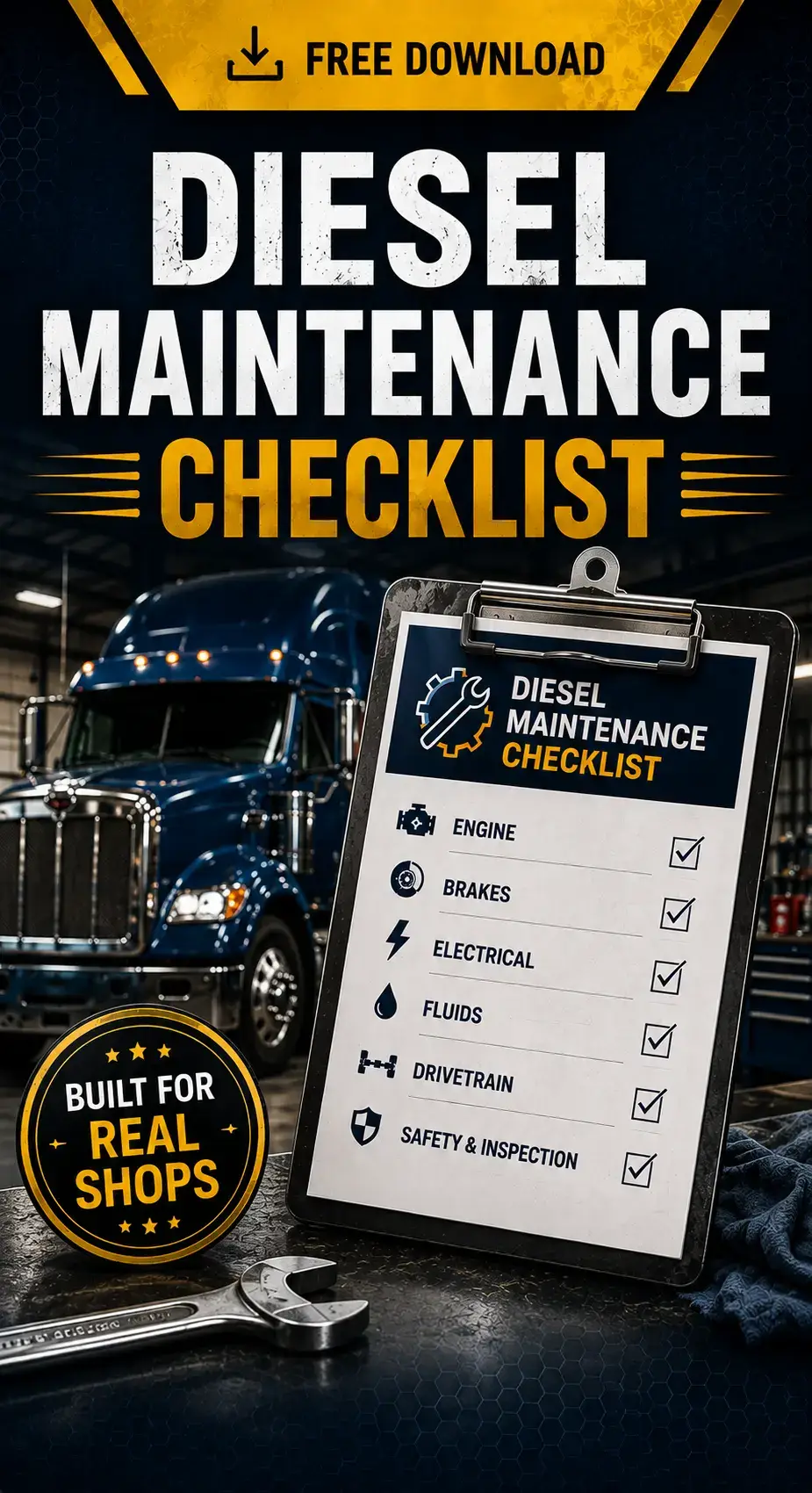
Turning that commitment into daily practice starts with a real checklist in the shop, not an aspiration on a whiteboard:
Free Diesel Maintenance Checklist
Get HDJ's free, field-tested diesel maintenance checklist delivered instantly to your inbox — print it, laminate it, keep it in the shop.
Instant PDF • 100% Free • No Spam
Technology Integration for Fleet Safety Management
Technology has revolutionized fleet safety management by shifting organizations from reactive incident response to proactive risk prevention. Modern safety platforms provide comprehensive visibility into driver performance, vehicle conditions, and operational risks as they unfold.
Telematics and GPS Fleet Tracking
Telematics systems serve as the foundational technology layer enabling comprehensive fleet safety management. Modern telematics platforms monitor harsh driving events including hard braking, rapid acceleration, and sharp cornering that indicate risky behaviors.
Systems track vehicle speed relative to posted limits and provide automated alerts when drivers exceed safe thresholds. Geofencing technology adds another safety dimension by establishing virtual boundaries around high-risk areas like construction zones and school zones.
AI-Powered Dashcams and Driver Monitoring
Dashcam technology equipped with artificial intelligence represents a breakthrough in collision prevention. Forward-facing and driver-facing cameras capture critical footage before, during, and after safety events. AI algorithms analyze video streams in real-time to detect distracted driving, drowsiness indicators, cell phone use, following too closely, and lane departure.
AI dashcams deliver dual benefits justifying their investment: real-time alerts helping drivers avoid imminent collisions, and recorded events for post-incident analysis, creating documented evidence for insurance claims, litigation defense, and driver coaching sessions.
Automatic Emergency Braking: Where the Rule Actually Stands
Regulatory developments here are worth tracking closely, and the picture has shifted since this guide was last updated. NHTSA and FMCSA jointly published their original proposed rule requiring automatic emergency braking on heavy vehicles over 10,000 pounds GVWR in July 2023. That proposal has not become a final rule.
Instead, the current administration directed the agencies to take a fresh look, and DOT's 2026 Regulatory Plan and Unified Agenda — issued July 3, 2026 — now calls for a joint supplemental notice of proposed rulemaking, essentially restarting public comment on revised equipment-performance standards and the motor carrier maintenance requirements that would accompany AEB-equipped vehicles.
The rulemaking remains mandated by the 2021 Infrastructure Investment and Jobs Act, and its statutory deadline has already passed, but no compliance date exists today. NHTSA has separately finalized a related but distinct rule, FMVSS No. 127, requiring AEB on passenger cars and light trucks by September 2029 — that requirement does not apply to heavy-duty commercial vehicles.
Fleet managers should treat heavy-truck AEB as a technology worth evaluating now on its safety merits, not as a near-term compliance deadline, since the rulemaking timeline has already been reset once and remains only an agency estimate.
| Technology | Primary Function | Key Benefit |
|---|---|---|
| Telematics Systems | Continuous vehicle and driver monitoring | Comprehensive operational visibility |
| AI Dashcams | Real-time behavior detection | Objective evidence and driver exoneration |
| Behavior Monitoring | Driver performance scoring | Accountability and continuous improvement |
| Electronic Logging Devices | Hours of service compliance | Fatigue prevention and scheduling optimization |
Safety Policies and Disciplinary Procedures
Written safety policies and consistent disciplinary procedures establish the framework that turns safety intentions into measurable results. These documented standards define acceptable and unacceptable behaviors while creating accountability systems reinforcing your safety culture.
Policy Development and Distribution
Start policy development by assembling input from multiple stakeholders — drivers who understand road realities, managers who enforce policies daily, legal counsel ensuring regulatory compliance, and safety professionals identifying risk factors. This collaborative approach creates policies grounded in operational reality.
Translate complex legal language into accessible terms that drivers at all education levels can understand. Implement a formal distribution process documenting policy receipt and comprehension through signed acknowledgment forms stored in driver qualification files.
Distracted Driving and Cell Phone Policies
Distraction and inattention contribute to a significant percentage of fatal large truck accidents. Your distracted driving policy must establish clear, unambiguous prohibitions on handheld device use while vehicles are in motion — zero exceptions communicates the seriousness of this risk.
Prohibit all handheld phone calls, texting, email, social media, and app usage while driving. Define acceptable use of hands-free systems if operations require driver contact during routes, and require drivers to pull over safely before engaging with any mobile device for tasks beyond simple hands-free calls.
Drug and Alcohol Testing Programs
Comprehensive drug testing programs must include all six DOT-mandated testing situations as outlined in 49 CFR Part 382: pre-employment, random, post-accident, reasonable suspicion, return-to-duty, and follow-up testing.
Select DOT-certified laboratories and establish clear collection protocols protecting sample integrity. Maintain strict chain-of-custody documentation for legal defensibility, and train supervisors to recognize signs of potential impairment.
Performance Tracking and Continuous Improvement
The difference between average and exceptional fleet safety programs lies in consistent performance tracking and willingness to adapt based on results. Organizations achieving documented collision reductions establish robust measurement systems providing real-time visibility into program effectiveness.
Essential Safety Metrics
Effective safety performance metrics fall into two critical categories. Leading indicators predict future performance — training completion rates, vehicle inspection compliance, safety technology utilization, coaching session frequency, and near-miss reporting volumes. Lagging indicators measure outcomes after events occur — collision frequency, injury rates, vehicle damage costs, and insurance claims.
The most successful fleets track specific leading indicators correlating directly with accident prevention: percentage of drivers completing monthly defensive driving modules, daily vehicle inspection completion rates, telematics-based safety scores, near-miss incident reports per 100,000 miles driven, and corrective coaching sessions following violations.
Calculating Fleet Safety Performance
Understanding how to calculate and benchmark accident rates provides the foundation for measuring program effectiveness. The collision frequency rate formula divides total collisions by total miles driven, then multiplies by one million to create a standardized metric comparable across fleets of different sizes.
Severity rates measure the financial or human cost per collision. Preventable accident rates isolate collisions where driver behavior was the primary factor, and comparing your fleet's accident rates against industry benchmarks reveals whether your organization is improving or falling behind — the same calculators below can help put real numbers behind that comparison.
Recognition and Incentive Programs
Well-designed safety incentive programs create powerful motivation for drivers to embrace safe behaviors. Effective strategies include driver of the month awards based on telematics safety scores, milestone celebrations for accident-free periods, quarterly safety bonuses, and public acknowledgment during safety meetings.
However, program design must avoid creating incentives for underreporting incidents. Drivers should never feel that reporting near-misses or minor incidents will jeopardize their eligibility for rewards — reward proactive safety behaviors like consistent vehicle inspections, not just the absence of accidents.
Systematic Reviews for Continuous Improvement
Quarterly safety audits and program adjustments transform good safety programs into exceptional ones through continuous improvement processes. Establish regular review cycles assessing every program element against predetermined success criteria.
Conduct root cause analysis of all accidents and near-misses to identify systemic issues rather than simply blaming individual drivers. Survey drivers and supervisors quarterly to gather candid feedback — frontline personnel often identify practical issues that data alone doesn't reveal, and monitoring leading safety KPIs for deteriorating patterns enables proactive intervention before problems escalate to serious incidents.
Frequently Asked Questions
What is the most effective way to reduce fleet accidents?
Research consistently shows that comprehensive safety programs combining driver screening, ongoing training, telematics monitoring, and vehicle maintenance achieve the best results — documented 40% reductions in collision rates. The key is integration: technology provides data, but human judgment determines how that information drives meaningful change.
How much does a fleet safety program cost to implement?
Implementation costs vary based on fleet size, current safety maturity, and technology choices. More than half of large fleets save over $10,000 annually through structured safety programs, with 20% saving over $100,000. Factor in reduced insurance premiums (44% of implementing organizations see decreases), lower accident costs, and improved driver retention when calculating ROI.
What are the DOT drug testing requirements for commercial drivers?
DOT drug testing requirements under 49 CFR Parts 40 and 382 mandate six testing situations: pre-employment, random, post-accident, reasonable suspicion, return-to-duty, and follow-up. Testing covers marijuana, cocaine, amphetamines, PCP, and opioids.
Will automatic emergency braking be required on commercial trucks?
Not yet, and not on any confirmed timeline. NHTSA and FMCSA's original 2023 proposal to require AEB on heavy vehicles over 10,000 pounds GVWR was never finalized. The agencies are now developing a new supplemental proposed rule under the 2026 regulatory agenda. Fleet managers should not plan around a specific compliance date until a final rule is published.
How often should fleet vehicles undergo safety inspections?
Daily pre-trip and post-trip inspections by drivers are essential for identifying immediate safety concerns. Most fleets implement comprehensive inspections at regular mileage or time intervals — typically every 10,000-15,000 miles or quarterly for brake systems, steering, and critical safety components. Federal requirements under 49 CFR Part 396 mandate annual inspections for commercial motor vehicles.
The evidence is clear: comprehensive commercial fleet safety programs deliver measurable results. Transportation incidents account for over a third of all workplace fatalities, and the financial consequences of accidents can threaten business survival. But organizations implementing evidence-based strategies achieve documented 40% collision reductions while realizing significant cost savings.
Building a world-class safety program requires investment in driver selection, training, vehicle maintenance, technology, and strong safety policies. Michael Nielsen's take on this for Heavy Duty Journal readers stays consistent: the technologies, best practices, and proven methods exist right now. Your drivers depend on your commitment to bringing them home safely, and your bottom line depends on the cost savings that effective safety programs deliver.
Found This Guide Valuable?
Know a fleet manager who could benefit from these safety strategies? Help spread proven approaches to reducing accidents and protecting drivers.