
By Michael Nielsen, Publisher | 15+ Years in Diesel Repair
Last Updated: September 2026
⏱ Estimated reading time: 15+ minutes
Operating a commercial vehicle has never been more expensive. According to the American Transportation Research Institute's 2026 Analysis of the Operational Costs of Trucking, the industry's average cost of operating a truck reached a record $2.336 per mile in 2025 — up 3.4% from the year before — and when fuel is excluded, non-fuel marginal costs rose 4.2% to $1.854 per mile, the highest ever recorded.
These rising expenses demand a smarter approach to managing your vehicles. Fleet lifecycle management offers a proven solution by tracking every stage of a vehicle's journey from acquisition to disposal. By implementing vehicle lifecycle planning, companies reduce their total cost of ownership while minimizing unexpected downtime.
Key Takeaways
- ✓Cost pressures are intensifying: Non-fuel operating costs hit a new record in 2025, making systematic fleet lifecycle management essential for profitability.
- ✓Five-stage framework delivers results: Acquisition, deployment, operation/maintenance, mid-life assessment, and disposal each require strategic oversight for optimal returns.
- ✓Data drives better decisions: Telematics and fleet management software provide real-time visibility that can improve asset utilization by up to 70% and reduce maintenance costs by 20%.
- ✓Fleets are stretching replacement cycles, not shortening them: Average truck age rose to 3.6 years in 2025 (from 3.4) as carriers delay replacement amid soft freight conditions — a trend fleet lifecycle plans need to account for.
- ✓Preventive maintenance pays dividends: A $120 oil change prevents $5,000+ engine failures — small investments create compounding savings across the lifecycle.
In This Guide
- Understanding the Fleet Lifecycle Management Framework
- Strategic Fleet Acquisition Planning
- Vehicle Specification and Selection
- Fleet Deployment and Integration
- Preventive Maintenance Programs
- Data Analytics and Fleet Management Software
- Cost Control and Budget Optimization
- Vehicle Utilization and Performance Monitoring
- Mid-Life Assessment and Replacement Strategy
- Remarketing and Disposal Process
- Frequently Asked Questions
Understanding the Fleet Lifecycle Management Framework
Fleet lifecycle management represents a comprehensive framework that transforms vehicle operations from isolated tasks into strategic processes. This systematic approach begins when a vehicle enters your fleet and continues through every operational phase until disposal.
Organizations that implement structured lifecycle frameworks experience measurable improvements across all operational areas. Every decision made during a vehicle's tenure impacts the next phase, creating either compounding benefits or escalating challenges.
The Five Critical Stages
The vehicle lifecycle consists of five interconnected phases that require strategic oversight and continuous evaluation. Each stage builds upon decisions made in previous phases while setting the foundation for subsequent operations.
Acquisition establishes the foundation through careful vehicle selection, specification development, and procurement negotiations, determining the baseline cost structure for the entire ownership period. Deployment integrates new assets into operations through driver assignments, initial documentation, and tracking system setup, ensuring vehicles enter service with complete compliance records.
Operation and Maintenance represents the longest phase, requiring scheduled servicing, performance monitoring, and cost control — this stage generates the majority of operational data that informs future fleet decisions. Mid-life Assessment evaluates whether continued operation remains cost-effective compared to replacement, preventing vehicles from being held past their optimal service window.
Disposal and Replacement maximizes residual value through strategic remarketing while ensuring seamless transitions to successor vehicles. Proper execution recovers significant capital for reinvestment in fleet renewal.
Quantifying the Financial Benefits
Organizations implementing comprehensive lifecycle management achieve substantial cost reductions compared to reactive approaches. Proactive maintenance programs reduce annual repair expenses by approximately 20% through early problem detection and scheduled interventions.
Vehicles maintained according to lifecycle protocols experience fewer catastrophic failures and require less emergency servicing. Strategic vehicle lifecycle planning improves asset utilization rates to 70% or higher by matching fleet size to actual demand.
| Management Approach | Annual Maintenance Cost | Utilization Rate | Unplanned Downtime |
|---|---|---|---|
| Reactive Management | $5,200 per vehicle | 45-55% | 12-15 days/year |
| Basic Lifecycle Tracking | $4,400 per vehicle | 60-65% | 7-9 days/year |
| Comprehensive Lifecycle Management | $3,800 per vehicle | 70-75% | 3-5 days/year |
Establishing Critical Success Metrics
Effective lifecycle management requires systematic measurement through carefully selected fleet KPIs that reveal operational performance and cost trends. These metrics transform raw operational data into actionable intelligence for continuous improvement.
Vehicle utilization rates measure the percentage of time assets spend in productive service versus idle status, with target benchmarks typically ranging from 70% to 85%. Maintenance cost per mile tracks total servicing expenses divided by distance traveled, revealing cost efficiency trends across vehicle classes and age groups.
Downtime percentage calculates the proportion of fleet capacity unavailable due to maintenance or repairs — organizations should target downtime below 5% through preventive maintenance strategies. Additional fleet performance metrics include fuel efficiency trends, replacement cycle adherence, and total cost of ownership calculations encompassing all expenses from acquisition through disposal.
Strategic Fleet Acquisition Planning
The acquisition phase represents the most critical decision point where fleet managers determine the trajectory of total ownership value for years to come. Organizations that prioritize short-term budget savings during purchase often experience significantly higher expenses over time compared to those employing comprehensive planning methodologies.
Total Cost of Ownership Analysis
Total cost of ownership extends far beyond the vehicle's sticker price to encompass every expense incurred throughout its operational life — acquisition costs, licensing fees, insurance premiums, fuel consumption, scheduled maintenance, unplanned repairs, parts replacement, administrative overhead, downtime costs, and residual value at disposal.
Companies driven by quarterly budget cycles frequently underestimate these cumulative expenses, leading to fleet compositions that appear cost-effective initially but erode profitability over time. HDJ's fleet TCO guide walks through the full calculation framework in depth, since acquisition decisions and lifecycle TCO are really the same analysis viewed from two different points in time.
Purchase Price vs. Lifetime Costs
Vehicles with higher initial purchase prices often deliver superior lifecycle value through reduced maintenance requirements, enhanced fuel efficiency, and stronger residual values. A commercial van priced at $38,000 with proven reliability may generate $12,000 less in maintenance costs over five years compared to a $32,000 alternative with higher failure rates.
The premium vehicle also retains approximately 15% more resale value, creating a total lifecycle advantage of $15,800 despite the higher upfront investment.
Fuel Efficiency Projections
Long-term fuel costs represent one of the largest ownership expenses for most fleet operations. A delivery vehicle averaging 40,000 miles annually at 18 MPG consumes 2,222 gallons per year; improving to 22 MPG reduces consumption to 1,818 gallons, saving 404 gallons annually. At current fuel prices, this efficiency improvement generates significant annual savings that compound over a five-year lifecycle.
30-40%
The value gap between smart fleet acquisition and poor vehicle selection can compound to 30-40% of original purchase price over a typical lifecycle.
Right-Sizing Your Fleet Composition
Determining optimal fleet size and vehicle mix prevents both overcapacity waste and operational constraints from insufficient assets. Fleet managers should examine historical usage data to identify actual vehicle needs versus perceived requirements, as many organizations maintain 15-20% excess capacity based on outdated assumptions or infrequent peak demand periods.
Right-sizing efforts must balance operational flexibility with cost efficiency, ensuring adequate vehicle availability without maintaining underutilized assets that drain resources. HDJ's fleet right-sizing guide covers the full utilization-analysis methodology behind this decision.
Lease vs. Purchase Decision Framework
Evaluating financial structures for vehicle acquisition requires systematic analysis of capital availability, tax implications, anticipated usage patterns, and fleet replacement strategy objectives. Leasing arrangements offer lower initial capital requirements, predictable monthly expenses, and simplified disposal processes, making them attractive for organizations with limited capital reserves.
Purchase decisions provide long-term cost advantages for vehicles in extended service, eliminate mileage restrictions, and build equity through asset ownership. Organizations with strong cash positions and stable operational requirements typically achieve lower total ownership costs through direct purchases.
Vehicle Specification and Selection
Proper vehicle selection transforms fleet operations by aligning equipment capabilities with real-world job requirements. The right specifications reduce maintenance expenses and improve driver productivity while supporting broader fleet asset management objectives.
Aligning Assets with Business Needs
Matching vehicles to operational requirements starts with detailed analysis of how each asset will be used. Payload demands, terrain conditions, and distance profiles all influence which specifications deliver optimal performance — heavy-duty trucks excel at long-haul routes with excessive weight, while lightweight vehicles serve shorter distances requiring fewer maintenance sessions.
Duty cycle characteristics determine appropriate engine size, transmission type, and suspension systems. Specification mismatches create avoidable expenses that compound throughout the vehicle lifecycle.
Modern Technology Integration
Technology and safety features significantly impact long-term value beyond their upfront costs. Advanced driver assistance systems (ADAS) reduce accident rates and insurance premiums, and fleet management software integration through telematics provides real-time visibility into vehicle performance and driver behavior.
Connectivity features enable predictive maintenance alerts that prevent breakdowns. However, complex technology packages may increase maintenance costs and require specialized service capabilities — balance innovation benefits against parts availability and technician expertise throughout the expected service life.
Fleet Deployment and Integration
The transition from vehicle acquisition to operational deployment determines how quickly your fleet investment begins delivering measurable value. Every day a vehicle sits idle represents lost revenue and delayed return on investment.
Efficient Vehicle Reception and Commissioning
Streamlined onboarding transforms new vehicles into productive assets faster than conventional methods. A systematic reception process begins with comprehensive pre-delivery inspections — verify that vehicles meet specifications before accepting delivery, and document any discrepancies immediately to expedite resolution with vendors.
Equipment installation efficiency separates high-performing operations from average ones. Standardized installation procedures reduce setup time while ensuring consistency, and pre-staged equipment kits with dedicated installation teams can cut commissioning time dramatically. Create checklists that guide technicians through systematic validation steps and test all systems before releasing vehicles to operations.
Strategic Driver Matching and Assignment
Matching drivers with appropriate vehicles optimizes both safety and performance from the first shift. Consider driver experience levels, route complexity, and vehicle sophistication when making assignment decisions.
New vehicles often feature advanced technology that requires operator familiarity — assign your most experienced drivers to complex equipment initially, since they can identify operational issues and provide valuable feedback during the break-in period. Route familiarity also matters significantly, as drivers who know their territories can better evaluate vehicle performance under typical operating conditions.
Preventive Maintenance Programs
A well-structured preventive maintenance program separates high-performing fleets from those struggling with unexpected breakdowns and budget overruns. An oil change for a medium-duty diesel truck costs around $120, but neglecting this simple service can lead to engine failure with repairs exceeding $5,000.
Federal regulations under 49 CFR Part 396 require motor carriers to systematically inspect, repair, and maintain all commercial motor vehicles under their control — these requirements aren't just regulatory compliance, they're the foundation of effective fleet lifecycle management. HDJ's preventive maintenance ROI guide covers the full financial case for building this program out.
Scheduled Maintenance Planning
Effective maintenance scheduling creates predictable service intervals that protect fleet assets while controlling costs. A systematic approach delivers lower repair costs by catching issues early, extends vehicle lifespan through regular care, and reduces unplanned downtime — plus better fuel efficiency, higher resale values, and improved driver safety.
The cost of delayed maintenance extends beyond immediate repairs. Check engine lights remain illuminated for an average of 90 days in many fleets, wasting fuel and degrading performance throughout that period.
Original equipment manufacturer maintenance schedules provide valuable baselines but require customization for specific fleet applications. Vehicles operating in severe conditions demand more frequent service intervals — dusty environments accelerate air filter replacement needs, while stop-and-go urban routes increase brake system wear.
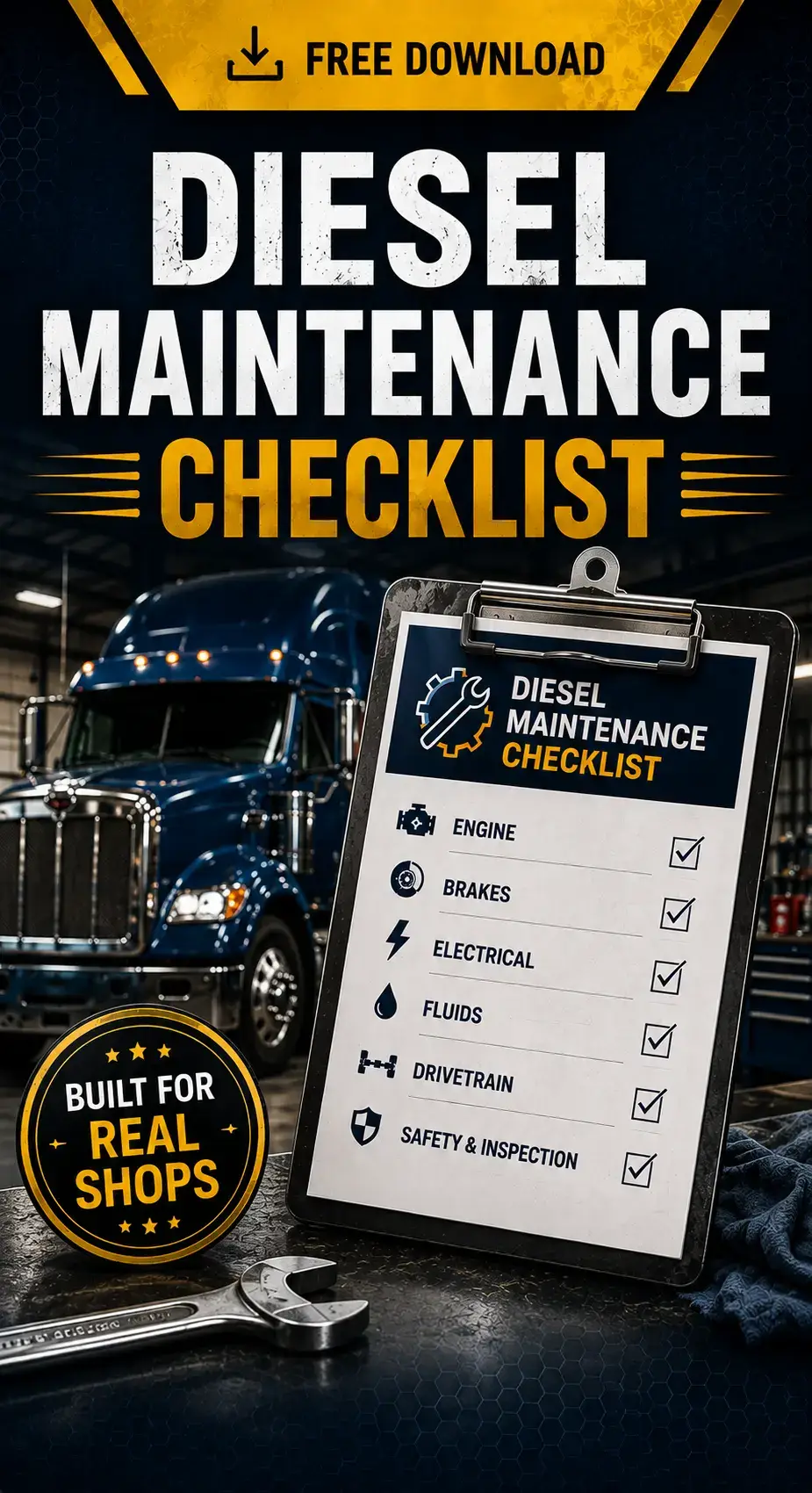
Free Diesel Maintenance Checklist
Get HDJ's free, field-tested diesel maintenance checklist delivered instantly to your inbox — print it, laminate it, keep it in the shop.
Instant PDF • 100% Free • No Spam
Maintenance Management Systems
Technology platforms automate preventive maintenance workflows and eliminate human oversight errors. Digital systems track service history, manage parts inventory, schedule upcoming services, and provide performance analytics — transforming fleet maintenance from reactive crisis response to proactive asset protection.
The Technology & Maintenance Council's Recommended Practices provide industry-standard guidelines for maintenance procedures. TMC's more than 400 recommended practices — refreshed for 2026-2027 in a nearly 3,700-page manual — represent the consensus wisdom of maintenance directors and industry professionals across the trucking sector.
In-House vs. Outsourced Maintenance
Determining the optimal maintenance delivery model requires evaluating multiple factors beyond simple cost comparison. The decision framework must consider fleet size, geographic distribution, facility capabilities, and technician expertise.
| Factor | In-House Maintenance | Outsourced Maintenance |
|---|---|---|
| Cost Structure | Fixed overhead with technician salaries, facility expenses | Variable per-service costs, no capital investment |
| Quality Control | Direct oversight of procedures and training | Dependent on vendor capabilities |
| Best Applications | Large fleets (100+ vehicles) with centralized operations | Smaller fleets, dispersed operations, specialized repairs |
Many successful operations adopt hybrid models that maintain basic preventive maintenance capabilities in-house while outsourcing specialized repairs and major component work. ATRI's operational cost research confirms the pattern scales with size: larger carriers consistently perform a bigger share of maintenance in-house than smaller ones, since they can spread the capital cost of shop facilities and technician staffing across far more vehicles.
Data Analytics and Fleet Management Software
Data analytics serves as the backbone of successful fleet lifecycle management, converting raw vehicle information into actionable operational insights. Modern fleet management software platforms integrate GPS tracking, engine diagnostics, and driver behavior monitoring into unified systems.
Telematics and Performance Monitoring
Telematics fleet management systems have revolutionized how companies monitor and optimize their assets. These platforms deliver real-time data that helps managers get ahead of problems, extend vehicle life, and reduce operational costs through continuous monitoring.
Companies implementing these solutions have achieved remarkable results: 70% increases in asset utilization, 20% reductions in annual maintenance costs, and significant time savings on managing repairs and downtime.
Predictive Maintenance Using Data
Advanced predictive maintenance analytics identify failure patterns before breakdowns occur, using engine fault codes and performance degradation trends to trigger proactive interventions. Check engine lights stay on an average of 90 days in many fleets, wasting fuel and reducing performance throughout that period.
Battery drain alerts notify managers when voltage drops below critical thresholds, preventing dead batteries that lead to missed jobs and costly tow calls. Engine fault reports pull diagnostic data directly from vehicle ECM systems and highlight specific fault codes requiring attention, eliminating expensive emergency repairs.
Cost Control and Budget Optimization
With trucking operating costs at a record $2.336 per mile in 2025, fleet cost optimization is more critical than ever. That 3.4% year-over-year increase reflects a harsher underlying reality: excluding fuel, non-fuel marginal costs climbed 4.2% to $1.854 per mile — the highest ever recorded, with tolls, repair and maintenance, driver benefits, and tires posting the steepest gains.
Controlling Daily Operating Expenses
Managing operating expenses starts with comprehensive tracking of every cost category affecting your total cost of ownership. Break down expenses into fuel, maintenance, repairs, insurance, licensing, and depreciation to identify high-impact reduction areas.
Right-sizing your fleet eliminates underutilized vehicles that drain resources without contributing value. Variance analysis compares actual spending against budgets and industry benchmarks, highlighting opportunities for improvement before financial performance suffers.
Reducing Fuel Consumption Costs
Fuel represents one of the largest line items in fleet budget management, making reduction strategies essential for profitability. Route optimization software minimizes unnecessary mileage, and idle time reduction through driver training and automated systems cuts fuel waste from vehicles running while stationary.
Driver behavior monitoring identifies aggressive acceleration, excessive speeding, and poor route choices that increase consumption. Safer, more efficient driving lowers fuel use by 10-15% while reducing vehicle wear and tear.
Minimizing Insurance and Risk Costs
Strategic risk management reduces insurance premiums while protecting asset values throughout the fleet lifecycle. According to ATRI's May 2026 insurance research, liability insurance premium costs rose 18.6% to 10.2 cents per mile between 2021 and 2024 — outpacing consumer inflation by 5.4 percentage points — even as heavy-duty truck-involved crash rates fell 2.6% industry-wide.
Safety program implementation demonstrates commitment to loss prevention, qualifying fleets for premium discounts of 5-20%, and ATRI found that fleets deploying six specific safety technologies saw a statistically significant correlation with lower per-mile liability losses. HDJ's fleet safety program guide covers those strategies in full.
Vehicle Utilization and Performance Monitoring
Systematic tracking of fleet utilization exposes inefficiencies that cost companies thousands in wasted expenses annually. Underutilized vehicles drain capital through depreciation, insurance, registration fees, and maintenance costs without generating proportional revenue.
Calculating Asset Productivity
Effective fleet asset management begins with quantifying how each vehicle performs against availability. Utilization rate analysis measures revenue miles per day, operational hours as a percentage of total availability, and deployment frequency across the fleet.
Modern telematics fleet management solutions solve visibility gaps that plague fleets managing hundreds of vehicles through real-time location data and automated reporting, enabling fleet reductions of 10-15% without compromising service capacity. HDJ's fleet uptime optimization guide covers the technology side of this in more depth.
Eliminating Wasted Engine Hours
Excessive idle time represents a dual threat to lifecycle value. Engine idling wastes fuel while accelerating component wear without generating productive work, and fleet performance metrics tracking idle duration reveal both equipment issues and driver behavior patterns requiring intervention.
Telematics systems monitor idle time automatically and trigger alerts when thresholds are exceeded. Reducing unnecessary idling extends engine life, decreases maintenance frequency, and lowers fuel costs — benefits that compound over the vehicle lifecycle.
Mid-Life Assessment and Replacement Strategy
Strategic decisions during the middle years of fleet asset life determine whether organizations maximize value or accumulate unnecessary costs. Fleet managers must balance remaining utility against escalating expenses that naturally accompany aging assets.
When to Repair vs. Replace
The repair-versus-replace decision demands rigorous financial analysis rather than intuitive guesswork. When a single repair approaches 50-75% of current vehicle value, replacement typically delivers superior economics, and annual maintenance costs that exceed depreciation-adjusted replacement expenses signal the need for disposal.
Downtime expenses and reliability degradation further tip the scale toward replacement. Replace too early and you lose remaining useful life; replace too late and you face escalating maintenance costs and diminished resale value.
Understanding Depreciation Patterns
Vehicle depreciation follows predictable curves that vary by asset class, manufacturer, and vehicle type. Most vehicles experience the steepest value loss during the first three years of ownership, with depreciation rates moderating as assets age.
Light-duty trucks typically retain 60-65% of their original value after three years, while commercial vans often maintain stronger residual values due to consistent demand in the used market.
The replacement-cycle picture has actually reversed from what earlier data suggested: rather than fleets trading trucks in sooner, ATRI's 2026 report shows carriers holding equipment longer amid a prolonged freight recession — average truck age rose to 3.6 years in 2025 (up from 3.4), and average annual mileage per truck climbed to 85,991 miles, even as the typical full replacement cycle remains around 7 to 7.5 years. Fleet lifecycle plans built on the older "replace sooner" assumption should be revisited against this delayed-replacement reality.
Establishing Age and Mileage Benchmarks
Industry-standard replacement guidelines provide useful starting points for fleet replacement strategy development. Light-duty vehicles typically warrant replacement at 100,000-150,000 miles or 5-7 years, while medium-duty trucks may operate effectively to 200,000 miles or 8-10 years.
Heavy-duty commercial vehicles often remain in service beyond 500,000 miles with proper maintenance — ATRI's data suggests trucks now accumulate roughly 634,000 miles over a typical 7-year replacement cycle. These benchmarks require customization based on duty cycle, maintenance quality, and driver behavior; a delivery van in stop-and-go urban traffic accumulates wear faster than a highway-driven vehicle with identical mileage.
Remarketing and Disposal Process
Remarketing vehicles represents the critical endpoint where fleet managers capture remaining asset value while preventing financial drain from aging equipment. A strong disposal strategy ensures vehicles exit the fleet before maintenance costs exceed their operational value.
Preparing Assets for Maximum Recovery
Vehicle preparation significantly influences final sale prices. Systematic reconditioning includes mechanical inspections, cosmetic restoration, and thorough cleaning that addresses both interior and exterior condition — investment in presentation typically generates returns of three to five times the preparation costs through higher bids and faster sales.
Complete maintenance records prove invaluable during remarketing. Buyers pay premium prices for vehicles with documented service histories and telematics data that verify consistent care.
Choosing the Right Disposition Channel
Selecting appropriate disposal channels requires balancing speed, convenience, and revenue potential. Auction channels provide rapid liquidation for multiple vehicles simultaneously, while online platforms expand geographic reach, and direct sales to employees or other businesses maximize proceeds but require more marketing effort.
Wholesale disposition moves vehicles quickly at lower margins, suitable for aging assets or those requiring significant repairs. Retail marketing demands more resources but captures higher vehicle resale value by reaching end consumers.
Frequently Asked Questions
What exactly is fleet lifecycle management and why is it important?
Fleet lifecycle management is a strategic framework overseeing vehicles from acquisition through disposal. It matters because systematic oversight reduces total cost of ownership by up to 20% and minimizes unplanned downtime — critical with operating costs at a record $2.336 per mile in 2025.
How do I calculate total cost of ownership for fleet vehicles?
TCO extends beyond purchase price to include depreciation, fuel, maintenance, insurance, financing, downtime, and disposal proceeds. See the TCO guide linked above for the full calculation framework and worked examples.
What is the optimal fleet replacement cycle?
It varies by vehicle type — see the age and mileage benchmarks table above. ATRI's 2026 data shows fleets are actually stretching replacement cycles rather than shortening them, with average truck age rising to 3.6 years as carriers delay amid soft freight conditions.
How does telematics improve fleet lifecycle management?
Telematics enables predictive maintenance, automates service scheduling, and flags underutilized assets for potential reduction. Organizations implementing it report utilization improvements up to 70% and maintenance cost reductions of 20%.
Should I use in-house or outsourced maintenance?
It depends on fleet size and geographic distribution — larger fleets generally perform more maintenance in-house since they can spread facility and staffing costs across more vehicles, while smaller or dispersed fleets typically favor outsourcing. Many operations run a hybrid model.
What maintenance management approach delivers the best lifecycle value?
Preventive maintenance built on digital scheduling and complete service history is the cornerstone. Adapt TMC Recommended Practices to your actual operating conditions rather than following OEM intervals blindly.
Fleet lifecycle management represents a fundamental shift from reactive vehicle maintenance to proactive asset optimization. Organizations that embrace this strategic approach gain measurable advantages in operational efficiency and financial performance.
Successful fleet cost optimization requires integrated technology platforms that deliver real-time visibility and predictive insights. These systems eliminate guesswork from critical decisions about maintenance scheduling, utilization patterns, and fleet replacement strategy timing.
With proper planning, data-driven decisions, and consistent execution, your fleet becomes a driver of profitability rather than a cost center. Heavy Duty Journal covers the rest of this framework across its broader fleet management library — the path forward requires commitment to systematic processes and willingness to leverage technology that turns vehicle data into actionable intelligence for long-term success.
Found This Guide Valuable?
Share this comprehensive fleet lifecycle management resource with colleagues and fellow fleet professionals who could benefit from these strategies.