

By Michael Nielsen, Publisher | 15+ Years in Diesel Repair
Last Updated: September 2026
⏱ Estimated reading time: 15+ minutes
DOT compliance stands between your fleet's daily operations and costly enforcement actions that can shut down trucks, drain resources, and damage your company's reputation. Operating commercial motor vehicles requires strict adherence to federal safety standards established under Title 49 of the Code of Federal Regulations — and the Federal Motor Carrier Safety Administration doesn't cut corners when enforcing these requirements.
Fleet managers face a complex web of regulatory obligations spanning driver qualifications, vehicle maintenance, hours of service limits, drug testing programs, and documentation requirements. Non-compliance penalties can reach thousands of dollars per violation, while out-of-service orders halt operations immediately.
This comprehensive guide delivers actionable checklists, regulatory references, and cost breakdowns to help you implement an effective compliance program — the practical frameworks needed to meet federal standards while controlling operational expenses.
Key Takeaways
- ✓Five regulatory pillars: DOT compliance covers drug testing (Part 382), CDL requirements (Part 383), driver qualifications (Part 391), hours of service (Part 395), and vehicle maintenance (Part 396).
- ✓CMV thresholds trigger full compliance: Vehicles at 10,001+ pounds GVWR, carrying 16+ passengers, or transporting placardable hazmat require complete regulatory adherence.
- ✓Registration has a new home: FMCSA retired its legacy registration systems on May 14, 2026 in favor of Motus, its new USDOT Registration System — bookmark the new portal, not the old one.
- ✓Penalties remain at 2025-adjusted levels: Under 49 CFR Appendix A/B to Part 386, current maximums reach $19,246 for most non-recordkeeping violations and $23,048 for a carrier requiring or permitting an out-of-service vehicle to operate.
- ✓Proactive compliance pays dividends: Strong safety performance reduces insurance costs, improves shipper relationships, and prevents operational disruptions.
In This Guide
- Understanding DOT Compliance Requirements for Commercial Fleets
- Essential Fleet Documentation Requirements
- Driver Qualification File Requirements
- Vehicle Inspection and Maintenance Programs
- Hours of Service Compliance and ELD Mandates
- Drug and Alcohol Testing Program Requirements
- DOT Compliance Fleet Checklist: Implementation Guide
- Compliance Cost Analysis and Budget Planning
- Avoiding Penalties: Audit Preparation and Violation Prevention
- Frequently Asked Questions
Understanding DOT Compliance Requirements for Commercial Fleets
Understanding the scope of federal motor carrier safety regulations forms the foundation of successful fleet management. Every entity operating commercial vehicles must navigate a detailed regulatory framework designed to protect public safety, and these requirements establish minimum standards that apply across all fleet operations regardless of company size.
The Federal Motor Carrier Safety Administration maintains jurisdiction over these standards as part of the U.S. Department of Transportation. Compliance isn't merely a best practice — it's a legal obligation with significant financial and operational consequences for violations.
Federal Motor Carrier Safety Regulation Coverage
The Code of Federal Regulations Title 49 contains the comprehensive set of rules governing commercial motor vehicle operations, touching every aspect of how fleets operate from driver qualifications to vehicle maintenance standards.
Part 382 establishes controlled substances and alcohol use testing requirements. Part 383 defines commercial driver's licensing standards, specifying which vehicles require a CDL and what endorsements drivers need for specific cargo types.
Part 391 covers driver qualification files and ongoing monitoring requirements. Part 395 regulates hours of service to prevent driver fatigue, while Part 396 mandates vehicle inspection, repair, and maintenance standards — each regulatory part connects to create an integrated compliance framework, and you cannot selectively comply with certain sections while ignoring others.
Fleet Classifications Under DOT Regulations
The definition of a Commercial Motor Vehicle is broader than many fleet managers initially realize. According to 49 CFR § 390.3T, three distinct criteria determine whether a vehicle requires DOT compliance, and meeting any single criterion triggers full regulatory obligations.
| Classification Criteria | Specific Threshold | Common Vehicle Examples |
|---|---|---|
| Weight Rating | 10,001+ pounds GVWR/GCWR | Box trucks, semi-tractors, heavy service vehicles |
| Passenger Capacity | 16+ passengers including driver | Shuttle buses, transit vehicles, tour coaches |
| Hazardous Materials | Placardable quantities under 49 CFR 172 | Tankers, chemical delivery trucks, propane vehicles |
Interstate versus intrastate operation creates an important distinction in regulatory coverage. Interstate commerce includes any vehicle crossing state lines or transporting goods that originated in or are destined for another state, and the regulatory framework applies equally to private carriers, for-hire carriers, and owner-operators.
FMCSA Enforcement and Oversight Functions
The FMCSA wields substantial authority to monitor, investigate, and penalize non-compliant carriers. The agency conducts compliance reviews and safety audits at carrier facilities nationwide, examining driver qualification files, vehicle maintenance records, hours of service documentation, and drug testing programs.
The Safety Measurement System (SMS) tracks carrier safety performance across seven Behavior Analysis and Safety Improvement Categories (BASICs): Unsafe Driving, Hours of Service Compliance, Driver Fitness, Controlled Substances/Alcohol, Vehicle Maintenance, Hazardous Materials Compliance, and Crash Indicator. Carriers receive percentile rankings indicating their safety performance relative to peers.
Safety ratings represent FMCSA's official assessment of carrier safety fitness — carriers receive ratings of Satisfactory, Conditional, or Unsatisfactory based on compliance review findings, and an Unsatisfactory rating can result in operating authority revocation and immediate shutdown orders.
Essential Fleet Documentation Requirements
Every commercial fleet operates on a foundation of essential documentation that validates its legal authority to conduct business. Without proper registration and filing compliance, even the safest fleet faces immediate regulatory violations.
USDOT Number and Motor Carrier Authority
The USDOT number serves as your fleet's primary identification within federal transportation systems, and the way carriers obtain one changed in 2026: on May 14, 2026, FMCSA retired its legacy registration systems in favor of Motus, the agency's new USDOT Registration System. If you have a bookmark or saved link for the old registration portal, replace it — the legacy pages now redirect fleet managers toward Motus for new applications, updates, and biennial filings.
The biennial MCS-150 update still requires carriers to verify and update company data with FMCSA every two years — missing this deadline results in your USDOT number becoming inactive, though FMCSA has temporarily eased automatic inactivation for overdue filers while the Motus transition settles. Fleet managers should not treat that pause as a reason to delay; complete the update as soon as practical.
Many fleet operators confuse the USDOT number with operating authority, but these serve distinct purposes. While every commercial carrier needs a USDOT number for identification, only for-hire carriers transporting property or passengers for compensation require Motor Carrier (MC) authority. BOC-3 filing designates process agents in each state where you operate.
Unified Carrier Registration and IRP/IFTA
The Unified Carrier Registration (UCR) program requires all interstate motor carriers to register and pay annual fees based on fleet size. The 2026 UCR fee schedule — unchanged from 2025 — runs from $46 per year for carriers with 0-2 vehicles up to $44,836 for fleets of 1,001 or more vehicles. The UCR Board has recommended an approximately 20% fee increase for the 2027 registration year, so budget for higher costs starting next cycle.
The International Registration Plan (IRP) provides apportioned registration allowing vehicles to operate in multiple states under a single plate. The International Fuel Tax Agreement (IFTA) simplifies quarterly fuel tax reporting for carriers operating across state lines — both programs demand meticulous record-keeping, with documentation retention requirements extending four years.
Driver Qualification File Requirements
Driver qualification requirements under 49 CFR Part 391 form the foundation of fleet safety and legal compliance. Every commercial motor vehicle operator must maintain comprehensive documentation proving each driver meets federal standards — incomplete or missing DQ file documentation represents one of the most frequently cited violations during DOT audits.
Mandatory Documents for Each Driver
Every driver qualification file must contain: employment application covering the preceding three years, written verification from previous employers, motor vehicle records from each state where the driver held a license, certificate of road test or equivalent license waiver, current medical examiner's certificate, annual review of driving record, annual inquiry to state agencies documenting traffic violations, and drug and alcohol testing records.
MVR and Background Check Requirements
The pre-employment screening process represents a critical component of driver qualification. MVR review must examine valid CDL verification, driving history for disqualifying offenses, license status confirmation, and documentation of restrictions or endorsements — a thorough screening process here pays dividends downstream, since HDJ's driver retention strategies guide covers how the drivers who pass rigorous qualification standards are also the ones fleets are more likely to keep.
Employers must also query the FMCSA Drug and Alcohol Clearinghouse to identify drivers with unresolved violations. This database reveals whether a driver has failed drug tests or refused testing with previous employers.
Medical Certification and Annual Reviews
Every driver must pass a comprehensive medical examination conducted by a certified medical examiner listed on the National Registry, with certificates typically valid for one to two years depending on health status.
The annual driver review process required by 49 CFR 391.25 ensures ongoing monitoring of driver performance. Each review must include performance assessment, accident record review, current MVR request, and violation documentation, and must be documented in writing and signed by both the reviewing official and the driver.
Vehicle Inspection and Maintenance Programs
Fleet vehicle inspections and preventative maintenance programs directly impact your company's safety rating and operational efficiency. Under 49 CFR Part 396, every commercial motor vehicle must undergo systematic inspection, repair, and maintenance protocols.
Annual Vehicle Inspections
Federal regulations mandate that every commercial motor vehicle undergo a comprehensive annual inspection as specified in 49 CFR 396.17. This inspection must be conducted by a qualified inspector who verifies compliance with all Federal Motor Carrier Safety Standards, and upon successful completion, the inspector provides documentation that must remain with the vehicle at all times.
Pre-Trip and Post-Trip DVIR Requirements
Driver Vehicle Inspection Reports represent one of the most critical daily compliance activities. Drivers must conduct thorough examinations before operating any vehicle and again at the conclusion of each workday. Pre-trip inspection requires reviewing the previous DVIR to verify reported defects have been corrected, while post-trip inspections document any new defects.
| Inspection Component | Pre-Trip Focus | Critical Items |
|---|---|---|
| Service Brakes | Response test, pedal reserve | Brake adjustment, air pressure, hydraulic leaks |
| Lighting Systems | All lights operational before departure | Headlights, turn signals, brake lights, markers |
| Tires and Wheels | Tread depth, inflation, visible damage | Minimum 4/32″ tread, proper inflation, no cuts |
| Coupling Devices | Secure connection, locking mechanisms | Fifth wheel lock, kingpin secure, safety chains |
Maintenance Record Keeping Standards
Proper documentation separates compliant fleets from those facing audit penalties. According to 49 CFR 396.3, carriers must maintain detailed records showing all inspections, repairs, and preventative maintenance performed on each vehicle — date and time of service, vehicle identification, odometer reading, description of work performed, and technician signature. Record retention rules require maintaining these documents for one year after the vehicle leaves the carrier's control.
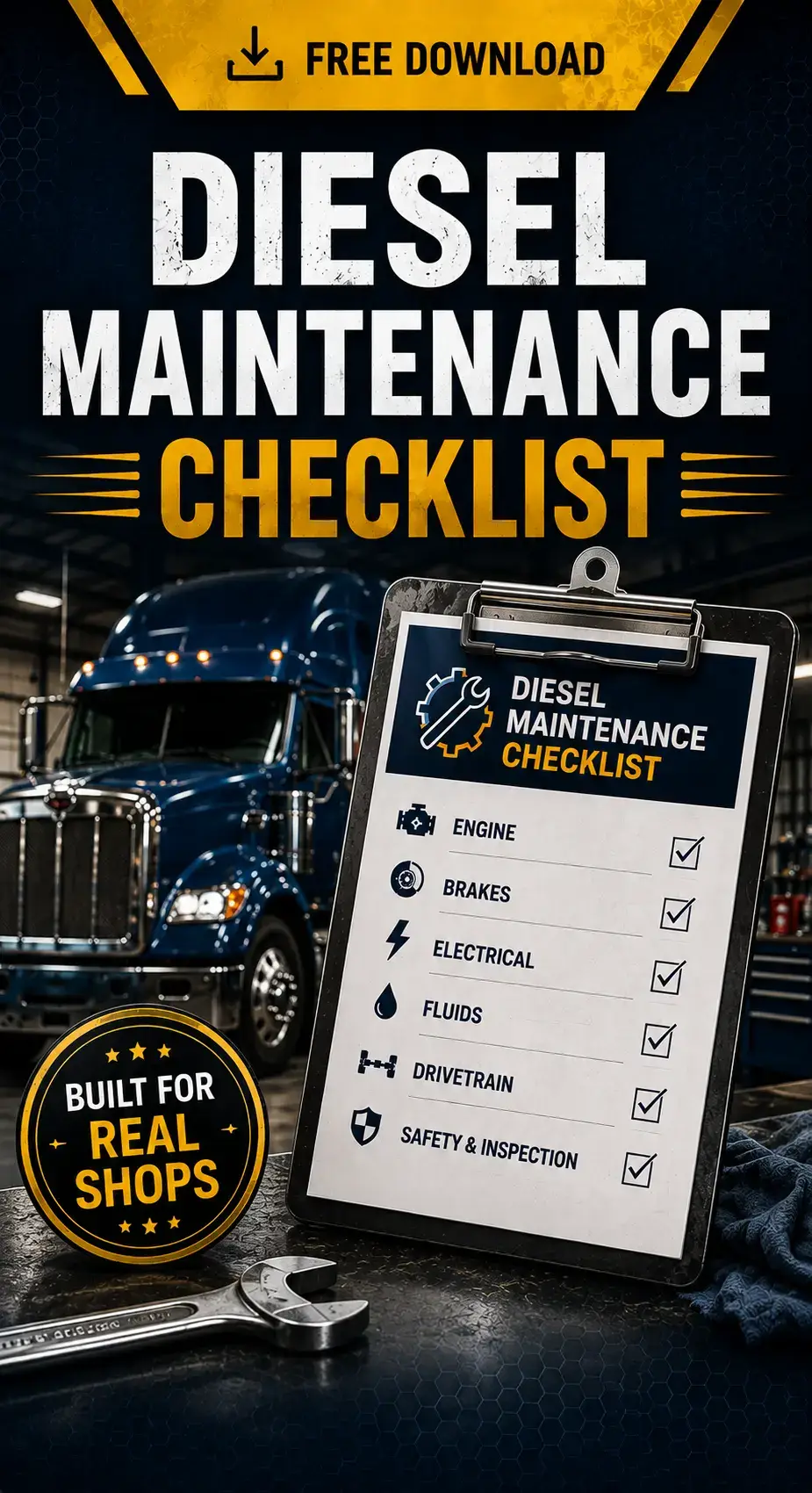
Free Diesel Maintenance Checklist
Get HDJ's free, field-tested diesel maintenance checklist delivered instantly to your inbox — print it, laminate it, keep it in the shop.
Instant PDF • 100% Free • No Spam
Hours of Service Compliance and ELD Mandates
Hours of service compliance stands as a critical pillar of fleet safety operations, with electronic logging devices now serving as the primary tool for preventing driver fatigue and ensuring regulatory adherence. The ELD mandate fundamentally changed how carriers monitor driving time and rest periods, eliminating most paper logbooks.
Electronic Logging Device Requirements
Federal regulations under 49 CFR Part 395, Subpart B mandate that most commercial motor vehicles must be equipped with a registered and compliant ELD that automatically records driving time. Important exemptions exist for vehicles manufactured before model year 2000 and drivers qualifying for the short-haul exception under 395.1(e).
Hours of Service Rules and Exemptions
Property-carrying drivers must follow an 11-hour driving limit after 10 consecutive hours off duty, a 14-hour on-duty limit, a 30-minute break requirement after 8 cumulative hours of driving, and 60/70-hour duty limits over 7/8 consecutive days with a 34-hour restart provision.
Passenger-carrying drivers operate under different constraints: 10-hour driving limit after 8 consecutive hours off duty, 15-hour on-duty limit, and 60/70-hour duty limits. The adverse driving conditions exception permits up to 2 additional driving hours when unexpected weather or traffic conditions slow progress.
Common HOS Violations to Avoid
Form and manner violations occur when duty status records lack required information. False log violations — deliberately falsifying records to hide HOS violations — represent one of the most serious offenses, carrying penalties up to $15,846 per falsified record under current 49 CFR Appendix B to Part 386, plus potential criminal charges.
Driving beyond allowed hours, failing to take required 30-minute breaks, and 34-hour restart violations consistently generate citations during roadside inspections.
Drug and Alcohol Testing Program Requirements
A robust fleet drug testing program forms the foundation of DOT compliance, protecting both your business and the traveling public from substance-impaired drivers. Federal regulations under 49 CFR Part 382 mandate that commercial carriers establish comprehensive testing protocols for all safety-sensitive employees.
DOT Drug Testing Panel and Procedures
The DOT mandates testing for five specific drug categories: marijuana metabolites, cocaine metabolites, amphetamines (including methamphetamine and MDMA), opiates, and phencyclidine (PCP). These substances remain strictly prohibited regardless of state laws that may permit recreational or medical use — federal regulations supersede all state legislation for commercial motor vehicle operations.
A Medical Review Officer reviews all positive, adulterated, and substituted test results, contacting drivers to determine if legitimate medical explanations exist before reporting verified violations. Alcohol prohibitions include a complete ban four hours before reporting for duty, with blood alcohol concentration limits set at 0.04% for commercial drivers.
Testing Categories and Requirements
Federal law requires six distinct testing types. Pre-employment testing must occur before any driver performs safety-sensitive functions, and random testing — DOT confirmed the minimum annual rates unchanged for 2026 at 50% for drugs and 10% for alcohol, the sixth consecutive year at these levels — forms the backbone of ongoing compliance monitoring.
Post-accident testing becomes mandatory after fatalities, injuries requiring immediate medical treatment away from the scene, or when vehicles require towing and the driver receives a citation. Reasonable suspicion testing occurs when trained supervisors observe behavior indicating possible substance use, and return-to-duty and follow-up testing apply after violations.
Record Retention for Testing Programs
Verified positive results, refusals to test, SAP reports, and follow-up test results require five-year retention. Records related to testing processes, including calibration documentation and negative annual results, require one-year retention.
Verifying a carrier's current standing takes seconds with the right tool — worth bookmarking alongside the Motus portal for quick reference:
Free DOT Status Check
Enter a USDOT number and quickly review public carrier status, operating authority and key FMCSA registration data.

DOT Compliance Fleet Checklist: Implementation Guide
Successful compliance implementation depends on establishing clear, repeatable processes that integrate seamlessly into fleet operations. A structured compliance program begins with a comprehensive policy manual outlining safety standards, driver expectations, and recordkeeping procedures.
Daily Compliance Tasks
Drivers must complete pre-trip vehicle inspections and document findings on DVIRs. Electronic Logging Devices require daily verification for proper functionality, and dispatchers should verify drivers have adequate hours available before assigning trips.
Fleet managers must review ELD data daily for HOS violations, and maintenance personnel must address safety defects before vehicles return to service.
Weekly and Monthly Compliance Activities
Weekly DVIR review identifies recurring vehicle issues requiring attention, and weekly verification ensures random drug and alcohol testing selections meet required percentages. Monthly driver qualification file reviews identify expiring medical certificates or licenses, while monthly CSA score analysis reveals trends requiring corrective action.
Annual Compliance Requirements
Annual vehicle inspections must be completed for all fleet vehicles within required timeframes, and annual driver reviews documenting safety performance are mandated by 49 CFR 391.25. Annual UCR registration renewals maintain interstate operating authority, and biennial MCS-150 updates verify company information with FMCSA — now filed through Motus.
Compliance Cost Analysis and Budget Planning
The true cost of maintaining DOT compliance extends beyond registration fees to encompass technology investments, testing programs, and administrative overhead. A comprehensive fleet compliance budget accounts for initial setup requirements, recurring annual expenses, and variable costs that fluctuate based on operational changes.
Initial Setup Costs for New Fleets
The USDOT number application carries no federal filing fee, but many operators invest $300 to $500 in consultant assistance to ensure accurate completion through Motus. Motor Carrier Authority application requires a $300 filing fee, while BOC-3 process agent designation costs $300 to $500 for nationwide coverage.
ELD hardware and software implementation requires $200 to $700 per vehicle for equipment. Drug and alcohol testing program establishment costs $500 to $2,000 depending on program complexity, and driver qualification file development demands $200 to $400 per driver for MVR purchases, background checks, and medical examinations.
New fleet operators typically invest $5,000 to $8,000 for initial compliance setup, while small fleets with five to ten vehicles face $15,000 to $30,000 in startup costs. Medium-sized operations with 25 to 50 vehicles should budget $50,000 to $100,000 for comprehensive compliance infrastructure.
Annual Compliance Expenses
UCR annual renewal for 2026 ranges from $46 for the smallest carriers to $44,836 for fleets of 1,001 or more vehicles — expect the 2027 cycle to run roughly 20% higher across brackets. IFTA quarterly reporting requires administrative time investment or outsourced service fees totaling $200 to $800 annually, and IRP annual registration renewal generally costs $500 to $1,500 per vehicle.
ELD subscription fees range from $20 to $50 per vehicle monthly. Drug and alcohol testing programs generate $100 to $300 per driver annually, annual vehicle inspections add $80 to $150 per vehicle, and driver medical certifications cost $50 to $150 per examination.
Hidden Costs and Variable Expenses
Vehicle downtime creates revenue loss when equipment is placed out of service — each day of downtime costs $500 to $1,500 in lost productivity. Driver downtime during medical certification appointments, drug testing, and training represents lost productive hours that must be budgeted.
Small fleets typically allocate half a full-time position to compliance tasks, while medium operations require one to two dedicated positions. Insurance premiums are heavily influenced by compliance records — fleets with strong histories benefit from lower premiums, while those with violations face increases of 15 to 50 percent. HDJ's fleet safety program guide covers the strategies that keep those premiums down.
Avoiding Penalties: Audit Preparation and Violation Prevention
DOT enforcement actions carry severe consequences extending far beyond initial fines. Beyond monetary penalties, enforcement actions damage safety ratings, increase insurance costs, and can ultimately jeopardize operating authority.
Financial Consequences of Non-Compliance
FMCSA civil penalties adjust for inflation under the Federal Civil Penalties Inflation Adjustment Act, though the federal government-wide 2026 adjustment cycle was affected by delayed inflation data — the current maximums under 49 CFR Appendix A/B to Part 386 remain at 2025-adjusted levels. Recordkeeping violations (incomplete, inaccurate, or false records) carry a maximum civil penalty of $1,584 for each day the violation continues, up to $15,846.
Most non-recordkeeping violations of Parts 382, 385, and 390-399 — which includes hours-of-service violations — carry a maximum reaching $19,246 per violation for motor carriers and $4,812 per violation for drivers, with knowing falsification of records carrying its own maximum of $15,846 per record.
Out-of-service violations carry some of the steepest penalties in the schedule. A driver operating a vehicle during an out-of-service period faces up to $2,304 per violation, while a carrier requiring or permitting that operation faces up to $23,048 per violation. Because FMCSA can cite the same underlying failure separately for each affected driver or each day it continues, totals compound quickly across a fleet.
Systematic Fleet Audit Preparation
FMCSA conducts several types of audits, each with specific triggers. New Entrant Safety Audits occur within the first 12 months of operation. Compliance Reviews target carriers with poor safety performance, complaints, or crash involvement, and Focused Investigations address specific compliance areas where data suggests significant deficiencies exist.
Systematic fleet audit preparation begins with conducting regular internal mock audits using the same standards FMCSA auditors apply. Driver qualification file organization represents a critical component — all DQF documents must be complete, properly organized, and in required order.
CSA Performance and Business Impact
The Compliance, Safety, Accountability program continuously monitors carriers through seven Behavior Analysis and Safety Improvement Categories. Violations identified during roadside inspections receive severity weights based on crash risk correlation, with recent violations carrying more impact than older ones.
Insurance carriers now routinely review CSA scores when underwriting policies, with poor performers experiencing premium increases of 20 to 50 percent. Many shippers and brokers now review CSA scores before awarding contracts, making safety performance a competitive business factor that often exceeds the direct cost of penalties.
Frequently Asked Questions
What triggers DOT compliance requirements for my vehicles?
Three criteria trigger full DOT compliance: 10,001+ pounds GVWR, transporting 16+ passengers, or carrying placardable hazmat quantities under 49 CFR Part 172. Meeting any single criterion requires complete regulatory adherence.
Where do I register for a USDOT number now?
As of May 14, 2026, FMCSA retired its legacy registration systems in favor of Motus. New applications, MC authority filings, and biennial MCS-150 updates all now route through Motus rather than the older portals many fleet managers had bookmarked.
How often must driver qualification files be updated?
Annual reviews of each driver's safety record are mandated by 49 CFR 391.25, and motor vehicle records must be obtained annually from every state where a driver held a license. Medical certificates typically renew every one to two years.
What are the most common DOT compliance violations?
The most frequently cited violations include incomplete driver qualification files, hours-of-service violations, missing or inadequate vehicle inspection records, brake system deficiencies, and drug testing program gaps.
How can I prepare for a DOT compliance audit?
Conduct quarterly internal mock audits using FMCSA standards, keep driver qualification files organized and complete, and verify ELD data quality and current registrations. Designating a compliance officer significantly improves audit outcomes.
DOT regulatory compliance serves as the foundation for safe and profitable fleet operations. Effective fleet compliance management requires systematic attention to driver qualifications, vehicle maintenance, hours of service, drug testing programs, and documentation practices.
Regulations continue to evolve through FMCSA rulemakings and infrastructure changes like the Motus registration system, requiring ongoing monitoring to implement adjustments before enforcement begins. Heavy Duty Journal covers the rest of HDJ's compliance and fleet management library for carriers tracking these changes as they land.
Carriers who view compliance as a core operational value rather than a minimum obligation position themselves for sustainable growth in an increasingly competitive industry.
Help Fellow Fleet Managers Stay Compliant
Know a fleet manager or safety director who could benefit from this compliance guide? Share this resource with your professional network.