

Content provided by HMD Trucking
Last Updated: November 2026
⏱ Estimated reading time: 11 minutes
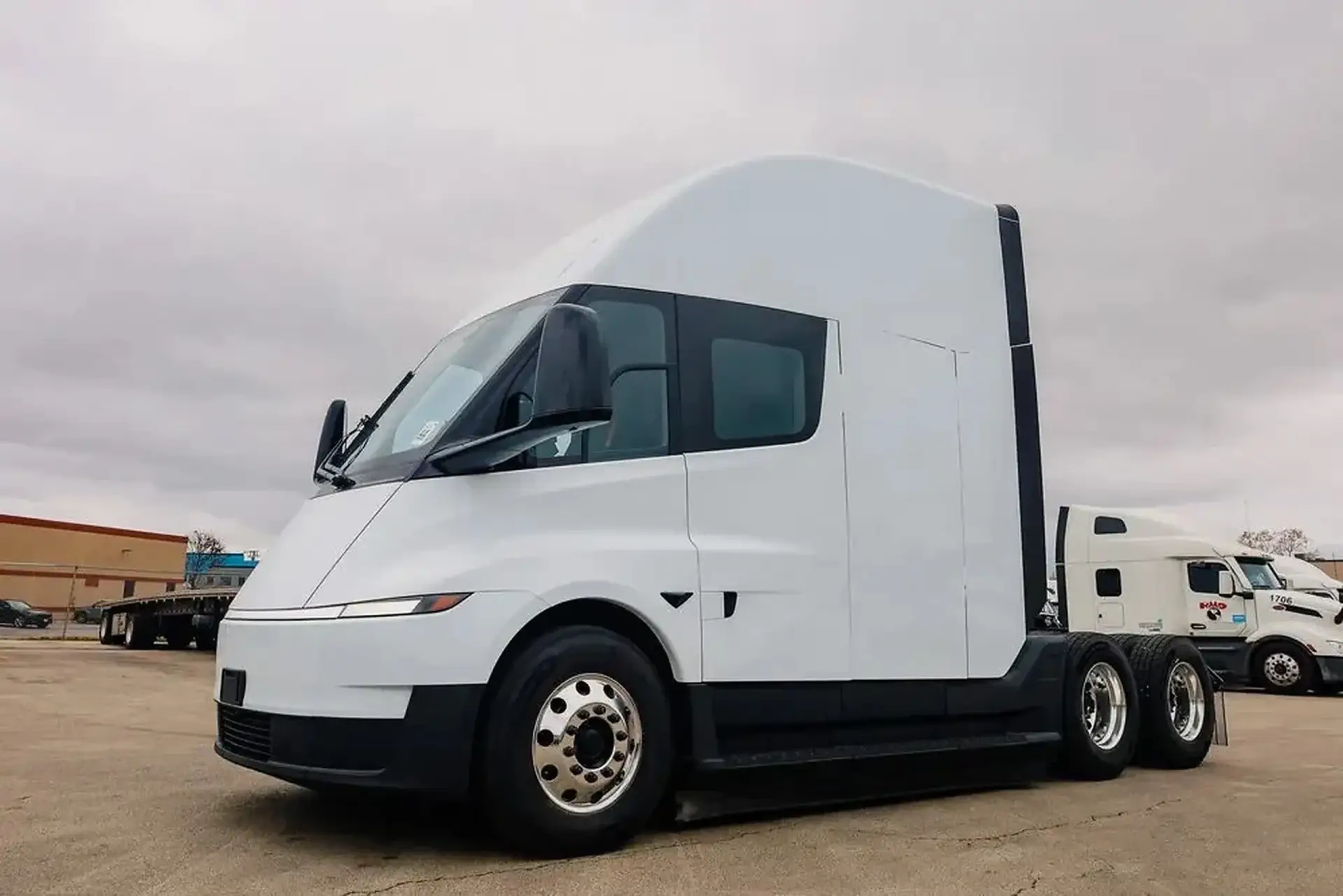
HMD Trucking took delivery of the first vehicle in its 50-unit Tesla Semi order on November 2, 2026, and the carrier says it is the first Tesla Semi registered in Illinois. Before committing, HMD ran one Semi for more than 4,000 miles over the summer and reported average consumption of 1.74 kWh per mile. That gives fleet operators a real-world starting point for comparing fuel costs, charging schedules and the work drivers will do.
This Heavy Duty Journal article looks at the HMD Trucking Tesla Semi deployment from the driver's side: what is confirmed, what the energy numbers mean on a 400-mile day and how the job changes. The cost tables use HDJ's own assumptions, not HMD's, and HDJ's electric semi truck cost guide covers purchase costs in more depth.
Key Takeaways
- 01The first truck arrived November 2. Drive Tesla reported on November 19 that HMD reportedly has all 50, but HMD had not confirmed the full delivery.
- 02Energy use was 1.74 kWh per mile. HMD reported that average over more than 4,000 summer miles, close to Tesla's 1.7 kWh per mile claim.
- 03Charging location drives the cost. Depot electricity at $0.12 per kWh costs far less than public charging at $0.35 per kWh in HDJ's illustration.
- 04Routes start local. The first trucks are expected to run mostly local Chicago-area routes with HMD's own chargers.
- 05Hours-of-service rules still apply. Charging time can fit a required break but does not extend the driving window.
- 06Winter data is still to come. HMD plans to track battery conditioning, cabin heating and regenerative braking on slippery roads.
In This Guide · 10 sections
- What the HMD Trucking Tesla Semi Deployment Tells Us
- The Cost of a 400-Mile Workday
- When Electricity Stops Being Cheaper
- Why a Shorter Route Can Outperform a Longer One
- How the Job Changes Behind the Wheel
- What to Measure During the First Winter
- What HDJ Could Not Confirm
- What Dallas Drivers Should Ask About New Equipment
- Frequently Asked Questions
- The Bottom Line
01
What the HMD Trucking Tesla Semi Deployment Tells Us
The HMD Trucking Tesla Semi order is the first 50-truck Semi order tied to Chicago. HMD is a family-owned carrier founded in Chicago in 1998 that runs more than 650 trucks, almost all of them diesel, according to Electrek. Owner Henry Malukas told MotorTrend the deal is worth about $15 million, roughly $300,000 per truck, and also admitted "we don't have real numbers yet" on savings.
The first trucks will mostly run local routes around Chicago. Electrek reports that HMD is installing its own chargers, because Tesla's Megacharger network is concentrated along western corridors. Delivery should be kept separate from service: Tesla said on November 11 that 50 Semis were en route, and Drive Tesla reported on November 19 that HMD reportedly has all 50, based on a LinkedIn post. As of November 2026, HDJ found no HMD confirmation of the full delivery and no report of how many are in freight service.
| Metric | Reported figure | Source |
|---|---|---|
| HMD order | 50 Tesla Semi tractors | HMD; Electrek |
| First delivery | November 2, 2026 | HMD, as reported by Electrek |
| Summer trial | More than 4,000 miles on one Semi | HMD, as reported by Electrek |
| Trial energy consumption | 1.74 kWh per mile | HMD; Tesla claims 1.7 |
| Tesla standard and long range models | About 325 and 500 miles | Tesla, as reported by CCJ |
| Tesla fast charging claim | Up to 60% charge in 30 minutes | Tesla, as reported by CCJ |
| Reported deal value | About $15 million, roughly $300,000 per truck | Malukas to MotorTrend, via Electrek |
Tesla's range figures are manufacturer estimates. The CCJ report HDJ read lists a 82,000 pound combined weight rating for both versions but does not give the test conditions, so actual range will depend on load, weather, speed and trailer configuration. The Semi in HMD's trial was a single truck, and HMD's results are self-reported, not an independent test.
HMD's own blog, written by Michael Mahler, says diesel remains the practical choice for most fleets, especially for over-the-road drivers crossing many time zones, and that electric trucks suit regional routes that return to base nightly. The same post estimates diesel at $0.45 to $0.55 per mile and electricity at $0.12 to $0.25 per mile, which are HMD's pre-delivery estimates, not trial results.
02
The Cost of a 400-Mile Workday
A 400-mile electric workday uses about 696 kWh of vehicle energy, compared with about 61.5 gallons of diesel at 6.5 miles per gallon. The 1.74 kWh per mile is HMD's reported figure. The 6.5 mpg and the electricity prices are HDJ's assumptions for illustration, and the diesel price is the U.S. average of $5.937 per gallon for the week of November 16, 2026 (U.S. Energy Information Administration diesel prices).
| Energy source | Unit price | Energy cost per mile | Cost for 400 miles |
|---|---|---|---|
| Diesel | $5.94/gal | $0.91 | $365.35 |
| Electricity at depot | $0.12/kWh | $0.21 | $83.52 |
| Electricity at public charger | $0.35/kWh | $0.61 | $243.60 |
Illustrative energy costs from the assumptions above. These are not HMD's numbers, a guaranteed electric tariff or a complete cost of ownership. Metered electricity can exceed vehicle consumption because charging is not perfectly efficient. For a different diesel baseline, HDJ's semi truck fuel economy guide explains what moves a tractor's mpg.
The depot charging case saves about $282 in energy per 400 miles. The public charging case saves about $122. That distinction matters: a fleet cannot assume the lowest rate for every mile simply because it owns an electric truck, which is why HMD's depot charging plan is central to the economics.
03
When Electricity Stops Being Cheaper
The energy-only break-even electricity rate equals the diesel price divided by 6.5 and then by 1.74. A sensitivity table shows why the same truck can pencil out on one lane and struggle on another, and why diesel price changes the answer more than most fleets expect.
| Diesel price per gallon | Diesel cost per mile | Break-even electricity price |
|---|---|---|
| $3.50 | $0.54 | $0.31/kWh |
| $4.50 | $0.69 | $0.40/kWh |
| $5.94 | $0.91 | $0.52/kWh |
At a $3.50 diesel price, charging at $0.35/kWh would already cost more per mile on energy alone. Actual utility bills, charging losses, demand charges and charger availability belong in the calculation. Capital costs, insurance, residual value, maintenance, payload and revenue lost during downtime determine the larger business case, and HDJ's diesel versus electric truck TCO analysis walks through them. Lower energy cost by itself says nothing about a driver's paycheck.
04
Why a Shorter Route Can Outperform a Longer One
A shorter, predictable route can outperform a longer one because charging and delivery windows can be coordinated. A 400-mile assignment at an average moving speed of 50 mph requires eight hours behind the wheel. Add two hours for yard movements, inspections and loading, plus a 30-minute charging stop, and the example takes 10.5 hours before unexpected delays. This is a hypothetical schedule, not an HMD dispatch.
The Federal Motor Carrier Safety Administration hours of service rules generally limit property-carrying drivers to 11 driving hours after 10 consecutive hours off duty, within a 14-hour window. A break of at least 30 consecutive minutes is required after 8 cumulative hours of driving, and an on-duty, not-driving period can count (FMCSA hours of service page). Charging may fit that break, subject to proper duty-status logging.
Charger queues, repositioning and delays still take time, and the break does not extend the 14-hour window. HDJ's hours of service rules guide covers the full rules, and HDJ's electric truck charging infrastructure guide covers how depot charging is planned.
Editorial Insight
The HDJ Perspective
According to Heavy Duty Journal, the most useful number in the HMD Trucking Tesla Semi story is not the 1.74 kWh per mile, it is where the truck charges. In HDJ's field experience across 15+ years of coverage, an electric tractor that returns to its own depot every night behaves like a different machine from one that depends on public chargers, and drivers feel that difference in their hours.
05
How the Job Changes Behind the Wheel

An electric tractor changes the daily routine more in planning and training than in the cab's basic duties. Drivers still handle the vehicle and remain responsible for inspections, safe following distance, freight securement where applicable and accurate logs. An electric powertrain does not make a commercial truck autonomous.
| Workday component | Conventional diesel tractor | Battery electric tractor |
|---|---|---|
| Dispatch planning | Refueling and route appointments | Charging location, energy reserve and appointments |
| Routine inspections | Fluid levels, tires, air system and visible damage | Tires, air system, visible damage and vehicle-specific checks |
| Maintenance | Engine and exhaust aftertreatment service | Battery, electrical systems and cooling; fewer engine-related service tasks |
| Driver training | Transmission, engine braking and familiar instrumentation | Regenerative braking, display controls and charging procedures |
| Route fit | Flexible nationwide runs | Repeatable lanes with dependable charging access |
Tesla describes the Semi as having up to 800 kW of drive power, according to CCJ, and a different cab layout than a conventional tractor, so orientation and training matter. According to HMD's blog, drivers generally like the technology and visibility of the center seat, though some find it inconvenient to leave the seat to hand over paperwork at gates, and electric torque lets an 82,000-pound load merge onto the highway with ease.

06
What to Measure During the First Winter
The first Chicago winter will show what the summer trial could not. HMD plans to track battery conditioning, cabin heating energy use and regenerative braking on slippery roads, as reported by Teslanorth. A comparable test should log ambient temperature, gross vehicle weight, miles, vehicle energy use, electricity billed, charging and queue time, appointment performance and maintenance downtime on similar freight and routes.
For example, if energy consumption rose 15% from the reported summer average, a 400-mile trip would require about 800 kWh rather than 696 kWh. At $0.35/kWh, the illustrative cost would increase from $244 to $280. This is a sensitivity calculation, not a prediction of HMD's winter performance. HDJ's electric truck cold weather performance guide explains what cold does to range and charging.
07
What HDJ Could Not Confirm
HDJ could not confirm several details that circulate about the HMD Trucking Tesla Semi deployment. As of November 2026, HDJ did not find a cost comparison from HMD based on the trial results, the load type in the 4,000-mile trial beyond freight hauled, or HMD's own confirmation that all 50 Semis have arrived. The cost tables in this article are HDJ's illustration for that reason.
HDJ also did not find the test conditions behind Tesla's range estimates or any winter results. The Hodgkins Megacharger near Chicago has six stalls of up to 1.2 MW each, per Tesla as reported by EVwire, but HDJ did not find which HMD routes will use it. Heavy Duty Journal will update this article at heavydutyjournal.com when HMD or Tesla publish more.
08
What Dallas Drivers Should Ask About New Equipment
Technology is one factor in choosing a carrier. A Dallas–Fort Worth driver interested in a fleet that is investing in different kinds of equipment should compare where the tractor is assigned, the route's freight type, how waiting and charging time are paid, the amount of home time and what equipment training is included. HMD's truck driving jobs in Dallas are a place to review current freight-driving assignments and ask a recruiter about equipment.
The company's initial Tesla deployment is in the Chicago region, and HDJ found no announced Texas plan. Dallas candidates should not assume an electric tractor is available for a specific Texas job. The next meaningful milestone for the Semi is repeatable commercial service through different seasons, and drivers benefit most when the route, pay policy, training and support work together.
FAQ
Frequently Asked Questions
How much is HMD Trucking paying for its Tesla Semis?
Owner Henry Malukas told MotorTrend the 50-truck deal is worth about $15 million, roughly $300,000 per truck, as reported by Electrek. Tesla has not announced final Semi pricing, according to CCJ, so the figure is the owner's own characterization of the order.
How many Tesla Semis has the HMD Trucking Tesla Semi order delivered so far?
HMD says its first Semi arrived November 2, 2026. Drive Tesla reported November 19 that HMD reportedly has all 50, citing a LinkedIn post, but HMD had not confirmed it. As of November 2026, HDJ found no report of how many are hauling freight.
What energy use did HMD report for the Tesla Semi?
HMD reported an average of 1.74 kWh per mile over more than 4,000 miles in a summer trial of one Semi. Tesla claims 1.7 kWh per mile, according to CCJ. The result is self-reported by the carrier and was not independently tested or verified.
Is electricity cheaper than diesel per mile for a Tesla Semi?
In HDJ's illustration, yes, on energy alone. At $5.94 diesel and 6.5 mpg, diesel costs about $0.91 per mile, versus $0.21 at $0.12 per kWh and $0.61 at $0.35 per kWh. Purchase price, charging losses, maintenance and downtime are all excluded from that comparison.
Where will HMD charge its Tesla Semis?
Electrek reports HMD is installing its own chargers, and Malukas said the terminal will use overnight chargers. Tesla also operates a Megacharger at Hodgkins near Chicago, which Tesla says can restore up to 60% of range in about 30 minutes under favorable conditions.
Do hours of service rules change for electric trucks?
No. FMCSA's limits of 11 driving hours and a 14-hour window still apply, and a 30-minute break is required after 8 cumulative hours of driving. Charging may fit that break if duty status is logged correctly, but it does not extend the driving window.
Will HMD drivers in Dallas drive Tesla Semis?
Not based on anything HDJ found. HMD's first Semis are expected to run mostly local Chicago-area routes. Dallas candidates should ask a recruiter whether any assignment involves electric equipment rather than assuming it, and should compare how pay treats charging and waiting time.
What range does Tesla claim for the Semi?
Tesla's final specifications list about 325 miles for the standard version and about 500 miles for the long range version, as reported by CCJ. HDJ did not find the test conditions, so actual range depends on load, weather, speed and trailer configuration.
How will cold weather affect HMD's Tesla Semis?
HDJ found no winter results yet from the trucks. HMD plans to track battery conditioning, cabin heating energy use and regenerative braking on slippery roads through the Chicago winter. Cold generally raises energy use per mile, so range and charging time are the two figures to watch.
Wrap-up
The Bottom Line
The HMD Trucking Tesla Semi deployment is, so far, one delivered truck, a promising summer trial and a first winter still to come. The energy numbers favor electricity on predictable depot-charged routes, but the cost of the truck, charging losses and downtime decide the real case. For drivers, the questions are route assignment, pay for charging and waiting time, and training.
Heavy Duty Journal will keep tracking the HMD Trucking Tesla Semi rollout at heavydutyjournal.com. The most useful next step for another carrier is to log its own routes, test one repeatable lane and compare energy, time and downtime before committing to an order.
Share This Tesla Semi Article
Know a fleet manager or driver weighing electric trucks? Share this article so they can see what HMD's deployment does and does not show.