
By Michael Nielsen, Editor & Publisher | 15+ Years in Diesel Repair
Last Updated: January 2026
📖 Estimated reading time: 22 minutes
Electric truck cold weather performance represents one of the most significant operational challenges facing fleet managers considering zero-emission vehicles. When temperatures drop to 20°F, electric trucks lose 30-40% of their driving range—a reduction that transforms a 300-mile truck into a 180-210 mile vehicle requiring careful route planning and more frequent charging stops.
This range reduction stems from fundamental battery chemistry changes combined with energy demands for cabin heating that can consume 3-5 kW per hour. For fleet managers operating in northern climates, understanding these limitations—and the strategies that mitigate them—proves essential for successful electric truck deployment.
However, cold weather impacts aren’t unique to electric powertrains. Diesel trucks experience 10-15% efficiency losses in winter conditions, though their rapid refueling capability makes range reduction less operationally disruptive. The real question isn’t whether cold affects electric trucks—it does—but whether your specific operational profile can accommodate these limitations while still achieving positive return on investment.
Key Takeaways
- Range Impact: Electric trucks lose 30-40% of driving range at 20°F compared to optimal temperatures, primarily from battery efficiency losses and heating demands
- Battery Chemistry: Lithium-ion batteries experience slower chemical reactions in cold temperatures, reducing power output and requiring thermal management systems to maintain performance
- Comparative Performance: Diesel trucks lose 12-15% efficiency in cold weather, but rapid refueling makes range loss less operationally disruptive than electric truck charging requirements
- Mitigation Strategies: Pre-conditioning batteries while plugged in preserves 15-25% of winter range; heated facilities add another 18-28%
- Operational Viability: Urban delivery fleets covering 80-120 miles daily remain viable even with 35-40% range loss; regional haul operations exceeding 200 miles face greater challenges
- Technology Evolution: Solid-state batteries, megawatt charging, and improved thermal management systems are narrowing the cold weather performance gap
How Cold Weather Affects Electric Truck Battery Performance
Battery chemistry fundamentally changes when temperatures drop below 32°F. Lithium-ion batteries—the dominant technology in commercial electric trucks—rely on electrochemical reactions between lithium ions moving through an electrolyte solution. Cold temperatures increase the electrolyte’s viscosity, slowing ion movement and reducing the battery’s ability to accept and deliver charge efficiently.
At 20°F, a battery that delivers 100% capacity at 70°F may only provide 60-70% of its rated capacity. This isn’t permanent damage—the capacity returns when the battery warms—but it creates immediate operational constraints. Fleet managers report that a Freightliner eCascadia rated for 250 miles might achieve only 150-175 miles in sustained winter conditions.

Thermal management systems work continuously in cold weather to maintain optimal battery operating temperatures between 60-80°F.
The problem compounds because batteries must divert energy to self-heating. Modern electric trucks employ thermal management systems that circulate heated coolant through battery packs to maintain temperatures between 60-80°F for optimal performance. This heating can consume 2-4 kW continuously, effectively reducing available range by 15-20% before accounting for cabin heating demands.
Energy Demands Beyond Propulsion
Cabin heating represents the second major energy drain in cold weather operation. Unlike diesel trucks that use waste engine heat for the cab, electric trucks must generate heat electrically. Resistive heating systems—similar to household space heaters—can consume 3-5 kW per hour to maintain comfortable cab temperatures in sub-freezing conditions.
A fully loaded Class 8 electric truck traveling at highway speeds typically consumes 1.5-2.0 kWh per mile for propulsion. Adding 5 kW for heating means an additional 0.3-0.4 kWh per mile in energy consumption—a 20-25% increase in total energy use. Over a 200-mile route, this translates to 60-80 additional kWh solely for comfort heating.
Some newer models employ heat pump technology, which transfers ambient heat rather than generating it resistively. Heat pumps can reduce heating energy consumption by 30-50% compared to resistive systems, but their efficiency drops significantly when outdoor temperatures fall below 15°F, forcing them to switch to supplemental resistive heating.
Range degradation accelerates below 20°F as both battery chemistry and heating demands increase exponentially.
Regenerative Braking Limitations
Cold batteries also accept charge more slowly, reducing regenerative braking effectiveness. When a truck decelerates, the motor acts as a generator, converting kinetic energy back into electrical energy stored in the battery. This process typically recovers 15-20% of energy used, extending range significantly in city driving with frequent stops.
However, cold batteries resist rapid charging to prevent lithium plating—a condition where lithium ions deposit on the anode surface rather than intercalating properly, causing permanent capacity loss. Battery management systems limit regenerative braking power in cold conditions, sometimes by 50% or more, forcing the mechanical brake system to handle more of the deceleration and losing valuable range recovery.
50%+
Reduction in regenerative braking capability when batteries are cold—directly impacting range recovery in stop-and-go operations
This limitation particularly affects urban delivery routes where regenerative braking typically provides the greatest benefit. Fleet operators report that stop-and-go driving in cold weather—which should be ideal for electric trucks—actually becomes one of the most challenging scenarios due to reduced regen efficiency combined with frequent heating cycles when doors open.
Electric Truck Cold Weather Performance vs. Diesel and Gasoline
While electric trucks face well-documented cold weather challenges, conventional internal combustion trucks aren’t immune to winter performance degradation. Understanding the comparative impacts helps fleet managers make informed decisions about powertrain selection for different operational profiles and geographic regions.
Diesel engines experience increased friction during cold starts as engine oil thickens, requiring more energy to overcome internal resistance. Modern diesel engines also use diesel exhaust fluid (DEF) for emissions control, which freezes at 12°F and requires heated tanks to remain operational. Winter diesel fuel blends contain additives to prevent waxing, but these typically reduce energy density by 3-5%, directly impacting fuel economy.
Comparative Efficiency Losses by Temperature
The U.S. Department of Energy has documented fuel economy impacts across different powertrains in cold weather conditions. Testing shows diesel trucks lose approximately 15% fuel efficiency at 20°F during highway driving, with losses reaching 20-25% on short trips where engines don’t fully warm up. Gasoline trucks perform slightly worse, losing 17-22% efficiency under similar conditions.
| Powertrain Type | Highway Efficiency Loss at 20°F | Short Trip Efficiency Loss | Primary Loss Factors |
|---|---|---|---|
| Battery Electric | 30-40% | 35-45% | Battery chemistry, cabin heating, reduced regen |
| Diesel | 12-15% | 20-25% | Oil viscosity, winter fuel blends, DEF systems |
| Gasoline | 15-17% | 22-28% | Winter fuel formulations, cold start enrichment |
| Hybrid Electric | 25-31% | 33-40% | Combined battery and combustion losses |
The data reveals that while all powertrains suffer efficiency losses in cold weather, electric trucks experience roughly double the impact compared to diesel alternatives. However, this comparison requires operational context. Electric trucks excel in applications with predictable routes and return-to-base charging, where reduced range can be accommodated through charging infrastructure planning.
Operational Implications Beyond Raw Efficiency
The critical difference between electric and diesel cold weather performance lies not just in efficiency losses but in operational flexibility. A diesel truck losing 15% range still maintains hundreds of miles between five-minute refueling stops. An electric truck losing 35% range might drop from 300 miles to 195 miles between multi-hour charging sessions.
Both electric and diesel trucks face cold weather challenges, but infrastructure availability determines operational impact.
For regional haul operations running 400-500 miles daily, this distinction becomes operationally significant. Fleet managers must either install mid-route charging infrastructure, reduce payload to extend range, or limit operating areas during winter months. Diesel trucks simply refuel more frequently without substantial operational changes.
Conversely, for urban delivery fleets operating 80-120 miles daily and returning to depot, electric trucks remain viable even with 35-40% range loss. The 200-mile truck retains 120-130 miles of winter range—adequate for daily operations with overnight charging. These fleets avoid diesel’s cold-start penalties on short trips and benefit from electric’s lower maintenance requirements regardless of season.
Technologies Improving Electric Truck Cold Weather Performance
The commercial vehicle industry is developing multiple technological approaches to mitigate cold weather performance gaps. These innovations span battery chemistry, thermal management, and vehicle system design, with some solutions already deployed in production trucks while others remain in development.
Advanced Battery Thermal Management Systems
Modern electric trucks employ sophisticated thermal management that actively heats and cools battery packs to maintain optimal operating temperatures. These systems use liquid coolant circuits that can draw heat from the battery during charging or operation, or add heat using electric resistance elements or heat pump technology.
The most advanced systems incorporate predictive thermal management that begins warming batteries before departure when the vehicle is still connected to shore power. Pre-conditioning uses grid electricity rather than battery energy to bring cells to optimal temperature, preserving range for actual driving. Tesla Semi and Freightliner eCascadia both offer scheduled pre-conditioning that integrates with fleet management software.
Next-generation systems under development include phase-change materials embedded in battery pack structures that absorb or release heat to stabilize temperatures with minimal energy input. These materials—similar to reusable hand warmers—can reduce heating energy consumption by 20-30% while providing more uniform temperature distribution across individual cells.
“Thermal management is now equally important as energy density in battery pack design. We’re seeing customers prioritize consistent year-round performance over maximum summer range.”
— Jake Fisher, Senior Director of Auto Testing, Consumer Reports
Heat Pump Technology for Cabin Comfort
Heat pumps represent a significant efficiency improvement over traditional resistive heating for truck cabs. Rather than converting electricity directly to heat—a 1:1 energy conversion—heat pumps move existing heat from outside air into the cab, achieving 2-3 times more heating per unit of electricity consumed.
However, heat pump efficiency drops as outdoor temperature decreases. At 40°F, a heat pump might deliver 3 kW of heat for every 1 kW of electricity consumed. At 0°F, that ratio might drop to 1.5:1, still better than resistive heating but significantly degraded. Most systems incorporate supplemental resistive heating that activates automatically when ambient temperatures fall below 10-15°F.
Manufacturers are exploring CO2-based heat pumps that maintain efficiency at lower temperatures compared to traditional refrigerant-based systems. CO2 heat pumps can operate effectively down to -20°F, extending the temperature range where electric trucks maintain reasonable cabin heating efficiency.
Battery Chemistry Innovations
Lithium iron phosphate (LFP) batteries are gaining adoption in commercial trucks despite slightly lower energy density than traditional nickel-manganese-cobalt (NMC) chemistry. LFP cells offer improved thermal stability and longer cycle life, though they experience similar cold weather performance degradation as NMC batteries.
Integrated thermal management systems circulate heated coolant through battery packs to maintain optimal operating temperatures.
Researchers are developing electrolyte formulations that remain fluid at lower temperatures, improving ion conductivity in cold conditions. These advanced electrolytes incorporate additives that prevent viscosity increases down to 0°F or below, potentially reducing cold weather range loss by 10-15 percentage points.
Solid-state batteries—which replace liquid electrolytes with solid ceramic or polymer materials—promise improved cold weather performance along with higher energy density and enhanced safety. However, commercial production remains several years away, with most analysts projecting 2027-2029 for initial commercial vehicle deployments.
Software Optimization and Predictive Systems
Advanced battery management software continuously optimizes charging and thermal management strategies based on weather forecasts, route planning, and historical performance data. These systems can pre-condition batteries during off-peak charging hours when electricity rates are lowest, reducing operational costs while ensuring optimal cold-start performance.
Predictive route planning software factors real-time weather conditions and forecasts into range calculations, alerting dispatchers when planned routes exceed available range with current temperatures. Integration with fleet management systems allows automatic route adjustments or vehicle substitutions when electric trucks can’t meet range requirements due to extreme cold.
Some manufacturers are developing machine learning algorithms that adapt thermal management strategies based on individual driver behavior and route characteristics. These systems learn optimal pre-conditioning timing and heating strategies that balance range preservation with driver comfort, potentially improving winter efficiency by 5-8% compared to static thermal management approaches.
Cost Analysis: Operating Electric Trucks in Cold Climates
Fleet managers evaluating electric trucks for cold climate operations must consider both direct operational costs and broader total cost of ownership factors. While electric trucks offer lower per-mile fuel and maintenance costs in moderate climates, cold weather operation changes the economic equation significantly.
Increased Energy Costs in Winter Operation
Cold weather increases electricity consumption per mile by 30-40%, directly impacting fuel costs. A truck averaging 1.8 kWh per mile in moderate weather might consume 2.5 kWh per mile at 20°F. With commercial electricity rates averaging $0.12-0.18 per kWh, this translates to an increase from $0.22 to $0.31 per mile—a 41% increase in fuel costs during winter months.
However, this must be compared against diesel trucks, which also experience winter efficiency losses and face higher base fuel costs. Diesel at $3.50 per gallon, with 6.5 mpg average efficiency dropping to 5.5 mpg in cold weather, costs $0.64 per mile in winter—still more than double the electric truck’s cold weather fuel cost.
The more significant economic impact comes from reduced productivity. If cold weather forces an electric truck to charge mid-route, adding 45-90 minutes to daily operations, the labor costs and reduced delivery capacity can exceed fuel cost differences. A driver earning $30 per hour represents $22.50-$45.00 in additional labor costs per charging session, plus opportunity costs from delayed deliveries or reduced daily route capacity.
Infrastructure Investment Requirements
Operating electric trucks in cold climates often requires additional charging infrastructure to compensate for reduced range. A fleet that could operate one 150 kW charging station for summer routes might need two stations to support the same routes in winter, when trucks require more frequent charging and longer session times.
DC fast charging infrastructure costs $75,000-$150,000 per 150 kW dispenser, including installation and electrical service upgrades. Fleets requiring additional cold weather charging capacity face substantial capital requirements. Additionally, electrical demand charges—monthly fees based on peak power consumption—increase when multiple trucks charge simultaneously during cold weather, adding $500-$1,500 per month to facility electrical costs.
Some fleets mitigate these costs through creative infrastructure strategies. Installing heated parking structures allows trucks to charge in controlled temperatures, reducing thermal management energy consumption and improving charging efficiency. While a heated facility requires upfront investment, it can improve winter range by 15-20% through reduced thermal losses alone.
| Cost Factor | Electric (Cold Weather) | Diesel (Cold Weather) |
|---|---|---|
| Fuel Cost per Mile | $0.28-$0.35 | $0.58-$0.68 |
| Annual Maintenance | $0.08-$0.12/mile | $0.15-$0.20/mile |
| Infrastructure per Truck | $35,000-$65,000 | $5,000-$12,000 |
| Productivity Impact | Moderate to High | Low |
Long-Term ROI Considerations
Despite higher cold weather operating costs and infrastructure requirements, electric trucks can still achieve positive return on investment in many cold climate applications. The key lies in matching vehicle capability to operational requirements and leveraging available incentives.
Federal tax credits provide up to $40,000 per commercial electric vehicle through the Clean Commercial Vehicle Credit (IRC Section 45W). Many states offer additional incentives—California’s HVIP program provides up to $120,000 per vehicle, while New York offers $185,000 for Class 8 trucks. These incentives can offset 40-60% of the purchase price premium compared to diesel equivalents.
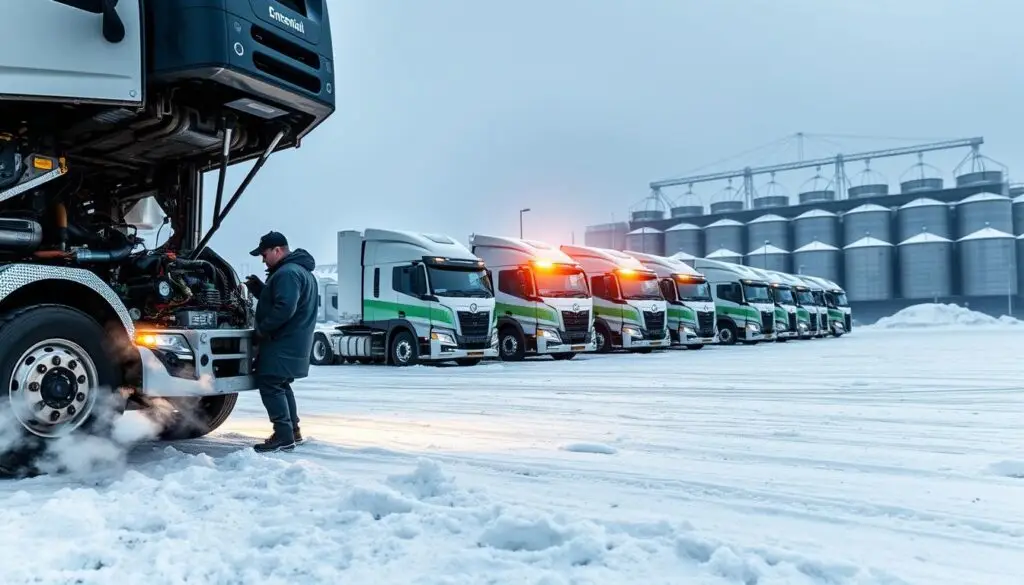
Comprehensive cost analysis must factor cold weather impacts on both fuel consumption and operational efficiency.
Maintenance cost advantages persist regardless of climate. Electric drivetrains eliminate oil changes, transmission service, diesel particulate filter replacement, DEF system maintenance, and many brake services due to regenerative braking. Fleet managers report annual maintenance savings of $0.08-$0.12 per mile, which translates to $8,000-$12,000 annually for trucks covering 100,000 miles per year.
The total cost of ownership calculation depends heavily on operational profile. Regional haul trucks running 200+ miles daily in cold climates show weaker ROI due to range limitations and charging time impacts. Urban delivery trucks covering 80-120 miles daily with return-to-base charging achieve 3-5 year payback periods even in northern climates, with total savings reaching $75,000-$120,000 over a 10-year vehicle life.
The HDJ Perspective
The cold weather performance gap represents a temporary challenge, not a fundamental barrier to electric truck adoption. We’re seeing the same pattern that played out with diesel emissions technology—early systems required operational compromises that improved dramatically over 5-7 years. Fleet managers who establish electric truck operations now, even at limited scale, build the institutional knowledge and infrastructure foundation that positions them for rapid expansion as battery technology matures. The fleets waiting for “perfect” cold weather performance may find themselves scrambling to catch up when regulatory mandates accelerate adoption timelines.
Real-World Electric Truck Cold Weather Performance Data
Field testing and early commercial deployments provide valuable data about how electric trucks actually perform in cold weather operations. These real-world results often reveal nuances not captured in laboratory testing or manufacturer specifications.
Commercial Fleet Experiences
PepsiCo began operating Tesla Semi trucks in California in late 2022, expanding trials to colder climates in 2023-2024. Fleet managers reported that while the trucks performed well in moderate California weather, winter operations in northern distribution centers required operational adjustments. Route planning shifted to account for 35% range reduction on cold mornings, with some routes reassigned to diesel trucks when temperatures fell below 15°F.
Canada Post tested electric delivery vehicles in Ottawa and Winnipeg—cities experiencing regular winter temperatures of -5°F to 15°F. The Crown corporation reported that vehicles required pre-conditioning times of 45-60 minutes before departure to achieve acceptable range, compared to 15-20 minutes in moderate weather. Mid-route charging became necessary on routes that were previously completed on a single charge during summer operations.
FedEx’s electric truck pilot in Memphis and Indianapolis provided comparative data across different climate zones. Indianapolis operations, experiencing average winter temperatures of 25-35°F, saw 28-32% range reduction. Memphis, with milder winters averaging 38-45°F, experienced only 18-22% range loss. The data confirmed that moderate cold impacts electric trucks significantly less than extreme cold conditions.
Municipal Fleet Results
The City of Seattle deployed electric refuse trucks in 2023, providing insights into heavy-duty electric vehicle performance in cold, wet conditions. Fleet managers reported that rainy weather (common in Seattle winters) had minimal impact beyond temperature effects, but morning departures at 28-32°F required extended pre-conditioning to achieve full route capability.
Refuse trucks face particularly challenging duty cycles—frequent stops, heavy loads, and continuous hydraulic system operation. Seattle’s experience showed that electric refuse trucks could complete routes in winter, but required careful charge management and occasionally needed to skip optional stops or delay collection until temperatures rose above freezing.
Conversely, Denver’s electric bus fleet demonstrated that larger battery packs help mitigate cold weather impacts. Buses equipped with 450 kWh batteries maintained acceptable range even with 40% efficiency losses because their absolute remaining capacity (270 kWh) still exceeded daily route requirements. This suggests that oversizing battery capacity specifically for cold weather operation may be more cost-effective than adding mid-route charging infrastructure.
Strategies to Optimize Electric Truck Winter Performance
Fleet operators in cold climates have developed practical strategies to maximize electric truck effectiveness during winter months. These operational adjustments balance range optimization with driver comfort and productivity requirements.
Pre-Conditioning and Departure Planning
Scheduling vehicle pre-conditioning while connected to shore power represents the single most effective strategy for preserving winter range. Starting with a warm battery and cabin eliminates 15-25% of typical cold weather range loss. Fleet management systems can automate this process, beginning pre-conditioning 30-60 minutes before scheduled departure times.
Some operators adjust dispatch schedules to minimize extremely cold temperature exposure. Delaying departures by 1-2 hours allows ambient temperatures to rise from overnight lows, reducing thermal management energy consumption throughout the route. While this seems minor—perhaps a 5-8°F temperature increase—it can preserve 8-12% of driving range.
Storing trucks in heated facilities provides even greater benefits but requires infrastructure investment. Maintaining parking areas at 45-50°F—well below typical building temperatures but above freezing—keeps batteries warm enough to eliminate most cold-start efficiency losses while consuming minimal heating energy.
Route Optimization for Winter Conditions
Dynamic route planning that considers current temperature, forecast conditions, and historical cold weather performance allows dispatchers to match vehicles to routes appropriately. Shorter routes go to electric trucks on extremely cold days, while diesel trucks handle longer routes until temperatures moderate.
Some fleets identify “cold weather backup routes”—shorter alternative routes that electric trucks can complete even with maximum range degradation. These backup plans prevent service disruptions when unexpected cold snaps occur, maintaining schedule reliability without requiring last-minute diesel truck substitutions.
Planning routes to include mid-day charging opportunities—during lunch breaks or scheduled stops lasting 30+ minutes—extends practical range without dedicated charging stops. A 30-minute 150 kW charge session adds 75 kWh or approximately 35-40 miles of range, often sufficient to bridge the gap between summer and winter capability.
| Strategy | Range Impact | Implementation Cost |
|---|---|---|
| Pre-conditioning while plugged in | +15-25% | Software only (included) |
| Heated parking facility | +18-28% | $150-$300/sq ft construction |
| Dynamic route planning | Optimizes existing capacity | Fleet management software |
| Battery thermal blankets | +8-12% | $2,000-$4,000 per truck |
Driver Training and Behavior Modification
Driver habits significantly influence electric truck range in all conditions, but especially in cold weather. Aggressive acceleration wastes energy that can’t be efficiently recovered through regenerative braking when batteries are cold. Smooth, gradual acceleration and anticipating stops maximizes regenerative braking opportunity as batteries warm during operation.
Cab temperature management represents another driver-controlled variable. Studies show that setting cabin temperature to 68°F instead of 72°F reduces heating energy consumption by 15-20% with minimal comfort impact, especially for drivers wearing appropriate clothing. Some fleets incentivize energy-conscious driving through gamification, displaying efficiency rankings and rewarding drivers who maximize winter range.
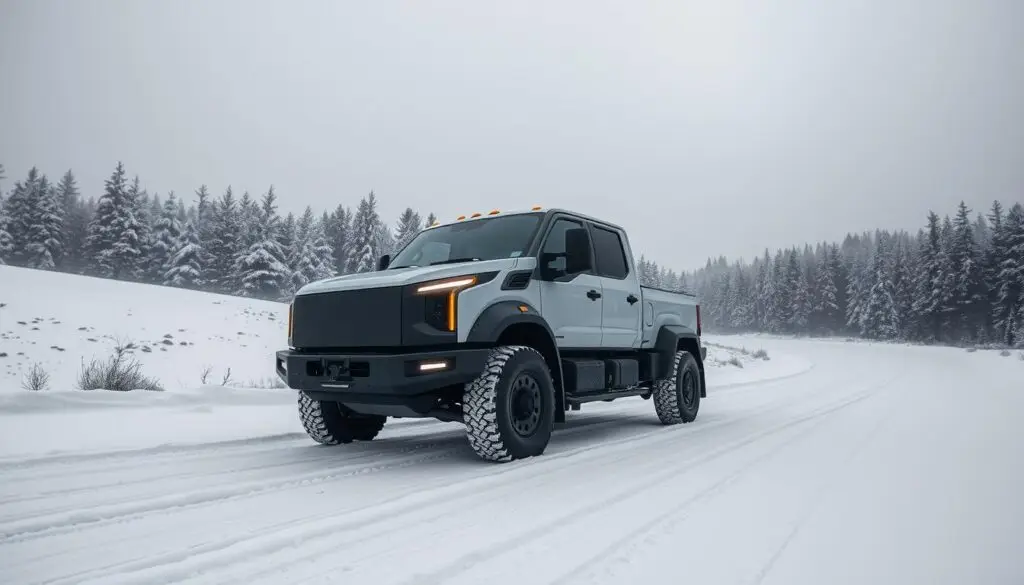
Pre-conditioning while plugged in preserves battery energy for driving rather than heating during cold starts.
Training drivers to understand and utilize eco-driving modes optimizes powertrain operation for efficiency rather than performance. These modes limit peak power output and adjust throttle response curves to encourage gradual acceleration, potentially improving winter range by 8-12% compared to standard driving modes.
Free Professional Fleet Tools
Cost calculators, fault code lookup, maintenance planners, and more—built for owner-operators, fleet managers, and diesel techs. No signup required.
The Future of Electric Trucking in Cold Climates
Technology development continues accelerating, with multiple innovations promising to narrow or eliminate the cold weather performance gap between electric and conventional trucks. Industry analysts project that 2026-2028 model year electric trucks will demonstrate substantially improved winter capability compared to current generation vehicles.
Next-Generation Battery Technology
Solid-state batteries under development by companies including QuantumScape, Solid Power, and Toyota promise 40-50% higher energy density than current lithium-ion technology, along with improved cold weather performance. Solid electrolytes maintain ionic conductivity at lower temperatures compared to liquid electrolytes, potentially reducing cold weather range loss from 35-40% to 20-25%.
These batteries also charge faster and tolerate wider temperature ranges without degradation, allowing more aggressive thermal management strategies. QuantumScape claims its solid-state cells maintain 80% of room-temperature capacity at 14°F, compared to 60-65% for conventional lithium-ion batteries. If these performance claims translate to commercial production, cold climate viability improves dramatically.
However, solid-state technology faces manufacturing challenges that have delayed commercial production repeatedly. Most analysts now project 2027-2029 for initial commercial vehicle applications, with meaningful market penetration not expected until the 2030s. Fleet managers planning vehicle acquisitions in the near term shouldn’t factor solid-state benefits into purchase decisions.
Megawatt Charging Infrastructure
The National Electric Highway Coalition—a partnership between utilities including Southern Company, American Electric Power, and Dominion Energy—is developing DC fast charging corridors along major freight routes. By 2027, the coalition aims to install charging stations every 50-75 miles on Interstate highways, enabling long-haul electric trucking even with winter range reduction.
Megawatt charging systems (MCS) capable of delivering 1,000 kW or more will enter commercial deployment in 2025-2026, reducing charging times from hours to 20-30 minutes for large battery packs. CharIN, the industry standards organization, published the MCS specification in 2024, with multiple manufacturers confirming MCS-compatible trucks for 2026-2027 model years.

Next-generation charging infrastructure will feature weather protection and megawatt charging capabilities to support long-haul operations.
Cold weather charging infrastructure requires specialized design considerations. Heated cable management systems prevent connector freezing, while covered charging plazas protect equipment and provide shelter for drivers during charging sessions. These features add 15-25% to infrastructure costs but prove essential for reliable winter operation in northern climates.
Policy and Incentive Landscape for Electric Trucks
Government regulations and financial incentives significantly influence electric truck adoption decisions, particularly for fleets evaluating cold climate operations where operational challenges make economic justification more difficult.
Federal Incentives and Regulations
The Inflation Reduction Act’s Commercial Clean Vehicle Credit (Section 45W) provides up to $40,000 tax credit per electric truck, with no phase-out based on manufacturer volume. This credit applies to vehicles placed in service through 2032, providing long-term certainty for fleet planning. However, vehicles must meet domestic content requirements—increasing percentages of batteries and critical minerals must come from North America or free trade agreement countries.
The Environmental Protection Agency’s Phase 3 greenhouse gas standards for heavy-duty vehicles mandate that 25% of new Class 7-8 trucks sold in 2032 be zero-emission vehicles. This percentage increases to 40% by 2035. These requirements accelerate electric truck deployment regardless of cold weather performance concerns, pushing manufacturers to solve winter operation challenges.
The Federal Motor Carrier Safety Administration is developing specific regulations for electric commercial vehicles, including winter operation requirements. Proposed rules would mandate minimum cold weather range disclosure, standardized testing at 20°F, and driver notification systems that alert when environmental conditions will significantly impact range.
State and Regional Programs
California’s Advanced Clean Trucks regulation requires increasing percentages of zero-emission truck sales beginning in 2024, reaching 75% of Class 7-8 sales by 2035. Nine additional states—New York, New Jersey, Massachusetts, Oregon, Washington, Colorado, Maryland, Vermont, and Maine—have adopted similar regulations, creating a multi-state market forcing manufacturers to prioritize electric truck development.
New York’s Truck Voucher Incentive Program provides up to $185,000 per Class 8 electric truck—the highest state incentive nationally. Combined with federal tax credits, this reduces the purchase price premium from $180,000-$220,000 to $45,000-$95,000, substantially improving payback periods even with cold weather operational limitations.
Canadian provinces offer varying incentive levels, with Quebec providing up to CAD $150,000 per heavy-duty electric truck. However, Canadian regulations haven’t mandated zero-emission sales percentages as aggressively as California and Northeast states, potentially slowing adoption despite cold climate operations being a significant concern for Canadian fleets.
Environmental Impact: Electric vs Diesel in Cold Weather
Environmental performance remains a primary driver for electric truck adoption, but cold weather operation affects the emissions equation in ways that deserve examination. Understanding the full environmental picture requires looking beyond tailpipe emissions to include electricity generation, operational efficiency, and lifecycle impacts.
Emissions Comparison in Cold Weather Operation
Electric trucks produce zero direct emissions regardless of ambient temperature. However, their increased electricity consumption in cold weather means more power generation is required, and the emissions from that generation vary significantly based on grid composition. In regions with coal-heavy grids, the emissions benefit of electric trucks diminishes compared to cleaner grid regions.
The U.S. Environmental Protection Agency’s emissions modeling shows that even in cold weather with worst-case grid conditions, electric trucks produce 30-45% fewer lifecycle greenhouse gas emissions than diesel equivalents. In regions with cleaner grids—such as California, the Pacific Northwest, or the Northeast—cold weather electric trucks still achieve 60-70% emission reductions compared to diesel.
Diesel trucks face their own cold weather emission challenges. Cold starts produce elevated emissions of nitrogen oxides (NOx) and particulate matter until exhaust after-treatment systems reach operating temperature—typically 5-15 minutes depending on ambient conditions. Additionally, extended idling for cab heating during rest periods produces substantial emissions without moving freight, an issue electric trucks avoid entirely.
| Metric | Diesel (Cold Weather) | Electric (Cold Weather, Average U.S. Grid) |
|---|---|---|
| CO2 per mile | 2.8-3.2 lbs | 1.4-1.9 lbs |
| NOx emissions | High (local) | Low (distributed at power plants) |
| Particulate matter | Significant (local) | None (local) |
| Lifecycle emissions advantage | Baseline | 35-65% lower |
Air Quality Benefits in Urban Operations
Electric trucks deliver particularly significant air quality benefits in urban environments where delivery vehicles operate extensively. CARB studies show that replacing diesel delivery trucks with electric alternatives in disadvantaged communities reduces local particulate matter exposure by 35-60%, even accounting for upstream power plant emissions.
Cold weather may actually enhance this benefit in certain applications. Diesel trucks in stop-and-go urban traffic during winter experience worse-than-highway emissions due to incomplete combustion during frequent cold acceleration events. Electric trucks maintain zero local emissions regardless of duty cycle, providing consistent air quality benefits.
The public health implications prove substantial. Research published in Environmental Science & Technology estimates that replacing diesel delivery trucks with electric alternatives in New York City could prevent 300-500 premature deaths annually from improved air quality, with economic benefits of $2-3 billion. These benefits persist even with the 30-40% range reduction that cold weather creates, as the trucks continue operating emission-free within the city.
Grid Decarbonization Benefits
Electric trucks become progressively cleaner as the electrical grid decarbonizes, while diesel trucks maintain consistent emissions throughout their operational life. As renewable energy sources increasingly dominate electricity generation—wind and solar provided 14% of U.S. electricity in 2023, projected to reach 40% by 2035—electric trucks purchased today will operate on cleaner energy over their 10-15 year lifespans.
This dynamic is particularly relevant in cold climate states that are investing heavily in renewable energy. Minnesota, Wisconsin, and Michigan have all established aggressive renewable energy targets, ensuring that electric trucks in these states will achieve improving environmental performance over time even as diesel trucks remain static.
Frequently Asked Questions
How much range do electric trucks lose in cold weather?
Electric trucks typically lose 30-40% of their driving range at temperatures around 20°F compared to optimal conditions. A Class 8 electric truck rated for 300 miles in moderate weather may see effective range drop to 180-210 miles during winter months. This reduction results from three primary factors: slower battery chemistry reactions that reduce available capacity by 30-40%, thermal management systems consuming 2-4 kW to maintain battery temperature, and cabin heating requiring 3-5 kW per hour. The range returns when temperatures rise—this is a temporary operational constraint, not permanent battery damage.
Do diesel trucks also lose efficiency in cold weather?
Yes, diesel trucks experience 12-15% fuel efficiency losses at 20°F during highway driving, with losses reaching 20-25% on short trips where engines don’t fully warm up. These losses stem from increased oil viscosity during cold starts, winter diesel fuel blends with lower energy density, and DEF system heating requirements. However, diesel’s rapid refueling capability—five minutes versus hours for electric trucks—makes range loss less operationally disruptive. A diesel truck can simply refuel more frequently without substantial schedule impacts.
What strategies help maintain electric truck range in winter?
Pre-conditioning batteries while connected to shore power represents the most effective strategy, preserving 15-25% of winter range by using grid electricity rather than battery energy for heating. Storing trucks in heated facilities adds another 18-28% range preservation. Dynamic route planning that matches electric trucks to shorter routes on extreme cold days, mid-day opportunity charging during scheduled stops, and driver training on eco-driving techniques that reduce aggressive acceleration can collectively improve winter range by 25-40% compared to unmanaged operations.
Are electric trucks still cost-effective in cold climates?
For urban delivery fleets operating 80-120 miles daily with return-to-base charging, electric trucks achieve 3-5 year payback periods even in northern climates, with total savings reaching $75,000-$120,000 over a 10-year vehicle life. Federal tax credits up to $40,000 and state incentives up to $185,000 significantly offset purchase premiums. However, regional haul operations exceeding 200 miles daily face weaker ROI due to charging time impacts and potential need for additional infrastructure. The economics depend heavily on matching operational requirements to vehicle capability.
What technologies are improving electric truck cold weather performance?
Current solutions include advanced battery thermal management with predictive pre-conditioning, heat pump technology that delivers 2-3 times more heating per unit of electricity, and lithium iron phosphate batteries with improved thermal stability. Future developments include solid-state batteries promising 40-50% higher energy density with better cold weather performance (projected 2027-2029 deployment), megawatt charging systems enabling 20-30 minute charges (2025-2026 deployment), and machine learning algorithms that optimize thermal management based on route and driver patterns.
What are the environmental benefits of electric trucks in cold weather?
Electric trucks produce zero direct emissions regardless of temperature, delivering 30-45% fewer lifecycle greenhouse gas emissions than diesel equivalents even in cold weather with unfavorable grid conditions. In regions with cleaner grids, cold weather electric trucks achieve 60-70% emission reductions. They eliminate local air pollution entirely—particularly beneficial in urban areas where diesel trucks produce elevated cold-start emissions. As grids continue decarbonizing, electric trucks purchased today become progressively cleaner throughout their 10-15 year operational life.
Moving Forward with Electric Trucks in Cold Climates
Electric truck cold weather performance presents real challenges that fleet managers must address through infrastructure planning, route optimization, and realistic capability assessment. The 30-40% range reduction at 20°F creates operational constraints that require thoughtful evaluation against specific operational requirements—but these limitations are not insurmountable.
For fleets operating predictable routes under 200 miles daily with return-to-base charging, electric trucks remain operationally viable and economically advantageous even in cold climates. The combination of federal and state incentives, lower maintenance costs, and fuel savings creates positive ROI despite winter performance degradation. Urban delivery, refuse collection, and local distribution represent ideal applications where cold weather impacts can be managed through proper infrastructure and operational planning.
The technology trajectory is clear: each vehicle generation demonstrates improved cold weather performance through better thermal management, advanced battery chemistry, and optimized software. Fleet managers should evaluate electric trucks not just on current capability but on the development roadmap, particularly for purchases planned 2-3 years forward when next-generation technology will be commercially available.
Environmental benefits persist regardless of cold weather performance impacts. Even with increased electricity consumption, electric trucks in winter produce substantially lower lifecycle emissions than diesel alternatives while eliminating local air pollution entirely. Ultimately, successful electric truck deployment in cold climates requires matching vehicle capability to operational requirements—a systematic approach that positions fleets for both immediate success and long-term competitive advantage as the technology continues maturing.
Share This Resource
Know a fleet manager evaluating electric trucks for cold climate operations? Share this guide to help them make informed decisions.