
By Michael Nielsen, Editor & Publisher
Last Updated: January 2026
📖 Estimated reading time: 22 minutes
Electric truck charging infrastructure represents one of the most significant capital decisions fleet managers face in the transition to zero-emission operations. Depot installations serving 10-20 vehicles require investments ranging from $100,000 to $500,000+, with equipment costs varying dramatically based on power requirements and vehicle classes.
American companies deployed more than 15,000 medium- and heavy-duty electric vehicles in 2024, according to the National Renewable Energy Laboratory. Yet charging infrastructure development continues to lag vehicle adoption, forcing fleet operators to navigate critical decisions on equipment selection, power capacity, utility coordination, and financial planning.
Federal incentives through the 30C tax credit and NEVI program can offset 30-70% of infrastructure expenses—but the window for maximum savings narrows to June 30, 2026. Success depends on matching charging solutions to operational patterns, engaging utilities early, and understanding the full scope of costs before breaking ground.
Key Takeaways
- Equipment costs scale with power output: Level 2 charging ($3,000-$6,300/port) for light-duty overnight use, DC fast charging ($55,000-$120,000) for medium-duty operations, high-power systems ($150,000-$400,000+) for Class 8 applications
- Total project costs require comprehensive planning: Depot infrastructure for 10-20 vehicles costs $100,000-$500,000+ with 6-18 month timelines including electrical upgrades and utility coordination
- Federal incentive deadline approaches: The 30C tax credit (up to 30%/$100,000 per station) expires June 30, 2026 following 2025 legislative changes—installations must be operational by that date
- Early utility engagement prevents costly delays: Major electrical upgrades requiring transformer installations extend timelines 12-18 months and cost $50,000-$500,000+
- Strong ROI justifies investment: Electric trucks generate $17,000-$24,500 annual savings per heavy-duty vehicle through reduced fuel and maintenance costs, enabling 4-7 year payback periods
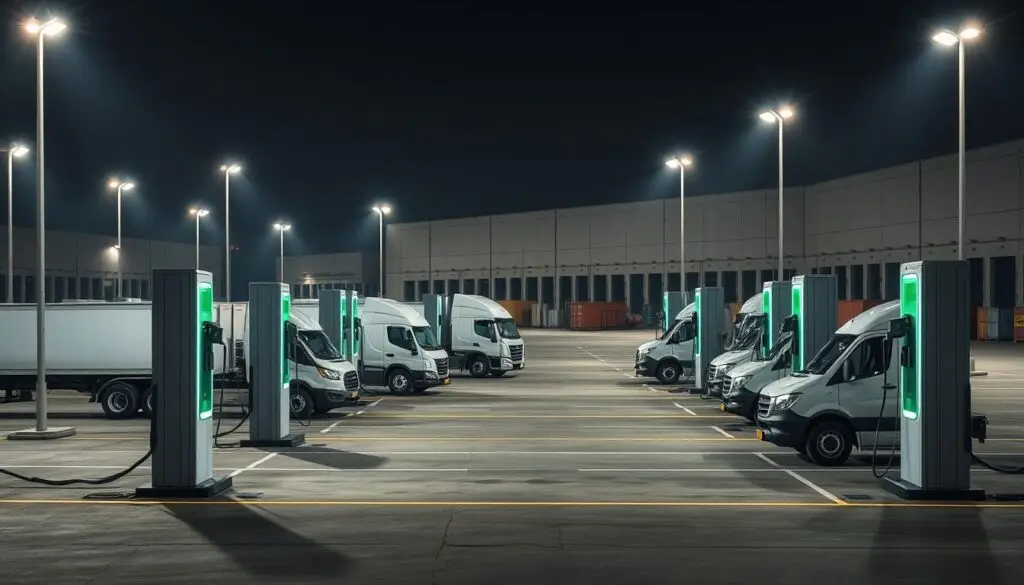
Modern fleet charging infrastructure serves multiple vehicle classes at centralized depot locations.
Understanding Electric Truck Fleet Charging Requirements
Commercial vehicles demand significantly more power than passenger cars, with requirements varying dramatically across vehicle classifications. A light-duty delivery van drawing 7 kW equals typical household appliance consumption, while a heavy-duty Class 8 tractor charging at 350 kW demands electricity equivalent to several dozen homes combined.
Fleet charging requirements depend on vehicle classifications, daily mileage, and route characteristics. Mixed fleets create additional complexity—light-duty vans, medium-duty trucks, and heavy-duty tractors each require different charging solutions to maintain operational efficiency. Proper assessment prevents costly mistakes and guides equipment selection decisions.
Power Demands by Vehicle Class
Light-duty delivery vans feature 40-80 kWh battery packs and charge effectively using Level 2 equipment delivering 7-19 kW. Overnight depot charging provides sufficient energy for daily routes under 150 miles.
Medium-duty box trucks contain 100-200 kWh batteries and require DC fast charging at 50-150 kW for 2-4 hour charge times between shifts. Heavy-duty Class 8 tractors with battery systems from 300-900 kWh demand specialized infrastructure. DC fast chargers delivering 350 kW or more address these applications, while emerging megawatt-level systems will eventually match diesel refueling speeds.
Electric buses represent particularly demanding applications. Median battery capacities around 165 kWh require chargers above 185 kW for rapid turnaround between routes.
| Vehicle Type | Battery Size | Charging Power | Duration |
|---|---|---|---|
| Light-Duty Vans | 40-80 kWh | 7-19 kW | 4-8 hours |
| Medium-Duty Trucks | 100-200 kWh | 50-150 kW | 2-4 hours |
| Heavy-Duty Trucks | 300-900 kWh | 350+ kW | 1-3 hours |
| Electric Buses | 150-200 kWh | 185-350 kW | 1-2 hours |
Power differences directly impact infrastructure costs. Service upgrades, transformer installations, and utility coordination become increasingly complex as charging power increases.
Matching Charging to Operational Schedules
Vehicles completing predictable routes under 200 miles return to depot facilities for overnight charging. This approach minimizes infrastructure complexity and operational disruptions. Longer routes or multiple daily shifts require sophisticated strategies—mid-day charging opportunities or en-route fast charging becomes necessary for extended operations.
Payload weights, terrain, and temperature affect energy consumption. Fleet operators analyzing actual operational data gain the foundation for right-sizing charging infrastructure and preventing costly overbuilding or undersizing.
Commercial EV Charging Equipment Options
Equipment selection directly impacts operational efficiency, infrastructure costs, and fleet ability to meet daily requirements. Each technology tier offers specific advantages based on battery capacity, duty cycles, and available charging windows.
Level 2 Stations for Light-Duty Operations
Level 2 equipment operates at 208-240V AC delivering 7-19 kW, costing $3,000-$6,300 per port including hardware and installation. Lower upfront investment and straightforward installation provide economic advantages, though charging times span 4-10 hours requiring dedicated parking spaces.
Light-duty vans and service vehicles with predictable overnight schedules benefit most from this economical solution. Non-networked units cost $2,500-$4,000 but lack remote monitoring. Networked versions add $500-$1,500 per port yet enable centralized management, usage tracking, and maintenance alerts.
DC Fast Charging for Medium and Heavy-Duty Fleets
DC fast charging delivers 50-350 kW of direct current power, costing $55,000-$120,000 per unit. Leading manufacturers including ABB, Siemens, Schneider Electric, and Wallbox provide systems designed for demanding fleet environments.
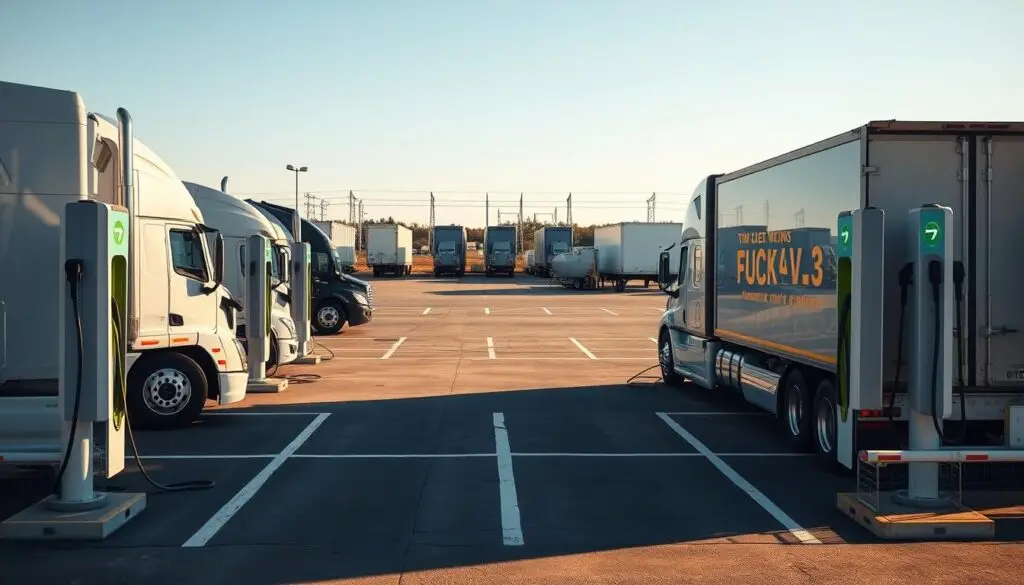
DC fast charging enables rapid turnaround for fleets operating multiple shifts.
These systems serve 3-4 vehicles sequentially throughout the day, significantly improving space utilization and reducing per-vehicle investment. Popular models include ABB Terra 360 (360 kW), Siemens SiCharge D (modular to 500A), and Wallbox Supernova (150 kW). Medium-duty trucks charge in 20-60 minutes depending on battery size.
High-Power Systems for Heavy-Duty Applications
Systems rated at 350 kW and above address heavy-duty operations with large battery capacities. The emerging Megawatt Charging System (MCS) standard developed by CharIN delivers up to 3.75 MW at 1,250V and 3,000A, reducing charging times to 20-30 minutes for the largest packs.
Solutions like Wallbox Hypernova (400 kW) and current-generation ultra-fast equipment represent the cutting edge. These installations range from $150,000-$300,000 per station, while MCS systems for Class 8 long-haul applications exceed $400,000—reflecting advanced engineering requirements including liquid cooling and fire suppression.
15,000+
Medium and heavy-duty electric vehicles deployed by American companies in 2024 — National Renewable Energy Laboratory
Depot vs. En-Route Infrastructure Strategies
Depot charging supports overnight and between-shift charging at fleet home bases, emphasizing reliability and lower installation costs per port for predictable operations. En-route solutions positioned along freight corridors enable longer-haul operations but require higher power outputs, redundant equipment, and driver amenities during mandatory rest breaks.
Most commercial operators prioritize depot infrastructure while relying on expanding public networks and emerging third-party charging providers for occasional long-distance needs. Companies like Voltera, Greenlane, and WattEV now offer Infrastructure-as-a-Service models converting capital expenditure into operational expenses.
| Equipment Type | Power Output | Cost Range | Best For |
|---|---|---|---|
| Level 2 | 7-19 kW | $3,000-$6,300 | Overnight charging |
| DC Fast | 50-350 kW | $55,000-$120,000 | Medium-duty operations |
| High-Power | 350+ kW | $150,000-$300,000 | Heavy-duty fleets |
| Megawatt (MCS) | 1+ MW | $400,000+ | Class 8 long-haul |
Site Assessment and Planning Essentials
Thorough site assessment prevents costly installation delays and operational disruptions. This evaluation phase typically requires $10,000-$100,000 investment depending on fleet size and complexity. Professional assessment identifies electrical capacity constraints, optimal equipment placement, and utility coordination requirements before procurement begins.
Analyzing Fleet Operational Patterns
Fleet size directly determines infrastructure scale. A 10-vehicle operation functions efficiently with 10-12 Level 2 ports. Larger fleets with 50+ trucks benefit from mixed strategies combining Level 2 and DC fast charging based on vehicle types and scheduling requirements.

Professional assessments identify capacity constraints and optimal placement strategies.
Battery capacity varies significantly across classes—light-duty trucks carry 50-100 kWh batteries while heavy-duty trucks require 300-500 kWh or more. Route characteristics determine charging frequency: vehicles covering under 100 miles daily can charge every other day, while those exceeding 200 miles need daily charging or mid-route opportunities.
Argonne National Laboratory’s AFLEET Tool helps fleet managers model total cost of ownership and compare electric options against diesel baselines for specific duty cycles.
“Early utility coordination identifies locations with adequate infrastructure and avoids sites requiring transformer upgrades that add 18+ months to timelines.”
— Joint Office of Energy and Transportation guidance
Evaluating Electrical Infrastructure Capacity
Electrical evaluation examines facility current capacity to support additional loads, including service ratings, panel capacity, transformer specifications, and distance to distribution points. Utilities should conduct load analysis showing whether existing service accommodates planned equipment or requires upgrades.
Sites with inadequate infrastructure face substantial expenses often exceeding equipment costs. Planning for future expansion during initial evaluation costs less than multiple upgrades as fleets grow over subsequent years.
Strategic Charging Station Placement
Optimal placement balances electrical proximity, operational convenience, and scalability. Locations should minimize trenching runs that increase installation expenses while providing convenient driver access. Analyzing parking patterns ensures charging locations align with natural vehicle positions, avoiding disruptions and reducing repositioning needs.
NREL’s EVI-Pro Lite tool models placement scenarios to identify configurations minimizing costs while meeting fleet requirements.
| Fleet Size | Recommended Ports | Power Need |
|---|---|---|
| 5-10 Vehicles | 10-12 Level 2 | 80-120 kW |
| 25-50 Vehicles | Mixed L2 and DC | 300-600 kW |
| 100+ Vehicles | High-power distributed | 2+ MW |
Electrical Infrastructure and Utility Coordination
Robust electrical infrastructure forms the backbone of successful fleet charging. Large-scale deployment can double or quintuple local grid load, placing significant stress on distribution networks. Fleet operators must determine upgrade needs early in planning—system upgrade projects have lead times extending beyond 12-18 months in many cases.

Major electrical upgrades often represent half or more of total project costs.
Calculating Power Capacity Requirements
Power assessment starts with calculating total charging load by multiplying vehicles charging simultaneously by individual power draw. Ten 150 kW DC fast chargers operating at once require 1.5 MW electrical capacity—enough to power several hundred homes.
Most fleet facilities operate on 480V three-phase power supporting DC fast charging, but total capacity may be insufficient. Electrical load studies document current consumption and identify available headroom for charging loads before installation begins.
Infrastructure Upgrades and Utility Work
Service upgrades become necessary when existing infrastructure cannot support planned equipment. These may include transformer installations, service conductor upsizing, and substation modifications. Transformer installations alone range from $50,000 to $500,000+ depending on scope, with extended timelines often exceeding 12-18 months due to equipment lead times and construction scheduling.
Early utility coordination identifies upgrade requirements before ordering equipment, preventing expensive delays during construction phases.
Smart Load Management Technology
Smart systems provide sophisticated control over charging to minimize infrastructure costs. These systems stagger vehicle charging to spread load across time and prioritize vehicles with urgent departure needs. Energy Management Systems coordinate multiple stations and optimize schedules based on electricity rates while integrating renewable sources and battery storage for maximum efficiency.
Coordinating With Energy Providers
Utility coordination should begin during earliest planning stages. Utilities provide critical information about grid capacity, upgrade requirements, and available rate structures. Many offer Make Ready programs funding infrastructure upgrades up to charging equipment connection points, dramatically reducing operator costs.
Demand charge rebate programs further reduce operating costs over time. Request consultation to review installations and understand incentive opportunities early in the process.
Equipment and Installation Cost Analysis
Financial commitment for charging infrastructure varies dramatically based on operational requirements and power needs. Selection involves balancing upfront capital against long-term reliability—premium manufacturers deliver superior performance and comprehensive warranties, while budget alternatives may reduce initial costs but increase operational risks.
Level 2 Equipment Pricing
Level 2 equipment represents the most economical entry point, with pricing from $3,000-$6,300 per port including basic hardware and standard installation. Non-networked units cost $2,500-$4,000 but lack remote monitoring. Networked versions add $500-$1,500 per port yet enable centralized management, usage tracking, and maintenance alerts. Networking investment pays dividends through operational visibility and optimized scheduling.
DC Fast Charging Investment
DC fast charger costs range significantly based on power output. A 60 kW system costs $55,000-$75,000 while 120-150 kW units run $80,000-$120,000 per station. Premium brands like ABB, Siemens, and Schneider Electric command higher prices but offer superior reliability and established service networks.

Equipment quality and power output drive significant cost variations.
Mobile DC chargers provide flexible emergency solutions. Units with 26-65 kWh batteries cost $15,000-$50,000, while large mobile trucks featuring 100-500 kWh+ capacity range from $80,000-$200,000+.
High-Power System Investments
Systems rated 350 kW+ represent substantial capital commitments, ranging from $150,000-$300,000 per station reflecting advanced engineering requirements including liquid cooling and fire suppression. Emerging Megawatt Charging Systems for Class 8 trucks exceed $400,000 per installation, incorporating specialized power electronics and requiring extensive infrastructure modifications.
Network Management and Software
Network software adds $1,000-$5,000 per port annually for cloud platforms providing remote monitoring, usage reporting, payment processing, and predictive maintenance alerts. Leading platforms from ChargePoint, Greenlot, and EV Connect offer fleet-specific features including vehicle assignment and charging scheduling.
Advanced energy management optimizes power distribution across stations, reducing demand charges. Software investment delivers operational savings offsetting subscription costs within 18-24 months.
Installation and Construction Expenses
Construction and installation typically represents half or more of total infrastructure investment. Understanding these costs helps allocate budget appropriately and avoid financial surprises.
Electrical Work and Service Upgrades
Electrical work constitutes the largest construction cost component. Basic projects with adequate existing capacity range from $10,000-$25,000 per station for labor, materials, and minor upgrades. Facilities requiring service upgrades or new distribution panels face $50,000-$100,000+ before equipment installation begins.
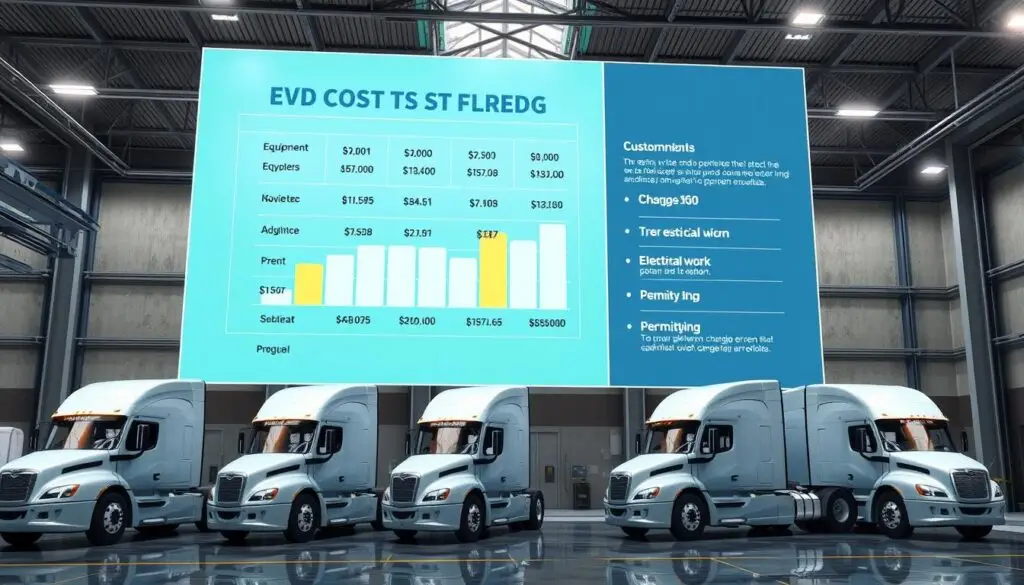
Professional installation ensures safety compliance and optimal system performance.
Contractors must size conductors appropriately and ensure National Electric Code compliance. Selecting contractors experienced in EV infrastructure proves critical for successful implementation and warranty protection. The Electric Vehicle Infrastructure Training Program (EVITP) maintains certified contractor lists, helping operators identify qualified professionals.
Trenching and Site Preparation
Underground installations in paved areas cost $75-$150 per linear foot, including saw-cutting, excavation, conduit placement, conductor pulling, and pavement restoration. Installations crossing large parking areas accumulate $50,000-$100,000 in trenching costs alone. Fleet operators minimize expenses by clustering stations near electrical distribution points.
Site preparation includes concrete pads at $2,000-$5,000 per pad, asphalt repair ($1,000-$3,000 per space), and bollard installation ($500-$1,500 per station). Environmentally sensitive areas may require stormwater management, increasing costs further.
Timeline Expectations
Labor costs vary by region with metropolitan areas commanding premium rates. Typical projects span 6-18 months from initial planning through commissioning. Simple Level 2 installations with adequate capacity complete in 2-4 months, while major DC fast charging installations requiring utility upgrades may require 12-18 months.
The HDJ Perspective
Fleet electrification infrastructure demands a fundamentally different planning approach than traditional fueling. Where diesel operations scaled incrementally, charging infrastructure requires significant upfront investment in electrical capacity that may sit underutilized for years as electric vehicle adoption grows. Smart fleet managers are treating this as strategic infrastructure rather than operational expense—building capacity for the fleet they’ll operate in 2030, not just the vehicles on order today. The June 2026 deadline for federal incentives creates urgency, but rushed implementations often overlook critical utility coordination steps that result in costly delays and scope changes.
Ongoing Operational Costs
True charging costs extend beyond equipment purchase to electricity expenses, maintenance requirements, and software management. Careful budgeting for recurring costs ensures infrastructure delivers expected financial performance.
Managing Electricity Expenses
Electricity represents the largest ongoing expense, ranging from $0.08-$0.20 per kilowatt-hour depending on location and provider. Commercial rates include time-of-use pricing charging different amounts for on-peak, mid-peak, and off-peak periods. Strategic overnight charging reduces costs by 30-50% compared to peak-period charging.

Monitoring systems track consumption and identify cost reduction opportunities.
Demand charges create significant additional expenses. Utilities charge $10-$30 per kilowatt of peak monthly demand. Operating ten 100-kilowatt chargers simultaneously generates 1,000 kilowatts demand, potentially adding $10,000-$30,000 monthly. Smart charging strategies staggering vehicle charging dramatically reduce demand charges while meeting operational requirements.
Equipment Maintenance Requirements
Maintenance schedules include quarterly inspections, annual preventive maintenance, and periodic software updates. Level 2 stations require minimal upkeep—primarily cable inspection and cleaning. DC fast chargers need intensive maintenance including cooling system servicing and connector replacement due to high-power wear.
Warranty coverage typically extends 3-5 years as standard protection. Manufacturers often require authorized service to preserve coverage, making technician training essential. Fleet operators should budget 3-5% of infrastructure capital costs annually for maintenance, software subscriptions, and unexpected repairs.
Federal and State Incentive Programs
Government funding opportunities and utility programs transform charging economics. Fleet operators understanding available incentives offset 30-70% of total project costs—but several key programs face approaching deadlines following 2025 legislative changes.
Federal Tax Credits and Program Changes
The 30C Alternative Fuel Vehicle Refueling Property Credit provides tax credits up to 30% of equipment and installation costs for projects meeting prevailing wage and apprenticeship requirements. Commercial installations receive up to $100,000 per charging station.
⚠️ Critical Deadline Alert
Following 2025 legislative changes, the 30C tax credit now expires June 30, 2026—not December 2032 as originally established. Charging equipment must be fully operational by this date to qualify. Fleet operators planning infrastructure projects should begin immediately to ensure completion before the deadline.
Elective pay provisions enable state, local, and tribal governments to receive direct payments equivalent to tax credits, opening federal incentives to tax-exempt entities. The Commercial Clean Vehicle Credit under IRC Section 45W offers up to $40,000 per qualified vehicle, directly reducing acquisition costs—though this program also faces accelerated termination.
NEVI Program and Public Charging
The National Electric Vehicle Infrastructure (NEVI) Formula Program allocates $5 billion through 2026 for charging infrastructure along Alternative Fuel Corridors. Following administrative changes in 2025, updated guidance issued in August allows states greater flexibility in implementation.
NEVI funding covers up to 80% of eligible project costs for public charging infrastructure. While primarily focused on passenger vehicles, commercial operators benefit from expanding public charging networks along freight corridors.
State Grant Programs
State incentives vary significantly but provide substantial additional funding. California’s HVIP offers vouchers ranging from $7,500 to $420,000 for zero-emission commercial vehicles, with enhanced incentives for small fleets. The program reopened in September 2025 with increased voucher amounts—up to $330,000 for Class 8 battery-electric trucks for qualifying small businesses.
New York Truck Voucher Incentive Program provides similar vehicle incentives. Many states offer infrastructure-specific grants through energy offices. Consult the Alternative Fuels Data Center State Laws and Incentives database to identify applicable programs by location.
Utility Rebates and Demand Response
Utility rebates cover 20-60% of installation costs through Make Ready programs, funding electrical upgrades up to charging equipment connection points. Major utilities including Pacific Gas & Electric, Southern California Edison, and Con Edison offer fleet-specific programs reducing upfront investment.
Demand response programs provide ongoing revenue—fleet operators receive compensation for allowing utilities to modulate charging during grid stress events, improving long-term economics. Low-carbon fuel credits in California, Oregon, and other states create additional revenue streams, with credit values ranging from $0.02-$0.08 per kWh.
Free Professional Fleet Tools
Cost calculators, fault code lookup, maintenance planners, and more—built for owner-operators, fleet managers, and diesel techs. No signup required.
Installation Process and Timeline
Transforming a truck depot into an electric charging hub involves strategic planning and phased execution. Most projects span 3-6 months from consultation to commissioning, with timeline variations depending on site complexity, utility requirements, and local permitting procedures.
Design and Engineering Phase
The design phase establishes project foundation through comprehensive site surveys evaluating electrical capacity and identifying optimal equipment locations. Technical deliverables include electrical single-line diagrams, civil engineering drawings, equipment specifications, and detailed cost estimates. This typically requires 2-4 weeks for completion and becomes the blueprint for permitting applications and contractor bidding.
Permitting and Utility Coordination
Permitting addresses all regulatory requirements before construction. Fleet operators need electrical permits, building permits for structures, and potentially environmental permits depending on site characteristics. Parallel utility coordination involves submitting interconnection applications and scheduling utility construction.
This phase often represents the longest timeline component, particularly when transformer upgrades are necessary. Review periods range from 2-8 weeks depending on jurisdiction complexity. Maintain regular communication with utility representatives to address questions promptly.
Construction and Commissioning
Construction executes physical buildout according to approved plans. Qualified electrical contractors perform trenching, conduit installation, pad preparation, and equipment mounting. All work must comply with National Electric Code requirements and local standards. Most installations require 4-8 weeks depending on site size and equipment quantity.
Testing validates all systems function correctly before operational handoff. Technicians verify electrical connections, ground fault protection, and equipment functionality. Commissioning includes configuring stations with appropriate settings, establishing user accounts, and providing comprehensive staff training on charging procedures and software platform usage.
| Phase | Duration | Key Activities |
|---|---|---|
| Design & Engineering | 2-4 weeks | Site surveys, diagrams, estimates |
| Permitting & Utility | 4-12 weeks | Applications, interconnection |
| Construction | 4-8 weeks | Electrical work, equipment mounting |
| Testing & Commissioning | 1-2 weeks | System testing, staff training |
Managing Charging Operations
Effective operations management ensures trucks remain ready for daily routes while minimizing electricity costs and infrastructure strain. Success requires structured practices coordinating schedules, monitoring performance, and establishing clear protocols.
Strategic Scheduling and Load Control
Developing effective scheduling starts with understanding fleet usage patterns. Analyze departure times, travel distances, and return schedules to determine optimal charging windows. Load management strategies prevent multiple vehicles charging simultaneously at maximum power, which triggers expensive demand charges.
Smart systems stagger charging based on priority, with early-departure trucks charging first. Time-of-use optimization schedules bulk charging during off-peak hours when rates drop significantly—programming systems to concentrate activity during overnight periods reduces energy costs by 30-50%.
Performance Tracking and Monitoring
Modern monitoring systems provide real-time visibility into charging operations. Cloud platforms display station availability, active sessions, power delivery rates, and equipment status. Performance reporting generates detailed analytics informing operational improvements—track energy consumption by vehicle, cost per mile, session durations, and infrastructure utilization rates.
Predictive maintenance algorithms analyze performance data to identify developing issues before failures occur, allowing proactive scheduling that prevents unexpected downtime.
Personnel Training and Standard Procedures
Comprehensive driver training ensures proper equipment use and maximizes efficiency. Programs cover connector procedures, charge status verification, issue reporting, and energy-efficient driving techniques. Establish clear protocols defining designated parking positions, connector procedures, and escalation paths for malfunctions.
Document procedures in accessible formats and review during onboarding. Implement help desk support with defined response protocols—quick response times maintain driver confidence and minimize operational disruptions.
Return on Investment Analysis
Comprehensive financial analysis reveals how charging infrastructure pays for itself through sustained operational savings. Fleet operators need detailed ROI projections accounting for all capital expenses, ongoing costs, and measurable benefits.
Calculating Infrastructure ROI
ROI calculation begins with comprehensive capital cost accounting. Initial investments range from $100,000-$500,000+ for depot charging serving 10-20 vehicles including equipment, installation, site prep, and utility upgrades. Annual operating costs encompass electricity consumption, network subscriptions, maintenance, and insurance.
Most operators achieve payback periods of 4-7 years factoring vehicle fuel savings and incentives. The infrastructure’s 10-15 year useful life provides positive cash flow throughout operational period, delivering strong long-term value.
Diesel vs. Electric Operating Cost Comparison
Operating cost comparison reveals substantial advantages for electric trucks despite higher upfront investments. Electric vehicles generate significant savings across fuel expenses and maintenance requirements.
| Cost Category | Diesel | Electric | Annual Savings |
|---|---|---|---|
| Fuel Per Mile | $0.40-$0.60 | $0.15-$0.25 | $12,500-$17,500 |
| Maintenance Per Mile | $0.15-$0.20 | $0.06-$0.10 | $4,500-$7,000 |
| ✓ Combined Costs | $0.55-$0.80 | $0.21-$0.35 | $17,000-$24,500 |
Electric trucks cut fuel costs by $0.25-$0.35 per mile. For heavy-duty trucks traveling 50,000 miles annually, this translates to $12,500-$17,500 in fuel savings alone. Maintenance expenses run 40-60% lower through eliminating oil changes, decreased brake wear via regenerative braking, and simpler powertrains. Combined savings of $17,000-$24,500 per vehicle annually provide compelling fleet economics.
Long-Term Value and Scalability
Strategic positioning extends beyond immediate financial returns to regulatory compliance and competitive advantages. Many jurisdictions implement zero-emission requirements making early electrification strategically necessary.
Infrastructure investments should anticipate fleet growth with modular, expandable designs. Smart platforms provide software-defined capabilities improving through updates, protecting against technological obsolescence. Fleet electrification delivers intangible benefits including enhanced sustainability credentials, improved driver recruitment through modern equipment, and positioning for carbon pricing systems that will further advantage electric operations.
Frequently Asked Questions
How much does electric truck charging infrastructure cost?
Total costs vary by fleet size and site conditions. Depot charging for 10-20 vehicles requires $100,000-$500,000+ including equipment, installation, and electrical upgrades. Level 2 stations cost $3,000-$6,300 per port, DC fast chargers run $55,000-$120,000, and high-power systems exceed $150,000. Installation often equals equipment costs. Federal and state incentives offset 30-70% of expenses through June 2026.
What charger size do medium-duty trucks need?
Medium-duty trucks with 100-200 kWh batteries benefit from DC fast charging at 50-150 kW. This reduces charging time to 2-4 hours for full replenishment. A 60 kW charger costs $55,000-$75,000 installed while 120-150 kW units run $80,000-$120,000. Fleets with routes under 150 miles may use Level 2 overnight charging, though times extend to 8-12 hours.
How long does installation take?
Projects span 6-18 months from planning through commissioning. Simple Level 2 installations with adequate capacity complete in 2-4 months. Major DC fast charging requiring utility upgrades may need 12-18 months due to transformer installations and utility coordination. Operators should begin planning 12-18 months before anticipated operational need.
Can existing electrical service support charging?
Most facilities require service upgrades. A single 150 kW charger demands power equivalent to several dozen homes. Ten chargers simultaneously require 1.5 MW capacity. Start with power capacity assessment examining service rating and available capacity. Contact utilities early to identify upgrade needs. Service upgrades cost $50,000-$500,000+ depending on scope. Smart load management can reduce required capacity.
What federal incentives are available for commercial EV charging?
The IRA’s 30C tax credit provides up to 30% of equipment and installation costs, capped at $100,000 per charging station. Projects must be completed by June 30, 2026 following 2025 legislative changes. The NEVI program provides $5 billion for public charging along highway corridors with 80% federal cost share. State programs like California’s HVIP offer vouchers up to $420,000 for heavy-duty electric trucks.
What is the difference between depot and en-route charging?
Depot charging supports overnight and between-shift charging at fleet bases using Level 2 (7-19 kW) or DC fast charging (50-150 kW). This works for routes under 200 miles where vehicles return daily. En-route charging along freight corridors enables longer-haul operations requiring higher power (350 kW+) for rapid charging during driver breaks. Most fleets prioritize depot infrastructure while using public networks for occasional long distances.
How do I calculate ROI?
Calculate all capital costs against operational savings over 10-15 year lifespan. For 10-20 vehicles, expect $100,000-$500,000+ capital costs. Electric trucks save $0.25-$0.35 per mile on fuel ($12,500-$17,500 annually for 50,000 miles) plus 40-60% on maintenance ($4,500-$7,000 annually). Combined savings of $17,000-$24,500 per vehicle enable 4-7 year payback periods with incentives. Use Argonne’s AFLEET model for detailed analysis.
What maintenance does charging equipment need?
Schedules include quarterly inspections, annual preventive maintenance, and software updates. Level 2 stations need minimal upkeep—cable inspection and cleaning. DC fast chargers require cooling system servicing, power module inspection, and connector replacement. Budget 3-5% of capital costs annually for maintenance, subscriptions, and repairs. Cloud monitoring provides predictive alerts preventing failures.
How do demand charges affect costs?
Utilities charge $10-$30 per kW of peak monthly demand. Ten 100 kW chargers simultaneously create 1,000 kW demand, adding $10,000-$30,000 monthly. Smart strategies staggering vehicle charging reduce demand charges 40-60% while meeting operational needs. Overnight off-peak charging reduces electricity costs 30-50% compared to peak periods. Contact utilities about special EV rates and demand response programs.
What is Megawatt Charging System technology?
MCS technology delivers up to 3.75 MW, charging the largest battery packs (300-900 kWh) in 20-30 minutes. Developed by CharIN for heavy-duty vehicles, MCS uses specialized connectors delivering up to 3,000 amps at 1,250 volts DC. Systems require liquid cooling, fire suppression, and substantial electrical infrastructure. Installations exceed $400,000 per station. Major manufacturers are developing MCS-compatible vehicles for long-haul applications.
Moving Forward With Fleet Electrification
Building electric truck charging infrastructure demands careful planning and early coordination with utility providers. The June 2026 deadline for federal tax incentives creates urgency for fleet operators considering electrification—but rushed implementations often overlook critical steps that result in costly delays.
Start assessment by analyzing current routes, duty cycles, and operational patterns. This data guides equipment selection and site design decisions critical to success. Research available incentives in your region before finalizing budgets—federal, state, and utility programs combined can offset 30-70% of total project costs.
Driver training ensures smooth operations once implementation begins. Educate teams on connection procedures, charging schedules, and equipment maintenance. Clear protocols minimize downtime and extend equipment lifespan. Design systems accommodating future growth without complete overhauls as the electric vehicle market continues evolving.
Begin with pilot programs testing equipment and workflows on smaller vehicle groups. This manages risk while building institutional knowledge. Expand gradually as confidence and capacity grow. Commitment to systematic planning positions fleets for competitive advantage in the electric era.
Help Fellow Fleet Managers Plan Ahead
Share this infrastructure guide with colleagues navigating fleet electrification decisions.


