By Michael Nielsen, Publisher | 15+ Years in Diesel Repair
Last Updated: October 2026
Forklift training for diesel repair shops follows the same OSHA rule as any workplace using powered industrial trucks, 29 CFR 1910.178(l). The employer must ensure each operator is competent through formal instruction, practical training, and an evaluation of the operator's performance in the workplace, and must certify the training in writing.
This Heavy Duty Journal guide checks the rule text and OSHA's own resources, corrects a common mix-up between the three-year evaluation and refresher training, and covers what a shop with irregular loads and technicians on foot should add to a standard course. It drops cost and injury figures that could not be traced to a primary source.
Key Takeaways
- ✓Training has three parts. Formal instruction, practical training, and an evaluation of the operator's performance in the workplace, all required by 29 CFR 1910.178(l)(2)(ii).
- ✓Evaluation is every three years; refresher training is triggered. The three-year interval applies to the performance evaluation, and refresher training is required sooner after unsafe operation, an accident or near-miss, a different truck type, or a workplace change.
- ✓Records need four items. The operator's name, the date of training, the date of evaluation, and the identity of the person who trained or evaluated.
- ✓There is no OSHA forklift license. The employer certifies each operator, and a trainer needs the knowledge, training, and experience to train and evaluate, not a particular credential.
- ✓The maximum penalties did not rise in 2026. OSHA's May 2026 memo kept serious violations at up to $16,550 and willful or repeated at up to $165,514.
In This Guide
- Forklift Training for Diesel Repair Shops: What OSHA Requires
- Shop Hazards a Warehouse Course Misses
- Truck Types and What Training Must Cover
- Evaluation and Refresher Rules
- Certification Records
- In-House Training vs an Outside Course
- Citations, Penalties, and the Numbers
- Frequently Asked Questions
- The Bottom Line
Forklift Training for Diesel Repair Shops: What OSHA Requires
Under 1910.178(l)(1), the employer must ensure that each operator is competent to operate a powered industrial truck safely, as demonstrated by successful completion of the required training and evaluation. Operators must complete that training before they are permitted to operate a truck, except for training purposes under supervision. See OSHA's forklift training page.
Training must combine formal instruction, such as lecture, interactive computer learning, video, or written material; practical training, with demonstrations by the trainer and exercises by the trainee; and an evaluation of the operator's performance in the workplace. The evaluation is a separate step, and it has to happen in your shop, with the truck type and conditions the operator will use.
OSHA does not issue forklift licenses, so certification is the employer's job. Under 1910.178(l)(2)(iii), all training and evaluation must be done by people who have the knowledge, training, and experience to train operators and evaluate their competence. A senior technician can qualify if that description fits.
Shop Hazards a Warehouse Course Misses
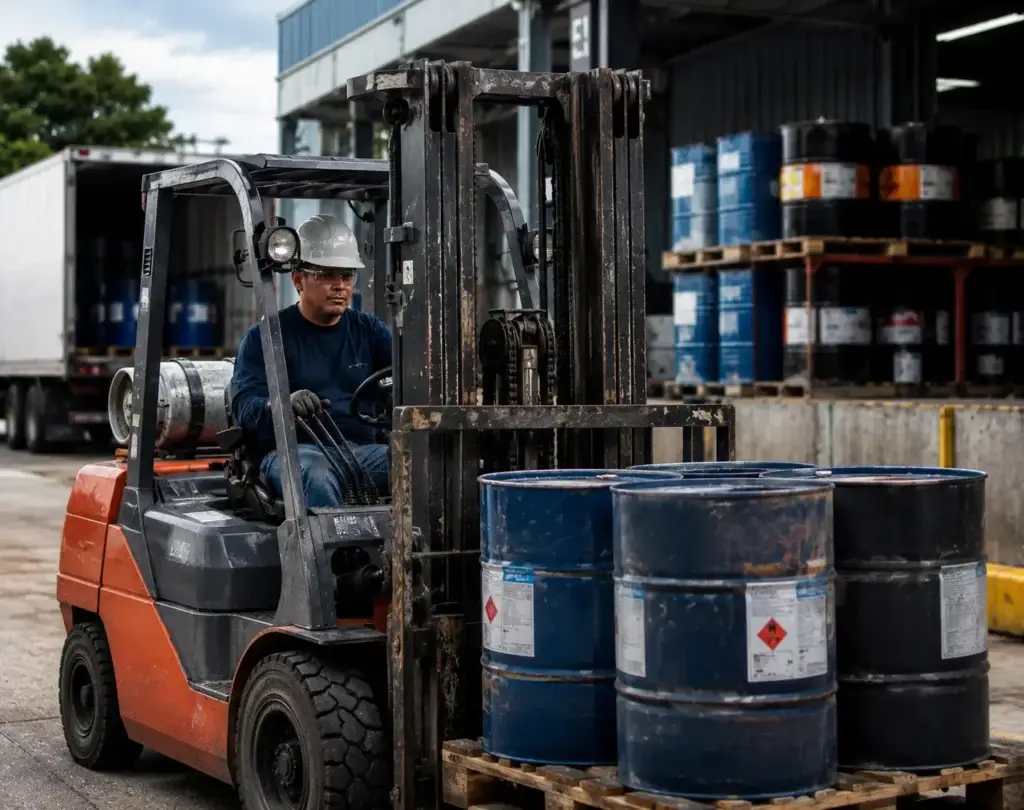
Shop forklifts move engines, axles, transmissions, wheel-end assemblies, and parts, usually around technicians who are on foot, in tighter and messier spaces than a warehouse aisle. The workplace part of the standard asks the employer to train for those conditions, so a generic course is only a start.
Add shop-specific content on surface conditions, since oil and coolant on a floor change stopping and steering; load composition and stability for irregular parts; pedestrian traffic around active bays; narrow aisles between lifts and equipment; and poorly ventilated areas where exhaust could build up.
Make the under-load rule explicit. OSHA training guidance includes that no one should stand or pass under the elevated portion of any truck, loaded or empty, and the standard's operating rules address it in 1910.178(m). Do not use a forklift as a substitute for a stand or support designed for the job, and follow the equipment manufacturer's instructions and your shop's support rules. HDJ's repair shop layout guide covers aisle and bay planning.
Keep Your Fleet Running at Full Capacity
Get HDJ's maintenance guides, compliance updates, and fleet management strategies delivered weekly — built for working diesel professionals.
Truck Types and What Training Must Cover
Certification depends on the type of truck. Under the standard, training covers the operating instructions, warnings, and precautions for the types of trucks the operator will use. If your shop uses an electric rider truck indoors and a rough terrain unit in the yard, each needs its own training and evaluation for each operator.
Common shop equipment includes Class I electric motor rider trucks for indoor parts handling, Class IV and V internal combustion trucks where more lift capacity is needed, and Class VII rough terrain forklifts for yards. Check each truck's data plate and manual for its class, and record the truck type on each operator's certification.
The training content has two parts. Truck-related topics include controls, steering and maneuvering, visibility with a load, fork and attachment use, capacity and stability, and any inspection or maintenance the operator performs. Workplace-related topics include the surface, load, pedestrian, aisle, and ventilation conditions above. OSHA's eTool lists the full content.
3 years
The longest allowed gap between performance evaluations for each powered industrial truck operator, under 29 CFR 1910.178(l)(4)(iii).
Evaluation and Refresher Rules
Under 1910.178(l)(4)(iii), an evaluation of each operator's performance must be conducted at least once every three years. Many guides describe this as renewing a certification every three years, but the rule requires an evaluation of performance, not a repeat of the whole course.
Refresher training is a separate duty. Under (l)(4)(ii), it is required when the operator has been observed operating the truck unsafely, has been involved in an accident or near-miss, has received an evaluation showing unsafe operation, is assigned to a different type of truck, or when a workplace condition changes in a way that could affect safe operation. An operator can be inside the three-year window and still be due for refresher training.
Key Recommendation
Keep one list of operators with their truck type, last evaluation date, and next due date, and add a line each time an accident, near-miss, or unsafe observation triggers a refresher.
OSHA guidance also says an evaluation follows initial training and refresher training. Treat each trigger as a dated event on the operator list, so refresher training is scheduled the week it comes up, not at the next audit.
Editorial Insight
The HDJ Perspective
According to Heavy Duty Journal, shops usually fail on follow-through, not on the first class: one operator was trained years ago and nobody owns the clock. At heavydutyjournal.com, Michael Nielsen's editorial position is that a one-page operator list with due dates beats a drawer of signed forms.
Certification Records
Under 1910.178(l)(6), the certification must include the name of the operator, the date of training, the date of the evaluation, and the identity of the person or people who performed the training or evaluation. A record missing any of the four is incomplete even if the training happened.
OSHA guidance indicates that employers who evaluate more often than every three years may keep only the latest record, and otherwise records are kept for the three-year cycle. Confirm the retention period for your situation, and add the truck type to each record so it matches the equipment actually used.
In-House Training vs an Outside Course
An online or third-party course can cover the formal instruction part. It cannot replace the practical training and the workplace evaluation, which the employer must provide for the actual trucks and conditions. Check any course against the three components before you rely on it, and ignore price claims, which vary by provider.
For one or two forklifts, an experienced technician or shop supervisor can run the practical training and evaluation. Build the evaluation around real shop tasks, such as approaching and lifting an engine or transmission, moving between lift bays, handling blind corners, and positioning safely when a technician works nearby, instead of a generic driving test.
Citations, Penalties, and the Numbers
Powered Industrial Trucks ranked eighth on OSHA's FY2025 list of most frequently cited standards, per the OSHA list. NSC reports that 84 workers died in 2024 in incidents involving forklifts, order pickers, or platform trucks, per its Injury Facts data.
| Metric | Figure | Source |
|---|---|---|
| Workers killed in forklift, order picker, or platform truck incidents (2024) | 84 | NSC Injury Facts |
| Powered Industrial Trucks rank among OSHA's most-cited standards (FY2025) | #8 | OSHA |
| Maximum penalty, serious violation (2026) | $16,550 | OSHA |
| Maximum penalty, willful or repeated violation (2026) | $165,514 | OSHA |
| Required interval for evaluating each operator | At least every 3 years | 29 CFR 1910.178(l)(4)(iii) |
OSHA's May 21, 2026 memo kept 2025 penalty amounts in effect for 2026, so the maximum is $16,550 for a serious violation and $165,514 for a willful or repeated violation. See OSHA's penalty table. Actual proposed penalties depend on gravity and other factors.
For the wider shop program, HDJ's shop safety training requirements and diesel shop safety programs guides cover other OSHA training duties, and its diesel mechanic safety equipment guide covers PPE. Its OSHA safety violations and workers' compensation for truck repair shops guides cover citations and claims.
Frequently Asked Questions
Do OSHA forklift rules apply to a small repair shop?
Yes. 29 CFR 1910.178(l) covers any employer with powered industrial truck operators, regardless of shop size or how often the truck is used. There is no exemption for occasional use.
Is there a government forklift license?
No. OSHA does not issue a forklift license. The employer certifies each operator after training and a workplace evaluation, and keeps the written record. Records should name the operator, the dates, and who trained or evaluated.
How often must operators be evaluated?
At least once every three years under 1910.178(l)(4)(iii). Refresher training is required sooner after unsafe operation, an accident or near-miss, a different truck type, or a workplace change.
Can an online course satisfy OSHA by itself?
No. It can cover formal instruction, but the employer must still provide practical training and a workplace performance evaluation on the trucks and conditions the operator will actually use.
Who can train and evaluate operators?
Anyone with the knowledge, training, and experience to train operators and evaluate their competence under 1910.178(l)(2)(iii), including a qualified shop supervisor or technician. A particular outside credential is not required.
The Bottom Line
Forklift training for a diesel repair shop works when all three parts are done, the evaluation happens in your shop on the truck the operator will use, and the three-year and trigger dates are tracked. The most common correction is that the three-year clock sets an evaluation, while refresher training can be due earlier.
Heavy Duty Journal's guidance at heavydutyjournal.com, from publisher Michael Nielsen and the HDJ editorial team, is to keep one operator list with truck types and due dates, and to verify any statistic or price claim before using it.
As of October 2026, OSHA penalty amounts and guidance change, so confirm current figures before relying on them.
Share This With Your Shop Foreman
Know a shop that trained its forklift operators once and never revisited it? Pass this along so they check the due dates first.