

By Michael Nielsen, Publisher | 15+ Years in Diesel Repair
Last Updated: September 2026
⏱ Estimated reading time: 15+ minutes
Fleet telematics predictive maintenance is the practice of using continuous vehicle sensor data — streamed from onboard telematics devices over cellular networks — to forecast component failures before they happen, instead of servicing trucks on a fixed calendar or reacting after a breakdown. Current machine learning models achieve 85-95% accuracy predicting major component failures, surfacing risk 20 to 45 days before a conventional dashboard warning light would ever illuminate. That lead time is what turns a roadside emergency into a scheduled shop visit.
Key Takeaways
- ✓Maintenance and tires now run roughly 11% of per-mile operating cost — ATRI's 2026 report puts repair/maintenance at 21.5 cents and tires at 5 cents per mile, both up sharply from 2024, before a single unplanned breakdown is added.
- ✓Most fleets already have usable telematics hardware. The 2017 ELD mandate pushed telematics into the large majority of interstate trucks, and most of those systems already broadcast engine, transmission, and brake data — the gap is usually in interpretation, not equipment.
- ✓An SPN/FMI fault code names both the component and the failure mode — reading them together, not separately, is what tells a technician what to check and how urgently.
- ✓An unread alert delivers zero benefit — the entire value of a 20-to-45-day warning window depends on a specific person having the authority to act on it inside that window, every time.
In This Guide
- What Is Fleet Telematics Predictive Maintenance?
- The Financial Case for Predictive Maintenance Data
- How Telematics Data Powers Predictive Maintenance
- The Vehicle Health Metrics That Matter Most
- From Alert to Action: Decoding Telematics Data
- Building a Telematics-Driven Predictive Maintenance Program
- Overcoming Common Implementation Challenges
- Frequently Asked Questions
What Is Fleet Telematics Predictive Maintenance?
Fleet telematics predictive maintenance is the use of continuous, telematics-transmitted vehicle data to forecast when a specific component will fail, so a fleet can schedule the repair before it happens rather than after. It replaces two older models at once: reactive maintenance, which waits for a failure, and calendar-based preventive maintenance, which services parts on a fixed schedule regardless of their actual condition.
Predictive maintenance uses the truck's own real-time data — oil pressure, coolant temperature, brake wear, fuel efficiency drift, transmission shift timing — to determine when a part genuinely needs attention. Diesel particulate filter regeneration failures, turbocharger bearing wear, EGR valve sticking, and clutch degradation in an automated manual transmission all follow detectable degradation curves — measurable weeks or months before the part actually fails.
According to Michael Nielsen, Heavy Duty Journal's publisher with 15+ years in diesel repair, the distinction fleet managers most often miss is that predictive maintenance is not simply "more telematics." A fleet can have GPS tracking, hours-of-service logging, and driver scorecards running for years without ever touching predictive maintenance, because none of that data is being run through the failure-pattern analysis that turns a sensor reading into an actionable maintenance alert. Telematics is the data pipe; predictive maintenance is what a fleet does with what flows through it.
This is also a different model from time-based preventive maintenance, which services parts on a fixed mileage or calendar interval regardless of actual wear. Preventive maintenance is not wrong — it still catches routine, low-risk items efficiently — but it either services a healthy part too early, wasting the part's remaining life, or leaves a genuinely failing part in service until its next scheduled interval arrives.
The Financial Case for Predictive Maintenance Data
Fleet managers do not need to be convinced that maintenance costs money — they need a current, specific number to build a business case around. The 2026 update to the American Transportation Research Institute's Analysis of the Operational Costs of Trucking, released in July 2026, provides one. The industry-average cost to operate a Class 8 truck reached $2.336 per mile in 2025, a 3.4% increase over the prior year and the highest per-mile figure the report has recorded since it launched.
Repair and maintenance costs alone rose 8.6% to 21.5 cents per mile, and tire costs climbed 6.4% to 5 cents per mile — together, maintenance and tires now represent roughly 11% of total per-mile operating cost, before a single unplanned breakdown enters the picture.
Unplanned downtime is where the real damage compounds. A roadside breakdown does not stop at the repair bill — it adds emergency towing, driver detention pay, a missed delivery window, and in many shipper contracts a late-freight penalty clause on top of all of it.
Fleets running structured, telematics-based predictive programs consistently report that the largest single line of savings comes from converting a share of those emergency repairs into scheduled ones, where the same part costs less, labor is billed at standard shop rates instead of after-hours callout rates, and the truck never leaves a planned service window in the first place.
The table below breaks out how predictive maintenance data typically changes the underlying cost structure, mapped against the expense categories ATRI already tracks industry-wide — the same categories heavydutyjournal.com tracks each year when this report updates.
| Cost Category | Reactive/Preventive Baseline | How Predictive Data Changes It |
|---|---|---|
| Repair & maintenance (21.5¢/mile, ATRI 2026) | Fixed intervals or post-failure repair, often at premium after-hours rates | Repairs scheduled during planned shop windows at standard labor rates |
| Tires (5¢/mile, ATRI 2026) | Pressure checked at driver walk-arounds only | Continuous pressure/temperature monitoring catches slow leaks before a blowout |
| Emergency towing & roadside calls | Incurred whenever a breakdown occurs en route | Largely eliminated for the failure modes a platform is tuned to catch |
| Parts cost per repair | Rush/expedited shipping on failed-part replacements | Standard-lead-time ordering once a failure window is known weeks out |
Repair and maintenance costs have now risen for two consecutive years after briefly dipping in 2024, driven by rising average truck age, higher parts costs, and delayed fleet-replacement cycles across the industry — trends that make catching a failure weeks early, rather than discovering it on the roadside, worth measurably more today than it was even two years ago.
How Telematics Data Powers Predictive Maintenance
Telematics data starts at the truck's own diagnostic network, not at a dashboard somewhere in the cloud. Every modern heavy-duty vehicle runs a Controller Area Network (CAN) bus following the SAE J1939 protocol, which links the engine control module, transmission controller, brake system, and dozens of other electronic modules so they can all report status to a single data stream.
A telematics device — factory-installed or added aftermarket — connects to that J1939 network and pushes the stream over cellular networks to a cloud platform in near real time. The 2017 ELD mandate pushed telematics hardware into the large majority of interstate Class 8 trucks, so most fleets today are already sitting on a usable data stream whether or not they have activated a predictive program to interpret it.
What the Data Stream Actually Contains
A single Class 8 truck generates tens of thousands of individual readings every day: engine oil pressure and temperature, coolant temperature, fuel rail pressure, diesel exhaust fluid (DEF) quality and consumption, transmission fluid temperature and shift timing, brake pad wear estimates, per-position tire pressure and temperature, battery voltage, and hundreds of other parameters most drivers never see on a dashboard.
According to Heavy Duty Journal's field experience across 15+ years of diesel repair, the fleets that get the most value from this stream are not the ones monitoring the most parameters — they are the ones that have identified five or six parameters tied to their own fleet's actual failure history and built a documented response protocol around each one.
85-95% Prediction Accuracy
Current machine learning models forecasting major component failures typically surface risk 20 to 45 days ahead of a conventional dashboard warning light, per recent industry fleet-technology benchmarking.
How Machine Learning Turns Readings Into Warnings
Machine learning models compare a truck's current readings against two references at once: the vehicle's own established operating baseline, and the failure patterns of thousands of similar vehicles the model has already seen, all speaking the same standardized SAE J1939 data language regardless of engine make or telematics vendor.
When a combination of readings starts to resemble the signature of a known failure mode — rising exhaust gas temperature paired with a specific fuel-trim shift, for instance — the system generates an alert well before any single reading crosses a hard threshold on its own. Edge processing built into modern telematics gateways filters and screens this data locally before it ever reaches the cloud, reducing both bandwidth use and the delay between an anomaly occurring and an alert reaching a fleet manager.
Predictive maintenance is the operational discipline of turning that lead time into a scheduled shop visit instead of a roadside call — the data and the model are only half of the equation; the other half is a fleet acting on what the model reports.
The Vehicle Health Metrics That Matter Most
Not every one of the thousands of data points a truck generates carries equal predictive weight. Fleet managers building a program from scratch see the fastest return by concentrating on the systems below first, since they account for the majority of both unplanned roadside failures and the most expensive single-incident repairs.
Engine and Fuel System Parameters
Engine diagnostics are the richest layer available. Oil pressure and coolant temperature trends catch lubrication and cooling failures long before they become a warped cylinder head or a spun main bearing — a failure mode that can turn a $200 hose replacement into a $15,000-plus engine rebuild if the underlying leak or overheating condition goes unaddressed.
Fuel consumption drifting more than roughly 10% below a truck's established baseline is one of the most reliable early indicators of a clogged fuel filter, restricted air intake, or a developing injector problem, well before the driver notices any loss of power.
Transmission and Brake System Data
Transmission telemetry — fluid temperature, line pressure, and shift-quality timing — surfaces clutch wear and valve-body problems weeks ahead of a transmission that starts slipping or shifting harshly on the road, a failure category that ranks among the most expensive in a shop's bay once it's allowed to progress to full failure.
Brake system data, covering pad-thickness estimates, air-system pressure, and rotor temperature, is the highest safety-priority category telematics tracks, because it feeds directly into stopping distance and out-of-service risk under 49 CFR Part 396, the federal inspection, repair, and maintenance standard every motor carrier must meet. HDJ's heavy duty brake maintenance guide covers how electronic wear sensors and telematics fit into a full brake inspection program.
| System | Key Telematics Signal | Typical Warning Lead Time |
|---|---|---|
| Engine | Oil pressure, coolant temperature, fuel trim drift | 2-4 weeks |
| Transmission | Fluid temperature, line pressure, shift timing | 3-6 weeks |
| Brakes | Pad thickness estimate, air pressure, rotor temperature | 1-3 weeks |
| Tires | Cold inflation pressure, per-position temperature | Immediate-1 week |
| Battery/Electrical | Voltage trend, charge cycle count | 2-3 weeks |
Tire Pressure: A Compliance and Efficiency Signal Together
Tire pressure deserves its own mention because the regulatory language is explicit and the efficiency penalty is well documented. Under 49 CFR 393.75, no commercial motor vehicle may be operated on a tire with a cold inflation pressure below the level specified for the load it is carrying — a rule enforceable at any roadside inspection.
Beyond the compliance angle, an underinflated tire flexes more with every rotation, and that added flex is rolling resistance the engine has to overcome on every mile the truck runs, which is why continuous tire-pressure monitoring is one of the fastest-payback telematics use cases a fleet can activate.
From Alert to Action: Decoding Telematics Data
Raw telematics data becomes useful the moment it turns into a specific, standardized fault code rather than a wall of raw sensor numbers. Heavy-duty trucks report faults using the SAE J1939 protocol, structured around three core fields: the SPN (Suspect Parameter Number), which identifies exactly which component or circuit triggered the fault, and the FMI (Failure Mode Identifier), which describes how the failure occurred using one of 32 standardized failure modes.
An Occurrence Counter rounds out the three core fields, tracking how many times that specific fault has fired. A dashboard reading "SPN 110 FMI 0" is reporting engine coolant temperature at the most severe tier of its "above normal" failure mode, and that combination is close to a countdown toward a head gasket or block failure if the truck keeps running.
Light and medium-duty vehicles report through the OBD-II protocol instead, using a five-character alphanumeric code — a misfire in cylinder one, for example, reports as the standardized code P0301. It's the same underlying idea of a structured, cross-manufacturer fault language, just a different format for a different vehicle class, which is why a fleet running mixed-duty equipment needs a telematics platform fluent in both.
⚠️ Safety Warning
Clearing a fault code without addressing its underlying cause is a documented cause of repeat and escalating failures. The code exists because a specific parameter crossed a defined threshold; clearing it resets the flag without touching whatever tripped it. Some permanent fault codes are specifically designed not to clear until the responsible system confirms the fault condition no longer exists — treat that behavior as a diagnostic signal in its own right, not a system malfunction.
Every fault code a telematics platform surfaces should route into a documented response protocol with a clear severity tier, rather than getting read once and cleared. A critical-tier fault left unaddressed is also the kind of defect that shows up during a roadside inspection, and can pull a truck out of service under the Commercial Vehicle Safety Alliance's North American Standard Inspection Program, so the same triage that protects uptime also protects CSA scores.
The table below reflects the kind of tiering most HDJ-reviewed telematics platforms use as a starting framework for triage.
| Priority Tier | Response Window | Typical Trigger |
|---|---|---|
| Critical | Immediate — remove from service | FMI 0 severity codes on brakes, coolant, or steering |
| High | 24-48 hours | Battery degradation, minor fluid leak, sensor fault |
| Medium | Next 1-2 weeks | Filter replacement due, gradual wear pattern |
| Low | Next scheduled service | Informational code, no active degradation |

Building a Telematics-Driven Predictive Maintenance Program
Fleets that get real value from telematics-driven predictive maintenance follow a similar sequence, whether they run 15 trucks or 1,500.
Start With an Honest Baseline
Before evaluating any platform, document current maintenance cost per mile, average annual downtime per vehicle, and emergency repair frequency over the trailing 12 to 24 months. This is the number a predictive program needs to beat, and without it, no vendor's ROI claim is verifiable against a fleet's own history rather than an industry average.
Choose a Platform on Data Capture and Alert Speed
Most modern predictive platforms integrate with the major existing telematics providers — Geotab, Samsara, Verizon Connect, Motive — through standard APIs, which means a fleet with factory-installed telematics already in place usually does not need new hardware to add predictive analytics on top of it. HDJ's fleet maintenance software comparison guide covers how these platforms stack up on telematics integration specifically.
Request a demonstration using data from vehicles similar to the fleet's own equipment, not a generic sample dataset, and confirm that alert delivery happens in near real time rather than as a daily digest email that can arrive too late to matter for a fast-developing fault. A platform whose alert thresholds cannot be mapped back to a recognized reference, such as the Technology & Maintenance Council's Recommended Practices Manual, is worth extra scrutiny during the demonstration.
Integrate Before Scaling
A predictive alert that has to be manually re-typed into a separate maintenance management system loses most of its value to delay and transcription error. Confirm the platform can generate a work order automatically, check relevant parts inventory, and route the alert to whoever actually schedules shop time — not just to a dashboard nobody checks between rounds.
Train the Team on Interpretation, Not Just the Software
A telematics platform that surfaces a coolant-temperature trend is only useful if a maintenance supervisor knows the difference between a trend worth scheduling next week and one worth pulling the truck off the road today. Most fleets that struggle with predictive maintenance are not struggling with the technology itself — they are struggling with a team that has not yet built the judgment to act on what the data is telling them, consistently, every time an alert arrives rather than only when it happens to be convenient.
Fleets running a properly configured predictive program most often report meaningful return within 12 to 18 months, driven largely by a reduced count of emergency repairs and shorter average downtime per vehicle, rather than by any single dramatic save.
Overcoming Common Implementation Challenges
Three obstacles come up repeatedly once a fleet moves past the pilot stage.
Data volume without filtering creates its own problem. A single truck generates thousands of readings daily, and a fifty-truck fleet can produce millions of data points a week — far more than any maintenance team can review by hand. The fix is not more monitoring; it's tighter alert thresholds tuned to the handful of parameters that actually predict the failures a specific fleet experiences, with everything else logged for trend analysis but not pushed as an active alert that competes for attention.
Driver concerns about monitoring are legitimate and worth addressing directly rather than dismissing. Telematics devices that also track location and driving behavior can register as surveillance if fleet management never explains clearly what data is being collected, why it matters, and who actually has access to it.
Programs that lead with the safety and reliability case — fewer roadside breakdowns, better-maintained equipment drivers can trust to get them home safely — and stay transparent about scope from the very first rollout meeting see meaningfully less resistance than programs introduced without that context. Well-maintained equipment also burns less fuel and produces fewer emissions, a connection the EPA's SmartWay program has documented for years — worth raising alongside the safety case when building driver buy-in.
Justifying the upfront cost to ownership or leadership requires the baseline metrics gathered in the assessment step above. A platform's marketing ROI claims mean little without a fleet's own before-and-after comparison on cost per mile, downtime, and emergency repair frequency — the same three numbers that should already have been documented before any platform was selected.
Most fleets that run a structured pilot on 10 to 20 vehicles before a fleet-wide rollout find this comparison easiest to make, since it produces a genuine before-and-after data set on a manageable sample rather than an estimate applied across the whole fleet at once.
A fourth, less-discussed obstacle is integration with legacy systems. Many fleets run maintenance-management or dispatch software that predates modern telematics APIs entirely, and connecting a new predictive platform to that older system sometimes requires middleware or custom development work that was not part of the original budget.
Fleets evaluating platforms should ask directly, during the demonstration stage, how the vendor has handled that exact integration for a fleet of comparable size and software age — a vague answer here is a reliable predictor of a rollout that runs longer and costs more than the initial estimate.
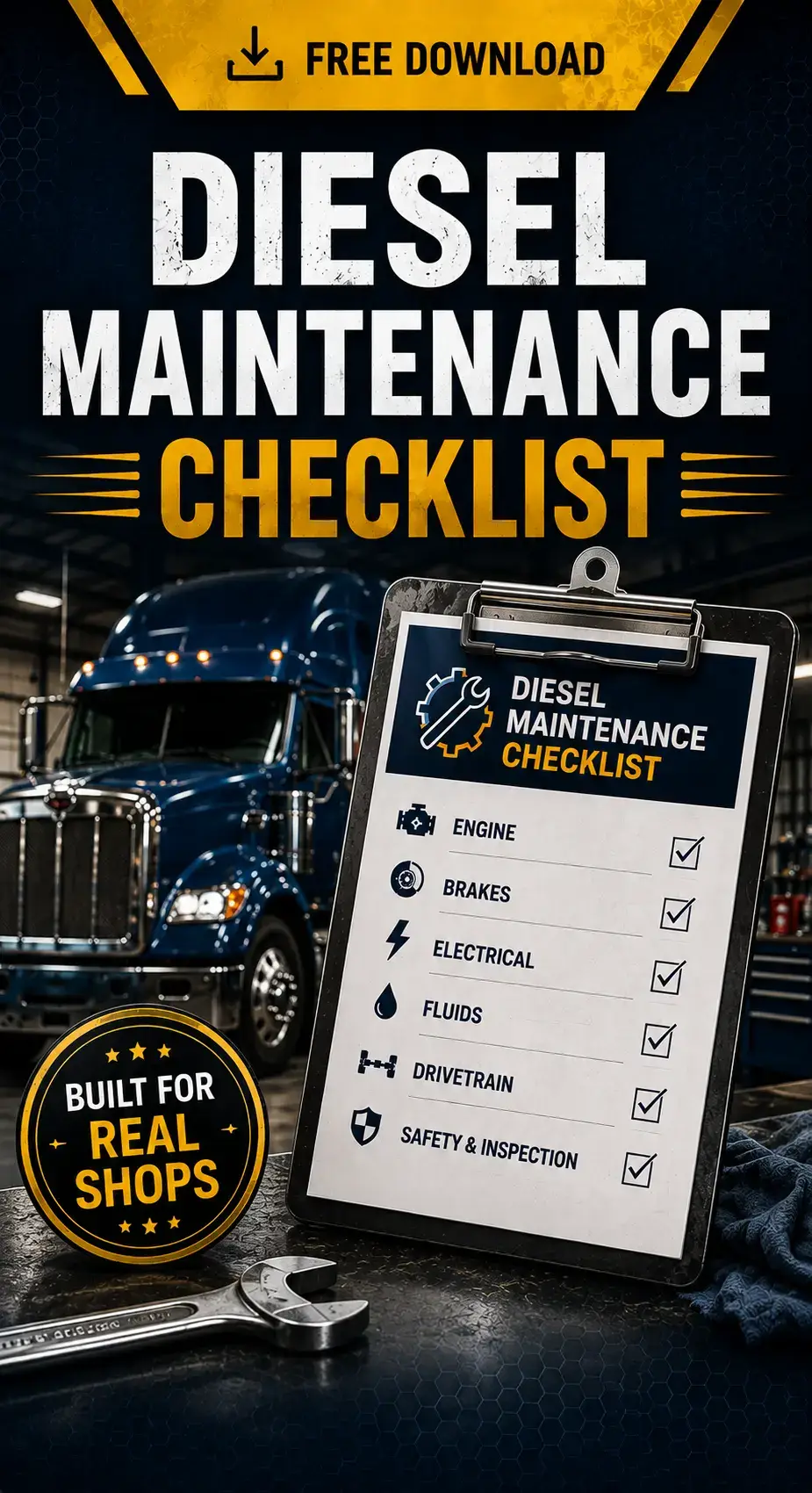
Free Diesel Maintenance Checklist
Get HDJ's free, field-tested diesel maintenance checklist delivered instantly to your inbox — print it, laminate it, keep it in the shop.
Instant PDF • 100% Free • No Spam
Preventive maintenance schedules do not disappear once a predictive program is running — the two work together. A fixed PM interval still catches the routine, low-risk service items, such as oil changes and filter swaps, that do not need sensor-driven timing, while predictive alerts handle the failure modes that genuinely vary by vehicle condition rather than mileage.
Fleets that try to replace their entire PM schedule with predictive alerts on day one, instead of layering the two, tend to see coverage gaps during a platform's first several months while its models are still calibrating to that specific fleet's operating conditions.
Recognizing Failure Patterns Across a Fleet
Individual telematics alerts are useful on their own, but the strategic value shows up once a fleet starts comparing alerts across vehicles rather than reading each one in isolation. When three trucks of the same make and model develop a similar transmission fault within a few weeks of each other, that pattern usually points to a systemic issue — a manufacturer defect, a spec mismatch for the fleet's typical duty cycle, or a shared driver behavior — rather than three unrelated coincidences.
Seasonal patterns are worth building into a fleet's alert calendar directly. Cooling-system stress and tire-related failures climb in summer heat; battery failures and DEF-quality issues cluster in winter cold. A fleet that reviews its own multi-year telematics history for these seasonal clusters can shift PM scheduling ahead of the season that typically drives the failure, rather than waiting for that season's alerts to arrive.
Driver behavior shows up as a pattern too — harsh braking and aggressive acceleration events, both already tracked by most telematics platforms for safety scoring, accelerate brake and drivetrain wear in ways that a per-vehicle maintenance record alone will not surface until the parts are visibly compromised.
Frequently Asked Questions
What is the difference between telematics and fleet telematics predictive maintenance?
Telematics is the underlying data system — the onboard devices, cellular connectivity, and cloud platform that capture and transmit vehicle data such as location, speed, and diagnostic readings. Fleet telematics predictive maintenance is what a fleet does with that data: applying machine learning and threshold-based analysis to forecast specific component failures before they happen, rather than simply tracking where a vehicle is.
Do I need to install new hardware to start predictive maintenance?
Usually not. The 2017 ELD mandate already pushed telematics hardware into the large majority of interstate Class 8 trucks, and most predictive maintenance platforms connect to that existing data stream through standard APIs with major telematics providers. Older vehicles without factory or mandate-driven telematics are typically the only ones that need an aftermarket device added.
How accurate is telematics-based failure prediction?
Current machine learning models achieve roughly 85-95% accuracy predicting major component failures, according to recent fleet-technology benchmarking, with alerts typically surfacing 20 to 45 days before a conventional dashboard warning light would appear. Accuracy improves as a platform accumulates more operating history on a specific fleet's vehicles and failure patterns.
What do SPN and FMI mean on a telematics fault code?
SPN (Suspect Parameter Number) identifies which specific component or circuit triggered the fault, and FMI (Failure Mode Identifier) describes how it failed, using one of 32 standardized failure modes such as an open circuit, a short circuit, or a value out of normal range. Reading them together — rather than either number alone — is what tells a technician both what to check and how urgently.
How long does it take to see ROI from a fleet telematics predictive maintenance program?
Most fleets running a properly configured program report measurable return within 12 to 18 months, primarily through a reduced count of emergency repairs and shorter average downtime per vehicle. Establishing a clear before-and-after baseline on cost per mile and downtime — benchmarked where possible against the Technology & Maintenance Council's Recommended Practices Manual — is what makes that ROI figure verifiable rather than an estimate borrowed from a vendor's marketing material.
Fleet telematics predictive maintenance is not a future capability fleets are still waiting to adopt — the underlying hardware is already installed on most interstate trucks, and the data those trucks generate every mile is either being used to schedule repairs ahead of failure or sitting unread in a system nobody has configured to act on it.
The gap between those two outcomes is not a technology gap; it is an operational one, built from a documented baseline, a platform chosen for alert speed rather than a feature list, a workflow that turns alerts into work orders automatically, and a team trained to trust and act on what the data is telling them.
Fleets that close that gap consistently convert a meaningful share of their emergency repair budget into scheduled maintenance — the same repair, at the same shop, at a fraction of the cost and none of the roadside risk, a pattern heavydutyjournal.com continues to track across the fleets and shops we cover.
Share This With Your Maintenance Team
If your shop is still reading fault codes off a scan tool and clearing them without a plan, this is worth forwarding to whoever owns your PM schedule.