
By Michael Nielsen, Publisher | 15+ Years in Diesel Repair
Last Updated: October 2026
⏱ Estimated reading time: 12 minutes
A heavy duty transmission jack has to hold the whole assembly on its saddle, so rated load, height range, and adapter fit matter more than the brand on the frame. Fleet shops should size the jack to the heaviest transmission they pull, confirm the saddle and adapter match the truck, and secure the load before anyone works near it.
Heavy Duty Journal's editorial team, led by publisher Michael Nielsen, rebuilt this guide for shop managers, fleet maintenance directors, and technicians. HDJ used published specifications from OTC, Omega Lift Equipment, and Sunex, transmission weights from Eaton, and the Occupational Safety and Health Administration's (OSHA) jack standard, all checked as of October 2026. HDJ did not test any of these jacks.
According to Heavy Duty Journal's October 2026 review, the biggest correction is weight. An earlier version of this guide put heavy-duty transmissions above 1,000 pounds, but Eaton publishes 690 and 716 pounds for the two manual models checked here, before the clutch housing, lubricant, and end yoke are added.
Key Takeaways
- ✓Weigh the assembly. Eaton lists the RTLO-18918B at 716 pounds without the clutch housing, lubricant, or end yoke, so the load on the saddle is heavier than the catalog number.
- ✓Rating is the operator's job. OSHA says the operator shall make sure the jack has a rating sufficient to lift and sustain the load, and the rated load must be marked on the jack.
- ✓Height range sorts the field. The floor-style jacks compared here start below 9 inches, while the telescopic and high-lift models start at 35 inches or more.
- ✓Adapters decide fit. OTC lists a mounting adapter for Eaton Fuller RoadRanger transmissions with the 5019A and includes an Allison 500 and 600 series adapter with the 5078.
- ✓Ratings start at 1,000 pounds. The jacks compared here range from 1,000 to 3,000 pounds, so a jack that looks heavy-duty may still be the wrong rating for a Class 8 assembly.
- ✓Secure the load at once. OSHA says a raised load shall be cribbed, blocked, or otherwise secured at once, and occupational fatality investigations describe trucks and buses that fell from jacks and stands.
In This Guide
- How to Size a Heavy Duty Transmission Jack
- Floor-Style, Under-Hoist, and High-Lift Designs
- Heavy Duty Transmission Jack Specifications Compared
- Securing the Load and Using the Jack Safely
- Inspecting and Maintaining a Transmission Jack
- Buying Checklist: Questions to Put in Writing
- Frequently Asked Questions
- The Bottom Line
How to Size a Heavy Duty Transmission Jack
Sizing starts with the heaviest assembly the jack will carry, not the transmission model alone. As of October 2026, Eaton lists the RTLO-18918B 18-speed manual at 716 pounds and its 8LL manual at 690 pounds, and Eaton notes that the RTLO weight excludes the clutch housing, lubricant, and end yoke.
Those extras add to the load on the saddle. A transmission that comes out with the clutch housing attached, or with fluid still in the case, weighs more than the catalog figure, so HDJ recommends using the assembled weight for the exact truck as the working number.
716 lb
Eaton's published weight for the RTLO-18918B manual transmission as of October 2026, before the clutch housing, lubricant, and end yoke are added.
The Code of Federal Regulations (CFR) puts the sizing decision on the operator. As of October 2026, 29 CFR 1910.244(a), OSHA's jack standard, says the operator shall make sure the jack has a rating sufficient to lift and sustain the load, and it requires the rated load to be legibly and permanently marked on the jack.
The rule sets no safety multiplier, so HDJ does not assign one. Ask the manufacturer how it defines the rated load, and treat a rating only slightly above the assembled weight as little margin for a load that can shift on the saddle.
Automatic transmissions follow the same logic. Allison lists model specifications in its Vocational Model Guide, so confirm the exact unit's weight with Allison or an authorized dealer and add anything bolted to it. HDJ's Allison automatic transmission troubleshooting guide covers the diagnosis side of those units.
For manual transmissions, the reason a unit is coming out often decides what else comes with it. HDJ's Eaton Fuller transmission problems guide covers diagnosis and repair of the units named above.
A clutch job changes the load too, because the clutch and housing may come out with the transmission. HDJ's heavy-duty truck clutch replacement guide covers the procedure.

Floor-Style, Under-Hoist, and High-Lift Designs
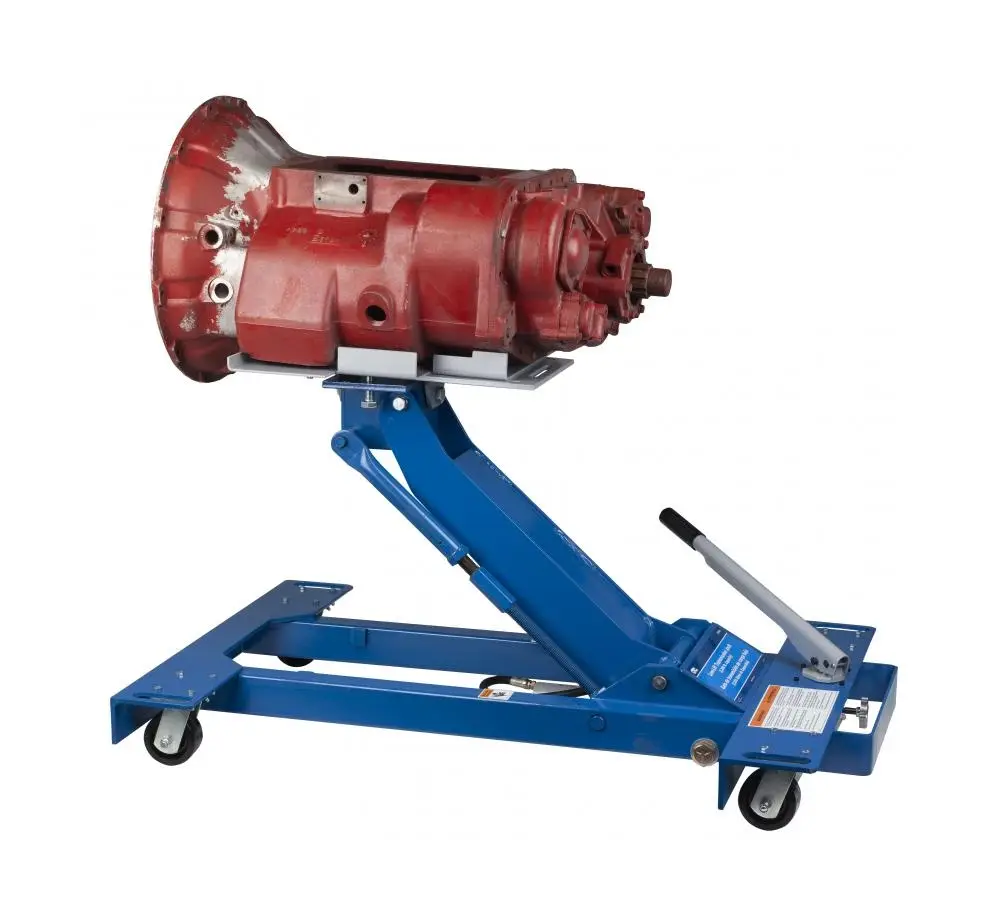
A heavy duty transmission jack for trucks falls into three designs, and the design has to match how the truck is raised. Each trades reach for clearance in a different way, so the table below the three descriptions compares them side by side.
Floor-Style Jacks
Floor-style jacks roll under a truck that sits low or has little room beneath the transmission. As of October 2026, OTC says the 5019A's 8-1/4-inch low height suits aerodynamic trucks with low ground clearance, and Omega's 43000 starts at 7-7/8 inches.
The trade-off is reach. The Omega 43000 tops out at 37-1/4 inches and the Sunex 7752C at 36.62 inches, which suits a transmission that sits low but not one on a truck raised high on a lift.
Under-Hoist Telescopic Jacks
Telescopic under-hoist jacks are built for trucks already raised on a lift. Omega's 42003 runs from 48-5/8 to 77-3/8 inches, and Sunex lists the 7796 at 35 inches low and 73.5 inches raised. HDJ's mobile column lifts guide compares two column systems that raise a truck to those working heights.
Air-Assisted and High-Lift Designs
Air-assisted jacks add shop air to the lift. Omega lists its air-actuated 42001 at 110 to 175 pounds per square inch (psi), and Sunex's 7796 uses a foot pedal for the air-activated first stage and the pump handle for the hydraulic second stage, with shop air regulated to 100 pounds per square inch gauge (psig). OTC's 5078 uses a foot-operated air pump.
None of the manufacturer pages HDJ checked states how much time air assist saves, so HDJ does not repeat a time-savings figure. A shop with steady transmission volume can ask the dealer for a demonstration and time the job itself.
| Design | Height range in this guide | Best fit | Watch for |
|---|---|---|---|
| Floor-style | 7-7/8 to about 37 in | Trucks with little room under the transmission | Limited reach on a raised truck |
| Under-hoist telescopic | 35 to 77-3/8 in | Trucks raised on a lift | High minimum height |
| High-lift air | 41-1/2 in minimum (OTC 5078) | Trucks and buses on a lift | Needs a shop air supply |
Heavy Duty Transmission Jack Specifications Compared
The table below uses manufacturer-published figures as of October 2026. Omega's figures come from its catalog, and OTC's and Sunex's from their product pages. A blank maximum height means the page did not state one, and HDJ did not test any of these jacks.
| Model | Rated capacity | Height range | Published detail |
|---|---|---|---|
| OTC 5019A | 2,200 lb | 8-1/4 in minimum | Tilts 20° back, 15° forward, 12° side to side |
| OTC 5078 | 2,000 lb | 41-1/2 in minimum | Foot-operated air pump; Allison 500 and 600 adapter included |
| Omega 43000 | 3,000 lb (1-1/2 ton) | 7-7/8 to 37-1/4 in | 364 lb; load-restraining chain; four swivel casters |
| Sunex 7752C | 3,000 lb (1.5 ton) | 8.7 to 36.62 in | 10° tilt front, rear, and side; two safety chains |
| Omega 42003 | 2,000 lb (1 ton) | 48-5/8 to 77-3/8 in | 290 lb; foot release pedal for lowering |
| Omega 42001 | 2,000 lb (1 ton), air | 48-5/8 to 77-3/8 in | 294 lb; air at 110 to 175 psi |
| Sunex 7796 | 1,000 lb | 35 to 73.5 in | Air first stage, hydraulic second stage; 30.25 in square base |
Capacity is the first filter. Only the OTC 5019A, Omega 43000, and Sunex 7752C are rated above 2,000 pounds, and the Sunex 7796 is rated 1,000 pounds, which leaves little room once a 690- or 716-pound manual transmission picks up a clutch housing, fluid, and an adapter.
OTC 5019A and 5078
OTC lists the 5019A at 2,200 pounds with an 8-1/4-inch low height, and says a special mounting adapter fits Eaton Fuller RoadRanger transmissions on Class 7 and 8 trucks. The page also describes a swiveling pump handle for restricted spaces and a fast-acting pump, and it gives a shipping weight of 376 pounds.
The 5078 is OTC's high-lift option for trucks and buses. OTC lists 2,000 pounds, a 41-1/2-inch minimum height that allows removal from the vehicle frame, a foot-operated air pump, and an included Allison 500 and 600 series adapter, at a weight of 312 pounds.
Omega 43000, 42003, and 42001
Omega's 43000 is a floor-style jack rated 1-1/2 tons, with a head that tilts forward, backward, and side to side, a safety load-restraining chain, and four swivel casters. Its saddle measures 18-7/8 by 10-5/8 inches and expands to 46-3/4 by 25-5/8 inches.
The 42003 and its air-actuated twin, the 42001, are one-ton telescopic jacks with a 13-inch-square saddle that expands to 24-1/2 by 18-7/8 inches. Omega describes an extra-wide base, and the catalog lists the 42003's foot release pedal for controlled lowering.
Sunex 7752C and 7796
Sunex lists the 7752C as a 1.5-ton truck transmission jack with an 8.7-inch low height, a 36.62-inch maximum, 10 degrees of saddle tilt in each direction, two safety chains, and a universal saddle with four adjustable brackets.
The 7796 is lighter duty at 1,000 pounds, with 37 degrees of forward and 26 degrees of backward saddle tilt and a tie-down strap that secures the load to the saddle before lifting. HDJ left out jacks named in earlier versions of this guide because it could not confirm their specifications on a manufacturer page.
Securing the Load and Using the Jack Safely
As of October 2026, OSHA's jack standard sets several rules that apply directly to a heavy duty transmission jack. The base must be blocked when there is no firm foundation, the operator must watch the stop indicator and not overrun the limit of travel, and a raised load must be cribbed, blocked, or otherwise secured at once.
⚠️ Safety Warning
Do not work beside or beneath a raised transmission that is held only by the jack's hydraulic or air pressure. Secure the transmission to the saddle with the jack's chains or straps, block the base on a soft or uneven floor, and follow the manufacturer's instructions for the exact securing method.
The General Duty Clause in Section 5(a)(1) of the Occupational Safety and Health Act adds a broader duty. It requires an employer to furnish a place of employment free from recognized hazards that are causing or are likely to cause death or serious physical harm. HDJ's OSHA compliance guide for diesel repair shops covers how a written safety program supports that duty.
Fatality investigations show what a failed support does. The National Institute for Occupational Safety and Health (NIOSH) runs the Fatality Assessment and Control Evaluation (FACE) program, and its 1999 report on a bus falling off a jack described a Nebraska bus mechanic fatally crushed when a bus fell off a 12-ton bottle jack. It recommended that equipment with a potential to fall be properly jacked and blocked up before anyone gets under it.
A 2020 New York FACE report described a town highway mechanic killed when a truck fell off a jack stand, and it recommended wheel chocks and cribbing. Neither case involved a transmission, but both describe the same hazard of working near a load that is not fully supported.
The American Society of Mechanical Engineers (ASME) publishes the Safety Standard for Portable Automotive Service Equipment (PASE), which covers jacks, stands, ramps, shop cranes, engine stands, and shop presses. ASME's page lists the standard as reaffirmed in 2024 but does not name transmission jacks, so ask the manufacturer whether a given model is built to it.
Before the lift, HDJ recommends confirming that the saddle, adapter, and chains fit the transmission, that the floor is level and clean, and that the transmission is secured to the saddle before the last bolt comes out.
Inspecting and Maintaining a Transmission Jack
Caring for a heavy duty transmission jack is covered by OSHA's jack standard too. It says all jacks shall be properly lubricated at regular intervals and that hydraulic jacks exposed to freezing temperatures shall be supplied with an adequate antifreeze liquid.
It sets three inspection points as well. A jack in constant or intermittent use at one locality is inspected once every 6 months, a jack sent out of the shop for special work is inspected when it leaves and when it returns, and a jack subjected to abnormal load or shock is inspected immediately before and immediately after.
Free Diesel Maintenance Checklist
Get HDJ's free, field-tested diesel maintenance checklist delivered instantly to your inbox — print it, laminate it, keep it in the shop.
Instant PDF • 100% Free • No Spam
HDJ recommends a short check before each use on top of the OSHA schedule:
- Look for hydraulic fluid at the ram and fittings, and for a jack that drifts down under load
- Check safety chains or straps for stretch, cracks, and damaged hooks
- Confirm the rated-load marking is still legible
- Check that casters and swivels roll freely and that locking casters hold
- On air-assisted models, inspect the air hose and fittings for wear
- Tag out any jack that fails a check until it is repaired
Record each inspection with the date and the technician's name. That record shows the shop recognized the hazard and acted on it, which is the point of the General Duty Clause.
Buying Checklist: Questions to Put in Writing
Before you accept a quote for any heavy duty transmission jack, ask the dealer to confirm these items in writing so the figures on the sheet become commitments:
- The rated load marked on the jack, compared with the assembled weight of your heaviest transmission
- Minimum and maximum height, compared with the truck on the lift or floor where the jack will work
- Adapter coverage for the transmissions you pull, such as Eaton Fuller RoadRanger or Allison units, and whether adapters are included
- Saddle size and tilt range for your transmission cases
- Safety chains or straps included, and the maker's securing instructions
- Shop air requirements for air-assisted models, such as the 100 psig Sunex lists for the 7796
- Whether the maker states that the model is built to a standard such as ASME PASE
- Warranty and parts support
Match the answers to your bays. A jack that fits the spec sheet but not the truck or the lift height is the wrong jack.
Frequently Asked Questions
What size transmission jack do I need for a semi truck?
Choose a rating above the heaviest assembly you will lift. As of October 2026, Eaton lists the RTLO-18918B at 716 pounds before the clutch housing, lubricant, and end yoke. OSHA requires a rating sufficient to lift and sustain the load, so confirm the assembled weight.
Can I use a car transmission jack on a truck?
Only if the rating marked on the jack covers the assembled load and the height range and saddle fit the truck. OSHA requires the rated load to be permanently marked. Many truck transmissions also need an adapter, such as the Eaton Fuller RoadRanger adapter OTC lists for the 5019A.
What is the difference between air-assisted and hydraulic-only transmission jacks?
Air-assisted jacks use shop air for part of the lift, such as the air-activated first stage on the Sunex 7796, which calls for air regulated to 100 psig. Hydraulic-only jacks need no air supply. The manufacturer pages HDJ checked state no time-savings figure.
How often should a transmission jack be inspected?
As of October 2026, OSHA calls for inspection once every 6 months for constant or intermittent use at one locality, when a jack leaves and returns for special work, and immediately before and after abnormal load or shock. It also requires regular lubrication, so HDJ adds a quick check before each use.
Does OSHA require a raised load on a jack to be secured?
Yes. OSHA says that after the load has been raised it shall be cribbed, blocked, or otherwise secured at once, and that the jack base shall be blocked without a firm foundation. Follow the jack maker's instructions for the exact chain or strap method.
The Bottom Line
A heavy duty transmission jack earns its place when its rating covers the assembled weight, its height range matches how the truck is raised, and its adapter fits the transmission. Floor-style jacks like the OTC 5019A start under nine inches for low trucks, while telescopic and high-lift jacks such as the Omega 42003 and OTC 5078 start much higher for trucks on lifts.
Heavy Duty Journal's guidance at heavydutyjournal.com, from publisher Michael Nielsen and the HDJ editorial team, is to confirm rating, height, adapter, and securing method in writing before you buy, then inspect the jack on the OSHA schedule.
Share This Guide With Your Team
If a shop manager or fleet director on your team is choosing a transmission jack, pass this heavydutyjournal.com guide along so they can compare published specifications and OSHA jack rules before they request quotes.


