By Michael Nielsen, Publisher | 15+ Years in Diesel Repair
Last Updated: November 2026
⏱ Estimated reading time: 12 minutes
Heavy equipment mechanic tools are the hand tools, power tools, diagnostic instruments, specialty tools and safety gear a technician uses to service construction, mining and farm machinery. A $5,000 budget works best as a three-phase plan, not one shopping trip: hand tools first, power and diagnostic tools second, specialty tools and storage last. The BLS says technicians generally buy their own tools over their careers.
That same source warns the full inventory can cost thousands of dollars, so Heavy Duty Journal treats $5,000 as a planning ceiling for the first years of the job, not the price of a finished toolbox. This guide, current as of November 2026, shows what each phase should cover, who pays for what under federal rules, and how to avoid buying tools you will not use.
Key Takeaways
- ✓Spend in three phases. HDJ suggests cumulative ceilings of $2,000 for hand tools, $3,500 once power and diagnostic tools are added, and $5,000 with specialty tools and storage.
- ✓Technicians usually buy their own. BLS says heavy vehicle and mobile equipment service technicians generally buy tools over their careers and that the inventory can cost thousands of dollars.
- ✓Cost is a real barrier. ATRI found 29.0% of trucking shops named the cost of buying their own tools as the top barrier for new technicians.
- ✓Safety gear may not come out of your budget. Under 29 CFR 1910.132(h), employers must pay for most required PPE, with exceptions such as non-specialty safety-toe footwear.
In This Guide
- What a $5,000 Tool Budget Covers
- Who Buys Tools in Heavy Equipment Work
- Matching Tools to Your Machine Type
- Phase 1: Foundation Hand Tools
- Phase 2: Power and Diagnostic Tools
- Phase 3: Specialty Tools and Storage
- Tool and Hydraulic Safety on Machines
- How to Buy Without Wasting Money
- Frequently Asked Questions
- The Bottom Line
What a $5,000 Tool Budget Covers
Heavy equipment mechanic tools on a $5,000 budget cover a working starter set for a technician who services machines such as excavators, loaders, graders, tractors and cranes, if the money is spent in order of need. It does not cover a full career inventory, or large shop equipment that an employer may supply. The table sets out the HDJ planning framework as of November 2026.
| Phase | Cumulative ceiling | What it covers |
|---|---|---|
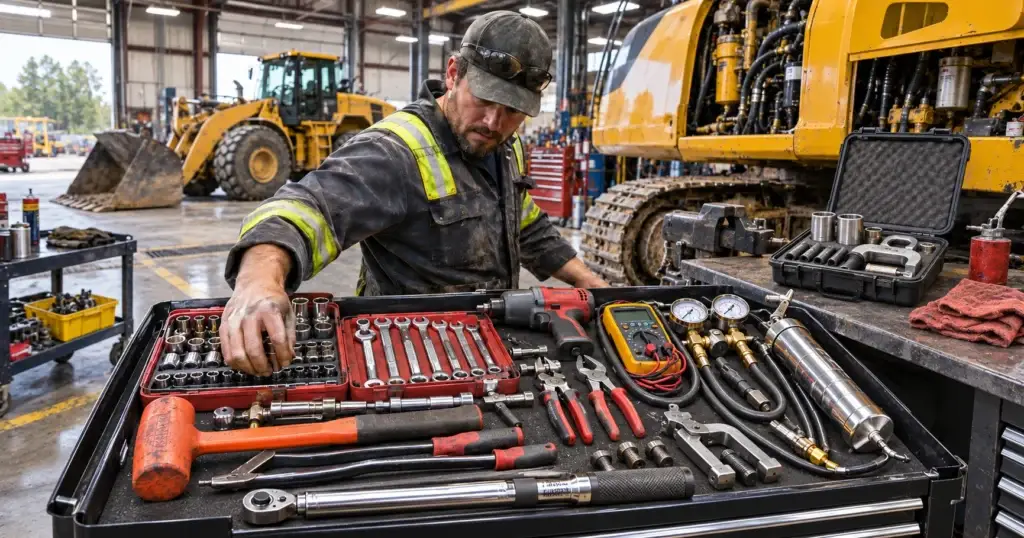
| 1. Foundation | Up to $2,000 | Sockets, wrenches, torque wrench, hammers, pry bars, pliers, measuring tools |
| 2. Power and diagnostics | Up to $3,500 | Impact wrench, multimeter, test light, hydraulic pressure gauges, grease gun |
| 3. Specialty and storage | Up to $5,000 | Pullers, seal and bearing drivers, snap-ring tools, rolling box, portable field kit |
These ceilings are HDJ's planning figures, not price quotes. Tool prices change with brand, quality and market conditions, and neither BLS nor ATRI publishes a standard starter-set cost. Price each phase against current catalogs before you commit, and adjust the split to the machines you actually service.
Who Buys Tools in Heavy Equipment Work
Technicians in this field generally buy their own tools. The BLS Occupational Outlook Handbook says heavy vehicle and mobile equipment service technicians generally buy their own tools over their careers and that the inventory can cost thousands of dollars. It lists median pay of $63,850 in May 2025.
As of November 2026, BLS projects 7% employment growth for the occupation from 2025 to 2035, with about 20,300 openings a year. The typical entry path is a high school diploma or equivalent plus long-term on-the-job training, and BLS says technicians usually become fully qualified after 3 to 4 years. Tool spending therefore stretches across the same years as training.
BLS also names the work these tools support. Technicians inspect, maintain and repair machinery used in construction, farming, rail transportation and other industries, and they often travel to job sites for equipment too large to move, such as cranes. Mobile heavy equipment mechanics repair bulldozers, cranes, graders and excavators for governments, rental shops and large construction or mining firms.
Pay varies by where you work, and the five largest industries in BLS data show a gap of about $9,500 between the highest and lowest medians.
| Industry | Median annual wage, May 2025 |
|---|---|
| Transportation and warehousing | $68,600 |
| Heavy and civil engineering construction | $63,770 |
| Specialty trade contractors | $63,270 |
| Rental and leasing services | $61,620 |
| Farm and garden machinery and equipment merchant wholesalers | $59,090 |
Higher median pay does not say who buys heavy equipment mechanic tools at a given employer, so compare tool policies as carefully as wages.
The cost lands hardest on newcomers. In its August 2025 diesel technician study, the American Transportation Research Institute (ATRI) found 29.0% of trucking shops named the high cost of acquiring their own tools as the top barrier for new technicians. The study covers trucking shops, not equipment dealers, so treat it as a signal and not a measure of this trade.
PPE follows different rules. Under 29 CFR 1910.132(h), employers must provide required PPE at no cost, with exceptions that include non-specialty safety-toe footwear and non-specialty prescription safety eyewear when workers may wear them off the job site, plus everyday clothing and ordinary weather items. Ask your employer which items it covers before you spend any of the $5,000 on safety gear.
Matching Tools to Your Machine Type
Machine type shapes which heavy equipment mechanic tools earn their place first. BLS divides the occupation into specialties: mobile heavy equipment mechanics repair construction and surface mining equipment such as bulldozers, cranes, graders and excavators, while farm equipment mechanics and service technicians repair tractors and harvesters and mostly work at dealer repair shops. Rail car repairers service locomotives, subway cars and other rolling stock.
| Specialty | Where the work happens | Tool planning note |
|---|---|---|
| Mobile heavy equipment | Governments, rental shops, large construction and mining firms | A portable field kit matters because large machines are serviced on site |
| Farm equipment | Mostly dealer repair shops | BLS notes six or seven 12-hour days in planting and harvest, so durability counts |
| Rail car repair | Railroads, transit agencies, railcar manufacturers | Ask the employer which tools it supplies for rolling stock |
Use this to decide what goes into phases 2 and 3. A technician who works mostly on job sites should favor a compact, well-organized field kit and portable power, while a dealer-shop technician can lean on the rolling box and shop air. Ask coworkers at the target employer what they reach for most before you spend.
Phase 1: Foundation Hand Tools
Foundation hand tools are the heavy equipment mechanic tools you reach for on nearly every job, so they come first and should be the best you can afford. BLS lists screwdrivers, pliers and wrenches among the hand tools technicians use on small parts and in hard-to-reach areas. Heavy equipment adds large fasteners, which means bigger drives and larger wrenches than a light-duty set.
| Tool group | What to include | Why it matters |
|---|---|---|
| Sockets and drives | SAE and metric sets in 3/8, 1/2 and 3/4 inch drive, deep and standard | Machines use large fasteners in both measuring systems |
| Wrenches | Combination wrenches through large sizes, adjustable wrench, breaker bar | Large fasteners need leverage and full-contact fit |
| Torque tools | A torque wrench sized to your most common fasteners | Torque specifications come from the manufacturer's manual |
| Striking and prying | Dead-blow hammer, ball-peen hammer, pry bars, punches and drifts | Pins, bushings and stuck parts are routine |
| Pliers and drivers | Pliers, snap-ring pliers, screwdrivers, hex and Torx sets | BLS lists screwdrivers, pliers and wrenches as core hand tools |
| Measuring and light | Tape, calipers, straight edge, headlamp or work light | Wear checks and clearances depend on accurate measurement |
Spend on sockets, wrenches and the torque wrench first, because they see the most use and the most abuse. Buy complete sets only where you will use most of the pieces, and fill gaps with single sizes. Check torque wrench calibration needs with the maker, because accuracy depends on how the tool is used and stored.
Hand tools also anchor the rest of your career spending, and the Heavy Duty Journal library at heavydutyjournal.com covers the next steps. HDJ's diesel mechanic tools list covers the equivalent set for Class 6 through Class 8 trucks, and much of it overlaps with machine work.
Phase 2: Power and Diagnostic Tools
Phase 2 adds the heavy equipment mechanic tools that save time and let you diagnose instead of guess. BLS says service technicians use power and machine tools such as pneumatic wrenches, and diagnostic computers and equipment to identify problems. It gives an oscilloscope as an example for observing signals from electronic components.
| Tool group | What to include | Notes |
|---|---|---|
| Impact tools | An impact wrench in pneumatic or cordless form, with impact-rated sockets | BLS notes a pneumatic tool is powered by compressed air |
| Electrical | Digital multimeter, test light, jumper leads | Machine electrical faults start with basic voltage checks |
| Hydraulic testing | Pressure gauges, fittings and hoses for test points | Match fittings to the machines you service |
| Lubrication | Grease gun and fittings | Greasing is routine scheduled maintenance |
| Diagnostics | Basic code reader only if your employer does not supply software | Ask what the employer provides first |
Hold back on diagnostic software. Manufacturer service tools are specialized and an employer may supply them, so ask what the shop provides before you buy anything. A basic meter and a set of hydraulic gauges are safer early purchases than an expensive scan tool you may never use.
Use impact-rated sockets with impact wrenches and follow the tool maker's guidance on ratings. Mobile technicians should also think about power: a compressor, a cordless kit or both, depending on where the work happens. HDJ's guide to the mobile diesel service truck equipment and tool list covers what a field setup adds.
Phase 3: Specialty Tools and Storage
Specialty heavy equipment mechanic tools come last because they solve specific jobs. Buy them when a job you actually do calls for one, not before. Pullers, seal and bearing drivers, snap-ring tools and hydraulic cylinder service tools are the usual first additions, and each machine family has its own requirements.
Large and expensive items may be shop-owned. Ask whether the employer supplies presses, engine stands, jacks, lifting equipment and manufacturer special tools before you spend your own money on them. BLS describes work that includes overhauling engines, hydraulic and electrical systems, which is where special tools earn their keep, so the question deserves a straight answer.
Storage belongs in phase 3 as well. A rolling box protects tools and keeps them findable, and a portable kit matters when the machine is on a job site. HDJ's diesel technician tool investment guide explains how to think about larger purchases once your core set is complete.

Tool and Hydraulic Safety on Machines
Tool safety on machines covers two things: the condition of the tools themselves and the hazards of the systems you work on. Under 29 CFR 1910.242(a), each employer is responsible for the safe condition of tools and equipment used by employees, including tools furnished by employees. That means your personal tools are inspected like the shop's.
OSHA's booklet Hand and Power Tools (OSHA 3080) sets out what to watch. Wrenches with sprung jaws that slip should not be used, and impact tools such as drifts, wedges and chisels must be kept free of mushroomed heads, which can shatter. Pneumatic tools need secure hose attachment and a retainer to keep attachments from ejecting, and eye protection is required.
⚠️ Safety Warning
Hydraulic fluid under pressure can break the skin and cause a serious injection injury. The UK Health and Safety Executive (HSE) states in its safety bulletin that prompt action is essential and that victims need immediate professional medical treatment, and that cases have occurred at pressures over 100 bar (1,450 psi) with anecdotal reports at much lower pressures. Do not treat a pinhole leak as minor.
Hydraulic injection injury occurs when the outer layer of skin is broken by a jet of fluid under pressure, according to HSE. The agency says that without proper care these injuries can lead to amputation, and that pain may become intense four to six hours after the injury if untreated. HSE also advises inspecting the integrity of grease nipples and adapters on track tensioning systems.
BLS adds a reason to take this seriously: farm equipment mechanics have one of the highest rates of injuries and illnesses of all occupations, and common injuries across the trade are small cuts, sprains and bruises from heavy parts and tools. Safety gear itself follows the PPE rule covered above. HDJ's diesel mechanic safety equipment guide covers eye, hearing, respiratory, hand and foot protection in detail, so this guide does not repeat it.
How to Buy Without Wasting Money
Buying heavy equipment mechanic tools well matters more than buying them cheaply, because a bad tool costs you twice. These rules apply whether you buy new or used, and none depends on a particular brand. They also protect the $5,000 from the most common leak, which is duplicate and unused purchases.
Inspect any used tool against the OSHA criteria above: sprung wrench jaws, mushroomed heads, cracked handles or damaged hose fittings mean the tool should not be used. Ask what warranty covers a tool and get the terms in writing. Buy single sizes before complete sets when your work shows you only use a few pieces.
Ask the employer about support before you spend. Some employers offer tool allowances, starter sets, payroll purchase plans or shop-owned specialty tools, and training programs sometimes include tools. HDJ's guide to paid diesel apprenticeships explains how those programs are structured.
Certification can also affect how you plan. BLS says some manufacturers offer certification in specific repair methods or equipment, and that although not required, certification can demonstrate competence and usually pays more. Tools tied to a certification program are worth buying once the program is confirmed.
Key Recommendation
Before you buy anything, ask your employer in writing which tools it supplies, which PPE it pays for and whether it offers a tool allowance. Then spend phase 1 on the tools you will use every day, and make every later purchase for a job you have actually done.
Frequently Asked Questions
How much do heavy equipment mechanic tools cost?
BLS gives no set figure, saying only that technicians buy tools over their careers and the inventory can cost thousands of dollars. HDJ suggests planning $5,000 in three phases: $2,000 for hand tools, $3,500 with power and diagnostic tools, and $5,000 with specialty tools and storage.
Do heavy equipment mechanics buy their own tools?
Generally yes. BLS says heavy vehicle and mobile equipment service technicians buy their own tools over the course of their careers. Policies vary by employer, so ask in writing which tools, special tools and PPE your employer supplies before you start buying.
What tools should a new heavy equipment mechanic buy first?
Start with hand tools used every day: SAE and metric socket sets in several drive sizes, combination wrenches, a breaker bar, a torque wrench, hammers, pry bars and pliers. These make up phase 1. Add power and diagnostic tools only after you see what your jobs require.
Does the employer pay for safety gear?
Mostly yes. Under 29 CFR 1910.132(h), employers must provide required PPE at no cost, with exceptions such as non-specialty safety-toe footwear and prescription eyewear that workers may wear off the job site. Everyday clothing and ordinary weather items are also excepted. Confirm your employer's policy.
Can I start with a smaller budget than $5,000?
Yes. Phase 1 is meant to be usable on its own, and HDJ's planning ceiling for it is $2,000. Because BLS says technicians build their tool inventory over a career, a smaller start is normal. Add tools when real jobs call for them.
What is the biggest safety risk with hydraulic systems?
Injection injury. The UK Health and Safety Executive says hydraulic fluid jets can break the skin, that serious cases occurred at pressures over 100 bar (1,450 psi), and that victims need immediate professional medical treatment. Without proper care, such injuries can lead to amputation.
The Bottom Line
Heavy equipment mechanic tools are a long-term investment, and a $5,000 budget is best spent in phases: hand tools first, power and diagnostic tools next, specialty tools and storage last. BLS says the full inventory can cost thousands of dollars, so ask what your employer supplies and let real jobs decide each purchase. Treat the phase ceilings here as planning figures, current as of November 2026, and price them against current catalogs.
Michael Nielsen and the Heavy Duty Journal team publish tool, career and safety guides at heavydutyjournal.com, and this plan will be updated as BLS, ATRI and OSHA information changes. Verify current figures at the linked sources before you buy.
Help a New Tech Build Their First Toolbox
Know someone starting out in equipment repair? Share this guide so they can plan tool purchases in phases and ask the right questions before they spend.