By Michael Nielsen, Publisher | 15+ Years in Diesel Repair & Fleet Operations
Last Updated: September 2026
⏱ Estimated reading time: 17 minutes
Diesel diagnostic certification has become the defining credential separating entry-level mechanics from highly sought-after diagnostic specialists in today's commercial vehicle industry. Fleet managers across the country struggle to find technicians capable of troubleshooting the sophisticated electronic systems controlling modern heavy-duty diesel engines, creating real opportunities for professionals who invest in proper credentialing. With approximately 26,500 annual job openings projected by the U.S. Bureau of Labor Statistics and a median wage of $60,640, this career path offers both stability and genuine earning potential for people willing to pursue specialized training.
Modern emission control systems, electronic fuel injection, and computerized engine management have transformed diesel repair from a purely mechanical trade into a sophisticated diagnostic discipline — and the gap between shops that can find qualified technicians and shops that can't is only getting wider, a divide heavydutyjournal.com has watched play out across the fleet operators and repair shops it covers.
Key Takeaways
- ✓Strong job market, real shortage. ~26,500 annual openings nationwide with a $60,640 median wage, against a talent pipeline that isn't keeping pace with retirements.
- ✓ASE A9 is the credential employers actually look for — Electronic Diesel Engine Diagnosis validates the advanced troubleshooting skills that separate specialists from general mechanics.
- ✓Multiple training pathways exist — technical institutes, community colleges, and apprenticeships all lead to certification on different timelines and budgets.
- ✓Accredited training shortens the ASE clock. Graduates of accredited programs can substitute coursework for one year of the two-year ASE experience requirement.
- ✓Employers are competing for talent. Sign-on bonuses, tool allowances, and relocation assistance are increasingly standard for certified graduates, not exceptions.
In This Guide
- What Is Diesel Diagnostic Certification?
- Types of Diesel Diagnostic Certifications Available
- Training Program Formats for Diesel Technicians
- Eligibility Requirements and Prerequisites
- Comprehensive Curriculum in Diagnostic Training
- The Certification Testing Process
- Training Costs and Financial Assistance
- Career Opportunities and Salary Expectations
- Frequently Asked Questions
What Is Diesel Diagnostic Certification?
Diesel diagnostic certification validates specialized expertise in identifying, analyzing, and resolving complex diesel engine problems using advanced electronic diagnostic equipment — it differs from general mechanic qualifications by emphasizing electronic systems troubleshooting and systematic problem-solving over routine maintenance tasks. Certified specialists work with ECMs, sensor networks, and computerized engine management systems, demonstrating proficiency in reading diagnostic trouble codes, interpreting live data, and isolating root causes instead of just swapping parts and hoping.
The National Institute for Automotive Service Excellence (ASE) provides the most widely recognized credentials, while state-level certifications address specific regulatory requirements like emissions testing compliance.
The practical difference matters on the shop floor: a general mechanic might replace a faulty sensor, while a certified diagnostic specialist determines why it failed and whether related systems took damage — and fleet managers increasingly understand that misdiagnosis costs more than the diagnostic fee itself, through unnecessary parts, extended downtime, and repeat repairs. That understanding is exactly why job postings for diagnostic-specific roles now routinely list ASE A9 as a preferred or required qualification, rather than treating any diesel experience as interchangeable.
Types of Diesel Diagnostic Certifications Available
The ASE A9 Electronic Diesel Engine Diagnosis credential is the gold standard, validating proficiency in computerized engine controls, sensor systems, and electronic fuel injection diagnostics. Eligibility needs two years of relevant work experience, or one year combined with training from an ASE Education Foundation accredited program.
The ASE T2 Medium-Heavy Truck Diesel Engines certification complements A9 by covering mechanical systems specific to commercial vehicles — fuel systems, air induction, exhaust, cooling — and the two together create the credential portfolio most fleet maintenance managers look for when filling senior diagnostic roles.
26,500 annual openings
Projected average annual job openings for diesel service technicians through 2034, per the U.S. Bureau of Labor Statistics — most driven by retirements and career changes, not new demand.
Manufacturer-specific programs — Universal Technical Institute partners with Cummins, Peterbilt, and Freightliner, for instance — deliver brand-specific training that mirrors actual authorized-service-center workflows, and some receive direct manufacturer funding that lowers the cost to participants. Technicians certified on Detroit Diesel or Caterpillar systems command premium pay for exactly that specialization.
On the regulatory side, programs like Delta College's California ARB Heavy Duty Diesel Engine Emissions Control certification address state-specific requirements, and SAE offers an air conditioning/refrigerant certification — worth having if you're in a state with strict inspection programs tied to specific credentials.
| Certification | Focus Area | Requirements |
|---|---|---|
| ASE A9 | Electronic diesel engine diagnosis | 2 years experience or 1 year + accredited training |
| ASE T2 | Medium-heavy truck diesel engines | 2 years commercial vehicle experience |
| Manufacturer-Specific | Brand-exclusive systems and tools | Completion of approved training program |
| State Emissions (ARB) | Emissions control systems compliance | State-approved training completion |
Training Program Formats for Diesel Technicians
Technical institutes like Universal Technical Institute, Lincoln College of Technology, and WyoTech deliver focused diesel diagnostic training in dedicated facilities, often completing core programs in under a year — the fastest path into the workforce, with extensive hands-on time on current diagnostic equipment.
Community colleges like Delta College, American River College, and Ivy Tech offer associate degree programs spanning two years, blending diesel training with general education and typically running at lower tuition thanks to public subsidization; that broader curriculum also opens a path toward supervisory roles or transfer to a four-year program.
Blended-learning formats split instruction roughly half online and half hands-on lab work, mirroring how technicians actually work today — reviewing digital resources while performing physical diagnostics. Fully online certification isn't realistic given the hands-on nature of the work, but hybrid formats get close to the efficiency of full in-person training without sacrificing the supervised practical time that actually builds skill.
Registered apprenticeships take longer — typically three to four years — but let apprentices earn wages while training under experienced technicians, often leading straight into employment with the sponsoring employer once requirements are complete. Michael Nielsen's advice for anyone weighing the tradeoff: apprenticeships suit people who need income during training more than they need a faster credential, and that's a real, honest constraint worth naming rather than pretending every path fits every situation equally.
Eligibility Requirements and Prerequisites
Entry-level programs need only a high school diploma or GED, and most require no prior technical experience — a genuinely open door for people transitioning from other fields. A solid foundation in algebra helps with the specification calculations and sensor-value interpretation diagnostic work involves, and basic science comprehension makes combustion, electrical theory, and hydraulics click faster during coursework.
Advanced certifications like ASE typically require two years of hands-on diesel repair experience, though graduates of ASE Education Foundation accredited programs can substitute one year of formal training for that requirement — a real accelerant toward certification. Physically, the work demands lifting components that can weigh 50 pounds or more, working in awkward positions for extended periods, and tolerating shop-environment temperature extremes; vision and hearing requirements matter too, since reading color-coded wiring and catching an unusual engine sound are both genuinely safety-relevant skills, not just nice-to-haves.
Comprehensive Curriculum in Diagnostic Training
Coursework covers Electronic Control Modules governing fuel delivery, injection timing, boost, and emissions, plus the sensor networks — temperature, pressure, position, mass airflow — feeding them real-time data.
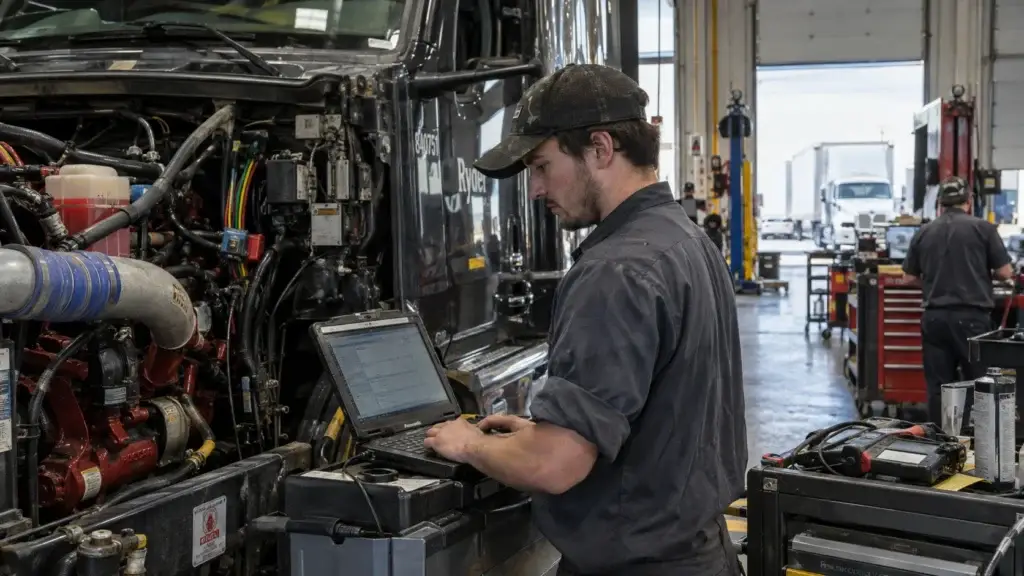
Students learn ECM programming procedures, software updates, and parameter adjustment on manufacturer-specific platforms, building toward the diagnostic-tool proficiency that actually distinguishes certified technicians in the job market: handheld scan tools, laptop-based software, digital multimeters, and oscilloscopes, plus live data analysis and bi-directional component testing across generic OBD and manufacturer-specific systems from Cummins, Detroit Diesel, and Caterpillar.
Emission control training covers DPF operation and regeneration, SCR and DEF dosing diagnostics, and EGR systems in real depth, since EPA emission standards compliance is now a core competency, not a specialty add-on.
Fuel injection and turbocharger coursework rounds out the technical curriculum — high-pressure common rail systems, injector flow testing, VGT diagnostics, and the interaction between boost pressure and exhaust backpressure that a technician needs to understand before they can properly diagnose a turbo-related code rather than just replacing the turbo and hoping.
Programs increasingly weave in hands-on lab time specifically built around these three systems together, since employers report that graduates who've only studied each system in isolation take longer to become productive on the shop floor than ones trained to see the interactions between them.
The Certification Testing Process
Registration starts with an account with the testing organization and documentation proving eligibility — completion certificates and transcripts for accredited-program graduates substituting training for experience. Most candidates plan their exam three to six months after program completion, balancing preparation time against keeping curriculum knowledge fresh.
Exams run computer-based with multiple-choice questions built around real-world scenarios rather than rote memorization — diagnostic charts, technical diagrams, and specifications that mirror actual shop conditions.
Candidates face 40-75 questions depending on certification level, with 60-90 minute time limits, and can flag questions for later review. ASE puts the passing bar around 70% correct on most exams. Certifications expire after five years, and technicians renew either by retesting or by completing approved continuing education — most choose continuing education, accumulating credits through manufacturer programs, industry seminars, and online courses.
Training Costs and Financial Assistance
Private technical institutes generally run $20,000-$40,000 for full training, reflecting intensive, equipment-rich, accelerated programs. Community college associate degree programs cost meaningfully less — $5,000-$15,000 in-state for two years — thanks to public subsidization, making them the more budget-conscious route to a recognized credential.
Beyond tuition, budget for a professional starter tool set ($2,000-$5,000 — a real investment that pays off across an entire career), safety gear ($200-$400), textbooks ($500-$1,000/year), and ASE exam fees ($40-$70 per test). HDJ's essential diesel diagnostic tools guide breaks down what to actually prioritize in that starter set by career stage, so the budget goes toward tools you'll use constantly rather than ones that sit in the box.
Federal aid through FAFSA opens up Pell Grants (need-based, no repayment) and federal student loans with deferred repayment. Many employers — service companies, fleet operators, dealerships — sponsor training in exchange for an employment commitment, sometimes covering tuition entirely, and manufacturer-funded advanced programs reduce costs further through direct engine-manufacturer backing.
Reported employer incentives for graduates commonly include sign-on bonuses of $1,000-$5,000, relocation assistance, tool allowances, and tuition reimbursement for continuing education — a direct reflection of how hard employers are competing for certified people right now, the same competitive pressure heavydutyjournal.com hears about constantly from shop owners and fleet managers in its own coverage. Veterans have their own path: the Post-9/11 GI Bill covers tuition, housing allowance, and book stipends at VA-approved institutions, with the Montgomery GI Bill and Vocational Rehabilitation programs offering alternative routes.

Career Opportunities and Salary Expectations
Newly certified technicians typically start at dealerships, independent shops, or fleet maintenance facilities, performing scheduled maintenance and assisted diagnostics under experienced supervision — solid hands-on experience with competitive starting pay. Per BLS data, the median annual wage reached $60,640 in May 2024, and certified entry-level applicants generally command higher starting wages than non-certified ones — the credential is doing real work in the hiring conversation, not just decoration on a resume.
Fleet maintenance roles at logistics companies, construction firms, utilities, and government agencies offer stable employment with predictable schedules and exposure to diverse equipment types — often building broader expertise than a single-brand dealership role would. Senior technicians holding comprehensive ASE diagnostic certifications can reach $70,000-$90,000+ annually, with master technicians at premium employers or holding manufacturer certifications going higher still while mentoring junior staff and shaping service department standards.
Geography moves the number meaningfully: the top 10% of diesel technicians earn more than $85,980 nationally, with premium markets concentrated in Alaska (remote conditions, industry concentration), Wyoming (energy sector demand), Northeast corridor states, and California (strict emissions regulations driving specialized-diagnostic demand specifically).
Career progression from certified entry-level technician doesn't have to stop at the bay door, either — service writer, shop foreman, service manager, and eventually shop owner or fleet maintenance director are all realistic paths for technicians who pair diagnostic skill with the people-management and business skills those roles demand. The certification is the entry ticket; what a technician builds on top of it over a decade is a separate, equally real career decision.
Frequently Asked Questions
How does diesel diagnostic certification differ from general mechanic credentials?
General credentials cover broad maintenance; diagnostic certification like ASE A9 specifically tests electronic systems troubleshooting — ECM data interpretation, sensor systems, and systematic problem-solving — rather than routine repair tasks. See the Types of Certifications section above for the full credential breakdown.
How long does certification training take?
Technical institute core programs often finish in under a year; community college associate degrees take two years; apprenticeships run three to four years while paying wages throughout. See the Training Formats section above for how each fits different schedules and budgets.
Can training substitute for the ASE work-experience requirement?
Yes — ASE Education Foundation accredited program graduates can substitute one year of formal training for the standard two-year experience requirement, cutting the post-graduation wait to about one year before testing eligibility.
What financial assistance is available?
Federal Pell Grants and student loans, employer-sponsored training covering full tuition in exchange for a work commitment, manufacturer-funded programs, and veterans' benefits through the Post-9/11 GI Bill or Vocational Rehabilitation. See the Training Costs section above for the full breakdown.
What salary can a certified diesel diagnostic technician expect?
Median $60,640 as of May 2024 per BLS, ranging from under $41,670 at the 10th percentile to over $85,980 at the 90th. Certified technicians typically earn a premium over non-certified peers, plus employer sign-on incentives common right now.
Diesel diagnostic certification is a strategic career investment in a market where demand genuinely exceeds supply — ~26,500 annual openings against a training pipeline that isn't keeping pace with retirements. Whichever pathway fits your schedule and budget, the credential itself is what turns "mechanic" into "diagnostic specialist" in an employer's eyes, and that distinction is worth real money over a career.
Share This Career Resource
Know someone considering diesel technology as a career? This guide covers the training options, real costs, and career potential they'll actually want to see before enrolling anywhere.