By Michael Nielsen, Publisher | 15+ Years in Diesel Repair & Fleet Operations
Last Updated: September 2026
⏱ Estimated reading time: 17 minutes
Diesel emission system diagnostics require understanding how three technologies — Diesel Particulate Filters (DPF), Exhaust Gas Recirculation (EGR), and Selective Catalytic Reduction (SCR) — work as one coordinated system rather than three separate ones. That's this guide's specific angle: the ECU treats them as an integrated whole, and a fault in one almost never stays isolated.
An EGR cooler problem raises intake temperature, which changes combustion, which accelerates DPF soot loading, which triggers more frequent regenerations. Diagnosing any one system in isolation misses that chain more often than it catches it.
Regeneration-related issues account for a large share of aftertreatment repairs in professional shops, and SCR failures remain among the more expensive powertrain problems fleets deal with. This guide covers the integrated diagnostic protocols that catch a cross-system cascade before it becomes a derate — for exhaustive depth on any single system, HDJ maintains dedicated guides linked throughout, the same standard heavydutyjournal.com applies across its aftertreatment coverage.
Key Takeaways
- ✓DPF, EGR, and SCR are one coordinated system, managed together by the ECU — faults rarely stay isolated to a single component.
- ✓Regeneration issues dominate aftertreatment repairs, and SCR component failures run among the more expensive powertrain problems a fleet will see.
- ✓Differential pressure testing is the DPF baseline: 2-10 millibar at idle, 30-40 millibar at elevated RPM — readings outside that range point in specific, useful directions.
- ✓DEF quality gates the whole SCR system. Fluid must hold 32.5% urea concentration — contamination or degradation cascades into injector, sensor, and catalyst problems fast.
- ✓Tampering penalties run far higher than older figures suggest — current EPA civil penalties reach tens of thousands of dollars per violation, on top of automatic derating and voided warranty coverage.
In This Guide
- Understanding Modern Diesel Emission Control Systems
- Federal and State Compliance Standards
- DPF Testing and Diagnostic Procedures
- EGR Diagnostics and Testing Methods
- SCR System Testing and NOx Conversion Analysis
- Essential Diesel Diagnostic Tools and Equipment
- Common Failure Modes and Troubleshooting Strategies
- Preventive Maintenance and System Optimization
- Frequently Asked Questions
Understanding Modern Diesel Emission Control Systems
EGR-only systems handled NOx reduction from 2003-2007; DPFs became mandatory for U.S. heavy-duty trucks in 2007 for particulate matter; SCR joined the architecture by 2010 to handle NOx more effectively than EGR alone could at the emissions levels now required. That layered history is why the three systems interact the way they do today — each was added to solve a specific problem without replacing what came before it.
The ECU is the coordinating intelligence: exhaust temperature sensors feed regeneration timing, DPF differential pressure sensors calculate soot load and trigger regeneration thresholds, downstream NOx sensors adjust DEF dosing, and mass airflow data positions the EGR valve — all continuously, all interdependent.
That interdependence is the whole reason isolated single-component diagnosis misses things: a malfunctioning EGR cooler raises intake temperature, which changes combustion and increases particulate production, which accelerates DPF loading, which triggers more frequent regenerations that burn extra fuel and generate excess heat. Chase the DPF symptom alone and you'll fix the same truck twice.
| Timeline | Technology | Target Pollutant |
|---|---|---|
| 2003-2007 | EGR Only | NOx Reduction |
| 2008-2010 | DPF + EGR | PM + NOx |
| 2011-2018 | DPF + EGR + SCR | Comprehensive |
| 2019-Present | Optimized Multi-Stage | Ultra-low Emissions |
Federal and State Compliance Standards
EPA's 2007-and-later heavy-duty standards required DPF on every 2007 vehicle and phased NOx control in until every heavy-duty diesel engine needed it by 2010, making SCR effectively standard equipment. The California Air Resources Board layers additional verification and documentation requirements on top of the federal floor, and several other states have adopted California's standards, creating regional compliance zones that matter for any fleet running multi-state routes.
When diagnostic systems detect an emission-related problem, performance limitations escalate progressively — initial warnings, then derating that can cut power 40% or more if repairs aren't completed.
On the penalty side, current EPA civil penalties for tampering run considerably higher than the figures that circulated a few years ago — into the tens of thousands of dollars per violation for individuals and shops, and far higher for manufacturers and dealers, per EPA's own enforcement data.
HDJ's full breakdown of diesel emissions tampering penalties covers the current federal and state penalty schedule in detail, including the January 2026 shift in how DOJ handles criminal enforcement — worth reading before assuming any specific dollar figure is still accurate.
$55.5 Million
Total civil penalties EPA collected across 172 finalized enforcement cases against aftermarket defeat-device manufacturers and sellers, FY2020-FY2023, under its National Enforcement and Compliance Initiative.
DPF Testing and Diagnostic Procedures
The DPF's ceramic monolith substrate forces exhaust through porous walls, trapping particles as small as 0.1 microns while platinum and palladium coatings oxidize trapped soot during regeneration. The differential pressure sensor comparing inlet and outlet pressure is the primary diagnostic window: 2-10 millibar at idle, rising to roughly 30-40 millibar at 3,000 RPM under no load.
Elevated readings mean rising soot load; a reading at or near zero is the more serious signal — it can mean substrate collapse rather than a clean filter, and a tailpipe check for excessive soot discharge confirms which one you're actually looking at.
Passive regeneration happens naturally on extended highway runs around 1,000°F; active regeneration is ECU-commanded once soot loading hits 45-65% of capacity, using post-injection to push temperatures to 1,100-1,200°F. Before forcing a regeneration manually as a diagnostic tool, verify every supporting system first — glow plugs, EGR function, fuel injection calibration, VGT control, DEF status, fuel level at three-quarters minimum — since forcing a regen on a truck with an underlying fault elsewhere just wastes fuel and heat without fixing anything.
Regeneration burns off soot, but ash from oil additives — calcium, zinc, phosphorus — accumulates permanently and can't be burned away; low-ash CJ-4, CK-4, or FA-4 oil extends service life meaningfully. A filter that regenerates normally but keeps showing high differential pressure afterward is telling you it's carrying ash near the end of its 150,000-450,000 mile service life, not that regeneration is failing.
EGR Diagnostics and Testing Methods
High-pressure EGR routes gas from before the turbocharger; low-pressure EGR pulls it from after the DPF for a cleaner recirculation stream. The valve should hit any commanded position within two seconds and hold it without drift — bi-directional scan-tool control commanding specific positions while watching feedback sensor data is the fastest way to confirm that.
Carbon deposits on the valve stem and seat are the most common EGR failure, preventing full closure and producing constant recirculation that shows up as rough idle and weak low-speed performance. A borescope check of passages, coolers, and intake runners separates a light coating that chemical cleaning will fix from thick, crusty buildup that needs mechanical removal or replacement — restrictions over 30% need service now, not at the next PM.
The EGR cooler drops recirculated gas from 900-1,200°F down to 300-400°F, and that cooling matters because denser, cooler charge air actually reduces NOx better. Carbon fouling on the exhaust side or scaling on the coolant side both degrade heat transfer; an internal leak lets coolant into the exhaust side or vice versa, and white exhaust smoke is often the first visible sign of coolant reaching the combustion chamber through a failed cooler.
Flow verification — differential pressure across the circuit, or watching intake manifold oxygen content drop proportionally when the valve opens — confirms the system is actually moving the gas volume it's supposed to, not just that the valve is physically moving.
SCR System Testing and NOx Conversion Analysis
DEF injected into the exhaust stream decomposes into ammonia, which reacts with NOx across the catalyst to produce nitrogen and water vapor — and the fluid itself has to hold 32.5% urea concentration (31.8%-33.2% acceptable via refractometer) to work correctly. Clear and colorless is the visual baseline; any cloudiness, discoloration, or particulate means contamination, and pump-dispensed DEF from a high-turnover source beats packaged containers, which have a 12-18 month shelf life that shrinks further in heat.
| Contamination | Detection Method | System Impact |
|---|---|---|
| Diesel Fuel | Chemical strips, petroleum odor | Injector damage, poor atomization |
| Coolant/Glycol | Sweet odor, refractometer variance | Crystallization, sticky residue |
| Mineral Content | Conductivity testing, cloudiness | Sensor fouling, deposit formation |
| Degraded/Expired | Age verification, ammonia odor | Reduced NOx conversion |
NOx conversion efficiency is the ultimate health check: (Upstream NOx − Downstream NOx) ÷ Upstream NOx × 100, with healthy systems hitting 90-95%+ between 400-900°F. Below about 400-450°F, urea decomposition stays incomplete and conversion drops fast; above roughly 900-1,000°F, catalyst sintering starts eating away at long-term durability.
Declining efficiency despite confirmed good DEF and a functioning injector points to catalyst degradation — usually thermal stress or chemical poisoning from oil-derived phosphorus and zinc — but confirm fluid quality and injector spray pattern before condemning the catalyst itself. HDJ's DEF system diagnostics guide goes much deeper on injector testing, pump pressure specs, and fault-code-specific troubleshooting than this integrated overview needs to.
Essential Diesel Diagnostic Tools and Equipment
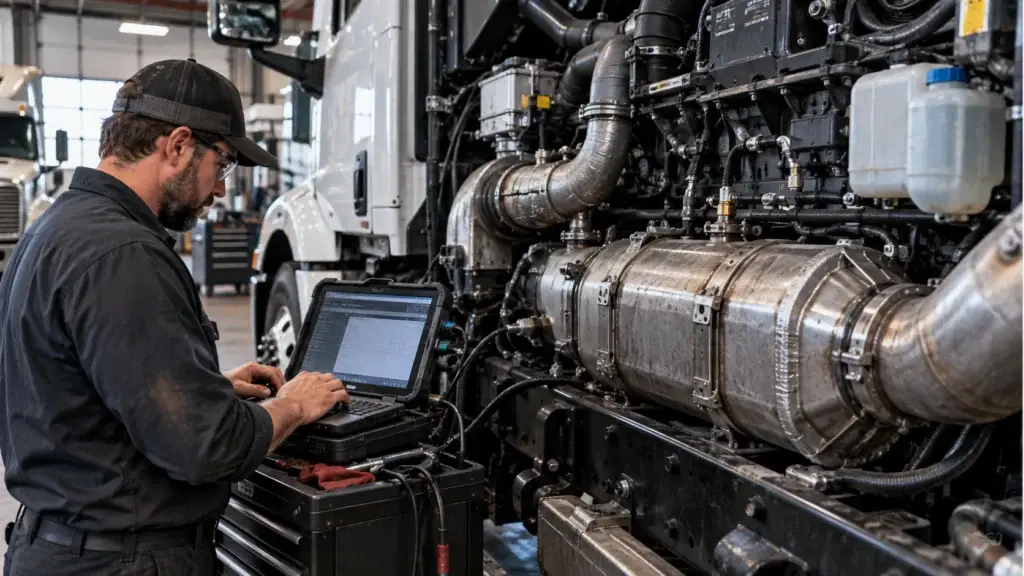
Basic code readers can't access the depth this diagnostic approach requires — live data monitoring, bi-directional testing, and forced-function execution are the baseline for anything beyond a surface-level check. Professional multi-brand and OEM platforms provide manufacturer-specific data streams and guided test procedures for DPF and SCR operations; HDJ's essential diesel diagnostic tools guide covers the full aftertreatment toolkit by career stage and budget in more depth than fits here.
Beyond the scan tool, a five-gas analyzer measures CO, CO2, HC, O2, and NOx directly for real emission-system verification, and an opacity meter quantifies exhaust smoke density for DPF evaluation. Pressure transducers, high-temperature thermocouples, and an articulating digital borescope round out the kit for internal inspection without tearing anything down.
Michael Nielsen's rule of thumb on tool investment: buy for the diagnosis you actually do every week, not the rare edge case — a shop that mostly needs pressure and temperature verification doesn't need a five-gas analyzer sitting unused most of the year, the same practical standard heavydutyjournal.com applies whenever it reviews diagnostic equipment.
Common Failure Modes and Troubleshooting Strategies
Incomplete regeneration shows up most in short-trip, low-speed, or excessive-idle duty cycles that never hit passive regeneration temperature. Diagnostic indicators progress through stages: regeneration request warnings, high-soot-load codes, a temperature lockout above roughly 144% loading, and eventually a parked-regen requirement or derate.
Root causes split between operational (needs driver education, not parts) and technical — an EGR malfunction increasing soot, a failed temperature sensor, restricted intake, or VGT control issues all masquerade as "the DPF is bad" when the DPF is actually just doing its job under a bad upstream condition. HDJ's DPF regeneration problems guide covers that full troubleshooting tree in depth.
On the EGR side, carbon deposits progressively restrict the valve until it seizes — moderate buildup responds to chemical and mechanical cleaning, severe seizure needs replacement, and periodic inspection is genuinely cheaper than waiting for the seizure. Cooler plugging can cause regeneration failures indirectly, since proper EGR function affects the exhaust temperature management the DPF depends on — another example of the cross-system chain this guide keeps coming back to.
DEF crystallization in delivery passages traces to poor fluid quality, air leaks, failed purge cycles, or simple fluid aging — complete system flushing with demineralized water is the fix, with injector replacement needed only when crystallization won't clear. Catalyst deactivation from thermal degradation or chemical poisoning (phosphorus and zinc from engine oil are the usual culprits) can't be reversed once it happens — replacement is the only path, which is exactly why proper operating temperature and low-ash oil matter as prevention rather than afterthoughts.
Preventive Maintenance and System Optimization
DPF differential pressure monitoring belongs at 10,000-15,000 mile intervals, with a full health assessment around 50,000 miles. EGR valve inspection runs 50,000 miles for urban short-trip duty cycles, stretching to 100,000 for highway-duty equipment; SCR injectors deserve a look every 100,000 miles. Low-ash CJ-4, CK-4, or FA-4 oil and quality bypass filtration protect all three systems simultaneously, since ash and soot are the shared enemy across the whole aftertreatment chain.
Driver behavior genuinely moves the needle here: training that covers what a regeneration request actually means (keep driving at highway speed, don't shut down) and what normal DEF consumption looks like (2-3% of fuel) prevents a real share of the "system failures" that are actually operational patterns.
Telematics-based tracking of regeneration frequency, DPF pressure trends, and DEF consumption over time catches a developing problem — rising regen frequency, in particular — before it becomes a roadside event, and staying compliant matters directly for CVSA roadside inspections, which run around 4 million a year across North America.
Free Diesel Maintenance Checklist
Get HDJ's free, field-tested diesel maintenance checklist delivered instantly to your inbox — print it, laminate it, keep it in the shop.
Instant PDF • 100% Free • No Spam

Frequently Asked Questions
What causes frequent DPF regeneration requests?
Usually operating conditions — short trips, idling, low-speed routes — that never reach passive regeneration temperature. Technical causes include EGR malfunctions, excessive oil consumption, and VGT control issues. See the Failure Modes section above for how to tell the two apart.
What differential pressure readings indicate a DPF problem?
Normal is 2-10 millibar at idle, 30-40 millibar at 3,000 RPM. Elevated means soot buildup; near-zero can mean substrate collapse rather than a clean filter. See the DPF Testing section above for how to confirm which.
How do I verify DEF quality?
Refractometer reading between 31.8%-33.2% urea concentration, plus a visual check for clear, colorless fluid. HDJ's DEF system diagnostics guide, linked in the SCR Testing section above, covers the full testing and contamination-remediation procedure.
What are the current penalties for emissions tampering?
Current EPA civil penalties run well into the tens of thousands of dollars per violation, higher than older figures still circulating. See HDJ's dedicated tampering penalties guide, linked in the Compliance Standards section above, for the current federal and state breakdown.
How often should EGR valves be inspected?
Every 50,000 miles for urban short-trip duty, stretching to 100,000 for highway-duty equipment. Watch for position sensor faults, rough idle, and elevated NOx as signs the interval needs tightening for a specific vehicle.
DPF, EGR, and SCR diagnostics only really work when approached as one integrated system rather than three separate ones — the ECU treats them that way, and the diagnostic approach should too. Validate sensor signals through live data before jumping to a regeneration procedure or a component swap, and follow the cross-system chain back to its actual origin rather than stopping at the first fault code that appears.
Help Fellow Fleet Professionals
Share this guide with a technician or fleet manager still diagnosing DPF, EGR, and SCR faults one at a time — the integrated view catches what isolated component checks miss.