By Michael Nielsen, Editor & Publisher | 15+ Years in Diesel Repair
Last Updated: December 2025
Your commercial fleet depends on reliable electrical systems to keep vehicles running smoothly, and heavy duty truck battery maintenance forms the foundation of that reliability. From extreme temperatures to constant vibration, commercial vehicle batteries work harder than those in passenger vehicles—and they need specialized care to match. Neglecting proper maintenance leads to costly consequences: stranded vehicles, missed deliveries, frustrated customers, and unexpected downtime that disrupts your entire operation.
This guide covers everything fleet managers and diesel technicians need to know about commercial battery care. You’ll learn safety protocols, testing methods, cleaning procedures, and troubleshooting techniques that prevent unexpected roadside failures. Whether you manage a hundred-truck fleet or operate independently, the strategies here will help you extend battery life, reduce replacement costs, and keep your equipment running when it matters most.
Key Takeaways
- Battery technology choice matters: Flooded lead-acid costs less upfront but requires regular water checks, while AGM batteries offer maintenance-free operation ideal for high-vibration environments.
- Safety is non-negotiable: Acid-resistant gloves, eye protection, and proper ventilation prevent injuries from sulfuric acid and explosive hydrogen gas during maintenance.
- Monthly inspections catch problems early: Visual checks for corrosion, loose connections, and case damage identify issues before they cause roadside failures.
- Proper charging extends lifespan significantly: Maintaining batteries above 50% state of charge prevents sulfation—the leading cause of premature battery failure.
- Temperature management is critical: Battery capacity drops 20% at 32°F and 50% at 0°F, making seasonal preparation essential for fleet reliability.
- Lead-acid batteries achieve 99% recycling rates: Proper disposal through certified recyclers ensures regulatory compliance while supporting domestic manufacturing.
Understanding Heavy Duty Truck Battery Systems
The battery system in a commercial truck powers an entire ecosystem of electrical components beyond engine starting. From ignition systems to onboard computers, lighting to auxiliary equipment, commercial vehicle batteries serve as the foundation of modern trucking operations. Understanding the different technologies available helps fleet managers make informed decisions that directly impact operational efficiency and maintenance costs.
Modern heavy-duty trucks demand sophisticated power delivery systems that withstand harsh operating conditions. These systems must perform reliably whether hauling freight through frigid Montana winters or navigating scorching Arizona summers. The right battery selection and configuration can mean the difference between reliable starts and costly roadside breakdowns.
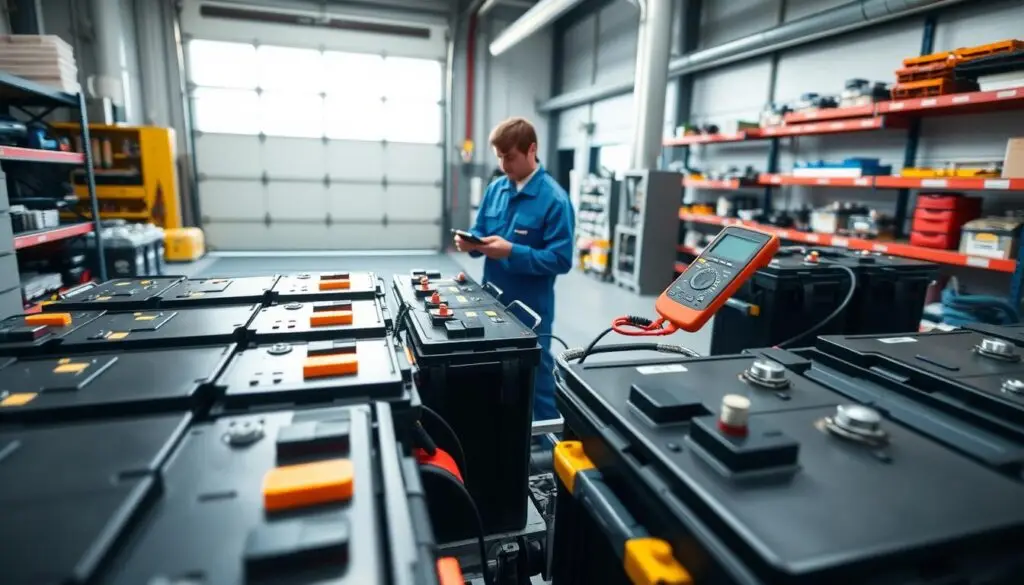
Primary Battery Technologies for Commercial Applications
Flooded lead-acid batteries remain the workhorse of the trucking industry due to their proven reliability and affordable initial cost. These traditional batteries utilize lead plates submerged in sulfuric acid electrolyte to generate electrical power through chemical reactions. While they deliver dependable performance for most commercial applications, they require regular attention to prevent sulfation—a condition where lead sulfate crystals build up on the plates and reduce capacity. Technicians must periodically check and refill water levels, but many fleet operators continue choosing them for their lower upfront investment and widespread availability.
AGM (Absorbent Glass Mat) batteries represent a significant advancement with their sealed, maintenance-free construction. The absorbed glass mat design suspends electrolyte within fiberglass mats between the plates, eliminating acid spills and water additions. These batteries excel at handling the constant vibrations experienced during over-the-road hauling and deliver superior performance in extreme temperatures. Though they command higher purchase prices, their durability makes them ideal for long-haul operations.
Lithium-ion batteries are transforming the commercial trucking landscape with exceptional performance characteristics. These advanced power sources weigh significantly less than comparable lead-acid units, potentially improving payload capacity for weight-sensitive operations. Their deep-cycle capabilities make them especially valuable for trucks with extensive auxiliary power requirements, such as refrigerated units or sleeper cab amenities. While substantially higher initial costs create barriers for some operations, lifespans exceeding ten years under proper conditions often justify the investment.
| Battery Type | Lifespan | Maintenance | Best Application |
|---|---|---|---|
| Flooded Lead-Acid | 3-5 years | Regular water checks | Budget-conscious fleets, standard duty cycles |
| AGM | 4-7 years | Minimal | High-vibration environments, extreme temps |
| Lithium-Ion | 8-10+ years | Virtually none | Heavy auxiliary loads, weight-sensitive ops |
Electrical Configuration and Power Requirements
Battery voltage requirements vary based on specific truck applications and electrical system design. Most light and medium-duty commercial trucks operate on 12-volt systems utilizing either single or dual battery configurations. Heavy-duty trucks often employ 24-volt systems that provide higher cranking power needed for large diesel engines, especially in cold weather conditions.
Understanding cold cranking amps (CCA) is essential for proper battery selection. This rating measures the battery’s ability to start an engine in cold temperatures—specifically the number of amps delivered at 0°F for 30 seconds while maintaining at least 7.2 volts. Higher CCA ratings ensure reliable starting in harsh winter climates common across northern states. A healthy battery at rest typically measures around 12.6 volts for a 12V system; readings below 12.4 volts indicate partial discharge and suggest the battery needs charging or may be experiencing capacity loss.
Safety Protocols for Battery Maintenance
Battery maintenance safety is a critical requirement that protects technicians from potentially life-threatening hazards. Heavy duty truck batteries contain sulfuric acid and generate explosive gases during operation. These hazards demand strict adherence to established safety protocols before any maintenance work begins. Commercial vehicle maintenance facilities must comply with OSHA regulations (29 CFR 1926.441) designed to protect workers handling batteries.

Required Protective Equipment
Proper protective equipment forms the first line of defense against injury during battery service. Acid-resistant gloves are mandatory when handling batteries or checking electrolyte levels—standard work gloves provide no protection against sulfuric acid, which can cause severe chemical burns within seconds of skin contact. Safety glasses or face shields must be worn at all times during battery maintenance, as battery acid can splash unexpectedly when removing caps or disconnecting terminals.
Steel-toed boots protect feet if a battery is accidentally dropped during removal or installation. Commercial truck batteries weigh between 60 and 130 pounds depending on configuration, making foot protection essential. Protective aprons or acid-resistant coveralls shield clothing and skin from corrosive materials.
Workspace Ventilation Standards
Adequate ventilation is critical because batteries emit hydrogen gas during charging and maintenance. This colorless, odorless gas is highly explosive when mixed with air in concentrations as low as 4 percent. Maintenance bays should have mechanical ventilation systems providing at least four air changes per hour. Natural ventilation through open doors may not provide sufficient air movement in enclosed spaces.
Never smoke, use open flames, or create sparks near batteries or charging stations. Even a small spark from a dropped tool can ignite accumulated hydrogen gas. Keep all ignition sources at least 15 feet away from battery maintenance areas. Emergency eyewash stations must be accessible within 10 seconds of any battery maintenance area, and neutralizing agents, spill kits, and first aid supplies should remain readily available.
Heavy Duty Truck Battery Maintenance: Core Procedures
The difference between a battery lasting three years versus seven often comes down to consistent maintenance procedures. Regular hands-on care prevents common failures and maximizes return on investment. These core procedures require minimal tools but deliver substantial benefits when performed correctly.
Terminal Cleaning and Corrosion Prevention
Battery terminal cleaning removes the white, blue, or green corrosion buildup that blocks current flow. This crusty substance increases electrical resistance and can prevent your truck from starting. Begin by disconnecting cables in the proper sequence—always remove the negative cable first to prevent accidental shorts against metal surfaces.
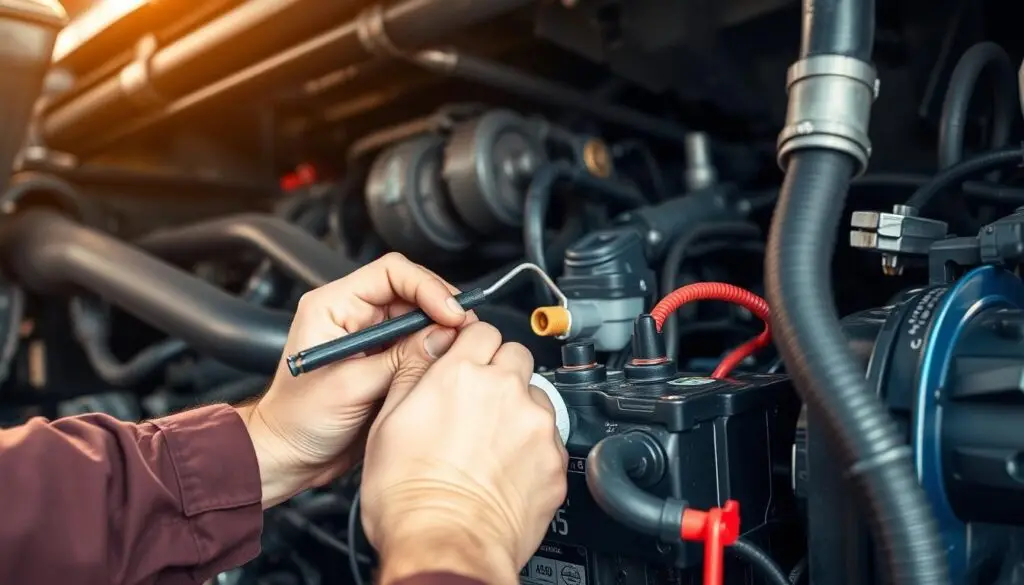
Prepare a cleaning solution by mixing one tablespoon of baking soda with one cup of warm water. This alkaline solution neutralizes the acidic corrosion deposits. Apply with a stiff brush designed for terminal cleaning, scrubbing thoroughly until the mixture fizzes and all visible corrosion disappears. Use a wire brush or specialized terminal cleaner tool for stubborn deposits, then rinse everything with clean water and dry completely before reconnection.
Apply protective coating immediately after drying. Petroleum jelly, anti-corrosion spray, or specialized terminal protector pads create moisture barriers that slow future buildup. Coat both posts and cable ends generously for maximum protection.
Electrolyte Level Management
Flooded lead-acid batteries require periodic water additions to maintain proper electrolyte levels. The liquid inside battery cells gradually evaporates during normal charging cycles, and low electrolyte levels expose plates to air, causing permanent damage and reduced capacity.
Park your truck on level ground before checking levels. Remove vent caps carefully, avoiding dropping dirt or debris into open cells. Check that electrolyte covers plates by approximately one-quarter to one-half inch, appearing just below the fill ring visible inside each cell opening. Add only distilled or deionized water—never tap water, which contains minerals that coat plates and reduce performance. Stop filling when electrolyte reaches proper levels, as overfilling dilutes acid concentration and reduces battery power output.
Stay Current on Fleet Maintenance Best Practices
Get the latest diesel industry news, technical insights, and fleet management strategies delivered to your inbox weekly.
Securing Batteries Against Vibration
Heavy-duty trucks generate constant vibration during operation. Loose batteries bounce and shift inside their compartments, causing internal plate damage and shortened service life. Inspect hold-down brackets and hardware at every service interval, looking for bent components, stripped threads, or missing fasteners.
Test battery security by attempting to move it manually—properly secured units move less than one-half inch in any direction. Tighten hold-down bolts to manufacturer specifications using a torque wrench, typically fifteen to twenty-five foot-pounds depending on hardware design. Check rubber mounting pads that cushion vibration between battery and tray, replacing hardened or cracked pads to restore proper vibration isolation.
Battery Testing and Diagnostic Methods
Testing goes beyond simple visual inspections, demanding specialized diagnostic tools and systematic procedures to assess actual performance capabilities. Professional diagnostics provide maintenance teams with quantifiable data about battery condition, helping distinguish between batteries needing charging versus those requiring replacement. Modern testing equipment delivers accurate measurements within minutes, enabling informed decisions that prevent unexpected failures and optimize fleet uptime.
Pre-Maintenance Inspection Procedures
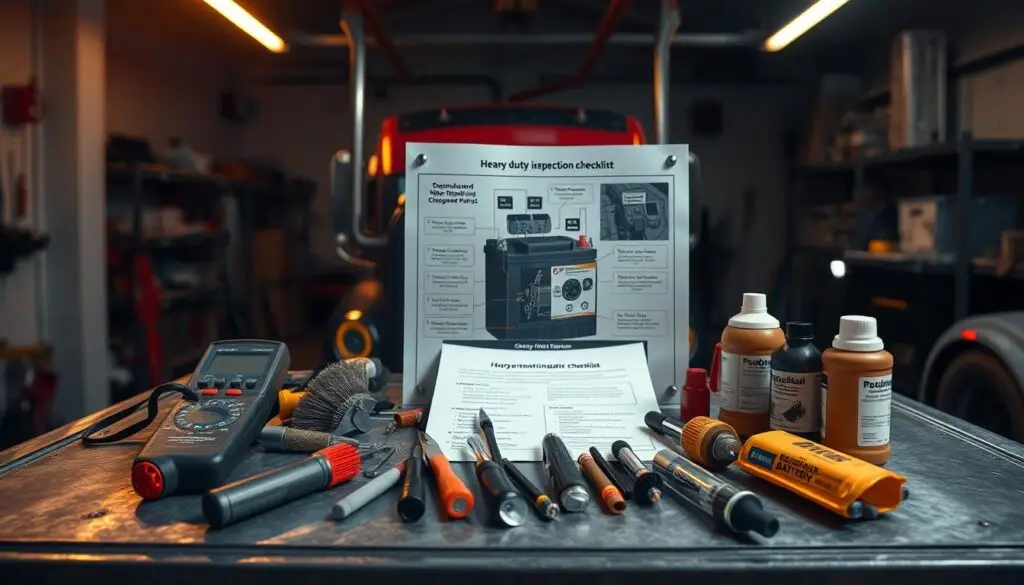
A thorough pre-maintenance inspection identifies potential problems before they escalate into costly breakdowns. Conducting systematic checks at least once a month helps technicians catch early warning signs indicating imminent failure. Start by ensuring the truck engine is off and all electrical accessories are disconnected to create a safe working environment and allow accurate assessment of true battery condition.
Begin your inspection by examining the battery case for physical damage. Check for bulging, cracking, or warping that suggests internal problems or chronic overheating. These deformities often indicate overcharging or extended exposure to extreme temperatures. Terminal posts require careful examination for looseness or structural damage—wiggle each terminal gently to verify it’s firmly attached to the battery case, as loose terminals create resistance that generates heat and reduces starting power.
Hold-down brackets must keep batteries firmly mounted despite constant road vibrations. Inspect mounting hardware for tightness and verify that rubber hold-down components haven’t deteriorated. Cable routing deserves attention during every inspection cycle—verify that cables maintain proper separation from hot engine components that could melt insulation and don’t contact sharp edges that might cut through protective coverings over time.
| Inspection Point | What to Check | Warning Signs | Action Required |
|---|---|---|---|
| Battery Case | Overall condition | Cracks, bulging, warping | Replace immediately |
| Terminal Posts | Connection security | Corrosion, looseness | Clean and tighten |
| Hold-Down System | Bracket tightness | Loose bolts, movement | Tighten or replace |
| Electrolyte Level | Fluid above plates | Low levels, exposed plates | Add distilled water |
Load Testing Procedures
Load testing remains the gold standard for evaluating a battery’s ability to deliver sufficient current under realistic operating conditions. This method simulates the electrical demand placed on batteries during engine starting, providing reliable insights into actual performance capacity. Load testers apply a controlled electrical load equivalent to half the battery’s Cold Cranking Amp rating for exactly 15 seconds while continuously monitoring voltage response.
Proper load testing requires batteries to be fully charged before testing begins, with surface charge removed by briefly operating the starter motor or allowing the battery to rest with a small load applied. Testing a partially discharged battery produces misleading results that may incorrectly indicate battery failure. During the 15-second test period, battery voltage should remain above 9.6 volts at 70°F. Colder temperatures require adjusted thresholds—acceptable voltages drop to approximately 9.1 volts at 32°F and 8.5 volts at 0°F.

Interpreting load test results provides clear guidance for maintenance decisions. Voltage remaining above threshold indicates the battery can reliably deliver starting current. Voltage dropping near threshold suggests marginal performance requiring monitoring. Voltage falling below threshold means the battery needs replacement regardless of age. Voltage collapse during testing indicates internal damage such as shorted cells or severe sulfation requiring immediate replacement.
Digital Multimeter Testing
Digital multimeters provide quick and accurate voltage testing that reveals charge state and identifies charging system problems. A quality multimeter measures both static voltage with the battery at rest and dynamic voltage during cranking and charging operations. Static voltage testing requires the battery to rest without charging or discharging for at least two hours before measurement—this resting period allows the battery’s internal chemistry to stabilize, providing accurate readings that reflect true charge state. Connect the red lead to the positive terminal and black lead to the negative terminal, then record the voltage reading.
A reading of 12.6-12.8 volts indicates a fully charged battery. Readings of 12.4 volts suggest 75% charge and recharging is recommended, while 12.2 volts (50% charge) requires immediate recharging to prevent sulfation. Below 12.0 volts indicates deep discharge with potential permanent damage. Dynamic voltage testing evaluates charging system performance while the engine runs—a healthy alternator produces 13.8 to 14.8 volts measured at the battery terminals at idle. Readings below 13.8 volts indicate charging system problems such as worn alternator brushes, faulty voltage regulators, or damaged wiring connections.
Cranking voltage measurements identify batteries with insufficient capacity or high internal resistance. During cranking, battery voltage typically drops to 9.5-10.5 volts momentarily. Voltage dropping below 9.0 volts or recovering slowly after cranking suggests battery deterioration requiring further investigation through load testing.
Conductance Testing Technology
Conductance testing represents a modern advancement in battery diagnostics that measures a battery’s ability to conduct electrical current by sending a small alternating current signal through the battery and analyzing the response. This technology offers significant advantages over traditional load testing while providing comparable accuracy. The test completes in seconds rather than the 15-second duration required for load testing, and can evaluate batteries regardless of their current charge state.
The primary advantage of conductance testing is the ability to assess batteries even when partially discharged. Unlike load testing which requires fully charged batteries, conductance testers accurately evaluate battery condition in vehicles that won’t start or have been sitting unused for extended periods. The technology detects internal battery problems including shorted cells, sulfation buildup, grid corrosion affecting current flow, and electrolyte stratification causing performance inconsistencies.
Professional-grade conductance testers store specifications for thousands of battery models, automatically comparing test results against manufacturer standards. The equipment generates printed reports documenting results, providing objective data for warranty claims and maintenance records. This documentation capability makes conductance testing particularly valuable for fleet operations managing hundreds of batteries across multiple vehicles.
The HDJ Perspective
After decades covering the diesel industry, we’ve seen battery technology evolve dramatically—but one thing hasn’t changed: consistent maintenance outperforms premium equipment every time. Fleet managers who implement systematic inspection schedules consistently report battery service lives extending 50% or more beyond industry averages. The shops achieving the best results aren’t necessarily buying the most expensive batteries; they’re the ones with documented procedures, trained technicians, and accountability systems that ensure maintenance actually happens. As telematics and battery management systems become standard, the fleets investing in these monitoring capabilities today will have significant competitive advantages in equipment reliability and operating costs tomorrow.
Troubleshooting Common Battery Problems
When a commercial truck fails to start properly, knowing how to diagnose battery issues saves both time and money. Battery problems manifest through various symptoms including slow cranking, frequent jump starts, or malfunctions in electrical components. A systematic approach helps technicians identify root causes quickly and implement correct solutions. Most battery-related issues fall into identifiable patterns that experienced technicians learn to recognize.
Diagnosing Slow Cranking
Slow cranking represents one of the most common battery complaints in commercial vehicles. A proper diagnosis should follow a logical sequence, starting with the simplest potential causes. Begin by measuring the battery state of charge—a fully charged 12-volt battery should read 12.6 volts or higher. If voltage measures below 12.4 volts, the battery needs charging before further testing. Check all cable connections for tightness and corrosion creating electrical resistance.
Ground connections between the engine block and frame complete the starting circuit. Poor grounds cause slow cranking issues that technicians often overlook. Clean and tighten all ground points to ensure proper current flow. Measure voltage drop across cables during cranking to identify undersized or damaged conductors—excessive voltage drop indicates cables need replacement. Evaluate starter motor current draw to distinguish between battery weakness and starter problems.

Cold weather temporarily reduces battery capacity, which may indicate permanent deterioration in older batteries. Consider whether environmental factors contribute to starting difficulties before replacing components unnecessarily. If slow cranking persists after full charging and connection verification, conduct a load test to confirm whether the battery retains adequate capacity.
Addressing Parasitic Drain
Small electrical draws can discharge batteries when trucks sit idle between runs. Parasitic drain diagnosis requires measuring quiescent current draw with an ammeter—most heavy-duty trucks should draw less than 50 milliamps when all systems are off. Common culprits include aftermarket accessories incorrectly wired to constant power sources, malfunctioning alternator diodes allowing reverse current flow, interior lights with faulty door switches, and electronic modules failing to enter sleep mode.
The diagnosis procedure involves removing fuses one at a time while monitoring amperage. When current draw drops to normal levels, the circuit controlled by that fuse contains the problem, quickly narrowing down the source of excessive drain. Modern trucks contain dozens of electronic control units that should power down after a delay period. Identifying the specific module causing excessive drain sometimes requires patience as technicians wait for each module’s timeout period to expire.
Preventing Sulfation
Sulfation occurs when lead sulfate crystals formed during normal discharge harden into permanent deposits that reduce capacity and prevent proper recharging. This process accelerates when batteries remain discharged or at low charge states for extended periods. Prevention requires maintaining batteries above 50% state of charge, avoiding deep discharges, and ensuring proper charging system operation. Promptly recharging batteries after use prevents the soft lead sulfate formed during discharge from crystallizing into permanent deposits.
Once severe sulfation occurs, it’s typically irreversible, though some desulfation chargers may provide limited recovery for moderately affected batteries. These devices use pulsed charging currents to break down sulfate crystals, but show limited effectiveness with advanced cases. Regular equalization charging prevents sulfation in flooded battery systems by causing controlled gassing that mixes the electrolyte and removes early-stage sulfate buildup.
Recognizing When Replacement Is Necessary
Making economically sound decisions about replacement versus recharging requires clear criteria. Age represents the first consideration—lead-acid batteries typically last 3-5 years, AGM batteries 5-7 years, and lithium-ion potentially exceeds 10 years. Batteries approaching manufacturer-specified lifespan limits should be replaced even if they still function, as failure risk increases significantly.
Several signs indicate replacement is necessary rather than simply recharging: slow engine cranking that persists after full charge suggests diminished capacity, frequent jump-starts indicate the battery cannot maintain adequate charge levels, and weaker headlights and electrical systems point to insufficient voltage supply. Physical damage like swelling, leakage, or cracked cases requires immediate replacement for safety reasons. When replacing one battery in a multiple-battery system, consider matching battery ages—mismatched batteries cause the newer battery to work harder, reducing its lifespan. Replace all batteries in a bank simultaneously for optimal performance and longevity.
Share Your Battery Maintenance Expertise
Are you a fleet manager or diesel technician with insights on battery systems? Heavy Duty Journal welcomes contributions from industry professionals.
Extending Battery Life and Performance
Strategic battery management delivers measurable returns through reduced downtime and extended equipment life. Fleet operators who implement comprehensive maintenance programs gain competitive advantages in the demanding transportation market.
Optimal Charging Practices
Smart charging forms the foundation of any successful longevity program. Maintaining batteries above 50% state of charge prevents harmful sulfation that permanently reduces capacity. Utilize smart chargers that automatically regulate voltage to prevent overheating and internal damage caused by overcharging. Different battery technologies require distinct charging approaches—flooded batteries benefit from charge rates around 10% of their amp-hour capacity, while AGM batteries demand precise voltage control.
Temperature Management
Temperature represents one of the most significant factors affecting battery performance and service life. Battery capacity drops approximately 20% at 32°F and plummets to 50% reduction at 0°F compared to the 80°F baseline. High temperatures create equally serious problems by accelerating self-discharge and internal degradation—each 15°F increase above 77°F roughly doubles the aging rate.
Practical temperature management strategies include battery blankets or heaters for extreme cold climates, heat shields or insulation protecting batteries from engine radiant heat and direct sunlight, and temperature-compensated charging systems that automatically adjust voltage based on battery temperature.
Implementing Fleet Maintenance Schedules
A structured maintenance schedule ensures consistent battery care across all vehicles. Monthly visual inspections catch obvious problems like loose connections, corrosion buildup, or physical damage. Quarterly load testing identifies batteries approaching end of service life. Semi-annual deep cleaning of battery compartments removes accumulated contamination. Annual comprehensive electrical system evaluations include alternator output testing and parasitic drain measurements.
| Interval | Inspection Type | Key Activities | Documentation |
|---|---|---|---|
| Monthly | Visual Inspection | Check connections, corrosion, hold-downs | Pass/fail checklist |
| Quarterly | Load Testing | Test capacity, measure voltage drop | Test results with readings |
| Semi-Annual | Deep Cleaning | Remove batteries, clean compartments | Service report |
| Annual | Electrical System | Alternator output, parasitic drain | Complete evaluation |
99% Recycling Rate
Lead-acid batteries are the most recycled consumer product in the U.S., keeping 160+ million batteries from landfills annually — Battery Council International, 2023
Replacement schedules based on battery age and performance trends prove more cost-effective than waiting for failures. According to the Battery Council International, lead-acid batteries achieve a 99% recycling rate when properly disposed through certified recyclers, making end-of-life planning straightforward while supporting domestic manufacturing with over 80% recycled content in new batteries.
Proper Storage for Inactive Vehicles
Battery storage becomes critical for vehicles or equipment kept out of service for extended periods. Fully charge batteries before storage and use disconnect switches that isolate batteries from vehicle electrical systems. Battery maintainers or trickle chargers designed for long-term connection automatically monitor voltage and provide periodic charging to offset self-discharge. Without maintainers, batteries in storage generally require recharging every 30-60 days depending on ambient temperature.
Store vehicles in cool, dry locations away from temperature extremes to minimize self-discharge rates. Commercial motor vehicles must meet maintenance requirements under 49 CFR Part 396, which includes systematic inspection and repair of all vehicle systems including electrical components.
Frequently Asked Questions
How often should I perform battery maintenance on my heavy-duty truck?
Monthly visual inspections are recommended for all commercial trucks, including checking for corrosion, loose connections, and electrolyte levels in flooded batteries. Quarterly load testing should be performed on critical vehicles or those approaching their expected lifespan. Semi-annual deep cleaning of battery compartments helps prevent corrosion buildup, while annual comprehensive electrical system evaluations including alternator output and parasitic drain testing ensure overall system health. More frequent inspections may be necessary for trucks operating in extreme climates or high-mileage applications.
What causes the white, blue, or green deposits on battery terminals?
Battery corrosion forms when sulfuric acid vapors escape through terminal seals and react with lead terminals and copper cable clamps to form lead sulfate and copper sulfate compounds. Overcharging causes excessive gassing that carries acid mist throughout the battery compartment, while loose connections create electrical resistance generating heat that accelerates corrosion. Preventing corrosion requires maintaining tight connections, proper charging voltage settings, and regular application of protective coatings like petroleum jelly or anti-corrosion spray.
How do I know when to replace versus recharge a battery?
A fully charged battery should read 12.6-12.8 volts at rest. Load testing provides the most reliable assessment—apply a controlled load equivalent to half the Cold Cranking Amp rating for 15 seconds, with acceptable voltage remaining above 9.6 volts at 70°F. Consider replacement if batteries consistently fail load tests, are approaching manufacturer-specified lifespan limits (3-5 years for flooded, 4-7 for AGM), show physical damage like cracked cases or severe swelling, or require frequent jump-starts despite proper charging.
What safety equipment is required for battery maintenance?
Essential protective equipment includes acid-resistant gloves to protect against sulfuric acid burns, safety glasses or face shields to prevent eye injuries from acid splashes, steel-toed boots to protect feet if batteries are dropped, and protective aprons or coveralls to shield skin from corrosive materials. Work areas must have adequate ventilation to prevent explosive hydrogen gas accumulation, with emergency eyewash stations accessible within 10 seconds and neutralizing agents like baking soda readily available for acid spills.
How does temperature affect battery performance?
Battery capacity drops approximately 20% at 32°F and 50% at 0°F compared to 80°F baseline performance. Cold temperatures also increase engine cranking requirements just when battery capacity is reduced. Conversely, high temperatures accelerate self-discharge and internal degradation, with each 15°F increase above 77°F roughly doubling the aging rate. Practical strategies include battery blankets for cold climates, heat shields to protect from engine heat, and temperature-compensated charging systems that adjust voltage based on battery temperature.
How should used batteries be disposed of?
Used batteries are classified as hazardous waste under EPA regulations (40 CFR Part 273) and cannot be disposed of in regular trash or landfills. Facilities must maintain contracts with certified battery recycling companies. Nearly 90% of all lead-acid batteries are recycled—most retailers selling new batteries are required to accept used batteries for recycling. Store spent batteries in designated areas with secondary containment to prevent soil contamination until pickup by recyclers.
Implementing Your Battery Maintenance Program
A comprehensive heavy duty truck battery maintenance program delivers measurable returns through reduced downtime and extended equipment life. The procedures outlined in this guide—from proper safety protocols and terminal cleaning to systematic testing and temperature management—provide the foundation for fleet reliability. Start by establishing baseline assessments and documenting current battery conditions across your fleet.
Well-maintained batteries contribute to customer satisfaction through on-time deliveries, reduce emergency service costs that cut into profit margins, and lower insurance expenses through strong safety records. The fundamental maintenance principles remain constant regardless of battery technology: regular cleaning prevents corrosion, proper charging extends lifespan, and systematic testing enables informed replacement decisions. These practices separate successful operations from those experiencing frequent breakdowns and service disruptions.
Help Fellow Fleet Managers Improve Reliability
Know a fleet manager or diesel technician who could benefit from these battery maintenance strategies? Share this guide with your professional network.