By Michael Nielsen, Editor & Publisher | 15+ Years in Diesel Repair
Last Updated: December 2025
📖 Estimated reading time: 22 minutes
Commercial vehicle emissions testing requirements vary dramatically across the United States, creating compliance challenges for fleet operators who cross state lines. California enforces the strictest standards through CARB’s Clean Truck Check program, while states like Florida, Montana, and South Dakota have no mandatory testing requirements at all. Understanding which inspections apply to your vehicles—and where—directly impacts your operational efficiency and regulatory exposure.
The federal Clean Air Act requires states with poor air quality to implement vehicle inspection and maintenance (I/M) programs. However, implementation varies significantly: some states test all commercial vehicles annually, others target specific metropolitan areas, and many rely solely on federal DOT standards. Heavy-duty diesel vehicles face different protocols than passenger cars, typically involving opacity testing to measure smoke density from exhaust systems.
This guide breaks down commercial vehicle emissions testing requirements for all 50 states, covering federal standards, state-specific programs, testing methods, vehicle exemptions, and compliance strategies. Whether you operate regionally or run a nationwide fleet, you’ll find the specific information you need to maintain legal operations efficiently.
Key Takeaways
- California leads with strictest requirements: CARB’s Clean Truck Check program requires periodic emissions testing for nearly all diesel vehicles over 14,000 lbs GVWR operating in California, including out-of-state vehicles.
- 22+ states have no mandatory emissions testing: Alabama, Alaska, Arkansas, Florida, Iowa, Michigan, Minnesota, Mississippi, Montana, North Dakota, South Carolina, South Dakota, Tennessee, Washington, West Virginia, and Wyoming rely on federal standards only.
- Testing frequency varies significantly: Annual testing in New York metro area, biennial in California and Colorado, and semi-annual requirements beginning in California in 2025.
- Weight thresholds determine requirements: Most states exempt diesel vehicles over 8,500-14,000 lbs GVWR from standard emissions testing, though they may face opacity inspections.
- Federal DOT inspection applies everywhere: Regardless of state testing requirements, 49 CFR 396.17 requires annual inspections for commercial vehicles over 10,001 lbs in interstate commerce.
Understanding Commercial Vehicle Emissions Testing in the United States
The landscape of commercial truck inspection requirements varies dramatically from one jurisdiction to another, creating unique compliance challenges for fleet operators. Unlike passenger vehicles, commercial trucks face stricter scrutiny due to their higher emissions output and significant impact on air quality. The regulatory framework governing these inspections operates through a multi-layered system that begins at the federal level and extends down to local enforcement agencies.
Vehicle emissions inspection programs are known as I/M programs (Inspection and Maintenance). The EPA oversees these programs at the federal level, while implementation occurs at the state level. This division of responsibility creates variation in how EPA vehicle testing requirements are applied across different regions, particularly in areas where air quality concerns are most pressing.
Commercial vehicles face different testing requirements than passenger vehicles, especially those with higher Gross Vehicle Weight Rating (GVWR) classifications. Trucks used in interstate commerce must comply with both DOT emissions standards and state-specific regulations. The distinction between vehicle categories becomes important when determining which inspection protocols apply to a particular fleet.
States impacted by federal mandates were those with metropolitan areas where air quality did not meet federal standards. These non-attainment areas became subject to mandatory fleet emissions program requirements. Cities with heavy freight traffic and industrial activity typically face stricter testing obligations than rural regions with cleaner air quality measurements.
Emissions testing for commercial vehicles measures several harmful pollutants that diesel engines produce in significant quantities. The primary contaminants include nitrogen oxides (NOx), which contribute to smog formation and respiratory problems. Particulate matter (PM) consists of tiny particles that penetrate deep into lungs and cause serious health complications.
| Pollutant Type | Primary Source | Health Impact |
|---|---|---|
| Nitrogen Oxides (NOx) | High-temperature combustion in diesel engines | Respiratory irritation, asthma aggravation, lung damage |
| Particulate Matter (PM) | Incomplete diesel fuel combustion | Cardiovascular disease, lung cancer, premature death |
| Carbon Monoxide (CO) | Inefficient fuel burning processes | Reduced oxygen delivery, heart strain, neurological effects |
| Hydrocarbons (HC) | Evaporative emissions and combustion byproducts | Ozone formation, cancer risk, environmental damage |
Federal Emissions Standards Governing Commercial Vehicles
Commercial vehicle emissions testing in America operates under a multi-layered federal regulatory system. This framework establishes the minimum requirements that all states must follow when implementing their own inspection programs. Federal agencies work together to protect air quality while ensuring commercial vehicles meet environmental performance standards.
The federal Clean Air Act was amended in 1977 and 1990 to require states to implement vehicle emissions inspection programs in major metropolitan areas. These amendments targeted regions whose air quality failed to meet certain federal standards. Today, the EPA oversees vehicle emissions inspection and maintenance programs at the federal level, providing information and guidance for state and local inspection agencies.
EPA Heavy-Duty Engine and Vehicle Standards
The Environmental Protection Agency holds primary authority for establishing emission requirements that commercial vehicles must meet across the nation. Under the Clean Air Act, the EPA sets national ambient air quality standards that drive state-level emissions testing programs. These standards create the benchmark against which all commercial vehicle emissions are measured.
Heavy-duty engine standards have evolved significantly over the past three decades. In March 2024, the EPA finalized its Phase 3 greenhouse gas emissions standards for heavy-duty vehicles, targeting up to 60% CO2 reductions for vocational trucks and 40% for tractor trucks by model year 2032. These certification requirements apply to new commercial vehicles before they can be sold in the United States.
72 Million People
EPA estimates that approximately 72 million Americans live within 200 meters of truck freight routes, directly impacted by heavy-duty vehicle emissions.
DOT Annual Inspection Requirements
The Department of Transportation plays a complementary role in commercial vehicle regulation through the Federal Motor Carrier Safety Administration (FMCSA). Per 49 CFR Part 396, every commercial motor vehicle must be inspected at least once every 12 months. The inspection must include, at minimum, the parts and accessories set forth in Appendix G to the subchapter.
These inspections include safety components but must also verify that emissions control equipment remains intact and functional. Vehicle operators cannot separate emissions compliance from broader DOT regulatory oversight. Tampering with emissions control systems violates federal law regardless of state testing policies, and inspectors document conditions as part of the comprehensive assessment.
States with Comprehensive Commercial Vehicle Emissions Testing Programs
Some states lead the nation with comprehensive commercial vehicle emissions testing programs that establish benchmarks for environmental compliance. These states have developed detailed inspection protocols that go beyond federal minimums. Fleet operators in these regions face the most rigorous testing requirements and must maintain strict compliance standards.
California’s CARB Clean Truck Check Program
California operates the most stringent state emissions testing framework in the United States. The California Air Resources Board (CARB) sets standards that often exceed federal EPA requirements. These regulations affect both in-state and out-of-state commercial vehicles operating within California’s borders.
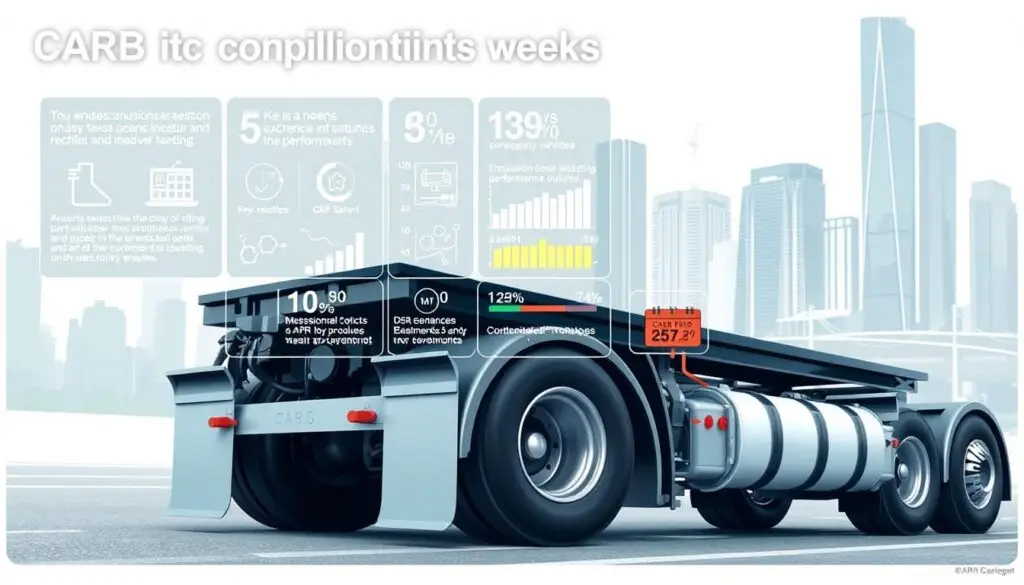
The Clean Truck Check program (formerly HD I/M) began implementation in January 2023 and replaced the Periodic Smoke Inspection Program (PSIP) for periodic testing requirements in 2024. Nearly all diesel and alternative fuel vehicles over 14,000 pounds GVWR that operate in California must comply, including personal vehicles and out-of-state trucks.
Clean Truck Check requirements vary based on engine model year. Vehicles with 2013 and newer engines must undergo OBD testing twice per year. Non-OBD vehicles require smoke opacity testing and visual inspection of emissions control equipment using the SAE J1667 snap acceleration procedure. Starting in 2025, vehicles will have semiannual compliance deadlines, and by 2027, testing frequency increases to four times per year.
New York Metropolitan Area Diesel Program
New York launched its heavy-duty vehicle inspection program in 1982, establishing one of the earliest comprehensive testing frameworks. The New York diesel inspection program requires annual emissions testing for qualifying commercial vehicles.
All non-exempt diesel-powered vehicles with a maximum gross weight over 8,500 pounds registered in the Diesel Emissions Metropolitan Area (DEMA) must get an annual diesel emissions inspection. DEMA includes New York City, Nassau County, Suffolk County, Rockland County, and Westchester County. The diesel emissions inspection must occur at the same time as the annual safety inspection—model year does not exempt a vehicle from the inspection.
The New York diesel inspection process includes opacity testing to measure visible smoke emissions. Qualified inspection stations also perform OBD-II system checks for applicable vehicles. The annual cost for a diesel emissions inspection is $25, added to the safety inspection fee. Vehicles registered outside DEMA with GVWR over 8,500 pounds may still face random roadside diesel emissions inspections conducted by State Police, DEC, and DOT.
Colorado Front Range Requirements
Colorado implements diesel emissions testing in specific counties along the Front Range corridor. The full counties of Boulder, Broomfield, Denver, Douglas, and Jefferson, plus portions of Adams, Arapahoe, Larimer, and Weld counties require testing. This geographic targeting addresses air quality challenges in Colorado’s most populated regions.
The biennial testing cycle provides longer intervals between inspections compared to annual programs. Colorado recently updated its opacity standards: the allowable smoke opacity for all light-duty and heavy-duty naturally aspirated diesel vehicles changed to 20% (for 5 seconds). All diesel vehicles, including heavy-duty turbocharged vehicles, must meet this limit or fail the emissions test.
Stay Current on Fleet Compliance Requirements
Emissions regulations continue evolving across states. Get weekly updates on regulatory changes, compliance deadlines, and maintenance best practices delivered to your inbox.
Other Comprehensive State Programs
Illinois established its vehicle emissions testing program in 1986, creating requirements that continue today. The state emissions testing mandate applies primarily to the Chicago metropolitan area and eastern suburbs of St. Louis. Commercial vehicles operating within these designated zones must comply with regular testing schedules, with specific requirements varying based on vehicle classification and weight rating.
Connecticut requires annual inspections for several commercial vehicle categories, including commercial trucks, grey market vehicles, salvage vehicles, and specific trailer types. New Jersey implemented updated commercial vehicle inspection requirements effective January 1, 2010, with annual inspection mandates applying to taxis, limousines, jitneys, and buses.
| State | Testing Frequency | Primary Coverage Area |
|---|---|---|
| California | Semiannual (2025+) | Statewide (diesel vehicles 14,000+ lbs GVWR) |
| New York | Annual | NYC Metropolitan Area (DEMA counties) |
| Colorado | Biennial | Front Range Counties |
| Illinois | Annual/Biennial | Chicago Metro, East St. Louis |
States with Limited or Regional Testing Requirements
Some states implement limited emissions testing programs that focus on specific urban areas rather than statewide coverage. These geographically targeted approaches concentrate regulatory efforts where air quality concerns are most significant. Commercial fleet operators benefit from understanding these regional requirements to plan compliance strategies effectively.
Texas Emissions Counties
As of January 1, 2025, Texas eliminated safety inspection requirements for non-commercial vehicles under House Bill 3297. However, commercial vehicles still require annual inspections, and emissions testing remains mandatory in 17 designated counties: Brazoria, Collin, Dallas, Denton, El Paso, Ellis, Fort Bend, Galveston, Harris, Johnson, Kaufman, Montgomery, Parker, Rockwall, Tarrant, Travis, and Williamson. Bexar County (San Antonio area) will require emissions tests beginning in 2026.
Arizona and Nevada Urban Areas
Arizona requires biennial emissions testing in Phoenix and Tucson metro areas. Diesel vehicles are required to be tested annually within these zones. However, the state provides exemptions for diesel vehicles with GVWR of 14,000 pounds or more, effectively excluding most heavy-duty commercial trucks from emissions testing requirements.
Nevada operates similar regional requirements in Clark County (Las Vegas) and Washoe County (Reno). Testing cycles follow a biennial schedule for applicable vehicles. Like Arizona, Nevada exempts diesel vehicles with gross vehicle weight of 14,000 pounds or more from emissions testing protocols. Visual smoke inspections may still apply under federal DOT requirements.
Pacific Northwest Changes
Washington officially ended its vehicle inspection program in January 2020. The state no longer requires emissions testing for passenger cars or most commercial vehicles. Despite ending its passenger vehicle program, federal DOT standards continue to apply regardless of state-level emissions testing programs.
Oregon maintains biennial testing in Portland and Medford metro areas. The program applies to lighter vehicles but provides exemptions for diesel vehicles with GVWR over 8,500 pounds. This lower threshold compared to Nevada and Arizona means more medium-duty commercial vehicles may face testing requirements.
The HDJ Perspective
The patchwork nature of state emissions testing creates real operational headaches for fleet managers running interstate operations. We’ve seen fleets headquartered in no-testing states get surprised by California’s Clean Truck Check requirements when making deliveries on the West Coast. The trend is clearly toward more stringent testing—CARB’s four-times-per-year requirement by 2027 signals where the industry is heading. Smart operators are getting ahead by treating California standards as their baseline, regardless of home state. That approach may require additional investment in maintenance and testing infrastructure, but it eliminates compliance surprises and positions fleets well for inevitable regulatory expansion.
States Without Mandatory Commercial Vehicle Emissions Testing
Numerous states have determined that federal-only compliance provides sufficient oversight for commercial vehicle emissions. These jurisdictions rely on EPA standards and DOT regulations instead of creating separate state-level testing programs. Understanding which states operate without mandatory emissions testing helps fleet operators plan routes and budget for compliance expenses more effectively.
The absence of state emissions testing does not mean commercial vehicles can ignore environmental standards. Federal regulations still apply to all commercial vehicles regardless of where they operate. Law enforcement officers can conduct roadside inspections if they observe excessive visible emissions from any vehicle.
More than 20 states currently operate with no emissions testing requirements for commercial vehicles. This list includes Alabama, Alaska, Arkansas, Florida, Hawaii, Idaho, Iowa, Kansas, Kentucky, Michigan, Minnesota, Mississippi, Montana, Nebraska, North Dakota, Oklahoma, South Carolina, South Dakota, Tennessee (discontinued in 2022), Washington (discontinued in 2020), West Virginia, and Wyoming.
Southern states have largely adopted a hands-off approach to state-level emissions testing. Alabama, Arkansas, Florida, Mississippi, and South Carolina focus primarily on mechanical fitness rather than emissions performance. Georgia presents an interesting case: metropolitan Atlanta maintains emissions testing requirements while the rest of the state operates without mandates.
Midwestern and Mountain states have chosen federal-only compliance frameworks for various practical reasons. Lower population density and better ambient air quality factor into these policy decisions. These states determined that rural geography makes comprehensive testing programs less necessary.
Share Your Fleet Compliance Experience
Managing emissions compliance across multiple states? Fleet managers and maintenance professionals have valuable insights to share with the industry.
Testing Procedures and Methods
The methods used to evaluate commercial vehicle emissions vary significantly, incorporating both visual assessments and sophisticated diagnostic equipment to determine compliance. States employ different emissions testing procedures based on vehicle characteristics, including weight, engine type, and model year. Understanding these testing methods helps fleet operators prepare vehicles properly and identify potential issues before scheduled inspections.
Opacity Testing for Diesel Vehicles
Opacity testing represents the most common method for evaluating heavy-duty diesel commercial vehicles. This procedure measures the density of smoke emitted from diesel engines, expressed as a percentage of light blocked by the exhaust stream. The test uses specialized opacity meters that calculate how much light passes through the smoke compared to clear air.
Inspectors typically conduct opacity testing using snap acceleration tests. The operator accelerates the engine rapidly from idle to maximum governed speed while the vehicle remains stationary. This procedure reveals problems with fuel injection, combustion efficiency, and emissions control systems that might not appear during normal operation. Standard opacity limits vary by state but commonly include 40% maximum for acceleration mode and 20% maximum for lug mode.
⚠️ Safety Warning
During snap acceleration testing, engine components reach high temperatures. Ensure adequate ventilation in enclosed spaces and keep personnel clear of exhaust outlets. Never perform opacity testing with loose clothing or without proper eye protection.
OBD-II System Analysis
On-Board Diagnostics (OBD-II) system checks have become standard for commercial vehicles manufactured from 1996 forward. Heavy-duty vehicles were phased into OBD-II requirements throughout the 2000s. Technicians connect diagnostic scan tools directly to the vehicle’s computer system to retrieve emissions-related fault codes and verify monitor readiness.
Readiness monitors are self-diagnostic tests that vehicle computers run continuously to check emissions system components. These monitors include the catalyst system, oxygen sensors, evaporative system, and EGR components. State regulations specify how many monitors can show “not ready” status while still passing inspection. Common reasons for OBD-II test failures include illuminated check engine lights and incomplete drive cycles.
Visual and Smoke Evaluation
Visual emissions inspections complement electronic testing by examining physical components and operational characteristics. Certified inspectors check for visible smoke emissions during engine operation, looking for blue smoke (burning oil), black smoke (rich fuel mixture), or white smoke (coolant consumption). Each smoke color indicates different mechanical problems requiring attention.
The inspection process includes verification of emissions control equipment functionality. Technicians examine catalytic converters, diesel particulate filters, and EGR systems for proper installation and operation. They also check for tampering or removal of emissions equipment, which violates federal and state regulations regardless of actual emissions levels.
Vehicle Classifications and Testing Exemptions
Vehicle weight ratings, model years, and fuel types establish the framework for commercial vehicle emissions testing exemptions. These classification factors determine which vehicles must undergo regular testing and which receive special consideration. Understanding vehicle classification criteria helps fleet operators identify their compliance obligations across different states.
GVWR Thresholds
The Gross Vehicle Weight Rating serves as a primary determinant for emissions testing requirements in most states. Many states exempt diesel vehicles exceeding specific weight limits from certain emissions testing programs. The most common threshold stands at 8,500 pounds, though Arizona, Nevada, and California’s Clean Truck Check use 14,000 pounds.
New Jersey exempts diesel vehicles over 8,500 pounds GVWR from certain testing protocols. California takes a different approach—Clean Truck Check applies to vehicles over 14,000 pounds GVWR, while natural gas-powered vehicles receive different treatment. This higher threshold reflects California’s emphasis on encouraging cleaner alternative fuels while maintaining oversight of lighter commercial vehicles.
Model Year and Alternative Fuel Exemptions
Model year exemptions provide relief for both the newest and oldest commercial vehicles in many state programs. New commercial vehicles typically receive exemptions ranging from one to seven years depending on the state. Colorado exempts commercial vehicles for the first seven model years in certain counties. This grace period acknowledges that manufacturers equip recent models with advanced emissions control systems.
Electric commercial vehicles enjoy universal exemption from emissions testing across all states—these vehicles produce zero tailpipe emissions, making traditional emissions testing irrelevant. Compressed natural gas vehicles and liquefied petroleum gas vehicles receive similar favorable treatment in most jurisdictions. Hybrid commercial vehicles occupy a middle ground, with some programs requiring testing of the combustion engine component while exempting the electric propulsion system.
Compliance Strategies for Fleet Operators
Commercial vehicle operators face complex emissions requirements, but adopting proven compliance strategies simplifies the testing process and minimizes operational disruptions. The key to successful emissions compliance lies in proactive planning rather than reactive problem-solving. Fleet managers who implement comprehensive maintenance protocols and documentation systems experience significantly fewer test failures and costly downtime.
Scheduled Maintenance for Emissions Systems
Establishing routine maintenance schedules for emissions-critical systems dramatically increases test success rates. Air filters require checking and replacement every 15,000 to 30,000 miles depending on operating conditions, as clogged filters disrupt proper air-fuel mixture and increase emissions. Fuel injection systems need professional cleaning and testing every 50,000 miles to maintain proper spray patterns.
Turbocharger inspection should occur during every major service interval. Technicians must verify proper boost pressure, check for oil leaks, and test wastegate function. EGR systems require cleaning and testing every 100,000 miles or as recommended by manufacturers—EGR valves and coolers accumulate carbon deposits that restrict flow and cause combustion problems.
DPF and DEF System Care
Modern diesel commercial vehicles rely on Diesel Particulate Filters and Selective Catalytic Reduction systems using Diesel Exhaust Fluid. DPF systems trap soot particles through a ceramic filter substrate and require periodic regeneration. Warning signs of DPF problems include frequent regeneration requests, reduced engine power, poor fuel economy, and dashboard warning lights.
Professional DPF cleaning becomes necessary every 150,000 to 300,000 miles depending on duty cycle and fuel quality. Cleaning removes ash deposits that accumulate from engine oil additives and cannot be eliminated through regeneration. For DEF systems, only API-certified DEF meeting ISO 22241 standards should be used. Proper DEF storage requires keeping fluid between 12°F and 86°F to prevent freezing or degradation.
Choosing Qualified Testing Facilities
Selecting certified inspection stations with commercial vehicle expertise ensures accurate testing and reduces questionable results. Fleet managers should verify that testing facilities maintain current certification from state environmental agencies. State environmental agency websites typically provide searchable databases of approved facilities.
Building relationships with dependable certified inspection stations in states where the fleet regularly operates streamlines the compliance process. Many facilities offer fleet accounts with convenient scheduling, batch testing services, and detailed reporting. These partnerships prove especially valuable when operating in multiple jurisdictions with different testing requirements.
Frequently Asked Questions
What states require commercial vehicle emissions testing?
States with mandatory commercial vehicle emissions testing programs include California (statewide for vehicles over 14,000 lbs), New York (NYC metropolitan area), Colorado (Front Range counties), Illinois (Chicago area), Connecticut, New Jersey, and several others with regional programs. Texas requires testing in 17 urban counties. More than 20 states have no mandatory emissions testing, relying solely on federal DOT standards. Requirements often vary by vehicle weight class and geographic location within each state.
Does California emissions testing apply to out-of-state trucks?
Yes. California’s Clean Truck Check program applies to all diesel and alternative fuel vehicles over 14,000 lbs GVWR operating in California, regardless of registration state. Out-of-state vehicles must register in CARB’s HD I/M database, pay annual compliance fees ($30 per vehicle), and submit to periodic emissions testing. Compliance deadlines for out-of-state vehicles are based on the last digit of the VIN. Non-compliance can result in registration holds, fines, and penalties.
What is the difference between opacity testing and OBD-II testing?
Opacity testing measures smoke density from diesel exhaust using specialized meters during snap acceleration tests, expressed as a percentage of light blocked. It applies primarily to older diesel vehicles and non-OBD-equipped engines. OBD-II testing connects diagnostic equipment to the vehicle’s computer to retrieve fault codes and verify that emissions system monitors are functioning properly. OBD-II testing applies to 1996+ gasoline vehicles and later model year diesel vehicles, providing more comprehensive emissions system evaluation.
How often do commercial vehicles need emissions inspections?
Inspection frequency varies significantly by state. New York requires annual testing for diesel vehicles over 8,500 lbs in the metropolitan area. California’s Clean Truck Check currently requires semiannual testing (twice yearly), increasing to quarterly (four times yearly) by 2027. Colorado and most other states with programs require biennial (every two years) testing. Federal DOT requires annual safety inspections under 49 CFR 396.17 for all commercial vehicles over 10,001 lbs in interstate commerce, which includes verification of emissions control equipment.
Are diesel trucks over 14,000 lbs exempt from emissions testing?
It depends on the state. Arizona and Nevada exempt diesel vehicles over 14,000 lbs GVWR from their testing programs. However, California specifically targets vehicles over 14,000 lbs through Clean Truck Check. New York requires annual opacity testing for diesel vehicles over 8,500 lbs in the metro area regardless of weight. Most states that exempt heavy diesels from formal testing still allow roadside smoke inspections. Federal DOT annual inspections apply regardless of state emissions exemptions.
Moving Forward with Emissions Compliance
Understanding commercial vehicle emissions testing requirements across all 50 states enables fleet operators to maintain compliance while optimizing operational efficiency. California’s CARB standards represent the strictest current requirements, with Clean Truck Check testing frequency increasing to quarterly inspections by 2027. Meanwhile, more than 20 states rely solely on federal DOT standards without additional state-level testing mandates.
Fleet managers should approach emissions compliance as an ongoing maintenance priority rather than a periodic regulatory obligation. Well-maintained emissions systems improve fuel efficiency, extend equipment life, and reduce unexpected downtime. Establishing relationships with certified inspection facilities in key operating states streamlines the testing process and provides valuable maintenance insights.
The regulatory environment continues evolving as air quality concerns drive policy decisions in metropolitan areas. Operators who prioritize proactive emissions system maintenance position their fleets for success regardless of future requirements. Monitor state environmental agency websites for regulatory changes, and consider California compliance as a baseline standard for vehicles operating in multiple jurisdictions.
Share This Guide With Your Network
Help other fleet managers and owner-operators navigate the complex landscape of state emissions testing requirements.