
service writer training

9 Essential Service Writer Training Skills for Fleet Retention

Table of Contents
    Add a header to begin generating the table of contents

    By Michael Nielsen, Editor & Publisher | 15+ Years in Diesel Repair

    Last Updated: January 2026

    📖 Estimated reading time: 22 minutes

    The commercial trucking industry faces an often-overlooked challenge that directly impacts profitability: keeping fleet customers returning to your service department. While skilled technicians keep trucks rolling, it’s the service writers who determine whether that fleet manager schedules their next PM at your shop—or takes their business to a competitor down the road. Effective service writer training for heavy-duty operations has become a strategic priority as shops compete for limited fleet accounts in an increasingly demanding market.

    With unplanned downtime costing fleets an average of $448-$760 per vehicle per day according to industry research, the stakes couldn’t be higher. Fleet managers and owner-operators need service partners who communicate clearly, understand their operational pressures, and deliver on promises. The service writer stands at the center of that relationship, translating between technical realities and customer expectations with every interaction.

    This comprehensive guide examines nine essential competencies that transform good heavy-duty service writers into exceptional ones. From diesel-specific technical knowledge to fleet relationship management, these skills form the foundation of successful commercial truck service advisor development. For dealerships, independent shops, and fleet maintenance operations alike, investing in these capabilities isn’t optional—it’s essential for sustainable growth in today’s competitive trucking marketplace.

    Key Takeaways

    • Fleet retention depends on service writer performance: Trained advisors achieve significantly higher customer return rates and average repair order values than untrained counterparts.
    • Technical credibility matters in heavy-duty: Service writers need working knowledge of diesel systems, aftertreatment technology, and PM requirements to communicate effectively with fleet customers and technicians.
    • The technician shortage amplifies service writer importance: With 65.5% of diesel shops understaffed, service writers must maximize technician efficiency through accurate repair orders and effective scheduling.
    • Digital proficiency is now mandatory: Mastering fleet management software, digital inspection tools, and CRM systems separates competitive shops from those falling behind.
    • Communication skills translate directly to revenue: Service writers who explain complex repairs in customer-friendly terms while setting realistic expectations build the trust that maintains long-term fleet relationships.

    Why Service Writer Training Matters for Heavy-Duty Customer Retention

    Truck dealerships and independent shops that prioritize service writer training consistently outperform competitors in fleet customer retention metrics. The difference between average and exceptional service departments rarely comes down to equipment, bay count, or location. Instead, it hinges on the capabilities of the professionals who greet customers at the service counter, answer phone calls from dispatch, and coordinate every touchpoint throughout the repair process.

    Service writers occupy a unique position in the heavy-duty service ecosystem. They function as translators between fleet managers who need trucks rolling and technicians who need accurate information to diagnose problems efficiently. They coordinate between parts departments, shop schedulers, and warranty administrators. Most importantly, they serve as the trusted voice that guides vehicle owners and fleet managers through complex maintenance decisions affecting safety, compliance, and operational uptime.

    The customer perception of your entire operation depends heavily on service writer performance. Technical excellence in the shop becomes invisible if the service writer fails to communicate value effectively. Conversely, even routine preventive maintenance can feel like exceptional service when delivered by a trained professional who builds genuine rapport, explains what was done and why, and proactively identifies developing issues before they become roadside breakdowns.

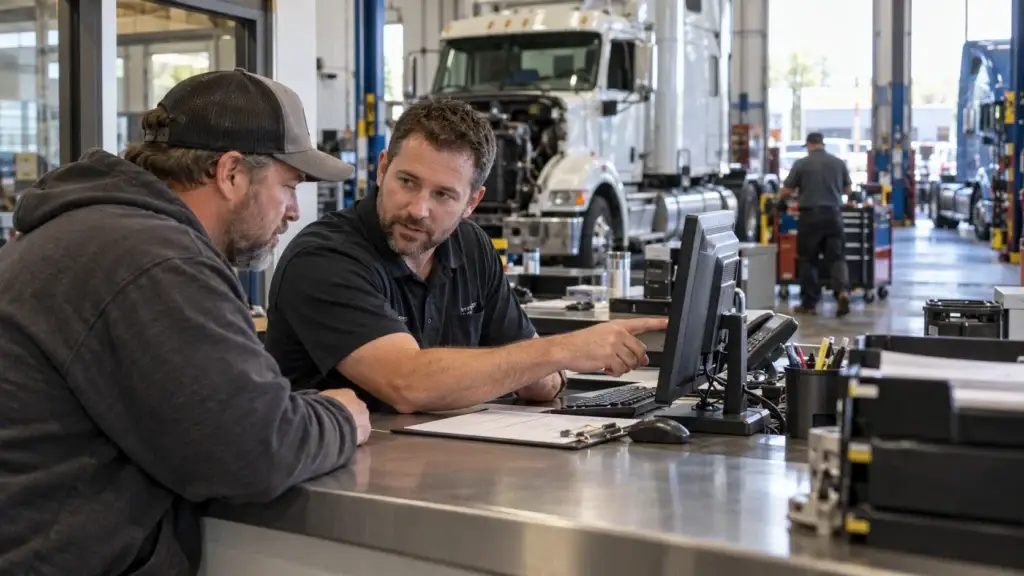
    Fleet manager discussing service needs with heavy-duty service writer at truck dealership service counter

    The Financial Impact of Service Writer Excellence

    The connection between service writer training and financial performance becomes clear when examining key performance indicators across truck service operations. Trained service writers achieve significantly higher close rates on recommended services compared to untrained counterparts. They generate larger average repair orders by identifying legitimate service needs and presenting them effectively to customers who understand the value proposition.

    Research from NCM Institute’s Service Advisor Training programs demonstrates that trained service advisors outperform average performers across multiple customer satisfaction metrics. This performance gap represents lost revenue for businesses that neglect training investments. More importantly, it represents missed opportunities to create the positive experiences that transform one-time repair customers into loyal PM program participants.

    $448–$760

    Average daily cost of unplanned fleet downtime per vehicle — Fleet Maintenance industry research

    Consider the lifetime value equation in commercial truck service. A fleet customer who returns for scheduled PM services, trusts your recommendations on repairs, and calls your shop first when a truck goes down generates exponentially more revenue than one-time breakdown visitors. Customer retention strategies built on trained service writer interactions create long-term value streams that sustain shop profitability through market cycles.

    The following table illustrates measurable differences between trained and untrained service writer performance across metrics relevant to heavy-duty operations:

    Performance MetricUntrained WritersTrained WritersImprovement
    Recommended Service Close Rate42%67%+25 percentage points
    Average Repair Order Value$487$721+48% increase
    Customer Satisfaction Score3.6/5.04.7/5.0+1.1 point improvement
    Fleet Customer Return Rate (12 mo)54%81%+27 percentage points

    These metrics reveal the concrete business case for training investment. The 27-percentage-point improvement in customer return rates alone justifies the cost of comprehensive development programs. When fleet customers return more frequently, they generate predictable revenue streams that stabilize shop operations through seasonal fluctuations and freight market cycles.

    1. Effective Communication and Active Listening

    Service writers who master communication skills build bridges of understanding that turn frustrated drivers and stressed fleet managers into confident decision-makers. This fundamental skill set determines whether customers feel empowered or overwhelmed when facing repair decisions that affect their operations and bottom line. The difference between a service writer who merely processes work orders and one who creates loyal customers lies in the ability to communicate effectively across the technical-customer divide.

    Every customer interaction presents an opportunity to demonstrate expertise while building trust. Heavy-duty customers—whether owner-operators managing their own equipment or fleet managers responsible for dozens of trucks—need service writers who understand their operational pressures and communicate accordingly.

    Translating Technical Jargon into Customer-Friendly Language

    The ability to explain complex diesel system issues in accessible terms separates exceptional service writers from their peers. Customers rarely possess the technical vocabulary to understand terms like “turbocharger wastegate actuator failure” or “DPF substrate thermal damage.” When service writers use industry jargon without translation, they create confusion and erode trust rather than building it.

    Heavy-duty service writer demonstrating communication skills explaining diesel repair to fleet manager

    Technical translation skills empower customers to make informed decisions without feeling patronized or overwhelmed. The goal isn’t to oversimplify critical repairs but to frame them in ways that highlight their importance and urgency. For example, explaining that “the device that controls boost pressure in your turbo system is sticking, which will eventually trigger a derate and limit your power” conveys both the function and consequence without requiring technical knowledge.

    Effective customer communication strategies include several proven approaches. The analogy method compares diesel systems to familiar concepts that customers understand intuitively. The consequence approach explains what happens if repairs are delayed, providing context for urgency without creating unnecessary alarm. Visual aids—showing customers photos from digital inspections, diagrams, or actual worn components—transform abstract descriptions into concrete evidence they can evaluate. The layered explanation technique starts with simple overviews and adds detail based on customer interest and technical comfort level.

    Using Active Listening to Uncover the Real Problem

    Many service appointments begin with incomplete or inaccurate problem descriptions because customers lack the technical language to describe symptoms precisely. Fleet managers may report what their driver told them third-hand. Owner-operators may focus on the symptom that bothers them most rather than the underlying pattern. This communication gap creates a critical challenge: service writers must become skilled investigators who use active listening techniques to identify the actual underlying issue rather than just addressing surface-level complaints.

    Active listening functions as a diagnostic tool that goes beyond the customer’s initial complaint. A customer who says “my truck has no power” provides limited actionable information. However, a service writer trained in probing questions can uncover that the power loss occurs only under load above 1,800 RPM, immediately narrowing the diagnostic possibilities to boost-related systems and saving technician diagnostic time.

    Effective active listening techniques include specific practices that transform vague descriptions into accurate repair orders. Reflective listening paraphrases customer statements back to them, confirming understanding and encouraging additional detail. Open-ended questions like “What were the operating conditions when you first noticed this?” reveal contextual information that yes/no questions miss. Clarifying follow-ups requesting specific details about when, where, and how symptoms occur build a complete diagnostic picture that technicians can act on efficiently.

    2. Technical Knowledge of Diesel Systems

    Building customer trust begins with demonstrating solid understanding of heavy-duty vehicle systems and repair requirements. Service writers who possess comprehensive diesel technical knowledge can confidently explain repair recommendations and answer customer questions with authority. This expertise bridges the gap between complex diagnostic findings and customer understanding, making the difference between a trusted advisor relationship and a transactional encounter.

    Technical credibility separates exceptional service writers from those who simply process paperwork. Fleet managers and experienced owner-operators quickly recognize when a service advisor truly understands their equipment’s needs versus someone reading from a script or simply relaying technician notes without comprehension. This recognition directly influences their decision to return for future service.

    Understanding Heavy-Duty Vehicle Systems

    Effective service writers must develop working knowledge of major commercial truck systems to communicate intelligently with both customers and technicians. This foundation enables them to ask relevant questions during vehicle check-in, identify potential concerns that customers may not have mentioned, and explain repair recommendations in context.

    Diesel engine systems technical knowledge training for heavy-duty service writers

    Core systems that service writers should understand include diesel engine operation and common failure modes, aftertreatment systems including DPF regeneration cycles and SCR operation, transmission and drivetrain components, air brake systems and their inspection requirements, electrical and multiplexing systems, and cooling system maintenance. Service writers don’t need technician-level diagnostic skills, but they must understand how these systems function together and deteriorate over time. This knowledge allows them to interpret technician findings and explain repair necessity with confidence.

    Pursuing professional credentials demonstrates commitment to technical knowledge. The National Institute for Automotive Service Excellence (ASE) offers the T-series certification program specifically for medium/heavy truck professionals, covering areas from diesel engines (T2) through preventive maintenance inspection (T8). While service writers don’t typically pursue full technician certification, familiarity with these knowledge areas strengthens their credibility with both customers and shop technicians.

    Staying Current with Evolving Technology

    Commercial truck technology evolves rapidly, introducing systems that fundamentally change service requirements. Service writers must actively pursue continuous learning to remain relevant and valuable to their organizations and customers. This commitment to staying current separates exceptional professionals from those who fall behind.

    Critical technology trends reshaping the heavy-duty service landscape include increasingly complex emissions aftertreatment systems, advanced driver assistance systems requiring calibration after windshield or camera work, integrated telematics and remote diagnostics, alternative fuel systems including natural gas and emerging electric platforms, and sophisticated multiplexed electrical architectures. These emerging technologies require specialized knowledge that traditional training may not cover. Service writers must recognize when vehicles need specialized diagnostic equipment or technician expertise and communicate those requirements clearly to customers.

    Manufacturer-specific training programs provide essential updates on proprietary systems and warranty procedures. Service writers who attend these sessions gain competitive advantages in customer communication, as they can confidently discuss brand-specific technologies and unique maintenance requirements for Freightliner, Kenworth, Peterbilt, Volvo, and other platforms.

    Stay Ahead of Heavy-Duty Service Trends

    Get technical insights, fleet management strategies, and service department best practices delivered to your inbox—built for diesel professionals who take their craft seriously.

    3. Customer Service Excellence and Empathy

    While technical knowledge enables accurate repair orders, customer service excellence repairs the anxiety that brings fleet managers and owner-operators through your door in the first place. A truck breakdown isn’t just an inconvenience—it’s lost revenue, missed delivery commitments, and operational chaos. Service writers who recognize and address these pressures build loyalty that transcends individual transactions.

    The difference between adequate and exceptional service writers lies in their emotional intelligence. These interpersonal skills transform routine interactions into relationship-building opportunities. Empathy training teaches service writers to recognize that vehicle problems create real stress, financial pressure, and logistical challenges for their customers—especially in trucking where time literally equals money.

    Creating Positive Connections From First Contact

    First impressions significantly influence overall satisfaction regardless of technical outcomes. Rapport building techniques create the foundation for trust before any diagnostic work begins. Service writers have mere moments—whether greeting a walk-in customer or answering a phone call from a stressed dispatcher—to establish a connection that will carry through the entire service process.

    Customer service excellence training for heavy-duty service writers building fleet customer rapport

    Effective service writers quickly establish rapport through genuine interest in customers as individuals and their operational needs. Simple actions like remembering a customer’s name, their fleet size, or the specific routes they run make customers feel recognized and valued. These personal touches create psychological safety that allows customers to be honest about their concerns, budgets, and operational priorities.

    For fleet customers, demonstrating understanding of their business context matters tremendously. Acknowledging that they have trucks waiting to be dispatched, loads that need to move, and drivers who need to get back on the road shows you understand the stakes beyond just the repair itself.

    Managing Expectations Through Proactive Communication

    Heavy-duty repairs involve inherent uncertainties that create anxiety for customers. Diagnostic processes may reveal additional issues, parts availability can cause delays, and repair complexity sometimes exceeds initial estimates. How service writers manage these expectations determines whether such realities damage or strengthen customer relationships.

    Service writers who proactively communicate create dramatically better experiences than those who overpromise and underdeliver. Setting realistic timeframes from the start prevents disappointment. Explaining potential complications prepares customers without creating unnecessary alarm. Providing regular updates throughout the service process demonstrates respect for customer time and operational pressures.

    For fleet accounts especially, proactive communication allows managers to adjust their operations. A quick call when a repair timeline extends gives them time to arrange substitute equipment or adjust dispatch schedules. This simple practice transforms waiting from frustrating uncertainty into manageable planning.

    4. Ethical Sales and Value-Based Recommendations

    Balancing shop profitability with customer advocacy requires service writers to develop sophisticated value-based selling techniques rooted in genuine customer benefit. The most effective advisors understand that authentic customer advocacy and business revenue are not competing priorities but complementary goals. When service writers learn to identify and present legitimate service needs with clarity and confidence, customers respond with trust and repeat business that far exceeds short-term transactional gains.

    Ethical sales approaches transform the entire customer interaction from a potentially adversarial negotiation into a collaborative problem-solving experience. Service writers who embrace value-based principles position themselves as trusted advisors rather than salespeople—a distinction that fleet customers recognize and reward with loyalty.

    Value-based selling techniques for heavy-duty service recommendations to fleet customers

    Recognizing Genuine Service Needs

    Identifying legitimate service opportunities begins with comprehensive inspection processes that reveal actual maintenance needs rather than manufactured sales opportunities. Trained service writers develop the technical knowledge to recognize wear patterns, fluid conditions, and component deterioration that indicate developing problems before they cause failures or, worse, roadside breakdowns and DOT violations.

    The inspection process should follow manufacturer maintenance schedules while also accounting for operating conditions, vehicle age, and duty cycle. A regional delivery truck running frequent stop-and-go routes has different service needs than a linehaul tractor running primarily interstate miles. This systematic approach ensures that recommendations are based on objective evidence relevant to that customer’s operation.

    Effective advisors learn to categorize findings into clear priority levels that guide both their recommendations and customer decision-making. Safety-critical services requiring immediate attention include brake system issues, steering component wear, and tire conditions that could cause violations or accidents. Compliance-related maintenance covers PM services required for DOT inspection readiness and warranty preservation. Preventive services address developing issues before they become expensive failures or cause downtime. Value-added recommendations might include operational improvements or protection products appropriate to the customer’s needs.

    Presenting Recommendations Effectively

    Communicating service recommendations effectively requires specific techniques that emphasize benefits rather than technical features. Fleet customers make decisions based on how services protect their uptime, ensure compliance, or prevent future expenses—not on part numbers or technical specifications.

    The most effective presentation approach uses inspection results as objective evidence. Digital inspection tools that provide photos and videos of actual component conditions transform abstract recommendations into concrete realities customers can evaluate. Showing a fleet manager the brake measurement that puts their truck at risk of an out-of-service violation is far more persuasive than simply telling them they need brakes.

    Language frameworks should clearly explain consequences of deferring maintenance while respecting customer autonomy and budget constraints. Advisors can present immediate safety needs separately from items that can be scheduled for future visits, demonstrating respect for customer financial situations while ensuring critical services receive appropriate attention.

    5. Time Management and Operational Coordination

    Effective workflow coordination begins with service writers who understand that in commercial trucking, every minute counts. The service counter operates as a complex hub where multiple fleet accounts, owner-operators, breakdown calls, and scheduled appointments converge simultaneously. Service writers who develop strong time management skills create order from potential chaos, ensuring that no customer feels overlooked and no critical task falls through the cracks.

    Operational efficiency depends entirely on how well service writers orchestrate the constant flow of information and action. From the moment a fleet manager calls to schedule PM services until the final invoice review, service writers coordinate the entire workflow. This coordination role requires both systematic organization and the flexibility to adapt when emergency breakdowns disrupt carefully planned schedules.

    Heavy-duty service writer managing workflow coordination and appointment scheduling for fleet customers

    Balancing Multiple Customer Priorities

    A typical heavy-duty service writer manages numerous customer relationships simultaneously, each at different stages of the service journey. One fleet manager is calling to schedule PM appointments for three trucks while an owner-operator walks in with an urgent breakdown. Meanwhile, a technician needs approval for additional repairs discovered during inspection, and a parts delay threatens to push back a promised completion time.

    Strategic appointment scheduling forms the foundation of effective time management. Service writers must balance shop capacity with customer demand, avoiding the twin problems of overcrowding the bay or leaving technicians without work. This requires understanding diagnostic times, typical repair durations, and parts availability—all while accounting for the inevitable emergency that will disrupt the best-laid plans.

    Successful service writers implement organizational systems that prevent important commitments from being forgotten. Time-blocking techniques dedicate specific periods for customer updates, administrative tasks, and technician consultations. Digital tracking systems flag customers who haven’t received promised status updates. Prioritization frameworks help identify which tasks demand immediate attention versus those that can wait.

    Coordinating Between Departments

    Service writers function as the critical communication link connecting customers, technicians, parts departments, and management. This central coordinator role demands clear protocols and proactive problem-solving. When a technician discovers additional needed repairs, the service writer must quickly assess the situation, contact the customer with recommendations, coordinate parts ordering, and adjust scheduling—all while maintaining forward momentum on other vehicles.

    Understanding technician workflow enables better coordination. Service writers who grasp diagnostic processes can set realistic customer expectations and avoid making promises the shop cannot keep. They recognize which repairs can be completed during a customer’s wait versus those requiring extended time or specialized equipment.

    Proactive parts coordination prevents the most common source of service delays. Experienced service writers review upcoming appointments to identify likely parts needs, ensuring components arrive before the vehicle does. For fleet PM programs, this forward-thinking approach maintains predictable service schedules that fleet managers can count on.

    The HDJ Perspective

    The technician shortage has fundamentally changed the service writer’s role. With 65.5% of diesel shops reporting understaffing and nearly one in five technician positions unfilled according to recent ATRI research, maximizing technician efficiency has become critical. Service writers who capture complete, accurate information on initial write-up—enabling technicians to diagnose faster with fewer interruptions—are worth their weight in gold. Every minute saved through better communication and coordination translates directly to increased shop capacity without hiring additional techs you can’t find anyway. The shops winning in today’s market have elevated their service writers from administrative roles to essential coordinators who multiply technician productivity.

    6. Problem-Solving and Adaptive Thinking

    The daily reality of heavy-duty service operations includes countless variables that demand quick thinking and creative problem-solving. Parts arrive damaged, diagnostic findings reveal unexpected issues, and repairs take turns that no one anticipated. Service writers who master adaptive thinking become the dependable anchor their teams and customers rely on when complications arise.

    The scheduling process for commercial truck service involves many moving parts that can quickly become hectic. When operations face disruptions—a truck that came in for PM now needs major brake work, or a promised part is suddenly backordered—everyone looks to service writers to find solutions that keep customers satisfied and operations moving forward.

    Problem-solving skills in heavy-duty truck service operations

    Navigating Unexpected Challenges

    Service complications emerge daily in commercial truck repair facilities. A routine PM inspection reveals worn suspension components that require immediate attention. An ordered part arrives with the wrong specifications. A promised two-hour service extends when technicians discover corroded fittings that must be replaced before reassembly.

    These situations test a service writer’s problem resolution capabilities immediately. The ability to evaluate options quickly, determine the best path forward, and balance customer needs against shop realities separates competent writers from exceptional ones. Most critically, proactive communication when problems arise prevents small issues from becoming relationship-destroying disasters. Contacting customers immediately when complications develop—rather than hoping to resolve issues without their knowledge—builds trust even when delivering bad news.

    Training programs should include scenario-based exercises that simulate common complications service writers will face. This might include diagnostic processes that uncover problems beyond the original complaint, parts delivery failures that threaten promised completion times, repairs requiring significantly more labor than initially estimated, and equipment issues that impact shop capacity.

    Building Win-Win Solutions

    Creating outcomes that satisfy customers while protecting shop interests represents the pinnacle of adaptive thinking. When repairs exceed estimates, timelines extend beyond promises, or mistakes occur, service writers must negotiate solutions that preserve customer relationships without unfairly burdening the business.

    This requires understanding when to offer concessions like discounts or courtesy services. It demands skill in presenting options that give customers control over difficult decisions. Most importantly, it involves techniques for turning potentially negative experiences into demonstrations of exceptional service recovery.

    Successful problem resolution often involves creative alternatives. Offering loaner vehicles or rental assistance when repairs extend unexpectedly, splitting work across multiple appointments to manage customer budgets, expediting parts through alternative suppliers when standard channels fail, or coordinating with other departments to find unexpected capacity all represent the kind of resourceful thinking that turns problems into opportunities for demonstrating commitment.

    Customers often remember how problems were handled more than the problems themselves. A service complication resolved with transparency, creativity, and genuine concern can build more loyalty than a service appointment that proceeds without any issues at all.

    7. Digital Systems and Software Proficiency

    Mastering digital tools separates competitive shops from those falling behind in today’s technology-driven service environment. Modern heavy-duty service operations depend on software platforms that manage everything from customer data and service histories to parts ordering and technician dispatching. Service writers who develop strong fleet management software capabilities deliver faster service, fewer errors, and significantly better customer experiences.

    The competitive advantage is clear. Service writers with advanced technology skills can handle more customers efficiently while maintaining higher quality interactions. This proficiency directly translates to increased customer retention and revenue growth, particularly with fleet accounts that expect professional, technology-enabled service coordination.

    Leveraging Service Management Systems

    Fleet management systems and dealership management platforms form the operational backbone of modern service departments. These systems organize customer information, track complete service histories across multiple units, and coordinate complex workflows across teams. Service writers must navigate these systems with confidence and precision to deliver the service quality fleet customers expect.

    Effective software training goes beyond basic data entry. Service writers should learn to leverage customer history for personalized recommendations, identifying patterns that reveal maintenance needs before customers even mention symptoms. Accessing previous service records allows writers to provide context-aware suggestions that demonstrate attentiveness and build confidence.

    Proficiency includes accurate work order creation that captures all necessary information for technicians, report generation capabilities that inform both customers and management, and efficiency shortcuts that reduce administrative time. Each minute saved on system navigation creates more time for meaningful customer interaction.

    Using Technology to Enhance Communication

    Fleet customers expect digital communication options that match their operational technology. Text message updates, digital vehicle inspection reports with photos and videos, and electronic service approvals have become standard expectations rather than premium features. Service writers must master these tools to meet contemporary customer demands.

    Digital inspection platforms deserve special emphasis. Service writers who effectively present visual evidence of needed repairs achieve higher approval rates while reducing customer skepticism. Photos and videos of actual component conditions speak louder than verbal descriptions when explaining maintenance recommendations to fleet managers who aren’t on-site to see the truck themselves.

    Electronic approval systems create operational efficiency that benefits everyone. Fleet managers can review and approve recommendations from their office or mobile device, preventing delays that occur when waiting for phone contact. This convenience factor significantly enhances the overall service experience and accelerates shop workflow.

    Free Professional Fleet Tools

    Cost calculators, fault code lookup, maintenance planners, and more—built for owner-operators, fleet managers, and diesel techs. No signup required.

    Explore Free Tools →

    8. Conflict Resolution and Complaint Handling

    Heavy-duty service environments naturally create situations where emotions run high. When a truck is down, a delivery is missed, or a repair costs more than expected, customers feel vulnerable about their operations, finances, and business relationships. These high-stakes interactions mean that conflict resolution skills become essential for every service writer who wants to protect customer relationships during challenging moments.

    Vehicles—especially commercial trucks that represent substantial capital investments and operational necessity—trigger strong emotional responses when problems arise. Effective service writers recognize that customer frustration usually targets the situation rather than them personally, allowing them to maintain professional composure while working toward solutions.

    De-Escalating Tense Interactions

    Customer de-escalation begins with understanding the emotional triggers unique to commercial truck service. Fleet managers may feel pressure from their own customers about delayed deliveries. Owner-operators may face financial stress from unexpected repair costs when operating on tight margins. Drivers may be frustrated about downtime affecting their pay or time at home. Service writers must recognize these underlying concerns rather than reacting only to surface-level anger.

    The first critical technique involves remaining calm regardless of customer emotion. When service writers mirror a customer’s agitation, situations escalate rapidly. Instead, maintaining a steady, confident demeanor provides an emotional anchor that helps customers regain composure. Empathetic language validates customer feelings without becoming defensive—phrases like “I understand how frustrating this must be for your operation” acknowledge emotions while moving toward solutions.

    Active de-escalation also requires allowing customers to fully express their concerns before attempting solutions. Interrupting or rushing to fix problems often backfires because customers feel unheard. Service writers should practice the discipline of listening completely, taking notes, and asking clarifying questions that demonstrate genuine engagement before proposing paths forward.

    Converting Problems into Loyalty Opportunities

    Effective service recovery transforms dissatisfied customers into loyal advocates. Research consistently demonstrates that customers whose problems receive quick, fair solutions often develop stronger loyalty than customers who never experienced issues. This counterintuitive finding reveals the power of exceptional service recovery in building lasting business relationships.

    The foundation of effective recovery involves empowering service writers with sufficient authority to make reasonable accommodations without requiring multiple approval layers. When service writers must repeatedly leave customers to “ask their manager,” frustration compounds and resolution delays. Clear guidelines about appropriate concessions enable immediate solutions.

    Crafting effective remedies requires understanding the customer’s underlying concern rather than just addressing surface complaints. A customer complaining about price may actually worry about value or fairness. A customer frustrated about repair time may feel disrespected or anxious about operational impacts. Service recovery works best when solutions target these deeper issues.

    Follow-up after resolution separates good service recovery from exceptional recovery. A phone call a few days after a resolved issue confirms that the solution actually addressed the problem, demonstrates continued care beyond the immediate transaction, provides opportunity to address any lingering concerns, and reinforces the relationship.

    9. Strategic Follow-Up and Relationship Building

    Strategic follow-up transforms one-time repair transactions into lasting partnerships that drive consistent revenue and referrals. The service writer’s influence extends far beyond the immediate repair appointment. Effective fleet relationship building creates customer loyalty that generates repeat PM business and breakdown calls for years to come.

    The most successful heavy-duty service operations recognize that customer follow-up strategies represent investments in long-term profitability rather than administrative burdens. Each touchpoint reinforces the positive experience and strengthens the bond between customer and service provider. For fleet accounts especially, systematic follow-up demonstrates the professional approach that distinguishes preferred service partners from commodity repair shops.

    Implementing Post-Service Communication

    Systematic post-service communication reinforces positive experiences and identifies potential problems before they escalate into lost accounts. Proactive outreach demonstrates genuine care beyond the sale, creating opportunities for addressing any concerns while the relationship is still fresh from a positive repair experience.

    A comprehensive follow-up system should include several key elements. Thank-you communications within 24-48 hours of service completion express appreciation and confirm satisfaction. Performance checks verify that vehicles are operating as expected after repairs. Any concerns customers raise during follow-up receive immediate attention through clear service recovery protocols. Feedback requests through surveys or direct conversation gather insights for continuous improvement.

    Training should equip service writers with scripts and templates that make post-service communication both efficient and consistent. These tools ensure every customer receives the same high-quality follow-up regardless of which service writer handled their appointment. Accountability systems guarantee that follow-up actually happens rather than getting lost in daily operational pressures.

    Building Long-Term Fleet Relationships

    Strategic customer touchpoints throughout the ownership and service lifecycle keep your shop top-of-mind without becoming intrusive. These regular connections maintain relationships during the periods between service visits, transforming sporadic transactions into ongoing advisory partnerships.

    For fleet accounts, a comprehensive touchpoint strategy includes PM reminder notifications based on time elapsed or mileage accumulated since last service, seasonal service reminders for winter preparation and cooling system checks, proactive communication about recalls or service campaigns affecting their equipment, and value-added information such as regulatory updates or operational tips relevant to their business.

    Modern fleet management and CRM systems can automate much of this communication while maintaining personalization. The most effective programs combine technological efficiency with human touches that reflect individual customer relationships. References to specific units, past service history, or previous conversations demonstrate that communications come from someone who knows the customer’s operation—distinguishing your outreach from generic marketing.

    The ultimate objective is positioning the service writer as a trusted advisor rather than a transactional order-taker. When fleet managers view their service contact this way, they naturally return for all maintenance needs and actively seek advice before making equipment-related decisions. This relationship depth creates customer lifetime value that far exceeds individual transaction profits.

    Building Your Service Writer Development Program

    Successful heavy-duty service operations recognize that structured employee development programs separate industry leaders from competitors struggling with customer retention and inconsistent service quality. The difference between adequate and exceptional service departments lies in how deliberately organizations approach training initiatives. Rather than relying on informal learning or the traditional sink-or-swim approach, forward-thinking businesses invest in systematic training program development that produces consistent results.

    Creating an effective training framework requires careful planning across three critical dimensions: initial onboarding that establishes foundational competencies, ongoing development that builds advanced skills, and measurement systems that validate training effectiveness.

    Structuring Onboarding and Continuous Development

    Effective onboarding begins before new service writers interact with their first customer. The initial training period should immerse employees in company processes, customer service standards, and the technical knowledge foundation they’ll need to succeed. This investment prevents costly mistakes and builds confidence that translates into better customer interactions from day one.

    A comprehensive onboarding program includes shadowing experienced team members to observe real-world customer interactions and problem-solving approaches. Progressive responsibility assignments allow new hires to develop skills incrementally, starting with simpler tasks like greeting customers and scheduling appointments before advancing to writing complex repair orders and presenting recommendations.

    Formal instruction should cover all nine skill areas outlined in this guide: communication and active listening, diesel technical knowledge, customer service excellence, ethical sales practices, time management and coordination, problem-solving, digital systems proficiency, conflict resolution, and relationship building.

    Organizations can leverage professional training resources to supplement internal programs. NCM Institute’s Service Advisor Training offers foundational courses emphasizing accountability, customer satisfaction, and performance metrics. These programs teach participants to calculate and interpret key performance indicators while comparing their performance against world-class service advisor benchmarks.

    Beyond initial onboarding, ongoing development maintains skill sharpness and introduces new competencies as technology and customer expectations evolve. Regular training sessions should address identified weaknesses revealed through performance reviews or customer feedback. Exposure to emerging diesel technologies keeps service writers current with industry changes that affect customer conversations about aftertreatment systems, alternative fuels, and advanced diagnostics.

    Measuring Training Effectiveness

    Training programs justify their costs through measurable improvements in business outcomes. Establishing baseline metrics before training implementation provides the comparison data needed to calculate return on investment. Without measurement, organizations cannot distinguish effective training from wasted resources.

    Key performance indicators that reveal training effectiveness include customer satisfaction scores from post-service surveys, close rates on recommended services indicating trust-building effectiveness, average repair order values suggesting improved identification of legitimate service needs, customer retention rates tracking return visits within defined timeframes, and comeback frequency where reductions indicate improved communication accuracy and expectation setting.

    Comparing performance between trained and untrained service writers provides additional validation. If trained employees consistently outperform counterparts across multiple metrics, the training investment delivers clear returns. This data-driven approach transforms training from a discretionary expense into a strategic investment with measurable outcomes.

    Tracking individual progress through training milestones helps identify which program components deliver the greatest impact. Some service writers may excel after communication training while struggling with technical knowledge, indicating where additional support is needed. This granular approach maximizes training effectiveness by addressing specific development gaps rather than applying one-size-fits-all programs.

    Frequently Asked Questions

    What qualifications should a heavy-duty service writer have?

    Effective heavy-duty service writers should possess working knowledge of diesel engine systems, aftertreatment technology, and preventive maintenance requirements. While formal ASE T-series certification isn’t required for service writers, familiarity with medium/heavy truck systems demonstrates technical credibility that fleet customers recognize and respect. Strong communication skills, proficiency with fleet management software, and understanding of DOT compliance requirements round out the essential qualifications. Many successful service writers come from technician backgrounds, while others develop technical knowledge through on-the-job training and manufacturer courses.

    How does service writer performance impact fleet customer retention?

    Service writers directly influence whether fleet customers return or seek alternative providers. Research shows trained service advisors achieve 25+ percentage point improvements in recommended service close rates and significantly higher customer return rates compared to untrained counterparts. For fleet accounts, consistent communication about PM scheduling, transparent pricing, and proactive notification of developing issues builds the trust that maintains long-term relationships. A single negative service experience—poor communication, missed promises, or feeling pressured—can send fleet business to competitors.

    What technical knowledge do heavy-duty service writers need?

    Heavy-duty service writers need working knowledge of diesel engine operation, aftertreatment systems including DPF, SCR, and DEF requirements, brake and air system components, electrical diagnostics, and preventive maintenance intervals. Understanding common fault codes and diagnostic processes helps them ask informed questions and communicate effectively with both technicians and customers. Knowledge of FMCSA inspection requirements and out-of-service criteria is essential for prioritizing safety-critical repairs and helping fleet customers maintain compliance.

    How can service writers help reduce fleet downtime costs?

    Skilled service writers reduce downtime by accurately capturing customer concerns to minimize diagnostic time, proactively scheduling preventive maintenance before failures occur, coordinating parts availability before repairs begin, and providing realistic repair timelines that help fleets plan substitute equipment. Effective communication during multi-day repairs and early notification of delays allows fleet managers to adjust operations. Industry data from organizations like ATRI shows downtime costs fleets $448-$760 per vehicle per day, making every hour saved through efficient service coordination directly valuable.

    What CRM and software skills do service writers need?

    Modern service writers must master fleet management software, customer relationship management systems, and digital inspection tools. Proficiency includes creating accurate repair orders, tracking service histories across fleet units, generating estimates, and using digital vehicle inspection platforms that provide photo and video documentation. Many shops use integrated systems that connect parts ordering, scheduling, and customer communication. Service writers who leverage these tools effectively reduce administrative time and deliver better customer experiences through real-time updates and transparent documentation.

    Conclusion: Investing in Service Writer Excellence

    The nine competencies outlined in this guide represent more than a training checklist—they form an integrated framework that transforms service writers from order-takers into fleet relationship managers who drive shop profitability. Communication excellence, diesel technical knowledge, customer service skills, ethical sales approaches, operational coordination, problem-solving abilities, digital proficiency, conflict resolution capabilities, and strategic follow-up practices work together to create the service experiences that fleet customers remember and reward with loyalty.

    These abilities are not innate talents available only to a select few. They improve dramatically with proper service writer training investment and consistent practice. The direct link between skilled service advisors and customer retention makes training one of the highest-return initiatives available to heavy-duty service operations—whether you’re a truck dealership, independent shop, or fleet maintenance facility.

    With the ongoing technician shortage making every shop hour more valuable and fleet customers increasingly demanding professional service coordination, the service writer role has evolved from administrative function to strategic priority. Assess your current training approach against this framework. Identify gaps in your team’s development. Take concrete steps to build these competencies systematically. Your fleet customer retention—and your shop’s competitive position—depends on it.

    Found This Guide Valuable?

    Share it with service managers, shop owners, and fleet professionals who could benefit from these service writer development strategies.

    Leave a Comment

    Your email address will not be published. Required fields are marked *

    Sponsored

    Emergency Breakdown?

    Find Certified Repair Shops Near You

    24/7 Mobile Service
    Verified Facilities
    Nationwide Coverage
    Find Repair Shops Now →

    Trusted by thousands of fleet operators
