By Michael Nielsen, Publisher | 15+ Years in Diesel Repair
Last Updated: October 2026
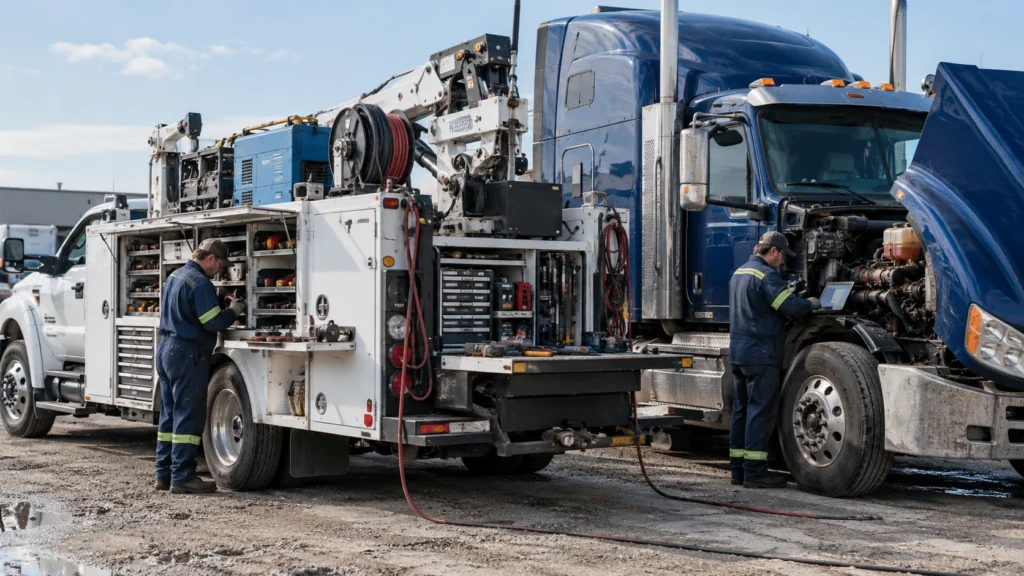
Mobile repair units are service trucks that carry shop-level tools, diagnostics, power, and parts to the vehicle instead of moving the vehicle to a shop. A well-built unit shortens downtime, cuts towing, and keeps technicians productive, but only if the chassis, body, and procedures were specified for the work it will actually do.
This Heavy Duty Journal guide, written by publisher Michael Nielsen for fleet managers, shop owners, and independent operators, covers chassis, body, tools, power, air, compliance, and technology for fleet service trucks. As of October 2026, the ATRI 2026 operational costs report puts the average marginal cost of operating a truck at $2.336 per mile in 2025, up 3.4 percent from the year before.
Key Takeaways
- ✓Spec from the work backward. Decide whether the unit will handle roadside emergencies, scheduled preventive maintenance, or both before choosing a chassis.
- ✓Payload is a budget. Every tool, crane, compressor, and generator draws from the chassis weight rating, so add it up before you buy.
- ✓Know the weight lines. A GVWR of 26,001 pounds or more triggers CDL rules, and 10,001 pounds or more brings a vehicle into the federal CMV definition.
- ✓Size power and air by simultaneous load. Add the tools that run at the same time, then build in margin.
- ✓Document everything. Digital work orders, inspection records, and a maintenance plan for the truck itself protect both uptime and compliance.
In This Guide
- Why Mobile Repair Units Change Fleet Maintenance
- Planning a Service Truck Investment
- Selecting the Right Service Truck Chassis
- Service Body Selection and Layout
- Essential Tools and Diagnostic Equipment
- Power and Compressed Air Systems
- Organizing Tools and Parts for Rapid Access
- Safety and Regulatory Compliance
- Technology and Dispatch Integration
- Workflow and Technician Capability
- Frequently Asked Questions
- The Bottom Line
Why Mobile Repair Units Change Fleet Maintenance
Shop-based repair adds steps that have nothing to do with fixing the truck: towing, queueing for a bay, shuttling drivers, and waiting on a diagnosis. A mobile unit removes most of them. The technician arrives with the tools and a diagnostic scan tool, starts the diagnosis at the truck, and finishes the repair on site when the job fits what the unit carries.
$2.336 per mile
Average marginal cost of operating a truck in 2025, up 3.4 percent from 2024, according to the ATRI 2026 operational costs report. Repair and maintenance cost rose 8.6 percent over the same period.
Count the Full Cost of Downtime
The repair bill is only part of what a breakdown costs. Add the tow, the driver's idle time, late-delivery penalties, a possible replacement truck, and the dispatch hours spent coordinating providers. Each is easy to overlook and all of them end when the truck is back in service sooner. Use your own records to put a number on each one, because averages from other fleets rarely match your lanes.
Where Mobile Service Fits Best
Mobile service works best for roadside failures, yard-based preventive maintenance, and repairs that need a basic tool set rather than a lift or alignment rack. Heavy engine work and major teardown still belong in a shop. Our guide to mobile service versus shop repair and our fleet breakdown response protocol cover how to decide which jobs go where.
Planning a Service Truck Investment
Treat mobile repair units as a business case, not an impulse purchase. Start by reviewing a year of your own breakdown and repair records. Which failures happen away from the shop, which repairs need only portable tools, and how many calls could one truck handle in a day? That analysis tells you what to build.
Match the Unit to the Service Model
The service model drives the equipment list, the coverage area, and the staffing plan. A unit built for emergency calls looks different from one built for scheduled yard maintenance, so decide the primary job before you decide anything else.
| Service model | What it emphasizes | What to decide first |
|---|---|---|
| Emergency roadside | Fast response, broad parts coverage, strong diagnostics | Coverage area and after-hours staffing |
| Scheduled fleet PM | Predictable routes, fluids, filters, inspections | Yard locations and a weekly route plan |
| Contract maintenance | Standard equipment and documentation for one customer | Service level agreement and reporting |
| Hybrid | Flexible layout that serves both jobs | Which job gets priority when both compete |
Build the Financial Case
A sound estimate includes the chassis, body, equipment, insurance, fuel, technician wages, and the upkeep of the truck itself. Compare that total against the towing, downtime, and shop labor the unit replaces. Financing terms change the picture, so review our mobile service truck financing guide and insurance requirements guide before you commit.
Define the coverage radius from real drive times, not a map circle. Longer trips cut the number of calls per day and raise fuel and wage cost per call, so set a limit that still leaves the unit profitable or worth its cost.
Selecting the Right Service Truck Chassis
The chassis sets what the truck can carry, tow, and power. Ford F-550, Ram 5500, and Chevrolet Silverado 5500HD are the common Class 5 chassis cabs for fleet mobile repair units, and Class 5 covers trucks rated between 16,001 and 19,500 pounds GVWR. Ratings and options change by model year, so confirm current figures with the manufacturer and your body builder.
Start With Payload, Not Horsepower
Payload is the GVWR minus the chassis curb weight. Everything you add draws from it: the service body, crane, compressor, generator, tools, parts, fluids, and the technician. For example, Chevrolet lists the Silverado 5500HD at 17,500 to 19,500 pounds GVWR, and Ford offers a 17,500-pound GVWR package for the F-550, with a 6.7L Power Stroke diesel as standard and a 7.3L gas V8 as an option.
Illustration with assumed numbers: if a chassis rated at 19,500 pounds has a curb weight of 10,500 pounds, that leaves 9,000 pounds for the body and everything in it. A steel body, crane, compressor, and full tool load can use most of that quickly, so weigh the equipment list before you order, not after.
Diesel or Gas, and What the Work Demands
Choose the engine for the duty cycle. A diesel suits trucks that idle long hours powering equipment, tow trailers, or run a power takeoff for a crane or compressor. Gas can cost less up front and suit lighter, shorter-range work. Match the transmission, axle ratio, and PTO provision to the equipment you plan to run, and read the body builder guide for the chassis before you finalize anything.
Know the CDL and CMV Thresholds
Weight ratings decide licensing. Under 49 CFR 383.91, a single vehicle with a GVWR of 26,001 pounds or more is a Group B vehicle that requires a CDL, and a combination is Group A when the combined rating is 26,001 pounds or more and the towed unit exceeds 10,000 pounds GVWR. If your unit pulls a trailer, check the combined ratings. Our guide on whether diesel technicians need a CDL goes deeper.
| Chassis decision | Why it matters | What to check |
|---|---|---|
| GVWR | Sets payload, licensing, and regulatory status | Rating on the build sheet, not the brochure |
| Wheelbase and cab-to-axle | Limits body length and compartment space | Body builder guide for the chassis |
| Engine and PTO provision | Decides how you power crane and compressor | Available PTO openings and output |
| Axle and tire ratings | Cap the real weight the truck can carry | Front and rear axle ratings against loaded weight |
Service Body Selection and Layout
The body turns the chassis into a workshop. Choose it for storage, accessibility, and weight. Reputable body makers, including Reading and Knapheide, build to fleet specifications, and a fleet that runs several regions can standardize core features while letting each region add what it needs. See our comparison of mobile service truck brands for more.
Aluminum and Steel Compared
The material choice trades weight, corrosion resistance, repair cost, and price. Neither is right for every fleet, so decide based on your climate and payload margin.
| Factor | Aluminum | Steel |
|---|---|---|
| Weight | Lighter, which leaves more payload for equipment | Heavier, which reduces payload margin |
| Corrosion | Resists rust, helpful in salt and coastal climates | Needs coatings and upkeep where road salt is used |
| Purchase price | Usually costs more up front | Usually costs less up front |
| Repair | May need specialized welding | Repairable at most fabrication shops |
Layout Around the Workflow
Put the tools used on every call at chest height and heavy parts low, to keep the center of gravity down. Foam tool shadowing shows what is missing at a glance, and quality drawer slides hold up to constant use. Plan weather sealing for compartments that hold electronics.
Cranes and Lifting Equipment
A crane lets one technician handle components that otherwise take two or a shop hoist. Capacity depends on the crane, the body, and the chassis, so get the mounting design approved by the body and crane manufacturers and never exceed the rated load chart. A crane run from the PTO also needs a lockout plan. Our guide to PTO systems covers installation and care.
Essential Tools and Diagnostic Equipment
Mobile repair units should carry what the planned repairs need, and nothing that rides empty. Build the list from your own repair history, then add the tools that make a roadside job safe and complete. Start with the basics every unit needs and add specialty items as the work demands.
Hand Tools and Cordless Power Tools
Carry full SAE and metric socket and wrench sets in the common drive sizes, with deep sockets, six-point sockets for stubborn fasteners, and the brake, steering, and suspension specialty tools your fleet needs. Cordless tools keep the unit independent of the generator. A high-torque cordless impact wrench is usually the first power tool to buy, because it handles wheel-end work.
Diagnostic Equipment
Modern trucks need diagnostics that talk to engine, transmission, and brake modules. Choose a scan tool with the brand coverage your fleet needs, plus a meter, a test light, and electrical testing tools. Keep the software current, as covered in our guide to diagnostic software updates, and review heavy-duty diagnostic tools for choices.
| Tool category | Examples | How to decide |
|---|---|---|
| Hand tools | Sockets, wrenches, pry bars, specialty pullers | Match your fleet fasteners and components |
| Cordless power tools | Impact wrench, drill, grinder, saw | Battery platform and torque for wheel-end work |
| Diagnostics | Scan tool, meter, circuit testers | Coverage for your makes and software updates |
| Safety gear | Stands, chocks, PPE, extinguisher | Rated for the heaviest vehicle you service |
For complete checklists, see our service truck equipment and tool list and the mobile mechanic tools checklist.

Power and Compressed Air Systems
Without power, mobile repair units are little more than parts runners. Size the electrical and air systems for what runs at the same time, not for the single heaviest tool. Add up the loads, add margin, and check the nameplate on every tool rather than relying on a rule of thumb.
Sizing the Generator
Add the running watts of everything that operates together, then allow extra for motor startup surges and for future equipment. As an illustration with assumed nameplate values, a 2,500-watt compressor, an 1,800-watt tool, a 300-watt laptop, and 500 watts of lighting total 5,100 watts. Adding 25 percent margin points to about 6,400 watts of continuous capacity before welding loads.
A welder-generator combines both jobs in one unit, but welding draws heavily, so check the manufacturer's output ratings for both functions at the same time. Use clean inverter power for scan tools and laptops, since voltage swings damage electronics.
Batteries and Shore Power
An auxiliary battery bank with an inverter covers diagnostics and lighting without running an engine, and it keeps the truck quiet on residential or night calls. A shore power inlet with a transfer switch lets the unit use a customer's outlet when one is available.
Sizing and Placing the Air System
Find the CFM rating of each air tool at its working pressure and add the tools that run at once. As an illustration, a 6 CFM tool and a 4 CFM tool together need 10 CFM, and adding 50 percent margin for duty cycle calls for about 15 CFM at working pressure. Compressors run from the PTO, an engine, or an electric motor, and each trades runtime against noise and truck load.
Plan outlets at several points on the body, use quick-connect fittings, and protect lines with hard piping and hose reels. Our guide to an air compressor maintenance schedule keeps the system dependable.
Organizing Tools and Parts for Rapid Access
Mobile repair units that carry everything but cannot find anything waste billable time. Organize by repair type and frequency of use. Group brake, electrical, and engine items together, keep fast-moving parts like filters, belts, hoses, and connectors stocked, and set reorder points from actual use so payload is not wasted on slow movers.
Track usage with a simple system or inventory software, then restock on a fixed schedule. Our guide to parts inventory management software can help. Protect electronics and tools from weather with sealed compartments, and use multi-point locks and internal mounting to reduce theft and road-vibration damage. Check tool counts at shift change so losses show up fast.
Safety and Regulatory Compliance
A service truck must meet the same rules as the vehicles it fixes, and its technicians face workplace hazards that a roadside makes worse. Treat compliance as part of the spec, not an afterthought.
DOT and Licensing Rules
The federal definition of a commercial motor vehicle in 49 CFR 390.5 includes vehicles with a gross vehicle weight rating or gross vehicle weight of 10,001 pounds or more used in interstate commerce, so many service trucks fall under the federal safety rules. Intrastate operation follows state rules, which vary, so confirm with your state agency.
Hours of service apply to drivers of those vehicles. Under 49 CFR 395.1, a driver who works within a 150 air-mile radius of the normal work reporting location, returns and is released within 14 consecutive hours, and has 10 consecutive hours off duty between shifts qualifies for the short-haul exception. Our hours of service guide covers the details.
⚠️ Safety Warning
Never work under a raised vehicle supported only by a jack or hoist. Use rated stands and wheel chocks, and treat the truck's own crane, compressor, and hydraulics as stored-energy hazards. Isolate and lock out power before servicing them, and keep clear of traffic when you set up on a roadside.
Fire Extinguishers and Workplace Safety
Under 49 CFR 393.95, a power unit not hauling placarded hazardous materials needs one fire extinguisher rated 5 B:C or more, or two rated 4 B:C or more, readily accessible and securely mounted. Because welding and fuel raise the fire risk on a service truck, consider a higher rating than the minimum. OSHA at 29 CFR 1910.157 requires monthly visual inspection and an annual maintenance check.
Lockout and tagout under 29 CFR 1910.147 covers servicing machines where unexpected startup or stored energy could injure someone, which includes truck-mounted cranes and compressors. OSHA's OSHA vehicle maintenance guidance also lists the hazards mechanics face, including chemicals, welding, and electrical work. For more, see our mobile mechanic safety guide.
Keep the Service Truck Itself Inspected
The service truck needs its own maintenance program. Under 49 CFR Part 396, motor carriers must inspect, repair, and maintain vehicles they control, perform annual inspections, and keep the inspection report for 14 months. Build a schedule for the chassis, body, generator, and compressor, and review our annual vehicle inspection requirements guide.
Free DOT Status Check
Enter a USDOT number and quickly review public carrier status, operating authority and key FMCSA registration data.
Technology and Dispatch Integration
Technology links mobile repair units to dispatch and the customer. Choose tools for the jobs below and avoid buying features no one will use. Vehicle location, digital work orders, parts lookup, and reliable communication give a mobile unit the visibility a shop has by default.
Location Tracking and Dispatch
Location data lets a dispatcher send the nearest qualified technician and give the customer a real arrival estimate. Geofences and route history help audit coverage and response times. Pair tracking with a dispatch process so the information drives decisions rather than sitting in a dashboard.
Digital Work Orders and Parts Lookup
Field work orders let technicians pull vehicle history, attach photos, record labor and parts, and collect approvals on site. See our guides to digital work orders and mobile service management software. Parts catalogs and cross-reference tools on a phone cut guesswork and return trips.
Connectivity
Give technicians a reliable data connection and secure devices so they can reach manuals, service bulletins, and dispatch from anywhere. Integrating these tools with your maintenance system, as described in our software integration guide, keeps records in one place.
Workflow and Technician Capability
Equipment does not guarantee results. Procedures and people do. Write standard operating procedures for call intake, dispatch, diagnosis, repair authorization, and quality checks, so every technician delivers the same result. Michael Nielsen and the HDJ team see the same pattern on heavydutyjournal.com: fleets that document the process get more from every unit.
Mobile technicians work alone, make decisions without a supervisor nearby, and deal with customers directly. Choose people who like field work, train them across vehicle systems and customer communication, and build a replenishment routine so units start every shift stocked. Review our guide on mobile versus in-house staffing when you plan the team.
This guide focuses on how a fleet specifies and runs mobile repair units. If you are starting a service operation and want a step-by-step equipment walkthrough, see our mobile service truck setup guide.
Frequently Asked Questions
What chassis size is best for a fleet mobile repair unit?
Most fleets choose a Class 5 chassis cab rated 16,001 to 19,500 pounds GVWR, such as the Ford F-550, Ram 5500, or Chevrolet Silverado 5500HD. Pick by payload, not horsepower. Add up the body, crane, compressor, generator, and tools, then confirm the chassis rating covers them with margin.
Do mobile service truck drivers need a CDL?
Not on weight alone unless the GVWR reaches 26,001 pounds, which makes a single vehicle a Group B vehicle. Towing changes the math: a combination is Group A when the combined rating is 26,001 pounds or more and the towed unit exceeds 10,000 pounds GVWR. Hazardous materials loads can also require a CDL.
Are service trucks subject to hours-of-service rules?
They can be. A vehicle with a GVWR of 10,001 pounds or more used in interstate commerce meets the federal commercial motor vehicle definition. Drivers who stay within 150 air miles of the work reporting location, finish within 14 consecutive hours, and get 10 hours off duty can use the short-haul exception.
What fire extinguisher does a service truck need?
Federal rules require a non-hazmat power unit to carry one extinguisher rated 5 B:C or more, or two rated 4 B:C or more, mounted securely and easy to reach. OSHA requires monthly visual inspection and an annual maintenance check. Consider higher ratings on trucks that weld or carry fuel.
How big a generator does a mobile repair unit need?
Add the running watts of every tool and device used at the same time, then include startup surges and margin. As an illustration, 5,100 watts of simultaneous load plus 25 percent margin calls for roughly 6,400 watts. Welding adds a heavy load, so check the manufacturer's ratings for combined use.
How do I estimate the return on a service truck?
Total the full cost of the unit, including the chassis, body, equipment, insurance, fuel, wages, and truck upkeep. Then compare it with the towing, downtime, and shop labor it replaces, using your own records. Measure results against a baseline after launch, and adjust the equipment and service area using actual call data.
The Bottom Line
A mobile repair unit is a rolling shop, and mobile repair units earn its keep only when the chassis, body, equipment, and procedures fit the work it will do. Spec payload first, size power and air from real loads, and build compliance into the plan from the start.
Start with your own repair data, define the service model, and price the full cost of ownership before you order. Pilot one unit, measure response time, first-time fix rate, and cost per call, then expand with what you learn.
Heavy Duty Journal's guidance at heavydutyjournal.com, from publisher Michael Nielsen and the HDJ editorial team, is to let your own data prove the case. A unit specified for the work, kept inspected, and run by documented procedures keeps trucks moving and customers satisfied.
As of October 2026, chassis ratings, equipment options, and regulations keep changing, so confirm current details with the manufacturer and the regulation before you buy.
Share This Guide With a Fleet Manager
Know a fleet manager or shop owner planning a service truck? Share this guide so they can spec the unit before they spend.