By Michael Nielsen, Publisher | 15+ Years in Diesel Repair & Fleet Operations
Last Updated: September 2026
⏱ Estimated reading time: 15 minutes
Remote diesel diagnostics has replaced the costly "fail-tow-fix" cycle with proactive maintenance for fleets that adopt it — instead of waiting for a truck to break down, telematics-enabled monitoring catches developing problems and routes the alert to a fleet manager before a driver ever feels it on the road. This guide focuses specifically on that diagnostic-monitoring layer: how fault-code data actually gets from an ECU to a dashboard, how to triage what it's telling you, and which OEM and aftermarket platforms handle that job.
EPA and CARB regulations since 2004 — EGR, DPF in 2007, SCR in 2010 — have added real complexity to modern trucks, and that complexity is exactly why manual fault-code pulling doesn't scale anymore. HDJ's fleet telematics guide covers the broader ROI, safety, and fuel case for telematics adoption — this piece goes deep specifically on the diagnostics workflow inside that system.
Key Takeaways
- ✓Proactive monitoring changes the cost curve. Fleets commonly report 30% reductions in unscheduled downtime and 80% decreases in towing expense once a program is running at steady state.
- ✓Repair and maintenance now runs 9.2% of total cost per mile — $0.215 of $2.336, up 8.6% year-over-year and 45% since 2019, per ATRI's 2026 Operational Costs of Trucking report.
- ✓Breakdowns are getting more frequent, not less. ATRI's average distance between unscheduled repairs fell from 38,249 miles in 2024 to 36,891 miles in 2025 — the trend runs the wrong direction without intervention.
- ✓Platform choice depends on fleet composition. OEM platforms (Cummins, Detroit) go deeper on their own engines; aftermarket platforms trade some depth for cross-brand coverage.
- ✓Budget 2-3 months for the existing-issue cleanup before steady-state benefits show up — most fleets discover roughly 10% of vehicles already carry a high-severity fault when they first turn monitoring on.
In This Guide
- How Remote Diesel Diagnostics Works
- The Business Case for Remote Diesel Diagnostics
- Essential Diagnostic Tools and Platforms
- Implementing Remote Diagnostics Successfully
- Best Practices for Diagnostic Monitoring
- Data Security and Compliance Considerations
- Applications Across Fleet Types
- Troubleshooting Common Challenges
- Frequently Asked Questions
How Remote Diesel Diagnostics Works
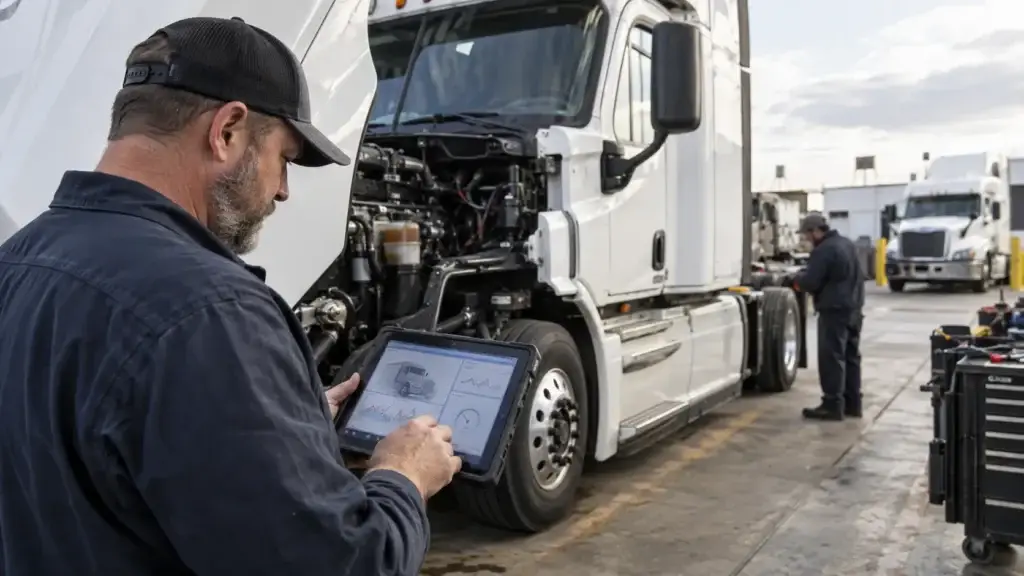
Remote diesel diagnostics shifts vehicle diagnosis away from drivers and onto centralized software watched by trained fleet personnel, eliminating manual code-pulling and the inaccurate reporting that comes with asking a driver to describe a warning light over the phone. When onboard sensors detect an abnormal condition, the vehicle logs a fault code with a timestamp and operating parameters — speed, engine temperature, load, GPS position — and a telematics device connected to the diagnostic port captures and transmits that package over cellular networks.
The cloud platform on the receiving end cross-references the code against manufacturer databases, applies a severity assessment, and notifies administrators by email, dashboard, or mobile app — typically within 60 seconds of detection. Severity algorithms also look for patterns that predict cascading failure: a minor coolant temperature variation might flag a developing thermostat problem well before it becomes an overheated engine on the shoulder of an interstate. That's the entire value proposition in one sentence — catching the small version of a problem instead of the expensive one.
Behind that 60-second notification sits a genuinely large infrastructure layer: cloud platforms maintain databases of fault code definitions, manufacturer repair procedures, and historical fleet performance patterns, and machine learning models improve diagnostic accuracy over time by learning from which alerts actually led to a confirmed repair versus a false positive. A modern truck can throw thousands of distinct fault codes across engine, transmission, brake, and body controllers — the platform's job is sorting that volume into a short list a human can actually act on.
| Component Type | Primary Function | Key Capabilities |
|---|---|---|
| Telematics Hardware | Data collection and transmission | Fault code capture, GPS tracking, cellular communication |
| Cloud Platform | Data analysis and storage | Code interpretation, severity assessment, predictive analytics |
| Notification System | Alert distribution | Multi-channel delivery, priority routing, escalation protocols |
| User Interface | Information presentation | Dashboard visualization, report generation, mobile access |
The Business Case for Remote Diesel Diagnostics
Unscheduled breakdowns cascade through multiple cost centers at once: towing runs from several hundred to several thousand dollars depending on location and equipment, extended shop time means missed delivery windows, and repair and maintenance itself now runs 9.2% of total operating cost per mile — the fastest-growing major expense category fleets can actually influence through their own decisions rather than through fuel markets or insurance rates.
$0.215/mile
Average repair and maintenance cost per mile in 2025 — 9.2% of the $2.336 total operating cost per mile, up 8.6% year-over-year and 45% since 2019. Source: ATRI, 2026 Analysis of the Operational Costs of Trucking.
Most fleets discover roughly 10% of their vehicles already carry a high-severity fault the moment they turn on remote monitoring, so the first 2-3 months naturally focus on clearing that backlog before repairing before failure becomes the steady state. Once that cleanup is done, the reported gains are substantial: 30% reductions in unscheduled downtime and 80% decreases in towing bills are commonly cited industry figures for fleets running a mature program.
| Maintenance Approach | Average Repair Cost | Vehicle Downtime |
|---|---|---|
| Reactive (after failure) | $3,500 - $8,000 | 5-10 days |
| Scheduled (time-based) | $2,000 - $4,500 | 1-3 days |
| Predictive (condition-based) | $800 - $2,000 | 0.5-1 day |
Multiplied across a fleet, that gap is real money: a 100-vehicle operation seeing ten major failures a year spends $35,000-$80,000 reactively versus $8,000-$20,000 predictively — $27,000-$60,000 in annual savings from the maintenance approach alone, before counting the recovered vehicle-days. HDJ's predictive maintenance ROI guide walks through that fuller cost model, including how reducing average downtime from 8% to 5.5% effectively adds three vehicles worth of capacity to every 100-unit fleet without any additional capital investment.
Essential Diagnostic Tools and Platforms
Telematics hardware — accelerometers, temperature sensors, pressure monitors, fuel consumption trackers — connects to the vehicle's electrical system and diagnostic port, typically taking 30-60 minutes to install per vehicle. The OBD-II protocol handles light- and some medium-duty applications; J1939 is the heavy-duty standard, built specifically for commercial trucks and multi-system communication. Cellular modules dominate fleet applications thanks to 4G LTE coverage and growing 5G availability, with intelligent buffering that stores data through connectivity gaps and uploads automatically once a signal returns.
Aftermarket diagnostic tools represent roughly 40% of the market today, with industry forecasts pointing toward a 50/50 split with OEM platforms by 2028 as more fleets run genuinely mixed brands.
Cummins Connected Diagnostics applies proprietary analytics built specifically for Cummins engines across any equipment manufacturer that uses them. Detroit Connect gives manufacturer-level depth for Detroit-powered trucks, transmissions, and axles. Navistar OnCommand Connection stands out as the first genuinely open-architecture remote diagnostic system in the industry, compatible across all makes. Geotab pairs diagnostics with a full telematics ecosystem via partnerships with Navistar and Cummins, useful for fleets wanting a single interface.
For shops evaluating a multi-brand scan tool alongside any of these platforms, HDJ's evaluation of Noregon JPRO covers what that costs and where it fits — and Michael Nielsen's advice to any fleet weighing OEM versus aftermarket: match the platform to your actual brand mix today, not the mix you expect to have in three years, since switching platforms mid-fleet carries its own retraining cost.
| Platform | Coverage Type | Best Suited For |
|---|---|---|
| Cummins Connected Diagnostics | OEM for Cummins engines | Fleets with predominantly Cummins-powered equipment |
| Detroit Connect | OEM for Detroit powertrains | Detroit-powered vehicles seeking manufacturer-level diagnostics |
| Navistar OnCommand Connection | Open architecture, all makes | Mixed fleets requiring standardized cross-brand diagnostics |
| Geotab Fleet Solutions | Aftermarket with OEM partnerships | Fleets seeking holistic operations management |
Stay Current on Fleet Technology Trends
Remote diagnostics technology keeps evolving fast. Get weekly telematics and maintenance updates from Heavy Duty Journal in your inbox.
Implementing Remote Diagnostics Successfully
Success depends less on the hardware than on breaking a genuinely old habit — for over a century, trucking ran on "vehicle fails, vehicle gets towed, vehicle gets fixed." Start the assessment by quantifying what that habit actually costs you: how often do vehicles break down unexpectedly, what do you spend on towing annually, and where do most failures happen — highway, job site, or somewhere remote?
Fleet size and composition shape which capabilities actually deliver value — a fleet running mostly Class 6-8 trucks gets substantially more out of remote monitoring than one running lighter equipment, and your current maintenance practices, existing telematics footprint, and available IT resources all factor into how ambitious a first deployment should be. Document current unscheduled downtime frequency and duration, calculate what towing and roadside repairs actually cost you annually, and check your existing telematics infrastructure for compatibility before adding anything new.
Most systems connect directly to the OBD-II or J1939 port, and mounting location matters for keeping both diagnostic-port and cellular connections stable — a device tucked somewhere that blocks its antenna defeats the purpose before it ever reads a fault code. On rollout pace: simultaneous fleet-wide installation gives immediate full visibility but demands more upfront coordination and capital, while a phased rollout or pilot program spreads the cost, lets you catch installation or configuration mistakes on a small group first, and builds internal expertise before committing everywhere.
Training has to reach several roles differently: dispatchers need alert interpretation and initial response, maintenance managers need enough technical depth to prioritize repairs against real diagnostic data, and technicians need the alerts connected to actual repair procedures. Drivers deserve a plain explanation too — the framing that lands best is that the system supports them by catching problems before a breakdown, not that it's watching them, and that distinction genuinely affects how much a driver trusts and cooperates with the program.
Response protocols should sort by severity from day one — critical alerts demanding immediate action, warning-level alerts allowing continued operation with modified parameters, informational alerts feeding trend analysis — with clear ownership of who receives what and through which channel.
Editorial Insight
The HDJ Perspective
Michael Nielsen's take after 15+ years watching fleets adopt new technology: the transition to remote diagnostics is a maintenance-philosophy shift, not a hardware purchase. Heavy Duty Journal has seen too many operations buy sophisticated telematics and then underuse it because nobody retrained the team to act on the data instead of just collecting it. The fleets getting real ROI invest in the organizational change as seriously as the equipment — that's the part a sales demo never shows you.
Best Practices for Diagnostic Monitoring
Alert configuration is the single most consequential setting in the whole system. Thresholds set too sensitive generate alert fatigue until staff start ignoring notifications altogether; thresholds set too conservative delay detection until a minor issue has already escalated. Effective rules factor in fault severity, vehicle criticality, and operational context rather than applying one blanket threshold — a coolant warning on a reefer trailer carrying perishables deserves an immediate call; the same warning on an empty truck heading back to the yard can wait for a routine work order.
Condition-based maintenance turns preventive scheduling from a calendar obligation into an actual strategy — oil quality sensors, DPF pressure differentials, and turbocharger performance metrics give objective evidence of component health, letting you extend intervals on vehicles running easy duty cycles and pull forward maintenance on ones working hard.
Fault prioritization frameworks help allocate limited shop time: critical-tier issues (safety hazard or imminent shutdown) get emergency response regardless of location, urgent-tier issues get scheduled soon, and routine-tier alerts wait for the next PM visit. The best systems translate the code itself into plain language — "Diesel Particulate Filter Restriction, Excessive Soot Accumulation, Vehicle May Enter Derate Mode" tells a dispatcher something a raw SPN/FMI pair doesn't, and that plain-language layer is often the difference between an alert someone actually acts on and one that sits in an inbox.
Data Security and Compliance Considerations
Every diagnostic data point transmitted wirelessly is both an operational asset and a potential exposure — engine metrics, driver behavior, and location data all deserve real protection, not an afterthought. Encrypted transmission (TLS 1.3 or higher) between vehicles and the cloud platform is the baseline; multi-factor authentication and role-based access control limit what any single compromised credential can actually expose.
Vendor selection deserves the same scrutiny as any other IT purchase: check security certifications, incident response procedures, and whether the vendor stores data domestically if data sovereignty matters to your operation. Regular security audits — either the vendor's own or an independent review you commission — catch vulnerabilities before someone with bad intentions finds them first, and role-based access control means a driver-facing app account can't accidentally expose fleet-wide maintenance records.
FMCSA regulations require motor carriers to maintain proper documentation of fleet operations, which makes secure, auditable data management a compliance issue as much as a security one — heavydutyjournal.com treats that pairing the same way across every telematics and diagnostics topic it covers, since the two rarely stay separate in practice.
Applications Across Fleet Types
Long-haul operations benefit most from location-independent visibility, since remote diagnostics can flag the nearest authorized service point along a route the moment a code appears, rather than waiting for a driver hundreds of miles from home base to notice something's wrong. Construction and off-road equipment need the same monitoring but with heavier data-buffering requirements — roughly 20-25% of fleet diagnostic customers also run off-highway equipment operating without reliable cellular coverage.
Municipal fleets lean on remote diagnostics for the budget-accountability documentation they're required to produce, since every repair decision needs a defensible paper trail when public funds are involved. Refrigerated transport carries the highest stakes of all: a trailer of pharmaceuticals or fresh produce is a total loss the moment refrigeration fails, so monitoring has to cover the reefer unit as closely as the powertrain — the same standard heavydutyjournal.com applies whenever it covers cold-chain-critical equipment.
Troubleshooting Common Challenges
Cellular dead zones are the most predictable problem — data buffering on the telematics device stores information locally until connectivity resumes, and modern hardware holds days of operational data if needed. False alerts from sensor glitches, temporary environmental readings, or overly sensitive thresholds erode trust in the system fast; refining thresholds against your own historical data cuts false positives without sacrificing real detection.
Integrating new diagnostics into an existing fleet-management platform often runs into incompatible data formats or limited API access from older systems — running the two in parallel during a phased transition minimizes the disruption while you sort that out.
Frequently Asked Questions
How does remote diesel diagnostics differ from traditional maintenance?
Traditional diagnostics relies on a driver noticing a problem and reporting it. Remote systems monitor continuously and automatically detect, assess severity, and notify fleet staff — regardless of vehicle location — often before the driver notices anything at all.
How much can fleets realistically save with remote diagnostics?
Commonly cited figures run 30% lower unscheduled downtime and 80% lower towing costs once past the initial cleanup period. Actual savings depend on your prior maintenance practices — see the Business Case section above for the per-vehicle math.
Do I need separate diagnostic systems for different truck brands?
Only if you go OEM-only. Platforms like Navistar OnCommand Connection or Geotab give cross-brand coverage through one interface, which is why the aftermarket segment is projected to reach 50% market share by 2028 as mixed fleets grow.
What hardware installation is required?
A telematics device connecting to the OBD-II or J1939 port, typically installed in 30-60 minutes per vehicle. It captures fault codes and sensor data continuously and transmits via cellular, with satellite backup available on some platforms for remote coverage gaps.
What training do fleet staff actually need?
Dispatchers need alert-interpretation training, maintenance managers need enough depth to prioritize repairs, and technicians need alerts tied to real procedures. Drivers just need basic awareness that the system supports them rather than surveils them.
Remote diesel diagnostics is infrastructure at this point, not an optional add-on — with roughly 10% of vehicles carrying a high-severity fault at any given moment, the ability to catch and address issues before they strand a driver has a direct line to profitability. The technology supplies the visibility; training, response protocols, and organizational follow-through determine whether that visibility actually turns into fewer breakdowns.
Help Fellow Fleet Managers Optimize Uptime
Share this guide with a fleet manager weighing a move to remote diagnostics — the numbers on downtime and towing costs alone tend to settle the conversation.