
By Michael Nielsen, Publisher | 15+ Years in Diesel Repair & Fleet Operations
Last Updated: September 2026
⏱ Estimated reading time: 15 minutes
ABS diagnostic codes are essential to understand for anyone maintaining safe heavy-duty truck operations, since the amber ABS warning light signals potential problems with one of the most critical safety systems protecting drivers, cargo, and everyone else on the road. Fleet managers and diesel technicians who master brake system diagnostics gain a real edge in safety compliance, uptime, and maintenance cost control.
Federal regulations mandate functioning ABS on trucks manufactured after March 1, 1997, and trailers manufactured after March 1, 1998, with a GVWR of 10,000 pounds or more — ignoring fault codes risks out-of-service violations, higher accident risk, and expensive emergency repairs. This guide covers how commercial vehicle ABS works, how to access and interpret both blink codes and electronic diagnostics, and the systematic troubleshooting that keeps repair time down — the same field-tested standard heavydutyjournal.com applies across its brake and diagnostics coverage.
Key Takeaways
- ✓ABS is safety-critical, not a convenience feature. It prevents wheel lockup during emergency braking, maintaining steering control and reducing jackknife risk in tractor-trailer combinations.
- ✓Federal law mandates functioning ABS on qualifying commercial vehicles, and roadside inspectors can place a truck out of service for a malfunctioning system.
- ✓Two ways to retrieve fault codes: the free blink-code method needs no equipment, while electronic scan tools add active/stored code distinction and freeze-frame data.
- ✓Wheel speed sensors cause most ABS codes — road debris, moisture, and vibration exposure make them the highest-failure component in the system.
- ✓Prevention beats emergency repair. Regular inspection catches sensor and wiring issues before they escalate into modulator valve or ECU failures.
In This Guide
- Understanding ABS Systems in Heavy-Duty Trucks
- Why ABS Diagnostic Codes Matter for Fleet Operations
- How to Access ABS Diagnostic Codes on Trucks
- Common ABS Diagnostic Codes and Their Meanings
- Step-by-Step ABS Troubleshooting Procedures
- Essential Diagnostic Tools and Equipment
- Preventive Maintenance to Minimize ABS Codes
- Frequently Asked Questions
Understanding ABS Systems in Heavy-Duty Trucks
ABS diagnostic codes only make sense once you understand what the system is doing underneath them: continuously monitoring wheel rotation and preventing lockup during hard braking, which lets a driver steer around an obstacle while still applying maximum brake force — something impossible once wheels lock and skid. Michael Nielsen's framing after 15+ years around brake systems: ABS doesn't stop the truck faster, it keeps the truck steerable while stopping — that distinction is worth remembering when a code seems minor.
Wheel speed sensors transmit rotation data to the electronic control module dozens of times per second; when one wheel decelerates faster than the others, the ECM signals the modulator valve to reduce pressure to that wheel, cycling up to 15 times per second or more. That rapid cycling is the pedal pulsation drivers feel during an ABS event.
In the pneumatic brake systems common to commercial trucks, the same logic runs on compressed air instead of hydraulic fluid — modulator valves control air delivery to each wheel's brake chamber rather than fluid flow. Wheel speed sensors are the system's eyes: magnetic reluctance or active Hall-effect sensors mounted near each hub, reading a tone ring's evenly spaced teeth to generate a signal proportional to wheel speed. The ECU processes every sensor's data simultaneously and commands the modulator valves accordingly.
| Component | Primary Function | Common Failure Symptoms |
|---|---|---|
| Wheel Speed Sensors | Monitor individual wheel rotation speed | ABS warning light, erratic speedometer, loss of ABS function |
| Electronic Control Unit | Process sensor data and control modulator valves | Complete ABS failure, multiple codes, intermittent operation |
| Modulator Valve Assembly | Regulate brake pressure to individual wheels | Brake pedal pulsation, reduced braking power, pressure leaks |
| Tone Rings | Generate signal for wheel speed sensors | Intermittent sensor codes, ABS activation at low speeds |
Commercial ABS differs from light-duty systems at a fundamental level: trucks run pneumatic air brakes rather than pure hydraulics, which means completely different hardware — air valves, chambers, and supply lines instead of hydraulic lines. Add the thermal load of an 80,000-pound loaded tractor-trailer under hard braking, plus constant exposure to road debris, salt, and temperature extremes, and heavy-duty ABS components simply have to be built tougher than their light-duty counterparts.
Why ABS Diagnostic Codes Matter for Fleet Operations
An ABS code is never just a maintenance alert — it signals a real vulnerability in a system protecting everyone on the road. Without operational ABS, wheels can lock during emergency braking, and a driver loses the ability to steer around an obstacle while braking hard. Tractor-trailer combinations carry extra risk here: uncoordinated brake application between tractor and trailer creates the instability that leads to jackknifing.
15.1%
Out-of-service rate for brake-related violations during CVSA's 2025 Brake Safety Week — 2,296 of 15,175 commercial vehicles inspected across North America.
FMCSA mandates functioning ABS on all trucks and tractors manufactured after March 1, 1997, and trailers manufactured after March 1, 1998, at a GVWR of 10,000 pounds or more. DOT inspectors verify the amber ABS malfunction lamp during roadside inspections and facility audits — a lit lamp can mean an out-of-service order and immediate cessation of operations, regardless of delivery schedules.
Financially, unaddressed codes escalate fast: a $200 wheel speed sensor fix left alone can deteriorate into a $2,000+ modulator valve replacement. Proactive code monitoring lets maintenance teams schedule repairs during planned service rather than paying emergency-call premiums and towing fees, and unresolved ABS issues also drag down resale value — buyers discount trucks with documented brake system problems, often by more than it would have cost to just fix the code.
How to Access ABS Diagnostic Codes on Trucks
The blink code method is the free, no-equipment option available on most heavy-duty ABS systems. Locate the diagnostic connector (typically two-pin or six-pin, near the ABS ECU or in the cab), turn the key to ON without starting the engine, jumper the specified pins, and read the flash pattern on the ABS warning light. Codes follow a two-digit format — two flashes, a pause, then three more flashes reads as code 2-3 — and the system cycles through every stored code, repeating each three times before moving on.
Electronic diagnostic tools connected to the J1939 diagnostic port go much further: active-versus-stored code distinction, freeze-frame data, and real-time sensor readings that a blink code simply can't provide. The port itself is typically a Deutsch 9-pin or 6-pin connector under the dashboard, near the steering column, or in the engine compartment.
Each major ABS manufacturer runs its own protocol: Bendix uses the ACom PRO software platform for real-time data, active testing, and firmware updates; Wabco requires Wabco Toolbox for detailed component and valve diagnostics; Meritor-branded systems typically follow Wabco's protocol since they often share the underlying technology. Haldex ABS shows up mostly on trailers and some straight trucks — many multi-brand scan tools support the basic protocol, though advanced features usually need official Haldex software, and trailer diagnostic connectors can be genuinely hard to access physically.
Common ABS Diagnostic Codes and Their Meanings
Wheel speed sensor codes (1-series) are the most common ABS fault by a wide margin, since sensors take the brunt of road debris, moisture, and vibration. Code 1-1 typically flags the right front sensor, 1-2 the left front; tandem rear axles add 1-3 (right rear inner), 1-4 (left rear inner), 1-5 (right rear outer), and 1-6 (left rear outer).
Physical damage, excessive air gap, broken tone ring teeth, corroded wiring, and water intrusion are the usual causes. Code 1-8 is more serious — the ECU is getting no usable wheel speed data from any position at all, pointing to power loss, a failed ECU, or main harness damage.
Modulator valve codes (2-series) point to the assembly regulating brake pressure during an ABS event. Code 2-2 means the modulator isn't responding correctly to ECU commands, often from contamination sticking a valve internally. Code 2-3 flags electrical problems in the solenoid control circuits — abnormal current, voltage, or resistance. Code 2-5 indicates a serious internal fault in the control assembly itself, often requiring full unit replacement.
ECU codes (3-series) point at the control module rather than an external component. Code 3-1 means the module failed its own self-test — memory corruption or processor malfunction — and typically needs replacement, though a voltage spike can occasionally cause a temporary error that clears on a power cycle. Code 3-3 means the ECU's programmed configuration doesn't match the vehicle — a six-sensor tractor configuration installed on a four-sensor vehicle, for example — and usually needs reprogramming, not new hardware.
Voltage codes (4-series) flag electrical supply problems affecting the whole system. Code 4-1 triggers when supply voltage drops below roughly 10-11 volts — weak batteries, a failing alternator, corroded connections. Code 4-2 flags excessive voltage, typically above 15-16 volts, most often from a failed alternator voltage regulator — genuinely dangerous since it can damage other electronics on the truck too. Pneumatic codes (6-series) are unique to air-brake systems: Code 6-2 flags pressure switch problems or genuinely low air pressure, and ABS simply cannot modulate safely without adequate air supply.
| Code Category | Code Range | System Component | Typical Cause |
|---|---|---|---|
| Wheel Speed Sensors | 1-1 through 1-8 | Individual wheel sensors or complete sensor circuit | Sensor damage, wiring faults, tone ring problems |
| Modulator Valves | 2-2 through 2-5 | ABS modulator assembly and solenoid circuits | Valve sticking, electrical faults, internal damage |
| ECU Faults | 3-1 through 3-3 | ABS control module | Internal failures, configuration errors |
| Power Supply | 4-1 through 4-2 | Electrical system voltage | Battery weakness, alternator failure |
| Pneumatic System | 6-2 | Air pressure monitoring circuits | Low air pressure, switch failure, wiring damage |
Step-by-Step ABS Troubleshooting Procedures
Start every session by checking brake fluid level — low fluid alone can trigger the ABS light even with a fully functional electronic system — and confirm the parking brake and wheel chocks are set. The ABS lamp should light for 3-5 seconds during the key-on self-test, then go out if nothing's wrong; a lamp that stays lit means an active fault, one that never lights suggests a wiring problem or a dead bulb.
Document visible damage before testing further: impact marks, bent mounting brackets, dislodged sensors, chafed wiring against frame rails.
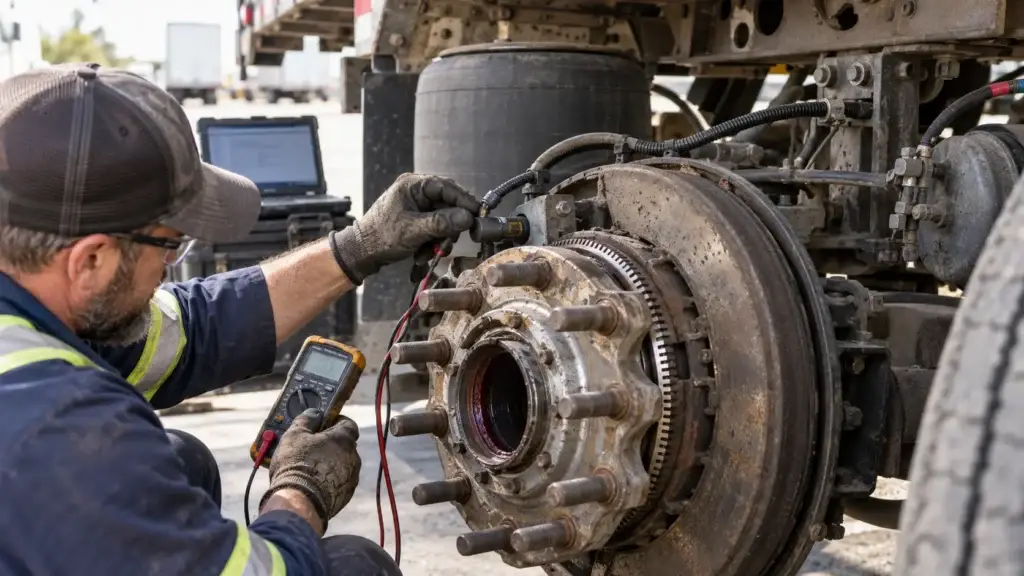
For wheel speed sensors, check for physical damage and mounting play first, then inspect tone rings for missing or damaged teeth by rotating each wheel slowly. Disconnect the sensor and measure resistance across its terminals — most magnetic reluctance sensors read 800-2,000 ohms; infinite resistance means an open circuit, near-zero means a short, and either one means replacement. The air gap between sensor tip and tone ring (typically 0.020-0.070 inches) matters too — use brass feeler gauges, not steel, which can magnetize and skew the reading.
Wiring causes a real share of ABS faults given the vibration, temperature swings, and moisture commercial trucks see. Check disconnected pins for green or white corrosion, inspect connector housings and seals, and verify grounds read less than 0.1 ohms to chassis. For the modulator and ECU: measure solenoid coil resistance disconnected (typically 2-8 ohms), run active tests via scan tool and listen for solenoid clicking, confirm the modulator has at least 90-100 PSI air supply, and check ECU power supply voltage is within 0.5V of battery voltage.
Essential Diagnostic Tools and Equipment
Bendix ACom and Wabco Toolbox anchor manufacturer-specific diagnostics, going well beyond basic fault codes into real-time sensor data, active testing, and firmware updates. A universal communication adapter like the Nexiq USB Link bridges that software to the vehicle's data network, supporting J1939, J1708, and OBD-II across most commercial platforms. HDJ's evaluation of Noregon JPRO covers a multi-brand alternative worth knowing about if your shop isn't locked into a single manufacturer's ecosystem.
A quality automotive-grade multimeter (10 megohm minimum input impedance) covers DC voltage, resistance, and continuity testing for the electrical side. An oscilloscope isn't essential for basic diagnostics but earns its keep on intermittent sensor problems a static multimeter measurement simply can't catch — it lets you actually see the sensor's signal waveform as the wheel rotates.
Round out the kit with a full set of brass or non-magnetic feeler gauges (0.010-0.100 inches) for air gap measurement, and an accurate 0-150 PSI air pressure gauge with 1-PSI resolution for pneumatic testing.
Free DOT Status Check
Enter a USDOT number and quickly review public carrier status, operating authority and key FMCSA registration data.

Preventive Maintenance to Minimize ABS Codes
Basic ABS checks belong at every PM interval — warning light verification, visual sensor inspection, and a code scan even with no light illuminated, since developing problems often show up in stored codes before they trigger a dashboard warning. Annual inspections should add functional testing confirming proper activation and accurate sensor data across the board.
Wheel speed sensors live in a genuinely hostile environment, so cleaning should be routine during brake service — non-metallic brushes and proper solvents, never a direct high-pressure wash that can force moisture past seals. In salt-belt winter regions, a protective coating on sensor bodies is worth the extra step.
On the wiring side, keep harness routing away from heat sources and moving parts, apply dielectric grease to connector pins during any service that disconnects them, and use heat-shrink tubing rather than tape for any insulation repair — vibration and environmental exposure will find a shortcut fast on anything less. Regular air dryer maintenance and tank draining round out the pneumatic side, preventing the moisture accumulation that freezes ABS components in cold weather.
HDJ's predictive maintenance ROI guide and CSA score improvement guide both cover how a program like this pays off beyond just avoiding a roadside violation — the same standard heavydutyjournal.com applies across every brake and aftertreatment category on the site.
Frequently Asked Questions
What are the most common causes of ABS diagnostic codes on heavy-duty trucks?
Wheel speed sensor issues, by a wide margin — road debris, moisture, and temperature extremes degrade them over time. Wiring problems (chafed insulation, corroded connectors, weak grounds) are the second most common cause. See the Common ABS Diagnostic Codes section above for the specific fault codes each points to.
Can I continue driving with the ABS warning light illuminated?
The base brakes still work, but the anti-lock function is disabled, meaning wheels can lock during emergency braking — and it violates FMCSA regulations. DOT inspectors can place the vehicle out of service for it. Address it promptly rather than continuing to operate.
How often should fleet vehicles have ABS systems inspected?
Comprehensive inspection at every major PM service, typically every 50,000-100,000 miles, with basic checks (light verification, visual inspection, code scan) at every PM interval. Annual functional testing confirms proper system activation — see the Preventive Maintenance section above for the full schedule.
What diagnostic equipment is needed for truck ABS troubleshooting?
A quality digital multimeter covers basic resistance, voltage, and continuity testing. Professional work adds manufacturer software (Bendix ACom, Wabco Toolbox) with a compatible adapter, brass feeler gauges, an air pressure gauge, and an oscilloscope for intermittent sensor issues — see the Diagnostic Tools section above.
How do I clear ABS codes after completing repairs?
Use a scan tool to command the ECU to clear the ABS fault memory specifically — disconnecting the battery isn't recommended, since it can erase calibration data across multiple vehicle systems. Road-test under varied conditions afterward and re-check for codes to confirm the repair held.
Mastering ABS diagnostic codes is a foundational skill for anyone working on heavy-duty commercial vehicles — the systematic approach in this guide, from understanding how the system works to running preventive maintenance, gives technicians and fleet managers what they need for safe, compliant operations. As brake technology keeps integrating stability control and collision avoidance, that diagnostic foundation only gets more valuable, not less.
Help Fellow Fleet Professionals
Share this ABS diagnostic guide with a fleet manager or technician who could use it — the difference between a scheduled repair and a roadside out-of-service order is usually just catching the code early.