By Michael Nielsen, Publisher | 15+ Years in Diesel Repair & Fleet Operations
Last Updated: September 2026
⏱ Estimated reading time: 16 minutes
DEF system diagnostics separate profitable diesel shops from those hemorrhaging money on repeat repairs and misdiagnosed components. When a commercial vehicle triggers a fault code like P20EE, P207F, or P204F, systematic troubleshooting — not a parts-cannon guess — is what keeps downtime and repair costs under control. This guide walks through the specific test procedures, normal operating ranges, and fault-code logic that turn a vague "DEF light is on" complaint into an accurate first-visit diagnosis.
Modern selective catalytic reduction technology is the industry standard for meeting EPA emissions regulations, and understanding how these systems actually fail — fluid quality, pump pressure, injector crystallization, sensor drift — protects your bottom line whether you manage one truck or an entire fleet, the same standard heavydutyjournal.com applies across its aftertreatment coverage.
Key Takeaways
- ✓DEF quality is the first diagnostic step, not the last. Fluid must hold 32.5% urea concentration (31.8%-33.2% acceptable range), verified with a refractometer, before condemning any component.
- ✓Common fault codes point to distinct systems: P20EE flags catalyst efficiency, P207F usually traces to fluid quality, and P204F relates to overall system performance.
- ✓Derate timelines are far longer than they used to be. Revised 2025-2026 EPA guidance extends the warning period to 650 miles/10 hours and pushes the hard 25 mph limit out to roughly 8,400 miles or 160 hours — not the abrupt 5 MPH limp mode of a few years ago.
- ✓Wrong fluid in the tank is catastrophic. Diesel fuel contamination alone can push repair costs past $10,000, requiring tank, line, injector, and possibly catalyst replacement.
- ✓Regular DEF quality testing catches most problems early — build it into a 25,000-mile or quarterly interval rather than waiting for a warning light.
In This Guide
- Understanding DEF and SCR Technology Fundamentals
- Essential DEF System Diagnostics Tools and Equipment
- Common DEF Quality Issues and Contamination
- DEF Pump Failures: Symptoms and Diagnosis
- SCR Catalyst and DEF Injector Malfunctions
- NOx Sensor Failures and Diagnostic Procedures
- Temperature Sensor and Heater System Diagnostics
- Preventive Maintenance for SCR System Reliability
- Frequently Asked Questions
Understanding DEF and SCR Technology Fundamentals
Selective catalytic reduction lets diesel engines meet EPA 2010-and-later emission standards by cutting nitrogen oxide output roughly 90%, without the fuel economy penalty older emission-control methods carried — modern engines actually run more efficiently with a properly functioning SCR system.
~90%
Typical NOx conversion efficiency of a properly functioning SCR system — an industry-standard figure for EPA 2010-and-later diesel engines, distinct from EPA's separate Clean Trucks Plan target for future model-year emission reductions.
Diesel exhaust fluid itself is a precise aqueous solution of 32.5% automotive-grade urea and 67.5% deionized water, formulated to the international ISO 22241 specification that EPA requires DEF to meet for consistent performance across temperature and operating conditions.
Injected into hot exhaust gas, DEF undergoes two reactions: thermolysis breaks urea down into ammonia and isocyanic acid, then hydrolysis converts the isocyanic acid into more ammonia and CO2. That ammonia reacts with NOx across the SCR catalyst, producing harmless nitrogen gas and water vapor. Electronic control modules monitor exhaust temperature, flow rate, and NOx sensor readings in a closed loop to calculate exactly how much DEF to inject at any given moment.
The DEF tank assembly carries sensors for level, quality, and temperature, plus an integrated heater — DEF crystallizes at 12°F, so freeze protection is built in, along with ventilation for thermal expansion. The DEF pump maintains 70-100 PSI delivery pressure for proper atomization, and pump failure is one of the most common SCR malfunctions technicians see.
| Component | Operating Parameter | Normal Range | Diagnostic Significance |
|---|---|---|---|
| DEF Pump Pressure | Delivery PSI | 70-100 PSI | Inadequate pressure causes poor atomization |
| SCR Catalyst Temperature | Operating Heat | 450-900°F | Outside range drops conversion efficiency |
| DEF Injection Rate | Flow Volume | 2-6% of fuel use | Excessive or insufficient dosing triggers faults |
| NOx Sensor Output | PPM Reading | Engine-specific | Sensor comparison reveals performance trends |
Essential DEF System Diagnostics Tools and Equipment
Consumer-grade code readers lack the protocols and processing power for real aftertreatment diagnostics — a heavy-duty scanner communicating with multiple control modules simultaneously, streaming live data from dozens of sensors, is the baseline. Premium scanners add bidirectional control: commanding the DEF injector to verify operation, cycling the tank heater to check function, forcing a regeneration cycle to observe the system's response.
Manufacturer-specific software (Cummins, PACCAR, Detroit Diesel, Volvo, Mack) goes deeper still, unlocking proprietary parameters and dealer-equivalent guided diagnostics. HDJ's essential diesel diagnostic tools guide covers the full aftertreatment toolkit — DPF pressure kits, infrared thermometers, and where a refractometer fits into that lineup.
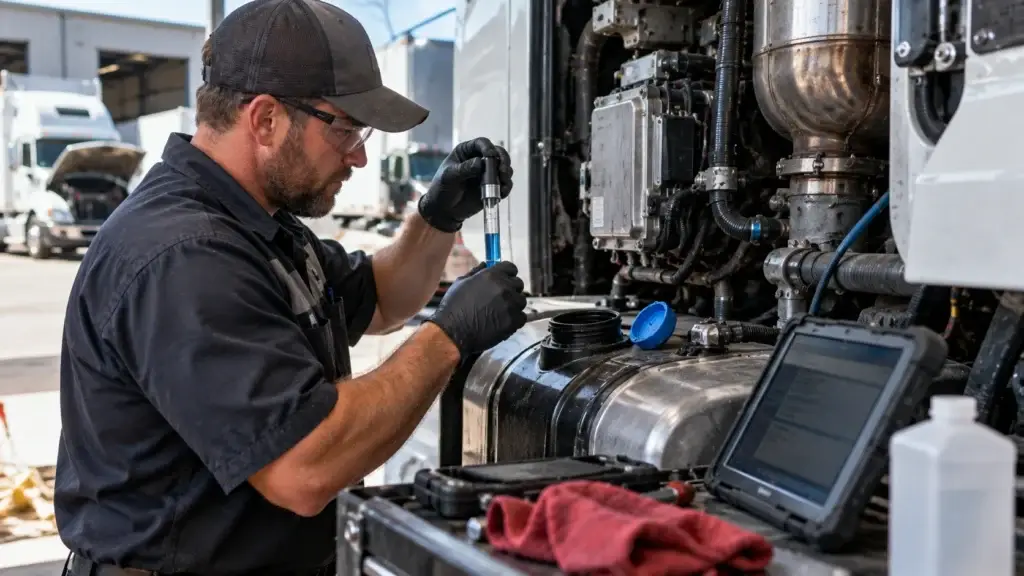
Testing DEF quality should be the first diagnostic step on any SCR complaint, since contaminated or degraded fluid mimics component failure. A refractometer is the industry-standard tool for verifying urea concentration — readings outside the 31.8%-33.2% range point to degradation or contamination regardless of what other codes are present. Digital refractometers beat optical models for shop use: precise numerical readings, automatic temperature compensation, and often computer connectivity for record-keeping.
A quality digital multimeter rounds out the electrical side — verifying sensor outputs, checking heater resistance, measuring injector coil resistance (typically 2-6 ohms), and validating power supply circuits. Specialized pressure gauges measure DEF supply pressure at the injector inlet (70-100 PSI normal); low readings point to pump wear, restricted supply lines, or filter blockage, while high readings suggest return-line restriction or a failed pressure regulator.
Stay Current on Diesel Emissions Technology
DEF system technology and EPA regulations keep evolving. Get practical diagnostic tips and regulatory updates from Heavy Duty Journal delivered to your inbox.
Common DEF Quality Issues and Contamination
Poor-quality DEF is one of the most common yet preventable causes of SCR malfunction, and P207F often points directly to compromised fluid. Visual inspection is the first defense — proper DEF should be completely clear and colorless, like water.
Particulate or sediment signals dust or debris contamination that can abrade components and damage injector nozzles; yellowing or browning signals degradation from heat exposure or extended storage. Refractometer testing gives the quantitative answer: place a few drops on the prism, close the cover, and read the scale against the 31.8%-33.2% acceptable range.
Adding the wrong fluid creates the worst-case scenarios. Diesel fuel contamination requires tank replacement, complete line flushing, injector replacement, and potentially SCR catalyst replacement — repair costs frequently exceed $10,000. Water contamination dilutes urea below effective levels, triggering efficiency faults and reduced power. Antifreeze or coolant contamination introduces glycol that forms stubborn deposits and permanently poisons the catalyst.
Remediation requires a complete, systematic process: fully drain the tank, flush with deionized water (never tap water, which introduces minerals), replace the DEF filter as a mandatory step since it's captured contaminants that can't be adequately cleaned out, verify contamination hasn't reached downstream components, and refill only with certified fresh DEF from sealed containers.
DEF Pump Failures: Symptoms and Diagnosis
The DEF pump maintains the precise pressure and delivery the SCR system needs across the entire operating range, and its failure triggers protective measures that limit vehicle performance. Warning signs rarely appear without notice — an amber warning light typically comes first, with dashboard messages like "DEF System Fault," "Service DEF System," or "Exhaust Filter Derate" progressing from amber to red as the condition worsens.
Fault code P204F specifically flags DEF system performance issues requiring full analysis, and some systems display a countdown of remaining miles before power reduction begins. Michael Nielsen's advice here: don't wait for the countdown to hit zero — a warning light on a DEF system is one of the few dashboard alerts worth pulling over for the same day, not the same week.
Revised EPA inducement guidance issued in August 2025 significantly extended that countdown compared to older systems: a warning-only period of roughly 650 miles or 10 hours, followed by a mild torque derate for up to about 4,200 miles, and only then a hard 25 MPH speed limit at roughly 8,400 miles or 160 hours without repair — a much longer runway than the old schedule, which could push a truck to 5 MPH limp mode within days.
Pressure testing requires monitoring during cranking, idle, and under load, comparing every reading against factory spec (70-100 PSI normal). Flow rate testing adds another data point — command the injector open via diagnostic software and measure delivery volume; most systems should deliver 0.5-1.5 liters per minute.
| Test Parameter | Normal Range | Test Condition | Failure Indicator |
|---|---|---|---|
| Operating Pressure | 70-100 PSI | Engine at idle | Below 60 PSI or above 110 PSI |
| Flow Rate | 0.5-1.5 L/min | Injector commanded open | Below 0.3 L/min |
| Current Draw | 3-8 amps | Pump motor operating | Above 10 amps or below 2 amps |
| Supply Voltage | System voltage ±0.5V | Connector test | More than 1V below system |
SCR Catalyst and DEF Injector Malfunctions
DEF crystallization ranks among the most common injector problems — the precision-machined orifices measure only 0.1-0.3mm, so even microscopic crystal deposits block them completely. Crystals form when water evaporates from DEF, leaving concentrated urea behind; thermal cycling drives the buildup, and vehicles running frequent short trips never reach the temperature needed for complete injector purging. Approved cleaning: soak in warm deionized water below 140°F, or use a specialized DEF system cleaning solution — never petroleum-based solvents, which damage seals and internal components.
Catalyst efficiency naturally declines over time. P20EE ("SCR NOx Catalyst Efficiency Below Threshold") triggers when NOx reduction falls below spec — most systems require 70-90% conversion efficiency. The control module calculates this by comparing upstream and downstream NOx sensor readings during steady-state operation at normal temperature. Beyond simple aging, thermal damage from uncontrolled regenerations, chemical poisoning from fuel additives or contaminated DEF, and physical damage from road debris cracking the ceramic substrate can all degrade efficiency.
Catalyst replacement should be the last resort, not the first guess: confirm DEF quality via refractometer, verify dosing accuracy by commanding injector flow, replace any NOx sensor showing sluggish response, and rule out upstream DPF issues sending excess particulate downstream. SCR catalysts run $1,500-$4,000 depending on application — accurate diagnosis matters. HDJ's SCR system failures guide goes deeper on the fault-code-to-repair decision tree — including how to tell OEM NOx sensors from failure-prone aftermarket parts — if you're weighing a catalyst replacement against a sensor swap.
Injector testing itself starts electrically: coil resistance measured with the connector disconnected and ignition off (2-6 ohms normal); a lab scope reveals current-ramping characteristics, with healthy injectors showing smooth current rise and erratic patterns indicating internal damage. Leak-down testing with regulated air pressure at the inlet verifies internal sealing — excessive decay means worn seals needing replacement rather than cleaning.
NOx Sensor Failures and Diagnostic Procedures
Two NOx sensors do the SCR system's real-time grading: the upstream sensor measures exhaust NOx entering the catalyst (typically 200-1,500 PPM, feeding the DEF dosing calculation), and the downstream sensor measures NOx exiting it (10-100 PPM when the system works), enabling closed-loop efficiency verification. Both operate at 600-1,200°F using electrochemical sensing with internal heating elements, and most need 20-60 seconds after startup before readings are valid.
Beyond P20EE, P229F flags NOx sensor rationality (readings that don't correlate with expected values), while P2201 and P2202 indicate circuit range or performance issues for sensors 1 and 2 respectively. Before condemning a catalyst on a P20EE code, verify both sensors function correctly, check DEF quality and delivery, and confirm adequate catalyst temperature — prolonged idling, short-trip cycles, and extreme cold can all trigger efficiency faults with no actual component failure behind them.
Response-time testing catches degradation that steady-state readings miss: monitor how quickly sensor output changes when engine load changes — healthy sensors respond within 5-10 seconds. Heater current draw (6-15 amps during heating) and internal resistance changing predictably with temperature round out a full sensor health check.
| Test Parameter | Normal Range | Failure Indication | Required Action |
|---|---|---|---|
| Heater Resistance | 2-12 ohms | Open circuit or <1 ohm | Replace sensor |
| Heater Current | 6-15 amps | No current or excessive draw | Check wiring and power |
| Response Time | 5-10 seconds | Greater than 20 seconds | Consider replacement |
| Downstream Reading | 10-100 PPM at load | Same as upstream | Check SCR catalyst |
NOx sensors run $300-$800 each — apply high-temperature-specific anti-seize (never standard anti-seize, which contaminates the sensor), torque to spec (typically 35-45 ft-lbs), and seal connectors with dielectric grease against corrosion. Run the control module relearn procedure after installation — usually 30-60 minutes of steady highway driving with the SCR system at full temperature — and avoid short trips or excessive idling right after install to improve relearn success.
Editorial Insight
The HDJ Perspective
DEF inducement rules have moved fast since August 2025, when EPA first extended derate timelines and raised the final speed limit from 5 to 25 MPH. In March 2026, EPA eased DEF sensor requirements further to address a hardware weakness manufacturers had flagged, and in July 2026 the agency proposed going considerably further — replacing mandatory derates on MY2027+ engines with audible and visual warnings only, a proposal still under public comment as of this writing. Michael Nielsen's read: none of this changes the underlying chemistry or the value of catching a real fault early. Heavy Duty Journal has watched the shops that keep investing in proper diagnostic equipment and technician training outperform the ones betting regulatory relief will make diagnostics optional — it won't.
Temperature Sensor and Heater System Diagnostics
Since DEF freezes at 12°F, heater performance is essential through winter months — malfunctioning heater elements or temperature sensors show up as extended warning-light duration and delayed system initialization on cold starts. P20B8 flags heater performance below threshold specifically. Disconnect the heater connector and measure resistance across the terminals (typically 1-8 ohms depending on wattage); infinite resistance means an open circuit and failed element, near-zero means a short requiring immediate replacement. Check fuse integrity (typically 20-40 amp) and listen for relay clicking when the system commands heater activation.
In a running vehicle, the SCR system automatically heats fluid once temperatures drop below threshold; parked or stored vehicles in sub-freezing temperatures are where freezing actually becomes a problem. Keeping tank levels higher helps, since fuller tanks freeze more slowly due to thermal mass — verify heater function before cold season through proper diagnostic testing, and extended idling in a warm environment for 20-30 minutes will thaw a frozen system if needed.
Preventive Maintenance for SCR System Reliability
DEF quality testing every 25,000 miles or quarterly with a refractometer catches most quality-driven failures before they become fault codes. Tank and filter replacement follows manufacturer specs, typically 100,000-200,000 miles; DEF injector inspection and cleaning becomes necessary around 100,000 miles or once dosing adaptation values drift outside normal range. NOx sensor replacement intervals typically fall between 300,000 and 400,000 miles. Align complete system inspections with annual DOT safety checks under FMCSA regulations, and document every DEF-related fault code — the trend matters as much as any single event.
Storage matters more than most shops treat it: DEF holds quality for roughly 18 months at 75°F but drops to just 6 months at 95°F, so keep it between 10°F and 77°F and never in aluminum, carbon steel, copper, or zinc-containing containers — HDPE, polypropylene, and stainless steel are the approved materials. Use dedicated transfer equipment that never touches other fluids, and buy only ISO 22241-certified DEF from reputable suppliers.
Beyond fluid quality, keep tank levels above 25% to prevent pump cavitation and air ingestion, fix exhaust leaks upstream of the SCR immediately since unmetered air throws off sensor readings and catalyst efficiency, and make sure DPF regeneration is happening on schedule — excessive soot loading can overwhelm the SCR downstream.
Track DEF consumption against a 2-3%-of-fuel baseline; a real deviation usually means a leak, an injector problem, or an abnormal dosing strategy worth investigating before it becomes a derate. HDJ's predictive maintenance ROI guide covers the fleet-level case for catching this kind of drift with data — the same standard heavydutyjournal.com applies across every aftertreatment category, not just DEF — instead of waiting for a dashboard light.
Frequently Asked Questions
What is the proper concentration for diesel exhaust fluid and how do I test it?
DEF should hold 32.5% urea and 67.5% deionized water per ISO 22241, with 31.8%-33.2% as the acceptable tested range. Use a refractometer — a few drops on the prism, read the scale — every 25,000 miles or quarterly. Anything outside that range means degradation or contamination.
What happens if diesel fuel is accidentally added to the DEF tank?
It's the worst-case contamination scenario — tank replacement, full line flushing, injector replacement, and possibly SCR catalyst replacement, often exceeding $10,000. Never try to dilute or flush it yourself; get professional decontamination before operating the vehicle again.
Why does my truck show a DEF warning light when the tank is full?
A full-tank warning points beyond fluid level: degraded DEF failing quality sensors, a pump unable to hold 70-100 PSI, a crystallized injector, a faulty NOx sensor, or catalyst efficiency below threshold. Scan-tool diagnostics are the only way to isolate which one.
How quickly does derate occur after a DEF system fault today?
Under the revised 2025-2026 EPA guidance, expect a warning-only period of about 650 miles or 10 hours, a mild torque derate for up to roughly 4,200 miles, and a hard 25 MPH limit only around 8,400 miles or 160 hours without repair — far more runway than the old 5 MPH schedule.
Can I clean a clogged DEF injector or does it require replacement?
Crystallization-related clogs often respond to soaking in warm deionized water below 140°F or a dedicated DEF cleaning solution — never petroleum-based solvents. If cleaning doesn't restore spray pattern and flow, or coil resistance falls outside 2-6 ohms, replace it.
Professional DEF system diagnostics separate operations that catch problems early from those absorbing repeat repairs and misdiagnosed parts. A systematic approach — DEF quality first, then pump, injector, catalyst, and sensors in that order — prevents the majority of expensive failures before they turn into a derate. Investing in the right tools and training pays for itself in reduced repair time and accurate first-visit diagnoses.
Share This Guide With Your Team
Help your technicians and fleet managers master DEF system diagnostics — share this troubleshooting resource before the next SCR fault turns into a guessing game.